MAR-APR, 2015. VOL. III/XVII www.srjis.com Page 2915 ACADEMIC CHEATING AMONG ADOLESCENTS IN RELATION TO SELF
CONTROL
Prof. Ashok K. Kalia,Professor,
Department of Education, MDU Rohtak
Mr. Vinod Kumar, Research Scholar, Department of Education, MDU Rohtak
Academic Cheating is a solemn issue in front of academic world. The present study has tried to
explore the academic cheating among adolescents with different levels of self control. A representative sample
of 300 (150 male and 150 female) adolescents from urban and rural schools of five districts in Haryana was
randomly selected. Academic Cheating Scale by Kalia & Kirandeep (2011) and Self Control Scale by Singh &
Sengupta (1996) were used to assess academic cheating and self control of adolescents. ANNOVA and t-test
was applied to study significant difference in academic cheating among adolescents with different levels of self
control. The study revealed that adolescents having very low self control were found to be significantly higher
on academic cheating. No significant difference was observed among high self control and very high self
control adolescents on academic cheating. However results differ for rest of groups.
Keywords: Academic Cheating, Self Control and Adolescents.
Introduction:
Academic cheating is so pervasive among today's school students that the majority
engages in dishonest behaviour in one form or another. Cheating occurs at all levels of public
education and not to a particular institution (Hardigan, 2004). In this respect, Callahan (2004)
reported that cheating is expanded in schools and universities all over the world. Adolescence
period found to be a period of emotional extreme, self centeredness, free from rules and
regulation and show impulsive behaviour. There may be many reasons why adolescents
MAR-APR, 2015. VOL. III/XVII www.srjis.com Page 2916 choose to cheat. Kleiner et al. (1999) gives reasons that adolescents can feel an immense
pressure from their peers or their parents to perform up to a standard that they feel they
cannot reach themselves. Strom (2007) suggested adolescents may turn to cheating to help
alleviate some of stress of examination. According to Murdock et al., (2001) adolescents may
also have academic and social motivations behind their academic dishonesty. Being afraid of
failure, having no ability, and wanting to take risks could be other reasons for academic
cheating. Cheating in academic context covers verity of fraudulent actions e.g. lying or
forging documents, buying papers, plagiarism, purposely not following the rules, altering
results, furnishing false information regarding assignments, making up sources, creating
interference in class during instruction, capitalizing on the weakness of persons, procedures,
or processes to gain advantage. (Arent, 1991; Moore, 1998; Packer, 1990; Pratt and
Mclaghlin, 1989; Maslach, 2004; Cizek , 2003), Active cheating to improve one’s own grade
and Passive cheating to assist others in improving their grades Kalia (2005).
Self-control can be considered both as an individual trait factor and as a situational factor
which may fluctuate across different tasks, as the difficulty level of tasks change in terms of
suppressing one’s urges and as the temporal sequence of tasks require consecutive use of
self-control. Michel (1981) has pointed out that when the delay is self imposed it is known as self
control. Thus self-control refers to behaviour in which a person monitors his or her own
action in the absence of or in the contradiction to the presence in the immediate environment
(Liebert, Poulous and Marmor, 1979). Researchers have linked self-control to academic
dishonesty (Bolin, 2004; Cochran, Wodd, Sellers, & Chamlin, 1998; Grasmick, Tittle,
Bursik, & Arneklev, 1993). Gottfredson and Hirschi’s (1990) General Theory of Crime, now
known as self-control theory, is one of the most popular crime theories (Agnew, 1995;
Tibbetts & Gibson, 2002). Theory of crime addresses the interaction of a lack of self-control
and perceived opportunity as major causes of all deviant behaviour, including academic
dishonesty. Jackson et al. (2002) showed that there is a negative correlation between
self-control and academic cheating. Bolin (2004) concluded that there is a positive correlation
between weak self-control, cheating opportunities and cheating. Bolin’s (2004) research
looked at the role of self-control, cheating attitudes, and perceived opportunity to cheat as
possible predictors of cheating behaviour. Cochran et al. (1998) reported their findings as
strong support for the direct and interactive effect of self-control on academic dishonesty. A
MAR-APR, 2015. VOL. III/XVII www.srjis.com Page 2917 control and cheating behaviour in the western culture, but there is a dearth of studies in
Indian setup. It is therefore appropriate to investigate academic cheating among adolescents
in relation to their self control in Indian setup.
Objectives
To study Academic Cheating among adolescents having very low self control, low self
control, medium self control, high self control and very high self control.
To study Academic Cheating among male adolescents having very low self control, low
self control, medium self control, high self control and very high self control.
To study Academic Cheating among female adolescents having very low self control,
low self control, medium self control, high self control and very high self control.
Hypothesis
There is no significant difference in academic cheating among adolescents having very
low self control, low self control, medium self control, high self control and very high
self control.
There is no significant difference in academic cheating among male adolescents having
very low self control, low self control, medium self control, high self control and very
high self control.
There is no significant difference in academic cheating among female adolescents
having very low self control, low self control, medium self control, high self control and
very high self control.
Method of Study
The study was carried out to investigate academic cheating among adolescents in relation to
their self control. Accordingly descriptive survey method of research was used to conduct the
study.
Sample
The sample comprised of 300 adolescents studying in different secondary schools of five
MAR-APR, 2015. VOL. III/XVII www.srjis.com Page 2918 State. A random sample of 150 adolescents (75 male and 75 female) from rural schools and
150 adolescents (75 male and 75 female) from urban schools formed the sample of the study.
Tools used:-
A self reported academic cheating Scale by Kalia and Kirandeep (2011) and Self Control
Scale by Singh and Sengupta (1996) were used to assess academic cheating and self control
among adolescents.
Data Collection and Scoring:-
Self reported cheating and self control questionnaires were administered to adolescents in
their classroom settings. Before administering the test, the objectives of the study were
explained to them. They were requested to respond each item honestly. On completion, the
questionnaires were collected and scored as per directions given in the manual.
Analysis of data
One way ANNOVA was applied to test the significance of difference among different
groups under consideration. In order to compare different groups ‘t’ test was applied.
Table No.1 (a)
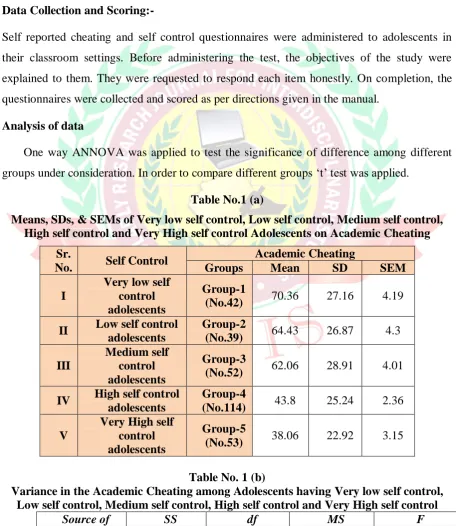
Means, SDs, & SEMs of Very low self control, Low self control, Medium self control, High self control and Very High self control Adolescents on Academic Cheating
Sr.
No. Self Control
Academic Cheating
Groups Mean SD SEM
I
Very low self control adolescents
Group-1
(No.42) 70.36 27.16 4.19
II Low self control adolescents
Group-2
(No.39) 64.43 26.87 4.3
III
Medium self control adolescents
Group-3
(No.52) 62.06 28.91 4.01
IV High self control adolescents
Group-4
(No.114) 43.8 25.24 2.36
V
Very High self control adolescents
Group-5
(No.53) 38.06 22.92 3.15
Table No. 1 (b)
Variance in the Academic Cheating among Adolescents having Very low self control, Low self control, Medium self control, High self control and Very High self control
[image:4.595.70.527.211.738.2]MAR-APR, 2015. VOL. III/XVII www.srjis.com Page 2919 Variation
Between
Groups 43363.9 4 10840.98 16.02
Within
Groups 199656.64 295 676.8 Sig. at 0.01
Total 243020.55 299
From the table no. 1 (b) results of ANOVA indicate that F-ratio for the different
groups came out to be 16.02 which is statistically significant at 0.01 level of significance. It
indicates that different groups are significantly different from each other. Different groups
were compared using ‘t’ test. Table no. 1(c) depicts ‘t’ ratio among different groups.
Table No. 1(c)
‘t’ Ratios of Very low self control, Low self control, Medium self control, High self control and Very High self control Adolescents on Academic Cheating
Sr. No
Group-1 Group-2 Group-3 Group-4 Group-5
‘t’ ratio
Level of Sig.
‘t’ ratio
Level of Sig.
‘t’ ratio
Level of Sig.
‘t’ ratio
Level of Sig.
‘t’ ratio
Level of Sig. 1. Group-1 --- 0.98 N.S 1.42 N.S 5.71 .01 6.28 .01 2. Group-2 --- 0.93 N.S 4.33 .01 5.07 .01 3. Group-3 --- 4.12 .01 4.72 .01 4. Group-4 --- 1.41 N.S 5. Group-5 ---
From the table no. 1 (a) the Mean scores of different groups depicts that Group-1 i.e.
Very low self control adolescents (70.36 ± 27.16) is highest among all other groups on
academic cheating, the ‘t’ ratio being 0.98, 1.42 which is statistically insignificant. Hence no
significant difference was observed among adolescents having very low self control in
comparison to adolescents having low self control and medium self control. However ‘t’ ratio
being 5.71 and 6.28 is statistically significant at 0.01 level of significance. It indicates that
adolescents having very low self control were found significantly higher on academic
cheating in comparison to high self control and very high self control adolescents.
The mean score of Group-2 i.e. Low self control adolescents (64.43 ± 26.87) is
highest among Medium self control adolescents (62.06 ± 28.91), High self control
adolescents (43.8 ± 25.24) and Very high self control adolescents (38.06 ± 22.92) on
academic cheating, the ‘t’ ratio being 0.93 found to be insignificant. Hence no significant
[image:5.595.101.533.72.158.2]MAR-APR, 2015. VOL. III/XVII www.srjis.com Page 2920 adolescents. However ‘t’ ratio being 4.33 and 5.07 is statistically significant at 0.01 level of
significance. It indicates that low self control adolescents were found to be significantly
higher in comparison with the high self control and very high self control adolescents on
academic cheating.
The mean scores of Group-3 i.e. Medium self control adolescents (62.06 ± 28.91), is
highest in comparison with High self control adolescents (43.8 ± 25.24) and Very high self
control adolescents (38.06 ± 22.92), the ‘t’ ratio being 4.12 and 4.72 indicates that medium
self control adolescents were found to be significantly higher in comparison with adolescents
having high self control and very high self control on academic cheating.
The mean score of Group-4 i.e. High self control adolescents (43.8 ± 25.24) is higher
than that of Very high self control adolescents (38.06 ± 22.92), ‘t’ ratio being 1.41 found to
be insignificant. It indicates that no significant difference was found among high self control
adolescents and very high self control adolescents on academic cheating.
Hence that hypothesis that there is no significant difference in academic cheating
among adolescents having very low self control, low self control, medium self control, high
[image:6.595.70.523.256.741.2]self control and very high self control is partially rejected.
Table No. 2 (a)
Means, SDs, & SEMs of Male Very low self control, Male Low self control, Male Medium self control, Male High self control and Male Very High self control
Adolescents on Academic Cheating Sr.
No. Self Control
Academic Cheating
Groups Mean SD SEM
I
Male Very low self control adolescents
Group-1
(No.21) 75.67 27.58 6.02
II
Male Low self control adolescents
Group-2
(No.20) 59.7 25.18 5.63
III
Male Medium self control adolescents
Group-3
(No.23) 69.26 33.53 6.99
IV
Male High self control adolescents
Group-4
(No.58) 43.36 25.59 3.36
V
Male Very High self control adolescents
Group-5
MAR-APR, 2015. VOL. III/XVII www.srjis.com Page 2921 Table No. 2 (b)
Variance in the Academic Cheating of Male Adolescents having Very low self control, Low self control, Medium self control, High self control and Very High self control
Source of
Variation SS Df MS F
Between
Groups 32789.18 4 8197.29 11.65
Within
Groups 102067.38 145 703.91 Sig. at
0.01
Total 134856.56 149
From the table no. 2 (b) results of ANOVA indicate that F-ratio for the different
groups came out to be 11.65 which is statistically significant at 0.01 level of significance. It
indicates that different groups are significantly different from each other. Different groups
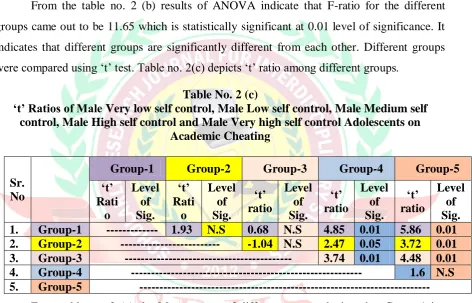
were compared using ‘t’ test. Table no. 2(c) depicts ‘t’ ratio among different groups.
Table No. 2 (c)
‘t’ Ratios of Male Very low self control, Male Low self control, Male Medium self control, Male High self control and Male Very high self control Adolescents on
Academic Cheating
Sr. No
Group-1 Group-2 Group-3 Group-4 Group-5 ‘t’ Rati o Level of Sig. ‘t’ Rati o Level of Sig. ‘t’ ratio Level of Sig. ‘t’ ratio Level of Sig. ‘t’ ratio Level of Sig. 1. Group-1 --- 1.93 N.S 0.68 N.S 4.85 0.01 5.86 0.01 2. Group-2 --- -1.04 N.S 2.47 0.05 3.72 0.01 3. Group-3 --- 3.74 0.01 4.48 0.01 4. Group-4 --- 1.6 N.S 5. Group-5 ---
From table no. 2 (a) the Mean scores of different groups depicts that Group-1 i.e.
Male Very low self control adolescents (75.67 ± 27.58) is highest among all other groups on
academic cheating, the ‘t’ ratio being 1.93 and 0.68 is statistically insignificant for male
adolescents having low self control and medium self control. It indicates that no significant
difference was observed among male very low self control adolescents in comparison with
male adolescents having low self control and medium self control. However the ‘t’ ratio
being 4.85 and 5.86 is statistically significant at 0.01 level of significance. It indicates that
male adolescents having very low self control were found significantly higher on academic
cheating in comparison to male adolescents having high self control and very high self
MAR-APR, 2015. VOL. III/XVII www.srjis.com Page 2922 The mean score of Group-2 i.e. Male Low self control adolescents (59.7 ± 25.18) is
highest among Male High self control adolescents (43.36 ± 25.59) and Male Very high self
control adolescents (34.39 ± 21.71), t ratio being 2.47 and 3.72 is statistically significant at
0.05 and 0.01 level of significance. It indicates that Male low self control adolescents were
found to be significantly higher in comparison with the Male high self control and Male very
high self control adolescents on academic cheating. However mean score Male Low self
control adolescents (59.7 ± 25.18) is lower than Male Medium self control adolescents (69.26
± 33.53), the ‘t’ ratio being -1.04 found to be insignificant, indicates that no significant
difference was observed among Male low self control adolescents and Male medium self
control adolescents.
The mean scores of Group-3 i.e. Male Medium self control adolescents (69.26 ±
33.53) is highest in comparison with Male High self control adolescents (43.36 ± 25.59) and
Male Very high self control adolescents (34.39 ± 21.71), the ‘t’ ratio being 3.74 and 4.48 is
statistically significant at 0.01 level of significance, indicates that Male medium self control
adolescents were found to be significantly higher on academic cheating in comparison with
the Male high self control adolescents and Male very high self control adolescents.
The mean score of Group-4 i.e. Male High self control adolescents (43.36 ± 25.59) is
higher than that of Male Very high self control adolescents (34.39 ± 21.71), ‘t’ ratio being 1.6
is statistically insignificant. It indicates that no significant difference was observed among
male adolescents having high self control in comparison with the male very high self control
adolescents on academic cheating.
Hence that hypothesis that there is no significant difference in academic cheating among
Male adolescents having very low self control, low self control, medium self control, high
self control and very high self control is partially accepted.
Table No. 3(a)
Means, SDs, & SEMs of Female Very low self control, Female Low self control, Female Medium self control, Female High self control and Female Very high self control
Adolescents on Academic Cheating Sr.
No. Self Control
Academic Cheating
Groups Mean SD SEM
I
Female Very low self control adolescents
Group-1
(No.21) 65.05 26.31 5.74
MAR-APR, 2015. VOL. III/XVII www.srjis.com Page 2923 control adolescents (No.19) III Female Medium self control adolescents Group-3
(No.29) 56.34 23.73 4.4
IV
Female High self control adolescents
Group-4
(No.56) 44.26 25.09 3.35
V
Female Very High self control adolescents
Group-5
[image:9.595.107.492.71.247.2] [image:9.595.70.532.260.676.2](No.25) 42.16 23.99 4.79
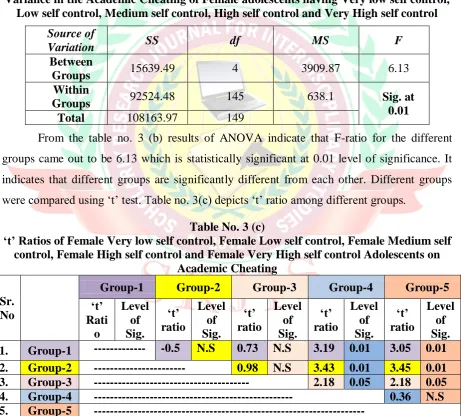
Table No. 3 (b)
Variance in the Academic Cheating of Female adolescents having Very low self control, Low self control, Medium self control, High self control and Very High self control
Source of
Variation SS df MS F
Between
Groups 15639.49 4 3909.87 6.13
Within
Groups 92524.48 145 638.1 Sig. at
0.01
Total 108163.97 149
From the table no. 3 (b) results of ANOVA indicate that F-ratio for the different
groups came out to be 6.13 which is statistically significant at 0.01 level of significance. It
indicates that different groups are significantly different from each other. Different groups
were compared using ‘t’ test. Table no. 3(c) depicts ‘t’ ratio among different groups.
Table No. 3 (c)
‘t’ Ratios of Female Very low self control, Female Low self control, Female Medium self control, Female High self control and Female Very High self control Adolescents on
Academic Cheating
Sr. No
Group-1 Group-2 Group-3 Group-4 Group-5 ‘t’ Rati o Level of Sig. ‘t’ ratio Level of Sig. ‘t’ ratio Level of Sig. ‘t’ ratio Level of Sig. ‘t’ ratio Level of Sig. 1. Group-1 --- -0.5 N.S 0.73 N.S 3.19 0.01 3.05 0.01 2. Group-2 --- 0.98 N.S 3.43 0.01 3.45 0.01 3. Group-3 --- 2.18 0.05 2.18 0.05 4. Group-4 --- 0.36 N.S 5. Group-5 ---
From table no. 3(a) the Mean scores of different groups depicts that Group-1 i.e.
Female Very low self control adolescents (65.05 ± 26.31) is highest among all other groups
MAR-APR, 2015. VOL. III/XVII www.srjis.com Page 2924 which is found to be higher. The ‘t’ ratio being -0.5 and 0.73 found to be insignificant,
indicates that no significant difference was observed on academic cheating among Female
very low self control adolescents in comparison with Female adolescents having low self
control and medium self control. However the ‘t’ ratio being 3.19 and 3.05 is statistically
significant at 0.01 level of significance for Female high self control and Female very high self
control adolescents. It indicates that female adolescents having very low self control were
found significantly higher on academic cheating in comparison with Female high self control
and Female very high self control adolescents.
The mean score of Group-2 i.e. Female Low self control adolescents (69.42 ± 28.36)
is highest among Female Medium self control adolescents (56.34 ± 23.73), Female High self
control adolescents (44.26 ± 25.09) and Female Very high self control adolescents (42.16 ±
23.99). The ‘t’ ratio being 0.98 found to be statistically insignificant in comparison with
Female Medium self control adolescents, indicates that no significant difference was
observed among Female Low self control adolescents and Female Medium self control
adolescents. However ‘t’ ratio being 3.43 and 3.45 is statistically significant at 0.01 level of
significance, indicates that Female low self control adolescents were found to be significantly
higher in comparison with the Female high self control and Female very high self control.
The mean scores of Group-3 i.e. Female Medium self control adolescents (56.34 ±
23.73), is highest in comparison with Female High self control adolescents (44.26 ± 25.09)
and Female Very high self control adolescents (42.16 ± 23.99), the ‘t’ ratio being 2.18 and
2.18 is statistically significant at 0.05 level of significance, indicates that Female medium self
control adolescents were found to be significantly higher in comparison with the Female high
self control adolescents and Female very high self control adolescents on academic cheating.
The mean score of Group-4 i.e. Female High self control adolescents (44.26 ± 25.09)
is higher than that of Female Very high self control adolescents (42.16 ± 23.99), ‘t’ ratio
being 0.36 indicates that no significant difference was found among Female high self control
adolescents and Female very high self control adolescents on academic cheating.
Hence that hypothesis that there is no significant difference in academic cheating among
Female adolescents having very low self control, low self control, medium self control, high
MAR-APR, 2015. VOL. III/XVII www.srjis.com Page 2925 SUMMARY AND CONCLUSIONS
The study was conducted to compare academic cheating among male, female, urban
and rural adolescents having different level of self-control. The analysis of data revealed that
i. Adolescents having very low self control were found to be significantly higher on
academic cheating in comparison to rest of the groups. Results were alike for
same group comparison in all cases i.e. male and female adolescents.
ii. Adolescents having low self control were found to be significantly higher on
academic cheating in comparison to adolescents having high self control and very
high self control in all cases i.e. male, female adolescents. However no significant
difference was observed among adolescents having low self control and medium
self control in all cases i.e. male and female adolescents.
iii. Adolescents having medium self control were found significantly higher on
academic cheating in comparison to adolescents having high self control and very
high self control. Similar results were observed in case of male and female
adolescents on academic cheating.
iv. No significant difference was observed among adolescents having high self
control and very high self control. Results were alike for same group comparison
in all cases i.e. male and female adolescents.
Bibliography
Bolin, A.U. (2004). Self-control, perceived opportunity, and attitudes as predictors of academic dishonesty. Journal of Psychology, 138, 101-114.
Hardigan, P. C. 2004. First and third-year pharmacy students attitudes toward cheating behaviors. American Journal of Pharmaceutical Education 68(5): 1–5.
Kalia, A.K & Dalal, K (2011). Manual of Academic Cheating Scale, Agra. National Psychological Corporation.
Kleiner, C., & Lord, M. (1999). The cheating game. U. S. News & World Report, 127 (20), 54-63.