A STRUCTURAL EQUATIONS MODELING OF
PURCHASING DECISION THROUGH E-COMMERCE
1TOGAR ALAM NAPITUPULU, 2OKKY KARTAVIANUS
1Lecturer, Graduate School, Bina Nusantara University, Indonesia
2Former Graduate Student in Management Information Systems, Bina Nusantara University, Indonesia
E-mail: [email protected] , [email protected]
ABSTRACT
The purpose of the study is to explore the factors influencing customer buying decision through Internet shopping. Several factors such as information quality, firm’s reputation, perceived ease of payment, sites design, benefit of online shopping, and trust that influence customer decision to purchase from e-commerce sites were analyzed. Factors such as those mentioned above, which are commonly considered influencing purhasing decision through online shopping in other countries were hypothesized to be true in the case of Indonesia. A random sample comprised of 171 Indonesian people who have been buying goods/services through e-commerce sites at least once, were collected via online questionnaires. To test the hypothesis, the data were examined using Structural Equations Modeling (SEM) which is basically a combination of Confirmatory Factor Analysis (CFA), and linear Regression. The results suggest that information quality, perceived ease of payment, benefits of online shopping, and trust affect online purchase decision significantly. Close attention need to be placed on these factors to increase online sales. The most significant influence comes from trust. Indonesian people still lack of trust toward online commerce, so it is very important to gain customer trust to increase sales. E-commerce’s business owners are encouraged to develop sites that can meet the expectation of potential customer, provides ease of payment system, provide detailed and actual information and responsible for customer personal information and transaction records. This paper outlined the key factors influencing online shopping intention in Indonesia and pioneered the building of an integrated research framework to understand how consumers make purchase decision toward online shopping; a relatively new way of shopping in the country.
Keywords: E-commerce; Online purchasing decision; Structural Equations Modeling; Regression;
Confirmatory Factor Analysis
1. INTRODUCTION
Internet usage nowadays is no longer limited as a networking media, but it also has a role as marketing and transaction medium for some people. By using Internet, people have the opportunity to sell goods/services worldwide. Indonesia with 39.6 million Internet users ranked fourth in Asia or eleventh in the world. In 2009[1], the total value of online transactions reached approximately Rp. 35 trillion (Alam, 2010)[2]. E-commerce nowadays can be constructed easily as cheaper Internet access than ever before and there are many banks that provide the features of Internet Banking (e-banking) that can help support the payment process in e-commerce so that it can develop quickly. Advances
is expected to provide good results to the e-retail company so they can use the findings to engage the customers to shop online. E-retailer can be more attractive to encourage the customers to do shopping on the Internet.
2. LITERATURE REVIEW
Electronic commerce (e-commerce) is the buying and selling, marketing of products and services, and providing information via computer networks (O'Brien & maracas, 2006)[3]. Many companies are now engaged in or sponsor three basic categories of e-commerce applications, i.e., e-commerce business-to-consumer, business-to-business, and consumer-to-consumer (O'Brien, 2005)[4].
Lee et al. (2011)[5] conducted a study in Malaysia in 2010; the instrument used was questionnaire survey using seven Likert scale. Data collection method used was a snowball effect for 102 respondents. Through regression and correlation analysis, it was found that perceived value, perceived ease of use, perceived usefulness, firm's reputation, privacy, trust, reliability and functionality have a significant linear relationship to online repurchase intentions.
Delafrooz et al. (2011)[6] who conducted a study in Malaysia with 370 respondents obtained from a private university in Selangor by using path analysis found that the trust and consumer attitudes have the strongest direct effect on buying online intention. While the utilitarian orientation, convenience, price, broader product selection, and earnings have also strong indirect effect on online shopping intentions through attitudes toward online shopping as mediation.
Kwek et al. (2010)[7] conducted a study of 242 respondents in Malaysia by using multiple regression analysis and found that impulse buying intentions, consumer orientation to quality, customer orientation to brands, online trust and online purchasing experience is positively related to prior purchase intention of online customers.
Shergill & Chen (2005)[8] collected data by conducting surveys via e-mail randomly to 102 respondents in New Zealand. Then, using exploratory factor analysis and ANOVA found that the site design, site reliability, customer service sites, and site safety are the four dominant factors that influence consumer perceptions of online purchases.
Heijden et al. (2003)[9] conducted research on online purchase intentions using two different perspectives, namely the technology-oriented perspective and trust-oriented perspective. Research carried out having total of 228 students respondent
from a group of college students enrolled in a mandatory information system in a Dutch academic institution, took part in the survey. From the results of the conducted survey, it is known that the perceived risk, which is part of the trust perspective and part of the technological perspectives, and perceived ease of use have direct impact on online purchase behavior.
Research conducted by Sam et al. (2009)[10] of 208 respondents in Malaysia using multiple regressions suggested that empathy and trust are the factors that most directly influential in predicting online purchase intentions. To enhance consumer buying intentions online, service providers must provide services with empathy and increase customer confidence. Trust and empathy has a mediating role in the relationship between the other independent constructs (usability, site design, information quality and perception of risk) and the dependent variable (purchase intention online).
A study in China on 35 respondents who carried out by Su et al. (2008)[11] showed that online consumers are more concerned with the quality attributes associated with the resulting quality and customer service rather than the attributes associated with web transactions. There are six perceptions of the quality perceived by customers as follows: (1) information ease of use; (2) quality; (3) consumer service; (4) websites design; (5) process controllability; and (6) outcome quality.
Kim et al. (2004)[12] conducted a study of factors affecting the intention to search for information online and online shopping intention in Korea. The research was conducted by distributing questionnaires to people who buy books online for at least once. Method of confirmatory factor analysis, descriptive statistical analysis, and correlation analysis was used to evaluate the validity, and the structural equation model (SEM) was used to test the hypothesis. The results of research stated that the value of information through Internet search utilitarian, hedonic value of information retrieval via the Internet, the perceived benefits of online shopping, online shopping risk perception, and online shopping experiences affect online information search intentions. The research conducted also showed that online information search intentions positively influence online purchase intentions.
trust in the seller's beliefs varies with confidence in the brands, products and services confidence to be influenced by faith trust in brands.
Yulihasri et al. (2011)[14] conducted a study of Factors that Influence Customers’ Buying Intention on Shopping Online at Malaysia. Convenience sampling methods were used to gain the data from 226 respondents. The collected data were analyzed by using multiple regression method and it shows that Compatibility, usefulness, ease of use and security have been found to be important predictors toward attitude in on-line shopping.
A research conducted by Weisberg et al. (2011)[15] with sample of 115 working MBA students using multivariate regression analysis to analyze the collected data from 115 respondents showed that past purchasing predicts intentions to purchase and that trust and social presence act as partial mediators to it.
A survey of 115 respondents in Indonesia was conducted by Pujani (2011)[16]. The data were obtained by distributing questionnaires to undergraduate students of Management Department in Andalas University who are attending Management Information Systems (SIM) class of Regular, Non-Regular and International Programs. The study used Structural Equation Modeling (SEM) to analyze the data. The result from this study shows that quality of system and information; feature as well satisfaction influencing the use e-commerce website.
Al-Maghrabi & Dennis (2011)[17] conducted a study of 465 respondents. Survey respondents were people who were actively engaged in Internet and online shopping in Saudi Arabia. Questionnaires use 1to 7 Likert scales and build based on various construct from previous literature. The method of Structural Equation Model was used to confirm model fit. The results from this study are perceived usefulness, enjoyment, and social pressure are determinants of online shopping continuance in Saudi Arabia.
A study in Jordanian on 181 respondents who conducted by Nuseir et al. (2010)[18], analyze the collected data with multiple regression analysis shows that promotion and security are the most influential factors on customer purchase decision through Internet. The infrastructures for Internet and product and service characteristics were moderately related to consumers’ decision process.
Research that conducted by Abadi et al. (2011)[19] using structural equation modeling to analyze the data that collected from 250 respondents chosen randomly in Iran shows that perceived enjoyment, perceived usefulness, firm
reputation and social influence have an impact on a customer’s behavioral intentions.
3. RESEARCH METHODOLOGY
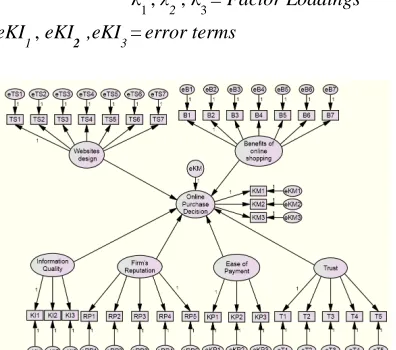
This research used primary data collected using questionnaires with the help of an online survey tool and propagated through the largest communities Forum in Indonesia, namely kaskus.co.id, and mailing-list (discussion group on the Internet). The questionnaire is divided into two parts, namely A and B. Part A of the questionnaire contains questions about demographic profile of respondents such as: age, gender, occupation, monthly income, educational background, and domicile. Part B of the questionnaire comprised 33 questions about the responses to factors or the latent variables within the theoretical framework of the study (Figure 1) which are: three questions for information quality, five for firm’s reputation, three for ease of payment, seven for websites design, seven for benefits of online shopping, five for trust, and three for online purchase decision.
The measurement items or operational variables were adapted from previous studies and revalidated for this study, i.e., information quality and websites design were measured with items adapted from Su et al. (2008)[11] and Chang et al (2008)[20], measures for firm’s reputation were adapted from Lee et al. (2011)[5] and Hess (2008)[21], ease of payment was measured with items adapted from Harris & Goode (2010)[29], the measures for benefits of online shopping were adapted from Delafrooz et al. (2011)[6] and Hui et al. (2006)[22] and trust was measured with items adapted from Beccera et al. (2011)[13], Chiu et al. (2009)[23], and Gefen et al. (2003)[24]. The measurement for these conceptual or latent variables was based on a five-point Likert scale with scale anchors from “1” – strongly disagree to “5” – strongly agree. To test the validity of the questionnaires, a pilot survey of 10 respondents was first conducted to ensure that the questionnaire was uniformly understood.
similarly be expanded for the other latent variables as well:
KI
1 = λ1 KI + eKI1
KI
2 = λ
2 KI + eKI2
KI
3 = λ3 KI + eKI3 Where,
KI
1, KI2 ,KI3 = Information quality Indicators
λ
1 , λ2 , λ3 = Factor Loadings
eKI
1 , eKI2 ,eKI3 =error terms
Figure 1.Model of the Relationship Among Variables in the Research
From the relationship between dependent and independent latent variables, multiple regression analysis, the second step under SEM, was used with the following model:
KM = β1KI + β2RP + β3KP + β4TS + β5B + β6T + e
Where,
KM = Online Purchase Decision KI = Information Quality
KP = Perceived Ease of Payment RP = Firm’s Reputation
TS = Websites design
B = Benefits of online shopping T = Trust
e = Disturbance Error
β1 , . . . . , β6 = regression parameters
The hypotheses for the study are as follows:
Hypotheses 1: The quality of information will have a positive influence on customer buying decisions through e-commerce.
Hypotheses 2: Firm’s reputation will have a positive influence on customer buying decisions through e-commerce.
Hypotheses 3: Ease of payment will have a positive influence on customer buying decisions through e-commerce.
Hypotheses 4: Websites design will have a positive influence on customer buying decisions through e-commerce.
Hypotheses 5: The benefits of online shopping will have a positive influence on customer buying decisions through e-commerce.
Hypotheses 6: Trust will have a positive influence on customer buying decisions through e-commerce.
4. RESULTS
4.1. Descriptive Analysis
Among the respondents there were 82 (47.95 %) females and 89 (52.05%) males. A majority of the respondents 134 (78.37%) were in 19-25 age category, while approximately 57 respondents (33.33%) indicated a monthly income of Rp. 2,000,001,- to Rp. 4,000,000,-. Their highest educations have completed, with bachelor’s degree 133 (77.78%), 9 (5.26%) with master’s degree, 23 (13.45%) with senior high school and 6 (3.51%) with diploma level. A sizeable number, i.e., 113 (66.08%) of the respondents are employed, 46 (26.9%) of the respondents are students, self-employed 10 (5.85%) and 2 (1.17%) unself-employed respondents.
4.2 Reliability Analysis
Reliability test using Cronbach’s Alpha was conducted on most variables to measure the inter-reliability. According to Gliem et al. (2003)[27] and Sekaran et. al. (2009, pp.325)[28]an instrument has an acceptable level of reliability when Cronbach’s Alpha is greater than 0.70. That statement is not absolute because the most decisive is the intuition of researchers. In this research of the seven research variables, firm’s reputation (0.565) and ease of payment (0.691) have a Cronbach’s alpha coefficient of less than 0.70, thus less reliable for the study. However, according to (Lee et al., 2011)[5] the firm's reputation is a significant factor while the payment convenience factor has a Cronbach’s alpha coefficient close to 0.7 so it should be held close to a further analysis of both factors.
4.3RegressionResults
[image:4.612.92.290.206.381.2]shopping (B), Websites design (TS), and Information Quality (KI) as independent variables with online purchase decision (KM) as dependent variable. The regression output is presented in the following equation:
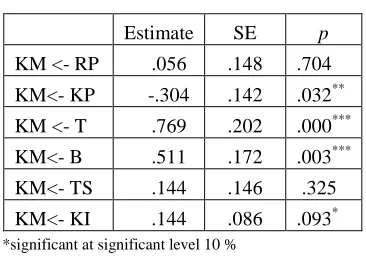
KM = .056 KI - .304 RP + .769 KP + .511 TS + .144 B + .144 T
[image:5.612.103.286.260.390.2]Further detail of the result of the regression is presented in Table 2, including standard errors (SE) and significancy of the coefficient of the regression in terms of p-value (p).
Table 2. Regression Results
Estimate SE p
KM <- RP .056 .148 .704
KM<- KP -.304 .142 .032**
KM <- T .769 .202 .000***
KM<- B .511 .172 .003***
KM<- TS .144 .146 .325
KM<- KI .144 .086 .093* *significant at significant level 10 %
**significant at significant level 5% ***significant at significant level 1%
It can be seen from Table 2 that Firm’s reputation does not significantly influence purchase decision with p-value p = 0.7. Ease of payment however does significantly affect purchasing decision through e-commerce at 5 % significant level with p-value p = 0.032. Similarly, Trust is significant at 1 %, with p-value p = 0.00, Benefits of online shopping is significant at 1% significant level with p-value p = 0.03, and Information quality is significant at 10% significan level with p-value p = 0.093. On the other hand, Websites design is not significant having p-value p =0.325.
In other words, four of the hypotheses, i.e., H1, H3, H5, and H6 are accepted, and the other two hypotheses, i.e., H2 and H4 are rejected. It can be concluded that Ease of Payment, Trust, Benefits of online shopping, Information Quality, have significant impact on customer online Purchase Decision. The estimated coefficients are: βEase of
Payment is -.304, βTrust is .769, βBenefits of online shopping is .511, and βInformation Quality is .144. This indicates that there is linear relationship between the dependent variable (online purchase decision) and four of predictor variables (ease of payment, information quality, benefits of online shopping, trust). Because the calculation is using standardized data, the coeffients also reflects the degree of
importance of the impact. Similarly, firm’s reputation and websites design do not have a significant impact on customer online purchase decision.
The findings in this study are consistent with research conducted by Su et al., (2008)[11], Pujani (2011)[16], and Sam et al., (2009)[10] which stated that the quality of information has little influence on purchasing decisions through e-commerce. To enhance the competitive strength, e-commerce sites should give more attention to the quality of information because the quality of information may give influence on a person's decision to buy through e-commerce (Sam et al., 2009)[10].
For hypotheses 2, the finding in this study is different with the result of the study conducted by Lee et al., (2011)[5], Abadi et al. (2011)[19] and Hess (2008)[21] which stated that the firm's reputation affects a person's decision to purchase products/services through e-commerce. This could be because of the cultural differences and philosophies in the countries. Different cultures and philosophies can lead to the view of certain values to be different.
The findings of this research showed that the ease of payment influences on customer buying decisions through e-commerce in Indonesia has a significant influence. These results are consistent with the research conducted by Harris & Goode (2010)[29] which stated that the e-commerce’s consumer emphasis on security and ease of payment online than offline services.
This research also found that websites design has no influence on the decision of a person in making a purchase through e-commerce. These findings are consistent with research that was done by Sam et al. (2009)[10], and Kim & Kim (2004)[30] but contrary to a study by Shergill et al. (2005) [8], Nuseir et al. (2010)[18]. Perception of aesthetics and function can have different views from one individual to other individual. Maybe for people who are less aware of the technology, the display of a simple site is just enough for them. As long as the site is easily accessible and the purchase process is easy then these people will make a purchase. But for certain people who like technology, the display may become a site for their assessment of the quality of services to be obtained. Because the different perceptions that lead to appearance of the site had little influence on a person's judgment in making purchases online.
research conducted by Delafrooz et al. (2011)[6], Al-Maghrabi & Dennis (2011)[17], Abadi et al. (2010)[19] and Hui et al. (2006)[22].
Trust is the most important factor that affect customer online purchase decision as can be seen from Table 2 in which the trust variable has the greatest influence on purchasing decision indicated by the largest regression coefficient of 0.769 and also having the most significance among the variables, this result are consistent with research conducted by Lee et al. (2011)[5], Kwek et al. (2010)[7], Heijden et al. (2003)[9], Sam et al. (2009)[10], Becerra et al. (2011)[13], and Weisberg et al.(2011)[15].
5. CONCLUSIONS
It can be concluded that Ease of Payment, Trust, Benefits of online shopping, and Information Quality, significantly affect customer online Purchase Decision. The estimated coefficients are:
βEase of Payment is -.304, βTrust is .769, βBenefits of online shopping is .511, and βInformation Quality is .144. This indicates that there is a linear relationship between the dependent variable (online purchase decision) and four predictor variables (i.e., ease of payment, information quality, benefits of online shopping, trust). The findings in this study support and confirm findings of the earlier research.
Trust is the most important factor for the owner or manager of e-commerce in business. Due to the high trust of consumers, it can increase the number of consumers conducting transactions. The greater the value or price of goods sold, then the level of trust that needs to be built also high. Trust can be obtained through a variety of ways, including building a site that can earn the trust of consumers such as through third-party security guarantees, selling products with a brand that can meet the expectations of consumer confidence, and build consumer confidence to the seller through the seller's dedication in protecting consumer privacy and recommendations from other consumers.
From the above conclusion, it can be seen that the trust factor has a significant influence on consumer buying decisions through e-commerce. Sellers or e-commerce businesses are advised to pay more attention to factors such as: quality of information on the site, ease of payment, consumer confidence, and the advantages of online shopping in order to attract more consumers to transact on the site.
The research also concluded that firm’s reputation and websites design do not have
significant impact on customer online Purchase Decision.
REFRENCES:
[1] http://www.internetworldstats.com/stats3.htm (accessed at 07 December 2011)
[2] Alam (2010). Online transactions in Indonesia Translucent USD 35 Trillion. [Electronic version]. Retrieved December 7, 2011 from: http://www.banningbusinesscenter.com/online- transactions-in-indonesia-translucent-usd-35-trillion.html,
[3] O'Brien, J. A., & Marakas, G. M. (2006).
Management Information Systems. 7th Edition.
New York: McGraw Hill.
[4] O'Brien, J. A. (2005). Introduction to Information Systems. 12th Edition. New York:
McGraw Hill.
[5] Lee, C. H., Eze, U. C., & Ndubisi, N. O. (2011). Analyzing key determinants of online repurchase intentions. Asia Pacific Journal of
Marketing and , 23 (2), 200-221.
[6] Delafrooz, N., Paim, L. H., & Khatibi, A. (2011). Understanding consumer’s internet purchase intention in Malaysia. African Journal
of Business Management , 5 (3), 2837-2846.
[7] Kwek, C. L., Tan, H. P., & Lau, T. C. (2010). The Effects of Shopping Orientations, Online Trust and Prior Online Purchase Experience toward Customers’ Online Purchase Intention.
International Business Research , 3 (3). 63-76.
[8] Shergill, G. S., & Chen, Z. (2005). Web-based Shopping: Consumers’ Attitudes Towards Online Shopping in New Zealand. Journal of
Electronic Commerce Research , 6 (2), 79-94.
[9] Heijden, H. v., Verhagen, T., & Creemers, M. (2003). Understanding online purchase intentions: contributions from technology and trust perspectives. European Joube concludedrnal of Information Systems , 12,
41–48.
[10] Sam, M. F., & Tahir, M. N. (2009). Website Quality And Consumer Online Purchase Intention Of Air Ticket International Journal
of Basic & Applied Sciences , 9 (10), 20-25.
[11] Su, Q., Li, Z., Song, Y. t., & Chen, T. (2008). Conceptualizing consumers’ perceptions of e-commerce quality. International Journal of
Retail & Distribution Management , 36 (5),
360-374.
[12] Kim, J. I., Lee, H. C., & Kim, H. J. (2004). Factors Affecting Online Search Intention and Online Purchase Intention. Seoul Journal of
[13] Becerra, E. P., & Korgaonkar, P. K. (2011). Effects of trust beliefs on consumers’ online intentions. European Journal of Marketing ,
45 (6), 936-962.
[14] Yulihasri, Islam, M. A., & Daud, K. A. K. (2011). Factors that Influence Customers’ Buying Intention on Shopping Online.
International Journal of Marketing Studies, 3
(1), 128-139.
[15] Weisberg, J., Te’eni, D., & Arman, L. (2011). Past purchase and intention to purchase in e-commerce the mediation of social presence and trust. Internet Research, 21 (1), 82-96. [16] Pujani, V. (2011). Use of Ecommerce
Websites in Developing Countries. World
Academy of Science, Engineering and Technology, 78, 790-795.
[17] Al-Maghrabi, T., & Dennis, C. (2011). What drives consumers’ continuance intention to e-shopping? Conceptual framework and managerial implications in the case of Saudi Arabia. International Journal of Retail &
Distribution Management, 39 (12), 899-926.
[18] Nuseir, M. T., Arora, N., Al-Masri, M. M. A., & Gharaibeh, M. (2010). Evidence of Online Shopping: A Consumer Perspective.
International Review of Business Research Papers, 6 (5), 90-106.
[19] Abadi, H. R. D., Hafshejani, S. N. A., & Zadeh, F. K. (2011). Considering Factors that Affect Users’ Online Purchase Intentions Using Structural Equation Modeling.
Interdisciplinary Journal of Contemporary Research in Business, 3 (8), 463-471.
[20] Chang, H. H., & Chen, S. W. (2008). The impact of online store environment cues on purchase intention Trust and perceived risk as a mediator. Online Information Review , 32 (6), 1468-4527.
[21] Hess Jr, R. L. (2008). The impact of firm reputation and failure severity on customers’ responses to service failures. Journal of
Services Marketing , 22 (5), 385–398.
[22] Hui, K. L., Tan, B. C., & Goh, C. Y. (2006). Online Information Disclosure: Motivators and Measurements. ACM Transactions on
Internet Technology , 6 (4), 415–441.
[23] Chiu, C. M., Chang, C. C., Cheng, H. L., & Fang, Y. H. (2009). Determinants of customer repurchase intention in online shopping.
Online Information Review , 33 (4), 761-784.
[24] Gefen, D., Karahanna, E., & Straub, D. W. (2003). Trust and TAM in Online Shopping: An Integrated Model. MIS Quaterly , 27 (1), 51-90.
[25] Nusair, K., & Kandampully, J. (2008). The antecedents of customer satisfaction with online travel services: a conceptual model.
European Business Review , 20 (1), 4-19.
[26] Chen, S. J., & Chang, T. Z. (2003). A descriptive model of online shopping process: some empirical results. International Journal
of Service Industry Management , 14 (5),
556-569.
[27] Gliem, J. A., & Gliem, R. R. (2003). Calculating, Interpreting, and Reporting Cronbach’s Alpha Reliability Coefficient for Likert-Type Scales. 2003 Midwest Research
to Practice Conference in Adult, Continuing, and Community Education , 82-88.
[28] Sekaran, U., & Bougie, R. (2009). Research
Methods for Business (Fifth ed.). New York:
John Wiley and Sons.
[29] Harris, L. C., & Goode, M. M. (2010). Online services capes, trust, and purchase intentions.
Journal of Services Marketing , 24 (3), 230–
243.
[30] Kim, E. Y., & Kim, Y. K. (2004). Predicting online purchase intentions for clothing products. European Journal of Marketing , 38 (7), 883-897.