A NEW DENSITY BASED PROBABILISTIC COUNTER
SCHEME FOR SOLVING BROADCAST STORM IN MOBILE
AD HOC NETWORKS
1A. SENTHIL KUMAR, 2K.S. RAMASWAMI
1Associate Professor, RVS College of Engineering and Technology, Coimbatore, India.
2Associate Professor & Head, Dept. of Maths, Coimbatore Institute of Technology, Coimbatore, India.
Email: [email protected], [email protected]
ABSTRACT
Broadcasting is a fundamental data dissemination mechanism for route detection, address resolution and many other network related services in Mobile Ad hoc Networks (MANETs). Although flooding is the simplest mechanism for broadcasting, where each node retransmits every individually received message exactly once, it is usually expensive and results in rigorous redundancy, contention and collisions in the network. These problems are widely referred to as the broadcast storm problem. Hence an effective broadcasting scheme is essential in MANETs to transmit a data packet from the sender to the rest of the network nodes. This work introduces a new counter-based broadcasting scheme to achieve efficient broadcasting by adaptive threshold with a predetermined forwarding probability ‘p’ which can be fixed based on the local density information. The counter identifies nodes with duplicate data packet using threshold values and node removes the redundant message. Probabilistic schemes do not require global topological information of the network to make a rebroadcast decision. As such every node is allowed to rebroadcast a message. The proposed work also adapts the random assessment delay (RAD) value to network congestion level and uses packet origination rate as an indicator of network congestion by keeping track of the number of packets received per second at each node. The extensive simulation results show that the new scheme outperforms the existing schemes in term of saved-rebroadcast, reachability and throughput.
Keywords: Manets, Flooding, Counter-Based, Broadcast Storm Problem, Throughput, Reachability
1. INTRODUCTION
In recent years, mobile ad hoc network (MANET) has gained a lot of attention because of its self-organizing and infrastructure-free characteristics. Unlike the traditional wireless networks, each node in MANET can act as a router to receive and forward packets. All nodes can randomly move around, leave the network or switch off. Hence, broadcasting has been widely used in diffusing data, routing or topology information in MANET. There are number of characteristics in MANET such as mobility services, no infrastructure and battery-powered properties make it used in a number of applications for MANET [1]. MANET is widely used in military, emergency operations, group communication, battle-fields, and disaster recovery. MANETs can be very useful in setting up an infrastructure-less network used to make a reliable and fast communication among soldiers in the battle-fields to recover any failure in the network.
mechanisms, the originator of a broadcast packet determines the relay nodes from its neighbors to rebroadcast the packet. Each node in the set of relay nodes further determines its relay nodes when receiving the broadcast packet from the originator, and so forth. In receiver-based mechanisms, a mobile node that has received a broadcast packet determines by itself whether or not to rebroadcast the packet. Qayyum et al. [10] proposed a sender-based mechanism called multipoint relay (MPR) for efficient broadcasting. The MPR technique restricts the number of retransmissions by selecting a small subset of neighbors which covers (in terms of one-hop radio range) the same network region that the complete set of neighbors does.
Ad hoc On-Demand Distance Vector Routing (AODV) is an on-demand protocol used to provide the route discovery and maintenance in a wide variety of network topologies and environments and to achieve improved performance, robustness and better scalability. Route Maintenance is a mechanism used to repair routes when they are invalidated or have broken links, so this error propagated to neighbors that have used this node as their next hop. The main feature of AODV is its ability to use a destination sequence number for each route entry created by the destination for any route information sending to requesting nodes with loop freedom and this requesting node always selects the node with the greatest sequence number. This protocol works on wired and wireless media. In AODV, the neighboring nodes can detect each other’s broadcasts by using symmetric links between neighboring nodes. It does not attempt to follow paths between nodes when one of these nodes cannot hear the other one [9].
The probabilistic broadcast includes counter-based, location-counter-based, distance-based and hybrid-based schemes. In counter-hybrid-based schemes, messages are rebroadcasted only when the number of copies of the message received at a node is less than a threshold value. In the location-based scheme, messages are rebroadcasted only when the additional coverage concept [11] determines the location of the mobile nodes to broadcast. In distance-based scheme messages are rebroadcasted according to the decision made between the relative distance of mobile node and the previous sender. In cluster-based scheme, the network is divided into number of clusters; each cluster has a single cluster head and several gateways. Each cluster head, in turn, acts as a source for rebroadcast within its own cluster and the gateways can communicate with
external clusters and are responsible for transmitting the broadcast message externally. Hybrid schemes [12,13] combine between the advantages of probabilistic and counter-based schemes to achieve the performance improvement. The second category is known as a deterministic broadcast scheme and includes multipoint relaying [14], node-forwarding [15], neighbor elimination [16], and clustering [17]. Deterministic schemes use network topological information to build a network including all the nodes in the network, so every node needs to exchange its information. Probabilistic schemes do not use any information from network but, rather, start of building a network with each broadcast domain. Ni et al. [18] proposed several receiver-based solutions for the broadcast storm problem: the counter-based, distance based, and location-based scheme. These schemes rely on various threshold mechanisms help a mobile node to decide whether to rebroadcast or not. Adaptive versions of the scheme were also proposed [4] in which the threshold values are dynamically chosen according to the number of neighbors of a mobile node. It had been shown that if location information is available through devices such as GPS receivers, the adaptive location-based scheme (ALB) is the best choice among threshold-based scheme in terms of saved broadcast and reachability.
2. RELATED WORK
Traditional flooding [21] suffers from the problem of redundant message reception. The same message is received multiple times by every node, which is inefficient, wastes valuable resources and can cause high contention in the transmission medium. In fixed probabilistic flooding the rebroadcast probability p is fixed for every node. This scheme is one of the alternative approaches to flooding that aims to limit the number of redundant transmissions. In this scheme, when receiving a broadcast message for the first time, a node rebroadcasts the message with a pre-determined probability p. Thus every node has the same probability to rebroadcast the message, regardless of its number of neighbours. Probability-based scheme is a very simple way of controlling message floods. Every node retransmits with a fixed probability. In the area-based scheme, a node determines whether to rebroadcast a packet or not by calculating and using its additional coverage area .The neighbour knowledge scheme maintains neighbour node information to decide who should rebroadcast. This method requires mobile hosts to explicitly exchange neighbourhood information among mobile hosts using periodic ‘‘HELLO” packets. The neighbour list at the present host is added to every broadcast packet. When a packet arrives at the neighbour of the present host, every neighbour compares its neighbour list with the list recorded in the packet. It rebroadcasts the packet if not all of its own neighbours are included in the list recorded in the packets. The length of the period affects the performance of this approach. Very short periods could cause contention or collision while too long periods may debase the protocol’s ability to deal with mobility.
The probabilistic approach has been proposed in [10,18] as a mechanism to reduce redundant rebroadcast messages. Probabilistic approach works as follows: when receiving a packet, each node forwards the packet with probability p. Ni et al. [18] have proposed a probability-based scheme to reduced the redundant rebroadcast packets like flooding and counter-based schemes. Every node in flooding is rebroadcast with a fixed probability P. On the other hand, counter-based scheme is proposed with additional coverage of each rebroadcast when receiving n redundant messages of the same packet. Zhang and Agrawal in [19] proposed a Dynamic probabilistic broadcast scheme as a combination of the probabilistic and counter-based approaches. The scheme is implemented using AODV protocol. Cartigny and Simplot in [11] proposed the
probabilistic scheme as a combination of the advantages of probability-based and distance-based schemes. A counter-based scheme which works as follows: when receiving a packet, the node initiates a counter and a timer. The counter is increased by one for each received redundant packet. When the timer terminates, if the counter is larger than a threshold value, the node will not rebroadcast the packet; otherwise, the node will broadcast it.
3. ISSUES
To lessen the broadcast storm problem, reference [18] suggests two directions: to restrain redundant rebroadcasts and to make a distinction between the timing of rebroadcasts. In counter based scheme, when c reaches a predefined threshold C, the host is inhibited from rebroadcasting this packet because the additional coverage could be low. It provides significant saving when a small threshold is used. A larger threshold will provide less saving in a sparse network but behave almost like flooding. In location based scheme, a predefined threshold is used to determine whether the receiving host should rebroadcast or not. Since added accurate information is used, the location-based scheme can attain better performance in terms of both reachability and the quantity of saving than the counter-based scheme. However, one problem with the schemes in is that the threshold used is a predefined fixed value. These schemes are referred to as fixed-threshold solutions. This poses a dilemma between reachability and the amount of saving on rebroadcasts as the host distribution of the MANET changes. In dense networks [21], multiple nodes share similar transmission ranges. Therefore, these probabilities control the number of rebroadcasts and thus might save network resources without affecting delivery ratios. Note that in sparse networks there is much less shared coverage; thus some nodes will not receive all the broadcast packets unless the probability parameter is high. Therefore, setting the rebroadcast probability p to a very small value will result in a poor reachability. On the other hand, if p is set to a very large value, many redundant rebroadcasts will be generated.
4. THE PROPOSED SCHEME
be fixed based on the local density information. The counter identifies nodes with duplicate data packet using threshold values and node removes the redundant message. This probabilistic approach does not need global topological information of the network to make a rebroadcast decision. Here every node is allowed to rebroadcast a message .The use of this scheme is to facilitate the mobile nodes to rebroadcast a message if the number of received duplicate packets is less than a threshold by taking in to account the status of the node density. In a network of random distribution of mobile nodes as in MANETs, there are regions of varying degrees of node density. Therefore, the forwarding probability p should be set dynamically to reflect local topological characteristics of a given node; e.g. whether the node is located in a sparse or dense region [22]. Consequently, it is critical to identify and categorize mobile nodes in the various regions of the network and appropriately adjust their forwarding probabilities. To achieve this, the node densities at various regions in the network are first determined using the neighbourhood information collected at nodes located in those regions. The neighbourhood information is collected using periodic exchange of ‘‘hello” packets to construct a 1-hop neighbour list at each node in the network. Using the node densities at various regions in the network, two new adjusted probabilistic route discovery approaches are suggested in this paper.
For a given topology scenario, if N is the number of nodes in the network and Ni is the number of neighbours at a node xi at a particular
time instant, the average number of neighbours
n
at a node in the network at that time instant is defined by the relation1
N
i i
N
n
N
=
=
∑
(1)Secondly, the maximum number of neighbours, nmax and minimum number of
neighbours, nmin are determined using the average
number of neighbours
n
. Let N1,N2, . . . ,Nk be the number of neighbours at nodes x1,x2, . . . ,xkrespectively, such that Ni >
n
, where i is a positiveinteger such that i ≤ k, then the expected maximum number of neighbours is defined as
1 max
N
i i
N
n
k
=
=
∑
(2)Also, if N1,N2, . . . ,Nr are the number of neighbours at nodes y1,y2, . . . ,yr, respectively,
such that Ni <
n
, where i is a positive integer such that i≤ r, then the expected minimum number of neighbours is defined as1 min
r
i i
N
n
r
=
=
∑
(3)Therefore, the expected minimum, average and maximum number of neighbours for a give
topology scenario are related as
min
n
<n
<max
n
.The most important factor in the evaluation of the new scheme is the selection of the threshold probability value pi for a giving Group-i.
A large pi for a group of nodes in a dense region of the network incurs more redundant rebroadcasts and a low pi in a sparse region of the networks leads to a poor network connectivity. Assume that the initial probability threshold is pc.
Then the forwarding probability at a node in Group-i can be obtained by
1
i c
p
p
i
=
(4)Each node independently chooses which group it belongs to by using its local node density and sets its forwarding probability accordingly
2
1
b i i
i
N
p N
=
=
∑
(5)where Ni is the number of nodes in Group-i and pi is the forwarding probability at nodes in Group-i.
3 2
1 1
.(
2)
(
2)
i i i i
i i
p N
p N
p N
N
=
<
=<
− <
−
∑
∑
(6)
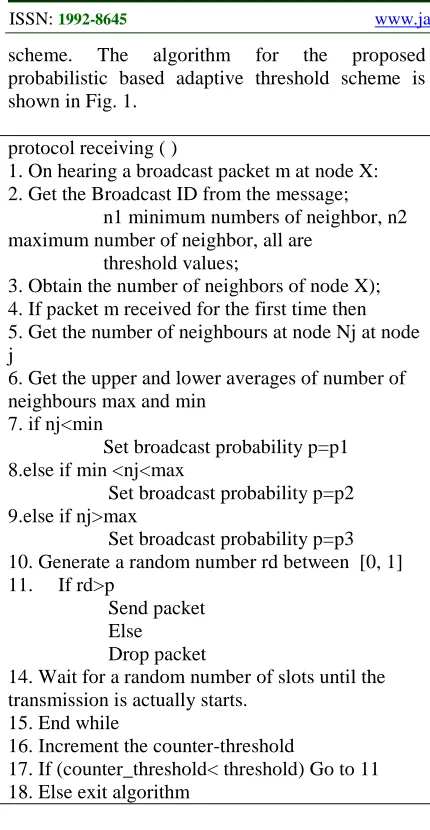
To resolve the dilemma between reachability and saving, we propose a new counter-based scheme in which each individual host can dynamically adjust its threshold C based on its neighborhood status. After waiting for a random assessment delay (RAD), which is randomly chosen between 0 and Tmax seconds, if c reaches a
scheme. The algorithm for the proposed probabilistic based adaptive threshold scheme is shown in Fig. 1.
protocol receiving ( )
1. On hearing a broadcast packet m at node X: 2. Get the Broadcast ID from the message; n1 minimum numbers of neighbor, n2 maximum number of neighbor, all are
threshold values;
3. Obtain the number of neighbors of node X); 4. If packet m received for the first time then 5. Get the number of neighbours at node Nj at node j
6. Get the upper and lower averages of number of neighbours max and min
7. if nj<min
Set broadcast probability p=p1 8.else if min <nj<max
Set broadcast probability p=p2 9.else if nj>max
Set broadcast probability p=p3 10. Generate a random number rd between [0, 1] 11. If rd>p
Send packet Else Drop packet
14. Wait for a random number of slots until the transmission is actually starts.
15. End while
16. Increment the counter-threshold
[image:5.612.86.301.72.487.2]17. If (counter_threshold< threshold) Go to 11 18. Else exit algorithm
Fig. 1. Algorithm for the Proposed Probabilistic
Based Adaptive Threshold Scheme
The use of a rebroadcast probability stems from the fact that packet counter value does not necessarily correspond to the exact number of neighbours of a node, since some of its neighbours may have suppressed their rebroadcast according to their local rebroadcast probability. Therefore to adapt Tmax to congestion levels, each node keeps
track of the number packets received per second. Thus, each host will use a threshold C depending on its current value of n to determine whether to rebroadcast or not. There should be a neighbor discovery mechanism to estimate the current value of n. This can be achieved through periodic exchange of ‘HELLO’ packets among mobile nodes. Each host now executes the following steps.
Essentially, the selection of an fitting RAD time plays a crucial role in the performance of any
broadcast scheme that employed the use of counter. In the original counter-based scheme, each node is assigned a preset constant value RAD_Tmax which
is used to decide RAD value at random. Thus, node does not utilize any network information such as congestion or number of neighbors in determining this value. Normally, in MANETs congestion can be achieved by increasing the packet size or increasing the packet generation rate or both. However, in this paper we choose to fixed the packet size but vary the packet generation rate because we anticipated that broadcast packets, as control type packets, to be generally small in size. Therefore to adapt ECS’s RAD Tmax to congestion levels, each node keeps track of the number packets received per second. Table 1 provides the average packet reception rate for ECS given various packet origination rates in a network with 45 nodes.
Each data point represents an average of 30 different randomly generated mobility scenarios with 95% confidence interval. The error bars in the graphs represent the upper and lower confidence limits from the means and in most cases they have been found to be quite small. For the sake of clarity and tidiness, the error bars have not been included in some of the graphs. We evaluate the broadcast schemes using the following performance metrics:
• Reachability – measures the proportion of nodes which can receive a broadcast packet. A mobile host will miss a packet if all of its neighbours decide to suppress rebroadcasts.
• Saved Rebroadcast (SRB) – This is defined as
(r – t)/r, where r and t are the number of nodes
that received the broadcast message and the number of nodes that transmitted the message respectively. a mobile host rebroadcasts every routing request packet if received for the first time. Consequently, there are N-1 possible rebroadcasts, where N is the total number of mobile nodes.
• End-to-end delay - is the average time difference between the time a data packet is sent by the source node and the time it is successfully received by the last node in the network.
5. SIMULATION RESULTS AND PERFORMANCE ANALYSIS
In order to verify the effect of the RAD adaptation, numerous simulations have been performed using the proposed scheme, counter-based, and flooding, and the results were compared in these three approaches. The performance analysis is based on the assumptions widely used in literature[2, 20].
1. All nodes are identical and equipped with IEEE 802.11 transceivers with the same nominal transmission range.
2. All nodes participate fully in the protocol of the network. In particular each participating node should be willing to forward packets to other nodes in the network.
3. Packets may be lost or corrupted in the wireless transmission medium during propagation. A node that receives a corrupted packet can detect and discards the packet. 4. All mobile nodes are homogeneous (i.e.
wireless transmission range and interface cards are the same)
For a given topology scenario, if N is the number of nodes in the network and Ni is the number of neighbours at a node xi at a particular time instant, the average number of neighbours _n at a node in the network at that time instant is defined by the relation. The simulation scenarios consist of three different settings, each specifically designed to assess the impact of a particular network operating condition on the performance of the protocols. First, the impact of network density or size is assessed by deploying 25, 50, and 100 mobile nodes. The second simulation scenario investigates the effects of offered load on the performance of the routing protocols by varying the number of source destination pairs (flows for short) over the range 1, 5, 10, 15 flows for each simulation scenario. The last set of simulations evaluates the performance impact of node mobility by varying the maximum node speed of 45 mobile nodes over the range 1, 5, 10, 15, 20 and 25 m/s in a fixed area
The distributed coordination function (DCF) of the IEEE 802.11 protocol [22] is utilized as MAC layer protocol while random waypoint model is used as the mobility model. In a random waypoint mobility model, each node at the beginning of the simulation remains stationary for a pause time seconds, then chooses a random destination and starts moving towards it with a randomly selected speed. After the node reaches its destination, it again stops for a pause-time interval
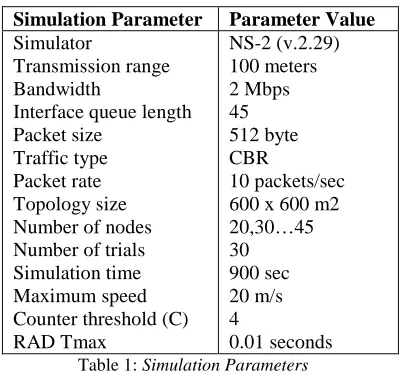
and chooses a new destination and speed. This cycle repeats until the simulation terminates. The simulation is allowed to run for 900 seconds for each simulation scenario. Other simulation parameters that have been used in our experiment are shown in Table 1.
Simulation Parameter Parameter Value
Simulator
Transmission range Bandwidth
Interface queue length Packet size
Traffic type Packet rate Topology size Number of nodes Number of trials Simulation time Maximum speed Counter threshold (C) RAD Tmax
NS-2 (v.2.29) 100 meters 2 Mbps 45 512 byte CBR
10 packets/sec 600 x 600 m2 20,30…45 30 900 sec 20 m/s 4
0.01 seconds
Table 1: Simulation Parameters
5.1. Effects of offered traffic load simulation
Like the previous studies, the offered traffic load simulation is done by changing the number of Constant Bit Rate (CBR) connections. This CBR connection ensures that all cells in a transmission are maintained from end to end. This service type is used for voice and video transmission that require little or no cell loss and rigorous timing controls during transmission. The numbers of CBR connections that are considered in the experiments are 10, 20, 30 and 45 for the number of nodes. The maximum speed 20 m/s is chosen to study the effects of traffic load in the network with high speed. When the speed is high the traffic load is concentrated on some nodes so the congestion is occurred.
The simulation parameters of this experiment are set as follows:
• Number of nodes: 45
• Maximum speed: 20 m/s.
• Packet rate: 4 packets/second.
5.2. Normalized Routing Load (NRL)
[image:6.612.321.523.171.360.2]any nodes used to reach to the destination, so we choose one of these connections. Most of the generated data packets and connections are dropped resulting from collisions and contention. Nevertheless, our proposed scheme will decrease the NRL over the traffic load percentage against other schemes and shows better performance up to 30%. This is because the flooding sends the packets to all nodes continuously without checking if these nodes receive this packet in previous time; thus this causes a collision and contention in the network leading to additional load on the network.
Fig. 2: Normalized Routing Load Vs.The Network Sizes
5.3. Average end-to-end delay
Fig. 3represents the delays of all schemes for different traffic loads. The delay is increased as the traffic load grows. The number of packets transmitted on the network has a considerable impact on delay. When the number of CBR connections increases the number of collisions, contentions and redundant rebroadcast packets grows. Thus, this leads to more retransmissions of packets towards the destination and, hence, resulting in growing delay. Fig. 3 shows that flooding incurs higher end-to-end delay. This is owing to the higher number of redundant rebroadcasts of RREQ packets with collisions and contention caused by many RREQ packets that fail to reach the destination.
Fig. 3: End-To-End Delay Vs Number Of Connections
5.4. Packet delivery ratio (PDR)
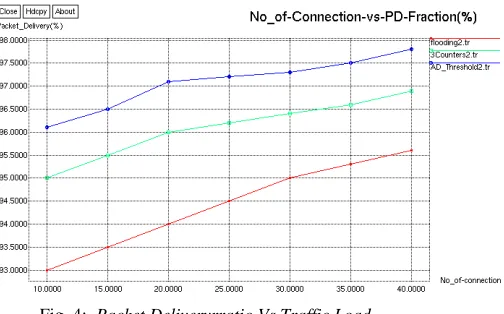
[image:7.612.92.312.247.402.2]Fig. 4 represents the PDR for all schemes in this study. This figure shows that our proposed scheme has a higher value of PDR compared with two counter-based and flooding. Packet delivery ratio increases when increasing the number of connections for the following reason: the more the network connections, the better and more available shortest paths towards destination. This implies that there are more connections to connect two nodes offering a better transmission in each area. Hence, there is a greater chance that a broadcast retransmission occurs successfully, resulting in an increased delivery ratio.
Fig. 4: Packet Deliveryrratio Vs.Traffic Load
6. CONCLUSION
[image:7.612.315.567.428.585.2]according to its neighbour’s information. The proposed work also adapts the random assessment delay (RAD) value to network congestion level and uses packet origination rate as an indicator of network congestion by keeping track of the number of packets received per second at each node. Simulation results reveal that this simple adaptation minimizes end-to-end delay and maximizes delivery ratio, and thus achieves superior performance in terms of saved rebroadcast, end-to-end delay and reachability over the other schemes.
REFERENCES
[1] Tseng, Y.-C., Ni, S.-Y., Chen, Y.-S., Sheu, J.- P., 2002. “The broadcast storm problem in a
mobile ad- hoc network Wireless Networks”, 8,
153–167.
[2] D.B. Johnson, D.A. Maltz, Y.C. Hu, J.G. Jetcheva, “The dynamic source routing
protocol for mobile ad-hoc networks”,
Internet draft, draft-ietf-manet-dsr-05.txt, 2001.
[3]. C.E. Perkins, E.M. Royer, S.R. Das, “Ad hoc
on-demand distance vector (AODV) routing”,
Internet draft, draft-ietf-manet-aodv-08.txt, 2001.
[4]. Y.C. Tseng, S.-Y. Ni, E.-Y. Shih, “Adaptive
approaches to relieving broadcast storms in a wireless multihop mobile ad hoc network”,
Proceedings of the IEEE 21st International Conference on Distributed Computing Systems (2001) 481–488.
[5]. A. Qayyum, L. Viennot, A. Laouiti, “Multipoint relay: an efficient technique for
flooding in mobile wireless networks,
INRIA research report RR-3898, 2000. [6]. H. Lim, C. Kim, “Multicast tree construction
and flooding in wireless ad hoc networks,
Proceedings of the Third ACM International Workshop on Modeling, Analysis, and Simulation of Wireless and Mobile Systems (2000) 61–68.
[7]. H. Lim, C. Kim, “Flooding in wireless ad hoc
networks, Journal of Computer Communications(2001) 353–363.
[8]. W. Peng, X.-C. Lu, “On the reduction of
broadcast redundancy in mobile ad hoc networks, Proceedings of the First Annual
Workshop on Mobile and Ad Hoc Networking and Computing (2000) 129–130. [9]. R. Khurram, “A survey of mobile ad hoc
networks”, Proceedings of the 2nd IEEE
Workshop on Mobile Computing Systems and Applications, May 2002.
[10]. B. Williams, T. Camp, “Comparison of
broadcasting techniques for mobile ad hoc networks”, in: Proceeding of MOBIHOC,
ACM, 2002. pp. 194–205.
[11]. J. Cartigny, D. Simplot, “Border node
retransmission based probabilistic broadcast protocols in ad-hoc networks”, in: Proceedings of HICSS-36, 2003.
[12]. A. Mohammed, M. Ould-Khaoua, L. Mackenzie, J. Abdulai, “Improving the
performance of counter-based broadcast scheme for mobile ad hoc networks, in”,
Proceedings of 2007 IEEE International conference on Signal Processing and Communications, 2007, pp. 1403–1406. [13]. A. Mohammed, M. Ould-Khaoua, L.
Mackenzie, “An efficient counter-based broadcast scheme for mobile ad-hoc networks”, in: Proceedings of the Fourth
European Performance Engineering Workshop Lecture Notes in Computing Science, 2007, pp. 275–283.
[14]. A. Qayyum, L. Viennot, A. Laouiti, “Multipoint relaying for flooding broadcast
messages in mobile wireless networks”, in:
Proceedings of the 35th Annual Hawaii International Conference on System Sciences, 2002, pp. 60–65.
[15]. G. Calinescu, I. Mandoiu, P.-J. Wan, A.Z. Zelikovsky, “Selecting forwarding neighbors
in wireless ad-hoc networks”, Mobile Networks and Applications, 9 (2004) 101– 111.
[16]. I. Stojmenovic, M. Seddigh, J. Zunic, “Dominating sets and neighbor
elimination-based broadcasting algorithms in wireless networks”, Proceedings of IEEE (2002) 14–
25.
[17]. W. Lou, J. Wu, “A cluster-based backbone
infrastructure for broadcasting in MANETs”,
in: Proceedings of IEEE Computer Society, 2003.
[18]. S.Y. Ni, Y.-C. Tseng, J.-P. Sheu, “The
broadcast storm problem in a mobile ad hoc network”, Proceedings of the International
Conference on Mobile Computing and Networking (MOBICOM) (1999) 151–162. [19]. Q. Zhang, D.P. Agrawal, “Dynamic
probabilistic broadcasting in MANETs”,
Proceedings of Journal of Parallel and Distributed Computing (2005) 220–233. [20]. C. E. Perkins and E. M. Moyer, "Ad-hoc
Mobile Computing Systems and Applications. New Orleans, L.A, 1999, pp. 90 – 100. [21]. Y. Sasson, D. Cavin, A. “Schiper,
Probabilistic broadcast for flooding in wireless mobile ad hoc networks”, in:
Proceedings of the IEEE Wireless Communications & Networking Conference (WCNC 2003), March 2003, pp. 1124–1130. [22]. Bani-Yassein M, Ould-Khaoua M, Mackenzei
LM, Papanastasiou S. “Performance analysis
of adjusted probabilistic broadcasting in mobile ad hoc networks”. Int J Wireless