PERFORMANCE IMPROVEMENT OF ROBUST CALL
ADMISSION CONTROL ALGORITHM FOR QOS SUPPORT
OVER FUTURE GENERATION WIRELESS
HETEROGENEOUS NETWORKS
1 G.NANTHA KUMAR,2 DR. A.AROKIASAMY
1Assistant Professor, Department of CSE, Anjalai Ammal Mahalingam
Engineering College, Kovilvenni, Tamil Nadu, India.
2 Professor, Department of CSE, E.G.S.Pillay Engineering College,
Nagapattinam, Tamil Nadu, India.
E-mail: [email protected], 2
[email protected]
ABSTRACT
Admission Control plays a remarkable role in dealing with lots of wireless heterogeneous networks which may admit new sessions for a network with most conquer aspect to supply the requested QoS. To keep off the abjection of QoS under the low priority sessions here, we nominate a QoS based Robust Call Admission Control (RCAC) Algorithm. The service classes are assorted into four major categories on the basis of class of service and type of service, which could be reacted on the real time and non real time traffics along with handover and incoming new request. The algorithm concentrates on providing priority based on transmission and space. This algorithm trying to downplays the blocked sessions that have been chosen with deficient resources around the network. With the help of simulated results and graph, we display that our suggested technique affords improve throughput along with cut down in delay.
Keywords:
QoS, Wireless networks, admission control, RCAC (Robust Call Admission
Controller), CAC (Call Admission Control)
1. INTRODUCTION
Supporting multimedia applications with different quality of service (QoS) requirements in the presence of diversified wireless access technologies (e.g.,3G cellular, IEEE 802.11 WLAN, Bluetooth) is one of the most challenging issues for fourth-generation (4G) wireless networks. In such a network, depending on the bandwidth, mobility and application requirements, users will be able to switch among the different access technologies in a seamless manner. Efficient radio resource management and call admission control (CAC) strategies will be key components in such a heterogeneous wireless system supporting multiple types of applications with different QoS requirements. The current standards of Telecommunication are driven to replace with 3G in upcoming years. This future cellular network is named as 4G. The objectives of 4G includes seamless communication with broad range connection with Internet at any time anywhere and support of data, pictures and videos on Internet. The 4G network will consist of Internet protocols such as to facilitate the
subscribers by enabling the selection of every application and any environment. In 4G cellular networks a high bandwidth with high data rate is required, also in 4G a quicker and optimized strategy of handover is required to make the clear and reliable communication. The 4G-network system will run with the cooperation of 2G and 3G and also will impart IP based wireless communication. The main target in 4G will be video streaming on IP based protocol.
QOS ISSUES IN 4G WIRELESS NETWORKS
The QoS issues in 4G wireless networks are as follows [1]
Real time applications require QoS guarantee. When the best-effort quality is acceptable, then the end user will require the QoS guarantee.
•Lack of protocols for implementing an overall adaptive application QoS support in order to obtain optimal QoS performance.
• QoS suffers from the lack of access, location transparency, re-configurability and adaptability, which became major shortcoming for the evolution towards the QoS of 4G mobile wireless network.
• Another challenge faced by the current Internet is the streaming of multimedia content to different receivers across heterogeneous networks.
• There are different standards adopted in different countries, which led the major issues in realization, and implementation of 4G networks today.
• Due to the intermittent quality degradation, QoS is difficult to maintain in wireless networks. To meet different user QoS requirements, 4G wireless network have to consider many service classes. The service classes considered may include different delay, throughput and bit error rate (BER) characteristics. There could be services that should have higher priority due to the nature of the service classes. There are two requests new and handoff request based on the priorities.
In order to avoid the degradation of the QoS of low priority sessions, in this paper, we propose a QoS based Robust admission control Algorithm. We concentrate to obtain transmission priority for real time flow and bandwidth priority to the non real time data flow of the same end-user, in order to prevent non real time flow starvation, without violating the real-time flow QoS requirements.
The paper is organized as follows Section II presents the related works done on the Admission Control. Section III gives the detailed description of the proposed QoS Based Robust Admission Controller. The simulation results are given in Section IV and the paper is concluded in Section V.
2. RELATED WORK
In this section we highlight some admission control algorithms that are related to and have inspired our approach. In [2] an admission control algorithm for heterogeneous networks is described. This algorithm focuses on the cooperation between existing networks, especially the cooperation between Universal Mobile Telecommunications System (UMTS) and wireless LAN (WLAN). The algorithm described in this article is a throughput-based algorithm. The decisions are taken at the RNC entity of UMTS, where the common admission control algorithm sends the users in either the UMTS or the WLAN taking into account only the available throughput of the networks. The RNC calculates the load value η new of the new
service, and after that it evaluates the load ηumts
on Node B. If η new + ηumts ≤ ηthreshold, the
service is admitted to UMTS. Otherwise, the RNC evaluates load ηwlan on the access point. If
ηnew + ηwlan ≤ ηthreshold, the service is
admitted to WLAN. If this procedure fails, the service is blocked, and the user should try to request that service again.
In [3] another admission control scheme for heterogeneous wireless networks is provided. This algorithm is similar to the previous one but works with different priority criteria. Here we have a central entity that supervises the networks and makes the decisions on admission. This algorithm distinguishes the calls and sends data calls to WLAN, voice calls (and data calls when WLAN is congested) to UMTS, and when all these networks are congested, it sends all calls to General Packet Radio Service (GPRS). The main ideas of all the Call Admission Control [4] approaches are
summarized in Table 1.
Table1. Different Approaches To CAC Design In Cellular Wireless Networks
Approach Description
Guard channel Some portion of the wireless resources is reserved for handoff calls so that handoff call dropping probability can be maintained below the target level.
Fractional guard channel New calls are gradually blocked according to the current status (i.e., the number of ongoing calls) of the network.
Collaborative The neighboring cells exchange information about the network status so that resource reservation can be made in advance accurately.
Non collaborative Using prediction techniques (e.g., ARMA model, Wiener filtering) to project the amount of the resources required locally so that the resources can be reserved in advance without the need for information exchange among neighboring cells
Mobility-based Mobility information (i.e., position and direction of movement) of mobiles can be used to enhance the accuracy of the resource reservation.
3. CALL ADMISSION CONTROL
Quality of Service (QoS) is provided to the network by a technique called Call Admission Control by controlling the access to the network resources. This may accept a new call request which may be provided by the resources that are available free to co-ordinate the QoS requirements without disturbing already accepted calls from the same resources. Tradeoff may occur between the QoS level consumed by the user and the utilization of resources in wireless heterogeneous networks. The call dropping and call blocking probability were the main parameters that have been relevance to the Quality of Service.
Requirements [5] for call admission control system
1. Limit the interference
2. QoS requirements
3. To support multimedia services 4. Fast Internet access
5. Voice and Video telephony 6. Signal Quality
7. Call Dropping Probability 8. Packet-Level Parameters 9. Transmission Rate
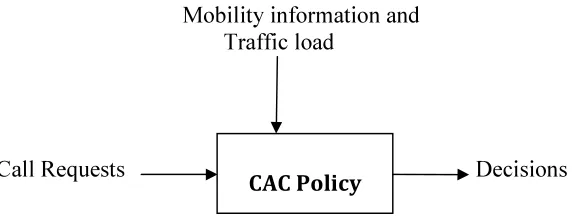
A CAC mechanism is usually defined as the detailed work involved in the CAC function. This includes the decision process [6], signaling, routing table establishment etc., The Decision process of CAC can often be formulated in a high level representation called the CAC policy. Whenever a user request a new connection, the call policy takes the call request as input, and based on the current traffic conditions of the system, decides whether or not to accept the user, as illustrated in Fig 1.
Mobility information and
Traffic load
[image:3.595.154.440.388.499.2]Call Requests Decisions
Fig 1. The CAC Decision Process
Call Admission Control in the Context of Future 4G Heterogeneous Wireless Systems
Next-generation wireless networks will be built on ubiquitous and converged network and service infrastructures. The main goal of the Admission Control algorithm is to control the admission of new or handover sessions while maintaining the load of the network within some boundaries that do not disturb the QoS of any other sessions. The main function of an efficient Admission Control algorithm for heterogeneous networks is to decide at a specific point in time if there is a network that has the available resources to serve (to satisfy the QoS requirements of) a new session..
The design of the AC algorithm must be made very carefully to minimize the following [7]
• False rejections, which occur when the algorithm rejects a session, although there is a network that can meet the session’s requirements. In this case capacity is wasted, and the operators’ revenues are not optimized.
• False admissions, which occur whenever the algorithm accepts a session although it turns out that the network, did not have the available capacity for the session. In this case QoS guarantees are not provided, and user satisfaction is degraded
The basic assumptions for admission control in heterogeneous wireless networks are,
Network (RAN) may have to be handed off to another RAN.
• New calls and handover calls normally have to be treated differently in terms of resource allocation.
• Handover calls are normally assigned higher priority than new calls. • Traffic will be routed through the
cooperating systems according to the restrictions and advantages of each system.
• Different levels of service classes can be identified for users in terms of QoS and priority.
• Mobile users can alternatively access different RANs during a call (intersystem handoffs).
• Coexisting RANs are to cooperate with each other.
Legacy networks usually use a single criterion in deciding whether to admit or reject a session. In the case of systems with multiple heterogeneous (including legacy) wireless networks, where different types of services are provided to users in [8] there are 18 different service classes defined for the users, the admission decision cannot be made based on one simple criterion, since there are many important factors that have to be taken into account. Specifically, we consider the following criteria,
• Network load: The predicted load of the network after the admission of the new session is computed; if it remains under a certain threshold, the new session can be accepted; otherwise, it will be rejected. The load is not computed in the same way in all networks, and the algorithm takes into account the distinct characteristics of each network before performing the measurements.
• User’s QoS requirements: QoS parameters such as mean throughput, bandwidth demands, service class, and priority of each session are taken into account to decide whether or not to admit the session.
• User’s context: The algorithm normally gives priority to handover sessions, which require lower blocking probability than new sessions. There is an exception for emergency calls. Also, there is an option or grouping the users according to their subscription.
• Link quality: If the admission of the new session results in a decrement of the link’s quality under a desired value, the session is
rejected. Link quality refers to the quality of the radio link between the base station and the mobile terminal. Link quality is measured based on the received signal strength at the mobile terminal and the interference caused to this link by other mobile terminals in the same area.
Challenges in CAC design for 4G wireless networks.
Heterogeneous environment
4G systems will consist of several types of wireless access technologies, so CAC schemes must be able to handle vertical handoff and special modes of connection such as ad hoc on cellular networks.
Multiple types of services
4G systems will need to accommodate different types of users and applications with different QoS requirements.
Adaptive bandwidth allocation
With multimedia applications, system utilization and QoS performance can be improved by adjusting the bandwidth allocation depending on the state of the network and users’ QoS requirements.
Cross layer design
Both call- and packet-level QoS need to be considered to design CAC algorithm. So that not only the call drops and call blocking probabilities but also the packet delay and packet drop probabilities can be maintained at the target level.
Call admission control schemes can be classified based upon the number of services/classes [9].
Type 1: A handover request with real time traffic (SC1)
Type 2: A handover request with non-real time traffic (SC2)
Type 3: A new request with real time traffic (SC3)
Type 4: A new request with non-real time traffic (SC4)
Our objective is to simultaneously provide transmission priority for the real time flow, and bandwidth priority to the non real time data flow of the same end-user. In order to prevent non real time flow starvation, without violating the real-time flow QoS requirements.
Accept call
SC1
SC2
SC3 Reject call
SC4
Fig.2. The System Model of Proposed RCAC Algorithm
4. ADMISSION CONTROL ALGORITHM
The admission control algorithm is described as follows. In Fig. 3 the flowchart of the proposed Admission Control algorithm is given, illustrating the actions that have to be performed before making a decision to admit a new session or not. In particular, when a new request arrives at the AC entity, the algorithm is triggered in order to find out if there is a RAN that can meet the session’s requirements and if the session can be served by that RAN. The first action of the algorithm is to determine the characteristics of the session. In general, a session declares its type
bandwidth requirements, delay sensitivity, the RAN from which the session request came (if it is a handoff session), and possibly a RAN preference. Based on these requirements, the session is corresponded to a service class and assigned a priority, at the same time taking into account constraints depending on the user’s context. The next step of the algorithm is to select the RANs that meet the session’s requirements and will provide the best QoS to it.
The proposed Robust Call Admission Control Algorithm is described as follows
When a new request arrives,
1. Check the characteristics of the session 2. Check for the target RAN or network
2.1 If it is unavailable, REJECT the session
Else
2.2 Check for the session, whether it is a hand off session / New session
If hand off session, then,
2.2.1 Check for sufficient resources
If it is available, then,
Call Admission
Control
Algorithm
2.2.1.1 Accept the session
Else
2.2.1.2 Check for the session, whether it is a hand off session / New session
End if
If hand off session, then,
2.2.1.2.1 Check if it can be served by another RAN
If another RAN is available, then,
2.2.1.2.2 Repeat from 2
Else
2.2.1.2.3 Force high loaded sessions to hand over to another RAN and Check if after the session can be admitted.
If it can admit the session, then,
2.2.1.2.4 Admit the session
Else
2.2.1.2.5 Check if low priority sessions can degrade their QoS as much as it needs to admit the session
If it can admit the session, then,
2.2.1.2.6 Admit the session
Else
2.2.1.2.7 Check for the session, whether it is a hand off session / New session
If hand off session
2.2.1.2.8 Enter the session in the queue
Else
5. PERFORMANCE EVALUATION OF THE PROPOSED
RCAC Algorithm
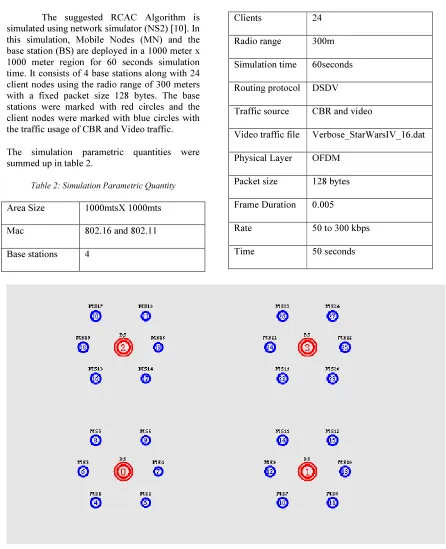
The suggested RCAC Algorithm is simulated using network simulator (NS2) [10]. In this simulation, Mobile Nodes (MN) and the base station (BS) are deployed in a 1000 meter x 1000 meter region for 60 seconds simulation time. It consists of 4 base stations along with 24 client nodes using the radio range of 300 meters with a fixed packet size 128 bytes. The base stations were marked with red circles and the client nodes were marked with blue circles with the traffic usage of CBR and Video traffic.
[image:8.595.81.527.161.710.2]The simulation parametric quantities were summed up in table 2.
Table 2: Simulation Parametric Quantity
Area Size 1000mtsX 1000mts
Mac 802.16 and 802.11
Base stations 4
Clients 24
Radio range 300m
Simulation time 60seconds
Routing protocol DSDV
Traffic source CBR and video
Video traffic file Verbose_StarWarsIV_16.dat
Physical Layer OFDM
Packet size 128 bytes
Frame Duration 0.005
Rate 50 to 300 kbps
Time 50 seconds
A. Performance Metrics
Evaluating the comparability between QoS based Adaptive Admission Controller (QAAC) algorithm and our projected Robust Call Admission Control Algorithm (RCAC) for QoS support in heterogeneous 4G Wireless networks which mainly focalizes on the higher performance on the basis of the following Metrics.
Throughput: The amount of traffic (real time and non – real time) which have been received by the network at the destination represented in Megabits/Second.
Delay: The average end to end delay occurring in the network at the destination part which has
been measured in terms of seconds.
B. Results
1. Based on Rate:
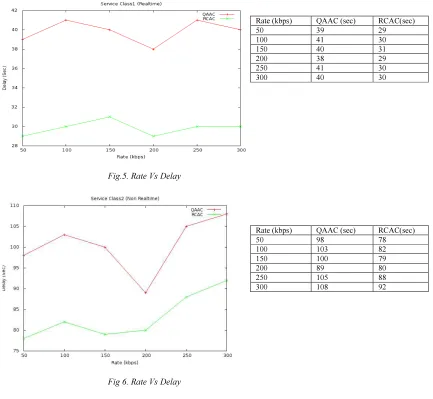
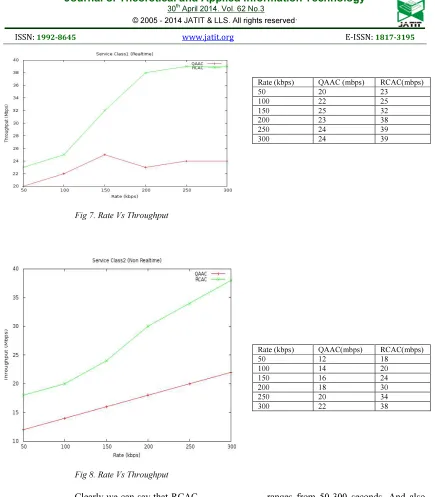
[image:9.595.85.518.337.736.2]Figure 5 and Figure 6 enlarges the graph between the rate of each traffic flow from 50-300 kbps and delay 0-50 seconds whereas Figure 7 and Figure 8 elaborates the graph between the rate of each traffic flow from 50- 300 kbps and throughput ranges form 20-40 Mbps and the performance has been evaluated for real time traffic of Service Class 1 (SC1) and also for non-real time traffic of Service Class 2 (SC2).
Fig.5. Rate Vs Delay
Fig 6. Rate Vs Delay
Rate (kbps) QAAC (sec) RCAC(sec)
50 39 29
100 41 30
150 40 31
200 38 29
250 41 30
300 40 30
Rate (kbps) QAAC (sec) RCAC(sec)
50 98 78
100 103 82
150 100 79
200 89 80
250 105 88
Fig 7. Rate Vs Throughput
Fig 8. Rate Vs Throughput
Clearly we can say that RCAC is better than QAAC when the rate is increased. This happens because our RCAC algorithm provides bandwidth and transmission priority for Real Time and Non Real Time Traffic flows respectively.
2. Based on Time :
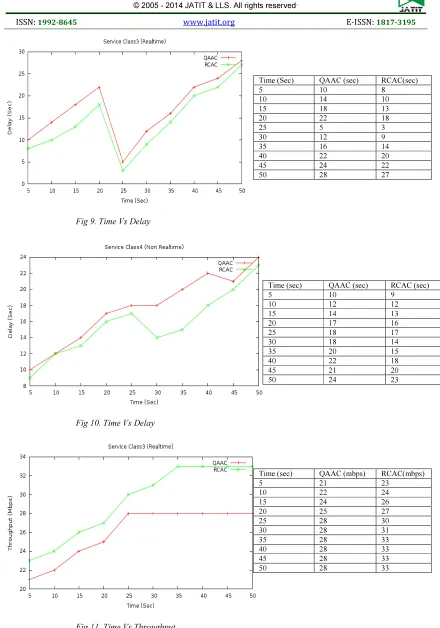
Figure 9 and Figure 10 expands the graph between the several intervals of the whole simulation time ranges from 5-50 seconds, by keeping the fixed traffic rate is 250kb and delay
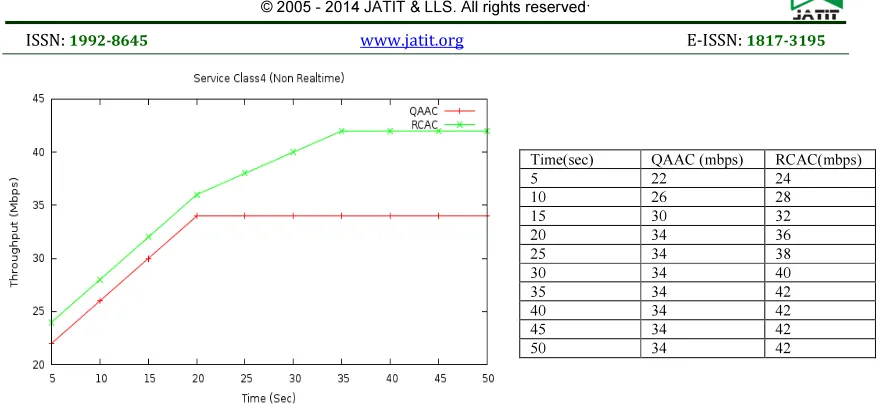
ranges from 50-300 seconds. And also Figure 11 and Figure 12 expand the graph between the same intervals of the simulation time ranges from 5-50 seconds with the throughput values ranges from 20-40 Mbps. The execution has been evaluated for service class 3 Real Time (RT) traffic and service class 4 Non real Time traffic (NRT).
Rate (kbps) QAAC (mbps) RCAC(mbps)
50 20 23
100 22 25
150 25 32
200 23 38
250 24 39
300 24 39
Rate (kbps) QAAC(mbps) RCAC(mbps)
50 12 18
100 14 20
150 16 24
200 18 30
250 20 34
Fig 9. Time Vs Delay
[image:11.595.82.522.93.721.2]Fig 10. Time Vs Delay
Fig 11. Time Vs Throughput
Time (Sec) QAAC (sec) RCAC(sec)
5 10 8
10 14 10
15 18 13
20 22 18
25 5 3
30 12 9
35 16 14
40 22 20
45 24 22
50 28 27
Time (sec) QAAC (sec) RCAC (sec)
5 10 9
10 12 12
15 14 13
20 17 16
25 18 17
30 18 14
35 20 15
40 22 18
45 21 20
50 24 23
Time (sec) QAAC (mbps) RCAC(mbps)
5 21 23
10 22 24
15 24 26
20 25 27
25 28 30
30 28 31
35 28 33
40 28 33
45 28 33
Fig 12. Time Vs Throughput
Clearly we can say that RCAC is better than QAAC when the time interval was increasing gradually. This happens because our RCAC algorithm provides bandwidth and transmission priority for real time and non real time traffic respectively.
6. CONCLUSION
Robust Call Admission Control algorithm is proposed in this article, which tries to increase the throughput, and shows deduction in delay occurs in wireless heterogeneous networks. Here, the Call Admission Control plays a key role in providing guaranteed QoS in the communication links between heterogeneous networks. The aim of algorithm is to simultaneously provide priority based on transmission and space. The performance metrics with the system of measurement has been studied with different simulation results for different scenario by changing the range of corresponding rate and time for available wireless heterogeneous networks. Since the DSDV routing protocol has been implemented here, as a future work we have a plan to measure the performance of the suggested algorithm for the different routing protocols with corresponding various traffic levels.
REFERENCES
[1] Ch. Sreenivasa Rao, K. Chenna Keshava Reddy, and D. Srinivasa Rao.QoS Based Adaptive Admission Controller for Next Generation Wireless Networks. International Journal of Computer Theory and
Engineering, Vol. 3, No. 5, October 2011.
[2] M. O’Callaghan et al., “Admission Control
for Heterogeneous Networks,”13th IST Mobile and Wireless Commun. Summit,
Lyon, June 2004.
[3] K. Suleiman, H. A. Chan, and M. Dlodlo, “Load Balancing in the CallAdmission Control of Heterogeneous Wireless Networks,” Proc. Int’l. WirelessCommun. and Mobile Comp. Conf., Vancouver, Canada, July 2006
[4] Dusit Niyato,Ekram Hassain Call admission control QoS provisioning in 4G wireless networks Issues and approaches. IEEE Network September/October2005.
[5] Shruti B. Deshmukh1 Vidya V. Deshmukh Call Admission Control in Cellular Network. International Journal of Advanced Research in Electrical, Electronics and Instrumentation Engineering Vol. 2, Issue 4, April 2013.
[6] Chi Wa Leong, Weihua Zhuang Call admission control for voice and data traffic in wireless communications. Computer communications 25(2002) Elsevier Science 972-979.
[7] Elias Z. Tragos and George Tsiropoulos, Admission Control for QoS Support in Heterogeneous 4G Wireless Networks National Technical University of Athens George T. Karetsos, Technology Education Institute of LarissaSofoklis A. Kyriazakos, Aalborg University IEEE Network • May/June 2008
Time(sec) QAAC (mbps) RCAC(mbps)
5 22 24
10 26 28
15 30 32
20 34 36
25 34 38
30 34 40
35 34 42
40 34 42
45 34 42
[8] WINNER Deliv. D1.3, “Final Usage Scenarios,” IST-2003-507581 WINNER, June 2005.
[9] V. S. Kolate, G. I. Patil, A. S. Bhide Call Admission Control Schemes and Handoff Prioritization in 3G Wireless Mobile Networks International Journal of Engineering and Innovative Technology (IJEIT) Volume 1, Issue 3, March 2012. [10] Network Simulator,