TUMOR BRAIN DETECTION THROUGH MR IMAGES: A
REVIEW OF LITERATURE
MOHAMMED SABBIH HAMOUD AL-TAMIMI1, GHAZALI SULONG2
1,2 Faculty of Computing, University Technology Malaysia, 81100 Skudai, Johor Bahru, Malaysia
E-mail: [email protected], 2
[email protected]
ABSTRACT
Today’s modern medical imaging research faces the challenge of detecting brain tumor through Magnetic Resonance Images (MRI). Normally, to produce images of soft tissue of human body, MRI images are used by experts. It is used for analysis of human organs to replace surgery. For brain tumor detection, image segmentation is required. For this purpose, the brain is partitioned into two distinct regions. This is considered to be one of the most important but difficult part of the process of detecting brain tumor. Hence, it is highly necessary that segmentation of the MRI images must be done accurately before asking the computer to do the exact diagnosis. Earlier, a variety of algorithms were developed for segmentation of MRI images by using different tools and techniques. However, this paper presents a comprehensive review of the methods and techniques used to detect brain tumor through MRI image segmentation. Lastly, the paper concludes with a concise discussion and provides a direction toward the upcoming trend of more advanced research studies on brain image segmentation and Tumor detection.
Keywords:Brain Tumor, Magnetic Resonance Image (MRI), Preprocessing and Enhancement, Segmentation, Feature Extraction, Classification
1. INTRODUCTION
Brain tumor, which is one of the most common brain diseases, has affected and devastated many lives. According to International Agency for Research on Cancer (IARC) approximately, more than 126000 people are diagnosed for brain tumor per year around the world, with more than 97000 mortality rate [1]. Despite consistent efforts to overcome the problems of brain tumors, statistics still shows low survival rate of brain tumor patients. To combat this, recently, researchers are using multi-disciplinary approach involving knowledge in medicine, mathematics and computer science to better understand the disease and find more effective treatment methods.
Magnetic resonance (MR) imaging and computer tomography (CT) scanning of the brain are the two most common tests undertaken to confirm the presence of brain tumor and to identify its location for selected specialist treatment options. Currently, there are different treatment options available for brain tumor. These options include surgery, radiation therapy, and chemotherapy. The choice for the treatment options depends on the size, type, and grade of the tumor. It also dependents on whether or not the tumor is putting pressure on vital
parts of the brain. Whether the tumor has spread to other parts of the central nervous system (CNS) or body, and possible side effects on the patient concerning treatment preferences and overall health [2] are important considerations when deciding the treatment options.
Accurate detection of the type of brain abnormality is highly essential for treatment planning in order to minimize diagnostic errors. The accuracy can be improved by using computer aided diagnosis (CAD) systems. The basic concept of CAD is to provide a computer output as a second opinion to assist radiologists’ image interpretation and to reduce image reading time. This improves the accuracy and consistency of radiological diagnosis. However, segmentation of the image of brain tumors is a very difficult task. In the first place, there are a large class of tumor types which have a variety of shapes and sizes [3]. Appearance of brain tumors at different locations in the brain with different image intensities [2] is another factor that makes automated brain tumor image detection and segmentation difficult.
concludes with a discussion on the future trends of more advanced research on brain segmentation.
2. BRAIN ANATOMY OVERVIEW:
The human brain which functions as the center for the control of all the parts of human body is a highly specialized organ that allows a human being to adapt and endure varying environmental conditions. The human brain enables a human to articulate words, execute actions, and share thoughts and feelings. In this section the tissue structure and anatomical parts of the brain are described to understand the purpose of this study.
The brain is composed of two tissue types, namely gray matter (GM) and white matter (WM). Gray matter is made of neuronal and glial cells, also known as neuroglia or glia that controls brain activity and the basal nuclei which are the gray matter nuclei located deep within the white matter. The basal nuclei include: caudate nucleus, putamen, pallidum and claustrum. White matter fibers consist of many elinated axons which connect the cerebral cortex with other brain regions. The left and the right hemispheres of the brain are connected by corpus callosum which is a thick band of white matter fibers [4].
[image:2.595.311.524.381.477.2]The brain also contains cerebrospinal fluid (CSF) which consists of glucose, salts, enzymes, and white blood cells. This fluid circulates through channels (ventricles) around the brain and the spinal cord to protect them from injury. There is also another tissue called meninges which are the membrane covering the brain and spinal cord [4].
Figure 1: Overview Structure of Human Brain, Left Side: An Axial Slice MR Image, Right Side, the Color
Coded Version of Image Left Side [5]
Figure 2 shows the anatomy of the brain. It is composed of the cerebrum and the brain stem. The cerebrum occupies the largest part of the brain. It is
connected with the conscious thoughts, movement and sensations. It further consists of two halves, the right and the left hemispheres. Each controls the opposite side of the body. Moreover, each hemisphere is divided into four lobes: the frontal, temporal, parietal and occipital lobes. The cerebellum is the second largest structure of brain. It is connected with controlling motor functions of body such as walking, balance, posture and the general motor coordination. It is situated toward the back side of the brain and is linked to brain stems. Both, cerebellum and cerebrum have a very thin outer cortex of gray matter, internal white matter and small but deeply situated masses of the gray matter. The spinal cord is connected to the brainstem. It is located toward the bottom of the brain. Brainstem controls vital functions in human body such as motor, sensory pathways, cardiac, repository and reflexes. It has three structures: the midbrain, pons and medulla oblongata [4].
Figure 2: The Major Subdivision of Human Brain [5]
2.1 Brain Tumors:
Under certain conditions, brain cells grow and multiply uncontrollably because for some reasons, the mechanism that control normal cells is unable to regulate the growth of the brain cells. The abnormal mass of brain tissue is the brain tumor that occupies space in the skull and interrupts the normal functions of brain and creates an increasing pressure in the brain. Due to increased pressure on the brain, some brain tissues are shifted, pushed against the skull or are responsible for the damage of the nerves of the other healthy brain tissues [3].
[image:2.595.102.279.531.656.2]more aggressive behaviour. Even, some tumor types are graded ranging from grade I (less malignant) to grade IV (more malignant). This signifies the rate of the growth despite of variations in grading systems which depends on the type of the tumor [3].
Primary brain tumors are the tumors that originated in the brain and are named for the cell types from which they originated. They can be benign (non-cancerous) and malignant (cancerous). Benign tumors grow slowly and do not spread elsewhere or invade the surrounding tissues. However, occupying a short space, even the less aggressive tumor can exercise much pressure on the brain and makes it dysfunctional. Conversely, more aggressive tumors can grow more quickly and spread to other tissues. Each of these tumors has unique clinical, radiographic and biological characteristics [3].
Secondary brain tumors originate from another part of the body. These tumors consist of cancer cells somewhere else in the body that have metastasized or spread to the brain The most common cause of secondary brain tumors are: lung cancer, breast cancer, melanoma, kidney cancer, bladder cancer, certain sarcomas, and testicular and germ cell tumors [3].
2.2 MRI Brain Imaging and Characteristics of Brain Tumors:
There are a variety of imaging techniques used to study brain tumors, such as: magnetic resonance imaging (MRI), computed tomography (CT), positron emission tomography (PET), and single photon emission computer tomography (SPECT) imaging and cerebral angiography. In recent years, CT and MR imaging are the most widely used techniques, because of their widespread availability and their ability to produce high resolution images of normal anatomic structures and pathological tissues. Magnetic resonance imaging (MRI) is a method used to visualize pathological or other physiological alterations of living tissues and is commonly used for brain tumor imaging because of the following reasons [7].
It does not use ionizing radiation like CT, SPECT and PET Its contrast resolution is higher than other techniques mentioned above
Ability of MRI devices to generate 3D space images enables them to have superior tumor localization its ability in acquisition of both functional and anatomical information about the tumor during the same scan.
[image:3.595.323.495.315.453.2]Before discussing the MR image characteristics of brain tumors, it is important to describe the working principle of MR imaging. During MR imaging, the patient is placed in a strong magnetic field which causes the protons in the water molecule of the body to align in either a parallel (low energy) or anti-parallel (high energy) orientation with the magnetic field. Then a radiofrequency pulse is introduced which forces the spinning protons to move out of equilibrium state. When a radio frequency pulse is stopped, the protons return to equilibrium state and produce a sinusoidal signal at a frequency dependent on the local magnetic field. Finally, a radio frequency coils or resonators within the scanner detects the signal and creates the image [8].
Figure 3: MRI Scanner Cutaway [5].
Magnetic-resonance imaging (MRI) is an imaging technique used primarily in medical settings to produce high quality images of the inside of the human body. A MRI is similar to CT, but it does not use X-rays. Instead, a strong, magnetic field is used to affect the orientation of protons, which behave like miniature magnets and tend to align themselves with the external field.
2.3 MR imaging (MRI):
Raymond V. Damadian invented MRI in 1969 and was the first person to use MRI to investigate the human body [9]. Eventually, MRI became the most preferred imaging technique in radiology because MRI enabled internal structures be visualized in some detail. With MRI, good contrast between different soft tissues of the body can be observed. This makes MRI suitable for providing better quality images for the brain, the muscles, the heart and cancerous tissues compared with other medical imaging techniques, such as computed tomography (CT) or X-rays [10].
magnetic signals weighting with aprticualr values of the echo time (Tg) and the repetition time (Tr). The signal processing has three different images that can be achieved from the same body: T1-weighted, T2-weighted and PD-T2-weighted (proton density).
Figure 4 (a) shows that a patient’s head is examined from three plans in a clinical diagnosis which are plane, sagittal plane and coronal plane. Furthermore, T1-weighted brain MR images from various planes are shown in figure 4 (b), (c), and (d).
(a)
[image:4.595.314.499.233.340.2](b) (c) (d)
Figure 4: Brain MR Images From (b) Axial Plane, (c)Sagittal Plane And (d) Coronal Plane [5].
There are two main MR imaging sequence families, depending on the type of echo recorded: spin echo sequence and gradient echo sequences. Spin echo (SE) sequence with its variant fast spin echo (FSE) sequence has been the standard MRI pulse sequences for anatomical and pathological details [11].
Brain images in MRI scan can be normal or abnormal. The normal brain is characterized by having gray matter (GM), white matter (WM) and cerebrospinal fluid (CSF) tissues. The abnormal brain usually contains active tumor, necrosis and edema in addition to normal brain tissues. Necrosis is a dead cell located inside an active tumor, while edema is located near active tumor borders. Edemas, which results from local disruption of blood brain barrier, often overlap with normal tissues and it is always difficult to distinguish from the other tissues [2].
An image from MRI scan is composed of gray level intensity values in the pixel spaces. The gray level intensity values depend on the cell
concentration in the volume scanned. A darker region indicates the presence of some abnormality.
In normal brain MR images, image intensity level for brain tissues is of the order of increasing brightness from CSF, GM to WM in T1-weighted (T1-w) and from WM, GM to CSF in T2-weighted (T2-w) image. This is illustrated in Figure 5.
(a) (b)
Figure 5: Original Raw MRI Data from Pioneer
Diagnostic Center. (a) T1-w axial scan image, (b) T2-w
axial scan image [5].
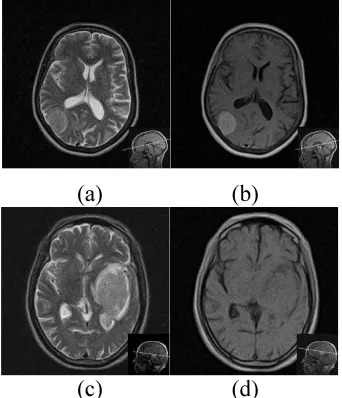
In tumorous brain, MR images intensity level of tumorous tissues exhibit different intensity level on T1-w and T2-w images based on the type of tumor. On T1-w, most tumors have low or intermediate signal intensity but for some tumors this does not hold true, for example, glioblastomamultiforme tumor has high signal intensity. On T2-w most tumors have bright intensity but there are tumors which have low intensity, the classic examples are lymphoma tumors [2]. Figure 6 shows some example of tumors intensity level characteristics in MRI.
(a) (b)
[image:4.595.97.285.267.468.2]
(c) (d)
[image:4.595.316.487.524.723.2](a) And (c) T2-w images, (b) and (d) T1-w Images. Tumor Region in a) Low Intensity, b) High Intensity, c)
High Intensity and d) Low Intensity [5]
2.4 Difficulties in segmentation of brain MRI:
Cortical segmentation has not been made fully automated and operated at high speed because of the reliability of the MRI with regards to the homogeneity of its magnetic field. The problems of MRI include:
Noise: random noise connected with MR imaging system. This is known to have a Rician distribution [12].
Intensity inhomogeneity also called bias field or shading artifact: the non-uniformity in the radio frequency (RF) field during data collection results in shading effect [13].
Partial volume effect: In this type of effect more than one type of class or tissue occupies one pixel or voxel of an image. The pixels or voxels are called mixels [14].
Segmentation of MRI outputs are normally done by medical experts and requires processes which consume time. As the images of tumor tissues from different patients contain many diverse appearance and gray level intensities and frequently look similar to normal tissues, the process of automation for segmentation of MRI outputs faces many challenges. One of these challenges is overcome by utilizing prior information about the appearance of normal brain when performing classification from a multi-dimensional volumetric features set. This is tantamount to using a statistical model for tumor and normal tissue of the same feature set.
Manual segmentation and analysis of MR brain tumor images by radiologists is carried out in nearly all Hospitals at the present moment. The reliability of the segmentation depends on the knowledge and skill of the radiologists. However, the process is manual, tedious, time-consuming, highly subjective and impractical in today’s medical imaging diagnosis where large numbers of images are taken for a single patient. As a result, there is strong demand to automate the tumor detection and segmentation process. Even though, there are numerous efforts and promising results in medical imaging community. There are still some challenges such as accurate and reproducible segmentation and characterization of abnormalities using intelligent algorithms due to the variety of shapes, locations and image intensities of different brain tumors. This paper focuses on developing a automated brain tumor detection and segmentation system. This will enhance the detection and
visualization of brain tumors from the output of MRI scans.
3. LITERATURE REVIEW: 3.1 Image Segmentation:
The purpose of segmentation is to separate an image information into clear meaningful parts by placing boundaries separating the area of the healthy brain from the area of the cancerous and tumorous brain. Segmentation must not allow regions of the image to overlap. Segmentation can therefore be formally defined as follows:
If F is the set of all pixels and P( ) is a homogeneity predicate defined on groups of connected pixels, then segmentation is a partitioning of the set F into a set of connected subsets or regions (S1, S2, …, Sn) such that:
With
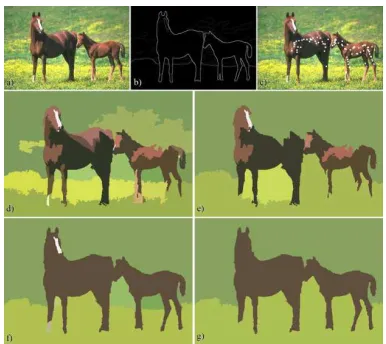
Homogeneity predicates P( ) are usually based on image intensity, color, texture, etc. According to Harlick and Shapiro [15], image segmentation can be classified into three categories: spatial clustering split and merge schemes, and region growing schemes.
[image:5.595.312.505.515.687.2](c) presenting, respectively, the results with best rand index and best BGM index [15].
a) Spatial clustering
Image segmentation and image clustering are different. In image segmentation, the grouping of the image is carried out in spatial domain. In image clustering, grouping is performed in the measurement space. Overlapping regions can be the result of clustering. It is not possible to produce overlapping regions from segmentation. Clustering and spatial segmentation can be combined to form spatial clustering, which combine histogram techniques with spatial linkage techniques for better results [15].
b) split and merge segmentation
The split method begins with the entire image, and repeatedly splits each segment into quarters if the homogeneity criterion is not satisfied. These splits can sometimes divide portions of one object. The merge method joins adjacent segments of the same object [16].
It is important to distinguish the separate regions for intensity based segmentation so that over-segmentation and under-over-segmentation of regions can be differentiated. Task of this kind can be performed using split segmentation or merge segmentation. If a region is not segmented fully, correction can be made by adding boundaries to, or splitting, certain regions that contain parts of different objects. If a region is segmented more than is necessary, correction can be made by eliminating false boundaries and merging adjacent regions if they belong to the same object or feature.
c) Region growing
Region growing connects neighboring points to make bigger region. The process of region growing is dictated by certain condition associated with the selection of a threshold value [16, 17, 18]. Seeded region growing starts with one or more seed points and then grows within the region to form a larger region satisfying some homogeneity constraint. The homogeneity of a region can be dependent upon any characteristic of the region in the image: texture, color or average intensity.
3.2 Review of Computational Techniques for Image Segmentation:
The automated detection and segmentation of brain tumor from MR helps to overcome the time taking process of manual segmentation of large datasets. It also ensures reproducibility which is
normally affected by inter and intra observer variability. However, automated systems are not without problems to achieve these objectives. For example, some of the major problems are pixel intensities violate the independent and identically distributed assumptions of images due to very nature of the brain MR images, presence of a considerable amount of artifacts and intensity inhomogeneity in MR images [19, 20]. There is a need that automated method must consider these problems in order to achieve the reproducible segmentation results and to develop clinically accepted automated methods.
In recent years, many methods have been suggested for automation of scanning, imaging and identification of brain tumors. These methods can be classified into two: intelligent based and non-intelligent based method. Intelligent based method include artificial neural networks, fuzzy logic, support vector machine and hybrid process. Whereas, the non-intelligent method include thresholding and region growing. However, there is no clear division between the two methods. Often, intelligent based method is used as non-intelligent. But it is modified to refine the output. In the following many notable methods have been reviewed.
3.2.1. Thresholding based methods
In thresholding approach; image segmentation is based on gray level intensity value of pixels. A thresholding procedure attempts to determine an intensity value, called the threshold, which separates the desired classes. The segmentation is then achieved by grouping all pixels with intensity greater than the threshold into one class, and all other pixels into another class.
However, thresholding is often used as an initial step in a sequence of image segmentation process. Its main limitation is that only two classes are generated and it does not work when confronted with structures that lack clear borders [21].
On the basis of thresholding value, there are two types of threshold values such as global and local thresholding [26]. The approach is called global thresholding when the T is fixed or constant. Otherwise, it is called local thresholding. If the background illumination is uneven, the global thresholding is likely to fail. In local thresholding, multiple thresholds are used to compensate the uneven illumination [27].
Generally, the threshold selection is done interactively. However, it is possible to derive automatic threshold algorithms. The limitation of the threshold method is that it generates only two classes. Hence, it cannot be applied in multicultural images. Moreover, thresholding does not consider the spatial characteristics of an image because of this it are sensitive to noise [23]. Both these artifacts, thus, corrupt the histogram of the image making separation more complicated and difficult.
Table1: An overview of thresholding based Methods
Proposed
Technique Remarks
Threshold and outlier detection
and Gaussian models [30]
•The edema region may require secondary
analysis followed by treatment after the primary focus on the tumor region.
•The detecting technique uses a concept to
detect difference between normal and abnormal space.
•Intensity features are used in this
technique.
Probability level set evolution [31]
•The automatic method has a lower level of
agreement with the human experts compared to the semi-automatic method.
•Only two MR images samples are used for testing and evaluate.
Marker Controlled Watershed [32]
•Different values of threshold are selected
for creating the Marker Controlled Watershed.
•Threshold values are highly dependent on shape and size of tumor and also on the view points (axial, coronal) of images.
OTSUs threshold [33]
•Tumor contrast suffusion high quality MRI scans with resolution and contrast for automated volume measurement and display.
Threshold maxima [34]
•An automatic image based method to detect tumors in 2D MRI head scans.
•Inter-hemisphere fissure (IHF) and
symmetrical nature threshold of the brain are used in the tumor detection
In recent days, integrated thresholding based tumor detection and segmentation methods [28, 29]. Using watershed and histogram analysis have been proposed. But, these papers did not specify the data used for testing and validating their methods. Similarly, no quantitative result has been provided.
The thresholding approach surveyed and analyzed is presented in this section.
3.2.2 Region growing based methods
Region growing is a technique to extract a region of the image based on predefined criteria. In its simplest form, region growing requires a seed point that is manually selected by an operator, and extracts all pixels connected to the initial seed with the same intensity value. To eliminate the dependency on initial seeds and to make the method automatic statistical information and a priori knowledge can be incorporated in the algorithm. Region growing can be so sensitive to noise, that it may cause extracted regions to have holes or even is disconnected.
Conversely, overlapping gray value distribution in MR images can cause separate regions to become connected.
Region growing is not often used alone because it is not sufficient to segment brain structures accurately and robustly. Pohle suggested that region growing can be an integrated technique using multi-level sets of boundary information [35]. In the algorithm, region growing is used as a propagation force and boundary information is used as a stopping criteria. Pohle successfully applied this technique to a total of 246 slices containing images of axial tumor obtained from 10 patients [35]. However, this method is semi-automatic as it relies on manual input seed region for region growing. A more accurate method needs precise anatomical information to locate initial seed pixels for each anatomical region and together with their associated homogeneity. Its reliability depends on accuracy of the model assumption on homogeneity and region characteristics.
As compared to edge detection method, segmentation algorithms based on region are simpler and have strongly immune to noise [23, 36]. Edge method divide an image based on frequent changes in intensity near the edges, while, region method divide an image into regions which are similar as per a set of predetermined criteria [22, 37]. Segmentation algorithms based on region consist of the following methods:
a.To select a group of seed pixels in an original image [40].
b.To select a set of identical criterion like grey level intensity or colour and develop a stopping rule.
c.To grow regions be attaching to each seed the neighboring pixels that have predetermined properties similar to seed pixels.
d.To control the growing region when it is realized that no more pixels meet the criterion to be included in that region like (size, likeness between a candidate pixel and the pixel grown so far or shape of the region already grown).
2.Region splitting and merging: Instead of selecting a seed point, the users may divide an image into a set of arbitrary detached regions and merge the regions [23, 38] to satisfy the conditions for reasonable segmentation. Basically, region splitting or merging is implemented with a theory based on quad tree data. For example, let R represent the whole image region and choose a predicate Q. i. We start with the whole image if Q(R) =
false [1], and then we demarcate the image into quadrants, if Q is false for any of the quadrant if Q (Ri) =false, thus, we sub-demarcate the quadrant into sub-quadrants and continue until no further splitting is possible.
ii. The final demarcation may have neighboring regions with identical properties, if only splitting is used. This weakness can be treated or by allowing both merging and splitting, that is, merging any neighboring region Ri & Rk for which Q (Ri U Rk) = true.
iii. Stop where there is need for further merging
Table2: An overview of Region growing based methods
Proposed Technique
Remarks
Fractal wavelet texture features
[41]
• There is no availability of
multimodality MR image data.
• The researchers have considered only the clearly visible tumor in pediatric brain MR image.
Histogram analysis 2D region growing [42]
• The proposed algorithm showed a
reliable performance against different artifacts such as noise.
Texture Feature. FCM [43]
• Good results and also achieved very
accurate results of segmentation which effectively extract the tumor region from brain MR images.
Seed-Based Region Growing •
Here a comparison is made between number of pixels of the raw MRI brain
(SBRG) [44] images and SBRG segmented abnormality area.
• As compared to the light MRI, it is seen that SBRG performed lower in dark MRI segmentation,
Seed-Based Region Growing Adaptive Network-Based Fuzzy Inference System
(ANFIS) Fuzzy c-Means
(FCM) [45]
• The ANFIS is seen to produce more segmentation of light MRI.
• The segmentation of light abnormality within the high background intensity performs unsatisfactorily result.
• It is observed that segmentation of dark abnormalities is not as effective as segmentation in light abnormalities.
3.2.3 Neural networks based methods
Neural network based segmentation methods use artificial neural network computational models consisting of processing elements (called neurons) and weighed connections between them. The weights (coefficients) are multipliers at the connections. Training is required to obtain the values of the coefficients. Several types of neural networks have been designed and used in medical image segmentation and other fields. Multilayer perceptron, back-propagation learning algorithm (MLP), Hopfield neural networks (HNN) and self-organizing maps (SOM) neural network are some of the algorithms used in segmentation process. A thorough treatment of neural networks can be found in [46]. The property of neural networks with respect to their ability to learn segmentation procedure through some form of learning process have attracted more researchers in image segmentation than other image processing techniques [47].
One of the earliest applications of MLP in brain tumor segmentation are those used by [48] who initially trained the neural networks using a known diagnostic image. An MLP model was constructed from the information obtained from the training process. For adaptive systems, information from subsequent images was used to generate the next training data set, which was then used to segment the subsequent image. The entire image data set was segmented iteratively. The proposed technique is semi-automatic and needs continuous interaction with the user. Tumor segmentation accuracy is measured using Jaccard’s similarity measure between areas delineated as a tumor by human expert and the proposed automatic methods achieved resulting in similarity index that varies from 0.6 to 0.8.
moment, contrast, inverse difference moment, sum variance, sum entropy, entropy, and difference entropy and information measure of correlation. In MLP, supervised learning is achieved by assigning labels to each anatomical designation in the image, which has reproducibility and speed constraints.
Detection and visualization of brain tumor can be carried out using self-organizing map (SOM) which is a special type of unsupervised learning artificial neural network. Logeswari and Karnan [50] used a modified version of SOM to perform detection and visualization process which they called hierarchical self-organizing map (HSOM). Their system consists of two phases. In the first phase, the MRI brain image is preprocessed to remove artifacts then HSOM is applied for image segmentation. Conventional SOM has limitations for which the number of neural units in the competitive layer needs to be approximately equal to the number of regions desired in the segmented image. Unfortunately determination, a priory, of the correct number of regions in the segmented image is difficult or impossible. HSOM overcomes this problem by performing a process which takes into consideration weight vectors, execution time and tumor pixels detected. However, the accuracy of the results obtained by Logeswari and KarnanKarnan [50] cannot be measured quantitatively and failed to distinguish the outer layer of the brain which is normally seen in MR brain images.
Kuo-Sheng designed a modified version of Hopfield neural network (HNN) which was capable of segmenting normal brain tissues and other medical images to their respective anatomical parts. This modified version of HNN employed a winner takes all learning mechanism called competitive Hopfield neural network (CHNN) [51]. The computational efficiency of CHNN is high, but there is no guarantee of its optimal convergence, i.e., it may get stuck at local minima.
Table3: An overview of neural networks based methods
Proposed
Technique Remarks
ANN using canny edge detection
adaptive thresholding
[52]
• MRI brain represents a healthy brain or a
tumor brain.
• In this paper two types of input features are used: canny edge detection and adaptive thresholding
Discrete wavelet transforms
(DWT) back propagation
• This paper uses hybrid classifier to
distinguish normal and abnormal brain
• This method had good accuracy in classifying both training and testing images.
• This method may be used for MRI
(BPNN) [53]. images with other contrast mechanisms like TI-weighted, proton-density weighted and diffusion-weighted MRIs. Neural Network
[54]. •
The results compared and tallied with the results in consultation with the specialist doctors in this field.
3.2.4 Fuzzy based methods
Fuzzy logic is a set of mathematical principles for knowledge representation based on degrees of membership rather than on crisp membership of classical binary logic. In brain tumor segmentation fuzzy systems allow for the development of methods and algorithms to perform the tasks related to intelligent human behavoiurs.
Gordillo employed fuzzy logic system to segment and detect tumor by using expert knowledge and features derived from MR images to build fuzzy rules. This system is fully automatic and exhibits unsupervised learning. Using intensity histogram analysis, knowledge extraction was performed as a new way to obtain membership functions to suit the MRI data [56]. The result of detection and segmentation through this method is found good with the lowest score of 71% and highest of 93% with experiments done on two types of brain tumors like glioblastoma and meningioma multiform. Though experiment is performed only on two types of brain tumors, glioblastoma and meningioma multiform.
Dunn suggested image segmentation using fuzzy c-means (FCM) clustering algorithm [55]. Several researches have implemented FCM and its improved versions for segmenting brain tumor from brain MR images.
Rajendran proposed fuzzy logic processing using c- means clustering on MRI for brain tumor segmentation [58]. Tumor class output of fuzzy clustering was used to initialize the region based algorithm which iteratively moves towards the final tumor boundary. Tests were performed on this method to ascertain the efficiency for 15 MR images where manual segmented ground truth is available. The result achieved is satisfactory having a Jaccard coefficient average value of 83.19% and sensitivity of 96.37%.
make clusters. This grouping of pixels into clusters takes place on the basis of the principle of maximizing inter and intra class similarity. The quality of clustering findings depends on the similarity measure used by the method and its implementation. Thus, clustering algorithms are classified as hard clustering, k-means clustering and fuzzy clustering and so on.
FCM clustering algorithm has been used to segment glioblastoma-multiform (GBM) brain tumors. Intensity overlapping of tissues and sensitivity of FCM to noise and initialization values caused inaccuracy in segmentation of tumors, although FCM algorithm is simple, fast and unsupervised.
Hsieh estimated the accuracy and efficiency of the system by using percent match and correspondence ratio [59]. The proposed systems overall percent match value was 72.80% ± 36.20% and the correspondence ratio value was 0.43% ± 0.86%. However, the overall performance of the system would be degraded if some noticeable edema tissues exist within the image,
Indah Soesanti proposed FCM algorithm that incorporates information about the summation of the membership function in the neighborhood of each pixel under consideration into the membership function for clustering [60]. They compared this system with other techniques to measure the performance of the method for noisy MRI brain images and discovered that the method is effective for relatively large tumor sizes ranging from 9.65 to 27.71 cm2. Unfortunately they did not indicate the data sources of MR brain images used in the experiment.
FCM using curvelet transform to remove noise was proposed by Jaffar [61]. Although Jaffar described in detail the process he employed in his FCM, he did not provide the result of segmentation and the qualitative performance and effectiveness of his system towards tumor detection.
Table4: An overview of Fuzzy based methods
Proposed
Technique Remarks
Fuzzy models Image Fusion
[62]
• The proposed algorithm consists of: the registration of multispectral MR images, the creation of fuzzy models describing the characteristics of tumor, the fusion based on fuzzy fusion operators and the adjustment by fuzzy region growing based on fuzzy connecting.
• Using linear image registration tool for evaluate the proposed method.
Histogram- • The FSL library tool based software was
based . Fuzzy
c-mean smoothen the
boundaries [63]
compared with the performance of the proposed algorithm. It is considered to be a good candidate for fully automatic MRI analysis systems.
• Because of the fully automated nature of
the algorithm with no human intervention, along with lesser number of iterations taken,
Fuzzy C-Means [64]
• Generalized spatial fuzzy c-means
(CSFCM) algorithm which possesses both pixel attributes and spatial local information that is weighted in correspondence with neighbor elements based on their distance attributes.
• This has the potentiality to improve the segmentation performance tremendously.
• This improves the segmentation
performance dramatically.
• Poor contrast, noise and non-uniform
intensity variation can affect the results.
Fuzzy possibilistic
c-means [65]
• The paper announce the developed a
hybrid segmentation method that uses both region and boundary information of the image to segment the tumor.
• Compare a fuzzy classification method and a symmetry analysis method for detecting the tumors.
• Evaluate the proposed method by testing 2 images provide by IBSR data.
Aggravation of filtering
method Fuzzy expert
[66]
• Feature Extraction is done by thresholding method. And, they develop Approximate Reasoning method to recognize the tumor grade in brain MRI.
• More than 26.3% of tested image gives not
correct answer using both proposed algorithm type I and type II.
3.2.5
Hybrid based techniquesHybrid system is a mix of different methods of machine learning algorithms. It was created to make them work together to achieve a better solution to a problem, as compared to using a single method to solve the same problem [46].
Jzau-Sheng integrated fuzzy c-means strategy with HNN and introduced a fuzzy Hopfield neural network which is used for medical image segmentation [51]. He used the global histogram of images and constructed the neurons with the help of the frequency occurrence of each gray level. Consequently, the number of neurons is independent of image size. Jzau-Sheng's experimentation resulted in accurate segmentation on normal axial brain MR images. Unfortunately, for the objective functions to converge to a stable state it needs several synchronous iterations.
(FBPA). The result obtained using this supervised hybrid techniques is promising, but due to the variability of image pixel intensities for different MRI scanners, different MR imaging modalities and effect of noise, it is difficult to ascertain the generalized efficiency for this technique.
Noor Eliaza comparatively studied the adaptive network based fuzzy inference system (ANFIS), k-nearest neighbors (KNN) and fuzzy c-means (FCM) for brain tumor segmentation [69].
The comparative study indicated that for light abnormalities best segmentation performance is achieved by using ANFIS, whereas K-NN is good for dark abnormalities. The study proposed integrating ANFIS, K-NN and FCM with other computer vision architectures to produce better segmentation accuracy.
NahlaIbraheem implemented a fuzzy kohonen neural network to get brain MR image segmentation[67]. NahlaIbraheem used entities such as area, entropy, mean and standard deviation to segment tumor from brain MR image but did not use any preprocessing for noise removal to improve the extraction of these entities. As a result, Nahla's qualitative and quantitative analyses of brain tumor segmentation system using fuzzy kohonen neural network lack satisfactory accuracy.
There exists a general problem regarding segmentation as to how to segment an image into homogenous segments in such a way that even after combining the two neighbors, it provides a heterogonous segment. For this, there are numerous techniques available for an error-free image division. A histogram-based represents a simple probability distribution function of intensity values of an image. Secondly, edge based technique is also used for detecting by using differential filter as image gradient or laplacian, then group them into contours that represents the surface. In the region based segmentation technique, the image is segmented into a set of homogenous regions and then they are merged according to certain rules involved [40]. In the Markov random field based segmentation technique, the true image is realized by a Markov or Gibbs random field with a distribution function. However, the hybrid segmentation techniques are put together on certain basis as edge based and region based techniques. In this, first the image is divided into regions and then they are merged together by using split and merge technique. After this, the contours are detected using edge-based technique.
Table5: An overview of Hybrid based techniques
Proposed
Technique Remarks
ANN fuzzy logic
[70]
• Adaptive Neuro-Fuzzy inference systems
(ANFIS) for MR brain tumor classification developed in this research and a
comprehensive feature set and fuzzy rules are selected to classify an abnormal image to the corresponding tumor type
• The classification accuracy of ANFIS is comparatively higher than the fuzzy and neural classifiers.
• The convergence time period of ANFIS is ten times better than the neural and the fuzzy classifier.
(DWT). principal component
analysis (PCA), (BPANN)
knearest neighbor classifier (KNN) [71].
• classify subjects as normal or abnormal
MRI human images,
• A classification with a success of 97% by FP-ANN and 98% has been obtained by k-NN,
• This research developed two hybrid
techniques, DWT + PCA + FP-ANN and DWT + PCA +k-NN to classify the human brain MR images. Without any tumor detection.
Neural network, adaptive adjustment
[72]
• The EM is initially used in brain MR
image histogram for estimating the distribution of parameters for WM, GM and CSF regions.
• These estimated parameters work as fitness function for tissue classification.
• The thresholds taken from the EM output
are utilized to adaptively adjusting the rate of expansion in the segmented area. This increases the classification quality.
(SVM) kernel space region growing technique [73]
• The kernel class selects the features from
MRI.
• Automatically segments the tumor using SVM.
• Refining the tumor contour through a region growing technique.
• Using few MR images to validate the
whole process without detecting the tumor volume.
3.2.6 Other Brain Tumor Segmentation and Detection Techniques
J. Zhou used a one support vector machine (SVM) to automate brain tumor segmentation. SVM has the advantage of generalizing and working in high dimensional feature spaces [74]. So that it can learn the nonlinear tumor data distribution and optimally produce a flexible decision boundary for the tumor region. In this framework, labeled image samples over the tumor areas must be feed to the one class SVM classifier when performing segmentation. The tumor segmentation is achieved by region based analysis. The method achieved acceptable result, but it needs continuous user interaction for the labeled samples
combines probabilistic boosting trees (PBT) with low level segmentation via graph cuts [75]. Tests on this system were conducted on 6 multi-spectral MRI datasets where manually segmented truth is available. The tests resulted in Jaccard coefficients of 0.78 ±0.17.
Hassan Khotanlou proposed brain tumor segmentation using two phase processing [65]. For the first phase, tumor is detected and segmented using a combination of histogram analysis, morphological operations and symmetry analysis. For the second phase, the tumor is detected using fuzzy classification method or symmetry analysis and some morphological operations. The two phase processing is valid if two assumptions are met. The first assumption is that the tumors appear in the image with specific gray level value and the second assumption is that the brain is roughly symmetrical. The method is tested on MR image volumes with cerebral tumors and manually segmented ground truth. The reported mean correct detection ratio (sensitivity) and Dice similarity score are 93% and 92% respectively.
Kishore used SVM classifier to classify tumor pixels based on feature vector generated from multi-parametric MR images [76]. The segmentation is done using level sets and region growing methods. The tests on their proposed techniques involve MR images where tumor regions were manually delineated from 11 subjects. Their proposed techniques have an efficiency measured in Dice similarity score of 0.69 with a standard deviation of ± 0.14. SVM have a limited accuracy because it treats image pixels as independent and identically distributed.
Table6: An overview of Other Brain Tumor Segmentation and Detection Techniques
Proposed Technique Remarks Unsupervised neural network clustering. k-means [77]
• The important phases of the proposed
methods in this paper are feature extraction, reduction of dimensionality, unsupervised data clustering, voxel classification and interactive post-processing refinement.
• A result of the unsupervised 3D segmentation seems to be highly stable.
• A comparison with standard unsupervised methods (k-means) is not very significant in the clinical environment as a consequence of the segmentation of multivariate medical images.
Graph cut [78].
• In the first formalize the problem as an energy minimization and give the modifications of the energy to allow user interaction and propagation. Next give the
graph cut solution for the segmentation phase.
• The proposed tool speeds up the segmentation and reduces intra- and inter-user repeatability when compared with conventional manual segmentation.
SVM multi-kernel
data fusion [79]
• A multi-kernel based SVM performing on
fusion of input data after feature selection is proposed for detecting brain tumors through multi-sequence MRI images.
• It can decrease the data required to speed up the process of segmentation and to improve the accuracy.
• By using this method, the accuracy for the
separation results is highly increased. This can remove or weaken the influence of low contrast, especially the VD volume.
Mathematic morphology
DWT. k-means [80]
• An enhancement process is applied for improving the quality of images along with mathematical morphology to increase the contrast in MRI images.
• Wavelet transform is applied in
segmentation process for decomposition of MRI images. Lastly, k-means algorithm is applied to extract the suspicious tumors from the brain.
• PSNR value is used for evaluate the
segmentation and detecting tumor process.
Cluster index. K-means [81]
• The color converted segmentation with
K-means clustering algorithm
• The regions of the brain related to tumors
can be correctly separated from colored image.
• Help pathologist to distinguish lesion size
and its region exactly.
Hierarchical Self Organizing Map (HSOM)
is applied for segmenting the images. ANN [82]
• The image is enhanced by removing the noise by using Weighted Median (WM) filters. A self-organizing map (SOM) or self-organizing feature map (SOFM) is a kind of artificial neural network for unsupervised learning.
• This enhanced image has the potential to
enable the observer to perceive the region of interest more effectively and thus the original image is improved.
DWT Gabor wavelets [83].
• Tumor detection take place in low-low
(LL) DWT
• Gabor filters are applied to the wavelet estimations at all levels for obtaining characteristics of texture features like entropy.
• The findings obtained as result of
considering minimal pixel values captures the features from all the three levels. This provides a maximum segmentation DWT Wavelet Statistical Texture Features (WST) (WCT) Wavelet Co-occurrence Texture features [84]
• The proposed combined wavelet based texture analysis method and Spatial Gray Level Dependence Method (SGLDM). The proposed system consists of four phases:
• Discrete Wavelet Decomposition. (ii)
Feature extraction (iii) Feature selection. (iv)Classification and evaluation.
• The output of the image is compared with
the boundary drawings of the radiologist.
For accurate diagnosis of brain tumor patients, proper segmentation method is required to be used for MR images to carry out an improved diagnosis and treatment. Currently, information is provided by many images from various slices required for accurate diagnosis, planning and treatment purpose. The volume of the available information requires computation processing to inform the decision-making.
Now-e-days, speed of computation is no longer an issue for researchers. Therefore, the focus is directed toward improvement of information from images obtained through the slice orientation and perfecting the process of segmentation to get an accurate picture of the brain tumor.
In this current paper, we attempted to review some of the worthwhile recent research works done on brain tumor detection and segmentation. Through analysis of the literature, we found that automation of brain tumor detection and segmentation from brain MR images is one of the most active research areas and enormous research has been done in this area for the last many years. However, currently there is no clinically accepted automated method.
REFRENCES:
[1] Ferlay J, Shin HR, Bray F, Forman D, Mathers C and Parkin DM, GLOBOCAN 2008 v2.0, Cancer Incidence and Mortality Worldwide,
International Agency for Research on Cancer,
Lyon, France, 2010. http://globocan.iarc.fr, Accessed on: November 13, 2011.
[2] http://www.radiologyassistant.nl/, Accessed on: January, 12, 2012
[3] Louis D.N., Ohgaki H., Wiestler O.D, Cavenee W.K. (Eds.), WHO Classification of Tumors of the Central Nervous System, International
Agency for Research on Cancer (IARC), Lyon,
France, 2007.
[4] Charles R. Noback, Norman L. Strominger, Robert J. Demarest and David A. Ruggiero, the Human Nervous System: Structure and
Function, 6th ed., Humana Press, 2005.
[5] www.teamrads.com/Cases/Neuroanatomy/MRI, Accessed on: January, 12, 2012
[6] Jan C. Buckner, et al., ―Central Nervous System Tumors, Mayo Clinic Proceedings, Vol. 82, No. 10, 2007, pp. 1271-1286.
[7] Medical Imaging in Cancer Care: Charting the Progress, US Oncology and National Electrical
Manufacturers Association (NEMA), Accessed
on January 20, 2012 at
http://www.healthcare.philips.com/pwc_hc/us_
en/about/Reimbursement/assets/docs/cancer_w hite_paper.pdf
[8] A. O Rodriguez, Principles of Magnetic Resonance Imaging, Revista Mexicana de
Fisica, Vol. 50, No. 3, 2004, pp. 272-286.
[9] Damadian, R., Goldsmith, M. & Minkoff, L. (1977). NMR in Cancer: XVI. FONAR Image of the Live Human Body. Physiological
Chemistry and Physics, Vol.9, No.1,
pp.97-100, ISSN: 0031-9325
[10] Novelline, R.A. & Squire, L.F. (2004). Squire's Fundamentals of Radiology, Harvard
Univ Press, ISBN 0674012798
[11] Catherine Westbrook, MRI at Glance,
Blackwell Science Publishing, 2002
[12] Prima, S., Ayache, N., Barrick, T. & Roberts, N. (2001). Maximum Likelihood Estimation of the Bias Field in MR Brain Images: Investigating Different Modelings of the Imaging Process, Processings of Medical Image Computing and Computer-Assisted
Intervention (MICCAI' 2001), Vol.2208,
pp.811-819, DOI: 10.1007/3-540-45468-3_97. [13] Li, X., Li, L., Lu, H., Chen, D. & Liang, Z.
(2003). Inhomogeneity Correction for Magnetic Resonance Images with Fuzzy C-Mean Algorithm, Processings of SPIE, Vol.5032, 2003.
[14] Ruan, S., Jaggi, C., Xue, J., Fadili, J. & Bloyet, D. (2000). Brain Tissue Classification of Magnetic Resonance Images Using Partial Volume Modeling. IEEE Transactions on
Medical Imaging, Vol.19, No.12,
pp.1179-1187, ISSN: 0278-0062.
[15] Haralick, R.M., and Shapiro, L.G. “SURVEY: image segmentation techniques”, Computer
Vision Graphics Image Processing, 1985, 29,
pp. 100-132.
[16] Jain R. et al, Machine Vision, McGraw-Hill, Inc. 1995.
[17] Sonka, M., Hlavac, V., and Boyle, R., “Image Processing, Analysis, and Machine Vision”, Brooks / Cole Publishing Company, 1998. [18] Zucker, S. W., “Region growing: Childhood
and adolescence”, Computer Graphics and
Image Processing, 1976, 5, 382-399
[19] L. J. Erasmus, D. Hurter, M. Naude, H.G. Kritzinger and S Acho, A short overview of MRI artifacts, SA Journal of Radiology, Vol. 8, No. 2, August 2004, pp. 13-17.
and Applications, ICMLA, Dec. 2005, pp. 215-220.
[21] Sezgin M. and Sankur B., Survey over image thresholding techniques and quantitative performance evaluation, Journal of Electronic
Imaging, Vol. 13, No. 1, Jan. 2004, pp. 146–
165.
[22] Rastgarpour M., and Shanbehzadeh J., Application of AI Techniques in Medical Image Segmentation and Novel Categorization of Available Methods and Tools, Proceedings of the International Multi Conference of Engineers and Computer Scientists 2011 Vol. I,
IMECS 2011, March 16-18, 2011, Hong Kong.
[23] W. X. Kang, Q. Q. Yang, R. R. Liang, “The Comparative Research on Image Segmentation Algorithms”, IEEE Conference on ETCS, pp. 703-707, 2009.
[24] L. Aurdal, “Image Segmentation beyond thresholding”, Norsk Regnescentral, 2006. [25] Wahba Marian, An Automated Modified
Region Growing Technique for Prostate Segmentation in Trans Rectal Ultrasound Images, Master’s Thesis, Department of
Electrical and Computer
Engineering,University of Waterloo, Waterloo,
Ontario, Canada, 2008.
[26] Y. Zhang, H. Qu, Y. Wang, “Adaptive Image Segmentation Based on Fast Thresholding and Image Merging”, Artificial reality and
Telexistence-Workshops, pp. 308-311, 1994.
[27] T. Lindeberg and M.-X. Li "Segmentation and classification of edges using minimum description length approximation and complementary junction cues", Computer
Vision and Image Understanding, vol. 67, no.
1, pp. 88-98, 1997.
[28] S. Xavierarockiaraj, K.Nithya, and R.Maruni Devi, Brain Tumor Detection Using Modified Histogram Thresholding- Quadrant Approach,
Journal of Computer Applications (JCA), Vol.
5, No.1, 2012, pp. 21-25.
[29] Anam Mustaqeem, Ali Javed and Tehseen Fatima, An Efficient Brain Tumor Detection Algorithm Using Watershed and Thresholding Based Segmentation, International Journal of Image, Graphics and Signal Processing
(IJIGSP), Vol. 4, No.10, 2012, pp. 34-39.
[30] Prastawa, Marcel, and Guido Gerig. "Automatic MS lesion segmentation by outlier detection and information theoretic region partitioning." Grand Challenge Work.: Mult.
Scler.Lesion Segm. Challenge (2008): 1-8.
[31] Dubey, R. B., Hanmandlu, M., Gupta, S. K., & Gupta, S. K. (2009). Semi-automatic
segmentation of MRI Brain tumor.
ICGST-GVIP Journal, 9(4), 33-40.
[32] Singh, Laxman, R. B. Dubey, Z. A. Jaffery, and Z. Zaheeruddin. "Segmentation and Characterization of Brain Tumor from MR Images". In Advances in Recent Technologies in Communication and Computing, 2009.
ARTCom'09. International Conference on, pp.
815-819. IEEE, 2009.
[33] Amruta, A., Abhijeet Gole, and Yogesh Karunakar. "A systematic algorithm for 3-D reconstruction of MRI based brain tumors using morphological operators and bicubic interpolation." Computer Technology and Development (ICCTD), 2010 2nd International
Conference on. IEEE, 2010.
[34] Somasundaram, K., and T. Kalaiselvi. "Automatic detection of brain tumor from MRI scans using maxima transform." UGC Sponsored National Conference on Image Processing-NCIMP. 2010.
[35] Pohle R, Toennies KD; Segmentation of medical images using adaptive region growing,
proceedings of SPIE -Medical Imaging, Vol.
4322, 2001, pp. 1337-1346.
[36] H. Zhang, J. E. Fritts, S. A. Goldman, “Image Segmentation Evaluation: A Survey of unsupervised methods”, computer vision and
image understanding, pp. 260-280, 2008.
[37] H. G. Kaganami, Z. Beij, “Region Based Detection versus Edge Detection”, IEEE Transactions on Intelligent information hiding
and multimedia signal processing, pp.
1217-1221, 2009.
[38] Zhang, Y. J, An Overview of Image and Video Segmentation in the last 40 years, Proceedings of the 6thInternational Symposium on Signal
Processing and Its Applications, pp. 144-151,
2001.
[39]Y. Chang, X. Li, “Adaptive Image Region Growing”, IEEE Trans. On Image Processing, Vol. 3, No. 6,1994.
[40] K. K. Singh, A. Singh, “A Study of Image Segmentation Algorithms for Different Types of Images”, International Journal of Computer
Science Issues, Vol. 7, Issue 5, 2010.
[41] Iftekharuddin, Khan M., Jing Zheng, Mohammad A. Islam, and Robert J. Ogg. "Fractal-based brain tumor detection in multimodal MRI." Applied Mathematics and
Computation 207, no. 1 (2009): 23-41.
[42] Park, Jong Geun, and Chulhee Lee. "Skull stripping based on region growing for magnetic resonance brain images." Neuro Image 47.4
[43] Qurat-Ul-Ain, Ghazanfar Latif, Sidra Batool Kazmi, M. Arfan Jaffar, and Anwar M. Mirza. "Classification and segmentation of brain tumor using texture analysis." In Proceedings of the 9th WSEAS International Conference on Recent Advances In Artificial Intelligence,
Knowledge Engineering and Data Bases, pp.
147-155. 2010.
[44] Ibrahim, Shafaf, Noor Elaiza Abdul Khalid, and Mazani Manaf. "Seed-based region growing (SBRG) vs. adaptive network-based inference system (ANFIS) vs. fuzzy c-means
(FCM): brain abnormalities
segmentation." International Journal of Electrical and Computer Engineering 5, no. 2
(2010): 94-104.
[45] Somasun daram, K., and T. Kalaiselvi. "Automatic brain extraction methods for T1 magnetic resonance images using region
labeling and morphological
operations". Computers in biology and
medicine 41.8 (2011): 716-725.
[46] Nikola K. Kasabov, Foundations of Neural Networks, Fuzzy Systems, and Knowledge Engineering, Massachusetts Institute of Technology, 1998, pp. 167-473
[47] M. Egmont-Petersen, D. de Ridder and H. Handels, Image processing with neural networks—a review, Pattern Recognition, Vol. 35, Issue 10, Oct. 2002, pp. 2279-2301. [48] Ozkan, Mehmed, Benoit M. Dawant, and
Robert J. Maciunas. "Neural-network-based segmentation of multi-modal medical images: a comparative and prospective study." Medical Imaging, IEEE Transactions on 12.3 (1993):
534-544.
[49] Kadam D. B., Gade S. S., M. D. Uplaneand R. K. Prasad, Neural Network Based Brain Tumor Detection Using MR Images, International
Journal of Computer Science and
Communication (IJCSC), Vol. 2, No.2,
July-Dec. 2011, pp. 325-331.
[50] T. Logeswari and M. Karnan, An improved implementation of brain tumor detection using segmentation based on soft computing, Journal
of Cancer Research and Experimental
Oncology, Vol. 2, No. 1, March 2010, pp.
006-014.
[51] Jzau-Sheng Lin, Kuo-Sheng Cheng and Chi-Wu Mao, A Fuzzy Hopfield Neural Network for Medical Image Segmentation, IEEE
Transactions on Nuclear Science, Vol. 43, No.
4, August 1996, pp. 2389-2398
[52] Badran, Ehab F., Esraa Galal Mahmoud, and Nadder Hamdy. "An algorithm for detecting
brain tumors in MRI images." Computer Engineering and Systems (ICCES), 2010 International Conference on.IEEE, 2010.
[53] Zhang, Yudong, Zhengchao Dong, Lenan Wu, and Shuihua Wang. "A hybrid method for MRI brain image classification." Expert Systems
with Applications38, no. 8 (2011):
10049-10053.
[54] Kadam, Deepak Bhimrao, S. S. Gade, M. D. Uplane, and R. K. Prasad. "Neural network based brain tumor detection using MR images." Int. J. Comp. Sci. Communications 2,
no. 2 (2011): 325-31.
[55] J. C. Dunn, A Fuzzy Relative of the ISODATA Process and Its Use in Detecting Compact Well-Separated Clusters, Journal of
Cybernetics, Vol. 3, No.3, 1973, pp. 32-57.
[56] Gordillo, N., Montseny, E., Sobrevilla, P. , A New Fuzzy Approach to Brain Tumor Segmentation, Fuzzy Systems (FUZZ), 2010
IEEE International Conference on , 18-23 July
2010, pp.1-8, , doi:
10.1109/FUZZY.2010.5584178
[57] Dehariya, Vinod Kumar, Shailendra Kumar Shrivastava, and R. C. Jain. "Clustering of Image Data Set Using Means and Fuzzy K-Means Algorithms."Computational Intelligence and Communication Networks
(CICN), 2010 International Conference on.
IEEE, 2010.
[58] A. Rajendran and R. Dhanasekaran, A hybrid Method Based on Fuzzy Clustering and Active Contour Using GGVF for Brain Tumor Segmentation on MRI Images, European
Journal of Scientific Research, Vol. 61, No. 2,
2011, pp. 305-313.
[59] Hsieh et al., Automatic Segmentation of Meningioma From Non-contrasted Brain MRI Integrating Fuzzy clustering and Region Growing, BMC Medical Informatics and
Decision Making, 11:54, Published online
2011 August 26. doi: 10.1186/1472-6947-11-54.
[60] Indah Soesanti, AdhiSusanto, Thomas Sri Widodo and Maesadji Tjokronagoro, MRI Brain Images Segmentation Based on Optimized Fuzzy Logic and Spatial Information, International Journal of Video and Image Processing and Network Security,
Vol. 11, No. 04, August 2011, pp. 6-11. [61] M. Arfan Jaffar, Quratulain, and Tae Sun
Wiley Online Library, Vol. 75, No. 6, April 2012, pp. 499- 504.
[62] Dou, W., Ruan, S., Chen, Y., Bloyet, D., & Constans, J. M. (2007). A framework of fuzzy information fusion for the segmentation of brain tumor tissues on MR images. Image and
vision Computing, 25(2), 164-171.
[63] Sikka, Karan, Nitesh Sinha, Pankaj K. Singh, and Amit K. Mishra. "A fully automated algorithm under modified FCM framework for
improved brain MR image
segmentation." Magnetic Resonance
Imaging 27, no. 7 (2009): 994-1004.
[64] Van Lung, H., & Kim, J. M. (2009, August).A generalized spatial fuzzy c-means algorithm for medical image segmentation. In Fuzzy Systems,
2009. FUZZ - IEEE 2009. IEEE International
Conference on (pp. 409-414). IEEE.
[65] Khotanlou, Hassan, Olivier Colliot, Jamal Atif, and Isabelle Bloch. "3D brain tumor segmentation in MRI using fuzzy classification, symmetry analysis and spatially constrained deformable models." Fuzzy Sets
and Systems 160, no. 10 (2009): 1457-1473.
[66] Fazel Zarandi, M. H., Marzie Zarinbal, and Mina Izadi. "Systematic image processing for diagnosing brain tumors: A Type-II fuzzy expert system approach." Applied Soft
Computing 11.1 (2011): 285-294.
[67] Nahla Ibraheem Jabbar and Monica Mehrotra, Application of Fuzzy Neural Network for Image Tumor Description, World Academy of Science, Engineering and Technology, Issue.
20, August 2008, pp. 575-577.
[68] Nandita Pradhan and A.K. Sinha, Fuzzy ANN Based Detection and Analysis of Pathological and Healthy Tissues in FLAIR Magnetic Resonance Images of Brain, international Journal of Information Technology and
Knowledge Management, Vol. 4, No. 2,
July-Dec. 2011, pp. 471-476.
[69] Noor Elaiza Abdul Khalid, Shafaf Ibrahim and Mazani Manaf, "Brain Abnormalities Segmentation Performances Contrasting: Adaptive Network-Based Fuzzy Inference System (ANFIS) vs. K-Nearest Neighbors (k-NN) vs. Fuzzy c-Means (FCM)", 15th WSEAS International Conference on Computers, Corfu
Island, Greece, July 2011, pp. 285-290.
[70] Hemanth, D. Jude, C. K. Vijila, and J. Anitha. "Application of Neuro-Fuzzy Model for MR Brain Tumor Image Classification." Int J
Biomed Imaging 16 (2009): 95-102.
[71] El-Dahshan, El-Sayed Ahmed, Tamer Hosny, and Abdel-Badeeh M. Salem. "Hybrid
intelligent techniques for MRI brain images classification." Digital Signal Processing 20.2
(2010): 433-441.
[72] Fu, J. C., Chen, C. C., Chai, J. W., Wong, S. T., & Li, I. C. (2010). Image segmentation by EM-based adaptive pulse coupled neural networks in brain magnetic resonance imaging. Computerized Medical Imaging and
Graphics, 34(4), 308-320.
[73] Zhang, N., Ruan, S., Lebonvallet, S., Liao, Q., & Zhu, Y. (2011).Kernel feature selection to fuse multi-spectral MRI images for brain tumor segmentation. Computer Vision and Image
Understanding, 115(2), 256-269.
[74] J. Zhou, K. L. Chan, V. F. H. Chong and S. M. Krishnan, Extraction of Brain Tumor from MR Images Using One-Class Support Vector Machine, Proceedings of the 2005 IEEE: Engineering in Medicine and Biology 27th annual conference, Shanghai- China, 1-4 Sep. 2005, pp. 6411- 6414.
[75] Michael Wels, et al., A Discriminative Model-Constrained Graph Cuts Approach to Fully Automated Pediatric Brain Tumor Segmentation in 3-D MRI, Lecture Notes in Computer Science, Medical Image Computing and Computer-Assisted Intervention – MICCAI 2008 , Vol. 5241 , 2008 , pp. 67-75.
[76] Kishore K. Reddy, et al, Confidence Guided Enhancing Brain Tumor Segmentation in Multi-Parametric MRI, 9th IEEE International
Symposium on Biomedical Imaging, May 2012,
pp. 366-369.
[77] Schenone, A., Firenze, F., Acquarone, F., Gambaro, M., Masulli, F., & Andreucci, L. (1996). Segmentation of multivariate medical images via unsupervised clustering with “adaptive resolution”. Computerized medical
imaging and graphics, 20(3), 119-129.
[78] Birkbeck, N., Cobzas, D., Jagersand, M., Murtha, A., & Kesztyues, T. (2009, December). An interactive graph cut method for brain tumor segmentation. In Applications
of Computer Vision (WACV), 2009 Workshop
on (pp. 1-7). IEEE.
[79] Zhang, N., Liao, Q., Ruan, S., Lebonvallet, S., & Zhu, Y. (2009, May). Multi-kernel SVM based classification for tumor segmentation by fusion of MRI images. In Imaging Systems and Techniques, 2009.IST'09. IEEE International Workshop on (pp. 71-75). IEEE.
![Figure 2: The Major Subdivision of Human Brain [5]](https://thumb-us.123doks.com/thumbv2/123dok_us/8913358.960472/2.595.311.524.381.477/figure-major-subdivision-human-brain.webp)
![Figure 3: MRI Scanner Cutaway [5].](https://thumb-us.123doks.com/thumbv2/123dok_us/8913358.960472/3.595.323.495.315.453/figure-mri-scanner-cutaway.webp)