EVALUATION METHODOLOGY OF BUS RAPID TRANSIT
(BRT) OPERATION
WU HONGYANGA
a
China Urban Sustainable Transport Research Center (CUSTReC), China Academy of Transportation
Sciences, Ministry of Transport, P.R.China
ABSTRACT
In the paper, the indicator system and evaluation methodology of BRT operation was established according to the characters of BRT development in China. These indicators include six aspects: infrastructure, transport capacity, service level, economic results, safety and emergency management, and energy saving & emission reduction. The pilot study was implemented in Jinan city. The results of pilot study show: the presented evaluation methodology of BRT operation agrees with the system designing standards and therefore is operational.
Keywords:Bus Rapid Transit (BRT), Evaluation methodology, Operation, Indicator system
1. INTRODUCTION
Thirteen of all Chinese major cities have launched their Bus Rapid Transit (BRT) system by the end of 2010, making the number of the BRT buses 2,943 and the total length of the bus routes 514 kilometers. The key issues concerning the BRT system include system capacity, the comparison between the BRT system and the conventional forms of mass transit, and the comparisons within different BRT systems. To draw conclusions it is necessary to conduct studies on the BRT system by developing an evaluation system that is equipped with comprehensive indicators and methodology.
Chinese scholars started to pay attention to the evaluation indicator system of the operation of the BRT system at the beginning of the 20th century. Lin Jing [1] developed an indicator system that focuses on the technical factors, the economic and social impacts of the BRT system. Jiaqing Wu and Zheng Lin [2] developed their indicator that is based on the present and future of the BRT system close to the Southern Central Axis Area in Beijing. The indicator examines the service level of the BRT system as well as the benefits it may generate to the operation companies and the community. Haixia Wang, Rui Song, Ming Li [3] developed the BRT evaluation indicator system and its Hierarchical structure to examine the infrastructure, service level, economic results of the BRT system, and its relationship with the urban development. Their study outcomes also include a rating standard for each indicator of the evaluation indicator system. Mingming Chen and Huimin Niu [4]
developed the evaluation indicator system and the related methodology to make comparison of BRT systems of different forms and time, and between the BRT system and other forms of mass transit. Hanying Deng and Chaohong Guo [5] separated the most effective BRT approach by recording and analyzing the features of the BRT system. Shengxue Zhu [6] described the functions and impacts of the BRT system from the angles of infrastructure investment, service level, and the overall benefits by using multiple individual factors as the indicators. They also built an indicator system to determine the development of the BRT system by using layer analysis. The post-BRT evaluation system developed by Yan Zhang [7] includes post-process evaluation, post-economic and social impacts evaluation, sustainability evaluation, and the overall post-evaluation.
2. THE DEVELOPMENT OF THE EVALUATION INDICATOR SYSTEM
2.1 Guidelines
The evaluation indicator system of the operation of the BRT system should be comprehensive, integrated, systematic, and scientific, and is of objectiveness, functionality, and equality, and is able to provide guidance to the evaluation and can be compared with other indicators as well.
2.2 Basic Functions
The basic functions of the evaluation indicator system of the operation of the BRT system include to ensure a scientific evaluation on the planning,
operation, and the service level of the urban BRT system; to improve the safety, convenience, mobility, comfort, and reliability of the urban BRT system, to examine the carrying out of the strategies and policies concerning the prioritizing of the public transport, and to provide suggestions for the state and local governmental departments to issue laws and regulations for the BRT system.
2.3 Structure Designing
The evaluation indicator system of the operation of the BRT system has three categories, thirteen aspects, and twenty-five individual indicators. The structure of the indicator is as the Fig.1.
3. METHODOLOGY AND MODEL
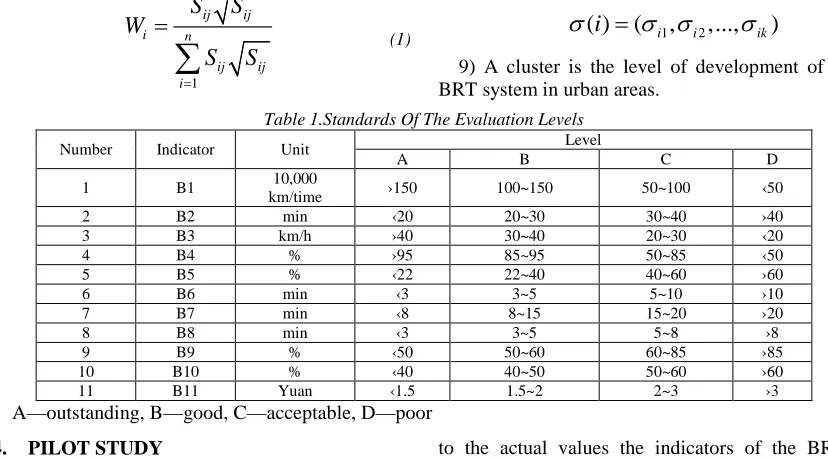
Taking the features of the Chinese BRT system into consideration, the study uses the gray clustering analysis as the tool of analysis. The steps are as the following:
1) Calculating the whitening matrix
{
d
ij}
;2) Calculating the eigenvalue
λ
jk;3) Transforming the indicators;
4) The non-dimension process;
5) Calculating the gray whitening function
(
)
jk ij
f
d
6) Calculating the weight of every indicator in each category.
The following formula can be used to calculate the weight of the gray cluster:
1
ij ij
i n
ij ij
i
S
S
W
S
S
==
∑
(1)In the formula,
W
istands for the weight of theevaluation factor
i
in levelj
.ij
S
stands for the average value of the evaluationfactor
i
in every level of the categorizing standard.7) Calculating the cluster coefficient
η
ij;1
( )
n
j k
i i j
i
w f
x
η
=
=
∑
(2)In the formula,
η
ij stands for the clustercoefficient of evaluation point
i
on evaluationlevel
j
; if the value of the indicator of theevaluation point
i
falls into categoryj
,( )
k j
f
x
stands for the function value of indicator’swhitening function
k
.8) Building cluster vector
σ
( )
i
;1 2
( )
i
(
i,
i,...,
ik)
σ
=
σ σ
σ
(3) [image:3.612.94.508.355.584.2]9) A cluster is the level of development of the BRT system in urban areas.
Table 1.Standards Of The Evaluation Levels
Number Indicator Unit Level
A B C D
1 B1 10,000
km/time ›150 100~150 50~100 ‹50 2 B2 min ‹20 20~30 30~40 ›40 3 B3 km/h ›40 30~40 20~30 ‹20
4 B4 % ›95 85~95 50~85 ‹50
5 B5 % ‹22 22~40 40~60 ›60
6 B6 min ‹3 3~5 5~10 ›10
7 B7 min ‹8 8~15 15~20 ›20
8 B8 min ‹3 3~5 5~8 ›8
9 B9 % ‹50 50~60 60~85 ›85
10 B10 % ‹40 40~50 50~60 ›60 11 B11 Yuan ‹1.5 1.5~2 2~3 ›3
A—outstanding, B—good, C—acceptable, D—poor
4. PILOT STUDY
The study uses the BRT1 system in the city of Jinan as the case example to examine the indicator of the evaluation indicators of the BRT operation status. The indicator of the evaluation of the service level of the BRT system is divided into four levels—A (outstanding), B (good), C (acceptable), D (poor).A—outstanding, B—good, C— acceptable, D—poor.
An effective evaluation on the service level of the BRT1 system in the city of Jinan can be conducted by applying the gray clustering analysis
to the actual values the indicators of the BRT1 system.
Table 2.Actual Values Of The Evaluation Indicators Of The Jinan BRT1 System
Evaluation indicator
Actual values
Evaluation indicator
Actual values
B1 490 B7 13
B2 32 B8 7
B3 21.5 B9 75
B4 90 B10 35
B5 38 B11 1
1) The whitening matrix is as the following:
D={490,30,21.5,90,38,8,13,7,75,35,1}
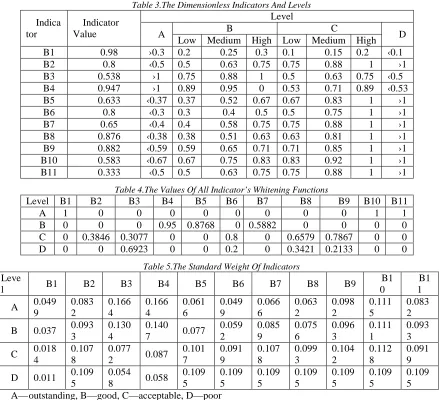
2) The results of non-dimension are as the Table 3.
3) Calculating all whitening functions, the results are listed in Table 4.
4) Calculating the weight of the indicators (see Table 5 for results)
5) Calculating the cluster coefficient of the indicators at four levels.
11
σ
=0.2446,
σ
12 =0.2517,σ
13 =0.2860,14
σ
=0.1207
Cluster vectors: ( ) {0.2446,0.2517,0.2860,0.1207}σ =i
6)The maximum cluster coefficient of cluster
vector
σ
( )
i
is 0.2860,meaning that the servicelevel of the BRT1 system in Jinan is medium in needing of improvement.
[image:4.612.89.528.264.664.2]The pilot study in Jinan shows that the evaluation indicator is adaptable and functional, and can be published as the indicator of the evaluation indicators of the BRT operation status.
Table 3.The Dimensionless Indicators And Levels
Indica tor
Indicator Value
Level
A B C D
Low Medium High Low Medium High
B1 0.98 ›0.3 0.2 0.25 0.3 0.1 0.15 0.2 ‹0.1
B2 0.8 ‹0.5 0.5 0.63 0.75 0.75 0.88 1 ›1
B3 0.538 ›1 0.75 0.88 1 0.5 0.63 0.75 ‹0.5
B4 0.947 ›1 0.89 0.95 0 0.53 0.71 0.89 ‹0.53
B5 0.633 ‹0.37 0.37 0.52 0.67 0.67 0.83 1 ›1
B6 0.8 ‹0.3 0.3 0.4 0.5 0.5 0.75 1 ›1
B7 0.65 ‹0.4 0.4 0.58 0.75 0.75 0.88 1 ›1
B8 0.876 ‹0.38 0.38 0.51 0.63 0.63 0.81 1 ›1
B9 0.882 ‹0.59 0.59 0.65 0.71 0.71 0.85 1 ›1
B10 0.583 ‹0.67 0.67 0.75 0.83 0.83 0.92 1 ›1
B11 0.333 ‹0.5 0.5 0.63 0.75 0.75 0.88 1 ›1
Table 4.The Values Of All Indicator’s Whitening Functions
Level B1 B2 B3 B4 B5 B6 B7 B8 B9 B10 B11
A 1 0 0 0 0 0 0 0 0 1 1
B 0 0 0 0.95 0.8768 0 0.5882 0 0 0 0
C 0 0.3846 0.3077 0 0 0.8 0 0.6579 0.7867 0 0
D 0 0 0.6923 0 0 0.2 0 0.3421 0.2133 0 0
Table 5.The Standard Weight Of Indicators
Leve
l B1 B2 B3 B4 B5 B6 B7 B8 B9
B1 0
B1 1
A 0.049
9 0.083 2 0.166 4 0.166 4 0.061 6 0.049 9 0.066 6 0.063 2 0.098 2 0.111 5 0.083 2
B 0.037 0.093
3
0.130 4
0.140
7 0.077
0.059 2 0.085 9 0.075 6 0.096 3 0.111 1 0.093 3
C 0.018
4
0.107 8
0.077
2 0.087
0.101 7 0.091 9 0.107 8 0.099 3 0.104 2 0.112 8 0.091 9
D 0.011 0.109
5
0.054
8 0.058
0.109 5 0.109 5 0.109 5 0.109 5 0.109 5 0.109 5 0.109 5
A—outstanding, B—good, C—acceptable, D—poor
The pilot study in Jinan shows that the evaluation indicator is adaptable and functional and can be published as the indicator of the evaluation indicators of the BRT operation status.
CONCLUSIONS
This paper puts forward a new method to evaluate the bus rapid transit (BRT) operation, and shows the accuracy and feasibility of the evaluation
support for urban public transport network in our country at the same time. It has great importance improving travel efficiency of residents and the service level of bus rapid transit (BRT).
ACKNOWLEDGEMENT
The study is funded by the Western Traffic Construction Projects of the Ministry of Transport (2011-318-221-1210) and Volvo Research and Educational Foundations. The author would like to extend the gratitude to the Energy Foundation and Jinan Urban Sustainable Transport Research Center, whose support was crucial to the completing of the study.
REFERENCES
[1] A book: Jing, L.,2005, Study on the Evaluation
Indicator of the BRT System, Changan University.
[2] Journal Articles: Wu, J., & Lin, Z., 2006, The
Evaluation Indicator of the Mass BRT System, Urban Public Transport, (7): 12-14.
[3] Wang, H., Song, R., & Li, M., 2008, Study on
the Evaluation Methods of the Development of the BRT System, The Journal of Transportation Engineering and Information Technology, 9(3):77-84.
[4] Chen, M., Niu, H., 2006, Study on the BRT
System and the Related Evaluation, Journal of Lanzhou Jiaotong University, 8(25):113-117.
[5] Deng, H., & Guo, C., 2009, Brief Introduction
of the Analysis on the Evaluation of the Operation System of the BRT System, Urban Roads Bridges & Flood Control, 9(5):18-21
[6] Zhu, S., 2007, Study on the Evaluation
Indicator Indicator of the Development of the BRT System, Urban Public Transport, (10):29-31.
[7] Zhang, Y., 2007, Post-Evaluation Indicator of