ORIGINAL RESEARCH ARTICLE
PROBLEMS FACED BY TEACHERS IN IMPLEMENTATION OF MID
DAY MEAL SCHEME AT PRIMARY SCHOOL LEVEL IN JAMMU
PROVINCE
1
*Rekha Rani and
2Darshana Sharma
1
Research Scholar, P.G. Department of Education, University of Jammu, Jammu
2Professor of Education, Directorate of Distance Education, University of Jammu, Jammu
ARTICLE INFO ABSTRACT
Mid Day Meal Scheme is being implemented in India since August 15, 1995, as a part of the National Programme of Nutritional Support to Primary Education. It was introduced in India with an objective to enhance enrolment, retention and attendance and simultaneously improving nutritional levels among children. Teachers play a key role in the successful implementation of mid day meal scheme at school level. The paper focuses on the problems faced by teachers in the implementation of mid day meal scheme. The study on which this paper is based was conducted in the Jammu Province. Survey method of descriptive research was used. Multistage sampling technique was used for the selection of sample. The sample size comprised 200 teachers selected randomly from the primary schools of Jammu Province. Self prepared questionnaire was used to collect the primary data. Data was analyzed using simple statistical technique such as percentages. Teachers pointed out a number of problems such as problem of management of the mid day meal, wastage of food by the students, insufficient and delayed receipt of funds, increased workload of teachers, procuring dry ration from the retail shops, lack of infrastructure for storage, cooking and serving food, lack of safety provisions, unhygienic surroundings, etc. being faced by them in implementation of Mid Day Meal Scheme. The paper puts forward certain suggestions for effective implementation of the scheme so that objectives of mid day meal can be achieved.
*Corresponding author:
Copyright ©2017,Rekha Rani and Darshana Sharma. This is an open access article distributed under the Creative Commons Attribution License, which permits unrestricted use, distribution, and reproduction in any medium, provided the original work is properly cited.
INTRODUCTION
Education is the most important factor for social, economic and political transformation. A well educated population, equipped with the relevant knowledge, attitudes and skills is essential for economic and social development in the twenty-first century. Education is the most potent tool for socio-economic mobility and a key instrument for building an equitable and just society. Education provides skills and competencies for economic well-being. Education also acts as an integrative force in society, imparting values that foster social cohesion and national identity (Narad, 2016). After independence the biggest challenge for India was education of its people and for this Government of India has launched a number of programmes to achieve the Universalization of
Elementary Education such as Non-Formal Education, Operation Blackboard, District Primary Education Programme, National Programme of Nutritional Support (Mid Day Meal), Sarva Shiksha Abhiyan (SSA), etc. The National Programme of Nutritional Support to Primary Education (Mid Day Meal Scheme) was originally started in Tamil Naidu in 1960s by then Chief Minister K.Kamraj and later expanded by the M. G. Ramachandran Government in 1982. The scheme was applauded widely and even World Bank praised the scheme. Finding its advantages, the National Programme of Nutritional Support to Primary Education (Mid Day Meal Scheme) was launched as a centrally sponsored scheme on August 15th, 1995 by the Ministry of Human Resource Development, Government of India. On November 28, 2001 the Supreme Court ordered all state governments to provide cooked meals
ISSN: 2230-9926
International Journal of Development Research
Vol. 07, Issue, 08, pp.14718-14722, August,2017
Article History:
Received 24th May, 2017
Received in revised form
15th June, 2017
Accepted 23rd July, 2017
Published online 30th August, 2017
Citation: Rekha Rani and Darshana Sharma, 2017. “Problems faced by teachers in implementation of mid day meal scheme at primary school level in
Jammu province”, International Journal of Development Research, 7, (08), 14718-14722.
REVIEW ARTICLE OPEN ACCESS
Keywords:
Mid Day Meal Scheme, Teachers,
(with 300 calories and 8-12 gm of protein) on every school day, for at least 200 days a year. It was further extended in 2002 to cover not only children studying in Government, Government aided and local body schools, but also children studying in Centres run under the Education Guarantee Scheme (EGS) and Alternative and Innovative Education (AIE) scheme. The objective of the mid day meal scheme is to improve the nutritional status of students in Government run schools besides encouraging children from disadvantaged background to attend school regularly. The scheme intends to promote social equality among the children and also enhance enrolment at the primary stage. National Programme of Nutritional Support to Education (popularly known as Mid Day Meal Scheme) was launched in the J&K State in September 2004 with an objective to give a boost to Universalization of Primary Education by increasing enrollment, retention and attendance. Under the scheme cooked food is supplied to students at primary schools from standard I to V. In October 2007, the scheme was extended to cover students of upper primary classes (i.e. class VI to VIII) and the name of the scheme was changed from ‘National Programme of Nutritional Support to Primary Education’ to ‘National Programme of Mid Day Meal in schools’ The scheme aims to provide 450 calories and 12 grams of proteins for children studying in primary level and 700 calories and 20 grams of proteins at the upper primary level to boost their nutritional level. The scheme was extended to all areas across the country from 1.4.2008 (MHRD, 2016). While the state governments are entrusted with the responsibility of its implementation, the centre provides dry ration and financial assistance.
REVIEW OF RELATED LITERATURE
A number of studies have been carried out to know the perception and problems faced by teachers in the implementation of Mid Day Meal Scheme (Gangadharan, 2006; Gupta, 2006; Samvad, 2007; Kumar, 2008; Chugh, 2008; Sinha, 2008; Parida, 2010; Bhargava and Bhargava, 2011; Hamid and Hamid, 2012, Uma, 2013; Meena, 2014; Saha, 2015; Ramkete and Singh, 2016). Gangadharan (2006) advocated that physical facilities for Mid Day Meal Scheme were available only in 50% schools and 94% schools were depended on firewood for cooking, separate building for kitchen outside the classroom were rare and adequate space was not there in 50% schools. Gupta (2006), Samvad (2007) and Kumar (2008) reported that after the introduction of the hot cooked Mid Day Meal Scheme, studies of the students got disturbed because a major portion of the teachers teaching time is consumed in the maintenance of accounts and buying of food ingredients. Chugh (2008) and Bhargava and Bhargava (2011) reported that the school’s Mid day Meal Scheme has increased the workload of the teachers and funds are also not provided on time. Singh (2008) found that the major problems linked with the scheme were poor infrastructure facilities, lack of varied menu, poor quality of food and delay in payment. Parida (2010) advocated that the study hours of the schools are getting affected due to direct involvement of teachers in the management and operation of the Mid Day Meal Scheme. Bhargava and Bhargava (2011) reported that the food material provided to the students was of low quality and supply of food material was not on time. Hamid and Hamid (2012) revealed that school suffered from managerial and administrative problems because there was no separate staff to look after the implementation of the Mid Day Meal Scheme and teachers use
to maintain daily records, receipt and expenditure under the programme. Uma (2013) analyzed that there was no proper kitchen in the school to prepare food and there was lack of infrastructure facilities. Meena (2014) reported that insufficient funds to implement the scheme resulted in poor quality of food and disrupted the classroom teaching-learning activities of the teachers and students. Saha (2015) found that majority of the schools were using firewood as a fuel for preparing meal and school verandah, field, classroom was the main venue for serving food with the result that food was not served under hygienic conditions. Ramteke (2015) and Singh (2016) found that Mid Day Meal Scheme is a burden on the teachers and it also disrupted the teaching-learning process. The studies reviewed provided the basis for the present study to be conducted in Jammu Province. Jammu Province has peculiar topography. There are plains as well as mountainous areas. Experience of problems can be geographically controlled. In view of this, it was imperative that a study be conducted to know the problems faced by teachers in implementation of mid day meal scheme at primary school level in Jammu Province. Moreover, no study has been conducted on provincial level to explore the problem faced by the teachers in the implementation of mid day meal scheme. It is hoped that knowledge of problems faced by the teachers in implementation of the Mid Day Meal Scheme will help the planners and administrators to reflect on the practices and strategies in planning, implementing and supervising the ongoing Mid Day Meal Scheme for achieving the objectives of the scheme. It is essential that the problems which the teachers are experiencing in the implementation of the scheme are overcome completely. The study also sought to propose ways in which problems can be overcome and the objectives for which the Mid Day Meal Scheme was launched can be achieved.
OBJECTIVES
To study the problems faced by the teachers in implementation of Mid Day Meal Scheme in Government Primary Schools of Province.
To make certain suggestions to overcome the problems faced by the teachers in implementation of Mid Day Meal Scheme in Government Primary Schools of Province.
RESEARCH METHODOLOGY
The study was designed on descriptive research methodology. Survey method was used for the study. In the first phase thirty teachers (ten each from district of Jammu, Samba and Rajouri) who were associated with mid day meal scheme and who volunteered to participate in the survey were invited to participate in the Focus Group Discussion to gain insight into the problem faced by them in the Mid Day Meal Scheme. Focus Group Discussion was held with three groups. The outcomes of Focus group discussion were used to prepare a structured questionnaire consisting of 30 items. Headmasters of six schools, implementing mid day meal scheme validated the content of the questionnaire. The questionnaire was piloted on ten teachers. Finally, a questionnaire consisting of 26 items was administered on a sample of 200 teachers from government primary schools of Jammu Province. Multistage sampling technique was used for the selection of sample. Data was analyzed using statistical technique such as percentage.
Interview with ten teachers was conducted to seek qualitative data. This provided further insight into the problems.
ANALYSIS AND FINDINGS
The analysis of data in the light of objectives and findings of the study are as follows:
The findings of the study are as follows
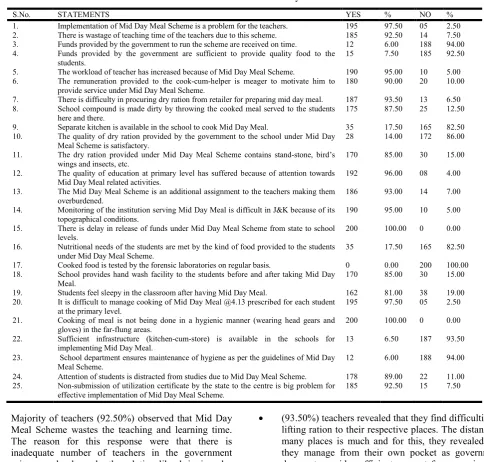
During the survey (97.50%) responded that Mid Day Meal Scheme is a problem for them because along with supervision of Mid Day Meal Scheme they have to make all possible arrangements and have to maintain the records of the scheme regularly.
Majority of teachers (92.50%) observed that Mid Day Meal Scheme wastes the teaching and learning time. The reason for this response were that there is inadequate number of teachers in the government primary schools and other duties like bringing dry rations from the ration store, eatables (oil, salt and other ingredients), appointing BLOs in villages etc. wastes their time of teaching.
Very small numbers of teachers (6.00%) responded that they receive all the funds from the government required to run this scheme on time.
Majority of teachers (92.50%) responded that the funds provided by the government are not sufficient to provide quality food to the students. For the smooth implementation of the scheme they consume the building fund, Red Cross Fund, Games Fund, etc. for providing meals to the students.
Maximum number of teachers (95.50%) responded that the workload of teachers has increased because along with the supervision they have to maintain Mid Day Meal register and other accounts related to the scheme.
(90.00%) teachers responded that the remuneration provided to the cook-cum-helper is very low and sometime that remuneration is also not provided on time and teachers have to pay them from their own pockets.
(93.50%) teachers revealed that they find difficulties in lifting ration to their respective places. The distance at many places is much and for this, they revealed that they manage from their own pocket as government does not provide sufficient amount for procuring dry ration from the retailer, like vehicle fare, etc.
(87.50%) teachers responded that the students up to class II are small kids and they make the school compound dirty by throwing the cooked meal here and there.
[image:3.595.56.541.254.716.2] (82.50%) teachers responded that that there was no separate kitchen available in the school to cook mid Table 1. Problems of teachers on Mid Day Meal Scheme
S.No. STATEMENTS YES % NO %
1. Implementation of Mid Day Meal Scheme is a problem for the teachers. 195 97.50 05 2.50
2. There is wastage of teaching time of the teachers due to this scheme. 185 92.50 14 7.50
3. Funds provided by the government to run the scheme are received on time. 12 6.00 188 94.00
4. Funds provided by the government are sufficient to provide quality food to the
students.
15 7.50 185 92.50
5. The workload of teacher has increased because of Mid Day Meal Scheme. 190 95.00 10 5.00
6. The remuneration provided to the cook-cum-helper is meager to motivate him to
provide service under Mid Day Meal Scheme.
180 90.00 20 10.00
7. There is difficulty in procuring dry ration from retailer for preparing mid day meal. 187 93.50 13 6.50
8. School compound is made dirty by throwing the cooked meal served to the students
here and there.
175 87.50 25 12.50
9. Separate kitchen is available in the school to cook Mid Day Meal. 35 17.50 165 82.50
10. The quality of dry ration provided by the government to the school under Mid Day
Meal Scheme is satisfactory.
28 14.00 172 86.00
11. The dry ration provided under Mid Day Meal Scheme contains stand-stone, bird’s
wings and insects, etc.
170 85.00 30 15.00
12. The quality of education at primary level has suffered because of attention towards
Mid Day Meal related activities.
192 96.00 08 4.00
13. The Mid Day Meal Scheme is an additional assignment to the teachers making them
overburdened.
186 93.00 14 7.00
14. Monitoring of the institution serving Mid Day Meal is difficult in J&K because of its
topographical conditions.
190 95.00 10 5.00
15. There is delay in release of funds under Mid Day Meal Scheme from state to school
levels.
200 100.00 0 0.00
16. Nutritional needs of the students are met by the kind of food provided to the students
under Mid Day Meal Scheme.
35 17.50 165 82.50
17. Cooked food is tested by the forensic laboratories on regular basis. 0 0.00 200 100.00
18. School provides hand wash facility to the students before and after taking Mid Day
Meal.
170 85.00 30 15.00
19. Students feel sleepy in the classroom after having Mid Day Meal. 162 81.00 38 19.00
20. It is difficult to manage cooking of Mid Day Meal @4.13 prescribed for each student
at the primary level.
195 97.50 05 2.50
21. Cooking of meal is not being done in a hygienic manner (wearing head gears and
gloves) in the far-flung areas.
200 100.00 0 0.00
22. Sufficient infrastructure (kitchen-cum-store) is available in the schools for
implementing Mid Day Meal.
13 6.50 187 93.50
23. School department ensures maintenance of hygiene as per the guidelines of Mid Day
Meal Scheme.
12 6.00 188 94.00
24. Attention of students is distracted from studies due to Mid Day Meal Scheme. 178 89.00 22 11.00
25. Non-submission of utilization certificate by the state to the centre is big problem for
effective implementation of Mid Day Meal Scheme.
day meal. For cooking and serving meal school verandah, fields, school ground was used.
Maximum numbers of teachers (86.00%) were not satisfied from the quality of dry ration provided by the government to the students. Food items do not have nutritional content because the ration which was stored in the godown for so many years was supplied to the school under mid day meal scheme and due to long time of storage its nutritional content is lost.
(85.00%) teachers responded that the dry ration provided by the government under Mid Day Meal Scheme contains sand-stone, bird’s wings and insects, etc.
(96.00%) teachers responded that the quality of education at primary level has suffered because of attention of teachers towards mid day meal related activities than on academics.
The responses of (93.00%) teachers revealed that Mid Day Meal Scheme is an additional assignment for them. They have to spend a considerable time and energy for the implementation of scheme.
(95.00%) teachers responded that monitoring of the institution serving mid day meal is difficult in J&K state because of its topographical conditions and shortage of manpower.
Almost all teachers (100.00%) responded that because of delay in funds from the government, teachers continuously provide food to students from their own resources and pocket and some time they lift ration on credit from the shops. But due to non-payment to the shopkeepers for couple of months, the shopkeepers also refuse to continue the supply of ration/edible oil and other necessary supply to the schools on credit basis.
(82.50%) teachers responded that the nutritional needs of the students are not met by the meal provided under Mid Day Meal Scheme because it does not include nutritional food items like egg, leafy vegetables, milk, seasonal fruits, etc.
(100.00%) teachers responded that the food cooked under mid day meal scheme is not tested in the forensic laboratories.
Majority of teachers (85.00%) responded that they do not have hand wash soap/liquid in the school for the students to wash their hands before and after taking meal.
(81.00%) teachers responded that students feel sleepy in the classroom after having meal in the school. (97.50%) teachers responded that it is difficult to give
nutritional food to primary class students @4.13 per student. Inflation is high and amount is meager. (100.00%) teachers responded that cooking of meals in
most of the schools by the cook-cum-helper is not being done in a hygienic manner (wearing head gears and gloves) especially in the far-flung areas.
(93.50%) teachers responded that sufficient infrastructure (kitchen-cum-stores) is not available in the schools for preparing and storing the ingredients of Mid Day Meal, and they use classroom’s corner for cooking and storing the ingredients.
(94.00%) teachers responded that school department does not ensure maintenance of hygiene as per the guidelines of Mid Day Meal Scheme.
Majority of teachers (89.00%) responded that because of Mid Day Meal Scheme the attention of students is distracted from studies because there is not much distance between the classroom and kitchen where meal is prepared.
(92.50%) teachers responded that non-submission of utilization certificate by the state to the centre is a big problem for effective implementation of Mid Day Meal Scheme.
SUGGESTIONS
The investigators suggest some ways to overcome the problems faced by the teachers in the implementation of Mid Day Meal Scheme:-
Instead of the school teachers being involved with every aspect of Mid Day Meal, from shopping to tasting, a separate person should be engaged as Mid Day Meal in-charge at cluster level under the scheme for maintaining records and making purchases.
Supply of Mid Day Meal should be substantially managed by local NGOs or SHGs which may helps in relieving the teachers from the additional assignment. This way the teachers can focus on the teaching-learning process in the schools.
To make Mid Day Meal Scheme more effective and successful, it is urgently required to ensure timely transfer of funds and food grains in schools.
CA&PD department can play an effective role in supplying food grains from CA& PD outlets to the schools. It would save precious time of teachers in collecting food grains and ensure its timely supply. Funds should be given at regular interval to the schools
to avoid discontinuation of Mid Day Meal Scheme or financial burden over teachers. Provision of advance payment should be made.
Utilization certificate to the centre by the state should be timely submitted.
The provision for cooking cost per child per day under the mid day meal scheme should be increased in order to be able to provide a nutritious meal to the child. Further this norm should be inflation-linked and reviewed regularly in relation to price index.
Mechanism should be evolved to monitor the schools in far-flung and mountainous areas so that the benefits of the scheme can reach really to the needy population. The quality of food grains delivered to schools and
cooked meal must be checked regularly. Monitoring of the scheme is essential requirement for quality assurance.
There should be random checking of cooked food by a team of health and sanitary experts or forensic laboratories.
School Health Programme need to be systematized in terms of regular health checkup, follow up, nutrient supplement and maintenance of health cards.
Each school should have spacious kitchen shed consisting of proper ventilations, light, proper height, and with store facility. The kitchen sheds need to be located little away from the classrooms. This will make students to concentrate on studies rather than looking on what is going on in the kitchen.
Cook-cum-helpers should be given awareness about hygienic conditions.
Provision of hand wash should be made available in each school for students so that they can learn hygiene. Cooks-cum-helpers should be paid well so that they
work with motivation and commitment and should be trained for hygiene and desirable cooking practices. Seasonal fruits, milk, egg, green leafy vegetables and
vitamin rich foods should be added to the menu to meet the nutritional needs of the students.
Conclusion
The study was conducted to gain the insights into the problems faced by teachers in the implementation of Mid Day Meal Scheme and to provide suggestions to make the scheme more effective. Teachers pointed out a number of problems like increased workload, disturbance in the teaching-learning process, insufficient funds, delay in receipt of funds, insufficient infrastructure and support staff, which are being faced by them. The teachers also expressed concerns about the quality of food and hygienic conditions under which food is served to the children. The results of the study and suggestions made in that context can be helpful to the policy planners and administrators at the state level to take steps for introducing interventions to overcome the problems so that the scheme can be implemented effectively and objectives for which the mid day meal scheme was launched can be realized.
REFERENCES
Bhargav, S., & Bhargav. A. 2011. An Evaluative Study of Opinion and Awareness of Primary School Teachers Towards Implementation of Mid Day Meal Program. Excel International Journal of Multidisciplinary Management Studies, 1 (1), 21-30.
Chugh, S. 2008. The Government Primary School Mid Day Meals Scheme: A Study of Best Practices in the Implementation of Mid Day Meal Programme in Punjab. Department of Comparative Education and International Co-operation, National University of Educational Planning and Administration (NUPA) 17-B, Sri Anrobindo Marg, New Delhi 110016.
Gangadharan, V. A. 2006. Noon Meal Scheme in Kerala. State Institute of Educational Management and Training.
Retrieved June 15, 2017 from
http://www.righttofoodindia.org/data/gangadharan2006kera lanoonmealmanagement.doc
Gupta, P. 2006. National Programme of Nutritional Support to Primary Education (Mid Day Meal Scheme) in District Shimla of Himachal Pradesh: An Evaluative Study. (Unpublished M.Phil. Dissertation). Himachal Pradesh University, Shimla.
Hamid, Y., & Hamid, A. 2012. Mid Day Meal Scheme and Growth of Primary Education: a Case Study of District Anantnag in Jammu and Kashmir. Bangladesh E-Journal
of Sociology, 9 (1), 80-89.
Kumar, A. 2008. Teachers’ Perceptions towards National Program of Nutritional Support to Primary Education (Mid Day Meal Scheme). The Primary Teacher, 33(1-2), 63. Meena, M. 2014. A Case Study: Impact of Mid Day Meal
Scheme on Enrolment of Student Specially Girl Child and Problems with This Meal Scheme. Paper presented at National Conference of The Indian Institute of Geographical Studies, Banglore, India. Abstract Retrieved July 20, 2017, from http://tiigs.org/ngys/imact of mid-day-meal-scheme-on-enrolment of students-specially-girl-child- and-problems-with-this-meal-scheme-a-case-study-of-kotda-tehsil/
Ministry of Human Resource Development. 2016, April 3. Mid
Day Meal Scheme. Department of School Education and
Literacy. Government of India. Retrieved August 17, 2017, from http:// mhrd.govt.in/mid-day-meal.
Narad, A. 2016. Implementation of Mid Day Meal Scheme in Government Elementary Schools of Bihar. MIER Journal of Educational Studies, Trends & Practices. 6 (1), 68-81. Parida, J. 2010. Mid Day Meal Scheme and Growth of Primary
Education - A case study of a district in Orissa. Journal of
Educational Planning and Administration, 24 (2), 169-177.
Ramteke, V. 2015. “A Study on Impact of Mid Day Meal Scheme in Government Aided School of Nagpur City.”
Gurukul International Multidisciplinary Research Journal
(GIMRJ), V (I), 54-59.
Saha, H. (2015). “Mid-Day Meal Programmer: Issues and Challenges.” International Journal of Research (IJR), 2
(5), 789-797.
Samvad, V. 2007. Implementation of the Mid Day Meal in 4 Districts (Bhopal, Seoni, Barwani and Sheopur) of Madya Pradesh. Retrieved July 15, 2017 from http://www.education.nic.in/elementary/mdm/data/NSMC-20.10.09ppt.
Singh, M. (2016). Mid-Day Meal Scheme: As Perceived by the School Teachers in Bihar. International Journal of
Novel Research in Humanity and Social Science, 3 (3),
53-59.
Sinha, D. 2008. “Social Audit of the Mid Day Meal Scheme in Andhra Pradesh.” Economic and Political Weekly, 43 (44),
57-61.
Uma. 2013. "Mid Day Meal Scheme and Primary Education in India: Quality Issues." International Journal of Scientific
and Research Publications, 3 (11), 1-3.