NEW CROSSOVER OPERATOR FOR GENETIC ALGORITHM
TO RESOLVE THE FIXED CHARGE TRANSPORTATION
PROBLEM
1AHMED LAHJOUJI EL IDRISSI, 2CHAKIR TAJANI, 3MOHAMMED SABBANE
1,3
Laboratory Modeling, Analysis, and Control of Systems (MACS), Faculty of Science Meknes, Morocco 2
Department of Mathematics, Polydisciplinary faculty of Larache, Morocco
[email protected], [email protected], [email protected]
ABSTRACT
Genetic algorithms (GAs) are a class of global optimization methods. It has been used to solve combinatorial problems. Among the difficulties in GAs, the parameter setting and the choice of the crossover operator adapted to the problem. In this paper, we studied the influence of these operators on the performance of the GAs by making a comparative study with different adapted operators to the Fixed Charge Transportation Problem (FCTP) and described the genetic algorithm to find an optimal solution. In addition, we proposed a new crossover operator for solving the FCTP. The experimental results show that the choice of adequate crossover is important to solve each combinatorial problem by genetic algorithm. Moreover, the GA with our developed crossover operator is more efficient.
Keywords: Combinatorial Problem, Fixed Charge Transportation Problem, Genetic Algorithm, Crossover
Operator, Priority Based Encoding.
1. INTRODUCTION
The fixed charge transportation problem (FCTP) is a problem of optimization and operations research; it is a generalization of the classical transportation problem [1]. It contains two costs, variable costs proportional to the amount shipped and fixed cost regardless of the quantity transported.
Many problems in the real world can be modeled as a FCTP such as the problem of allocation of launch vehicles for space missions [2], the allocation of teaching duties for teachers to minimize in the average number of distinct subjects assigned to each teacher [3] and goods distribution problem which is treated with Adlakha [4].
FCTP is classified as NP-complete problem which is difficult to resolve by exact methods [5], because of the fixed costs which are reflected by discontinuities in the objective function [6] as well as the computation time required to find a solution which is likely to increase exponentially with the size of the problem. However, the approximate methods and meta-heuristics can be used [7].
The GAs techniques are very powerful and widely applicable in the field of optimization [8]. It offers a population of chromosomes, each of which is a feasible coded solution. The values in standard are assigned to each chromosome, and the population is changing by a set of operators (crossover, mutation) until a stop criterion is reached [9]. A selection mechanism will be applied after the evaluation to choose the best chromosomes of the population with a high probability of choice [10].
To apply the GA approach, it is important to choose an adequate representation of chromosomes for the problem. Several representation methods are used to solve the FCTP. Z. Michalewicz and al. [11] proposed a matrix representation to solve the problem of distribution of goods where the chromosome was represented with a matrix m × n
and decoding for two-stages transportation problem called “Priority based Representation method” (pb-GA) which has several advantages and has been used successfully in several problems [15].
In this work, we consider the resolution of the FCTP by genetic algorithm using Priority based representation method “pb-GA” where we analyze and compare the performance of GA with four different suitable crossover operators to obtain optimal solution and to show the influence of these operators in the resolution of this kind of problem and to conclude the most adapted crossover operator for FCTP. After providing the comparative analysis, we propose a new crossover operator in order to improve the performance of the GA applied to FCTP and obtain best solution.
The second section is devoted to the presentation of the mathematical formulation of the FCTP and an introduction to the problem with examples and graphs to explain the transport flows. The Section 3 presents a brief discussion of adaptive genetic algorithm to solve the FCTP and all parameters that can influence the performance of the GAs (encoding, selection, crossover and mutation ...). Particularly, the crossover operator which is the most important operation in the genetic algorithm process. Hence; we present four types of suitable crossover used with the pb-GA. Moreover, we propose a new crossover operator that we called Inversion Position-based Crossover “IPX”. In section 4, we present numerical results where a comparative study of the four presented crossover operators (OPEX, OX, PX and PEX) with our operator has developed based on different standard existing instances in the literature to conclude the most performing operator for FCTP. The results show that the new proposed operator improves the performance of the GA.
2. PROBLEM DESCRIPTION
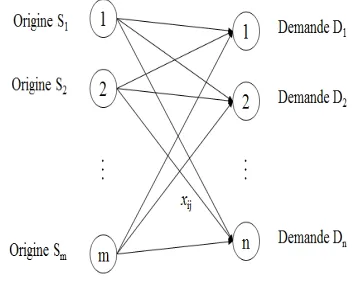
The Fixed Charge Transportation Problem (FCTP) is a particular case of the transportation problem, in which a variable cost that is proportional to the quantity shipped, with a fixed cost independent of the quantity transported. The goal is to find the combination of flow that minimizes the total variable and fixed costs while satisfying the demands of each origin and destination (Figure 1).
We have a group of warehouses Dj
(destination) j=1, 2,…,n that is served by a group of production sites Si (sources) i=1,2,...,m while
each producer has a given production capacity and each destination Si a request to meet Dj. The
[image:2.612.330.506.227.368.2]problem is to determine the amount of product to be sent from each place of production for each warehouse to minimize the total cost, fixed and variable to serve all destinations. To obtain the formulation of this problem, it is necessary to add the fixed cost in the modeling of the linear transport problem. In this case, the transport costs have a variable part cij xijand a fixed part fij yij.
Figure 1: Example of transportation plan
The fixed charge transportation problem can be formulated as follows:
(6)
2
1
;
2
1
(5)
0
(4)
2
1
(3)
2
1
)
2
(
0
,
0
0
,
1
)
1
(
)
(
1 1 1 1,...,n
,
j
,...,m
,
i
x
,...,n
,
j
D
x
,...,m
,
i
S
x
x
x
y
y
f
x
c
Z
Min
ij m i ij n j ij ij m i n j j i ij ij ij ij ij ij=
=
≥
=
≥
=
≤
=
>
=
+
=
∑
∑
∑∑
= = = =cij : variable cost from source i to destination j;
xij : quantity transported on the route (i,j);
fij : fixed cost associated with route (i,j);
yij : a binary variable yij =1 if xij >0 and 0 if xij = 0;
Si : amount of supply at source i;
Dj : amount of demand at destination j;
It is preferable to consider the balanced problem (Si=Dj) that is to say the availability equal
3. GENETIC ALGORITHM FOR FCTP
Genetic algorithms (GAs) are stochastic optimization algorithms based on the mechanisms of natural selection and genetics developed by John Holland in 1975 [10]. Their fields of application are extensive; especially in the areas of economy, finance, logistics and transport ... Usually, they can be used to the NP-complete problem, for example, in the backpack problem [16] and in the traveling salesman problem [17]…
This kind of Algorithm starts with initial generation of population, the second step is to apply the evaluation process and to use the genetic operators (selection, crossover, mutation…) to reproduce new population. Moreover, the selection is used according to the adopted method to select the best solutions [18].
In GAs, one of the most important processes is the encoding of chromosomes. Therefore, it is significant to choose the adequate representation of chromosomes for this problem. In this work, we have chosen the priority based representation for FCTP [19].
3.1 Proiority based representation for FCTP
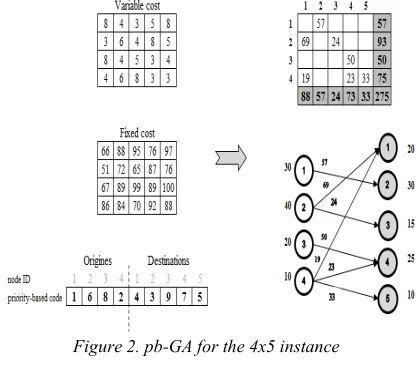
For this representation, the population is generated randomly from a series of numbers representing the transport network nodes where all the solutions are feasible even also after the crossover and mutation operations [20]. Also, in this encoding, a gene in a chromosome contains two types of information, the position of a gene to represent the nodes (source / destination) and the value of a gene, which represents the priority of the node for the construction of a transport plan. A chromosome consists of priorities of sources and destination to obtain a transport plan. Its length is equal to the total number of sources (m) and deposits (n), that is m+n.
From the code and the matrices costs, variable and fixed, we can construct the transportation plan using the corresponding algorithm (Figure3).
We use the formulation of M. L. Balinski [21] given by:
in step 3 of the decoding algorithm (Figure 3) to calculate the cost of transport, so that, it can be
[image:3.612.315.523.135.319.2]solved as a problem of linear transport, instead of working by two tables, we are working by a single table.
Figure 2. pb-GA for the 4x5 instance
Input:
m : number of sources, n : number of depots ; Si : supply of source i, i=1,2,…,m;
Dj: demand of depot j, j=1,2,…,n;
Cij : variable transportation cost of one unit of product from source i to depot j ;
fij : fixed transportation cost associated with route (i,j) ; v(i+j): chromosome;
Step 1: Xj 0, for each i,j;
Step 2: k argmax{v(t)|t=1,2,…,m+n}; select a node
Step 3: if k≤m, then i* k; select a source j* arg min{UCij= + f /min(Si /Dj) |v(m+j)≠0, j=1,2,…,n}; select a depot with lowest cost
else j* k-m; select a depot;i* arg min{UCij = + |v(i)≠0, i=1,2,…,m}; select a source with lowest cost
Step 4: x* * min{Si*,Dj*}; Si* Si*-xi*j, Dj* Dj*-xi*j, assign
available units and update availabilities of source i* and depot j*
Step 5: if Si*=0 then v(i*) 0; if Dj*=0 the v(m+j*) 0; remove priority of selected source or depot
Step 6: if Ǝi|i ≤ m,v(i)≠0 go to step2, else calculate the total transportation cost.
Ouput : the amount of transported product from source i to depot j ;
Figure 3. Decoding algorithm of the pb-GA for the FCTP
3.2 Initialization
Figure 4. Initialization of the population randomly
3.3 Crossover operators
The crossover is the most important genetic operator. It works with both parents and combination of different characteristics of the two chromosomes. It allows the reproduction of a new population. There are several operators used to the problem. In this context, we have chosen four adapted crossover operator for the FCTP in order to compare their performance and conclude the best choice of crossover for FCTP. In addition, we developed a new crossover operator to improve the performance of the genetic algorithm comparing with the four cited operators.
3.3.2 Oder of priority exchange crossover
(OPEX):
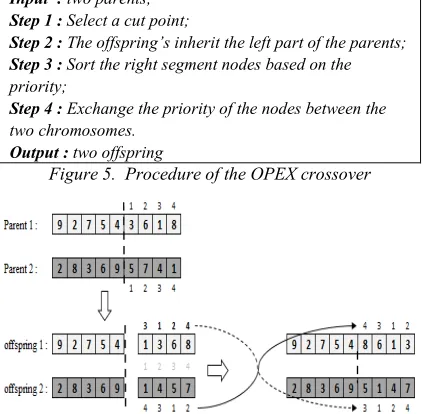
OPEX crossover operator consists in selecting a random crossover point. The child inherits the parent left chromosome segment and exchange the order of priority of the parents of nodes for the right of children segment [22]. The procedure illustrated in Figure 6. It works as follows:
Input : two parents;
Step 1 : Select a cut point;
Step 2 : The offspring’s inherit the left part of the parents;
Step 3 : Sort the right segment nodes based on the priority;
Step 4 : Exchange the priority of the nodes between the two chromosomes.
[image:4.612.89.271.71.184.2]Output : two offspring
Figure 5. Procedure of the OPEX crossover
Figure 6. Example of the OPEX crossover
3.3.3 Partial-Maped Crossover (PMX)
PMX used a special procedure for repairing to solve the illegitimacy caused by two simple
crossover points. Therefore, most of PMX is the two simple points, more than the crossover repair method [23]. The procedure illustrated in Figure 8.
It works as follows:
Input: two parents
Step 1: Select two positions along the string uniformly at random.
The substrings defined by the two positions are called the mapping sections.
Step 2: Exchange two substrings between parents to produce proto-children.
Step 3: Determine the mapping relationship between two mapping sections.
Step 4: Legalize offspring with the mapping relationship.
[image:4.612.340.492.297.470.2]Output: two offspring
Figure 7. Procedure of the PMX crossover
Figure 8. Example of the PMX crossover
3.3.4 Order Crossover (OX)
For this operator, two points are randomly selected from a parent, thus defining a crossover region. This region transmitted directly to the offspring; meanwhile, the remaining positions filled with the elements that do no belong to that region in the order that they appear in the second parent [24]. The procedure illustrated in Figure 10. It works as follows:
Input: two parents
Step 1: Select a substring from one parent at random.
Step 2: Produce a proto-child by copying the substring into the corresponding positions of it.
Step 3: Delete the nodes which are already in the substring from the second parent.
The resulted sequence of nodes contains the nodes that the proto-child needs.
Step 4: Place the nodes into the unfixed positions of the proto-child from left to right according
Output: two offspring
[image:4.612.89.300.467.674.2]Figure 10. Example of the OX crossover
3.3.5 Position-based Crossover (PX)
PX crossover operator is essentially a kind of permutation cross with a repair procedure. It is closer to the operator OX where nodes are selected in a random manner [25]. The procedure illustrated in Figure 12. It works as follows:
Input: two parents;
Step 1: Select a set of positions from one parent at random;
Step 2: Produce a proto-child by copying the nodes on these positions into the corresponding positions of it;
Step 3: Delete the nodes which are already selected from the second parent;
The resulted sequence of nodes contains the nodes the proto-child needs;
Step 4: Place the nodes into the unfixed positions of the proto-child from left to right according to the order of the sequence to produce one offspring;
Output: two offspring.
Figure 11. Procedure of the PX crossover
Figure 12. Example of the PX crossover
3.3.6 Proposed Inversion Position-based
Crossover (IPX)
In order to improve the performance of the genetic algorithm and find a better solution than those found by the operators already used, we proposed a new crossover operator that we called “Inversion Position-based crossover” (IPX). The principle is based on the crossover operator PX, the difference consist to invert the principle of PX operator. The procedure illustrated in Figure 14. works as follows:
Input: two parents;
Step 1: Select a set of positions from one parent at random;
Step 2: Produce a proto-child by copying the nodes on these positions into the corresponding positions of it;
Step 3: Delete the nodes which are already selected from the second parent;
Step 4: Place the nodes into the unfixed positions of the proto-child from right to left according to the order of the sequence to produce one offspring;
Output: two offspring.
Figure 13. Procedure of the IPX crossover
Figure 14. Example of the IPX crossover
3.1.Mutation operator
Mutation operator operates by exchanging information within a chromosome. However, instead of using this operator between two parents, we use between two segments of a parent. We have choosen a swap mutation operator which consist to permute the values of two randomly selected positions for each chromosome to reduce the risk of reproducing a chromosome with the same solution [11, 26]. Swap mutation consists to selects two elements and then randomly permutes the elements at these positions. The procedure illustrated in Figure 16. It works as follows:
Input : One paren;t
Step 1 : Select two element at random;
Step 2 : Swap the element on these positions;
Output : One offspring.
Figure 15. Procedure of the SWAP mutation
Figure 16. Example of the SWAP mutation operator
3.1.Evaluation and selection :
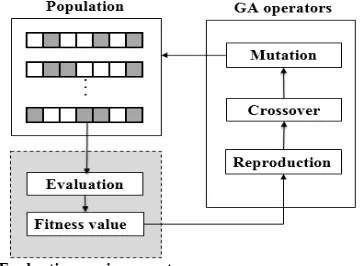
For the selection method, we used the method of selection by roulette strategy [17]. This method supplemented by the solutions resulting from operations of crossover and mutation, to ensuring that the population size remains fixed from one generation to another.
Figure 17. Principle of evaluation and selection process
3.1.Procedure of genetic algorithm :
For the proceeding of our algorithm, it takes as input the genetic algorithm parameter, and transport data to extract output as the optimal plan of transport. Figure 19. shows graphically the global of the proposed process problem-GA for FCTP.
Input : data transport, GA parameter t 1;
Initialization of P(t) by priority-based representation; Evaluation of P(t);
do (condition not finish) While Crossover P(t) by IPX
Mutate P(t) by SWAP mutation to yield C(t); Evaluation C(t) ;
Selecting P(t + 1) from P(t) and C(t) by roulette selection;
t t + 1;
[image:6.612.314.521.104.370.2]Output : Minimum total cost of transportation Figure 18. The proposed GA procedure for FCTP
We know that each genetic operator is applied to the population by a probability. Thus, for the crossover the probability must be chosen (Pc> 0.5)
for the population to progress. However; a mutation probability must be small enough that it does not have a purpose to bring a great change to individuals; but it is a kind of small changes on a reduced number of individual to give opportunity to the neighboring of the current population to be introduced to the new generation.
Thus, the parameters adopted for our examples are as follows:
Crossover rate Pc = 0.6;
Mutation rate Pm = 0.2; Population size, pop = 20;
[image:6.612.109.290.170.303.2]Maximum generation max_gen = 1000.
Figure 19. Process of the proposed GA for FCTP
4. RESULTS AND ANALYSIS
The fixed charge transportation problem (FCTP) is one of the most famous problems in the field of optimization and combinatorial problems. Experiments carried out to compare the performance of genetic algorithms with the crossover operators of adaptive dipped in our problem. We have proposed a new crossover operator adapted for combinatorial problems in general, and we have applied this operator on FCTP problem. The numerical results show a comparison between our operators and several operators used for FCTP. The operators of crossover are the following OPEX, PMX, OX, PX and our proposed operator IPX. In addition, we chose these operators since their use especially for FCTP.
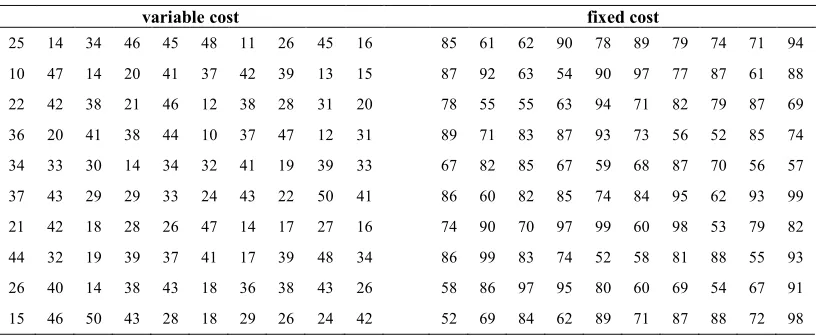
To test, we have chosen five instances (4x5, 5x10, 10x10, 10x20) cited bellow, and 30x50 already used in several articles [13, 19] without taking into account the multiplication by 10. For the optimal solution for small instances is known for small instances.
Table 1: The cost tables for 4x5 instance
variable cost fixed cost
8 4 3 5 8 60 88 95 76 97
3 6 4 8 5 51 72 65 87 76
8 4 5 3 4 67 89 99 89 100
4 6 8 3 3 86 84 70 92 88
Table 2: The optimal solution for 4x5 instance
57 57
93 69 24
50 50
[image:7.612.77.488.154.358.2]75 19 23 33
Table 3: The cost tables for 5x10 instance
variable cost fixed cost
8 4 3 5 2 1 3 5 2 6 160 488 295 376 297 360 199 292 481 162
3 3 4 8 5 3 5 1 4 5 451 172 265 487 176 260 280 300 354 201
7 4 5 3 4 2 4 3 7 3 167 250 499 189 340 216 177 495 170 414
1 2 8 1 3 1 4 6 8 2 386 184 370 292 188 206 340 205 465 273
4 5 6 3 3 4 2 1 2 1 156 244 460 382 270 180 235 355 276 190
Table 4: The optimal solution for 5x10 instance
157 0 0 0 0 130 0 27 0 0 0
293 0 79 90 0 0 0 0 124 0 0
150 0 0 0 32 0 88 30 0 0 0
575 225 71 0 183 0 0 0 0 0 96
310 0 0 0 0 0 0 0 0 273 37
[image:7.612.89.497.535.703.2]225 150 90 215 130 88 57 124 273 133
Table 5: The cost tables for 10x10 instance
variable cost fixed cost
25 14 34 46 45 48 11 26 45 16 85 61 62 90 78 89 79 74 71 94
10 47 14 20 41 37 42 39 13 15 87 92 63 54 90 97 77 87 61 88
22 42 38 21 46 12 38 28 31 20 78 55 55 63 94 71 82 79 87 69
36 20 41 38 44 10 37 47 12 31 89 71 83 87 93 73 56 52 85 74
34 33 30 14 34 32 41 19 39 33 67 82 85 67 59 68 87 70 56 57
37 43 29 29 33 24 43 22 50 41 86 60 82 85 74 84 95 62 93 99
21 42 18 28 26 47 14 17 27 16 74 90 70 97 99 60 98 53 79 82
44 32 19 39 37 41 17 39 48 34 86 99 83 74 52 58 81 88 55 93
26 40 14 38 43 18 36 38 43 26 58 86 97 95 80 60 69 54 67 91
Table 6: The optimal solution for 10x10 instance
30 0 14 0 0 0 0 16 0 0
17 0 0 0 2 0 0 0 0 0
27 0 0 0 6 0 21 0 0 0
29 0 3 0 0 0 0 0 0 26
20 0 0 0 20 0 0 0 0 0
18 0 0 0 0 10 0 0 8 0
11 0 0 0 0 0 0 0 11 0
15 0 0 0 0 10 0 5 0 0
14 0 0 13 0 0 0 0 1 0
23 23 0 0 0 0 0 0 0 0
[image:8.612.108.504.247.754.2]23 17 13 28 20 21 21 20 26
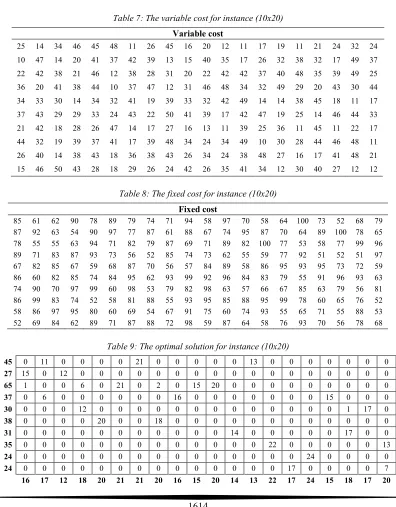
Table 7: The variable cost for instance (10x20)
Variable cost
25 14 34 46 45 48 11 26 45 16 20 12 11 17 19 11 21 24 32 24
10 47 14 20 41 37 42 39 13 15 40 35 17 26 32 38 32 17 49 37
22 42 38 21 46 12 38 28 31 20 22 42 42 37 40 48 35 39 49 25
36 20 41 38 44 10 37 47 12 31 46 48 34 32 49 29 20 43 30 44
34 33 30 14 34 32 41 19 39 33 32 42 49 14 14 38 45 18 11 17
37 43 29 29 33 24 43 22 50 41 39 17 42 47 19 25 14 46 44 33
21 42 18 28 26 47 14 17 27 16 13 11 39 25 36 11 45 11 22 17
44 32 19 39 37 41 17 39 48 34 24 34 49 10 30 28 44 46 48 11
26 40 14 38 43 18 36 38 43 26 34 24 38 48 27 16 17 41 48 21
15 46 50 43 28 18 29 26 24 42 26 35 41 34 12 30 40 27 12 12
Table 8: The fixed cost for instance (10x20)
Fixed cost
85 61 62 90 78 89 79 74 71 94 58 97 70 58 64 100 73 52 68 79
87 92 63 54 90 97 77 87 61 88 67 74 95 87 70 64 89 100 78 65
78 55 55 63 94 71 82 79 87 69 71 89 82 100 77 53 58 77 99 96
89 71 83 87 93 73 56 52 85 74 73 62 55 59 77 92 51 52 51 97
67 82 85 67 59 68 87 70 56 57 84 89 58 86 95 93 95 73 72 59
86 60 82 85 74 84 95 62 93 99 92 96 84 83 79 55 91 96 93 63
74 90 70 97 99 60 98 53 79 82 98 63 57 66 67 85 63 79 56 81
86 99 83 74 52 58 81 88 55 93 95 85 88 95 99 78 60 65 76 52
58 86 97 95 80 60 69 54 67 91 75 60 74 93 55 65 71 55 88 53
52 69 84 62 89 71 87 88 72 98 59 87 64 58 76 93 70 56 78 68
Table 9: The optimal solution for instance (10x20)
45 0 11 0 0 0 0 21 0 0 0 0 0 13 0 0 0 0 0 0 0
27 15 0 12 0 0 0 0 0 0 0 0 0 0 0 0 0 0 0 0 0
65 1 0 0 6 0 21 0 2 0 15 20 0 0 0 0 0 0 0 0 0
37 0 6 0 0 0 0 0 0 16 0 0 0 0 0 0 0 15 0 0 0
30 0 0 0 12 0 0 0 0 0 0 0 0 0 0 0 0 0 1 17 0
38 0 0 0 0 20 0 0 18 0 0 0 0 0 0 0 0 0 0 0 0
31 0 0 0 0 0 0 0 0 0 0 0 14 0 0 0 0 0 17 0 0
35 0 0 0 0 0 0 0 0 0 0 0 0 0 22 0 0 0 0 0 13
24 0 0 0 0 0 0 0 0 0 0 0 0 0 0 0 24 0 0 0 0
24 0 0 0 0 0 0 0 0 0 0 0 0 0 0 17 0 0 0 0 7
Table 10: Best chromosome for the test problem.
Instance Best chromosome
4x5 1 6 8 2 4 3 9 7 5
5x10 11 1 7 3 13 14 2 5 6 12 4 10 9 15 8
10x10 8 5 14 12 19 2 1 6 15 20 9 10 7 11 3 16 4 13 18 17
10x20 4 20 27 12 2 13 21 24 16 26 25 11 22 17 18 6 9 14 8 1 23 15 19 3 29 10 5 30 28 7
30x50
10 54 59 48 49 13 23 57 7 60 53 42 63 45 58 46 15 14 43 47 79 26 16 30 17 37 78 3 38 71 34 68 11 74 9 33 22 76 50 67 75 12 56 4 25 24 2 21 72 55 40 77 69 27 62 52 5 65 28 61 32 41 8 29 6 51 31 35 36 73 19 18 1 39 64 66 70 20 44 80 In this comparative study, for small instances, 4*5 and 5*10, the results obtained show that GA with all crossover operators used allow to obtain the best chromosome satisfying the optimal solution. However, with the proposed crossover operator IPX, you need a reduced number of iterations. For 5*10 instance, we need 69 iterations with the operator OPEX, 34 iterations with PMX operator, 27 iterations with OX, 16 iterations with PX operator to achieve the optimal solution that is Z=6195. By cons, 16 iterations are enough with the proposed IPX operator to get the same optimal solution.
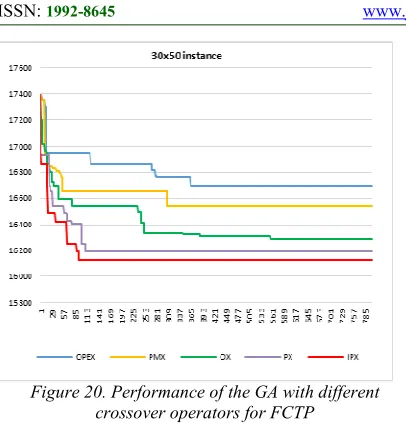
However, for problems with important size, the proposed operator IPX is very efficient compared to others, with a slight precision for the IPX operator in terms of optimal solution. Although, the latter is more advantageous to the level of number of iterations. Indeed, for 10*20 instance, the proposed operator IPX leads to the optimal solution Z=7303, this shows that our proposed operator is best compared to other operators.
On the other hand, the proposed operator IPX needs only 35 iterations to achieve optimal obtained solution. However, other operators do not achieve the optimal solution; they arrived at best and not the optimum solution after important iterations.
The performance of the IPX operator is clearer when the instances are more important. Indeed, for instance 30*50, the genetic algorithm with the proposed IPX operator converges to the optimal solution 16129 in 93 iterations which is not accessible to other operators. This shows the great performance of the proposed operator IPX, it allows achieving a better optimal solution in a reduced number of iterations over other operators.
In addition, the experimental results show that the execution time varies from one operator to another. The proposed operator IPX is the best than
Figure 20. Performance of the GA with different crossover operators for FCTP
Find an algorithm that solves a problem, this is not always an easy thing, but what can be even more difficult and especially much more interesting, is to find an algorithm that provides this solution quickly. A factor in the performance of the algorithm is to solve the problem in a manner more quickly.
The convergence and the time of execution of the algorithm to achieve the optimal solution are very important; it varies from one operator to another. For this reason, the choice of the operator is an important factor to improve the solution.
5. CONCLUSION
In this work, we are interested to the FCTP problem that is an NP-complete and combinatorial problem. View that its resolution by the exact methods is very difficult, we opted for genetic algorithms where the crossover operator subject of our study has a great effect. After having presented four crossover operators (OX, PMX, OPEX, PX) adapted to our problem, we proposed a new operator which we have called (IPX). A comparative study was elaborated supporting the conclusion that the proposed IPX operator higher performance than the four operators presented, especially for larger instances.
REFRENCES:
[1] F. L. Hitchcock, “The distribution of a product from several sources to numerous localities”,
Journal of Mathematical Physics, vol. 20, 1941, pp. 224–230.
[2] J. W. Stroup, “Allocation of launch vehicles to space missions: a fixed-cost transportation problem”, Operations Research, vol. 15, No. 6, 1967, pp. 11-57.
[3] T. H. Hultberg, D. M. Cardoso, “The teacher assignment problem: A special case of fixed charge transportation problem”, European Journal of Operational Research, vol. 101, 1997, pp. 463-473.
[4] V. Adlakha, K. Kowalski, “A heuristic method for more-for-less in distribution related problems”, International Journal of Mathematical Education in Science and Technology, vol. 32, 2001, pp. 61-71.
[5] W. M. Hirsch, G. B. Dantzig, “The fixed charge problem”, Naval Research Logistics Quarterly, vol. 15, 1968, pp. 413–424. [6] K. G. Murty, “Solving the fixed charge
problem by ranking the extreme points”,
Operations research, 1968, vol. 16, No. 2, pp. 268 -279.
[7] A. Sadighmanesh, K. Zare, M. Sabahi, “Distributed Generation unit and Capacitor Placement for Multi-objective Optimization”,
International Journal of Electrical and Computer Engineering, vol. 2, 2012, pp. 615-620.
[8] J. Gottlieb, L. Paulmann, “Genetic algorithm for the fixed charge transportation problem”,
in: Proc. of IEEE Inter. Conf. on Evolutionary Computation, 1998, pp. 330–335.
[9] J. R. Mohammed, “A Study on the Suitability of Genetic Algorithm for Adaptive Channel Equalization”, International Journal of Electrical and Computer Engineering, 2012, pp. 285-292.
[10] J. Holland, “Adaptation in natural and artificial systems”, University of Michigan Press, 1975.
[11] Z. Michalewicz, G.A. Vignaux, M. Hobbs, “A non-standard genetic algorithm for the nonlinear transportation problem”, ORSA Journal on Computing, vol. 3, 1991, pp. 307– 316.
[12] M. Gen, R. Cheng, “Genetic Algorithms and Engineering Optimization”, second ed., John Wiley & Sons, New York, 2000.
[14] M. Gen, F. Altiparmak, L. Lin, “A genetic algorithm for two-stage transportation problem using priority-based encoding”, OR Spectrum, vol. 28, 2006, pp. 337–354.
[15] L. Lin, M. Gen, X. Wang, “Integrated multi-stage logistics network design by using hybrid evolutionary algorithm”, Computers & Industrial Engineering, vol. 56, 2009, pp. 854–873.
[16] J.E. Lee, M. Gen, K.G. Rhee, “Network model and optimization of reverse logistics by hybrid genetic algorithm”, Computers & Industrial Engineering, vol. 56, 2009, pp. 951–964. [17] O. Abdoun, C. Tajani, J. Abouchabaka,
“Hybridizing PSM and RSM Operator for Solving NP-Complete Problems: Application
to Traveling Salesman Problem”,
International Journal of Computer Science Issues, vol. 9, No. 1, 2012, pp. 374-378. [18] A. Sadighmanesh, K. Zare, M. Sabahi,
“Distributed Generation unit and Capacitor Placement for Loss, Voltage profile and ATC Optimization”, International Journal of Electrical and Computer Engineering, vol. 2, 2012, pp. 774-780.
[19] M. I. Azim, M. F. Rahman, “Genetic
Algorithm Based Reactive Power
Management by SVC”, International Journal of Electrical and Computer Engineering,
2014, pp. 200-206.
[20] K.W. Kim, M. Gen, G. Yamazaki, “Hybrid genetic algorithm with fuzzy logic for resource-constrained project scheduling”,
Applied Soft Computing, vol. 2, 2003, pp. 174–188.
[21] M.L. Balinski, “Fixed cost transportation problems”, Naval Research Logistic Quarterly
vol. 8, 1961, pp. 41–54.
[22] M. Lotfia, R. Tavakkoli, “A genetic algorithm using priority-based encoding with new operators for fixed charge transportation problems”, Applied Soft Computing, vol. 13, 2013, pp. 2711–2726.
[23] L. Davis,“Applying adaptive algorithms to domains”. Proceeding of the International Joint Conference on Artificial Intelligence, vol. 1, 1985, pp. 162–164.
[24] G. Syswerda, “Schedule Optimization Using Genetic Algorithms”, Handbook of Genetic Algorithms, Van Nostran Reinhold, New York, 1990.
[25] B. Chakraborty, P. Chaudhuri, “ On The Use of Genetic Algorithm with Elitism in Robust and Non parametric Multivariate Analysis”, Austrian journal of statistics, vol. 32, No. 1-2, 2003, pp. 13–27.