CLUSTER BASED SLEEP SCHEDULING MECHANISM FOR
WIRELESS SENSOR NETWORKS
1
SREEVIDYA R. C., 2NAGARAJA G. S.
1
Asstt Prof., Department of Computer Science and Engineering, Bengalore, India
2
Assoc. Prof., Department of Computer Science and Engineering, Bengalore, India
E-mail: [email protected], [email protected]
ABSTRACT
Wireless Sensor Networks (WSN) are resource constrained. Energy consumption of whole network is balanced at individual nodes. Due to this nodes lifetime is extended. Absence of identifying the redundant nodes causes unnecessary energy consumption. To solve this, an energy efficient cluster method with cluster based redundancy discovery and sleep algorithm for energy efficient routing is proposed. In this work, Cluster heads are chosen based on residual energy, message representative path and distance. A cluster based algorithm is used for discovery of redundant nodes in the network. The algorithm works without any additional directional antennas. In each cluster, clustering sleep scheduling mechanism is initiated when data transfer rate is less than the threshold value. If the data transfer rate do not cross the threshold value, then all nodes in the cluster will go to sleep mode. The proposed method balances the energy at individual nodes and extends the network lifetime.
Keywords: Wireless Sensor Network, Cluster Head, Minimum Depth Tree (MDT), Intra-cluster Routing, Sleep Scheduling Algorithm.
1. INTRODUCTION
Wireless sensor networks are made up of large number of combinational devices that are placed over a wide area in an adhoc manner. Sensing devices have limited resources due to which processing and communicating processes are bounded. These sensing devices have numerous applications in a variety of fields including science and technology. The process of transmitting data on a network depletes more energy than sensing and computation. So, the power required to transmit grows exponentially with an increase in the distance of a node to be transmitted. To extend the network lifetime, the traffic and the distance to be transmitted has to be taken care [1], [2].
The resource constrained nature of the sensor devices makes the network to fail when half the nodes battery has been depleted. This constrained feature of sensor devices do not perform well with the traditional routing protocols [3] and adhoc networks. So, one way to save the transmission power is formation [4] of clusters. Clustering gathers the data from each of the sensor node and sends it to the base station through cluster heads. The clustered environment sends data over small distances so that energy spent is much less
compared to the energy spent by all the sensors when communicating directly to the base station. Hence, cluster formation with optimal Cluster-Heads selection can drastically affect the network’s communication energy dissipation [5], [6].
The selected cluster heads can be made use for data collection and habitat monitoring. Each cluster head in a cluster performs node interaction, validation and assignment of tasks. Every time the topology changes the cluster head has to maintain the cluster structure by considering hardware failures and mobility factors. Due to these activities in the network cluster head has to sustain a high energy consumption compared to other cluster members. So, the load of the cluster head has to be distributed among all other nodes.
2. RELATED WORK
Da-Ren Chen et al. [7] have proposed a self-stabilizing hop-constrained energy-efficient (SHE) protocol for constructing minimum hop and energy networks for QoS routing. In the paper, first multi hop methods are constructed within the cluster and the cluster transmits the packet form member nodes to their cluster heads. Adaptive routing is used from cluster heads to base stations in different route depending on their current values.
Hyunjo Lee et al. [8] have proposed a new energy-efficient cluster-based routing protocol, using a centralized clustering approach where cluster headers are selected by a representative path. To support reliability in communicating data multi hop routing protocol allows cluster communications. Message success rate and representative path helps in distributing clusters uniformly and to prolong the network lifetime.
Zhan-Yang Xu et al. [9] have proposed an energy efficient unequal clustering techniques which improves the selection of candidate cluster heads randomly by combining network clustering strategy and node dormancy strategy. The clustering sleep scheduling mechanism helps in achieving longer network lifetime.
Z. Zhang et al. [10] have proposed an energy-balanced mechanism for hierarchical routing (EBM-HR), in which the residual energy of redundant nodes is quantified and made hierarchic, so that the cluster head can dynamically select the redundant node with the highest residual energy grade as a relay to complete the information transmission to the sink node and achieve an intra-cluster energy balance. In addition, the network is divided into several layers according to the distances between cluster heads and the sink node. Based on the energy consumption of the cluster heads, the sink node will decide to re-cluster only in a certain layer so as to achieve an inter cluster energy balance.
Shaojie Wen et Al. [11] have proposed an energy-efficient opportunistic multicast routing protocol (E-OMRP) for the multicast energy consumption in mobile wireless sensor networks. The method divides the entire network into grids which obtains its own coordinates according to the grid. The method does not concern about the energy balance of all the individual nodes in network. If the energy consumption of whole network is balanced at individual node level, then some node life time will be extended. Absence of identifying the redundant nodes will cause unnecessary energy
consumption. In network, some nodes will monitor same area and transmit similar information. These will cause unnecessary energy consumption.
Ray, Anindita et al [12] have presented an energy efficient clustering protocol based on K-means algorithm named EECPK-means has been propose for WSN where midpoint algorithm is used to improve initial centroid selection procedure. The proposed approach produces balanced clusters to ultimately balance the load of Cluster Heads (CHs) and prolong the network lifetime. It considers residual energy as the parameter in addition to Euclidean distance used in basic K-means algorithm for appropriate CH selection. Multi-hop communication from CH nodes to BS takes place depending on their distances from base station. Simulation result shows that the proposed approach outperforms LEACH-B, K-means with respect to network lifetime and energy efficiency. Here, the major concern is easily troubled by surroundings (walls, microwave, large distances due to signal attenuation, etc.).
Song, X., Wen, et al [13] have illustrated a Coverage-aware Unequal Clustering Protocol with Load Separation (CUCPLS) for data gathering of Ambient Assisted Living (AAL) applications based on WSNs. Firstly, the coverage overlap factor for nodes is introduced the accounts for the degree of target nodes covered. In addition, to balance the intra-cluster and inter-cluster energy consumptions, different competition radiuses of CHs are computed theoretically in different rings, and smaller clusters are formed near the sink. Moreover, two CHs are selected in each cluster for load separation to alleviate the substantial energy consumption difference between a single CH and its member nodes. Furthermore, a back off waiting time is adopted during the selection of the two CHs to reduce the number of control messages employed. Simulation results demonstrate that the CUCPLS not only can achieve better coverage performance, but also balance the energy consumption of a network and prolong network lifetime.
accuracy of our proposed model and applicability to large scale WSNs.
Ho, Paul, and Huai Tan [15] have presented an effective clustering algorithm to estimate the channel gains required for coherent multi-user detection. To demonstrate the feasibility of this concept, simulate the bit error rates (BER) of 4-Frequency Shift Key (FSK) and 8FSK systems with three and four simultaneously transmitting sensor nodes, respectively. It was found that the BER of the proposed blind multi-user detector is very close to that achieved under perfect channel state information. This suggests that the proposed integrated modulation/random access approach can significantly improve spectral efficiency and mitigate multi-user interference. Compared to no multi-user detection, less energy is wasted on the re-transmissions caused by packet collisions and this helps to extend the lifetime of the sensor nodes. Though, it is extremely costly to implement in real time applications.
Cenedese, Angelo et al [16] have evaluated a clustering strategy that partition a sensor network into a non-fixed number of non-overlapping clusters according to the communication network topology and measurements distribution. To this aim, both a centralized and a distributed algorithm are designed that do not require a cluster-head structure or other network assumptions. As a validation, these strategies are tested on a real dataset coming from a structured environment and the effectiveness of the clustering procedure is also investigated to perform. Whereas, comparatively low speed of communication.
To overcome the above mentioned drawbacks, an effective clustering algorithm is implemented, which enhances the procedure acclimated in our anticipated strategy.
3. OVERVIEW
The cluster head is selected based on residual energy, distance and message success rate. All cluster heads are connected to sink nodes. The path between sink node and cluster head node is called as representative path. This path is created using the message success rate and it is used by sink node to selects cluster heads.
If the transmission is within the cluster then it is intra cluster and it is done by cluster head node itself. If the transmission is within the cluster then is called as intra-clustering method. In both methods, the aging tags are initialized to each individual data packets. Aging tags are used to reduce the tolerable delay. In intra-clustering
method, Intra-cluster routing technique is applied to determine suitable routes for packet transmission to sender. In intra-clustering method, path is created by sink node.
Each node has unique NID and that is stored in network table. This information is used to eliminate the redundant node. Data transfer rate is calculated with in cluster. If the data transfer rate is less than threshold value, then all nodes in cluster will go to sleep. We compare our cluster-based routing scheme with the existing routing protocols, such as LEACH, LEACH-C, and K-Way.
3.1 Cluster Formation
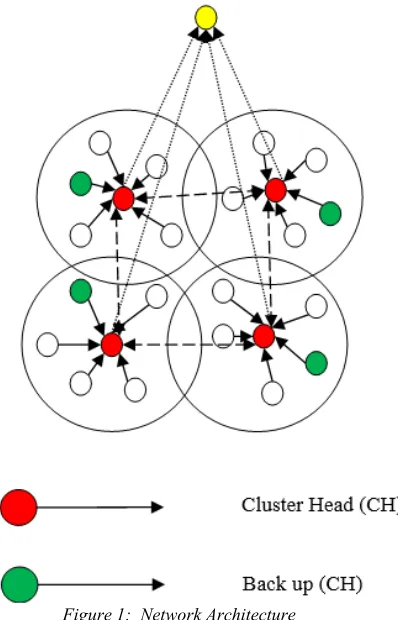
[image:3.612.328.527.387.697.2]Network consists of multiple sensor nodes and each sensor node communicates with all neighboring sensor nodes to make a cluster. Initially, sensor node sends “hello” data packets to its all neighboring nodes and each sensor node can communicate with other nodes with some radius. Let as assume d is the approximating distance and r is radius. The nodes within the radius are formed as cluster. Based on the radius, each sensor nodes are divided into multiple clusters.
Figure 1: Network Architecture
network table. Residual energy is calculated using the following equation
T S R
RE = E - (E + E ) (1)
In equation (1), E is the energy used for sending S
the packets andE is energy used for receiving R
packets.E is the total energy of node. T
The path between sink node and cluster head node is called as representative path. This path is created using the message success rate and it is used by sink node to selects cluster heads. Message successes rate is calculated using the following equation
i
i
E MSR 1 -
E
i
R
−
=
(2)
In equation (2), MSR is the message success rate,
i
E is the expected number of packets and Riis the
received number of packets in the given time. Each sensor node calculates its residual energy, distance among neighboring nodes and message success rate.
The cluster head is selected based on residual energy, distance and message success rate. All cluster heads are connected to sink nodes. Cluster head selected using the following algorithm.
Start
Define
RE = residual energy
D = distance
MSR = message success rate
If (all nodes in the list)
{
Get the RE, D, MSR values from network table
Node which as max (RE, MSR), min (d) is selected as CH
Second max (RE, MSR), min (d) is selected as back up CH
}
End
Algorithm 1: CH Selection
In the cluster, for all nodes CH selection algorithm is applied and the node which has maximum residual energy and MSR, minimum distance is selected as CH. Second maximum residual energy and MSR, minimum distance is selected as backup CH.
Data transmission is done in two ways. One is Inter-cluster routing and second one is Intra-cluster routing. Data transmission is within cluster then, Inter-cluster routing algorithm is applied and CH will execute this algorithm. Data transmission is one cluster to another cluster then Intra-cluster routing is applied and Sink node is executed this algorithm. The two algorithms are given below.
3.2 Inter-Cluster algorithm
In inter-cluster routing, the source node and destination node both are in the same cluster and CH is responsible for selecting the best route. When source node wants to send the packets to the destination, it will send the hello message to all the nodes in cluster. The destination node gives the message and gives the replay for ack message. The CH takes all nodes between the source and destination.
When multiple routes are there, then cost function is applied to select the best route. In route selection, a Minimum Depth Tree (MDT) is a tree constructed, that MDT minimizes the cost from each sensor node. MDT is applied or every possible combination of all sensor nodes. The Inter-Cluster routing algorithm is given below.
Start
Define
S = list of nodes between source and destination
For (
j
i i 1
C 0
= ≠
∑
){
For each sensor node in the list “S”
{
Multiple paths are calculated form source to destination.
Shortest path is selected among all multiple paths
}
}
Calculate the Cmin for each partitioned MDT using the equation (3)
Select the minimal Cmin
}
Choose the best set of sink nodes among all minimal values
End
Algorithm 2: Inter-Cluster Routing Algorithm
In Inter-cluster routing algorithm, shortest path is calculated for each sensor node to sink node in list. First calculate the number of children for each sensor node in MDT and then calculate the link cost to parent. The total data volume produced at each sensor node can be calculated from the following eq. 3.
* ( 1) *
i value
child
E C
NC PR NC PT
=
+ + (3)
In equation (3),
EI = Initial energy of sensor node
NC = the number of children
PR = Receiving power consumption per bit
PT = Transmitting power consumption per bit
value
C = the total data volume produced at sensor node
3.3 Intra-Cluster Algorithm
In Intra-cluster routing, data transmission is one cluster to another cluster. In this routing, source will be one cluster and destination will be in another cluster, SN will select the route. Initially, CH which has the source node sends a message to the SN with destination node details. SN will forward that message to the all other CH in the network. All remaining CH’s forwards message to its nodes. The destination node will send ack message to its CH and CH forwards to SN. SN node collects the all nodes in between the source and destination. Intra-cluster algorithm is applied to select the best path and the algorithm is given below.
Start
Define
If (CH check source and destination nodes are not in the same cluster)
{
CH sends the destination sensor node to SN (Sink node)
SN forwards the same message to the all CH in the region
All CH forwards destination message to all nodes in their cluster
Packets is reached to destination node, it will replay with ack message
BS node sends the destination node details to CH (which contains Source node)
CH gets the all list of nodes between source and destination
Assume S is list of nodes between source and destination
For (
j
i i 1
C 0
= ≠
∑
){
For each sensor node in the list “S”
Shortest path is calculated form source to destination.
Choose the sensor node as a root of the MDT which has shortest path among the all paths to several links
Calculate the Cmin for each partitioned MDT using the equation (3)
Select the minimal Cmin
}
Choose the best set of sink nodes among all minimal values
}
End
Algorithm 4: Intra-Cluster Routing Algorithm
3.4 Redundancy Algorithm
To prolong the network lifetime and reduce the energy consumption it is necessary to discover and identify the redundant nodes. We are assigning unique node ID to each and every cluster in the network and that information is stored in network table.
Start
Define
NID= Node ID
TI = Time Interval
Repeat (TI)
{
CH gests NID from all network table
CH sends their nodes NID to other CH’s
Other CH’s compare with their nodes NID
if same node NID exists
Then delete those NID from other NID
}
End
Algorithm 5: Redundancy Algorithm
CH gets all the nodes NID’s using the network table and its NID to all others CH in the network. All CH compare the received NID’s with their nodes NID. If any same NID is their means, it will delete that node from that cluster. This algorithm is applied for every periodic time.
3.5 Sleep Scheduling Algorithm
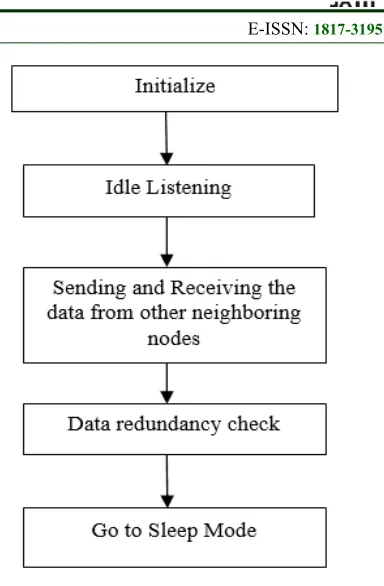
In WSN, at a time all nodes are not participating in data transmission. By using sleep scheduling algorithm, we set the sensor nodes which are not participating in the transmission into sleep node. This method will save unnecessary energy consumption.
[image:6.612.330.522.64.357.2]Initially, all nodes in the cluster in listening state. CH will calculate the threshold value of sensing data and if the threshold value is low then, it will send sleep message to all unused node.
Figure 2: Node Sleeping Steps
Assume TS is predefined threshold value and
C
TS is the calculated threshold value. Threshold value is calculated for define time slot and calculated using following equation 4.
send "W""
send "S""
if TS is ve
l
TS TS TS
l C if TS is ve
l +
= −
−
(4)
In equation (4), TSl latest threshold values. Based on theTSlvalue, CH will send W or S
message to all the nodes in cluster. W means wake up and S means sleep. If theTSlvalue is positive means, there is huge data transmission in the cluster then all nodes will get wake up (W) from CH. If theTSlvalue is negative means, there is huge data transmission in the cluster then all nodes will go to sleep state (S). Data redundancy check is done by using the algorithm (5).
4. EXPERIMENTAL RESULT AND DISCUSSION
model, we have simulated a wireless sensor network with 20 sensor nodes, which are randomly distributed between 150*100 area and communication through wireless channel with Omni-antenna. Each node has the 100 Mega Joule (MJ) as initial energy. By analyzing, the shortest distance between the each node is determined by employing proposed algorithm.
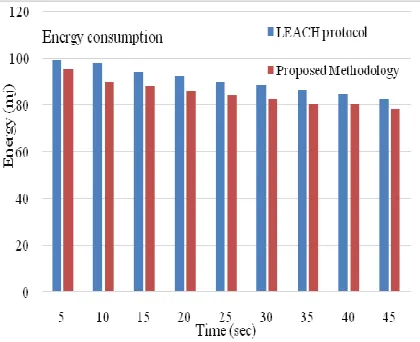
In this section, we compare our proposed methodology with the well-known existing LEACH protocol in terms of energy consumption. Table.1 confirms that the proposed method shows less energy consumption compared to LEACH protocol in different time intervals.
Table 1: Performance Evaluation
Time Interval (TI)
5
10
20
30
40
50
60
70
Energy(MJ)
100
94
99
90
92
87
89
82
86
80
89
87
85
88
88
85
In figures 3 and 4, we conclude that our proposed algorithm consumed less energy when comparing with the LEACH protocol. Our proposed algorithm performed well in terms of energy consumption in every time. This is because of the Clustering Sleep Scheduling Mechanism is on when data transfer rate is less than threshold value, all nodes in cluster will go to sleep mode which leads to balance the energy at individual nodes and it will prolong the lifetime of network.
Figure 3: Comparative analysis of Energy consumption for various periods
[image:7.612.92.302.392.563.2]Moreover, our proposed clustering algorithm uses the adaptive distance measure for the similarity matrix, which helps to select the single minimum distance transfer node for an each node which leads to select single transferring node instead of transferring the multiple nodes.
Figure 4: Comparative analysis of Energy consumption for various periods
5. CONCLUSION
A new energy- efficient cluster based redundancy discovery and sleep algorithm for energy efficient routing is proposed in this paper. CH is selected based on residual energy, message representative path and distance. Data transmission assessed in two ways such as within cluster and intra-cluster algorithms. Here, a cluster based algorithm is used for discovering the redundant nodes in network. In each cluster, Clustering Sleep Scheduling Mechanism is on when data transfer rate is less than threshold value. If the data transfer is less than threshold value, all nodes in cluster will go to sleep mode. The new method will balance the energy at individual nodes and it will extend the lifetime of network.
sensor network is further diminished by employing a new approach.
REFRENCES:
[1] J. Zheng, A. Jamalipour, “Wireless sensor networks: A Networking Perspective”, John Wiley & Sons, Inc. 2009.
[2] N. Tuah, M. Ismail and K. Jumari, “Cluster - Head Selection by Remaining Energy Consideration in a Wireless Sensor Network”,
Proceedings ofthe International Conference on
Informatics Engineering and Information
Science, Vol. 253, 2011, pp. 498-507.
[3] P. Tillapart, S. Thammarojsakul, T. Thumthawatworn and P. Santiprabhob, “An Approach to Hybrid Clustering and Routing in Wireless Sensor Networks”, Proceedings of
IEEE Aerospace Conference, 2005, pp. 1-8.
[4] G. J. Pottie and K. J. Kaiser, “Wireless Integrated Network Sensors”, Communications
of the ACM, Vol. 43, 2000, pp. 51-58.
[5] L. Ying and Y. Haibin, “Energy Adaptive Cluster-Head Selection for Wireless Sensor Networks”, Proceedings of Sixth International Conference on Parallel and Distributed Computing, Applications and Technologies
(PDCAT 2005), 2005, pp. 634-638.
[6] E. Akhtarkavan and M.T.M. Shalmani, “Energy Adaptive Cluster-Head Selection for Wireless Sensor Networks Using Center of Energy Mass”, Advances in Computer Science and
Engineering, Vol. 6, 2009, pp. 130-137.
[7] Chen, Da-Ren. “An energy-efficient QoS routing for wireless sensor networks using self-stabilizing algorithm”, Ad Hoc Networks, Vol. 37, 2016, pp. 240-255.
[8] H. Lee, M. Jang and J.W. Chang, “A new energy-efficient cluster-based routing protocol using a representative path in wireless sensor networks”, International Journal of Distributed
Sensor Networks, 2014.
[9] Z.Y. Xu, S.G. Zhao, and Z.J. Jing, “A Clustering Sleep Scheduling Mechanism Based on Sentinel Nodes Monitor for WSN”,
International Journal of Smart Home, Vol. 9, 2015, pp. 23-32.
[10] Zhang, Z., Wang, Y., Song, F. and Zhang, W., “An energy-balanced mechanism for hierarchical routing in wireless sensor networks”, International Journal of Distributed
Sensor Networks, 2015, pp.163.
[11] S. Wen, Z. Zhang, W. Yang, and S. Hou, “An energy-efficient opportunistic multicast routing protocol in mobile wireless sensor networks”,
Journal of Networks, Vol. 9, 2014, pp. 1819-1827.
[12] A. Ray, and D. De, “Energy efficient clustering protocol based on K-means (EECPK-means)-midpoint algorithm for enhanced network lifetime in wireless sensor network”, IET Wireless Sensor Systems, Vol. 6, No. 6, 2016, pp. 181-191.
[13] X. Song, T. Wen, W. Sun, D. Zhang, Q. Guo, and Q. Zhang, “A coverage-aware unequal clustering protocol with load separation for Ambient Assisted Living based on wireless sensor networks”, China Communications, Vol. 13, No. 5, 2016, pp. 47-55.
[14] A. Vajdi, G. Zhang, Y. Wang, and T. Wang, “A New Self-Management Model for Large-Scale Event-Driven Wireless Sensor Networks”, IEEE Sensors Journal, Vol. 16, No. 20, 2016, pp. 7537-7544.
[15] P. Ho, and H. Tan, “A Coherent Multi-User Frequency Shift Keying Receiver for Wireless Sensor Networks Based on Clustering Algorithms”, IEEE Wireless Communications
Letters, Vol. 5, No. 6, 2016, pp. 580-583.