IJPSR (2015), Vol. 6, Issue 12 (Research Article)
Received on 08 June, 2015; received in revised form, 21 July, 2015; accepted, 02 October, 2015; published 01 December, 2015
BUFFER AND EMULSIFIER OPTIMIZATION IN CREAM WITH ITS ANTIBACTERIAL ACTIVITY AND SENSITIVITY
Naniek Widyaningrum *1, 2, Achmad Fudholi 1, Sudarsono 1, and Erna P. Setyowati 1
Faculty of Pharmacy 1,Gadjah Mada University, Indonesia.
Program Study of Pharmacy 2, Sultan Agung Islamic University, Indonesia.
ABSTRACT: Introduction: Green tea contains epigallocatechin gallate (EGCG) that widely use as antibacterial. Formulation development with buffer and emulsifier addition is needed to increase its stability and effectiveness. Buffer addition will increase EGCG stability while emulsifier will increase the cream stability. Objective: This study aimed to determine the optimal formulation from buffer combination between citric acid, ascorbat acid, and triethanolamine that produce pH 5 and also emulsifier combination from propylene glycol, tween 80 and span 80 using simplex lattice design method. Moreover, the effectiveness of optimum cream formula was tested against
Propionibacterium acnes (P.acnes) and Staphylococcus epidermidis (S.epidermidis) while its sensitivity was tested on rabbit’s skin. Methods: Buffer optimization was obtained using 13 compositions with the combination of citric acid, ascorbat acid, and triethanolamine namely: 100-0-0,0-100-0,0-0-100,50-0-50,50-50-0,0-50-50,33-33-33,1,67-1,67-6,67, 6,67-1,67-1,67, 1,67-6,67-1,67, 100-0-0,0-100-0,0-0-100. Data was analyzed using design expert. The optimum buffer combination from ethyl acetate fraction of green tea leaves extract then formulated in the cream which contained various emulsifier composition. The comparison from 13 emulsifier composition of propylene glycol, tween 80, and span 80 is 10000,01000,00100,50050,50500,05050,33 -33-33,1,67-1,67-6,67,6,67-1,67-1,67, 1,67-6,67-1,67, 100-0-0,0-100 -0,0-0-100. Cream evaluation data included dispersive ability, adhesion and chemical stability was optimized using design expert. Furthermore, the optimal cream (contained 6% ethyl acetate fraction of green tea leaves extract, buffer composition, and optimal emulsifier) was evaluated its antibacterial activity through in vitro and sensitivity using patch test method. Result: The result showed that combination of 23,5 citric acid : 54 ascorbic acid : 22,5 triethanolamine as the optimum buffer composition and combination of 21 propylene glycol : 57 tween 80 : 22 span 80 as the optimum emulsifier composition. The amount of optimum cream hindrance on S.epidermis was 25mm, while on P.acnes was 18 mm. The optimum cream did not cause irritation on rabbit’s skin after 3 days evaluation. Conclusion: Optimal cream has the desired physical characteristics, chemical stability, and effectiveness.
INTRODUCTION: EGCG has a good solubility at pH 4-6. On other hand, due to its stability, EGCG is highly unstable at alkali with pH >8. EGCG stability is influenced by pH because EGCG will be more stable in acid aqueous 1.
QUICK RESPONSE CODE
DOI:
10.13040/IJPSR.0975-8232.6(12).5253-58
Article can be accessed online on: www.ijpsr.com
DOI link: http://dx.doi.org/10.13040/IJPSR.0975-8232.6(12).5253-58
Therefore, buffer addition is needed in formulation. However, buffer optimization on anti-acne cream formula containing EGCG has not been reported. EGCG is unstable to light because it will be degradated up to 85% after 1 hour exposure of radiation 2. Studies about EGCG on 8 green tea products that circulated in USA, Japan, and Korea showed a decrease in EGCG concentration after had been stored in dry temperature 20◦C during 6 months 3. It happened because EGCG as an antioxidant could experience oxidation due to the antioxidant activity of green tea itself was not Keywords:
Cream, Buffer, Emulsifier,
Antibacterial activity, Irritation test.
Correspondence to Author: Naniek Widyaningrum
Faculty of Pharmacy, Gadjah Mada University, Indonesia
E-mail:
enough to cope with the excessive oxidative stress. Therefore, antioxidant is needed to enhance the green tea stability.
Ascorbic acid is a water soluble antioxidant, its activity can protect catechin by reducing catechin free radical form into the reduced form. Citric acid is a buffer that has function to create acid pH on EGCG, while triethanolamine has function as alkali reductor. The three materials are expected to produce a pH 5 in cream preparation, pH 5 was selected due to the stability of EGCG on pH 4-6 and skin pH namely 4.5-6.5. Too much acidic pH can cause irritation on skin, whereas too alkaline pH can cause dry and falky skin.
Span 80 and tween 80 emulsifier are non-ionic emulsifier that safe for skin use. Non-ionic emulsifier was chosen because less irritative and less toxic. The combination of non ionic lipophilic and hydrophilic can establish a highly structured emulsion. Propylene glycol acts as a co-surfactant. Propylene glycol will penetrate into surfactan layer that cause the increase of interface fluidity so the emulsion stability will be increased 4. The combination between tween 80 and propylene glycol will increase microemulsion area 5. The use of these three components is intended to obtain a high HLB value thus increasing the stability of the oil-in-water emulsion. Simplex lattice design (SLD) is used in order to obtain the optimum comparison from those three oil in water emulsion. The optimum formula based on tween 80, span 80, and propylene glycol variation has not been reported.
METHODS:
Buffer pH 5 Optimization : citric acid, ascorbic acid, and triethanolamine containing 6% ethyl actetate fraction of green tea leaves extract mixed in various composition using simplex lattice design namely 100-0-0,0-100-0,0-0-100,50-0-50,50-50-0,0-50-50,33-33-33,1,67-1,67-6,67, 6,67-1,67-1,67, 1,67-6,67-1,67, 100-0-0,0-100-0,0-0-100. The pH was tested then analyzed using design expert. pH testing on extract that mixed with the three optimization ingridients was obtained using pH meter which callibrated by equimolar buffer pH 7 and potassium hydroxide phtalate buffer pH 4. Electrode is dipped into a mixture of extracts that
had been diluted with aquadest (one part of the mixture is diluted with 9 parts aquadest) then the pH was oberved.
Emulsifier optimization:
Physical characteristic testing and chemical stability were tested from propylene glycole, tween 80, and span 80 in formula containing 6% ethyl actetate fraction of green tea leaves extract. Physical characteristic testing including dispersive and adhesion ability.
Dispersive ability test:
Cream with a weight of 0.5 grams is placed in the middle of a round glass, covered with another glass and left for 1 minute and then measured the diameter of spreading cream. After that add 1 kilogram load and allowed one minute later measured the diameter of spreading cream.
Adhesion ability test:
0, 25 grams cream were placed over the object glass and pressed by 1 kilogram load during 5 minutes. After that, the object glass was set in testing machine. 80 grams load was added to the testing machine then wrote the time release of the cream from the object glass.
Chemical stability test:
Antibacterial activity testing:
The optimum cream was tested its antibacterial activity against P.acnes and S.epidermidis using modified method 8.
P.acnes ATCC 6919 and S.epidermidis ATCC 35984 were incubated inside blood gelatine media for 72 hours under anaerob condition for P.acnes test and 24 hours under aerob condition with temperature 37◦C for S. Epidermidis. The bacteria suspension was made using sterile 0.85% NaCl. Sterile cotton stick was inserted into the tube containing the bacteria, then pressed to the tube wall to avoid it’s getting too wet. The cotton was swabbed on Mueller Hinton (MH) media which had previously been incubated for approximately 2 hours until flat and thin as possible, then made a hole in the MH media. The ethyl actetate fraction of green tea leaves extract cream was added into the hole. The plate then incubated under 37 ° C temperature during 72 hours for P.acnes under anaerob condition and 24 hours for S. Epidermidis under aerobic condition. 5% lamb blood was added for P. acnes MH testing.
Irritation test: Using Ramington method namely Patch test. Optimum cream, bases and ethyl acetate fraction extract of green tea leaves extract were rubbed on the back of a female albino rabbit skin, and then evaluated for 3 days 6.
RESULT AND DISCUSSION: Buffer optimization:
pH measurement data was analyzed using DX9 software. Simplex lattice design equation related to pH data was obtained:
Y = 2(A) + 4(B) + 10(C) – 4,3(A)(B) + 3,97(A)(C) + 7,97(B)(C) - 57,87(A)2(B)(C) + 14,13(A)(B)2 (C) - 57,87(A)(B)(C)2
Y = pH
A = the proportion of citric acid component B = the proportion of ascorbic acid component C = the proportion of triethanolamine component
The equation showed that each component influencing the pH increase. Triethanolamine is the most influencing factor related to +10 coeficient
value. It was because triethanolamine with alkali characteristic give a significant impact against the pH increase. However, citric acid and ascorbic acid had not significant impact against the pH increase valued +2 and +4 due to the acidic characteristic of citric acid and ascorbic acid. Citric acid is more acidic if compared with the ascorbic acid. The combination of citric acid and ascorbic acid could decrease the pH with -4, 3 value. This was suitable with the research 9 that stated EGCG was stable in ascorbic acid but ascorbic acid could not decrease the pH significantly so acidic acid was needed to decrease the pH. The combantion of three components namely citric acid, ascorbic acid, and triethanolamine affected the pH decrease.
The combination of citric acid and ascorbic acid could decrease the pH because both components were acidic with -4,3 value (A)(B), citric acid with triethanolamine combination and ascorbic acid with triethanolamine combination could increase the pH value. This proofed by (A)(C) and (B)(C) combination with the values were +3,97 and +7,97. The most influencing factor due to the pH increase was triethanolamine because its alkaline characteristic with +10 coefficient value, then followed by ascorbid acid with +4 coefficient value, and last citric acid with +2 coefficient value. To conclude, the most influencing factor against the pH decrease was citric acid, then ascorbic acid, while triethanolamine affected the pH increase or as reductor for citric acid and ascorbic acid together with the three combinations could decrease to the desired pH which was pH 5.
FIG.1: BUFFER CONTOUR PLOT PROFILE
b. Emulsifier optimization:
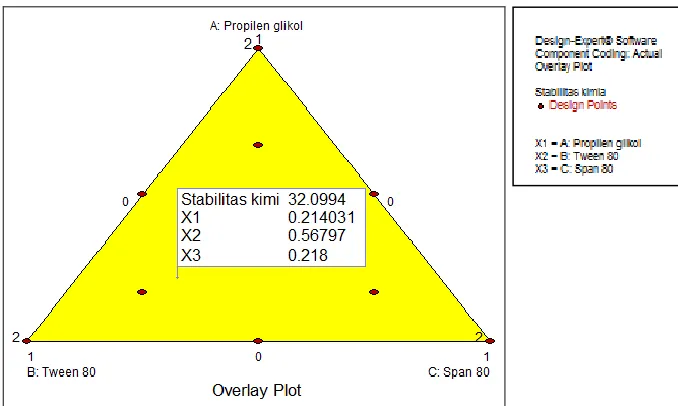
FIG.2: SUPER IMPOSED COUNTOR PLOT DIAGRAM OF THE OPTIMUM CREAM FORMULATION FROM ETHYL ACTETATE FRACTION OF GREEN TEA LEAVES EXTRACT
Emusifier composition on desirability value 0,908 was chosen as the optimum composition. Based on the super imposed contour plot diagram (Fig.2), showed that the chosen formula by the software as the optimum formula was the formula containing 21% propylene glycol, 57 % tween 80, and 22% span 80. Each component consist of 2, 1 gram, 5,7 gram and 2, 2 gram in 100 gram formula. Moreover, the software predicted physical characteristics and chemical stability value from the optimum formula namely dispersive ability was 5, 6 cm, adhesive 33 seconds, and chemical stability 32, 1%w/w.
Optimum formula verification:
[image:4.612.188.527.315.518.2]TABLE 1: THE RESULT FROM ETHYL ACTETATE FRACTION OF GREEN TEA LEAVES EXTRACT CREAM TESTING
No Response Experiment
value
Prediction value
1 Dispersive ability
5,7 cm 5,6 cm
2 Adhesion 32 second 33 second
3 Chemical stability
48,94%w/w 32,1%w/w
4 pH 5 5
One sample t-test analysis result showed that dispersive and adhesion ability between the prediction value and the optimum cream experiment value was more than 0, 05. That meant that there was no significant difference between the experiment value and prediction value so the equation of experiment result was marked as valid. Furthermore, one sample t-test analysis result for chemical stability testing showed that there was a significant difference with significancy value less
than 0, 05. It showed that the optimum formula could maintain EGCG stability, proved by the experiment result that higher than the prediction value.
The optimum cream’s antibacterial activity:
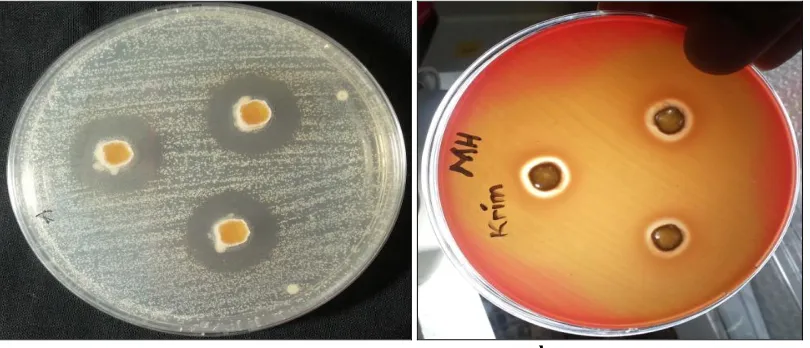
The good formula is the formula that can help the active ingredients to diffuse into medium test, means that components in the formula can release the active ingredients well and not reduce the efficacy of active ingredients. The hindrance amount of 6% ethyl acetate fraction of green tea leaves extract cream on S. epidermidis ATCC 35984 was 25 mm while the hindrance amount of 6% ethyl acetate fraction of green tea leaves extract cream on P. acnes ATCC was 18 mm. It showed that the chosen optimum cream could diffuse EGCG into the medium well so the optimum cream that aplicated on skin was expected to diffuse well.
[image:5.612.47.299.86.181.2]a b
FIG.3: THE OPTIMUM CREAM’S ANTIBACTERIAL ACTIVITY ON S.EPIDERMIS BACTERIA (a) AND P. ACNES (a)
Irritation test: The result showed that the cream did not cause irritation on rabbit’s skin that indicated by no reddish spots appeared on rabbit’s skin from the first day until the third day (72 hours). It indicated that 6% ethyl acetate fraction of
green tea leaves extract cream or even the optimum cream did not cause irritation for skin use. It accordance to the study 10 that 1% and 3% concentration did not cause toxicity effect while 7% and 10% concentration could cause toxicity on mice that given topical cream during 30 days.
a b c d
[image:5.612.106.511.342.516.2]CONCLUSION: The optimum cream containing combination ratio 23, 5 citric acid: 54 ascorbic acid : 22, 5 triethanolamine and combination 21 propylene glycol : 57 tween 80 and 22 span 80. The hindrance amount of the optimum cream was 25 mm on S. epidermis and 18 mm on P. acnes. The optimum cream did not cause any irritation on rabbit’s skin that had been evaluated for 3 days. Moreover, the optimum cream had the desired physical characteristic, chemical stability, and effectiveness and also could difuse EGCG well.
REFERENCES:
1. Lestari, A. Trisusilawati, M: Pengaruh asam fumarat-natrium bikarbonat terhadap kualitas granul effervescent teh hijau secara granulasi kering, Majalah Farmasi Indonesia. 2010. 21(4):231-237
2. Bianchi, A. Marchetti, N. and Scalia, S: Photodegradation of (-)-epigallocatechin-3-gallate in topical cream formulations and its photostabilization. J. Pharm. Biomed. Anal. 2011. 56(4): 692–697.
3. Friedman, M. Levin, C. E. Lee, S.-U. dan Kozukue, N: Stability of Green Tea Catechins in Commercial Tea Leaves during Storage for 6 Months. J. Food Sci. 2009. 74(2), 47–51
4. Chanana, G.D. dan Sheth, B.B: Particle size reduction of emulsions by formulation design-II: Effect of oil and surfactant concentration. PDA Journal of Pharmaceutical Science and Technology. 1995. 49: 71–76.
5. Syed, H.K. Peh, K.K: Identification of phases of various oil, surfactant/co-surfactants and water system by ternary phase diagram. Acta poloniae pharmaceutica-drug research. 2014. 71(2): 301–309.
6. Sugihartini, N: Optimasi Komposisi Enhancer dan Emulgator pada Formulasi Krim Fraksi Etil Asetat Ekstrak Teh Hijau (Camelia sinensis L) Sebagai Sediaan Topikal Anti Inflamasi, Disertasi, Universitas Gadjah Mada, Yogyakarta. 2013
7. Martono, Y. Martono, S: Analisis Kromatografi Cair Kinerja Tinggi Untuk Penetapan Kadar Asam Galat, Kafein Dan Epigalokatekin Galat Pada Beberapa Produk Teh Celup. Agritech. 2012. 32:4
8. Niyomkam, P. Kaewbumrung, S. Kaewnpparat, S. dan Panichayupakaranant, P: Antibacterial activity of Thai herbal extracts on acne involved microorganism. Pharm. Biol., 2010. 48(4): 375–380.
9. Chen, Z. Zhu Q. Wong Y. Zhang Z. and Chung H: stabilizing effect of ascorbic acid on green tea cathechins, Journal of Agricultural Food Chemistry. 1998. 46:2512-2516
10. Stratton, S. P. Bangert, J. L. Alberts, D. S. dan Dorr, R. T: Dermal toxicity of topical (-) epigallocatechin-3-gallate in BALB/c and SKH1 mice. Cancer Lett. 2000. 158(1): 47– 52.
All © 2013 are reserved by International Journal of Pharmaceutical Sciences and Research. This Journal licensed under a Creative Commons Attribution-NonCommercial-ShareAlike 3.0 Unported License.
This article can be downloaded to ANDROID OS based mobile. Scan QR Code using Code/Bar Scanner from your mobile. (Scanners are available on Google Playstore)
How to cite this article: