Full Length Research Article
DEVELOPMENT AND VALIDATION OF A STABILITY INDICATING RP-HPLC METHOD FOR
SIMULTANEOUS DETERMINATION OF HALOPERIDOL AND BENZHEXOL IN PHARMACEUTICAL
COMBINED DOSAGE FORMS
1,*
Mathews Bommella,
1Mukkanti, K.,
2Sarbani Pal, and
3Priyanka, P.,
1
Institute of Science and Technology, JNT University Hyderabad, Kukatpally, Hyderabad, 500 085 (India)
2Department of Chemistry, MNR Post Graduate College, Kukatpally, Hyderabad-500085, India
3
Department of Pharmacy, Osmania University Hyderabad 500 007 (India)
ARTICLE INFO ABSTRACT
The study describes development and subsequent validation of a stability indicating reverse-phase HPLC method for simultaneous estimation of the Haloperidol and Benzhexol in combined Pharmaceutical dosage form using RP-HPLC. Separation was accomplished on BDS 250 x 4.6 mm, 5m C18 column using 0.1% OPA buffer and acetonitrile (45:55 v/v) as mobile phase
pumped through at a flow rate of 1 ml/min at 30°C. Optimized wavelength was 210 nm, retention time of Haloperidol and Benzhexol were found to be 2.3 min and 2.7 min respectively. % RSD of the Haloperidol and Benzhexol were found to be 1.1 and 0.8 respectively. Mean recovery were found to be 99.97% and 99.94% for Haloperidol and Benzhexol respectively. The proposed method also proved to be suitable as a rapid and reliable quality control method.
Copyright©2016, Mathews Bommella et al. This is an open access article distributed under the Creative Commons Attribution License, which permits unrestricted use, distribution, and reproduction in any medium, provided the original work is properly cited.
INTRODUCTION
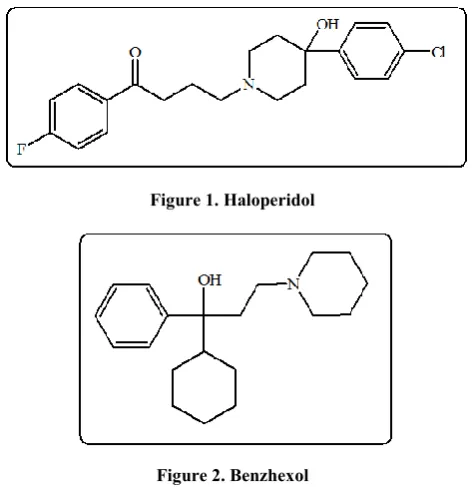
Haloperidol is 4-[4-(4-chlorophenyl)-4-hydroxy-1-piperidyl]-1
-(4-fluorophenyl)-butan-1-one (Figure 1), and is an
antidyskinetic and anti-psychotic drug that possesses a strong activity against delusions and hallucinations (Froemming et
al., 1989). It is most likely linked to an effective
dopaminergic receptor blockage in the mesocortex and the limbic system of the brain (B.S. Bunney et al., 1978). Benzhexol (also named Trihexyphenidyl) chemically
(±)-α-Cyclohexyl-α-phenyl-1- piperidinepropanol hydrochloride
(Figure 2) belongs to anti-parkinsonian category an antimuscarinic agent that excerts a direct inhibitory effect
upon the parasympathetic nervous system (Farnebo l-O et al.,
1970). It also has a relaxing effect on smooth muscle. It is indicated in the symptomatic treatment of all forms of Parkinsonism.
*Corresponding author: Mathews Bommella,
Institute of Science and Technology, JNT University Hyderabad, Kukatpally, Hyderabad, 500 085 (India).
It is often useful as adjunct therapy when treating Parkinsonism with levodopa. Additionally Benzhexol is indicated for the control of extra pyramidal disorders caused by nervous system drugs such as the dibenzoxazepines, phenothiazines, thioxanthenes and butryophenones (Mucklow, E. S et al., 1964). The parent drug stability test guideline Q1A (R2) issued by the International Conference on Harmonization (ICH) suggests that stress testing is an essential part of development strategy and is carried out under more severe condition than accelerated conditions. These studies provide information to establish its inherent stability characteristics of the molecule such as the degradation pathways, leading to identification of degradation products and hence supporting the suitability of the proposed analytical procedures (ICH Q1AR2, 1993; ICH Q1aR2, 2003). According to ICH guidelines stress testing should include the effect of temperature, light, oxidizing agents and susceptibility across a wide range of pH values and separation of drugs from degradation products (ICH Q1B, 1996; H.H. Tonnerson (Ed.), 1996 and Monika Bakshi, Saranjit Singh 2002).
ISSN: 2230-9926
International Journal of Development Research
Vol. 06, Issue, 08, pp.8828-8836, August,2016
DEVELOPMENT RESEARCH
Article History:
Received 18th May, 2016
Received in revised form 26th June, 2016
Accepted 20th July, 2016
Published online 24th August, 2016
Key Words:
Haloperidol, Benzhexol, RP-HPLC,
Figure 1. Haloperidol
Figure 2. Benzhexol
Figures 1, 2. Structures of Haloperidol and Benzhexol
It is also suggested that analysis of stability sample should be carried out using validated stability testing methods. From the detailed literature survey it was found that there is no stability indicating analytical method available for estimation of Haloperidol and Benzhexol combinations. The reported methods available for the estimation for analysis of Haloperidol and Benzhexol (srikantha D et al., 2014) either alone (Jian Fang et al., 1993; Lea AR et al., 1982; Bargo E 2006 and Mahadik KR et al., 2002) or in combination with other drugs in pharmaceutical dosage forms (Boehme CL et al., 1998; Patela YP et al., 1998 and Sane RT et al., 1992) or individually in biological fluids (Aboul-Enein HY et al.,
2006). Stability indicating and RP-HPLC Simultaneous estimation of this combined dosage form has been reported in combination with other drugs in pharmaceutical dosage forms (Trabelsi H et al., 2002 and Monser L et al., 2003). To our knowledge there has been no Stability indicating RP-HPLC method development and validation reported for the simultaneous estimation of Haloperidol and Benzhexol combination in which ICH recommended that stress conditions be applied. Therefore, the stability indicating method was also developed by applying different stress conditions like acidic, alkali, H2O2, thermal, and photo degradation. We have
planned to develop a new, simple, precise, economic and accurate Stability indicating RP-HPLC method development and validation for the estimation of Haloperidol and Benzhexol pharmaceutical dosage form according to ICH
(ICH Q2B 1996; ICH Canada 2002 and ICH Q2R1 2005)
Guidelines
EXPERIMENTAL
MATERIALS AND METHODS
Active pharmaceutical ingredients Haloperidol and Benzhexol were obtained as a gift samples from Spectrum pharma research solutions, Hyderabad. The pharmaceutical dosage form from Hexidol forte – Torrent Pharmaceuticals Ltd was
purchased from local pharmacy. The solvents used in this work were of HPLC grade and obtained from Ranchem Private Limited.
Instrumentation and chromatographic conditions
The analysis was performed on a high performance liquid chromatography system consisting of Waters 2695 with 2996 module Photo Diode Array detector equipped with a quaternary solvent delivery pump, automatic sample injector and column thermostat. The data acquisition and analysis was performed by using Empower2 software. The chromatographic separation was performed on BDS 250 x 4.6 mm, 5 C18
column using 0.1% OPA buffer and acetonitrile (45:55 v/v) as mobile phase at a flow rate of 1 ml/min, the column temperature was maintained at 30°C which gave acceptable retention time and good resolution between Haloperidol and
Benzhexol. The method was optimized at 210nm. The run
time was taken as 6 min.
Sample Processing
Diluents: Based up on the solubility of the drug, diluents were selected, firstly dissolved in Methanol and made up with water: ACN (50:50).
Preparation of Standard stock solutions
Accurately Weighed and transferred 10 mg & 2 mg of Haloperidol and Benzhexol working Standards into a 10ml clean dry volumetric flask respectively, add 7ml of diluent, sonicated for 30 minutes and make up to the final volume with diluents. From the above stock solutions, 1ml was pipette out in to a 10ml volumetric flask and then make up to the final volume with diluent.
Preparation of Sample stock solutions
5 tablets were weighed and calculate the average weight of each tablet then the weight equivalent to 1 tablet was transferred into a 10 ml volumetric flask, 7ml of diluent added and sonicated for 30 min, further the volume made up with diluent and filtered. From the filtered solution 1ml was pipette out into a 10 ml volumetric flask and made up to 10ml with diluent.
Preparation of buffer
Buffer: (0.1%OPA)
1 ml of Ortho phosphoric acid was taken in a 1000ml of volumetric flask, about 100ml of milli-Q water added then degassed and finally make up the volume with milli-Q water.
Method validation
System suitability parameters
The system suitability parameters were determined by preparing standard solutions of Haloperidol and Benzhexol and the solutions were injected six times and the parameters like peak tailing, resolution and USP plate count were determined.
Linearity
The linearity of the method was determined by preparing three individual series of solutions in the range of Haloperidol (25-150µg/ml), and Benzhexol (5-30µg/ml). The obtained peak areas were plotted against concentration.
Preparation of linearity solutions
Preparation of Standard stock solutions: Accurately Weighed
and transferred 10 mg & 2 mg of Haloperidol and Benzhexol working Standards into a 10ml clean dry volumetric flask respectively, add 7ml of diluent, sonicated for 30 minutes and make up to the final volume with diluents.. Flasks were made up with water and acetonitrile (50:50) and labelled as Standard stock solution 1, 2 and 3. From three stock solutions pipette out 0.25ml, 0.5ml, 0.75ml, 1.0ml, 1.25ml, 1.50ml into 10ml volumetric flask to get 25%,50%, 75%, 100%, 125%, 150% of standard solutions.
Precision
Method precision (repeatability)
The method precision/ repeatability can be determined by injecting six working standard solutions and six sample injections. The areas of all the injections were taken and standard deviation, %Relative standard deviation, %assay were calculated.
Intermediate precision
The intermediate precision can be determined by injecting six working standard solutions and six sample injections on different days by different operators or by different instruments. The areas of all the injections were taken and standard deviation, %Relative standard deviation, %assay were calculated. The results obtained were within the acceptance criteria.
Accuracy
Accuracy was tested by the standard addition method at three different levels 50%, 100% and 150%. The percentage recoveries of Haloperidol and Benzhexol present in the pharmaceutical dosage form were calculated.
Limit of detection and limit of quantification
Limit of detection (LOD) and limit of quantification (LOQ) of Haloperidol and Benzhexol were determined by calibration curve method. Solutions of Haloperidol and Benzhexol were prepared in linearity range and injected in triplicate. Average peak area of three analyses were plotted against concentration
Method robustness
The robustness can be determined by varying the following parameters: Robustness of the developed method was determined by making small deliberate changes in flow rate (±0.1ml/min), column temperature (±5%), organic mobile phase ratio (±10%), along with the optimized method.
Degradation studies
Oxidation
To 1 ml of stock solution of Haloperidol and Benzhexol, 1 ml of 20% hydrogen peroxide (H2O2) was added separately. The
solutions were kept for 30 min at 600c. For HPLC study, the resultant solution was diluted to obtain 100µg/ml & 20µg/ml solution and 10 µl were injected into the system and the chromatograms were recorded to assess the stability of sample.
Acid Degradation Studies
To 1 ml of stock solution Haloperidol and Benzhexol, 1ml of 2N Hydrochloric acid was added and refluxed for 30mins at 600c .The resultant solution was diluted to obtain 100µg/ml & 20µg/ml solution and 10 µl solutions were injected into the system and the chromatograms were recorded to assess the stability of sample.
Alkali Degradation Studies
To 1 ml of stock solution Haloperidol and Benzhexol, 1 ml of 2 N sodium hydroxide was added and refluxed for 30mins at 600c. The resultant solution was diluted to obtain 100µg/ml & 20µg/ml solution and 10 µl were injected into the system and the chromatograms were recorded to assess the stability of sample.
Dry Heat Degradation Studies
The standard drug solution was placed in oven at 1050c for 6 h to study dry heat degradation. For HPLC study, the resultant solution was diluted to 100µg/ml & 20µg/ml solution and10µl were injected into the system and the chromatograms were recorded to assess the stability of the sample.
Photo Stability studies
The photochemical stability of the drug was also studied by exposing the 1000µg/ml & 200µg/ml solution to UV Light by keeping the beaker in UV Chamber for 7days or 200 Watt hours/m2 in photo stability chamber. For HPLC study, the resultant solution was diluted to obtain 100µg/ml & 20µg/ml solutions and 10 µl were injected into the system and the chromatograms were recorded to assess the stability of sample.
Neutral Degradation Studies
RESULTS AND DISCUSSION
The present work was focused on development of a stability indicating RP-HPLC method for the simultaneous estimation of Haloperidol and Benzhexol in pharmaceutical dosage form. The solubility of the active pharmaceutical ingredient was checked in different solvents like methanol, water, acetonitrile and in different ratios but finally the standard was first dissolved in methanol and made up with water: ACN (50:50). So it was chosen as a diluent. Different mobile phases like methanol and water, acetonitrile and 0.01N potassium dihydrogen ortho phosphate buffer and acetonitrile and sodium dihydrogen phosphate buffer were used in compositions at a different flow rates but the peak resolution, retention time and tailing factor were not satisfactory, so at last acetonitrile and ortho phosphoric acid was selected as a buffer at flow rate of 1ml/min. The chromatographic separation was performed on BDS (250mm x 4.6mm x 5µ) kept at 30°C with a run time of 6 minutes. Finally the method was optimized by altering the mobile phase composition / ratio and the optimized wavelength of two drugs Haloperidol and Benzhexol were found to be at 210nm.
System suitability parameters
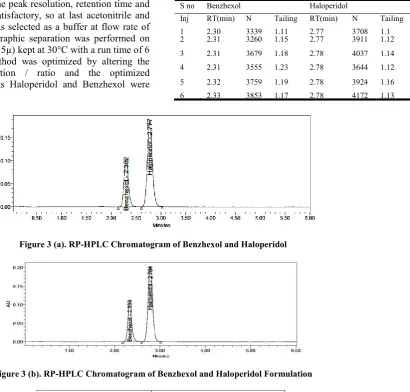
[image:4.595.139.550.207.599.2]The system suitability tests were conducted before performing the validation and the parameters were within the acceptance criteria like retention times were 2.3 min and 2.7 min for Benzhexol and Haloperidol, plate count was >2000, peak tailing was <2 and the %RSD of peak areas of six injections were ≤ 2% (Table 1). Hence the proposed method can be successfully applied to routine analysis. Chromatograms are shown in Fig 3(a), 3(b), 3(c).
Table 1. System suitability parameters for Haloperidol and Benzhexol
S no Benzhexol Haloperidol
Inj RT(min) N Tailing RT(min) N Tailing
1 2.30 3339 1.11 2.77 3708 1.1 2 2.31 3260 1.15 2.77 3911 1.12
3 2.31 3679 1.18 2.78 4037 1.14
4 2.31 3555 1.23 2.78 3644 1.12
5 2.32 3759 1.19 2.78 3924 1.16
6 2.33 3853 1.17 2.78 4172 1.13
Figure 3 (a). RP-HPLC Chromatogram of Benzhexol and Haloperidol
Figure 3 (b). RP-HPLC Chromatogram of Benzhexol and Haloperidol Formulation
[image:4.595.157.429.593.756.2]Linearity range
The linearity range was in the interval of Haloperidol (25-150µg/ml), and Benzhexol (5-30µg/ml) respectively. These were represented by a linear regression equation as follows: Haloperidol is y = 13299x + 33088 (r² = 0.999) and Benzhexol is y = 29305x + 1756 (r² = 0.999).
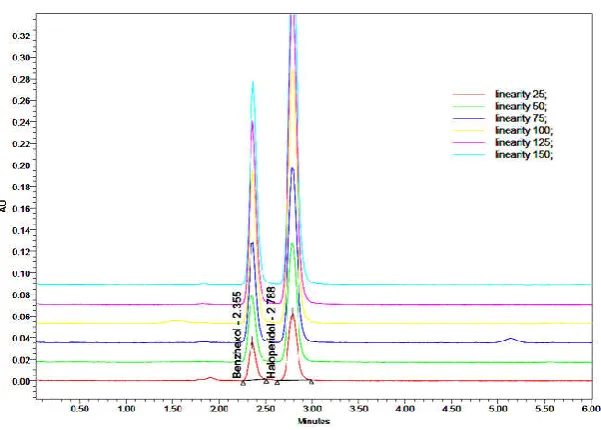
[image:5.595.54.543.165.533.2]Regression line was established by least squares method and correlation coefficient (r2) for Haloperidol and Benzhexol were found to be greater than 0.999. Hence the curves established were linear (Table 2, Graph 1). Chromatograms are shown in Fig 4.
Table 2. Linearity and Statistical analysis data for Haloperidol and Benzhexol
S.No Pipetted from stock (mL) Volume of flask (mL) Concentration in ppm (Haloperidol)
Concentration in ppm (Benzhexol)
%Linearity Level
1 0.25 10 25 5 25
2 0.5 10 50 10 50
3 0.75 10 75 15 75
4 1 10 100 20 100
5 1.25 10 125 25 125
6 1.5 10 150 30 150
Haloperidol Benzhexol
Conc. (μg/mL) Peak area Correlation Coefficient Conc. (μg/mL) Peak area Correlation Coefficient 25 388023
0.99
25 148848
0.99
50 722495 50 288366
75 1036366 75 440654
100 1350872 100 601633
125 1690422 125 742265
150 2025345 150 867516
Graph 1. Linearity Graphs of Haloperidol and Benzhexol
[image:5.595.146.447.560.775.2]Precision
Six replicates injections at the same concentration were analyzed on same day and two different days for verifying the variation in the precision and the % RSD for Haloperidol and Benzhexol were within acceptable limit of ≤2. Hence the method is reproducible on different days with different analyst and column. This indicates that the method is precise (Table 3).
Accuracy
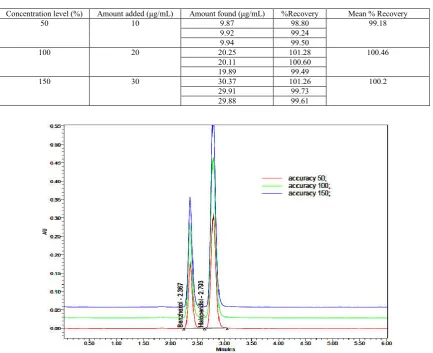
[image:6.595.84.518.386.739.2]The percentage recoveries for Haloperidol and Benzhexol were found to be 99.97% and 99.94% respectively (Table 4,5). The results of the recovery studies undoubtedly demonstrate accuracy of the proposed method. Chromatograms are shown in Fig 5.
Table 3. Determination of repeatability and intermediate precision
Drug Name Repeatability Intermediate
Peak Area Std Dev %RSD Peak Area Std Dev %RSD Haloperidol 1327372 14580.9 1.1 1324633 17740.9 1.3 Benzhexol 611695 4617.1 0.8 627967 7804.0 1.2
Table 4. Recovery data for the proposed RP-HPLC method for Haloperidol
Concentration level (%) Amount added (μg/mL) Amount found (μg/mL) % Recovery Mean % Recovery
50 50 49.41 98.83 99.94
50.76 101.53
49.72 99.45
100 100 100.3042 100.30 101.10
100.7094 100.71
99.2925 99.29
150 150 147.6194 98.41 99.20
147.1499 98.10
151.6209 101.08
Table 5. Recovery data for the proposed RP-HPLC method for Benzhexol
Concentration level (%) Amount added (μg/mL) Amount found (μg/mL) %Recovery Mean % Recovery
50 10 9.87 98.80 99.18
9.92 99.24
9.94 99.50
100 20 20.25 101.28 100.46
20.11 100.60
19.89 99.49
150 30 30.37 101.26 100.2
29.91 99.73
29.88 99.61
Limit of detection (LOD) and limit of quantification (LOQ)
The determined values of LOD and LOQ were calculated by using slope and Y-intercept.
The LOD and LOQ values for Haloperidol were found to be 0.91 and 2.76 µg/ml, Benzhexol were found to be 0.01 and 0.04 µg/ml respectively (Table 6).
Robustness
Robustness of the proposed method demonstrated a non-significant alteration through analysis of the sample and standard Haloperidol and Benzhexol (Table 7, 8). After this the results obtained were compared with that of optimized method. It was confirmed that by the deliberate changes in the parameters there was no any significant changes in standard deviation, relative standard deviation, theoretical plates, retention time and USP tailing factor.
Assay
The Content of Haloperidol and Benzhexol in the pharmaceutical dosage form were found by using the developed method. The percentage purity of Haloperidol and Benzhexol were found to be 100.16% and 100.33% and %RSD values for Haloperidol and Benzhexol were within limit of ≤2.
Forced degradation studies
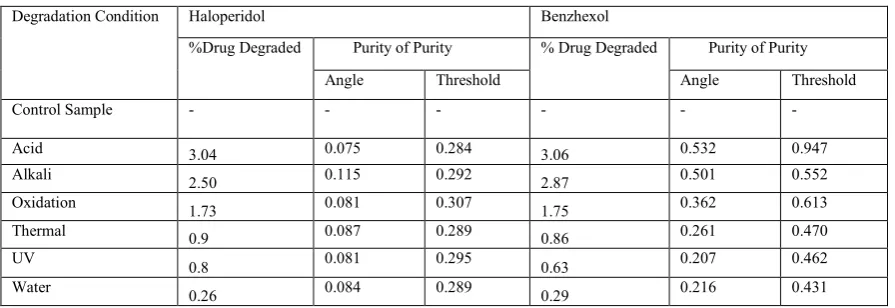
[image:7.595.75.523.641.795.2]The forced degradation studies were conducted and all the parameters for Haloperidol and Benzhexol were within the limits (Table 9). Haloperidol and Benzhexol have shown significant sensitivity towards the treatment of HCl, NaOH and peroxide solutions. The drugs gradually undergone degradation with time and prominent degradation was observed.
Table 6. Sensitivity table of Haloperidol and Benzhexol
Drug Name LOD(µg/ml) LOQ(µg/ml)
Haloperidol 0.91 2.76
Benzhexol 0.01 0.04
Table 7. Robustness results of the proposed RP-HPLC method for Haloperidol
S.no Parameters Peak area RT * % RSD
Optimized Used
1 Flow rate (ml/min) 1.0 1.1 1246967 2.55 1.8 0.9 1465081 3.10 0.3
4 Mobile phase 45:55 50:60 1388981 2.79 0.4 40:50 1423437 2.77 1.2
6 Temperature 300C 35
0C 1392588 2.78 0.5
250C 1472819 3.12 0.3
*RT=Retention Time
Table 8. Robustness results of the proposed RP-HPLC method for Benzhexol
S.no Parameters Peak area RT * % RSD
Optimized Used
1 Flow rate (ml/min) 1.0 1.1 610433 2.10 1
0.9 706004 2.58 0.6
4 Mobile phase 45:55 50:60 675536 2.31 0.7
40:50 683240 2.58 0.6
6 Temperature 300C 350C 669561 2.31 0.4
250C 703427 2.50 0.6 *RT=Retention Time
Table 9. Forced Degradation results of proposed RP-HPLC method
Degradation Condition Haloperidol Benzhexol
%Drug Degraded Purity of Purity % Drug Degraded Purity of Purity
Angle Threshold Angle Threshold
Control Sample - - - -
Acid 3.04 0.075 0.284 3.06 0.532 0.947
Alkali 2.50 0.115 0.292 2.87 0.501 0.552
Oxidation 1.73 0.081 0.307 1.75 0.362 0.613
Thermal 0.9 0.087 0.289 0.86 0.261 0.470
UV
0.8 0.081 0.295 0.63 0.207 0.462
Water
Haloperidol and Benzhexol were stable under forced thermal degradation, photolytic and neutral degradations. From the degradation studies, Peak purity test results derived from PDA detector, confirmed that the Haloperidol and Benzhexol peaks were homogeneous and pure in all the analyzed stress samples. Chromatograms are shown in Fig 6.
Conclusion
A new, simple, rapid and precise stability indicating reversed-phase high performance liquid chromatographic method was developed for the simultaneous estimation of Haloperidol and Benzhexol in bulk and combined pharmaceutical dosage forms. The method is simple, accurate, linear, sensitive and reproducible as well as economical for the effective quantitative analysis of Haloperidol and Benzhexol in bulk and combined dosage forms. The method was validated, and all the method validation parameters were tested and shown to produce satisfactory results. The method is free from interactions of the other ingredients and excipients used in the formulations. Finally, concluded that the method is suitable for use in the routine quality control of Haloperidol and Benzhexol in active pharmaceutical ingredients and in pharmaceutical dosage forms.
Acknowledgement
The authors thank Spectrum pharma research solutions, Hyderabad for providing Haloperidol and Benzhexol reference standards as gift samples to carry out the research work. KM thanks to UGC BSR Faculty fellow.
REFERENCES
Aboul-Enein, H.Y., Ali and Hoenen, H. 2006. Rapid determination of haloperidol and its metabolites in human plasma by HPLC using monolithic silica column and
solid-phase extraction, Biomedical Chromatography. 20(8),
pp.760-764.
Bargo, E. 2006. Determination of trihexyphenidyl HCL dosage forms, Journal of Pharmaceutical Sciences. 68(4), pp.503-535.
Boehme, C.L. and Strobel, H.W. 1998. High-performance liquid chromatographic methods for the analysis of haloperidol and chlorpromazine metabolism in vitro by
purified cytochrome P450 isoforms, Journal of
Chromatography. B Biomedical Sciences and
Application.718(2), pp.259-266.
Bunney, B.S. and Grace, A.A. 1978. Acute and chronic haloperidol treatment: Comparison of effects on nigral dopaminergic cell activity, Life Sciences. 23(16), pp.1715-1727
Farnebo l-o, fuxe K., hamburger, B. and Ljungdahl, H. 1970. Effect of some antiparkinsonian drugs on catecholamine
neurons. Journal of Pharmacy and Pharmacology. 22,
pp.733–737.
Froemming, J.S., Francis Lam, Y.W., Jann, M.W. and Davis, C.M. 1989. Pharmacokinetics of haloperidol. Clinical
Pharmacokinetics. 17(6),pp. 396-423.
ICH Guidance on analytical method validation (2002), International convention on quality for the pharmaceutical industry. Toronto, Canada.
ICH Harmonised Tripartite Guideline (2003) "Stability Testing Of New Drug Substances And Products Q1a(R2)"
ICH, Q2B Harmonised tripartite guideline (1996), Validation
of analytical procedure Methodology, International
conference on harmonization. Geneva, Switzerland.
ICH, Stability Testing of New Drug Substances and Products
(1993) International Conference on Harmonization,
IFPMA, Geneva.
ICH, Stability Testing Q1B 1996. Photostability Testing New Drug Substances and Products. International Conference on Harmonization, IFPMA, Geneva.
Jian Fang, John W. Gorrod. 1993. High-performance liquid chromatographic method for the detection and quantitation of haloperidol and seven of its metabolites in microsomal preparations, Journal of Chromatography B: Biomedical
Sciences and Applications. 614(2), pp. 267-273
Lea, A.R., Hailey, D.M., Drugged, P.R. 1982. Analysis of
[image:8.595.140.463.50.256.2]haloperidol tablets by high-performance liquid
chromatography-an inter-laboratory study. Journal of
Chromatography. 250, pp.35–42.
Mahadik, K.R., Aggarwal, H. Kaul, N. 2002. RP-HPLC estimation of trihexyphenidyl HCL and chlorpromazine HCL in tablets. Indian Drugs. 39, pp.441-445.
Monika Bakshi, Saranjit Singh. 2002. Development of validated stability-indicating assay methods—critical
review, Journal of Pharmaceutical and Biomedical
Analysis. 28, pp.1011–1040
Monser, L., Trablesi, H. 2003. A rapid LC method for the determination of haloperidol and its degradation products in pharmaceuticals using a porous graphitic carbon column, Journal of Liquid Chromatography and Related
Technologies. 26(2), pp.267-271.
Mucklow, E. S. and Metz, H. T. 1964. Remarkable Response to Benzhexol Hydrochloride (Artane) in Children with an Unusual Progressive Striatal Syndrome: A Report on 3 Cases. Developmental Medicine & Child Neurology.
6,598–605
Patela, Y.P., Dhorda, U.J. and Sundaresan, M. A. 1998. comparative study using HPLC and packed column
supercritical fluid chromatography for the assay of three anti-psychotic dosage forms. Talanta. 47(3), pp.625–630. Sane, R.T., Ghadge, J.K., Jain, A.B., Vaidya, A.T., Kotwal,
S.S. 1992. RP-HPLC estimation of haloperidol and propantheline bromide in tablets or capsules, Indian Drugs.
29, pp.240-244.
Srikantha Dammalapati, Ramesh Raju, Rudra Raju 2014. A Rp-Hplc Method For Simultaneous Determination Of Haloperidol And Trihexyphenidyl Hydrochloride In Tablet
Dosage Form, Asian Journal of Pharmaceutical and
Clinical research. 7(2), pp.14-18
Tonnerson, H.H. (Ed.)1996. the Photostability of Drugs and
Drug Formulations, (Taylor and Francis, London, p. 9). Trabelsi, H., Bouabdallah, S., Bouzouita, K., Santa, F. 2002.
Determination and degradation study of haloperidol by
high performance liquid chromatography. Journal of
Pharmaceutical and Biomedical Analysis, 29(4) pp.649–
657.
Validation of Analytical Procedures 2005. Text and
Methodology Q2 (R1), ICH Harmonised Tripartite
Guidelines.