4897
CLASSIFICATION OF WILD BIRD BY BEHAVIOR WITH
FASTER R-CNN FOR COMPLICATED ENVIRONMENT LIKE
ORCHARD
1CHEOL WON LEE, 2AZAMJON MUMINOV, 3DAEYOUNG NA, 4HEUNG SEOK JEON
1,2,4Konkuk University, Department of Computer Engineering, Chungju 27478, Rep. of Korea
3Handong Global University, Global Leadership School, Pohang 37554, Rep. of Korea
E-mail: 1[email protected], 2[email protected], 3[email protected], 4[email protected](Corresponding Author)
ABSTRACT
Wild birds cause significant damages to agricultural crops in orchards every year. The previous wild bird detection algorithms have limitations that cannot be accurately detected because of the biological characteristics of wild birds. In this paper, we propose a vision-based real-time wild bird detection algorithm that operates in a complicated environment like orchard using Faster R-CNN of deep learning. That is the Wild Bird Behavior Classification (WBBC) algorithm, classifies wild birds according to their behavior, which intended to improve the detection accuracy in a complicated environment. We verified the benefit of Behavior Classification model and the performance of the WBBC algorithm through experiments. In our experiments, the Behavior Classification shows 3.6 percent growth than unused. The WBBC algorithm has detected by 95.7 percent of average accuracy in a variety of environments.
Keywords: Computer Vision, Bird, Detection, Faster RCNN, Deep Learning.
1. INTRODUCTION
From the past to the present, to repel wild birds is a critical area of agriculture. Wild birds harm a variety of facilities such as rice paddy field, farms, and orchards. In particular case of orchards, a once pecking behavior of wild birds causes severe damage to the cultivated fruits. So it leads to serious economic damage. Therefore, orchards have used a variety of wild bird repellent methods to reduce these damages. We distinguish wild bird repellent between non-reactive and reactive methods.
Non-reactive methods are that work regardless of the presence of wild birds. These are traditional methods, such as scarecrows, balloons, kites, radios, and repetitive sound generators. However, non-reactive methods cannot prevent the adaptation of wild birds. Wild birds have traveled a wide range through wings, so they have evolved to adapt for survival in encountered unfamiliar environments. Thus, wild birds can adapt to repeatedly threats as non-reactive methods. In the previous paper, wild bird adapted non-reactive method using sound in 3 to 10 days in the experimental environment [1].
In order to solve the adaptation problem, reactive methods have been proposed to respond to the invasion of wild bird. Modern sensors are used to detect invasion such as ultrasonic, radar, laser, and vision (camera). So the performance of reactive methods depends on detection accuracy.
Ultrasonic, radar and laser detections cannot classify between orchard trees, leaves and entered wild birds. For this reason, the detection methods based on distance sensor cannot use to response invasion of wild birds.
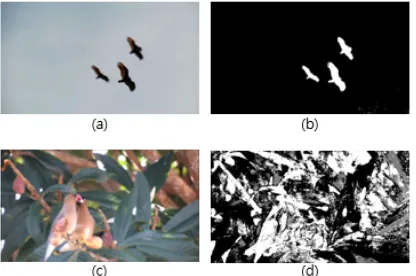
4898 Also, these approaches use the subtraction method. The subtraction method can remove the background in the image, as shown in Figure 1(a) and (b). Figure 1 (b) is the result of processing through the subtraction method, which removes the background for Figure 1(a) image. The subtraction method was able to detect wild birds with only a calculation of the white area. However, complicated environments make it difficult for detection of wild birds in the white area, as shown in Figure 1(c) and Figure 1(d).
Figure 1: Comparing Detection Performance In The Simple And Complicated Environment By Subtraction (a) Original Image In The Simple Environment (b) Subtracted Image In The Simple Environment (c) Original Image In Complicated Environment (d) Subtracted Image In Complicated Environment.
Recently, deep learning has been studied to find the objects that have been learned in advance even in a complicated image [13-16]. However, Wild birds have different appearance even same species by their habitat, have many characteristics depending on the species as ostrich and hummingbird. These characteristics make it difficult for deep learning to learn wild birds. As a result, detection accuracy is decreased.
To accurately detect wild birds, we propose a new wild bird detection algorithm using deep learning, which we call the Wild Bird Behavior Classification (WBBC) algorithm. The WBBC algorithm uses Faster R-CNN algorithm for real-time detection in complicated environments [13][16]. We also generate model through training wild bird data categorized by behavior for accurate learning.
Section 2 introduces other studies related to wild bird detection. Section 3 introduces the WBBC algorithm. Section 4 evaluates the performance of the proposed method through experiments in a complicated orchard environment.
Finally, section 5 describes the conclusion and further research directions.
2. RELATED WORK
This section introduces the research by the sensor used to detect wild birds such as ultrasonic, radar, microphone, and vision.
The ultrasonic sensor was used when the detection area was narrow and short. Qu Fang proposed a detection technique using ultrasonic sensors to protect the transmission line from wild birds[6]. However, the ultrasonic sensor cannot recognize the object itself.
The radar sensor was used in a case where the detection area is wide and open. J.R. Moon has proposed an approach for tracking and analyzing the characteristics of airplanes and wild birds detected through radar[7]. Jianmin Song has proposed a method to extract information from a single radar using a linear neutral regression method[8]. These radar-based detection methods are efficient for simple background areas such as sky and ocean. However, the radar sensor also cannot recognize to object itself as ultrasonic.
In Dan Stowell’s research[9], microphone sensors were used for bird detection in forests where the area was wide, and obstacles were large. Most of the microphone methods are used monitoring biological characteristics through wild bird sound. So, when a wild bird invades without chirp sound, the detection performance could be decreased.
[image:2.612.92.300.228.366.2]4899 However, despite image processing and deep learning algorithms, it is challenging to detect wild birds in a complicated environment with vision sensors. Image processing algorithm without deep learning has the problem of manually defining object and environments in each case. Deep learning algorithm has an overfitting problem as it learns the numerous appearance of wild birds.
3. WILD BIRD BEHAVIOR CLASSIFICATION ALGORITHM
We propose the Wild Bird Behavior Classification(WBBC) model based on Faster R-CNN algorithm of deep learning to detect and classify wild birds according to their behavior in real-time in complicated environments like an orchard.
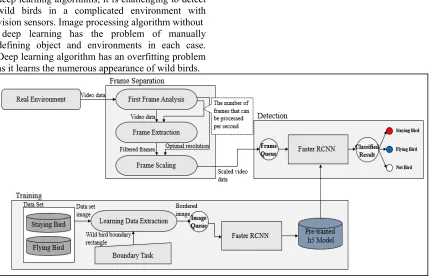
This algorithm is comprised of Frame Separation module for processing video data for real-time operation. Training module for learning wild bird data set. Detection module for classifying by pre-trained weight. The overall configuration of the WBBC algorithm can be seen in Figure 2.
3.1 Frame Separation
The first module in the WBBC algorithm is the Frame Separation. It is the module of processing the video frame for real-time detection using Faster R-CNN. The Faster R-CNN is an object recognition deep learning approach that operates in real-time, but it has a linear structure in which the number of computations increases as the resolution increases. If the resolution of the video data is higher than the processing level of the environment and the processing cannot process
more than one frame per second, a problem of detecting the past time point occurs in the present time point. On the other hand, if the resolution is too low, accurate detection is impossible. Because the resolution is the density representing the visual data, the higher resolution, the more accurate classification is possible.
Therefore, fitting the resolution to the operating environment is very important. So, at first, the WBBC algorithm define three resolution modes (224p, 480p, 720p). Then, in the First Frame Analysis step, the first frame of the video data is classified into all resolution modes through Detection module. The image calculation time for each resolution is measured to find optimal mode. The resolution policy find the largest resolution capable of handling more than one frame per second for accurate detection.
[image:3.612.93.524.112.388.2]4900 birds in real-time regardless of the video specification (resolution and Frame Per Second).
3.2 Training
Training is a core module that learns about wild birds using Faster R-CNN. The goal of this module is to build a pre-trained data model for classifying wild bird. To build a data model need to gather common features of wild birds though the training process of Faster R-CNN.
At first time, Faster R-CNN was trained in wild birds’ images of the CUB-200 data set. Next, we analyzed the images that failed to classify. As a result, we found two problems that make classification difficult. First, wild birds have a wide variety of appearances (size, beak, color, and leg). It can be vary depending on the habitat even if it is the same species. Second, wild birds change their appearance according to their dynamic movements, not fixed shapes like cars. These factors can cause overfitting problem in deep learning.
Therefore, the problem of diversity in the appearance of wild birds is solved using Faster R-CNN of deep learning. Also, dynamic change by movement is solved through learning classified behavior of wild birds.
The Training module make a model that trained by behavior of wild birds. The behavior was divided into Staying and Flying by image analysis of wild bird. So we manually created a separated dataset by Staying and Flying birds.
Learning Data Extraction step picks images in data set. Next, Boundary Task step manually makes boundary for training in picked image. Created bordered images are input to the image queue.
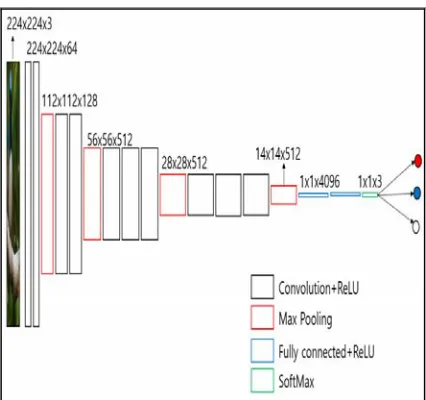
In the next step, the WBBC algorithm use deep model for training as VGG-16 network model. An orchard environment consists of branches, leaves, trees, and supporting objects. Therefore, a deep network is required in order to accurately classify wild birds in this complicated environment. The VGG model is known as one of the good candidates for classifying objects with high accuracy among various deep learning models with deep structure [17]. Therefore, we use VGG-16 model for classifying wild birds in complicated environment like orchard. Figure 3 shows the network structure used when operating in 224p resolution mode. This model consists of 6 steps. Each step consists of a convolution layer, an activation layer (ReLU) and a pooling layer. Finally, it connected to the Fully connected layer for classifying the behaviors of wild birds from
Staying Bird, Flying Bird, and NotBird states.
[image:4.612.313.526.510.710.2]After training, this module make weights as .h5 files. We will prove efficient of this approach in the experiments section 4.3.
Figure 3 : VGG-16 Based 224p Resolution Mode Network Model
Algorithm1 : Frame Separation
1 2
3 4
5
6
7 8 9 10 11 12 13
Input : Video data (Camera or Video file) Output : Frames of numbers that can be processed per second, scaled by mode
IFgets first frame:
Gets width, height and Frame Per Second information in first frame;
Calculates the mode and input frames per second through the time of one operation in Detection each 3mode, resolution mode is 224p, 480p, and 720p;
Sets the mode according to input frames per second, input frames per second is the maximum value for which the computation time of one frame is less than 1.
While do get frames per second:
IF last frame or frame is none: BREAK
ELSE:
Filters frames by the input frames per second
4901
3.3 Detection
The Detection module detect wild birds from incoming by Frame Separation module. More specifically, the frame input from Frame Separation module is taken from the frame queue. Next, Detection module read the weight created by Training module in advance. Next, the input frame is classified using the loaded weight. The classified results are represented as probabilities for the Flying Bird, Staying Bird, and Not Bird states, and the coordinates of the expected position of the wild birds.
4. EXPERIMENTS
4.1 Experiment Environment
Learning and verification experiments were conducted in the same environment. The experiment was carried out in the environment as follows. The operating system was Window 10, the processor was Intel i7-4890 3.60GHz, and the memory was 32GB. The Faster R-CNN was implemented with Python version 3.6.5, and the version of each library used is Tensorflow 1.10.0, Keras 2.2.0, OpenCV 3.4.1, CUDA 9.0, cuDNN 9.0.
.
4.2 DataSet
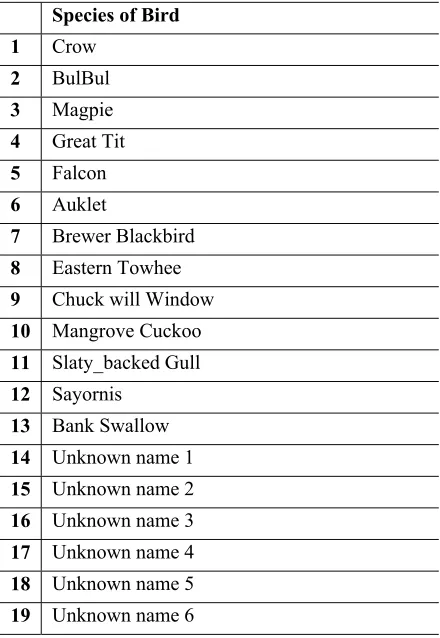
[image:5.612.308.528.118.437.2]The wild birds dataset used for experiments consists of 19 kinds of wild bird in the video data. Table 1 shows the kinds of wild birds used for training. Also, some names of wild birds were unknown. The dataset were composed of 3850 images gathered from Google search, separated by flying data and staying data for each species.
Table 1 : Kinds Of Birds Used In Training
Species of Bird 1 Crow
2 BulBul
3 Magpie
4 Great Tit
5 Falcon
6 Auklet
7 Brewer Blackbird
8 Eastern Towhee
9 Chuck will Window
10 Mangrove Cuckoo
11 Slaty_backed Gull
12 Sayornis
13 Bank Swallow
14 Unknown name 1
15 Unknown name 2
16 Unknown name 3
17 Unknown name 4
18 Unknown name 5
19 Unknown name 6
4.3 Benefits of Behavior Classification Approach
In this experiment, we show the benefits of behavior classification. As described in 3.2 section, we categorized three states for classification as Staying Bird, Flying Bird, Not Bird rather than two states as Bird or Not Bird. To evaluate behavior classification, we compared two methods. The data set of Normal model used for experiments consists of 2,695 images in the birds. The data set of behavior classification model were classified into images by Staying(1,524 images) and Flying(1,171 images). The images used in both models are the same images. The training was done with 2,695 images, 70 percent of the whole dataset. The verification was performed with the remaining 30 percent (1,155 images).
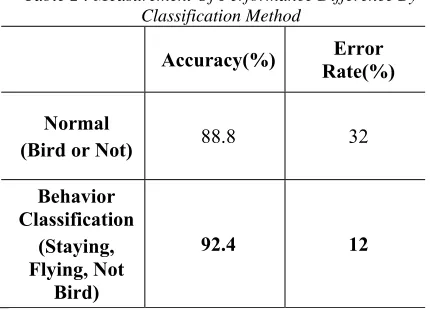
4902 The Normal model correctly detected 1,026 of the 1,155 images. The Accuracy of normal model is 88.8 percent. The Error Rate is 32 percent. The Behavior Classification model detected 1068 of the 1,155 images. The Accuracy of Behavior Classification model is 92.4 percent. Also, the Error Rate is 12 percent. The Behavior Classification model shows good value than Normal model.
The Behavior Classification models show that overfitting can be reduced, and as a result, wild birds detection accuracy can be improved.
Figure 4 shows the examples of classification results between Normal and Behavior Classification models. Examples 1 and 2 show an improved Boundary Box Error case. This error is the case of misclassification. Examples 3 and 4 show improved Detection Failures case in complicated environments.
[image:6.612.84.299.369.524.2]The proposed Behavior Classification model improved the Accuracy by 3.6 percent in our environment. Also, Error Rate was reduced by 20 percent.
Table 2 : Measurement Of Performance Difference By Classification Method
Accuracy(%) Rate(%) Error
Normal
(Bird or Not) 88.8 32
Behavior Classification
(Staying, Flying, Not
Bird)
4904
4.4 The Performance of WBBC Algorithm
We evaluated the performance of the WBBC algorithm using Behavior Classification model in this experiment. We have implemented and compared previous object detection algorithms such as SIFT, SURF, Optical flow, and HOG algorithms [18-21]. The Implementation details of all the algorithms are as follows.
4.4.1 SIFT for Bird Detection
The SIFT algorithm extracts unique invariant features from available images and classifies objects by matching features[18]. Wild bird detection using the SIFT technique works as follows:
Step 1: Capture the wild bird image of the video data manually.
Step 2: Extract SIFT features from the images of the captured wild bird image set.
Step 3: The extracted SIFT features are stored in the feature set.
Step 4: All the SIFT features in the feature set are retrieved from the input image (video frame).
Figure 5 : An Example Result Of Bird Detection Using SIFT
4.4.2 SURF for Bird Detection
The SURF algorithm is similar with SIFT in extracting scale and rotation invariant features and is more robust and faster than SIFT in the standard version of SURF[19]. Wild bird detection using the SURF algorithm works as follows:
Step 1: Capture the wild bird image of the video data manually.
Step 2: Extract SURF features from the images of the captured wild bird image set.
Step 3: The extracted SURF features are stored in the feature set.
[image:8.612.312.524.75.221.2] Step 4: All the SURF features in the feature set are retrieved from the input image (video frame).
Figure 6 : An Example Result Of Bird Detection Using SURF
Figures 5 and 6 show that the same frame is detected by SIFT and SURF but the extracted features (blue points in the image) are different.
4.4.3 Optical flow for Bird Detection
Optical flow is an algorithm for detecting an object through the movement of objects, surfaces, and edges in an image caused by the relative movement of the camera and the scene[20]. Wild bird detection using the Optical flow algorithm works as follows:
Step 1: Collect the first frame of video data. It is the previous frame.
Step 2: Convert the image to a gray channel, and then detect the contour by thresholding.
Step 3: Collect the second frame of video data and perform converting and detecting. This is the current frame.
Step 4: Relative motion is detected by comparing the previous frame with the current frame.
Step 5: Identify wild birds through the density of movement.
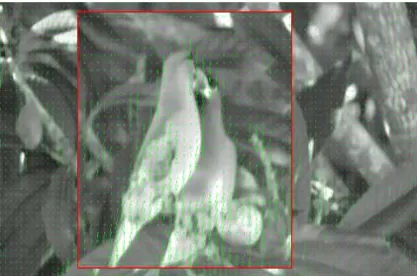
Figure 7 shows an image of wild birds processed with optical flow algorithm. Figure 8 is the result of detecting wild birds of Figure 7.
[image:8.612.314.524.561.699.2]4905 Figure 8 : Result Of Bird Detection Using Optical Flow
4.4.4 HOG + SVM for Bird Detection
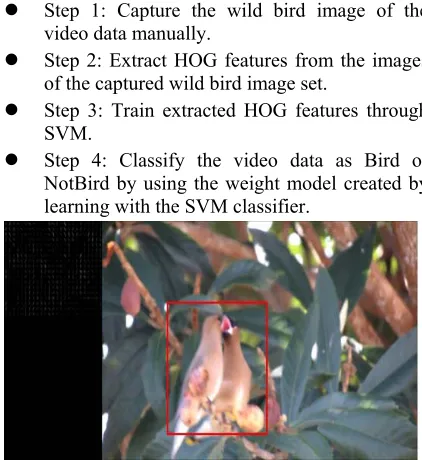
HOG is an algorithm for extracting features through the occurrence of a gradient direction in parts of an image, and SVM is a supervised learning model for analyzing data used in classification and regression analysis[21]. After extracting features using HOG, SVM detects wild birds by learning the extracted features. Wild bird detection using the HOG+SVM algorithm works as follows:
Step 1: Capture the wild bird image of the video data manually.
Step 2: Extract HOG features from the images of the captured wild bird image set.
Step 3: Train extracted HOG features through SVM.
Step 4: Classify the video data as Bird or NotBird by using the weight model created by learning with the SVM classifier.
Figure 9 : An Example Result Of Bird Detection Using HOG+SVM. The Left Image Is The Current Frame Converted To The HOG Feature.
4.4.5 The WBBC Implementation
The WBBC algorithm detects wild birds by Behavior Classification model created in Faster R-CNN. Wild birds detection using the WBBC algorithm works as follows:
Step 1: Capture the wild bird image of the video data manually.
Step 2: Distinguish the wild bird image data set as Staying and Flying bird.
Step 3: Faster R-CNN train classified data set and generate Behavior Classification model.
Step 4: Classify video data as Flying Bird, Staying Bird and Background using Faster R-CNN with Behavior Classification model.
[image:9.612.88.299.342.572.2] Step 5: Flying and Staying Bird are classified as Bird, and Background is classified as NotBird.
Figure 10 : An Example Result Of Bird Detection Using WBBC Algorithm.
4.4.6 Performance Analysis
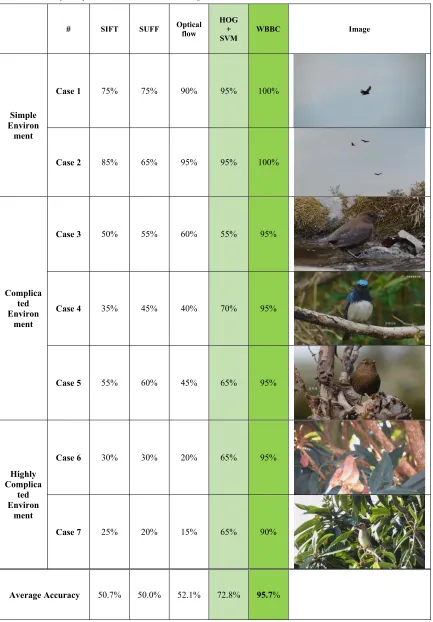
In order to compare the performance of the proposed WBBC algorithm with the previous algorithms, we constructed a total of 7 test sets. Each test-set extracts consecutive frames from video data and one test-set consists of 20 frames. Case 1 is a video clip of a wild bird flying on a simple environment, and Case 2 is a video clip of several wild birds flying on a simple environment. Case 3, 4, and 5 is a wild bird video clip on a complicated background with a variety of objects such as branches, leaves, and stones. Case 6 and 7 are highly complicated video clips than cases 3, 4, and 5. Images for feature extraction of previous algorithms were manually captured.
Table 3 shows the results, where 1 to 7 cases represent the accuracy that has been successfully detected. The Average Accuracy means accuracy in detection of a total of 140 frames.
4906 Table 3 Results of Comparison Each Bird Detection Algorithms
# SIFT SUFF Optical flow HOG + SVM
WBBC Image
Simple Environ ment
Case 1 75% 75% 90% 95% 100%
Case 2 85% 65% 95% 95% 100%
Complica ted Environ
ment
Case 3 50% 55% 60% 55% 95%
Case 4 35% 45% 40% 70% 95%
Case 5 55% 60% 45% 65% 95%
Highly Complica
ted Environ
ment
Case 6 30% 30% 20% 65% 95%
Case 7 25% 20% 15% 65% 90%
4907 The HOG + SVM showed 72.8 percent, this algorithm had higher accuracy than other previous algorithms. However, the detection was difficult if it did not completely match the features captured manually.
On the other hand, the WBBC algorithm was detected in various changing appearances (beak, wing, leg) of birds in complicated environments. The result of simple environments shows 100 percent detection accuracy as case 1 and 2. The result of complicated environments has 5 percent error with 95 percent accuracy as case 1, 2, and 3. This error was Boundary Error. The result of highly complicated environments shows 90 and 95 percent accuracy. In this case, errors were Boundary Error and Detection Failure. Average Accuracy of the WBBC algorithm was achieved 95.7 percent, with over 90 percent accuracy in all environments.
5. CONCLUSION
In this paper, we proposed a new vision-based real-time wild bird detection algorithm, which we call as WBBC model.
The WBBC model can solves wild bird classification problems that occur when detecting wild birds that change greatly in appearance by behavior, and the problem of detection in complicated environments.
We have verified two things. The first, the overfitting of dynamic changing appearance can be reduced by classifying behavior of birds. Our experiment shows 3.6 percent growth. The second, we verified through an experiment that compares various previous wild bird detection algorithms such as SIFT, SURF, Optical flow, and HOG+SVM. The WBBC algorithm showed best performance with 95.7 percent of Average Accuracy in variety of environments (simple, complicated, and highly complicated).
However, we could not able to process all incoming all frame data in video. Because, we used the VGG-16 network model to achieve high accuracy. Therefore, future work is to optimize the network model so that the entire frame of video can be performed.
ACKNOWLEDGEMENT:
This research was supported by Basic Science Research Program through the National Research Foundation of Korea(NRF) funded by the Ministry of Education(2018R1D1A1B07043417).
REFERENCES:
[1] C.W. Lee, D.W. Na, H.S Jeon, “Implementation of Vision-based Wild Bird Detection and Repelling System using RaspberryPi” , Proceedings of the Korean Society of Computer Information
Conference , 26(2), 2018,506-507.
[2] S. Y. Na, D. Shin, J. H. Jung, and J. Y. Kim, “Protection of orchard from wild animals and birds using USN facilities”, in
2010 The 2nd International Conference on Computer and Automation Engineering,
ICCAE 2010, 2010, pp. 307-311.
[3] K. Mihreteab, M. Iwahashi, and M. Yamamoto, “Crow birds detection using HOG and CS-LBP”, ISPACS 2012 - IEEE Int. Symp. Intell. Signal Process. Commun.
Syst., no. Ispacs, 2012,pp. 406–409.
[4] G. Mirzaei et al., “Avian detection &
tracking algorithm using infrared imaging”,
IEEE Int. Conf. Electro Inf. Technol., 2012,
pp. 1–4.
[5] Q. Xu and X. Shi, “A simplified bird skeleton based flying bird detection”, Proc.
World Congr. Intell. Control Autom., vol.
2015–March, no. March, 2015, pp. 1075– 1078.
[6] F. Qu and C. Li, “Design of transmission line solar ultrasonic birds repeller”, PEAM 2011 - Proc. 2011 IEEE Power Eng.
Autom. Conf., vol. 1, 2011, pp. 217–220.
[7] J. R. Moon, “Effects of birds on radar tracking systems”, IEE Conf. Publ., vol.
490, 2002, pp. 300–304.
[8] J. Song, H. Ning, W. Chen, J. Liu, and J. Li, “Bird flying track estimation based on single marine radar”, 3rd Int. Conf.
Commun. Netw. China, ChinaCom 2008,
2008,pp. 1224–1228.
[9] D. Stowell, M. Wood, Y. Stylianou, and H. Glotin, “Bird detection in audio: A survey and a challenge”, IEEE Int. Work. Mach.
Learn. Signal Process. MLSP, vol. 2016–
Novem, 2016, arXiv preprint arXiv:1608.03417.
[10] A. Marini, A. J. Turatti, A. S. Britto, and A. L. Koerich, “Visual and acoustic identification of bird species”, ICASSP, IEEE Int. Conf. Acoust. Speech Signal
Process. - Proc., vol. 2015–August, 2015,
4908 [11] D. Karmaker, I. Schiffner, R. Strydom, and
M. V. Srinivasan, “WHoG: A weighted HOG-based scheme for the detection of birds and identification of their poses in natural environments”, 2016 14th Int. Conf. Control. Autom. Robot. Vision, ICARCV 2016, vol. 2016, no. November, 2016, pp.
1–7
[12] L. Yan, Y. Yongyi, and X. Bo, “Bird objects detection and tracking on the wild field circumstance,” 2009 WRI World
Congr. Comput. Sci. Inf. Eng. CSIE 2009,
vol. 6, no. 40771151, 2009, pp. 533–536. [13] Li, Ce, Hanwen Hu, and Baochang Zhang.
"Evaluation of super-resolution on bird detection performance based on deep convolutional networks.", In Signal and Information Processing (GlobalSIP), 2017
IEEE Global Conference on, 2017 ,pp.
803-807.
[14] A. Takeki, T. T. Trinh, R. Yoshihashi, R. Kawakami, M. Iida, and T. Naemura, “Detection of small birds in large images by combining a deep detector with semantic segmentation”, Proc. - Int. Conf. Image
Process. ICIP, vol. 2016–Augus, 2016, pp.
3977–3981.
[15] X. Y. Zhang, X. J. Wu, X. Zhou, X. G. Wang, and Y. Y. Zhang, “Automatic detection and tracking of maneuverable birds in videos”, Proc. - 2008 Int. Conf.
Comput. Intell. Secur. CIS 2008, vol. 1,
2008, pp. 185–189.
[16] S. Tian and X. Cao, “Learning the state space based on flying pattern for bird detection”, in ICNS 2017 - ICNS:
CNS/ATM Challenges for UAS Integration,
2017, pp. 5B3-1.
[17] K. Simonyan and A. Zisserman, “Very deep ConvNets for large-scale image recognition”, CoRR, 2014, arXiv preprint
arXiv:1409.1556.
[18] D. G. Lowe, “Distinctive Image Features from”, Int. J. Comput. Vis., vol. 60, 2004,
no. 2, pp. 91–110.
[19] H. Bay, A. Ess, T. Tuytelaars, and L. Van Gool, “Speeded-Up Robust Features (SURF)”, Comput. Vis. Image Underst.,
2008, pp. 346-359.
[20] K. Maruyama, T. Saitoh, and R. Konishi, “Bird tracking and flapping motion recognition for monitoring system”,
Iccas-Sice, 2009, 2009,pp. 3613–3618.
[21] Perdersoli, Marco, Jordi Gonzalez, Bhaskar Chakraborty, and Juan J. Villanueva. “Boosting histograms of oriented gradients for human detection”, Computer Vision: Advances in Research & Development