Implementing an integrated management information
system in a medium sized construction firm.
BLAZA, Sonia.
Available from Sheffield Hallam University Research Archive (SHURA) at:
http://shura.shu.ac.uk/19359/
This document is the author deposited version. You are advised to consult the publisher's version if you wish to cite from it.
Published version
BLAZA, Sonia. (1995). Implementing an integrated management information system in a medium sized construction firm. Masters, Sheffield Hallam University (United Kingdom)..
Copyright and re-use policy
CITY CAMPUS FOND STREET SHEFFIELD SI 1WB
9 5Z 1 0 1 5 2 3 2 4 3 4
Fines are charged at 50p per hour
S12-| CZ U ^ .
2 2 MAR 2007 r
i y . ' '2 2
MAR
2007
iO '^LO
1
h
MAY 2 0 0 ^
ProQuest Number: 10694240
All rights reserved INFORMATION TO ALL USERS
The quality of this reproduction is dependent upon the quality of the copy submitted. In the unlikely event that the author did not send a com plete manuscript and there are missing pages, these will be noted. Also, if material had to be removed,
a note will indicate the deletion.
uest
ProQuest 10694240
Published by ProQuest LLC(2017). Copyright of the Dissertation is held by the Author. All rights reserved.
This work is protected against unauthorized copying under Title 17, United States C ode Microform Edition © ProQuest LLC.
ProQuest LLC.
789 East Eisenhower Parkway P.O. Box 1346
IMPLEMENTING AN INTEGRATED
MANAGEMENT INFORMATION SYSTEM
IN A MEDIUM SIZED CONSTRUCTION FIRM
SONIA BLAZA
A thesis submitted in partial fulfilment of the requirements of
Sheffield Hallam University for the degree of Master of Philosophy
OCTOBER 1995
ABSTRACT
Implementing An Integrated Management Information System In A Medium Sized Construction Firm
Sonia Blaza
This thesis describes a Teaching Company Scheme Project between Weaver Construction Ltd and Sheffield Hallam University (formerly Sheffield City Polytechnic) to implement an Integrated Management Information System (MIS) in a medium sized construction firm.
The construction industry is considered and the particular problems it has to face with respect to applying Information Technology (IT) during the construction process.
Methodologies used to implement computer based information systems in organisations are considered together with the development of an appropriate implementation model for Weaver Construction Limited. The model developed uses the traditional software systems life cycle as a framework, within which, other development tools are used.
An initial investigation revealed that the level of information technology awareness within the company was extremely low. In order to address this problem pilot Schemes were introduced whereby stand-alone systems were developed for several functional areas. These served the purpose of increasing the level of IT awareness within the company and also acted as a catalyst for the design of an integrated MIS, incorporating the standalone systems. The reasons behind partial integration as opposed to a fully integrated system are examined. The integrated MIS was never realised, and only partial integration was achieved.
ACKNOWLEDGEMENTS
CONTENTS
Page
Abstract i
Acknowledgements ii
Table of Contents iii
CHAPTER 1 INTRODUCTION
1.1 Introduction 1
1.2 Aims and Objectives 2
1.3 Research Methodology 3
1.3.1 Literature Search 3
1.3.2 Structured Systems Analysis of the firm 3
1.3.3 Design and Implementation 4
1.3.4 Post Implementation Review 4
1.4 Structure of the Thesis 4
CHAPTER 2 THE CONSTRUCTION INDUSTRY
2.1 Introduction 6
2.2 The Construction Industry in Britain 6
2.3 Development of Computers in the Construction Industry 10
2.4 Use of Computer Systems In The Construction Industry 13
2.4.1 Applications for the Contractor 15
2.4.2 Current Developments 16
2.4.3 The Way Forward 18
CHAPTER 3 IMPLEMENTING TECHNOLOGICAL CHANGE IN ORGANISATIONS
3.1 Introduction 20
3.2 The Nature of Change 20
3.3 Methodologies for Implementing Computer Based Information 21 Systems
3.3.1 The Systems Approach 24
3.3.2 Planning Approaches 25
3.3.3 Participation 29
3.3.4 Prototyping 31
3.4 Summary of Information Systems Methodologies 32
3.5 Methodologies for Implementing Integrated Technology 32
3.6 Developing an Implementation Model for the Construction 33 Industry
3.6.1 The Requirements Specification and Feasibility Study 35
3.6.2 Pilot Schemes 37
3.6.3 Systems Analysis and Design 38
3.6.4 Implementation and Testing 38
3.7 Summary 38
CHAPTER 4 SYSTEMS ANALYSIS AND PROBLEM IDENTIFICATION OF THE COMPANY
4.1 Introduction 40
4.2 Aims and Objectives of Computerisation 40
4.3 Initial Analysis of the Company 41
4.3.1 Company Background and Structure 42
4.4 Results of Investigation 46
4.4.1 The Surveying Department 46
4.4.1.1 Problems Identified within the Surveying Department 49
4.4.2 The Estimating Department 50
4.4.2.1 Problems Identified within the Estimating Department 51
4.4.3 The Buying Department 52
4.4.3.1 Problems Identified within the Buying Department 53
4.4.4 The Planning Department 53
4.4.4.1 Problems Identified within the Planning Department 54
4.4.5 The Contracts Department 55
4.4.5.1 Problems Identified within the Contracts Department 55
4.4.6 The Accounts Department 56
4.4.6.1 Problems Identified within the Accounts Department 57
4.5 Weaver Construction and Nolan's Model 57
4.6 Summary of Findings 59
CHAPTER 5 DESIGN, DEVELOPMENT AND IMPLEMENTATION OF COMPUTER SYSTEMS WITHIN THE COMPANY
5.1 Introduction 61
5.2 Introducing Technology into the Company 61
5.3 Bonus System 63
5.4 Appraisal of Pilot Studies 66
5.5 Detailed Systems Analysis 67
5.6 Designing an Integrated Database 67
5.7 Proposals for Further Implementation of Technology 68
5.8 A Partially Integrated System 69
5.9 Implementing the Systems 69
5.9.2 From Manual to Computerised Systems
5.10 Summary
71
72
CHAPTER 6 POST IMPLEMENTATION REVIEW: DATA COLLECTION AND ANALYSIS
6.1 Introduction 74
6.2 Attitude Formation and Change 74
6.3 Method Used To determine Attitudes To Computerisation 76
6.4 Reliability and Validity of Data Collection Method 79
6.4.1 Construct Validity 79
6.4.2 Concurrent Validity 79
6.5 Application of the Attitude Measuring Instrument 80
6.6 Current Users: Analysis of Data 80
6.6.1 Respose to New Computer Systems 80
6.6.2 Knowledge of IT 82
6.6.3 Impact on Job Function 84
6.7 Management: Analysis of Data 85
6.7.1 Response to New Computer Systems 85
6.7.2 Knowledge of IT 86
6.7.3 Impact on Job Function 86
6.8 Prospective Users: Analysis of data 86
6.8.1 Response to New Computer Systems 86
6.8.2 Knowledge of IT 88
6.8.3 Impact on Job Function 88
6.9 Chapter Summary 88
CHAPTER 7 DEVELOPMENT OF A NEW IMPLEMENTATION MODEL
7.1 Introduction 91
7.2 The Model Examined 91
7.2.1 The Positive Attributes of the Implementation Model 91
7.2.1.1 The Pilot Scheme 91
7.2.1.2 Staff Training 92
7.2.1.3 Systems Designed Using a Logical Model 92
7.2.2 The Negative Attributes of the Implementation Model 93
7.2.2.1 Resistance to Change 93
1.2.22 Lack of Planning and Commuincation 95
7.2.2.3 Systems Not Viewed Cross Functionally 95
1.2.2 A Lack of Shared Vision 96
7.3 Extensions to the Model 96
7.3.1 Evaluation of Opportunities and Threats to Management 97
7.3.2 Initial Awareness Programme 97
7.3.3 User Groups 99
7.3.4 Planning 99
7.4 Summary 100
CHAPTER 8 CONCLUSIONS
8.1 Introduction 101
8.2 IT Strategy Planning 101
8.3 An Integrated Organisational Change Programme 102
8.4 Top Management Support 103
8.6 Summary 105
REFERENCES 106
BIBLIOGRAPHY 110
APPENDICES
Appendix 1 Data Flow Diagrams A2
Appendix 2 Data Dictionary A9
Appendix 3 System Development Details A24
Appendix 4 Costing Exercise for Stand-alone Applications and A54 Integrated Database Design
Appendix 5 Post Implementation Interview Results A59
CHAPTER 1
INTRODUCTION
1.1 INTRODUCTION
The integration of construction processes using Information Technology offers considerable potential for construction firms as they meet the challenges of the 1990s. To date this potential has not been widely exploited. Most construction firms operate standalone computers which are usually dedicated to a particular business function with little integration between departments.
The benefits of integration have long been realised in other industries, particularly manufacturing, and much has been published which discusses the opportunities offered by technologies such as Computer Integrated Manufacturing. However, despite the promises offered by technology, the literature^)^) aiso suggests that there are a number of significant implementation problems which restrict the ability of firms to exploit the full potential of the integrated manufacturing technology. The implementation process is essentially multi-faceted and includes technical, business and organisational aspects. Both the technical and business dimensions are well documented. The organisational dimension, however, is the least documented and is something that is perceived as an interference and is usually dealt with after the system has been installed. It is in fact the lack of attention to this organisational dimension that has been the dominating factor in poor implementation of integrated systems that do not realise the goals they originally set out to achieve.
1.2 AIMS AND OBJECTIVES
The aims of this thesis are to investigate the organisational problems associated with implementing an integrated Management Information System (MIS) in a medium sized construction firm and identify the elements of a successful implementation methodology.
In achieving these aims, a number of objectives can be identified :
(i) To investigate the structure and operation of the construction industry and its current use of information technology.
(ii) To examine methodologies used in the implementation of information systems and select the most appropriate to the problem at hand.
(iii) To apply the selected methodology in the implementation of an integrated management information system within a construction organisation.
(iv) To conduct a post implementation review in order to determine attitudes towards computerisation in the company and highlight problems in the implementation.
(v) To critically evaluate the methodology in order to determine its strengths and weaknesses.
(vi) To establish a model which can be used for the successful implementation of an integrated management information system into medium sized construction firms.
1.3 RESEARCH METHODOLOGY
In order to achieve the aims and objectives of the research. Weaver Construction, a medium sized construction firm was used as a case study for the research. The bulk of the research was carried out in the time period between December 1989 and June
1991.
This section outlines the methods used in collecting and collating relevant information used in the investigation and production of a system implementation model.
1.3.1 Literature Search
The literature search provided an insight into the 'state of the art' regarding computing in the Construction Industry and also provided a better understanding of the construction process within a typical construction organisation. Information was also collected from Weaver Construction such as company brochures and marketing information in order to appreciate the management structure, the products of the company and market within which trading took place.
1.3.2 Structured Systems Analysis of the firm
Once the background knowledge had been acquired and the boundary of the research was established with senior management it was possible to specify a domain of work thus ensuring that relevant and appropriate information was collected. The most appropriate method for collecting this information was structured interviewing. Information gathering using this technique was used at two points during the research. Firstly in conducting a structured systems analysis of the firm and secondly in the post implementation review.
Gane and Sarson was used to produce a model of the organisation as a business system consisting of data flows, data stores, processes and external entities.
1.3.3 Design and Implementation
The model developed from the Structured Systems Analysis was used as a basis for problem identification. Many of the business processes lent themselves to improvement with the application of IT. Several of these processes were computerised in a pilot study. Following this an integrated database was designed to fully incorporate the pilot systems and all other business activities in the company. This formed the framework for further systems development.
1.3.4 Post Implementation Review
Following the implementation of the new information system a post implementation review was conducted in order to determine staff attitudes to computerisation and assess the success of the implementation process.
Two techniques, that of structured interviews and observation were used to collect the required information. The responses from the interviews were analysed in order to draw conclusions regarding the effectiveness of the new information systems. The analysis also provided the recommendations made for revisions to the implementation model.
1.4 STRUCTURE OF THESIS
Chapter 2 of the thesis provides an insight into the Construction Industry in Great Britain with regards to its products and structure. Computers in the Construction Industry are also examined together with the reasons for the industry having been reluctant to accept the new technology. It is shown how these barriers have with recent developments been removed and the necessity for construction companies to exploit this technology particularly through the integration of their business activities in order to achieve a competitive edge and to maintain profitable positions in both national and international markets.
Chapter 3 examines current methodologies used in the implementation of information systems. A methodology is devised for use in the case study company. This methodology uses the Software Development Life Cycle as a basic framework and incorporates ideas and tools from other methodologies.
Chapters 4 and 5 give an account of the stages of systems implementation at Weaver Construction. Included are details of the initial analysis and pilot schemes introduced into the company. The design of the integrated system is discussed and the subsequent implementation of a partially integrated system. Related implementation issues such as staff training, conversion procedures and the post implementation review are also highlighted.
Chapter 6 focuses on the examination of the implementation problems which were mostly related to staff attitudes. An attitude measuring instrument is developed, application of which provides useful data for a detailed analysis of implementation problems.
Chapter 7 uses the results provided in the previous chapter to provide a critique of the implementation methodology and recommend extensions in order to overcome the identified problems. Thus the model developed as a result of this investigation should be of assistance and guidance to construction firms who are considering the introduction of an integrated MIS into their company.
CHATTER 2
THE CONSTRUCTION INDUSTRY
2.1 INTRODUCTION
Today's construction projects are becoming increasingly dependent on new innovation with regard to the methods of construction and the use of efficient communication systems. Projects are constrained by time, quality and cost. The people involved in the construction process therefore need the best possible assistance to enable them to complete projects within these constraints whilst at the same time achieving the objectives of their organisation. Whatever form a construction company takes, it is likely to have the following objectives in common with other organisations^):
(i) to provide a fair return to shareholders; (ii) to satisfy clients' requirements;
(iii) to utilise resources efficiently;
(iv) to improve the company's position in its markets; (v) to develop products which can be sold profitably.
In order to examine how computer technology can be used as a strategy to achieving these objectives, it is first necessary to consider construction in Britain today and the problems facing the industry.
2.2 THE CONSTRUCTION INDUSTRY IN BRITAIN
In Britain, buildings are one of the nation's most important assets. In 1989 they were estimated to be worth £l,160bn in comparison with civil engineering assets which were estimated to be worth only £31 bn. Buildings account for nearly 90% of the nation's wealth and the construction industry's output amounts to over 10% of gross domestic product in Britain. In 1989, £52.5bn was invested in building works. Approximately one million people are employed in the industry (including apprentices) which accounts for approximately 4.5% of the employed labour force.^)
The Construction Industry covers a wide range of loosely integrated groups and organisations and comprises a large number of small firms and a small number of large ones. In 1989 there were nearly 219,000 legal units involved in construction work which generally includes the production, renewal, alteration, repair and maintenance of capital goods such as factories and domestic dwellings, social type buildings, together with civil engineering works. These goods are produced by combining land with a variety of raw materials and semi-processed components.(^) The end products being used for direct consumption by the private and public sectors. There are several characteristics displayed by the Construction Industry which make it unique in comparison with any other Industry.
These characteristics fall into four major groups:^) (i) The Physical nature of the product;
(ii) The structure of the Industry, together with the organisation of the construction process;
(iii) The determinants of demand; (iv) The method of price determination;
These groupings can be described as follows :
(i) The Product
The construction product is large, immobile and expensive. The value is usually high in comparison to the income of the purchaser. It is usually built to customer requirements, making it difficult to alter and allowing little scope to develop mass production techniques. The Product has a long life, hence existing stocks of buildings are large and a high percentage of construction output is in maintenance and repairs.
(ii) The Industry
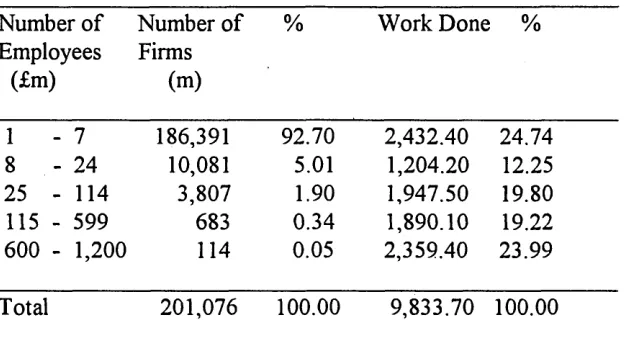
the architect who designs the product; the building contractor who offers a service in consulting and managing projects; the builder's merchant who distributes materials; and the small jobbing builder who confines activities to repair and maintenance work. Table 2A analyses the distribution of employees in relationship to size of firms. The largest number of employees in the industry are with small firms employing seven or fewer people. Medium sized firms employing between 115 to 599 people account for only 0.34% of firms yet are responsible for some 20% of the output of the industry.
Number of Employees
(£m)
Number of Firms
(m)
% Work Done %
1 - 7 186,391 92.70 2,432.40 24.74
8 - 24 10,081 5.01 1,204.20 12.25
25 - 114 3,807 1.90 1,947.50 19.80
115 - 599 683 0.34 1,890.10 19.22
600 - 1,200 114 0.05 2,359.40 23.99
Total 201,076 100.00 9,833.70 100.00
Source: Housing and Construction Statistics, 1991
TABLE 2A ANALYSIS OF PRIVATE CONTRACTING FIRMS AND OUTPUT FIGURES THIRD QUARTER 1989
Within the building process, members of different professions, such as the architect, the quantity surveyor, the structural engineer and the service engineer are brought together to form a complementary team to design the project. It is usual that after the design stage, the contractor is appointed. These teams are generally temporary arrangements. Once the project is complete, the various teams are disbanded and the experience and efficiencies gained are often lost.
[image:20.616.96.415.189.361.2]teamwork and partnership.
(iii) Demand
The demand for construction work has four distinct categories. These can be identified as :
- housing
- industrial and commercial buildings
- social buildings including, schools and churches - infrastructure
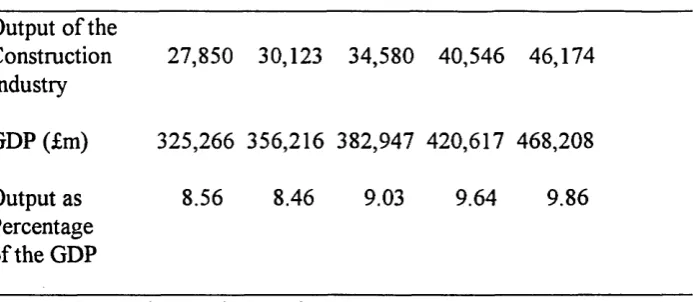
The Government, either central or local, is a major client of the construction industry and has a major influence on the demand for work. This tends to be mostly in the public sector but the government also indirectly affects demand in the private sector. To maintain an equilibrium between demand and supply for goods and services, the government adopts a combination of monetary and fiscal policies in order to control inflation and unemployment. This often results in fluctuations in demand according to the state of the economy with the consequent effects on the construction industry.^) Construction activity is cyclical and the output of the industry closely follows the growth pattern of the gross domestic product. Table 2B the construction industry output, shows a large increase over the period from 1985 to 1989, in which time a boom was experienced. Output has subsequently fallen as the industry is now suffering from depressed demand.
1985 1986 1987 1988 1989
Output of the Construction
Industry 27,850 30,123 34,580 40,546 46,174
GDP (£m) 325,266 356,216 382,947 420,617 468,208
Output as Percentage of the GDP
8.56 8.46 9.03 9.64 9.86
Source: Economic Trends, March 1991
TABLE 2B THE OUTPUT OF THE CONSTRUCTION INDUSTRY AND GDP 1985 - 1989
Latham(^) in his construction industry review proposes a productivity target of 30% real cost reduction by the year 2000 and recommends that government should establish benchmarking arrangements to provide pressure for continuous improvements in performance.
v) Price Determination
Because of the nature of the product, the structure of the industry and the characteristics of demand, the industry fixes its prices largely by competitive tender for each contract. This may take the form of open, selective and negotiated tendering. In each case a price is established prior to the finished product which may not always reflect the true cost of construction.
The pattern of demand and supply tends to make the construction industry fragmented, labour intensive and an irregular employer. This results in relatively little investment in new technology as the benefits of economies of scale cannot be fully realised. With the advent of information systems it may be possible to harness some of the wasted vitality.
2.3 DEVELOPMENT OF COMPUTERS IN THE CONSTRUCTION INDUSTRY
Whilst the characteristics identified do present problems for the construction industry,
[image:22.615.101.448.61.212.2]there are commonalities that relate to all companies. In all construction organisations certain processes have to be carried out. Such processes relate to estimating, planning and control. Initially all projects have to be priced as accurately as possible. Once a tender has been won, correct planning procedures have to be adopted so that building operations can take place and production and cost control procedures can be effectively introduced. This allows variations from the planned programme to be identified and remedial action taken where necessary, thus facilitating projects to be completed on time to the required quality and cost. It is these common processes where information technology can offer assistance and where systems development can take place to ensure the efficient generation of management information.
Despite the problematic characteristics of the industry, computers have been used in construction to provide information at the various stages of the construction process. The Construction Industry was amongst the first users of computers. Structural engineers used them in the nineteen forties as aid in analysis. However, to date construction is not an industry which has readily adopted and exploited computer technology in comparison with other industries. With the few exceptions of mostly larger firms, the industry has been slow to embrace the new technologies and available software and still relies heavily on traditional methods.
The structure of the industry itself and its peculiarities in comparison with other industries have been used to explain why there has been a reluctance to accept the new technology. In the recent past:
(i) Small firms, employing less than 25 people, found it difficult to justify the relatively large expenditure involved in purchasing a computer system.
Specialist staff were also required to operate, maintain and program computer systems.
for the then traditional computer equipment. The size of the computer also presented problems of finding suitable housing other than head office.
(iii) The large number of different types of construction firms each have differing requirements, has inhibited standardisation and formation of a large market for a specific application.
Other factors may have contributed to the reluctance of smaller firms to purchase equipment, however, the three major reasons can be defined as :
- cost - portability
- availability of software
Although the industry’s structure remains the same, advancements have been made in technology which have changed the face of computing beyond all recognition. The most significant advancements are :
(i) The development of microelectronics and the integrated circuit. This has brought great reductions in terms of the size of the computer. The
emergence of the personal portable computer has provided a tool, tolerant of harsh conditions and which can be easily transported from site to site.
Communication links can also quickly be established via modems and telephone lines, to head office.
(ii) An increase in software availability for the PC user in the construction industry.
(iii) The dramatic fall in costs of computer hardware. This has made computers more widely available to all and has also brought a boom in the home computer market, providing an increased awareness of computers and their
capabilities.
(iv) The development of 4th generation languages and software development environments. This has greatly simplified programming, removing the need for specialist staff to maintain and program a conventional computer.
(v) The use of open systems. This enables programs and data to be transferred between computers with different processors thereby facilitating integration of different systems.
Today, technology is not a limitation and the construction industry can no longer use the arguments of it being different from other industries as an excuse not to exploit the new technology. The barriers which may have been real or imagined have been removed. The firms within the construction industry cannot afford to ignore IT if they are to remain competitive and survive in international markets.
2.4 USE OF COMPUTER SYSTEMS IN THE CONSTRUCTION INDUSTRY
The role of the contractor in the construction process, irrespective of the size of the company, is to provide and manage the resources necessary to produce the required goods. For the contractor the areas in which a computer is useful are :
- Estimating - Planning - Purchasing - Surveying - Accounting
- Administration and office automation
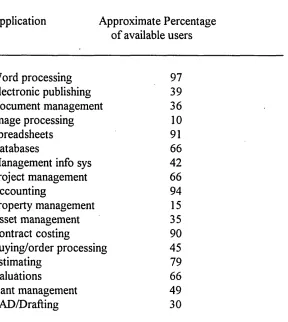
contractors have computer systems for buying and order processing, and estimating and valuations software have shown an increased usage over the past three years. Storage, retrieval and management of documents is problematic given the vast amount of data associated with a construction project, yet with only 35% of contractors are using document management systems.
Application Approximate Percentage of available users
Word processing 97
Electronic publishing 39
Document management 36
Image processing 10
Spreadsheets 91
Databases 66
Management info sys 42
Project management 66
Accounting 94
Property management 15
Asset management 35
Contract costing 90
Buying/order processing 45
Estimating 79
Valuations 66
Plant management 49
CAD/Drafting 30
[image:26.616.104.392.161.483.2]Source : Building IT for Quality, CICA & KPMG Peat Marwick
TABLE 2C Computer Software : Contractors
Investments have generally focused on providing IT support for specific activities within the construction process. Integration of various functions through electronic sharing and communication of information is not widespread at present, and is a major area of opportunity.^) The next section will take a closer look at the actual applications available to the contractor.
2.4.1 Applications tor the contractor
On examining the CICA software list(^) and the Software Guides in Construction Computing^ one can see the wide range of software that is currently available for the contractor.
For the contractor the starting point in the construction process involves the estimating function where the contractor receives the contract documents in order to produce an estimate of how much the contract will cost to complete. The pricing of bills may be carried out using a computerised estimating system. A bill of quantities can be scanned into the computer and priced using a computerised library of price details for each item of work. Once the contractor has produced a tender the priced bill will be returned to the quantity surveyor.
With the advent of open systems it is also possible for the client to send a disk containing the bill of quantities for direct input into the contractor's computer for pricing. This facility, however, has not been widely exploited. Some software developers are now producing estimating systems which can interact with other of their systems such as Valuations and Job Costing systems.
The planning function is a vital part of the construction process in order to complete a job within a certain time period. It is necessary before the start of a job and also during the construction stage so that potential problems may be identified. The most common techniques used by computer systems to relate activities by time is network analysis using the critical path method (CPM) or the project evaluation and review technique (PERT). Most planning packages are capable of producing high quality graphical outputs in a number of formats which the user may select to satisfy their requirements.
are also limited and typically involve the production of valuations and final accounts.
As mentioned earlier, accounting applications show the greatest use amongst contractors. Almost all contractors are now using computers in this area. Budgeting and financial modelling, cash flow, VAT systems, payroll are a few of the packages available to assist in the accounting function.
Again, certain office automation applications are widely used by the contractor for general administration purposes. Typewriters are being increasingly replaced by word processing packages. Electronic mail shows a limited use amongst contractors, which is to be expected given that many firms are operating standalone systems and are apparently loathe or unable to operate integrated systems.
Overall the use of IT on site is generally restricted to telephone, fax and some standalone systems. Investment is hindered by the environment and security risks associated with the use of IT hardware on construction sites.^
IT suppliers have succeeded in developing many of the applications required by their customer by providing specific solutions to problems but they must now move forward and deliver integrated tools that support the complete construction process.^
2.4.2 Current Developments
R e s e a r c h ( ^ ) , ( 1 4 ) ( 1 5 ) jncjicates that the majority of the systems highlighted tend to be
standalones dealing with only one management function and few, if any of these companies have integrated these management functions. Very little data is transferred directly from one system to another as often the various functions require the data to be presented in a different format. The potential savings in manpower arising from integrating these functions is, by any estimate, substantial Perhaps then, one of the most important areas for consideration is that of integrating systems both within and
external to an organisation. This facilitates data sharing between different applications which offers many advantages including inputting and updating data only once, production of management information which was not previously possible and more accurate and up to date information. At present telephone and fax dominate informal communication between companies. Technologies such as e-mail, virtual project networks, groupware and video conferencing are not widely used even though they offer various advantages over telephone and fax.(^)
Recent years have seen an increase in activities which help the exchange of data between systems and organisations.^ These include the development of open systems interconnection (OSI Seven Layer Model) and the work of EDICON, looking at how data may be transferred at a number of stages in the construction process, particularly between suppliers and contractors and between the Quantity Surveyor and contractor. CITE ( Construction Industry Trading Electronically), an initiative led by a group of contractors and suppliers, has been set up in order to produce standards for the transfer of the most frequently exchanged documents in the construction process.^ ^ Although a number of standards and conventions have been developed to achieve successful sharing of industry information, they do not have widespread support.1(20) The results of a recent survey show that levels of use of EDI in the construction industry is 6%, though this figure is expected to rise in the near fu tu re .^ )
Current research relating to integrating applications within the construction company itself includes the development of a 'Product Model'. This will use a central database which comprises all the data required at each stage in a construction project.
offers the added advantage of E-Mail, enabling users to communicate electronically. Other developments include the ability to access on line external databases such as BCIS providing cost information from the Building Cost Information Service, Context providing information on building products, codes of practice and British Standards and BRIX providing Building Research Station data.
2.4.3 The Way Forward
As highlighted previously, there is a wide variety of computer systems available for the contractor and many developments are taking place in the field of information technology in construction. However, computer systems have not yet altered the way in which the industry functions. The industry still comprises of a myriad of small to medium sized companies mainly operating on a local or region basis, usually under capitalized, highly competitive and facing an uncertain and widely fluctuating market demand. This model is different to most other manufacturing industries which have amalgamated to form a small number of large companies as for example the motor car producers. The fragmented nature of the industry and its lack of client focus and established IT standards have inhibited an integrated approach to IT.(22)
Other industries have used computer technology as a competitive edge, using it to broaden their perception of how things can be done and changing their working methods. The market leaders in IT developments have increased their market share and when their competitors have tried to follow in their footsteps they have only recovered part of their lost market share. In many industries it appears firms are having to use IT merely for competitive survival rather than competitive advantage.
A recent report commissioned by the Department of the Environment and B T ^ ) regarding the use of IT in the Construction Industry, outlines an IT strategy for the industry and provides an IT vision for the future. This vision includes an integrated project communications framework, based on key technical and commercial information relating to a project on a project database and integrated industry wide information
comprising standard component listings, building performance benchmarks, best practices, etc to improve and inform construction projects. The Construction Industry in Great Britain must keep up to date and exploit the computer technology available, especially if construction firms are to compete in international markets and Sir Michael Latham's challenged) of a 30% cut in costs by the year 2000 is to be achieved. Information is the lifeblood of any organisation. In order for a piece of information to be useful it must have certain attributes such as timeliness, conciseness and relevance to the recipient. IT can be used to effectively manage information in order to improve efficiency and help an organisation pursue its business goals and achieve competitive advantage. Dramatic improvement will however, require a business strategy based upon teamwork, integrated processes and a renewed focus upon meeting client's n e e d s . d )
2.5 SUMMARY
The construction industry is one of the most oldest professions known to man and as such has developed standard practices which have been slowly refined over time; the products of the construction industry are durable and remain for long periods of time. This has resulted in an industry which has been slow to embrace and exploit new ideas. This cautiousness can be offered as one of the reasons why the acceptance of IT in the industry has been slow. However, this chapter has illustrated that the major factors which have inhibited progress are:
- cost - portability
- availability of software
C U A r i'U K 3
IMPLEMENTING TECHNOLOGICAL CHANGE IN ORGANISATIONS
3.1 INTRODUCTION
As highlighted in the previous chapter, the construction industry faces many external pressures over which it has little influence. As it cannot control the environment then it is vital that construction companies adapt and change in order to meet the challenges presented to them. This chapter briefly examines the nature of change focusing in particular on technological change and the implementation of a computer system. It explores a range of methodologies which can be used to implement computer based information systems and proposes methodology for the implementation of an integrated Management Information System in a medium sized construction firm.
3.2 THE NATURE OF CHANGE
The need for change in an organisation can originate from both external and internal pressures. Externally there may be pressures such as changing markets, technological development and government policies and internally pressures may arise such as the realisation of an inefficient system. Ultimately all changes should be driven by business demands. Change can occur in one of three forms:^)
(i) structural - new rules, decision systems (ii) technical - new computer systems (iii) social - attitude change
All these variables are interdependent, for example, a technical change such as the introduction of a new computer systems may alter the tasks staff perform and the skills they require. Therefore technological change cannot be considered in isolation. It is important that the resulting social and structural impact is also taken into account.
model which provides a structured approach to managing change and can contribute to the successful execution of the process. Finding a suitable implementation model is no easy task. Indeed, there is no ideal implementation model. Different situations and problems require different approaches and solutions. The following section seeks to examine the different available methodologies for the implementation of a computer based information system which would bring about change of the technical form.
3.3 METHODOLOGIES FOR IMPLEMENTING COMPUTER BASED INFORMATION SYSTEMS
Early data processing systems in the 1950s were implemented without the use of any formal methodology. Programmers would carry out all tasks involved with the development of a system. The programmers, although highly technical people, did not often have the skills required to be able to translate users needs into a satisfactory system. As computerised information systems became more important it was recognised that regardless of how good the design of a system and the skills of a programmer were, unless the user requirements had been understood the resulting system would be inappropriate. As a result the role of the systems analyst was created so that more emphasis could be placed on the analysis and design of a system. The need for a methodology for the development of systems was also recognised. In response to this need, the systems development life cycle emerged in the late 1960s. This documents the stages involved in developing a system. This model consists of the following steps or phases :
(i) Requirements Specification (ii) Feasibility Study
Figure 3.1 shows the stages of the life cycle. The details of each sub stage identified within the life cycle can be explained as follows :
Requirements Specification
This is a specification of company objectives and system requirements, including reasons for implementing a new system.
Feasibility Study
The systems implementor must ensure that the requirements are realistic and feasible. A study is therefore conducted to investigate the proposed project. At this stage the development of a new system must be justified or the project abandoned.
Systems Analysis and Design
At this stage an in depth study is conducted into the existing system to determine current methods and future information requirements. A new information system is designed in accordance with the requirements specification. When the design has been approved, a system specification is produced, detailing all features of the system.
Implementation and Testing
This involves translating the design into a format which the computer can understand. The software system then needs to be tested to ensure that it operates correctly and in accordance with user requirements. Staff training also occurs at this stage.
Maintenance
There are two types of maintenance:
- where software errors are found after the system has been implemented that require
LU I __I
O ; >
° i
u j :<_3 LU
ZS
Q_
O
__I LU
>
LU
Q
LU
h
-CO
> “00
LU Cd
<
CD
O 00
LU
ro CD 13 !
zrt
correction;
- where enhancements required in order to continue meeting company requirements and objectives that change to meet the demands of an unstable environment.
Although the systems development life cycle is well known, it does have its limitations. Many users have questioned the productivity of the process and the quality of the
p r o d u c t^ ). Users feel that the development of systems is slow, expensive and still do
not adequately meet their requirements. Since the development of the systems life cycle a number of other methodologies have emerged all attempting in some way to address the problems of the traditional approach to developing systems.
A methodology is essentially "a collection of procedures, techniques, tools and documentation aids"(3). It is also based on a philosophy which will emphasise a theme throughout the stages of development. Avison and Fitzgerald^) identified four themes which are prevalent in various methodologies. The themes are :
(i) the systems approach (ii) planning approach (iii) participation (iv) prototyping
These themes will now be discussed in the following sections.
3.3.1 The Systems Approach
Systems theory emphasises that it is important to view a system as a whole rather than concentrating on the subsystems that constitute the whole. Focusing merely on the subsystems would lead to a condition known as sub-optimalisation, where the subsystems work effectively but pursue their own goals to the detriment of the goals of the whole. The principle of holism is also an important concept in systems theory that
states that the output of the whole is greater than the sum of the output of the individual parts. This theory can be applied to an organisation which can be viewed as a system with the functional departments acting as the subsystems. Equally it can be applied to the implementation of an information system. It would be pointless to computerise a department without first considering the needs of the organisation as a whole and the interconnections between different departments. If a socio technical perspective is taken then technology, the organisation, and people could be viewed as the subsystems which must work in harmony to optimise the operation of the system. Although the technological subsystems is predictable, the people and organisation subsystems are extremely complex and unpredictable. Applying the systems approach would mean all these subsystems need to be considered.
Checkland's Soft Systems Methodology^) is loosely based around systems theory. The theme in this approach is that analysts are dealing with an unstructured problem defined by different individuals with differing views which all need to be considered. As such the problems are "fuzzy" and solutions are not apparent and straightforward. Thus Checkland's methodology should result in a better understanding of the problem area and hence user requirements. The methodology also focuses on other important issues and implications of the implementation of an information system such as structural changes in the organisation.
3.3.2 Planning Approaches
Methodologies based on this approach emphasise the importance of planning at the strategic level prior to the development of any system. The organisational objectives and business strategy should first be determined and only then should an information system strategy be derived to support these.
information systems ^ will be outlined. In the first era (1960s onwards), which is known as the data processing era, systems were essentially transaction processing systems which computerised routine, operational tasks. The second era (1970s onwards), known as the management information systems era, was characterised by systems which aimed to provide more and better management information to support decision making. The third and current era (1980s onwards), known as the strategic information systems era is characterised by systems which aim to increase competitive advantage. The systems characteristic of the first era were developed in a piecemeal fashion to meet the needs of functional business areas. The IS strategy was rarely considered as a part of the system of a business strategy in the same way as for example a marketing strategy and a production strategy would be included. However, where the aims of implementation are those of increasing organisational effectiveness and competitiveness this approach to systems development becomes inappropriate. A different approach is required to produce systems characteristic of the second and third era. Typical types of strategic information systems include
(i) systems that link the organisation's technology directly to important external organisations and individuals, such as customers and suppliers;
(ii) systems that integrate and disseminate information in an organisation over established barriers such as different roles or departments;
(iii) systems that enable organisations to develop new products or services based on information;
(iv) systems that provide top executives with information to assist strategic activities.
These systems will affect the competitive position of an organisation and also depend
on internal information being integrated. Unless such systems are carefully planned and managed, organisations run the risk of eroding their competitiveness by poor investments in their information systems. It is therefore vital that top management who are responsible for formulating strategies have an understanding of strategic information planning. In a survey on information planning, by Galliers(^), out of 130 companies surveyed, only 10% said they had merged their IS planning with their business objectives. Top management were seen to be unambitious about systems planning and gave low priority to proposals which attempted to seek out opportunities which would give the business a competitive advantage. The potential contribution of information systems is too important to corporate success to be left to the technologist alone.
Planning approaches therefore emphasise the involvement of top management as well as the technologist in planning how information systems might best meet the organisational objectives. Methodologies based on the planning approach include Business Information Analysis and Integration Technique (BIATT), Business Systems Planning (BSP) and Stages of Growth Model. BIATT concentrates on analysing the information required to support the business objectives and then looks at the type of systems which could provide this information. BSP is similar to the traditional approach but emphasises strategic planning in the early stages and an organisation wide perspective. The data becomes a corporate resource which is available to everyone rather than being owned by departments.
The features that can identify an organisation as being at a particular stage are the applications portfolio, DP organisation, DP planning and control and user awareness. The model is based on the assumption that an organisation must move through each of the stages. Stages can not be skipped as at each one a process of organisational learning occurs, without which it is not possible to progress to the next stage. Briefly, the stages in the model are:
(i) Initiation (ii) Contagion (iii) Control (iv) Integration
(v) Data Administration (vi) Maturity
Initiation
At this stage the organisation acquires its first information system. Systems characteristic of this stage focus on automating well defined clerical procedures, for example payroll. There is no strategic interest shown by management.
Contagion
This is a period of rapid growth in which users demand more applications. There is a high level of investment in information systems in an attempt to satisfy the user requests.
Control
This represents a period of a tightly controlled investment in IS and the enforcement of strict policies and standards due to management concerns about cost and return on investment. This action may produce a backlog of applications and an increasing number of dissatisfied users.
Integration
This stage focuses on integrating existing systems through the use of databases.
Data Administration
The focus is now on managing information. Information is viewed as a corporate resource to be shared within the organisation.
Maturity
At this stage the development of information systems is closely integrated with the business strategy.
Nolan identified one particularly important transition period. This occurred sometimes in stage three, where an observable shift can be seen in orientation from management of the computer to management of the company's data resources. Throughout each stage management response to the growth of IS may be observed in the use of two levers, namely slack and control. Slack is allowing flexibility and the commitment of resources regarding IS. Control is the monitoring of IS efficiency. The balance between these two levers is important and will take a different form at each stage. For example in the Contagion stage slack is high and controls are low, users are allowed the freedom to explore with very little monitoring of their activities by senior management.
Although this model was developed in the era when mainframes were dominant, and its appropriateness today may be questioned, the model still provides a useful framework for information systems planning.
3.3.3 Participation
communicate effectively with the user. Many information systems although technically correct, fail because of the people problems encountered in the implementation process. Many of these problems could be overcome by greater involvement of all staff to be affected by the system. The involvement of users in the development and implementation of systems is known as the participative approach to systems implementation. The arguments for using a participative approach in systems implementation are as follows :
(i) the systems implementor who is often an outsider to the company has the opportunity to communicate and build rapport with the user which helps to break down barriers created from the mistrust of a 'foreigner' who is introducing change;
(ii) the user is the expert at doing the job and is the best person to inform .the systems implementor of what the job entails and the problems associated with it;
(iii) users have a right to control their destinies and should have some say in the future of their jobs;
(iv) involvement acts as a motivator and also leads to a greater level of acceptance of the system since the user has played a part in the evolution of the system;
(v) involvement at the design stage means that problems surface sooner and are dealt with more easily. It also provides a learning experience for the user and enables a better understanding of how the system works.
Enid Mumford(^) is a great pioneer of participative approaches to systems implementation and specifies three types of involvement:
(i) consultative - whereby the users are consulted about their needs but the bulk of the decisions are left to the systems design group;
(ii) representative - whereby an elected group represents the needs of their colleagues. The group also participate in the design process;
(iii) consensus - whereby the users make the decisions and are fully responsible for their implementation.
Effective Technical and Human Implementation of Computer Based Systems (ETHICS) is one methodology devised by Enid Mumford based on the participative approach.
3.3.4 Prototyping
A prototype is a working model of a system which will usually have some but not all of the features of the proposed system. Prototyping of information systems has only recently become popular with the development of fourth generation languages which have made it much quicker and cheaper to produce prototypes. Senn(^) states there are two primary uses of application prototyping. Firstly it can be used to identify and clarify the user requirements and secondly prototypes are useful in verifying the feasibility of a systems design. Analysts can provide the user with a working model which the user can experiment with and offer feedback as to how well the design meets their requirements. The prototype can then be refined, possibly undergoing several iterations until it proves satisfactory to the user. There are certain situations in which prototyping would be suitable. These are
- requirements are not known
- requirements are known but need verification and assessment
organisation in jeopardy
- new technology in which the organisation has no experience
When any of these situations arise then prototyping should be considered as part of the implementation process. Prototyping can be seen as a much improved form of systems investigation and analysis, as well as an aid to design(^)
3.4 SUMMARY OF INFORMATION SYSTEMS METHODOLOGIES
This section has examined a number of themes prevalent in information systems methodologies. These methodologies are composed of tools and techniques some of which may be common to several methodologies. Within each methodology the
software systems life cycle can be identified but the various phases have been adapted according to the philosophy underpinning the methodology. So far the discussion has centred around implementing an information system. The issue of a special purpose methodology for implementing an integrated management information system will now be addressed.
3.5 METHODOLOGIES FOR IMPLEMENTING INTEGRATED TECHNOLOGY
To date little research as regards implementing an integrated management information system in a construction firm has been conducted. However, this has for sometime been an area of ongoing research in other industries particularly manufacturing. Whilst it is acknowledged that construction is a unique industry, there are valuable lessons that can be learnt from other industries further in their IS maturity that could apply to any company implementing integrated technology. Tranfield and Smith(^) have carried out extensive research into the implementation of Computer Integrated Manufacturing (CIM) and identified key elements of a successful methodology. These elements include:
- Business driven. The reason for investing in IT should be to improve the competitiveness of the company.
- Back to basics rethink. Implementation should involve step function change. This
requires an analysis of the business and reappraisal of its objectives. An organisation redesign should accompany the change.
- Top management driven. The best way to achieve step function change is top down.
- Front end- back end. Business and managerial functions should be considered at the front end of the change process. The technological issues should be at the tail end of the process.
- Integrated change strategies. Successful implementation requires changing the company on a wide variety of fronts such as structural and culture changes.
- Investment in people as well as technology. People require training in order to acquire new skills and new attitudes required for new technology.
- Everybody on board. Step function change can only be achieved with the support of the entire organisation, particularly the management.
Smith and Tranfield(^) also suggest that the implementation should take place in short bursts of revolutionary change which is known as a 'sprint'. The sprints focuses on a few key areas of the business identified in a systems analysis and requires vision building, involving all company staff. When a plateau is reached change is implemented on an incremental basis and long term goals are set, this known as the 'performance ratchet'. The success factors identified must be applied and adapted to the context of the problem and implementation environment.
3.6 DEVELOPING AN IMPLEMENTATION METHODOLOGY FOR A CONSTRUCTION CONTRACTOR
accurate systems which meet users' requirements. It is therefore necessary to find the most suitable methodology and use it to solve the problem at hand. However, how does an organisation select an appropriate methodology?
Certain methodologies are more suitable for certain situations. For example, in a situation where there may be many 'soft' issues a methodology such as Checkland's SSM (^) may be most suitable as it attempts to resolve these issues as part of the analysis phase before the actual design of the system. It must be noted that in an ideal situation an organisation could select the most suitable methodology to the problem at hand. However, in practice, selection of a suitable methodology is not as simple as it might first appear, and the process may be subject to certain constraints. In this particular case study three factors, namely existing skills base, cost and 'organisational fit of the methodology' were important factors in the selection process.
(i) existing skills base - the systems implementor will usually be conversant with one or more methodologies and probably have a preferred methodology. If anything not within their portfolio of skills was selected training would be required which could be very costly depending on the popularity of the methodology. This would also delay the implementation process whilst the implementor is being trained in the chosen methodology and this could be time an organisation can ill afford.
(ii) cost - some methodologies may involve stages that require particular tools or processes that are costly in terms of human effort, time and organisational finances.
(iii) organisational fit - some methodologies or elements of them may simply not be appropriate to the culture of an organisation. For example in participative approaches it would be reasonable to assume that the consensus form of participation might be the most effective. However in a traditional, bureaucratic
organisation where roles and responsibilities are clearly defined and there are strict controls this form of participation would clearly be inappropriate.
Consequently, it is not always possible to choose the methodology that appears to be the most appropriate. These factors influenced and played an important part in shaping the implementation model adopted. In this research, an experimental approach was adopted whereby the traditional systems life cycle was used as a basic structure. Within this structure suitable tools and themes were employed from other methodologies and used in the production of systems.
The systems life cycle model is of course very general and some of the phases had to be broken down into a number of suitable sub stages. The approach adopted was continually reviewed and the resulting feedback applied in an attempt to improve the model. Flexibility and adaptability were key characteristics of the model as the company had limited experience of IT and there was no prior experience that could be used to inform the implementation of the new system.
Figure 3.2 shows the sub stages of the revised model. Phases 1, 2 and 5, The Requirements Specification, The Feasibility Study and Maintenance are as described in the traditional life cycle. Phases 2 and 3, Systems Analysis and Design and Implementation and Testing were broken down into a series of smaller and more manageable sub stages appropriate to the task at hand. The revised model will now be described in further detail.
3.6.1 The Requirements Specification and Feasibility Study
The user makes a request for a computerised MIS in the form of a requirements specification outlining the objectives and features that the system must perform.
SUB-STAGES OF LIFE CYC!
r \ .
STUDY
PHOT USER NEEDS
STANDALONE SYSTEMS
PROPOSALS FDR FURTHER TO USER
STRUCTURED NTERYOS DETAILED SYSTEMS ANALYSIS
USER NEDS
DESIGN
1_____
TRAINING UANTEHANCE REQUEST REVISED SYSTEM
NEW SYSTEM SPECIFICATION
fact viable and the requirements achievable. The feasibility study must be conducted in close conjunction with the management to gain a better understanding of the existing system and its perceived problems and also to acquire management commitment to the project. At this stage a decision must be made as to whether the objectives may met with or without amendments or to abandon the project.
3.6.2. Pilot Schemes
Priority applications are selected for computerisation and small prototypes with limited functionality are developed. These pilot systems provide a learning mechanism to discover problems in introducing new technology into the company and experiment with different ways of managing the implementation. They also generate initial interest in computers in a company with no technology and act as a catalyst for further and more complex systems implementation.
The effectiveness of the systems must be evaluated by obtaining feedback from users and using this to inform further development work.
3.6.3 Systems Analysis and Design
A systems analysis of the company is conducted in order to gain a more detailed understanding of working methods used and to identify problems within the company. Data are collected using structured interviews with members of staff at all levels. Data flow diagrams and are used to describe the company, additionally Nolan's Model as described earlier is applied to assess the current maturity of IT and how the company should progress to further maturity. In some cases business processes need to be redesigned in order to increase efficiency and effectiveness. It is important that business processes drive changes and not technology. One must first explore how IT might facilitate a business process rather than see how existing processes might be modified in order to apply IT.
ensure that the system design does not conflict with company policy and objectives.
3.6.4 Implementation and Testing
This is an iterative process whereby prototype systems are developed, the user then has a trial run of the system to ensure it meets their individual requirements. The system is altered if required, which may mean carrying out further analysis and altering the original system design. The system is then tested to ensure efficient operation and information generation.
The system is implemented using a 'bottom up implementation' approach. This involves implementing simple modules first, as in the pilot schemes. These modules are then integrated to form more complex systems which should satisfy all company information requirements.
Staff training also takes place before the system is finally installed. Documentation needs to be completed for programmers, giving detailed descriptions of how the system works, and for users giving operational instructions for the system. During the implementation a participative approach is used in each of the four stages. From the three types of involvement discussed the consultative approach was considered the most appropriate.
3.7 SUMMARY
Change can occur in one of three forms, structural, technical and social. The introduction of an integrated management information system would imply change of a technical nature but in reality involves both social and structural change. The social or organisational dimension is often ignored and unaccounted for leading to sub-optimal implementations.
In order to manage the organisational dimension appropriate measures must be