Munich Personal RePEc Archive
Conditional versus unconditional
forecasting with the New Area-Wide
Model of the euro area
Christoffel, Kai and Coenen, Gunter and Warne, Anders
European Central Bank
July 2007
Online at
https://mpra.ub.uni-muenchen.de/76759/
Conditional versus Unconditional Forecasting
with the New Area-Wide Model of the Euro Area
Kai Christoffel, G¨unter Coenen and Anders Warne∗,†
European Central Bank
10 July 2007
Preliminary and Incomplete Draft
Comments Welcome
Abstract
In this paper we examine conditional versus unconditional forecasting with a version of the New Area-Wide Model (NAWM) of the euro area designed for use in the context of the macroeconomic projection exercises at the European Central Bank (ECB). We first analyse the out-of-sample forecasting properties of the estimated model from 1999 to 2005 by comparing its unconditional forecasts with those obtained from a Bayesian VAR with a steady-state prior as well as na¨ıve forecasts. Model-based forecasts that are conditioned on differing information sets are then studied and evaluated through, for instance, modesty statistics to assess the relevance of the Lucas critique. In contrast to other studies in the literature, we condition on a fairly large set of policy-relevant variables. Furthermore, we consider conditioning information that partially, albeit not fully determine the future path of the observed variables, but which restrict the chan-nels through which they can be affected.
JEL Classification System: C11, C32, E32, E37
Keywords: DSGE modelling, open-economy macroeconomics, Bayesian inference,
forecasting, euro area
∗ Corresponding author: G¨unter Coenen, Directorate General Research, European Central
Bank, Kaiserstrasse 29, 60322 Frankfurt am Main, Germany, phone: +49-69-1344-7887, e-mail: [email protected], homepage: http://www.guentercoenen.com.
†We appreciate comments and suggestions from Malin Adolfson, Frank Smets, Mattias Villani, Raf
1. Introduction
Recent years have witnessed the development of a new generation of dynamic stochastic
general equilibrium (DSGE) models that build on explicit micro-foundations with optimising
agents. Major advances in estimation methodology allowed estimating variants of these
models that are able to compete, in terms of data coherence, with more standard
time-series models, such as vector autoregressions (VARs).1
Accordingly, the new generation of
DSGE models provides a framework that appears particularly suited for evaluating the
consequences of alternative macroeconomic policies. More recently, increasing efforts have
been undertaken to use these models also for forecasting purposes.2
In practice, forecasts at policy-making institutions are made conditional on a number
of technical assumptions. In particular, institutional forecasts tend to be conditioned on
a certain path for the nominal interest rate over the forecast horizon.3
However, they are
usually also conditioned on additional information, such as assumptions for the nominal
exchange rate as well as fiscal and foreign developments, which may at least partially
re-flect advanced knowledge on the part of experts or market participants. To the extent that
conditioning plays a crucial role in practical forecasting, incorporating conditioning
infor-mation is deemed important for developing modern forecasting tools that are eventually to
be used for forecasting purposes at policy-making institutions. Alternative methodological
approaches for incorporating conditioning assumptions have been proposed for structural
VARs by Waggoner and Zha (1999), Leeper and Zha (2003), and Robertson, Tallman and
Whiteman (2005). These methods have been extended to DSGE models by Smets and
Wouters (2004) and Adolfson, Las´een, Lind´e and Villani (2005). But so far, empirical
stud-ies have largely focused on the role of conditioning on a path for the nominal interest rate
alone, disregarding additional conditioning information.
In contrast to the existing studies, we examine model-based forecasts that are conditioned
on a fairly large set of policy-relevant variables, namely nominal interest and exchange rates,
but also fiscal and foreign variables. For our examination we utilise a version of the New
1See, among others, Smets and Wouters (2003, 2007), del Negro, Schorfheide, Smets and Wouters (2007),
and Adolfson, Lind´e, Las´een and Villani (2007).
2See Smets and Wouters (2004), Adolfson, Anderson, Lind´e, Villani and Vredin (2005), Adolfson, Lind´e
and Villani (2007), and Edge, Kiley and Laforte (2006).
3Historically, the assumption of unchanged interest rates was widespread amongst central banks, whereas
Area-Wide Model (NAWM)—an estimated small open-economy model of the euro area
that has been designed for use in the macroeconomic projection exercises at the European
Central Bank (cf. Christoffel, Coenen and Warne, 2007).4
In utilising the NAWM, we allow
for conditioning information that partially, albeit not fully determines the future path of
any particular endogenous variable, but which restricts the channels through which they
can be affected. For instance, the nominal exchanges rate and foreign prices are part of our
conditioning set, while domestic prices are not. The future path of the real exchange rate
can thus only vary with shocks affecting domestic prices. To our knowledge, there is no
study that looks at such a large, policy-relevant conditioning set or conditioning variables
that only partially determine the path of the observed variables.
The conditional forecast approach we apply is based on recursively manipulating certain
structural shocks to ensure that the observed variables are fully consistent with the
con-ditioning information, following Leeper and Zha (1993) and Adolfson, Las´een, Lind´e and
Villani (2005). Clearly, such conditional forecast experiments may be subject to the Lucas
(1976) critique since the shocks that need to be adjusted may behave very differently from
what is assumed in the model and thereby give rise to changes in agents’ beliefs about
the model’s structure. To assess the relevance of the Lucas critique, we evaluate the
con-ditional forecasts through “modesty statistics”, which were originally proposed by Leeper
and Zha (2003) for structural VAR analysis as a simple metric for evaluating howunusual
a conditional forecast of a variable is relative to an unconditional forecast. The underlying
idea is to compare the shocks that are adjusted over the conditioning sample with values
drawn from the estimated distribution of the shocks. If the behavior of the adjusted shocks
over the conditioning sample is very different from that implied by the model, then the
conditioning information need no longer be modest and instead be subject to the Lucas
critique. Adolfson et al. (2005) extended Leeper and Zha’s idea from structural VARs to
DSGE models subsequently, also taking the multivariate nature of the underlying shock
uncertainty into account.5
4While there exists a calibrated two-country version of the NAWM comprising the euro area and the
United States (cf. Coenen, McAdam and Straub, 2007), the estimated version maintains the simplifying assumption that the euro area is a small open economy motivated by the fact that the ECB’s macroeconomic projections are made conditional on assumptions regarding external developments. The development of the two versions of the NAWM builds extensively on the work by Smets and Wouters (2003) and Adolfson, Las´een, Lind´e and Villani (2007), who estimated, respectively, a closed and a small-open economy model of the euro area using Bayesian techniques, and the advances made in developing the International Monetary Fund’s calibrated Global Economy Model (GEM; cf. Bayoumi, Laxton and Pesenti, 2004) and the Federal Reserve Board’s calibrated open-economy model named SIGMA (cf. Erceg, Guerrieri and Gust, 2005).
5Note that models which explicitly take expectations into account, such as DSGE models, seem more
In conducting our examination of conditional forecasting with the NAWM, we start by
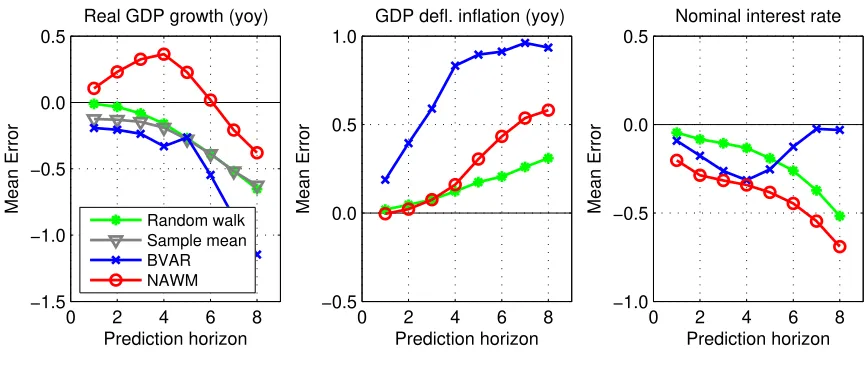
comparing the performance of the model’s unconditional forecasts to those obtained from
a Bayesian VAR and to different na¨ıve forecasts. The comparison reveals that the NAWM
performs favourably relative to the Bayesian VAR and the random walk, in particular in
the case of real GDP growth and GDP inflation for horizons that extend beyond one year.
We then show that conditioning on a possibly large set of policy-relevant variables helps to
improve the NAWM’s forecasting performance over some horizons, albeit not systematically.
This is in line with our finding that the conditioning assumptions are modest in the sense of
Leeper and Zha, at least as long as the multivariate nature of the shock uncertainty is taken
into account. We finally study the probability of prediction events, such as the event that
real GDP growth is negative for three consecutive quarters over the prediction horizon.
In so doing, we identify a heightened probability of a recession in 2001. The recession
signal is broadly similar across information sets, even though it is more pronounced when
conditioning on (ex-post) foreign data.
The remainder of the paper is organised as follows. Section 2 outlines the theoretical
specification of the NAWM, while Section 3 reports on our implementation of Bayesian
inference methods and on our estimation results. Section 4 compares the performance of
unconditional forecasts based on the NAWM against simple benchmarks. Section 5 examines
conditional versus unconditional forecasting with the NAWM and assesses the modesty of
the conditioning assumptions as well as prediction events. Section 6 concludes.
2. The New Area-Wide Model of the Euro Area
In this section, we outline the specification of the New Area-Wide Model (NAWM).
Throughout, we maintain the simplifying assumption that the euro area is a small open
economy. Within the domestic (i.e., the euro area) economy, there are four types of
eco-nomic agents: households, firms, a fiscal authority, and a monetary authority. As regards
firms, we distinguish between producers of tradable differentiated intermediate goods and
producers of three non-tradable final goods: a private consumption good, a private
invest-ment good, and a public consumption good. In addition, there are foreign intermediate-good
producers that sell their differentiated goods in domestic markets. International linkages
arise from the trade of intermediate goods and international assets, allowing for limited
exchange-rate pass-through and imperfect risk sharing.
In the following, we outline the behaviour of the different types of agents, formulate the
aggregate resource constraint and state the law of motion for the domestic (net) holdings
of foreign assets. In this context, we also define expressions for the trade balance and the
terms of trade and derive an expression for export demand. To the extent needed, foreign
variables and parameters are indexed with an asterisk, ‘∗’.
2.1. Households
There is a continuum of households indexed byh∈[ 0,1 ], the instantaneous utility of which depends on the level of consumption as well as hours worked. Each household accumulates
physical capital, the services of which it rents out to firms, and buys and sells domestic
gov-ernment bonds as well as internationally traded bonds. This enables households to smooth
their consumption profile in response to shocks. The households supply differentiated labour
services to firms and act as wage setters in monopolistically competitive markets. As a
con-sequence, each household is committed to supply sufficient labour services to satisfy firms’
labour demand.
Preferences and Constraints: Each household h maximises its lifetime utility in a given periodtby choosing purchases of the consumption good,Ch,t, purchases of the investment
good, Ih,t, which determines next period’s physical capital stock, Kh,t+1, the intensity with which the existing capital stock is utilised in production, uh,t and next period’s (net)
holdings of domestic government bonds and internationally traded foreign bonds, Bh,t+1 and B∗
h,t+1, respectively, given the following lifetime utility function:
Et
∞
k=0
βk
ǫCt+kln (Ch,t+k−κ Ct+k−1)−
ǫNt+k
1 +ζ (Nh,t+k)
1+ζ
, (1)
where β denotes the discount factor and ζ is the inverse of the Frisch elasticity of labour supply. The parameterκ measures the degree of external habit formation in consumption. Thus, the utility of household h depends positively on the difference between the current level of individual consumption, Ch,t, and the lagged economy-wide consumption level,
Ct−1, and negatively on the number of hours worked, Nh,t. We will refer to ǫCt and ǫNt as
Household hfaces the following period-by-period budget constraint:
(1 +τtC)PC,tCh,t+PI,tIh,t (2)
+ (ǫRPt Rt)−1Bh,t+1+ ((1−ΓB∗(sB∗,t+1;ǫRP ∗
t ))R∗t)−1StBh,t∗ +1+ Ξt+ Φh,t
= (1−τtN −τWh
t ) Wh,tNh,t+ (1−τtK) (RK,tuh,t−Γu(uh,t)PI,t)Kh,t
+τtKδ PI,tKh,t+ (1−τtD)Dh,t−Tt+Bh,t+StBh,t∗ ,
where PC,t and PI,t are the prices of a unit of the private consumption good and the
investment good, respectively. Nh,t denotes the labour services provided to firms at wage
rate Wh,t; RK,t indicates the rental rate for the effective capital services rented to firms,
uh,tKh,t, andDh,t are the dividends paid by the household-owned firms. Rt andRt∗ denote
the respective risk-less returns on domestic government bonds and internationally traded
foreign bonds. The latter are denominated in foreign currency and, thus, their domestic
value depends on the nominal exchange rateSt(expressed in terms of units of home currency
per unit of foreign currency).
As regards the provision of effective capital services, varying the intensity of utilising the
physical capital stock, uh,t, is subject to a proportional cost Γu(uh,t) which is assumed to
take the following form:
Γu(uh,t) = γu,1(uh,t−1) +
γu,2
2 (uh,t−1)
2 (3)
withγu,1, γu,2 >0.
The effective return on the risk-less domestic bonds depends on a financial intermediation
premium, represented by the exogenous “risk” premium shock ǫRPt , which drives a wedge between the interest rate controlled by the monetary authority and the return required
by the household.6 Similarly, when taking a position in the international bond market, the
household encounters an external financial intermediation premium ΓB∗(sB∗,t+1;ǫRP ∗
t ) which
depends on the economy-wide (net) holdings of internally traded foreign bonds expressed
in domestic currency relative to domestic nominal output, sB∗,t+1 = StB∗
t+1/PY,tYt, and
takes the form:
ΓB∗(sB∗,t+1;ǫRP ∗
t ) = γB∗
ǫRPt ∗exp
S
tBt∗+1
PY,tYt
−1
(4)
withγB∗ <0.7
6See Smets and Wouters (2007) for further discussion.
7Note that we have used current nominal output and the current exchange rate to scale B∗
t+1, because
Here, the shockǫRP∗
t represents the exogenous component of the external intermediation
premium and will be referred to as external risk premium shock. This specification implies
that, in the steady state, households have no incentive to hold foreign bonds and the
econ-omy’s net foreign asset position is zero.8 The incurred intermediation premium is rebated
in a lump-sum manner, being indicated by Ξt.
The fiscal authority absorbs part of the household’s gross income to finance its
expen-diture. In this context, τtC denotes the consumption tax rate levied on the household’s consumption purchases; andτtN,τtK andτtD are the tax rates levied on the different sources of the household’s income: wage incomeWh,tNh,t, rental capital incomeRK,tKh,t and
div-idend income Dh,t.9 Here, for simplicity, we assume that the utilisation cost of physical
capital as well as physical capital depreciation, δ PI,tKh,t, are exempted from taxation.
τWh
t is the additional pay-roll tax rate levied on wage income (representing the household’s
contribution to social security). The term Tt denotes lump-sum taxes.
Finally, it is assumed that each householdhholds state-contingent securities, Φh,t. These
securities are traded amongst households and provide insurance against household-specific
wage-income risk. This guarantees that the marginal utility of consumption out of wage
income is identical across households.10 As a result, all households will choose identical
allocations in equilibrium.11
The capital stock owned by household hevolves according to the following capital accu-mulation equation:
Kh,t+1 = (1−δ)Kh,t+ǫIt(1−ΓI(Ih,t/Ih,t−1))Ih,t, (5)
where δ is the depreciation rate, ΓI(Ih,t/Ih,t−1) represents a generalised adjustment cost function formulated in terms of the (gross) rate of change in investment, Ih,t/Ih,t−1, andǫIt
denotes an investment-specific technology shock. The adjustment cost function is assumed
to take the following form:
ΓI(Ih,t/Ih,t−1) =
γI
2
Ih,t
Ih,t−1
−gz
2
(6)
with γI > 0. The term gz denotes the rate of productivity growth in the economy’s
non-stochastic steady state.
8See Benigno (2001) for further discussion.
9For simplicity, it is assumed that dividends are taxed at the household level.
10The existence of state-contingent securities is assumed for analytical convenience and renders the model
tractable under staggered wage setting when households are supplying differentiated labour services. 11This in turn guarantees thatC
Choice of Allocations: Defining as Λh,t/PC,t and Λh,tQh,t the Lagrange multipliers
associ-ated with the budget constraint (2) and the capital accumulation equation (5), respectively,
the first-order conditions for maximising the household’s lifetime utility function (1) with
respect toCh,t,Ih,t,Kh,t+1,uh,t,Bh,t+1 and Bh,t∗ +1 are given by:
Λh,t = ǫCt
(Ch,t−κ Ct−1)−1
1 +τtC , (7)
PI,t
PC,t
= Qh,tǫIt
1−ΓI(Ih,t/Ih,t−1)−Γ′I(Ih,t/Ih,t−1)
Ih,t
Ih,t−1
(8)
+βEt
Λh,t+1 Λh,t
Qh,t+1ǫIt+1Γ′I(Ih,t+1/Ih,t)
Ih,t2 +1 I2
h,t
,
Qh,t = βEt
Λ
h,t+1 Λh,t
(1−δ)Qh,t+1 (9)
+ (1−τtK+1)RK,t+1
PC,t+1
uh,t+1+
τtK+1δ−(1−τtK+1) Γu(uh,t+1)
PI,t+1
PC,t+1
,
RK,t = Γ′u(uh,t)PI,t, (10)
β ǫRPt RtEt
Λ
h,t+1 Λh,t
PC,t
PC,t+1
= 1, (11)
β(1−ΓB∗(sB∗,t+1;ǫRP ∗
t ))R∗tEt
Λh,t+1 Λh,t
PC,t
PC,t+1
St+1
St
= 1. (12)
Here, Λh,t represents the shadow price of a unit of the consumption good; that is, the
marginal utility of consumption out of income. Similarly, Qh,t measures the shadow price
of a unit of the investment good; that is, Tobin’sQ.12
In equilibrium, with all households choosing identical allocations, the combination of the
first-order conditions with respect to the holdings of domestic and internationally traded
bonds, (11) and (12), yields a risk-adjusted uncovered-interest-parity condition, reflecting
the assumption that the return on internationally traded bonds is subject to an external
financial intermediation premium.
Wage Setting: Each household h supplies its differentiated labour services Nh,t in
monop-olistically competitive markets. There is sluggish wage adjustment due to staggered wage
contracts `a la Calvo (1983). Accordingly, householdhreceives permission to optimally reset its nominal wage contractWh,t in a given period twith probability 1−ξW.
12Notice that the domestic risk premium shock, ǫRP
t , affects investment via Tobin’s Q and helps to
explain the co-movement of consumption and investment observed in the data. In contrast, the consumption preference shock,ǫC
All households that receive permission to reset their wage contracts in a given period t
choose the same wage rate ˜Wt= ˜Wh,t. Those households which do not receive permission
are allowed to adjust their wage contracts according to the following scheme:
Wh,t = gz,t Π†C,tWh,t−1, (13)
wheregz,t=zt/zt−1, withztrepresenting trend labour productivity (see below), and Π†C,t=
ΠχW
C,t−1Π¯ 1−χW
t ; that is, the nominal wage contracts are adjusted one-to-one with the (gross)
rate of productivity growth and indexed to a geometric average of past (gross) consumer
price inflation, ΠC,t−1 =PC,t−1/PC,t−2, and the monetary authority’s possibly time-varying (gross) inflation objective, ¯Πt. Here,χW is an indexation parameter.
Each household h receiving permission to reset its wage contract in period t maximises its lifetime utility function (1) subject to its budget constraint (2), the demand for its
differentiated labour services (the formal derivation of which we postpone until we consider
the firms’ problem in Section 2.2 below) and the wage-indexation scheme (13).
Hence, we obtain the following first-order condition characterising the households’
opti-mal wage-setting decision:
Et
∞
k=0
(ξWβ)k
Λt+k(1−τtN+k−τtW+hk)gz;t,t+k
Π†C;t,t+k ΠC;t,t+k
˜
Wt
PC,t
(14)
−ϕWt+kǫNt+k(Nh,t+k)ζ
Nh,t+k
= 0,
where Λt+k denotes the marginal utility out of income (equal across all households),
gz;t,t+k =ks=1gz,t+s, Π†C;t,t+k=ks=1Π
χW C,t+s−1Π¯
1−χW
t+s and ΠC;t,t+k=ks=1ΠC,t+s−1. This expression states that in those labour markets in which wage contracts are
re-optimised, the latter are set so as to equate the households’ discounted sum of expected
after-tax marginal revenues, expressed in consumption-based utility terms, Λt+k, to the
dis-counted sum of expected marginal cost, expressed in terms of marginal disutility of labour,
∆h,t+k =−Nh,tζ +k. In the absence of wage staggering (ξW = 0), the factor ϕ W
t represents
a possibly time-varying markup of the real after-tax wage charged over the households’
marginal rate of substitution between consumption and leisure,
(1−τtN −τWh
t )
˜
Wt
PC,t
= −ϕWt ǫNt ∆t
Λt
, (15)
reflecting the existence of monopoly power on the part of the households.13
13Note that, in this case, also the marginal disutility is equal across households; that is ∆
Aggregate Wage Dynamics: With the continuum of households setting the wage contracts
for their differentiated labour services according to equation (13) and equation (14),
respec-tively, the aggregate wage index Wt evolves according to
Wt =
ξW gz,tΠ†C,tWt−1
1 1−ϕWt
+ (1−ξW) W˜t
1 1−ϕWt
1−ϕW t
. (16)
2.2. Firms
There are two types of monopolistically competitive intermediate-good firms: A continuum
of domestic intermediate-good firms indexed by f ∈[ 0,1 ] that produce differentiated out-puts that are sold domestically or abroad, and a continuum of foreign intermediate-good
firms indexed by f∗ ∈[ 0,1 ] that produce differentiated outputs that are sold in domestic markets. In addition there is a set of three representative domestic firms, which combine the
purchases of domestically-produced intermediate goods with purchases of imported
inter-mediate goods into three distinct non-tradable final goods, namely a private consumption
good, a private investment good and a public consumption good.
2.2.1. Domestic Intermediate-Good Firms
Technology: Each domestic intermediate-good firmf produces a differentiated intermediate good Yf,t with an increasing-returns-to-scale Cobb-Douglas technology that is subject to
fixed costs of production,ztψ,
Yf,t = maxεt(Kf,ts )α(ztNf,t)1−α−ztψ,0, (17)
utilising as inputs homogenous capital services,Kf,ts , that are rent from households in fully competitive markets, and an index of differentiated labour services, Nf,t, which combines
household-specific varieties of labour that are supplied in monopolistically competitive
mar-kets,
Nf,t =
1 0
Nf,th 1
ϕWt
dh
ϕW t
, (18)
where the possibly time-varying parameter ϕWt > 1 is inversely related to the intratem-poral elasticity of substitution between the differentiated labour services supplied by the
households,ηt=ϕWt /(ϕWt −1)>1.14
14As shown above, the parameterϕW
t has a natural interpretation as a markup in the household-specific
The variableεt represents atransitorytechnology shock that affects total-factor
produc-tivity, while the variablezt denotes apermanenttechnology shock shifting the productivity
of labour and introducing a unit root in the firm’s output. Both shocks, and the fixed cost
of production, are assumed to be identical across firms. The fixed cost is scaled by the
permanent technology shock to guarantee that the fixed cost as a fraction of output do not
vanish as output grows.15
Capital and Labour Inputs: Taking the rental cost of capital RK,t and the aggregate wage
index Wt as given, the intermediate-good firm’s optimal demand for capital and labour
services must solve the problem of minimising total input costRK,tKf,t+ (1 +τtWf)WtNf,t
subject to the technology constraint (17). Here, τWf
t denotes the payroll tax rate levied on
wage payments (representing the firms’ contribution to social security).
Defining asMCf,tthe Lagrange multiplier associated with the technology constraint (17),
the first-order conditions of the firms’ cost minimisation problem with respect to capital
and labour inputs are given, respectively, by
αYf,t+ztψ
Kf,ts MCf,t = RK,t, (19)
(1−α)Yf,t+ztψ
Nf,t
MCf,t = (1 +τtWf)Wt, (20)
or, more compactly,
α
1−α Nf,t
Kf,ts =
RK,t
(1 +τWf
t )Wt
. (21)
Here, the Lagrange multiplier MCf,t measures the shadow price of varying the use of
capital and labour services; that is, nominal marginal cost. We note that, since all firmsf
face the same input prices and since they all have access to the same production technology,
nominal marginal cost MCf,t are identical across firms; that is, MCf,t=MCtwith
MCt =
1
εtzt1−ααα(1−α)1−α
(RK,t)α((1 +τtWf)Wt)1−α. (22)
With nominal wage contracts for differentiated labour services h being set in monopo-listically competitive markets, firm f takes Wh,t as given and chooses the optimal input
of each labour variety h by minimising the total wage-related labour cost 01Wh,tNf,th dh,
subject to the aggregation constraint (18).
15The parameterψ will be chosen to ensure zero profits in steady state. This in turn guarantees that
The resulting demand for labour variety h is a function of the household-specific wage rate Wh,t relative to the aggregate wage indexWt:
Nf,th =
W
h,t
Wt
− ϕWt ϕWt −1
Nf,t (23)
with−ϕWt /(ϕWt −1) representing the wage elasticity of labour demand.
The wage indexWtcan be obtained by substituting the labour index (18) into the labour
demand schedule (23) and then integrating over the unit interval of households:
Wt =
1
0
W 1 1−ϕWt
h,t dh
1−ϕW t
. (24)
Aggregating over the continuum of firms f, we obtain the following aggregate demand for the labour services of a given household h:
Nth =
1 0
Nf,th df =
Wh,t
Wt
− ϕWt ϕWt −1
Nt. (25)
Price Setting: Each firm f sells its differentiated outputYf,t in both domestic and foreign
markets under monopolistic competition. We assume that the firm charges different prices
at home and abroad, setting prices in domestic (that is, producer) currency. In both
markets, there is sluggish price adjustment due to staggered price contracts `a la Calvo
(1983). Accordingly, firm f receives permission to optimally reset prices in a given period
teither with probability 1−ξH or with probability 1−ξX, depending on whether the firm sells its differentiated output in the domestic or the foreign market.
Defining as PH,f,t the domestic price of good f and as PX,f,t its foreign price, all firms
that receive permission to reset their price contracts in a given period t choose the same price ˜PH,t= ˜PH,f,t and ˜PX,t= ˜PX,f,t, depending on the market of destination. Those firms
which do not receive permission are allowed to adjust their prices according to the following
schemes:
PH,f,t = Π χH H,t−1Π¯
1−χH
t PH,f,t−1, (26)
PX,f,t = Π χX
X,t−1( ¯Π∗t)1−χHPX,f,t−1, (27) that is, the price contracts are indexed to a geometric average of past (gross)
intermediate-good inflation, ΠH,t−1 = PH,t−1/PH,t−2 and ΠX,t−1 = PX,t−1/PX,t−2, and possibly time-varying (gross) inflation objectives of the domestic and foreign monetary authorities, ¯Πt
Each firm f receiving permission to optimally reset its domestic and/or foreign price in periodtmaximises the discounted sum of its expected nominal profits,
Et
∞
k=0
Λt,t+k ξHk DH,f,t+k+ξkXDX,f,t+k
, (28)
subject to the price-indexation schemes (26) and (27) and taking as given domestic and
foreign demand for its differentiated output,Hf,t andXf,t (to be derived below), where the
stochastic discount factor Λt,t+k can be obtained from the consumption Euler equation of
the households, and
DH,f,t = PH,f,tHf,t−MCtHf,t, (29)
DX,f,t = PX,f,tXf,t−MCtXf,t (30)
are period-tnominal profits (net of fixed cost) yielded in the domestic and foreign markets, respectively, which are distributed as dividends to the households.16 Hence, we obtain
the following first-order condition characterising the firm’s optimal pricing decision for its
output sold in the domestic market:
Et
∞
k=0
ξHk Λt,t+k Π†H,t,t+kP˜H,t−ϕHt+kMCt+k
Hf,t+k
= 0, (31)
where we have substituted the indexation scheme (26), noting thatPH,f,t+k= Π†H,t,t+kP˜H,t
with Π†H,t,t+k =ks=1ΠχH
H,t+s−1Π¯ 1−χH t+s .
This expression states that in those intermediate-good markets in which price contracts
are re-optimised, the latter are set so as to equate the firms’ discounted sum of expected
revenues to the discounted sum of expected marginal cost. In the absence of price staggering
(ξH = 0), the factor ϕH
t represents a possibly time-varying markup of the price charged in
domestic markets over nominal marginal cost, reflecting the degree of monopoly power on
the part of the intermediate-good firms.17
Similarly, we obtain the following first-order condition characterising the firm’s optimal
pricing decision for its output sold in the foreign market:
Et
∞
k=0
ξXk Λt,t+k Π†X,t,t+kP˜X,t−ϕXt+k MCt+k
Xf,t+k
= 0, (32)
16Note that we have made use of the first-order conditions (9) and (20) to derive the expressions for
nominal profits.
where we have substituted the indexation scheme (27), noting thatPX,f,t+k= Π†X,t,t+kP˜X,t
with Π†X,t,t+k = ks=1ΠχX
X,t+s−1Π¯1−χX, assuming, for simplicity, that the foreign inflation objective is time invariant and equal to the domestic long-run inflation objective, ¯Π∗= ¯Π.
Aggregate Price Dynamics: With the continuum of intermediate-good firms f setting the price contracts for their differentiated products sold domestically,PH,f,t, according to
equa-tion (26) and equaequa-tion (31), respectively, the aggregate price index PH,t evolves according
to
PH,t =
(1−ξH)( ˜PH,t)
1 1−ϕH
t +ξ
H Π χH H,t−1Π¯
1−χH t PH,t−1
1 1−ϕH
t
1−ϕH t
. (33)
A similar relationship holds for the aggregate index of price contracts set for the
differ-entiated products sold abroad,PX,t, with
PX,t =
(1−ξX)( ˜PX,t)
1 1−ϕXt +ξ
X Π χX
X,t−1Π¯1−χXPX,t−1
1 1−ϕX
t
1−ϕX t
. (34)
2.2.2. Foreign Intermediate-Good Firms
Each foreign intermediate-good firmf∗ sells its differentiated goodYf∗∗,t domestically under
monopolistic competition, setting the price in domestic (that is, local) currency, as in Betts
and Devereux (1996). Again, there is sluggish price adjustment due to staggered price
contracts `a la Calvo. Accordingly, the foreign exporter receives permission to optimally
reset its price in a given period t with probability 1−ξ∗ and has access to the following
indexation scheme with parameterχ∗:
PIM,f∗,t = Πχ ∗ IM,t−1Π¯
1−χ∗
t PIM,f∗,t−1, (35)
where PIM,f∗,t =P∗
X,f∗,t and ΠIM,t−1 =PIM,t−1/PIM,t−2 with PIM,t =PX,t∗ . Here, we have
utilised the fact that, with foreign intermediate-good firms setting prices in domestic
cur-rency, the price of the intermediate good imported from abroad (the import price index of
the home country) is equal to the price charged by the foreign exporter in the home country
(the export price index of the foreign country).
Each foreign exporter f∗ receiving permission to optimally reset its price in period t
maximises the discounted sum of its expected nominal profits,
Et
∞
k=0
(ξ∗)kΛ∗t,t+kDf∗∗,t+k
subject to the price-indexation scheme and the domestic (import) demand for its
differen-tiated output,IMf∗,t=X∗
f∗ (to be derived below), where
Df∗∗,t = PIM,f∗,tIMf∗,t−MCt∗IMf∗,t (37)
withMCt∗ =StPY,t∗ representing the foreign exporter’s nominal marginal cost.
Hence, we obtain the following first-order condition characterising the foreign exporter’s
optimal pricing decision for its output sold in the domestic market:
Et
∞
k=0
(ξ∗)kΛ∗t,t+k Π†IM,t,t+kP˜IM,t−ϕ∗t+kMCt∗+k
IMf∗,t+k
= 0, (38)
where we have substituted the indexation scheme (35), noting that PIM,f∗,t+k = Π† IM,t,t+k
˜
PIM,t with Π†IM,t,t+k = ks=1Π
χ∗
IM,t+s−1Π¯ 1−χ∗ t+s .
The associated aggregate index of price contracts for the differentiated products sold in
domestic markets, PIM,t, evolves according to
PIM,t =
(1−ξ∗)( ˜PIM,t)
1
1−ϕ∗t +ξ∗ Πχ∗
IM,t−1Π¯ 1−χ∗
t PIM,t−1
1 1−ϕ∗t
1−ϕ∗
t
. (39)
2.2.3. Final-Good Firms
There are three different types of final-good firms which combine the purchases of the
domestically-produced intermediate goods with purchases of the imported intermediate
goods into three distinct non-tradable final goods, namely a private consumption good,
QC
t , a private investment good,QIt, and a public consumption good,QGt .
The representative firm producing the non-tradable final private consumption good,QCt, combines purchases of a bundle of domestically-produced intermediate goods, HC
t , with
purchases of a bundle of imported foreign intermediate goods, IMtC, using a constant-returns-to-scale CES technology,
QCt =
ν 1 µC C
HtC1− 1
µC + (1−ν
C)
1
µC (1−Γ
IMC(IMtC/QtC;ǫIMt ))IMtC
1− 1
µC
µC µC−1
(40)
where µC > 1 denotes the intratemporal elasticity of substitution between the distinct bundles of domestic and foreign intermediate goods, while the parameter νC measures the home bias in the production of the consumption good.
Notice that the final-good firm incurs a cost ΓIMC(IMtC/QCt ;ǫIMt ) when varying the use
of the bundle of imported goods in producing the consumption good,
ΓIMC(IMtC/QCt ;ǫIMt ) =
γIMC
2
ǫIMt IM
C t /QCt
IMC
t−1/QCt−1
−1
2
with γC
IM >0. As a result, the import share is relatively unresponsive in the short run to
changes in the relative price of the bundle of imported goods, while the level of imports is
permitted to jump in response to changes in overall demand.18 We will refer toǫIM t as an
import demand shock.
Defining asHC
f,tandIMfC∗,t the use of the differentiated output produced by the domestic
intermediate-good firmf and the differentiated output supplied by the foreign exporterf∗, respectively, we have
HtC =
1
0
Hf,tC 1
ϕHt df
ϕH t
, (42)
IMtC =
1
0
IMfC∗,t
1
ϕ∗ t df∗
ϕ∗
t
, (43)
where the possibly time-varying parameters ϕH
t , ϕ∗t > 1 are inversely related to the
in-tratemporal elasticities of substitution between the differentiated outputs supplied by the
domestic firms and the foreign exporters, respectively, with θHt = ϕHt /(ϕHt −1) > 1 and
θ∗t =ϕ∗t/(ϕ∗t −1)>1.19
With nominal prices for the differentiated goodsf and f∗ being set in monopolistically competitive markets, the final-good firm takes their prices PH,f,t and PIM,f∗,t as given and
chooses the optimal use of the differentiated goodsf andf∗ by minimising the expenditure for the bundles of differentiated goods,01PH,f,tHf,tC df and
1
0 PIM,f∗,tIMfC∗,tdf∗, subject to
the aggregation constraints (42) and (43). This yields the following demand functions for
the differentiated goods f and f∗:
Hf,tC =
P
H,f,t
PH,t
− ϕHt ϕHt −1
HtC, (44)
IMfC∗,t =
PIM,f∗,t
PIM,t
− ϕ∗t ϕ∗t−1
IMtC, (45)
where
PH,t =
1
0
(PH,f,t)
1 1−ϕHt df
1−ϕH t
, (46)
PIM,t =
1
0
(PIM,f∗,t)
1 1−ϕ∗
t df∗
1−ϕ∗
t
(47)
18While our treatment of the adjustment cost as being external to the firm would formally involve assuming the existence of a large number of firms with appropriate changes in notation (see, e.g., Bayoumi, Laxton and Pesenti, 2004), we abstract from these changes for ease of exposition.
19The parametersϕH
t andϕ∗t have a natural interpretation as markups in the markets for domestic and
are the aggregate price indexes for the bundles of domestic and imported intermediate
goods, respectively.
Next, taking the price indexesPH,tandPIM,tas given, the consumption-good firm chooses
the combination of the domestic and foreign intermediate-good bundlesHtC and IMtC that minimises PH,tHtC +PIM,tIMtC subject to aggregation constraint (40). This yields the
following demand functions for the intermediate-good bundles:
HtC = νC
PH,t
PC,t
−µC
QCt , (48)
IMtC = (1−νC)
PIM,t
PC,tΓ†IMC(IMtC/QCt;ǫIMt )
−µC
QC t
1−ΓIMC(IMtC/QCt;ǫIMt )
, (49)
where
PC,t =
⎛
⎝νC(PH,t)1−µC+ (1−νC)
PIM,t
Γ†IMC(IMtC/QCt ;ǫIMt )
1−µC⎞
⎠
1 1−µC
(50)
is the price of a unit of the private consumption good and
Γ†IMC(IMtC/QCt;ǫIMt ) = 1−ΓIMC(IMtC/QCt;ǫIMt )−Γ′IMC(IMtC/QCt;ǫIMt )IMtC. (51)
The representative firm producing the non-tradable final private investment good,QI t, is
modelled in an analogous manner. Specifically, the firm combines its purchase of a bundle of
domestically-produced intermediate goods, HI
t, with the purchase of a bundle of imported
foreign intermediate goods,IMtI, using a constant-returns-to-scale CES technology,
QIt =
ν 1
µI
I
HtI1− 1
µI + (1−ν
I)
1
µI (1−Γ
IMI(IMtI/QIt;ǫIMt ))IMtI
1−1
µI
µI µI−1
, (52)
whereµI>1 denotes the intratemporal elasticity of substitution between the distinct bun-dles of domestic and foreign intermediate inputs, while the possibly time-varying parameter
νI,t measures the home bias in the production of the investment good.
All other variables related to the production of the investment good—import adjustment
cost, ΓIMI(IMtI/QIt;ǫIMt ); the optimal demand for firm-specific and bundled domestic and
foreign intermediate goods, Hf,tI ,HtI and IMfI∗,t,IMtI, respectively; as well as the price of
a unit of the investment good,PI,t—are defined or derived in a manner analogous to that
for the consumption good.20
20Notice that even in the absence of import adjustment cost, the prices of the consumption and investment
In contrast, the non-tradable final public consumption good QG
t is assumed to be a
composite made only of domestic intermediate goods; that is, QGt =HtG with
HtG =
1
0
Hf,tG 1
ϕHt df
ϕH t
. (53)
Hence, the optimal demand for each domestic intermediate goodf is given by
Hf,tG =
P
H,f,t
PH,t
− ϕHt ϕHt −1
HtG, (54)
and the price of a unit of the public consumption good is PG,t =PH,t.
Aggregating across the three final-good firms, we obtain the following demand for
do-mestic and foreign intermediate goodsf and f∗, respectively:
Hf,t = Hf,tC +Hf,tI +Hf,tG =
P
H,f,t
PH,t
− ϕHt ϕHt −1
Ht, (55)
IMf∗,t = IMfC∗,t+IMfI∗,t =
PIM,f∗,t
PIM,t
− ϕ ∗
t ϕ∗
t−1
IMt, (56)
whereHt=HtC+HtI+HtG and IMt=IMtC+IMtI.
2.3. Fiscal and Monetary Authorities
2.3.1. Fiscal Authority
The fiscal authority purchases the final public consumption good, Gt, issues bonds to
re-finance its outstanding debt, Bt, and raises both distortionary and lump-sum taxes. The
fiscal authority’s period-by-period budget constraint then has the following form:
PG,tGt+Bt = τtCPC,tCt+ (τtN +τtWh)
1 0
Wh,tNh,tdh+ τtWf WtNt (57)
+τtK(RK,tut−(Γu(ut) +δ)PI,t)Kt+τtDDt+Tt+R−t1Bt+1,
where all quantities are expressed in economy-wide terms, except for the households’ labour
services and wages,Nh,t and Wh,t, which are differentiated across households.
The purchases of the public consumption good Gt are assumed to evolve exogenously.
As regards the evolution of the fiscal authority’s outstanding debt Bt, we note that our
model—in its current simplified specification—features “Ricardian equivalence”. Hence,
the particular time path of debt is irrelevant for the households’ choice of allocations. For
this reason and without loss of generality, we assume that lump-sum taxes close the fiscal
authority’s budget constraint each period. Finally, all distortionary tax rates τtZ with
2.3.2. Monetary Authority
The monetary authority sets the nominal interest rate according to a simple log-linear
interest-rate rule,
rt = φRrt−1+ (1−φR) π¯t+φΠπC,t−1−π¯t+φY yt (58)
+φ∆Π(πC,t−πC,t−1) +φ∆Y (yt−yt−1) +ηtR,
wherert= log(Rt/R) is the logarithmic deviation of the (gross) nominal interest rate from
its steady-state value. Similarly, πC,t = log(ΠC,t/Π) denotes the logarithmic deviation of¯
(gross) quarter-on-quarter consumer price inflation ΠC,t =PC,t/PC,t−1 from the monetary authority’s long-run inflation objective ¯Π, whileπ¯t= log( ¯Πt/Π) represents the logarithmic¯
deviation of the monetary authority’s possibly time-varying inflation objective from its
long-run value. Finally, yt =Yt/zt is the logarithmic deviation of aggregate output from trend
output implied by the assumed unit-root technology (that is, the output gap), whileηtR is a shock to the nominal interest rate.
2.4. Aggregate Resource Constraint and Net Foreign Assets
The model is closed by formulating the aggregate resource constraint and stating the law
of motion for the domestic net foreign assets. In this context, it is convenient to define the
trade balance and the terms of trade and to derive an expression for export demand.
2.4.1. Aggregate Resource Constraint
Imposing market-clearing conditions (see Christoffel, Coenen and Warne (2007) for details)
implies the following aggregate resource constraint:
PY,tYt = PH,tHt+PX,tXt
= PC,tCt+PI,t(It+ Γu(ut)Kt) + PG,tGt+PX,tXt (59)
−PIM,t
IMtC 1−ΓIMC(IM
C
t /QCt ;ǫIMt )
Γ†IMC(IMtC/QCt ;ǫIMt )
+IMtI 1−ΓIMI(IM
I
t/QIt;ǫIMt )
Γ†IMI(IMtI/QIt;ǫIMt )
.
2.4.2. Net Foreign Assets
The domestic holdings of foreign bonds (that is, the domestic economy’s net foreign assets,
denominated in foreign currency) evolve according to
(R∗t)−1Bt∗+1 = Bt∗+TBt
St
where
TBt = PX,tXt−PIM,tIMt (61)
is the domestic economy’s trade balance, which is conveniently expressed as a share
of domestic output, sTB,t = TBt/PY,tYt (like the net foreign assets with sB∗,t+1 =
StB∗t+1/PY,tYt).21
The terms of trade (defined as the domestic price of imports relative to the price of
exports in domestic currency) are given by:
ToTt =
PIM,t
PX,t
. (62)
Finally, the volume of exportsXtis determined by a demand equation similar in structure
to the domestic import equation,
Xt = νt∗
StPX,t
PX,tc,∗Γ†X(Xt/Ytd,∗;ǫXt )
−µ∗
Ytd,∗
1−ΓX(Xt/Ytd,∗;ǫXt )
,
(63)
whereνt∗ is a possibly time-varying export share, which captures the foreign preference for domestic intermediate goods. The variable PX,tc,∗ denotes the price of foreign competitors of domestic intermediate-good producers on the export side, Ytd,∗ is a measure of foreign demand, and ΓX(Xt/Ytd,∗;ǫXt ) is an adjustment cost function given by
ΓX(Xt/Ytd,∗;ǫXt ) =
γ∗
2
ǫXt Xt/Y
d,∗ t
Xt−1/Ytd,−∗1
−1
2
(64)
and
Γ†X(Xt/Ytd,∗;ǫXt ) = 1−ΓX(Xt/Ytd,∗;ǫtX)−Γ′X(Xt/Ytd,∗;ǫXt )Xt. (65)
3. Bayesian Estimation
We adopt the empirical approach outlined in Smets and Wouters (2003) and estimate our
version of the NAWM employing Bayesian inference methods. This involves obtaining
the posterior distribution of the model’s parameters based on its log-linear state-space
representation using the Kalman filter.22,23
21Notice that the existence of a financial intermediation premium guarantees that, in the non-stochastic steady state, domestic holdings of internationally traded bonds are zero.
22For details on the derivation of the log-linear representation of the NAWM, see Christoffel and Coenen (2006).
23For all computations, we use YADA, a Matlab programme for Bayesian estimation and evaluation of
In the following we briefly sketch the adopted approach and describe the data and the
prior distributions used in its implementation. In this context, we also provide information
on the structural shocks that we consider in the estimation and describe the calibration of
those parameters that we keep fixed. We then present our estimation results.
3.1. Methodology
Employing Bayesian inference methods allows formalising the use of prior information
ob-tained from earlier studies at both the micro and macro level in estimating the parameters
of a possibly complex DSGE model. This seems particularly appealing in situations where
the sample period of the data is relatively short, as is the case for the euro area. From a
practical perspective, Bayesian inference may also help to alleviate the inherent numerical
difficulties associated with solving the highly non-linear estimation problem.
Formally, let p(θ|m) denote the prior distribution of the vector θ ∈ Θ with structural parameters for some model m∈ M, and let p(YT|θ, m) denote the likelihood function for
the observed data, YT = {y1, . . . , yT }, conditional on parameter vector θ and model m.
The joint posterior distribution of the parameter vectorθ for modelm is then obtained by combining the likelihood function for YT and the prior distribution ofθ,
p(θ|YT, m) ∝ p(YT|θ, m)p(θ|m),
where “∝” indicates proportionality.24
The posterior distribution is typically characterised by measures of central location, such
as the mode or the mean, measures of dispersion, such as the standard deviation, or selected
percentiles.
As discussed in Geweke (1999), Bayesian inference also provides a framework for
compar-ing alternative and potentially misspecified models on the basis of their marginal likelihood.
For a given modelm the latter is obtained by integrating out the parameter vectorθ,
p(YT|m) =
θ∈Θ
p(YT|θ, m)p(θ|m)dθ.
Thus, the marginal likelihood gives an indication of the overall likelihood of a model
con-ditional on the observed data.
3.2. Data and Shocks
3.2.1. Data
In estimating the NAWM, we use data on 17 key macroeconomic times series:
• real GDP (Y) • total employment (E)
• private consumption (C) • compensation of employees (W)
• total investment (I) • nominal interest rate (R)
• government consumption (G) • nominal effective exchange rate (S)
• extra-euro area exports (X) • foreign competitors’ prices (PXc,∗)†
• extra-euro area imports (IM) • foreign demand (Yd,∗)†
• GDP deflator (PY) • foreign GDP deflator (PY∗)†
• consumption deflator (PC) • foreign nominal interest rate (R∗)†
• extra import deflator (PIM)
All time series are taken from an updated version of the AWM database (see Fagan,
Henry and Mestre, 2001), except for the time series for extra-euro area trade data (both
volumes and prices) which stem from internal ECB sources. The sample period ranges from
1985Q1 to 2005Q4 (using the period 1980Q2 to 1984Q4 as training sample). The times series
marked with a dagger (‘†’) are modelled using a structural VAR, the estimated parameters
of which are kept fixed throughout the estimation. Similarly, government consumption is
assumed to follow an autoregressive (AR) process with fixed estimated parameters.
Prior to estimation, the following data transformations have been made:
• We measure real GDP, consumption, investment, extra-euro area exports and
im-ports, the relevant deflators, wages and foreign demand in terms of
quarter-on-quarter growth rates, approximated by the first difference of their logarithm.
• We remove excess mean growth, relative to real GDP, from extra-euro area exports
and imports and foreign demand, to guarantee that these variables are
commensu-rate with the balanced-growth-path property of the model.
• We take the logarithm of government consumption and remove a linear trend
con-sistent with our assumptions of trend labour force growth of 0.8 percent and trend
labour productivity growth of 1.2 percent, both growth rates being expressed at an
annual rate.25
25That is, the model, which is implicitly defined in terms of per-capita variables, implies a trend growth
• We take the logarithm of employment and remove a linear trend consistent with
our assumption of trend labour-force growth of 0.8 percent at an annual rate,
not-ing that, in the absence of a reliable measure of hours worked, we use data on
employment in the estimation.26
• We construct a measure of the real effective exchange of the euro from the nominal
effective exchange rate, the domestic GDP deflator and the foreign GDP deflator
and then remove the mean.
• We deflate the competitors’ price on the export side with the foreign GDP deflator
and remove the existing linear trend.
The graphs of the transformed time series are depicted in Figure 1.
3.2.2. Shocks
Out of the total of 22 structural shocks incorporated in the outlined specification of the
NAWM (including shocks to the inflation objective and the 6 tax rates), we employ a
subset of 12 shocks, plus the 5 shocks of the autoregression and the structural VAR used to
model the time series of government consumption and the foreign variables, respectively:27
• transitory technology shock (ε) • export preference shock (ν∗)
• permanent technology shock (gz) • interest rate shock (ηR)
• domestic risk premium shock (ǫRP) • external risk premium shock (ǫRP∗)
• wage markup shock (ϕW) • shock to governm. consumption (ηG)
• investment-specific techn. shock (ǫI) • shock to competitors’ prices (ηPXc,∗)
• import demand shock (ǫIM) • shock to foreign demand (ηYd,∗
)
• price markup shock: domestic (ϕH) • shock to foreign inflation (ηΠ∗Y)
• price markup shock: exports (ϕX) • shock to foreign interest rate (ηR∗)
• price markup shock: imports (ϕ∗)
All shocks are assumed to follow first-order autoregressive processes, except for the price
markup shocks, the interest rate shock and the shocks in the AR model for government
26We relate the employment variable to the unobserved hours-worked variable by an auxiliary equation following Smets and Wouters (2003),
Et =
β
1 +βEt[Et+1] +
1
1 +βEt−1+
(1−βξE) (1−ξE)
(1 +β)ξE
Nt−Et
,
where a hat (‘’) denotes the logarithmic deviation from trend in the case of employment and from the steady-state value in the case of hours worked. The parameterξEdetermines the sensitivity of employment
with respect to hours worked.
27That is, we do not include the consumption preference shock,ǫC, the labour supply shock,
consumption and the structural VAR model for the foreign variables, which are all assumed
to be serially uncorrelated. In addition, we allow for measurement error in extra-euro area
trade data (both volumes and prices) and in the data on real GDP and the GDP deflator,
owing to prevailing problems regarding the measurement of the extra-euro area trade data
and the consequences this may have for the measurement of GDP.28
3.3. Calibration and Prior Distributions
3.3.1. Calibration
We follow the literature and first set key steady-state ratios—including the ratios of the
various nominal aggregate demand components over nominal GDP—equal to their empirical
counterparts over our estimation sample. For example, the ratios of private consumption
and total investment spending are set to 57.5 and 21 percent, respectively, while the export
and import ratios are set equal to 16 percent. The trend growth rate in labour productivity
gz is calibrated to equal 1.2 percent per annum, while the long-run (net) inflation objective
¯
Π−1 is assumed to be 2.0 percent at an annualised rate. The discount factor β is then chosen to imply an annualised equilibrium real interest rate of 2.5 percent.
Further, we fix a number of additional parameters that are inherently difficult to identify
empirically. This involves setting the capital share in productionα to 0.3 and the depreci-ation rate δ to 0.025, as commonly assumed in the literature. The steady-state wage and price markupsϕW,ϕH,ϕX andϕ∗ are set uniformly to 0.20, broadly in line with empirical findings of studies conducted at the OECD (cf. Martins, Scarpetta and Pilat, 1996, and Jean
and Nicoletti, 2002). Notice that we also set the inverse of the elasticity of labor supply
to 2, reflecting the observation that most macro studies overstate the elasticity of labour
supply. Regarding final-goods production, we choose values for the home-bias parameters
νC andνI that allow the model to replicate the import content of consumption and
invest-ment spending—roughly 10 and 6 percent, expressed as ratios of nominal GDP—utilising
information from input-output tables (cf. Statistics Netherlands, 2006). The intratemporal
elasticities of substitution between domestic and imported intermediate goods µC and µI
are uniformly set to 1.5, noting that, in the short run, these elasticities may vary depending
on the size of the adjustment costs associated with changing the respective import content.
Finally, using data from OECD (2004) and Eurostat (2006), the tax rates on consumption
purchases, labour and capital income and the contribution rates to social security are
cal-ibrated with τC = 18.3, τN = 12.2, τK = 0.30, τWh = 11.8 and τWf = 21.9, respectively.
Due to lack of reliable information the tax rate on dividend incomeτD is set to zero.
3.3.2. Prior Distributions
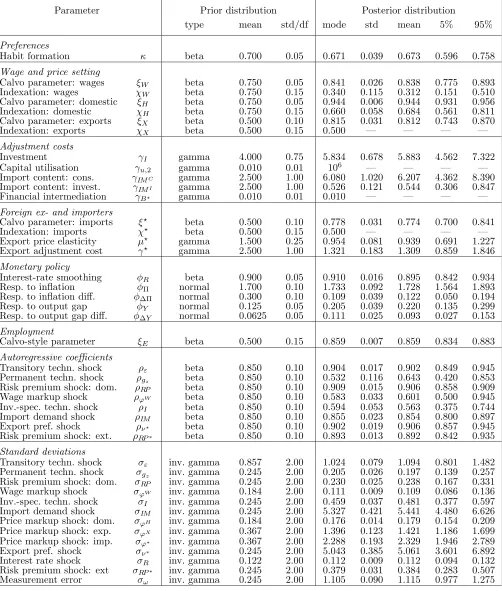
The left-hand columns in Table 1 summarise our assumptions regarding the prior
dis-tribution of the 43 parameters that we estimate. The prior assumptions for most of the
parameters of the domestic economy are similar to those chosen by Smets and Wouters
(2003), while the prior assumptions for the open-economy parameters follow closely those
in Adolfson et al. (2005).
For those parameters where theory implies boundedness between 0 and 1, a beta
distribu-tion is assumed as prior distribudistribu-tion. This group of parameters comprises the habit
forma-tion parameter, the Calvo and indexaforma-tion parameters underlying the wage and price-setting
decisions of households and firms, the degree of interest-rate smoothing in the interest-rate
rule, the Calvo-style adjustment parameter in the employment equation and the degree of
serial correlation of the structural shocks. Regarding the wage-setting decision of
house-holds and the price-setting decision of domestic firms selling their outputs at home, the
prior means for both the Calvo and the indexation parameters are set to 0.75. In contrast,
the prior means for the respective parameters of domestic firms selling abroad and for
for-eign exporters are set to 0.5, reflecting the higher volatility and lower persistence of import
and export price inflation. The prior mean for the autoregressive coefficients of those shock
processes featuring serial correlation is set to 0.85. Finally, the prior mean of the parameter
determining the degree of interest-rate smoothing is set to 0.9.
The prior distributions for the remaining parameters of the interest-rate rule are modelled
as normal distributions. The particular choice of these prior distributions follows Smets and
Wouters (2003) and ensures determinacy of the model solution under the prior
parametrisa-tion. In particular, the means of the prior distributions equal 1.7 for the inflation response,
0.3 for the response to the change in inflation, 0.125 for the output gap response and 0.0625
for the response to the change in the output gap.
Those structural parameters that are only bounded from below are modelled using a
gamma distribution. This group of parameters comprises the various adjustment cost
pa-rameters. Finally, the prior distribution for the standard deviations of the structural shocks
3.4. Estimation Results
The right-hand columns in Table 1 report our benchmark estimation results for the
NAWM.29The entries in the posterior-mode column give the values of the structural
param-eters obtained by maximising the posterior distribution with respect to these paramparam-eters.
The next column shows the respective standard deviations. The remaining three columns
report the mean, and the 5th and 95th percentile of the posterior distribution obtained
from the Metropolis-Hastings sampling algorithm based on 250,000 draws.
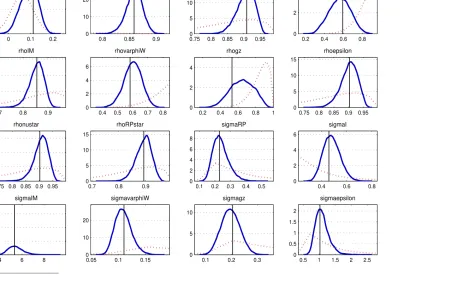
The plots of the prior and posterior distributions inFigure 2give an indication of how
informative the observed data are about the structural parameters. For those parameters
where the posterior distribution turns out to be close to the prior distribution, the data
are likely to be rather uninformative. Thus, Figure 2 suggests that the observed data
provide additional information for all parameters, except for the inflation response in the
interest-rate rule (φπ), which is a frequent finding in the literature.
Regarding the price and wage-setting parameters, we observe that the estimated Calvo
parameter for the domestic intermediate goods sold at home is rather high, which implies a
rather low sensitivity of domestic inflation with respect to movements in aggregate marginal
cost. This result is likely to depend on the chosen sample period. While our estimation
is based on data ranging from 1985 to 2005, Smets and Wouters (2003) estimate their
model on data from 1980 to 1999 and find a somewhat higher sensitivity. This is in line
with empirical evidence that the slope coefficient of Phillips-curve relationships has been
declining over recent years.30 In contrast, the Calvo parameters for setting the price of
intermediate goods sold abroad and for setting wages are noticeably lower. Similarly, the
Calvo parameter governing the price-setting decisions of foreign exporters is found to be
relatively low, causing a significant reduction in the degree of exchange-rate pass-through
on the euro area’s import side in the short to medium run.
In the NAWM, imports of foreign intermediate goods are used as inputs for the
pro-duction of the final consumption and investment goods. The estimates of the adjustment
29Notice that in estimating our preferred specification, we restrict 4 out of 42 parameters, based on the
marginal likelihood that we obtained for differing specifications (see Christoffel, Coenen and Warne (2007) for sensitivity analysis of the benchmark estimation results). In particular, in our preferred specification we do not allow for variable capital utilisation. Furthermore, we fix at their prior means the indexation parameters in the price-setting decisions of domestic and foreign exporters, as well as the sensitivity of the foreign intermediation premium to net foreign assets. These parameters are found to be inherently difficult to identify.
cost parameters associated with changing the import content differs substantially between
the consumption and the investment good. Specifically, the estimated cost of changing
the import content of the consumption good (γIMC) is substantially higher than the cost
associated with changing the import content of the investment good (γIMI). Comparing
posterior and prior distributions in Figure 2, we observe that this result is strongly driven
by the data. Apparently, the relative smoothness of the consumption series implies that
shocks affecting import quantities are mainly transmitted via adjustments in the import
content of investment.
The estimation results for the parameters determining the real side of the domestic
econ-omy are broadly comparable to the results in Smets and Wouters (2003). However, we
obtain a somewhat higher estimate for the degree of habit formation, even though the
dif-ferences in the specification of the utility function dilute the direct comparability. Similarly,
the estimated response coefficients of the interest-rate rule are broadly in line with the
esti-mates in Smets and Wouters (2003). The estimated inflation response is safely above unity,
ensuring determinacy of the equilibrium, while the response to the output gap is positive,
albeit small. We also find supportive evidence for a relatively high degree of interest-rate
smoothing.
4. Unconditional Forecasting
As pointed out by Adolfson, Lind´e and Villani (2007), one important dimension for
evalu-ating the empirical fit of a model in a policy environment is its out-of-sample forecasting
performance. In this section we will examine the forecasting properties of the NAWM
against a number of benchmarks. The purpose is not to find the best forecasting model,
but to check if the unconditional forecasts generated by the NAWM are “reasonable”; i.e.,
to examine if the forecasting performance of the model is not considerably worse than that
of the benchmarks.
In this regard we may evaluate the forecasting performance in a number of dimensions.
First, we may consider standard univariate statistics such as mean forecast errors and root
mean-squared forecast errors (RMSEs). Similarly, we may calculate multivariate statistics
for point forecasts such as the log-determinant statistic and the trace statistic. An advantage
of such statistics is that they take the multivariate nature of many forecasting situations
into account. At the same time, they are sensitive to the performance across the most