Published Online January 2014 (http://www.scirp.org/journal/ijg) http://dx.doi.org/10.4236/ijg.2014.51004
The Effect of a Single Shrub on Wind Speed and Nabkhas
Dune Development: A Case Study in Kuwait
Jasem M. Al-Awadhi
Department of Earth and Environmental Sciences, Faculty of Science, Kuwait University, Kuwait City, Kuwait Email: [email protected]
Received October 26,2013; revised November 28, 2013; accepted December 25, 2013
Copyright © 2014 Jasem M. Al-Awadhi. This is an open access article distributed under the Creative Commons Attribution License, which permits unrestricted use, distribution, and reproduction in any medium, provided the original work is properly cited. In accor-dance of the Creative Commons Attribution License all Copyrights © 2014 are reserved for SCIRP and the owner of the intellectual property Jasem M. Al-Awadhi. All Copyright © 2014 are guarded by law and by SCIRP as a guardian.
ABSTRACT
Thirty coastal nabkhas were selected for morphometrical measurements. The studied nabkhas were mostly elongated, with an average total length of about 12.9 m, an average width of 3.4 m, and an average height of 1.2 m. Optical porosity of nabkha shrub crown was measured and no apparent relationship with the horizontal size of trapped wind laden sand was found. A simple wind tunnel experiment was carried out to investigate the hori-zontal wind-flow distribution across a pro-typed shrub. The results of the experiment revealed that the degree of wind sheltering might extend up to a downwind distance approximately equal to 4.5 times the height of the shrub, where an effective velocity recovery started.
KEYWORDS
Nabkhas; Sediment; Porosity; Wind Tunnel
1. Introduction
Nabkha is a type of Aeolian landforms, which is com-monly developed as a result of sand accumulation around coastal and desert shrubs [1]. The morphology of nabk-has is controlled by growth patterns of shrub [2]. The height of nabkha, to some extent, is related to the height of the shrub crown, while its length is related to the overall height of the shrub [3], width of the basal shrub and wind velocity [4]. Other important factors control-ling nabkhas morphology include type of sediment supply and climate [5] as well as the porosity of the shrub crown (e.g., [2]). The wind regime is a major cli-matic factor that influences Aeolian processes including nabkha development [7]. The air-flow patterns over nabkhas were studied in a series of wind-tunnel experi-ments by Zhizhong et al. [8]. Nabkhas form a surface roughness, where they interact with airflow and, there-fore, cause significant variations in wind velocity and direction over the surface.
Grant and Nickling [9] carried out a field study to in-vestigate the effect of vegetation porosity (leaf density) on the drag coefficient of small conifer trees (1.4 m in height). They found that the porous element had a higher
drag coefficient than a solid element, and the drag coef-ficient changed on a continuum with porosity, reaching a peak at an intermediate porosity value (0.32), and even-tually falling to zero when the element was removed. Grant and Nickling [9] came to a conclusion that this peak in the drag coefficient (momentum extraction of vegetation) versus porosity curve corresponded to shel-terbelt efficiency that peaked at medium-porosities.
around shrubs.
2. Materials and Methods
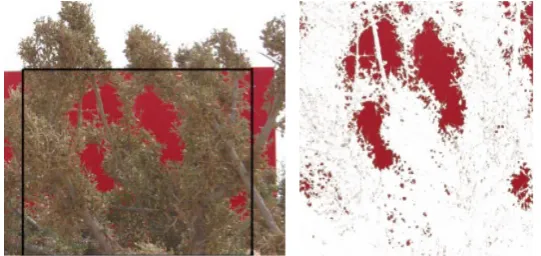
An attempt was made to carry out field measurements of morphometrical characteristics of thirty coastal nabkhas to support the results of the wind-tunnel. The morphme-tric parameters are defined in Figure 1. The field study area is located within the northern coastal plain of Ku-wait Bay and downwind of the major mobile sand corri-dor extending continuously from the northwestern border of Kuwait in a SE direction. The study area is well de-scribed by Al-Awadhi and Al-Dousari [13]. In this study, another attempt was also made to investigate the effect of shrub crowns porosity (p) of nabkhas on the horizontal dimension of sand trapped using image processing tech-nique built in PAX-it software. Digital images of the shrubs, with placing a red board behind the shrub as a distinguish background, were captured and analyzed for determining the porosity percentage. The angle of inci-dence of the image was selected to be consistent with the dominant wind direction (NW).The porosity of the shrub was then calculated as the percentage of red spots to the total selected area (Figure 2). For each shrub two images were captured, one upwind side and other downwind side, the calculated values were then averaged for the porosity percentage.
Variation in up and downwind velocities over pro- typed shrub due to its interaction with airflow was de-termined by conducting a simple experiment using the
Kuwait Institute for Scientific Research (KISR) wind tunnel (20 m long wind tunnel with a test-section di-mension of 1.2 m wide and 0.95 m height). The wind tunnel is of the blower type driven by a centrifugal fan. The components of the wind tunnel are shown in Fig-ure 3.
[image:2.595.123.476.456.552.2]A profile for wind flow distribution across a single shrub model (10 cm height) was obtained by using Dwyer Pitot-static tubes fixed at a height of 15 cm; i.e., 5 cm above the height of the model. As a reference point, the mean velocity was also measured at 140 cm upstream from the upwind edge of the model, on continuous bases at the same height; i.e., 15 cm. For a better simulation with the case in the field: 1) the tested shrub model was erected among other similar shrub models in the test- section of the wind tunnel along a line perpendicular to the flow direction and uniformly spaced at a center-to- center distance of 10 cm (Figure 4); 2) the whole up-stream length of the wind tunnel up to upwind edge of the model was laden by a sand of median grain size equal to 0.25 mm, obtained locally from the slip face of a bar-chan dune; and 3) based on the field measurements, the shrub model crown (7.5 cm) was lifted up from the wind tunnel testing floor to a height equal to 50% of its total height; this height represents the average height of nabk-ha dune crest, measured in the field, with respect to the its shrub height; and 4) a preselected velocity (6.3 m/s; fan-settings = 11 Hz) representing an average wind speed during summer period where Aeolian processes are ac-tive.
Figure 1. Schematic diagram illustrating the morphometric parameters of nabkhas.
[image:2.595.164.435.581.709.2]Figure 3. Components of Kuwait Institute for Scientific Research (KISR) wind tunnel.
Figure 4. Experimental setup showing the erection of pro-typed shrub models across the test-section of the wind tunnel.
3. Result
3.1. Morphometrical Parameters of the Studied
Nabkhas
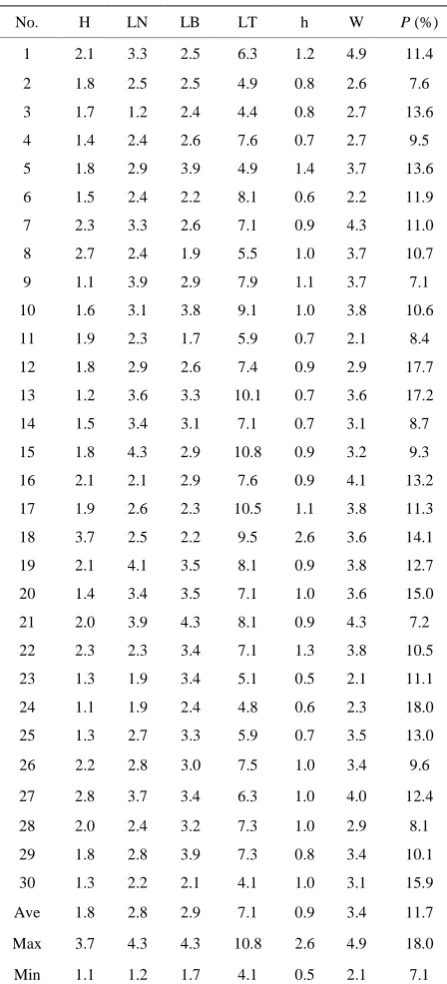
The studied nabkhas have an oval shape elongated paral-lel to the NW prevailing wind direction. Measurements of the morphometrical parameters of the studied nabkha are presented in Table 1. The total length (L) of nabkha dunes varies between 8 and 18 m with an average of 12.8 m, while their width (W) across their crest ranges be-tween 2.1 and 4.9 m. The length of the base (LB), where the shrub grows, varies between 1.7 and 4.3 m with an average of 2.9 m. The length of the tail (LT) varies be-tween 4.1 and 10.8 m with an average of 7.1 m, while the length of the nose (LN) varies between 1.2 and 4.3 m with an average of 2.8 m.
The crest height of the nabkhas (h) ranged between 0.5 to 2.6 m above their base level with an average of 0.9 m, while the height of shrub (H) ranged between 1.1 to 3.7 m above the ground with an average of 1.8 m. The opti-cal porosity of shrubs crown (p), the percentage of voids to total area of the shrub, of the studied nabkhas ranged between 7.1% to 18% with an average of 11.7%. Using the relationship obtained by Grant and Nickling [9]:
2.782
op=vp (1) where op is the optical porosity and vp is the volumetric porosity, the volumetric porosity (3-diemtional porosity—
the percentage of voids to total volume of the shrub) of the studied nabkhas ranged between 38.6% to 54% with an average of 46%.
Figure 5 illustrates the effect of shrub porosity (p) on the length dimensions of sand trapped. The figure weakly reveals that as the porosity increases the horizontal length of the nabkha decreases; i.e., it reveals weak cor-relations of such effect either on total length (L) or par-tial length (LN or LT). The possible explanation for such weakness in relationship is that the air flow, carrying the sediments, passing the shrub may vary due to high varia-tion in the porosity over the upwind shrub coverage area (leaf density), thus restricting the maximum growth of the nabkha in the horizontal as well as vertical directions. The other possible explanation could be related to the difficulty with using optical porosity; i.e., two elements of similar optical porosities may have significantly dif-ferent amounts of pore space within them, altering the way in which the wind would interact with these ele-ments [9]. For this reason, the crown porosity of the tested shrub model, used in the wind tunnel experiment, was not taken into consideration.
3.2. Wind Flow Pattern across a Shrub
Table 1. Morphometrical parameters of the studied nabk-has (all values in m).
No. H LN LB LT h W P (%)
1 2.1 3.3 2.5 6.3 1.2 4.9 11.4
2 1.8 2.5 2.5 4.9 0.8 2.6 7.6
3 1.7 1.2 2.4 4.4 0.8 2.7 13.6
4 1.4 2.4 2.6 7.6 0.7 2.7 9.5
5 1.8 2.9 3.9 4.9 1.4 3.7 13.6
6 1.5 2.4 2.2 8.1 0.6 2.2 11.9
7 2.3 3.3 2.6 7.1 0.9 4.3 11.0
8 2.7 2.4 1.9 5.5 1.0 3.7 10.7
9 1.1 3.9 2.9 7.9 1.1 3.7 7.1
10 1.6 3.1 3.8 9.1 1.0 3.8 10.6
11 1.9 2.3 1.7 5.9 0.7 2.1 8.4
12 1.8 2.9 2.6 7.4 0.9 2.9 17.7
13 1.2 3.6 3.3 10.1 0.7 3.6 17.2
14 1.5 3.4 3.1 7.1 0.7 3.1 8.7
15 1.8 4.3 2.9 10.8 0.9 3.2 9.3
16 2.1 2.1 2.9 7.6 0.9 4.1 13.2
17 1.9 2.6 2.3 10.5 1.1 3.8 11.3
18 3.7 2.5 2.2 9.5 2.6 3.6 14.1
19 2.1 4.1 3.5 8.1 0.9 3.8 12.7
20 1.4 3.4 3.5 7.1 1.0 3.6 15.0
21 2.0 3.9 4.3 8.1 0.9 4.3 7.2
22 2.3 2.3 3.4 7.1 1.3 3.8 10.5
23 1.3 1.9 3.4 5.1 0.5 2.1 11.1
24 1.1 1.9 2.4 4.8 0.6 2.3 18.0
25 1.3 2.7 3.3 5.9 0.7 3.5 13.0
26 2.2 2.8 3.0 7.5 1.0 3.4 9.6
27 2.8 3.7 3.4 6.3 1.0 4.0 12.4
28 2.0 2.4 3.2 7.3 1.0 2.9 8.1
29 1.8 2.8 3.9 7.3 0.8 3.4 10.1
30 1.3 2.2 2.1 4.1 1.0 3.1 15.9
Ave 1.8 2.8 2.9 7.1 0.9 3.4 11.7
Max 3.7 4.3 4.3 10.8 2.6 4.9 18.0
Min 1.1 1.2 1.7 4.1 0.5 2.1 7.1
in wind velocity were determined by conducting a simple wind tunnel experiment, and Figure 6 shows the non- dimensional mean flow distribution measured across a single shrub model.
[image:4.595.59.283.109.602.2]The figure reveals that the mean wind velocity imme-diately over the shrub; i.e., the direct interaction with airflow, is increased by a factor of 39%, and greater mean velocity reduction (83%) occurred downstream from the shrub at a distance 3.5 times its height (H), while in upstream the greater reduction (37%) occurred
Figure 5. Correlation between lengths of nabkha dune with the shrub porosity (p).
Figure 6. Velocity distribution across a model shrub; H and x are the height of shrub and distance from it, respectively; U0 is far upstream velocity and U is velocity at distance x.
at a distance 1 time H. The effective velocity recovery in downstream starts at distance approximately 4.5 times the shrub height, while the effective recovery in upwind stream seems to start at a distance 2 time the shrub height. Greater mean velocity reduction occurred immediately downstream from the shrub with a maximum value at a distance 2 times H.
Relating the wind tunnel findings, shown in Figure 6, with the horizontal dimensions of the studied nabkha dunes, it is obvious that the reduction or the degree of sheltering (tail length of nabkha dune) of studied shrubs extends in average to a downwind distance equal to 3.9 times the height of the shrub, where an effective wind velocity recovery starts (x/H = 4). Similarly, the upwind deposition forming the nabkha nose extends to an aver-age distance equal to 1.5 times the height of shrub from the base, where an effective upwind velocity reduction starts at (x/H = −2). The upwind peak reduction in veloc-ity occurs at x/H = −1, while the peak reduction in veloc-ity occurs at a downwind distance equal to 2 time the height of shrub (x/H = 2), where the crest of nabkha is formed. The length of the base (LB), where the crest oc-curs and the shrub grows, has an average value equal to
0 2 4 6 8 10 12 14 16 18 20 22 24
6 8 10 12 14 16 18 20
To ta l L en gt h o f N ab kh a (m )
Optical Porsity of Shrub , p(%) Nose Length (LN
( (Tail Length (TL (Total Length (L
0 0.2 0.4 0.6 0.8 1 1.2 1.4 1.6
-2 0 2 4 6 8 10 12 14 16
U/
U
0
[image:4.595.314.536.267.408.2]1.6 times the height of shrub where the peak reduction in velocity occurs. It must be pointed out that these mea-surements are rather preliminary, but they are encourag-ing.
The extent of reduction in erosion, or the degree of sheltering sand can be observed from Figure 6. It ex-tends up to an average downwind distance equal to 4.5 times the height of the shrub model (x/H = 4.5), where an effective velocity recovery starts. This finding agrees with the field measurements stated in the Section 3.1 (morphometric of nabkha); the tail length, which is asso-ciated with the degree of sheltering effect, may extend in average 4.7 times (0.5LB + LT) that of shrub height. From the same figure, it can be figured out that the up-wind deposition forming the nabkha nose may extend to a distance equal to two times the height of the shrub model. Reviewing the field measurements, it was found that the nose may extend in average 2.3 times (0.5LB + LN) that of shrub height.
4. Discussions
Nabkha is a special depositional Aeolian landform where accumulation of wind-laden particles is facilitated by vegetation as micro-wind breakers. Therefore, the mor-phometrical characteristics of nabkha sediments are closely related to vegetation morphology [1,14-16]. The nabkha thus grows along with plant, both vertically and horizontally [13].
Despite the importance of the continuous supply of sand, the size variability of nabkhas in the study area is controlled chiefly by the total shrub height [13]. It is also believed that, like sand fence porosity, the optical poros-ity of the shrub crown may affect the percentage of the trapped sand. The effect of porosity of sand fences on trapping wind laden sands has been studied by many au-thors [17-21]. Most of related studies concluded in gen-eral that there is a relationship between drag coefficient (Cd) (wind force) and the optical porosity (op), and the
most effective porosity in reducing the mean, near- ground wind speeds for the longest distances (10 to 15 times the height of the porous fence) ranges between 30% to 50%. Taylor [22] presented a curve showing the relationship between Cd and op; the porous elements
have higher Cd than solid elements and it may increase
up to 50%. In this study, however, the investigation of the effect of shrub optical porosity on the horizontal size of trapped wind laden sand does not show apparent rela-tionship in this regard (Figure 5). In addition to the ex-planations given in the result section, for such weak rela-tionship, the effect of shrub porosity on downwind re-gime may not be comparable to similar effect of porous fences, simply because a three dimensional porous shrub consists of a number of individual solid leaves, which interact with one another in a flow similar to wake
inter-ference. Thus, some momentum would be extracted by an upwind leaf, more by the next downstream leaf, until either all of the momentum is extracted or the other side of the shrub is reached [9]. This will certainly affect the Cd magnitude and subsequently affect in reducing the
mean, near-ground wind speeds for the shortest distances (about 4 times the height of the shrub; (Figure 6)).
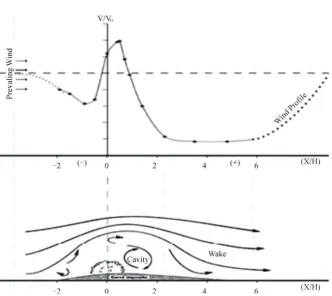
It is known that the total forces imparted by the wind to composite surfaces will be portioned between the erodible (nabkha dune) and non-erodible (shrub) surface elements [23]. The main influence of non-erodible ele-ment on erosion is sheltering effect. It captures some of the disturbing forces of wind and incoming saltations that would otherwise move the erodible surface sediments [24]; i.e., the shrub decreases the wind grain stress on the nabkha dune surface by absorbing a significant fraction of the downwind momentum flux [24-26]. Thus, the re-duction in the flow strength near a shrub bed reduces the sand flux, forming the crest part of nabkha, then part of this flux is deposited upwind and further downwind, forming the nose and tail, respectively, until an equili-brium condition exists between the height of the shrub (including leaf density) and sediment deposition. Accor-dingly, (Figure 7), based on field and wind-tunnel mea-surements, illustrates schematically the role of a shrub in interfering wind flow and sediment deposition patterns.
5. Conclusions
Wind tunnel experiment on a shrub reveals that greater mean velocity reduction (wake zone) occurs immediately down and upstream from the shrub, where most of the sand flux deposits, forming the crest part of nabkha dune. Then part of this flux is deposited further up and down-wind, forming the ends of nose and tail of nabkha at up-wind and downup-wind distances of approximately 2.3 and 4.7 times the height of the shrub, respectively, until an equilibrium condition exists between the height of shrub and wind sediment deposition. Field observations indi-cate that nabkha dune volume is closely related to shrub height rather than its porosity (leaf density), the higher the shrub the larger the nabkha, while no apparent rela-tionship with respect to the horizontal component of the nabkha is found as the crown porosity of the shrub changes.
The study shows that the pattern of horizontal wind flow reduction in front and behind a shrub is generally in agreement with the horizontal sediment deposition pat-tern around a shrub.
Acknowledgements
Figure 7. Schematic diagram for wind interference with the shrub to form nabkha dune.
Grant No. [SE01/11].
REFERENCES
[1] K. Ardon, H. Tsoar and D. G. Blumberg, “Dynamics of Nebkhas Superimposed on a Parabolic Dune and Their Effect on the Dune Dynamics,” Journal of Arid Environ- ments, Vol. 73, No. 11, 2009, pp. 1014-1022.
http://dx.doi.org/10.1016/j.jaridenv.2009.04.021
[2] A. Tengberg and D. L. Chen, “A Comparative Analysis of Nebkhas in Central Tunisia and Northern Burkina Fa- so,” Geomorphology, Vol. 22, 1998, pp. 181-192. http://dx.doi.org/10.1016/S0169-555X(97)00068-8 [3] F. I. Khalaf, R. Misak and A. Al-Dousari,”
Sedimento-logical and MorphoSedimento-logical Characteristics of Some Na- bkha Deposits in the Northern Coastal Plain of Kuwait, Arabia,” Journal of Arid Environments, Vol. 29, No. 3, 1995, pp. 267-292.
http://dx.doi.org/10.1016/S0140-1963(05)80107-7
[4] P. A. Hesp, “Ecological Processes and Plant Adaptations on Coastal Dunes,” Journal of Arid Environments, Vol. 21, No. 2, 1991, pp. 165-191.
[5] R. Cooke, A. Warren and A. Goudie, “Desert Geomor- phology,” UCL Press Limited, University College Lon- don, London, 1993.
[6] S. J. Lee, K. C. Park and C. W. Park, “Wind Tunnel Ob- servations about the Shelter Effect of Porous Fences on Sand Particle Movements,” Atmospheric Environment, Vol. 36, No. 9, 2002, pp. 1453-1463.
http://dx.doi.org/10.1016/S1352-2310(01)00578-7
[7] J. M. Al-Awadhi, A. Al-Hellal and A. Al-Enezi, “Sand Drift Potential in the Desert of Kuwait,” Journal of Arid Environments, Vol. 63, No. 2, 2005, pp. 425-438. http://dx.doi.org/10.1016/j.jaridenv.2005.03.011
[8] L. I. Zhizhong, W. U. Shengli, D. L. Janis, G. E. Lin, H. E. Mudan, W. Xiaofeng, J. Jianhui, L. Jinwei, L. I. Wan- juan and M. A. Rong, “Wind Tunnel Experiments of Air Flow Patterns over Nabkhas Modeled after Those From the Hotan River Basin, Xinjiang, China (II): Vegetated,” Earth Science China, Vol. 2, No. 3, 2008, pp. 340-345. [9] P. F. Grant and W. G. Nickling, “Direct Field Measure-
ment of Wind Drag on Egetation for Application to Windbreak Design and Modelling,” Land Degradation and Development, Vol. 9, No. 1, 1998, pp. 57-66. http://dx.doi.org/10.1002/(SICI)1099-145X(199801/02)9: 1<57::AID-LDR288>3.0.CO;2-7
[10] F. I. Khalaf and D. Al-Ajmi, “Aeolian Processes and Sand Encroachment Problems in Kuwait,” Geomorphology, Vol. 5, No. 2, 1993, pp. 111-134.
http://dx.doi.org/10.1016/0169-555X(93)90042-Z [11] A. Al-Enezi, K. Pye, R. Misak and S. Al-Hajraf, “Mor-
phologic Characteristics and Development of Falling Dunes, Northeast Kuwait,” Journal of Arid Environments, Vol. 72, No. 4, 2008, pp. 423-439.
http://dx.doi.org/10.1016/j.jaridenv.2007.06.017
[12] J. M. Al-Awadhi and R. M. Misak, “Field Assessment of Aeolian Sand Processes and Sand Control Measures in Kuwait,” Kuwait Journal for Science and Engineering, Vol. 27, No. 1, 2000, pp. 156-176.
North-East Kuwait,” International Journal of Earth Sci- ences (Geologische Rundschau), Vol. 102, No. 3, 2013, pp. 949-958.
http://dx.doi.org/10.1007/s00531-012-0833-9
[14] X. Wang, T. Wang, Z. Dong, X. Liu and G. Qian, “Nebkha Development and Its Significance to Wind Ero- sion and Land Degradation in Semi-Arid Northern China,” Journal of Arid Environment,Vol. 65, No. 1, 2006, pp. 129-141. http://dx.doi.org/10.1016/j.jaridenv.2005.06.030 [15] P. Hesp and A. McLachlan, “Morphology Dynamics,
Ecology and Fauna of Arctotheca Populifolia and Gaza- nia Rigens Nabkha Dunes,” Journal of Arid Environ- ments, Vol. 44, No. 2, 2000, pp. 155-172.
http://dx.doi.org/10.1006/jare.1999.0590
[16] A. J. Dougill and A. D. Thomas, “Nebkha Dunes in the Molopo Basin, South Africa and Botswana: Formation Controls and Their Validity as Indicators of Soil Degra- dation,” Journal of Arid Environments, Vol. 50, No. 3, 2002, pp. 413-428.
http://dx.doi.org/10.1006/jare.2001.0909
[17] K. K. Bofah and K. G. Al-hinai, “Field Tests of Porous Fences in The Regime of Sand-Laden Wind,” Journal of Wind Engineering and Industrial Aerodynamics, Vol. 23, 1986, pp. 309-319.
http://dx.doi.org/10.1016/0167-6105(86)90051-6 [18] J. E. Cermak, “Advances in Physical Modeling for Wind
Engineering,” Journal of Engineering Mechanics, ASCE, Vol. 113, No. 5, 1987, pp. 737-756.
http://dx.doi.org/10.1061/(ASCE)0733-9399(1987)113:5( 737)
[19] M. D. Perera, “Shelter Behind Two-Dimensional Solid and Porous Fences,” Journal of Wind Engineering and Industrial Aerodynamic, Vol. 8, No. 1-2, 1981, pp. 93-
104. http://dx.doi.org/10.1016/0167-6105(81)90010-6 [20] G. M. Heisler and D. R. DeWalle, “International Sympo-
sium on Windbreak Technology,” Reprinted from Agri- culture, Ecosystems and Environment, Vol. 22-23, pp. 41-69, Elsevier Science Publishers BV, Amsterdam, 1988.
[21] S. J. Lee, K. C. Park and C. W. Park, “Wind Tunnel Ob- servations about the Shelter Effect of Porous Fences on Sand Particle Movements,” Atmospheric Environment, Vol. 36, No. 9, 2002, pp. 1453-1463.
http://dx.doi.org/10.1016/S1352-2310(01)00578-7 [22] P. A. Taylor, “Turbulent Wakes in the Boundary Layer,”
In: W. L. Steffen and O. T. Denmead, Eds, Flow and Transport in the Natural Environment: Advances and Ap- plications, Springer-Verlag, Berlin, 1988, pp. 270-292. http://dx.doi.org/10.1007/978-3-642-73845-6_17
[23] J. M. Al-Awadhi (Abdullah), “Sand Transport and Depo- sition over Nonerodible Elements,” Ph.D. Thesis, Univer- sity of Aberdeen, Aberdeen, 1996.
[24] D. A. Gillette and P. H. Stockton, “The Effect of Non- Erodible Particles on Wind Erosion of Erodible Surfaces,” Journal of Geophysical Research, Vol. 94, No. D10, 1989, pp. 12885-12893.
http://dx.doi.org/10.1029/JD094iD10p12885
[25] L. K. Marshall, “Drag Measurements in Roughness Ar- rays of Varying Density and Distribution,” Agricultural Meteorology, Vol. 8, 1971, pp. 269-292.
http://dx.doi.org/10.1016/0002-1571(71)90116-6
[26] L. Lyles, R. L. Schrandt and N. F. Schneidler, “How Aerodynamic Roughness Elements Control Sand Move- ment,” Transactions, American Society Agricultural En- gineers, Vol. 17, No. 1, 1974, pp. 134-139.