An Experimental Comparison of Event Driven and Multi-Threaded Sensor Node
Operating Systems
Cormac Duffy, John Herbert, Cormac Sreenan
Computer Science Department
University College Cork, Ireland
{c.duffy|j.herbert|c.sreenan}@cs.ucc.ie
Utz Roedig
InfoLab21
Lancaster University, UK
[email protected]
Abstract
Two different operating system types are currently con-sidered for sensor networks: event driven and multi-threaded. This paper compares the two well -known op-erating systems TinyOS (event driven) and MANTIS (multi-threaded) regarding their memory usage, power consump-tion and processing capabilities. TinyOS and MANTIS are both ported to the DSYS25 sensor platform. Both operat-ing systems are used to execute the same sensor network application and the aforementioned parameters of interest are measured. The results presented in this paper show for which set of applications each operating system is prefer-able.
1. Introduction
Currently, operating systems for sensor nodes follow ei-ther one of two different design concepts,event-drivenand
multi-threaded. In event-driven systems every action an op-erating system has to perform is triggered by an event (e.g. a timer, an interrupt indicating new sensor readings or an incoming radio packet). The tasks associated with each event are processed sequentially until the operating system is idle and can be sent into an energy-efficient sleep state. As events are processed in order, expensive context switch-ing between tasks is not necessary. An example of such an operating system is TinyOS [1]. The second approach follows themulti-threadedoperating system concept. The operating system multiplexes execution time between the different tasks, implemented as threads. While switching from one thread to another, the current context has to be saved and the new context must be restored. This consumes costly resources in the constrained sensor node. An exam-ple of such an operating system for sensor nodes is MAN-TIS [2].
It is generally assumed that an event-driven operating
system is very suitable for sensor networks because few re-sources are needed, resulting in an energy-efficient system [1]. However, the exact figures are unknown and therefore this paper quantifies precisely the resource usage. It is also claimed that a multi-threaded operating system has com-paratively better event processing capabilities in terms of meeting processing deadlines [2]. Again, an in-depth anal-ysis is currently missing and is therefore conducted. For the comparisons, the event-based system TinyOS and the multi-threaded systemMANTIS bothexecute the same sen-sor network applications on the DSYS25 [3] sensor plat-form. Memory requirements, energy consumption patterns and the event processing capabilities of the two operating systems are investigated in this paper. The results presented can be used to decide which type of operating system should be used for a specific sensor network application. The re-sults also show that for a number of application areas a thread-based sensor network operating system is actually feasible and even preferable.
Historically, there has been much debate on whether an event-based or multi-threaded architecture is more efficient. However, none of these discussions consider the sensor net-work domain which dictates very specific constraints. Ex-isting work targets only a subset of aspects investigated in this paper. For example papers analyzing or describing one specific operating system (e.g. [1, 2, 4]), or publications comparing only one aspect (e.g. memory usage in [5]). As each single existing analysis is based on different assump-tions and experimental setups, it is not possible to extract an objective comparison. For an objective comparison of the operating systems, a complete study presented as in this paper, is required. Due to space restrictions, existing related work is not discussed in more detail.
Algorithm 1TinyOS structure
1:component_A
2: task do(){...}
3: command X(){...}
4: event Y(){...}
5:int_A
6: ...
7: post_task(A)
8:TOSH_run_task()
9: while(TOSH_run_next_task())
10: TOSH_sleep()
2. Sensor Node Operating Systems
In order to compare the event driven and multi-threaded operating system concepts, a well known and widely used implementation of each is selected, namely TinyOS and
MANTIS.
TinyOS The operating system and specialized applica-tions are written in the programming language nesC and are organized in self-contained components. A simplified view of this component structure is shown in Alg. 1. Components consist of interfaces in the form of command and event
functions. Components are assembled together, connect-ing interfaces used by components to interfaces provided by others, forming a customized sensor application. The re-sulting component architecture facilitates event-based pro-cessing by implementing event-handlers and TinyOS tasks. TinyOS tasks are deferred function calls and are placed in a simple FIFO task-queue for execution (see Alg. 1, line 8). TinyOS tasks are taken sequentially from the queue and are run to completion. Once running, the TinyOS task can not be interrupted (preempted) by another TinyOS task. Event-handlers are triggered in response to a hardware interrupt and are able to preempt the execution of a currently running TinyOS task (see Alg. 1, line 5). Event-handlers perform the minimum amount of processing to service the event. Further non time-critical processing is performed within a TinyOS task that is created by the event handler. After all TinyOS tasks in the task queue are executed, the TinyOS system enters a sleep state to conserve energy (see Alg. 1, line 10). The sleep state is terminated if an interrupt occurs.
MANTIS Each task the operating system must support can be implemented - using standard C - as a separate MANTIS thread. A simplified view of this thread struc-ture is shown in Alg. 2. A new thread is initialized and thread processing is started (line 1). Processing might be halted using the function mos_semaphore_wait when a thread has to wait for a resource to become available (line 3). An interrupt handler (line 4) using the function
mos_semaphore_post(line 5) is used to signal the waiting
Algorithm 2MANTIS structure
1:thread_A
2: while(running)
3: ...;mos_semaphore_wait(A1);...
4:int_A
5: ...;mos_semaphore_post(A1);...
6:dispatch_thread()
7: PUSH_THREAD_STACK()
8: CURRENT_THREAD = readyQ.getThread()
9: CURRENT_THREAD.state=RUNNING
10: POP_THREAD_STACK()
thread that the resource is now available and thread pro-cessing is resumed. While a thread is waiting on a re-source to become available, other threads might be acti-vated or, if no other processing is required, a power sav-ing mode is entered. Power savsav-ing is handled by a thread called idle-task which is scheduled when no other threads are active. Thread scheduling is performed within the ker-nel functiondispatch_threadshown in Alg. 2, line 6. This function searches a data structure called readyQ for the highest prioritized thread and activates it. When the dis-patch_threadfunction is called, the current active thread is suspended callingPUSH_THREAD_STACK(line 7) which saves CPU register information. The highest priority thread is then selected from the readyQ (line 8) and its register values are restored by thePOP_THREAD_STACKfunction (line 10). Before the dispatch_thread function is called, thereadyQstructure is updated. Threads that are currently sleeping or that are waiting on a semaphore (resource) are excluded from thereadyQ. The scheduling through the
dispatch_threadfunction can be initiated by two different means. Dispatch_threadis called when a semaphore op-eration is called (e.g. to let the current thread wait on a resource). Dispatch_threadis also called periodically by a time slice timer to ensure processing of all threads accord-ing to their priority.
3. Evaluation Setup
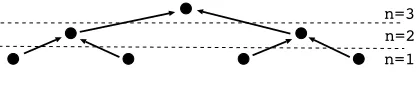
n=3
[image:3.612.65.274.71.118.2]n=1 n=2
Figure 1. Binary Tree
Application Scenario In many cases, a sensor network is used to collect periodically obtained measurement data at a central point (sink or base-station) for further analysis. The sensor nodes in such a network execute two major tasks. First a sensor nodes perform a sensing operation and second the node must forward the gathered data hop-by-hop to the sink. The execution time of the sensing task will depend on the nature of the physical phenomenon monitored and the complexity of the algorithm used to analyze it. Therefore, the position of the node in such a network and the complex-ity of the sensing task define the operating system load of the sensor node.
The complexity of the sensing operation depends on the phenomenon monitored, the sensor device used and the data preprocessing required. As a result, the operating sys-tem can be stressed very differently. If, for example, an ATMEGA128 CPU with a processing speed of 4M hz is considered, a simple temperature sensing task processed through the Analog to Digital Converter can be performed in less than a millisecond. If the same device is used in con-junction with a camera, image processing might take up to
100ms[7] before a decision is made. Note that a long sens-ing task can be split-up into several sub-tasks but in practice this is not always possible[7].
The complexity of a packet forwarding operation de-pends on the transceiver type, the MAC-layer and routing protocols used. On the DSYS25 platform with a Nordic transceiver approximately4000clock cycles are necessary to read a packet from the transceiver, perform routing and re-send the packet over the transceiver. The amount of packet forwarding tasks depends obviously on the node un-der consiun-deration and the current network topology.
Topology It is assumed that a binary tree topology is formed in the network (see Fig. 1). Depending on the po-sition n in the tree, a sensor node might process varying amounts of packets. In the experiments, the behavior of a single node at all possible positionsnis emulated and mea-sured by applying the sensing pattern and network traffic as described next.
Sensing Pattern A homogeneous activity in the sensor field is assumed for the abstract application scenario. Each sensor gathers data with a fixed frequencyfs. Thus,
ev-eryts = 1/fsa sensing task of the durationls has to be
processed. The durationls is variable betweenls = 4000
OS Program Size (KB) Required RAM (B)
TinyOS 9 283
[image:3.612.324.532.71.116.2]MANTIS 13.1 287
Table 1. Memory Usage
and ls = 400000clock cycles depending on the type of
sensing task under consideration (Which corresponds to
1ms/100mson a4M HzCPU).
Traffic Pattern Depending on the positionnof a node in the tree, varying amounts of forwarding tasks have to be performed. It is assumed that no time synchronization among the sensors in the network exists. Thus, even if each sensor produces data with a fixed frequency, data forward-ing tasks are not created at fixed points in time. The ar-rival rateλnof packets at a node at tree-levelnis modeled
as a Poisson process. As the packet forwarding activity is related to the sensing activity in the field, λn is given by:
λn = (2n−1)·fs. It is assumed that the duration
(com-plexity)lpof the packet-processing task, islp= 4000clock
cycles.
4. Memory Usage
The memory footprint of the operating system has to be as small as possible. The more complex an application is (with respect to memory requirements), the more likely a more capable Memory/CPU chip will be required to host the application.
In order to determine the memory usage of each oper-ating system, we use the GNU project binary utility avr-size. Avr-size is a flash image reader that outputs the pro-gram size and static memory (global variables) required by each operating system. However, the compilation pro-cedure for both operating systems is somewhat different. A specialized custom compiler (nesC) provided with the TinyOS framework, exploits the component-based architec-ture to include only components required by the applica-tion’s wiring schema in the compiled program image. Fur-thermore, the nesC compiler can deduce and remove any unused component functions within the application. Thus, to provide a fair memory comparison of both operating systems, the MANTIS application and operating system is stripped before compiling of all functionality that is not used for the abstract application .
Furthermore, the MANTIS scheduler dynamically allocates a memory pool to store the stack and processor registers for each thread.
The results show that both operating systems have very similar memory requirements. Thus, conventional micro-processors combining CPU and memory can normally hold either of the investigated operating systems.
5. Event Processing
It is assumed that the packet-processing task within the nodes has priority so that deadlines regarding packet for-warding can be met. Thus, in the MANTIS implementa-tion, the packet-processing task has a higher priority than the sensing task. In the TinyOS implementation, no prior-itization is implemented as this feature is not provided by the operating system.
To characterize processing performance of the operating system, the average task execution time Et of the packet
forwarding task, is measured. During the experiment, J
packet-processing timesejare recorded. To do so, the task
start timeestartand the task completion timeestopare
mea-sured and the packet-processing time is recorded as e =
estop−estart. The average task execution time Etis
cal-culated at the end of the experiment as:Et=!ej/J. For
each tree positionn, the experiment is run untilJ = 25000
packet-processing events are recorded.
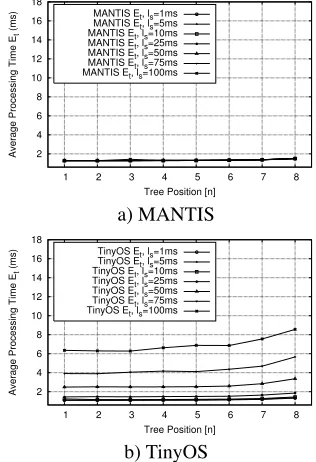
Results In the experiment, the average task execution timeEt is determined for TinyOS and MANTIS
support-ing the abstract application scenario (see Fig. 2).
Where MANTIS is used, it can be observed that the av-erage packet-processing time is independent of the sensing task execution time. Furthermore, Etis also independent
from the positionn of the node in the tree. The average processing time increases slightly, under a heavy load. This is due to the fact that under heavy load packet forwarding tasks have to be queued (see Fig. 2 a)).
Where TinyOS is used, the average processing time for the packet forwarding taskEtdepends on the length of the
sensing ls of the sensing task. In addition, under heavy
load the queuing effects of the packet forwarding tasks also contribute somewhat to the average processing time (see Fig. 2 b)).
The variance in the packet-processing time Et is also
recorded but not shown due to space restrictions. It has to be noted that this variance is significantly smaller in MANTIS than in TinyOS (e.g. withn= 8andls= 75ms, there is a
8.3msvariation of packet processing time in TinyOS com-pared with a0.4msvariation in MANTIS). Thus, MANTIS is better able to support scenarios which require predictable processing behavior.
2 4 6 8 10 12 14 16 18
1 2 3 4 5 6 7 8
Average Processing Time E
t
(ms)
Tree Position [n] MANTIS Et, ls=1ms MANTIS Et, ls=5ms MANTIS Et, ls=10ms MANTIS Et, ls=25ms MANTIS Et, ls=50ms MANTIS Et, ls=75ms MANTIS Et, ls=100ms
a) MANTIS
2 4 6 8 10 12 14 16 18
1 2 3 4 5 6 7 8
Average Processing Time E
t
(ms)
Tree Position [n] TinyOS Et, ls=1ms TinyOS Et, ls=5ms TinyOS Et, ls=10ms TinyOS Et, ls=25ms TinyOS Et, ls=50ms TinyOS Et, ls=75ms TinyOS Et, ls=100ms
[image:4.612.344.502.77.308.2]b) TinyOS
Figure 2. Average packet-processing timeEt
The thread prioritization capability of MANTIS is clearly visible in the experimental results. Packet process-ing times are independent of the concurrently executed and lower priority sensing task. In TinyOS, sensing and packet forwarding task delays are coupled, and the influence of the sensing activity on the packet forwarding activity is clearly visible.
6. Energy Consumption
To evaluate power-efficiency, This study investigates the available idle time in which low-power operations can be scheduled. Thus the comparative effectiveness of specific power management policies can be gauged on the amount of potential low-power (idle) time available.
In the experiment, the abstract application scenario is ex-ecuted by the sensor node running TinyOS or MANTIS. The duration of the experimentT and the durationik of
K idle time periods during the experiment is recorded. i
is defined as i = istop −istart . All idle periodsik are
summarized and the percentage idle time, It, the percent
of experiment time, in which the processor is idle, which is calculated as follows: It = (!ik/T)·100. Again, for
each tree positionn, the experiment is run untilJ = 25000
packet-processing events are recorded.
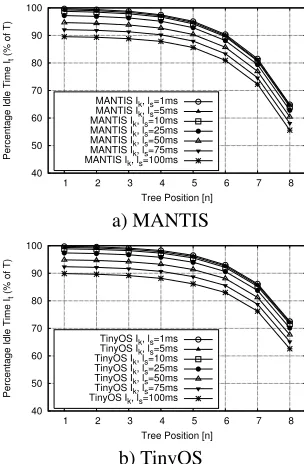
Results In the first experiment, the percentage idle time
Itis determined for TinyOS and MANTIS supporting the
40 50 60 70 80 90 100
1 2 3 4 5 6 7 8
Percentage Idle Time I
t
(% of T)
Tree Position [n] MANTIS Ik, ls=1ms MANTIS Ik, ls=5ms MANTIS Ik, ls=10ms MANTIS Ik, ls=25ms MANTIS Ik, ls=50ms MANTIS Ik, ls=75ms MANTIS Ik, ls=100ms
a) MANTIS
40 50 60 70 80 90 100
1 2 3 4 5 6 7 8
Percentage Idle Time I
t
(% of T)
Tree Position [n] TinyOS Ik, ls=1ms TinyOS Ik, ls=5ms TinyOS Ik, ls=10ms TinyOS Ik, ls=25ms TinyOS Ik, ls=50ms TinyOS Ik, ls=75ms TinyOS Ik, ls=100ms
[image:5.612.88.240.74.306.2]b) TinyOS
Figure 3. Percentage idle timeIt
The time spent in idle mode drops exponentially for both operating systems with the increasing node position in the tree described by the parametern. This behavior is expected as the number of packet tasks increases accordingly. Less obvious is the fact that the available idle time drops faster in MANTIS than in TinyOS. The fast drop in idle time is caused by the context switches in the MANTIS operating system. The more packet forwarding tasks are created, the more likely it is that a sensing task is currently running when a packet interrupt occurs. Subsequently, a context switch to the higher prioritized forwarding task is needed.
It is clearly visible that TinyOS is more energy efficient than MANTIS; especially under a high system load.
7. Conclusion
Both operating systems fit on standard microprocessors combining CPU and memory. However MANTIS uses
30% more space, but both systems are well within rea-sonable bounds for today’s microprocessors. The experi-mental results show that MANTIS is more predictable than TinyOS. Specifically, the packet forwarding task execution time in MANTIS has a low variation and is independent of other activity such as the sensing task. Thus, MANTIS would be preferable in situations that need deterministic and timely processing. However, as the experiments show, the MANTIS system is not as power-efficient as TinyOS. Thus, TinyOS would seem preferable if energy consumption is deemed to be of primary importance.
In general, the experiments confirm what one would
ex-pect. However, an interesting and not obvious fact is high-lighted by the experiments. If the system is not loaded (leaf node withn = 1and a sensing task with the size of
ls = 1ms) a difference of only0.1%in idle time is
mea-sured (compared to a difference of6.9%under heavy load withn = 8andls = 100ms). Thus, MANTIS would be
a good choice in cases where the sensor network is idle for long periods and suddenly high activity is encountered that requires timely processing of sensor information. For these kinds of applications, MANTIS combines both important sensor network design goals, i.e. energy efficiency and pre-dictive behavior.
References
[1] J. Hill, R. Szewczyk, A. Woo, S. Hollar, D. Culler, and K. Pister, “System architecture directions for networked sensors,” inACM SIGOPS Operating Systems Review, vol. 34, pp. 93–104, December 2000.
[2] S. Bhatti, J. Carlson, H. Dai, J. Deng, J. Rose, A. Sheth, B. Shucker, C. Gruenwald, A. Torgenson, and R. Han, “MANTIS OS: An embedded multithreaded operat-ing system for wireless micro sensor platforms,”ACM kluwer Mobile Networks & Applications Journal, spe-cial Issue on Wireless Sensor Networks, August 2005. [3] A. Barroso, J. Benson, T. Murphy, U. Roedig,
C. Sreenan, J. Barton, S. Bellis, B. O’Flynn, and K. Delaney, “Demo abstract: The DSYS25 sensor plat-form,” in 2nd international conference on Embedded networked sensor systems, pp. 314–314, November 2004.
[4] A. Dunkels, B. Gronvall, and T. Voigt, “Contiki - a lightweight and flexible operating system for tiny net-worked sensors,” in 29th Annual IEEE International Conference on Local Computer Networks, pp. 455–462, November 2004.
[5] C. Han, R. Kumar, R. Shea, E. Kohler, and M. Srivas-tava, “A dynamic operating system for sensor nodes,” in
3rd International Conference on Mobile Systems, Ap-plications, and Services, pp. 117–124, June 2005. [6] C. Duffy, U. Roedig, J. Herbert, and C. Sreenan, “A
performance analysis of TinyOS and MANTIS,” Tech. Rep. CS-2006-27-11, University College Cork, Ireland, November 2006.