SPECIAL SECTION
SPECIAL SECTION
By Peter Young and Arun Chotai
I
n the environmental and agricultural sciences, as in many
ar-eas of engineering and science, mathematical models are
nor-mally formulated as deterministic differential (or equivalent
discrete-time) equations. Most often, the structure of these
equations is defined by the scientist or engineer in a form that
is perceived to be appropriate according to the physical
na-ture of the system and the current scientific paradigms in the area of
study. Most of the “simulation” models that emerge from this
ap-proach are very large, with many unknown parameters.
Conse-quently, they are difficult, if not impossible, to identify, estimate, and
validate in rigorous statistical terms because of problems associated
with over-parametrization and the lack of experimental or monitored
data. Unlike the situation in engineering, however, natural
environ-mental systems, and many systems in agriculture, are not normally
Young ([email protected]) and Chotai are with the Centre for Research
on Environmental Systems and Statistics, Institute of Environmental and
Natu-ral Sciences, Lancaster University, Lancaster LA1 4YQ, U.K.
©199121st
CENTURY
manmade. As a result, their internal physical, biological,
and ecological mechanisms are often poorly understood,
and planned experiments that might lead to improvements
in such understanding are either difficult or, in the case of
environmental systems, even impossible to undertake.
Increasingly in recent years, however, the poorly defined
nature of many environmental and agricultural systems has
been recognized. It is now becoming accepted that a new
modeling philosophy and associated methodology is
re-quired that acknowledges the need to quantify the
uncer-tainty associated with the model (e.g., [1]-[3]). The Centre for
Research on Environmental Systems and Statistics (CRES) at
Lancaster University has been prominent in this area of
re-search. This article outlines the major aspects of our
ap-proach to stochastic modeling, as well as briefly describing
three studies that demonstrate the practical utility of this
ap-proach. In particular, the article shows how parametrically
efficient (parsimonious), low-order stochastic models can be
produced that reflect the dominant modal characteristics of
the system and can be interpreted in physically meaningful
terms. Within the present context, the most important aspect
of these data-based mechanistic (DBM) models is that they
provide an appropriate basis for advanced nonstationary or
nonlinear signal processing, adaptive forecasting, and
multivariable control system design.
Unlike data-based “black-box” models, DBM models are
required to have a mechanistic interpretation. Indeed, they
are not deemed truly credible in scientific terms unless such
an interpretation proves possible. But, unlike the situation
with “grey-box” models, such a physically meaningful
expla-nation is not imposed as a hypothesis prior to modeling.
Rather, it emerges from an inductive modeling procedure
only after the model structure has first been identified
parsi-moniously from a generic class of models with wide
applica-tion potential. In this manner, prior scientific prejudice
about the nature and complexity of the model is avoided,
and the resulting DBM model will normally have a structure
and parametrization that is appropriate to the information
content of the data. In this article, the generic class of
mod-els used in DBM modeling comprises stochastic linear and
nonlinear differential or difference equations, or their
trans-fer function equivalents.
DBM modeling methods were developed originally for
the analysis of measured time-series data, particularly in
re-lation to the design of signal processing, forecasting, and
au-tomatic control systems. In the early stages of modeling,
when observational data are either scarce or not available,
however, the same methodological tools can also be used to
obtain reduced-order versions of the large simulation
mod-els. The importance of reduced-order models that reflect
the dominant modes of system behavior is being widely
rec-ognized in many areas of application within the
environmen-tal and agricultural sciences. For example, such models
have been used in the simplification of large simulation
models used in climate research (e.g., [4]) and in optimal
control system design (e.g., [5]). An example of the DBM
ap-proach to model reduction is the modeling and control of
the microclimate in a large horticultural greenhouse [6]
where the reduced-order control model is obtained from a
much larger nonlinear simulation model. A similar DBM
ap-proach has been used to obtain linear, reduced-order
ver-sions of the topically important “global carbon cycle”
models [6], [7] used in the studies of the International Panel
on Climate Change (IPCC).
This article outlines the main aspects of DBM modeling,
as well as the associated methods of signal processing,
adaptive forecasting, and multivariable control that exploit
such models. This overall generic approach appears to have
wide application potential, and its practical utility is
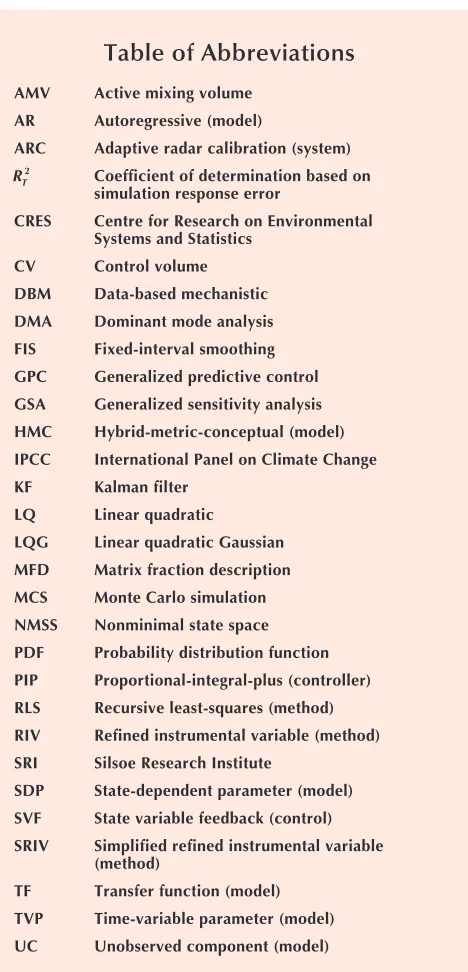
illus-Table of Abbreviations
AMV Active mixing volume
AR Autoregressive (model)
ARC Adaptive radar calibration (system) RT2 Coefficient of determination based on
simulation response error
CRES Centre for Research on Environmental Systems and Statistics
CV Control volume
DBM Data-based mechanistic DMA Dominant mode analysis
FIS Fixed-interval smoothing
GPC Generalized predictive control
GSA Generalized sensitivity analysis HMC Hybrid-metric-conceptual (model)
IPCC International Panel on Climate Change
KF Kalman filter LQ Linear quadratic
LQG Linear quadratic Gaussian
MFD Matrix fraction description MCS Monte Carlo simulation
NMSS Nonminimal state space
PDF Probability distribution function
PIP Proportional-integral-plus (controller) RLS Recursive least-squares (method)
RIV Refined instrumental variable (method)
SRI Silsoe Research Institute
SDP State-dependent parameter (model)
SVF State variable feedback (control)
SRIV Simplified refined instrumental variable (method)
TF Transfer function (model) TVP Time-variable parameter (model)
[image:2.612.317.551.59.545.2]trated by three practical examples. These range from the
model reduction and control application mentioned above
through the modeling and control of forced ventilation
sys-tems in agricultural buildings to the design of adaptive flood
forecasting and warning systems.
Methodological Background
The methods used in this article have been developed over
the past 20 years, and they cover four main areas: DBM
methods for modeling linear and nonlinear stochastic
sys-tems; dominant mode analysis (DMA) leading to the
com-bined linearization and simplification of large simulation
models; unobserved component (UC) models and their use
in the recursive estimation, forecasting, and smoothing of
nonstationary time series; and nonminimal state space
(NMSS) methods of control system design. All of these
meth-ods have been described in detail elsewhere, so they are
outlined only briefly in the following subsections.
Data-Based Mechanistic Modeling
Previous publications (e.g., [6]-[10]) illustrate the evolution
of the DBM philosophy and its methodological
underpin-ning. This methodological basis is heavily dependent on the
exploitation of recursive estimation in all its forms. These
include the traditional application to online and offline
pa-rameter estimation using recursive least-squares (RLS) and
optimal refined instrumental variable (RIV) algorithms; the
design of adaptive forecasting systems using the Kalman
fil-ter (KF) algorithm; the use of recursive fixed-infil-terval
smoothing (FIS) for more statistically efficient, offline
time-variable parameter (TVP) estimation for use in signal
extraction; and the exploitation of FIS combined with other
procedures for state-dependent parameter (SDP)
estima-tion and the nonparametric/parametric identificaestima-tion of
nonlinear stochastic systems.
The three major phases in the DBM modeling strategy
are as follows:
•
Stochastic Simulation Modeling and Sensitivity Analysis
(e.g., [2], [3], [6], [8], and the references therein). In
the initial phases of modeling, observational data may
well be scarce, so any major modeling effort will have
to be centered on simulation modeling, usually based
initially on largely deterministic concepts such as
dy-namic mass and energy conservation. Recognizing
the inherent uncertainty in many environmental and
agricultural systems, however, these deterministic
simulation equations can be converted into an
alter-native stochastic form. Here, it is assumed that the
as-sociated parameters and inputs can be represented in
some suitable stochastic form such as a probability
distribution function (PDF) for the parameters and
time-series models for the inputs. The subsequent
stochastic analysis then exploits Monte Carlo
simula-tion (MCS) in three ways: first, to explore the
propaga-tion of uncertainty in the resulting stochastic model;
second, as a mechanism for generalized sensitivity
analysis (GSA) to identify the most important
parame-ters leading to a specified model behavior; and third,
the use of MCS in stochastic optimization.
•
Dominant Mode Analysis and Simulation Model
Simpli-fication
(e.g., [6], [7], and the references therein). The
initial exploration of the simulation model in
stochas-tic terms can reveal the relative importance of
differ-ent parts of the model in explaining the dominant
behavioral mechanisms. This understanding of the
model is further enhanced by employing a novel
method of combined statistical linearization and
model order reduction. This is applied to time-series
data obtained from planned experimentation, not on
the system itself, but on the simulation model that
be-comes a surrogate for the real system. Such DMA is
ex-ploited to develop low-order, dominant mode
approximations of the simulation model;
approxima-tions that are often able to explain its dynamic
re-sponse characteristics to a remarkably accurate
degree (e.g., coefficients of determination
>
0.999; i.e.,
greater than 99.9% of the high-order model output is
explained by the low-order model). Conveniently, the
statistical methods used for such linearization and
or-der reduction exercises are the same as those used for
the next phase in the modeling process.
esti-mation [12]-[14], whereas if the system is heavily
nonlinear, the SDP estimation allows for identification
of the nonlinear model structure prior to final
nonlin-ear parametric estimation (see [7], [9], [14]). This
lat-ter approach provides an allat-ternative to, or a
reinforcement of, other approaches to nonlinear
mod-eling, such as neural network and neuro-fuzzy
model-ing (e.g., [15]). It has the advantage that the resultmodel-ing
models are normally much less complex, of
consider-ably lower order, and more easily interpretable in
mechanistic terms.
DBM modeling is obviously very different from
physi-cally based simulation modeling, but it is often confused
with grey-box modeling. Grey-box modeling follows the
tra-ditional hypothetico-deductive approach. Here the
hypoth-esis is normally in the form of a much-simplified model of
the physical system under study, and deduction is based on
estimating the parameters that characterize this assumed
model structure from measured data. In contrast, DBM
mod-eling is inductive and commences with few prior
percep-tions of the model form, except that it is a member of a
suitable, generic class of models (normally linear/nonlinear
differential equations or their discrete-time equivalents).
Methods of statistical model structure identification and
pa-rameter estimation are then utilized to produce a
low-di-mensional, black-box model, within this generic class of
models, that explains the data unambiguously in a
statisti-cally efficient manner. Only then is the question of the
un-derlying, mechanistic interpretation of the model
addressed, as illustrated by the examples discussed later. In
this manner, a minimally parametrized and statistically
well-defined model is obtained, and the dangers of imposing
too much confidence in prior assumptions about the
physi-cal nature of the system are avoided.
Signal Processing, Forecasting,
and Automatic Control
The DBM methods were developed primarily for modeling
systems from normal observational time-series data
ob-tained from monitoring exercises (or planned
experimen-tation, if possible) carried out on the real system. Often,
such time series require some form of preprocessing, and
this is accomplished using methods of nonstationary
time-series analysis based on recursive fixed-interval
smoothing (e.g., [11], [12], and the references therein).
These powerful statistical tools allow for interpolation
over gaps in the time series; the detection of outliers;
“sig-nal extraction,” including the estimation and removal of
periodic components (e.g., seasonal adjustment); and
time-frequency analysis.
The DBM models are also in a form appropriate for
model-based forecasting and control system design. Of
course, any available methods can be used for these
appli-cations. At Lancaster, however, the stochastic UC
model-ing approach based on TVP estimation provides the main
vehicle for adaptive forecasting ([12], [13], and the
references therein). Model-based automatic control
sys-tem design is formulated within the NMSS setting, normally
resulting in the multivariable proportional-integral-plus
(PIP) control algorithm (see [16] and the references
therein). The NMSS is the most natural state-space
defini-tion for discrete-time transfer funcdefini-tion models, and the PIP
controller provides a natural multivariable extension of
the conventional PI and PID controllers. In addition to
pro-portional and integral action, it includes additional
for-ward path and feedback filters that allow for NMSS state
feedback, without the need for state reconstruction, thus
enhancing robustness and closed-loop performance. Of
course, the PIP controller is just one specific outcome of
the NMSS design concept. This concept is not only
attrac-tive in its own right, but control algorithms that derive
from it are very general in form and thus able to mimic
other well-known design procedures, such as minimal
state linear quadratic Gaussian (LQG), generalized
predic-tive control (GPC), and Smith predictor control for
time-de-lay systems (see [17] and the references therein).
It should be noted that many of the time-series analysis
and modeling procedures mentioned above and used in
the examples described below are contained in the
MATLAB
CAPTAIN
time-series analysis and forecasting
toolbox, currently in the final stages of beta testing (see
http://www.es.lancs.ac.uk/cres/captain/).
Modeling and Control of a
Greenhouse Microclimate
The literature on modeling of the microclimate in
green-houses is very large, with models ranging from high-order,
nonlinear simulation models (e.g., [18]) through much
sim-pler but still physically meaningful data-based models (e.g.,
[19]) to purely black-box models (e.g., [5]). One important
aspect of this research has been the development and use of
models for the control of greenhouse microclimates (e.g.,
[20] and the references therein). This example falls into the
latter category and is concerned with the modeling and
au-tomatic control of the microclimate in the large Venlo
horti-cultural greenhouse at the Silsoe Research Institute (SRI) in
Bedford, U.K.
To simplify the model shown in Fig. 1, it was perturbed
about a number of different operating points by suitably
de-signed input functions. These were applied to each control
input in turn (i.e., the fractional valve aperture of the
heat-ing boiler
u
1,t, the input to the mist spraying system
u
2,t, and
the CO
2enrichment input
u
3,t), and they produced climate
perturbations defined by the internal air temperature
y
1,tin
°C, the percentage relative humidity
y
2,t, and the CO
2con-centration
y
3,tin ppm. The input-output perturbational data
set obtained in this manner was then used as the basis for
the identification and estimation of reduced-order,
dis-crete-time linear models that were directly suitable for
model-based PIP system design [21].
At the most important operating condition, the
esti-mated reduced-order model for
y
t t t tT
y
y
y
=
[
1, 2, 3,]
, in
re-sponse to
u
t t t tT
u
u
u
=
[
1, 2, 3,]
, takes the form of the
following discrete-time, transfer function matrix model:
y
tz
z
z
z
=
−
−
−
−
−
− −
−
0 0143
1 0 9056
0 0712
0
0 0587
1 0 79
1
1
1
1
.
.
.
.
.
06
0 7909
0
0
01791
1 0 6996
831294
1 0
1
1
1
1
1
z
z
z
z
z
−
−
−
−
−
−
−
−
.
.
.
.
.6541
1z
t
−
u
.
(1)
CO2
Humidity
Air Temperature
1/s
1/s
1/s
1/s
1/s
1/s
1/s
1/s
1/s
1/s
1/s ×1
×2
×3
×4
×5
×6
×7
×8
×9
×10
×11 Weather
Inputs
Control Inputs
Thermal Rad Coeffs
Heat Trans Coeffs
Stomatal Res
CO Model2
Latent Heat En Ex En Ex
Derivatives Demux
Mux u1
u2
u3
u4
u5
u6
u7
u8
This model is well identified, and the parameter estimates
are statistically well defined. As might be expected, the
ma-jor coupling is between the temperature and relative
humid-ity, with CO
2being almost independent of these variables.
Despite its simplicity, the model explains the high-order
nonlinear model response very well, with coefficients of
de-termination
R
T20 99
>
.
(i.e., over 99% of the high-order model
response explained by the low-order model). Clearly, the
dominant modal behavior of the simulation model at this
operating condition, which is so important for subsequent
control system design, has been captured very well.
More-over, this model is much simpler than might be expected on
the basis of the full nonlinear model equations.
From the DBM standpoint, it is important that the
re-duced-order model should make good physical sense, and,
as expected from mass and energy transfer considerations,
the temperature and humidity dynamics are highly coupled.
Indeed, it is possible to associate the model (1) with the
dif-ferential equations of mass and energy transfer for this
sys-tem (much simplified versions of the equations used to
derive the high-order model in Fig. 1). Since the model is
es-timated in discrete time, however, this relationship is not
too transparent. Consequently, it is better to delay our
illus-tration of such a mechanistic interpretation to the next
sec-tion, where a related model is estimated directly in
continuous-time terms and the physical interpretation is
much more obvious.
The high-order simulation model provided a very
use-ful vehicle for initial PIP control system design and
evalu-ation exercises [21], where it functioned as a valuable
surrogate for the real system before experimentation
was possible. Furthermore, the fact that the
reduced-or-der models were
structurally
identical to those identified
later from the real data meant that the initial PIP
control-ler designs were also structurally similar. Note that the
inherent stochastic nature of the DBM models is most
im-portant in the PIP control system design process, since it
allows for evaluation of the controller’s robustness to
uncertainty using stochastic simulations. These can be
either single simulations with stochastic inputs or MCS
used to assess the robustness of the control system to
uncertainty in the model parameters (e.g., [17] and the
references therein).
NMSS control system design is straightforward and
flexi-ble in this example [21]. Once the reduced-order TF matrix
model (1) has been obtained, it is converted
straightfor-wardly to the left matrix fraction description (MFD), and
thence to the following NMSS form:
x
t+1=
Fx
t+
Gu
t+
Dy
d t, +1y
t=
Hx
t(2)
where
F
and
u
tare defined as at the bottom of the next page
and
G
=
−
−
−
0 0143
0 0712
0
0 0587
0 7909
0
0
01791
831294
0
0
0
0
0
.
.
.
.
.
.
0
0
0
0
1
0
0
0
1
0
0
0
1
0 0143
0 0712
0
0 0587
0 7909
0
0
01791
8
−
−
−
.
.
.
.
.
31294
.
H
=
1 0 0 0 0 0 0 0 0 0 0 0
0 1 0 0 0 0 0 0 0 0 0 0
0 0 1 0 0 0 0 0 0 0 0 0
D
=
0 0 0 0 0 0 0 0 0 1 0 0
0 0 0 0 0 0 0 0 0 0 1 0
0 0 0 0 0 0 0 0 0 0 0 1
T
.
Here
x
t=
[
y
1,ty
2,ty
3,ty
1,t−1y
2,t−1y
3,t−1u
1,t−1u
2,t−1u
3,t−1z
tz
tz
tT
1, 2, 3,
] is the NMSS vector;
u
tu
tu
tu
t T=
[
1, 2, 3,]
is the
control input vector; and
y
d t d t d t d tT
y
y
y
,
=
[
1, 2, 3,]
is the
com-mand input vector (the user-defined levels of the three
cli-m a t e v a r i a b l e s ) . T h e v a r i a b l e s
z
i t,,
i
=
1 2 3 a re
, ,
integral-of-error states, introduced to ensure type 1
servo-mechanism performance (unity gain to the command inputs
and steady-state decoupling: i.e., in the steady state, the
controlled variables all reach their demand levels without
any effect on the steady-state levels of the other output
vari-ables).
PIP control system designs based on this NMSS model (2)
provide the basis for any SVF design procedures, such as
op-timal linear-quadratic (LQ), pole assignment, or
risk-sensi-tive/robust design. In the simplest LQ case, for example,
quadratic
cost
function
weighting
matrices
Q
=
diag[
111111111 100 5 25
]
and
R
=
diag [
1 01 01
.
. ]
produce the SVF control law below (equation
u
tat the bottom
of the next page), where the off-diagonals of the last 3
×
3
block in the matrix have been constrained to zero
consis-tent with the steady-state decoupling requirement. Note
that the pair [ , ]
F G
is stabilizable by the nonminimal state
feedback, and, in addition, we can always find a matrix
E
such that the Cholesky decomposition
EE
TQ
=
, ensuring
that the pair [ , ]
F E
is observable [22]. Consequently, this
PIP-controlled system will be stable and achieve the desired
LQ optimality.
that the relative values of the cost function weighting
ma-trix elements associated with the three integral-of-error
states have been adjusted here to ensure that the rise
times of each channel have the required control
character-istics, while minimizing harsh actuator movements that
could cause wear.
The controller designed in the above manner was
vali-dated in practical terms over a three-month implementation
period during the 1993-1994 growing season with a tomato
crop in the greenhouse. Fig. 3 shows the control
perfor-mance of each climate variable over the entire validation
pe-riod. Each graph shows the percentage of the validation
period that a control variable was inside a certain control
limit. For example, air temperature was less than 1°C away
from the set point for 98% of the validation period. This
per-formance easily meets the requirements of the growers.
Finally, it should be noted that the results shown in Figs. 2
and 3 were obtained with the simple, constant-gain,
multivariable controller defined above, and some
improve-ments in performance would be possible if more complex
control systems were used. For
exam-ple, further decoupling of the
tempera-ture and humidity control can be
accomplished by exploiting a special
form of multiobjective optimization
de-veloped at Lancaster (e.g., [16]). Here,
the Cholesky factors of the LQ cost
function weighting function matrices
are optimized so that off-diagonal
weightings are introduced into the cost
function to ensure satisfactory
de-coupling (or other multiobjective
re-quirements).
The responses obtained with such
an optimized PIP controller are shown
as the thick lines in Fig. 2; clearly, almost perfect decoupling
has been achieved. Other possible improvements include a
stability-guaranteed, neuro-fuzzy gain scheduling system
F
=
−
0 9056
0
0
0 0
0
0
0 0645
0
0 0 0
0
0 7906
0
0 0
0
0
0 6253
0
0 0 0
0
0
1
.
.
.
.
.
3537
0 0
0 4576 0
.
01171
.
581536 0 0 0
.
1
0
0
0 0
0
0
0
0
0 0 0
0
1
0
0 0
0
−
−
0
0
0
0 0 0
0
0
1
0 0
0
0
0
0
0 0 0
0
0
0
0 0
0
0
0
0
0 0 0
0
0
0
0 0
0
0
0
0
0 0 0
0
0
0
0 0
0
0
0
0
0 0 0
0 9056
0
0
0 0
0
0
0 0645
0
1 0 0
0
0 7906
0
0 0
0
0
0 6253
0
0 1
−
−
−
.
.
.
.
0
0
0
−
13573 0 0
0 4576
0
−
01171
581536
0 0 1
.
.
.
.
u
t= −
−
22 8406 12938
0
0 0
0
0
0 6036
0 0001
5 6927
0
0
0 6954
0
.
.
.
.
.
.
.
.
.
.
.
.
.
9666
0
0 0
0
0
0 7149
0 0001
0
0 7991
0
0 0015
0 0021 0 0021
−
−
0 0
−
0 0055 0
−
0 0001
−
0 6996
0
0
−
0 0112
.
.
.
.
x
tTemperature Humidity Carbon Dioxide
[ C]° [% RH] [p/m]
100 100 100
75 75 75
50 50 50
25 25 25
0 0 0
[%
Time]
[%
Time]
[%
Time]
0 0.5 1 1.5 0 2 4 6 0 20 40 60
Figure 3.
Long-term controller performance for the SRI Venlo greenhouse; presented as
percentage of total evaluation period (% time) against absolute control error in relation to
the set point (control limit).
u1 to y1
u1 to y2 u2 to y2
u2 to y1 1.5
1
0.5
0
0
−0.5 −1 −1.5
0 20 40
0 20 40
0
−0.05
−0.1
0 20 40
1.5
1
0.5
0
0 20 40
(e.g., [23]) or a fully adaptive PIP control system (e.g., [24]).
The latter would be straightforward to implement, since the
recursive estimation algorithms used in the modeling stage
of the design can be easily implemented online in real time.
However, the performance shown in Fig. 3 is perfectly
ac-ceptable for most practical purposes, and such added
com-plexity is not warranted in this case.
Modeling and Control
of Forced Ventilation Systems
This example is related to the previous one and concerns the
analysis of data from planned experiments in a large
instru-mented chamber in the Laboratory for Agricultural Buildings
Research at the Katholieke Universiteit Leuven (for details,
see [25]). This chamber, shown in Fig. 4, has a volume of 9 m
3and has been designed to represent a scale model of a
live-stock building or greenhouse for use in experimental
re-search on forced ventilation and heating in agricultural
buildings. The two variable inputs, ventilation rate (120-300
m
3/h) and heating element input (0-400 W), determine the
dominant airflow pattern within the chamber. An envelope
chamber or “buffer zone” is constructed around the test
room to minimize disturbance of the airflow by heat
conduc-tion from the laboratory. A series of aluminum conductor
heat sinks and steam generation from a water reservoir
pro-vide the internal heat and moisture production to simulate
animal occupants. To gain information about the distribution
of mass and energy in a quantitative manner, 36 temperature
sensors and 24 humidity sensors are positioned in a
three-di-mensional (3-D) array within the chamber.
The agricultural engineering literature reports a great deal
of research on the modeling of ventilated air spaces, much of
it based on deterministic simulation models. More recent
data-based modeling has been stimulated by the control
vol-ume (CV) concept of Barber and Ogilvie [26]. For example,
Berckmans et al. [25] use least-squares methods to estimate
the parameters in a simple conceptual CV model of an
imper-fectly mixed 3-D airspace from variations in ventilation rate
and heat supply, whereas Daskalov [27] develops a model for
measured temperature and humidity variations in a naturally
ventilated pig building using discrete-time TF models. To
ob-tain the DBM model, which can be considered a natural
ex-tension of these earlier models, the continuous-time SRIV
estimation algorithm is used first to identify the linear TF
(or-dinary differential equation) model between the measured
temperatures at the inlet,
T
i, and the outlet,
T. In the case of
the response to a step increase of the ventilation rate from 80
to 300 m
3/h, the estimated model for the change in
tempera-ture
∆
T
from the initial steady levels takes the form
∆
T t
s
∆
s
s
T t
i t( )
.
.
.
.
( )
=
+
+
+
+
1959
0 089
2962
0111
2
ξ
(3)
where
s
is the differential operator and
ξt
is the residual
noise. Fig. 5 compares the output of this model with the
mea-sured change in the outlet temperature, and the associated
residual
ξt
is plotted in the lower graph. This unexplained
residual has a zero mean value and low variance (0.021
com-pared with a measured variance of 2.619 for the output
∆
T
series;
R
T2
0 992
=
.
).
The TF model can be decomposed into a parallel or
feed-back connection of first-order processes, but the latter has
more physical significance, as required in DBM modeling.
This becomes clear if we invoke the classical theory of heat
transfer and formulate the differential equations of dynamic
heat transfer, bearing in mind the need to arrive at a
sec-ond-order, lumped, differential equation with a TF similar to
(3). Such analysis [28] yields the following equations for the
main chamber and the buffer zone:
Main Chamber:
d
T
dt
T
iK
T
T
(
∆
)
∆
∆
∆
=
β
1+
1 buff−
α
1Buffer Zone:
d
T
dt
K
T
K
T
T
(
)
(
)
∆
buff∆
∆
∆
buff buff
= −
2+
3−
.
In these equations,
β
1 1=
V
vol
;
α
1 1γ
1 1
1 1 1
=
+
vol
V
vol
k
sf
cp
;
K
1k
1 11 1 1
=
sf
vol
γ
cp
;
K
2k
2 2 2 1 1=
sf
vol
γ
cp
and
K
3k
1 1 2 1 1=
sf
vol
γ
cp
[image:8.612.312.552.529.709.2]where
T
is the temperature (°C) measured at the outlet
port but assumed to be representative of the temperature
in the active mixing volume (AMV) [10];T
iis the temperature
(°C) measured at the chamber inlet;
V
is the ventilation rate
(m s
3 −1);
γ
1
is the air density of the incoming air and the air in
the main chamber (kgm
−3);cp1
is the specific heat capacity of
the incoming air (Jkg
-1C
-1°
) and the air in the main
cham-ber;
k
1is the thermal conduction coefficient through the
in-ner chamber walls (Wm
−2°
C
−1); sf
1
is the surface area of the
AMV for imperfect mixing (m
2);
T
buffis the temperature in
the outer buffer zone (°C); vol2
is the volume of the AMV
as-sociated with the buffer zone (m
3);
k
2is the thermal
con-duction coefficient through the buffer zone (outer
chamber) wall (Wm
−2°
C
−1); and sf2
is the surface area of the
buffer zone AMV for imperfect mixing (m
2).
The differential equations above may be combined and
expressed in TF form to yield the following second-order TF
model for the complete chamber-buffer zone system:
∆
T
b s
b
∆
s
a s
a
T
i=
+
+
+
0 1
2
1 2
(4)
where
b
0= β
1;
b
1=
β
1(
K
2+
K
3);
a
1=
(
K
2+
K
3+ α
1)
;
a
2=
(
K
2+
K
3)
α
1−
K K
1 3.
Clearly, the TF model (4) has exactly the same structural
form as the estimated TF model (3), so in DBM modeling
terms, it can be considered as one particular physical
inter-pretation of the data-based model that has scientific
credi-bility. The first-order TF numerator (
B j
j,
=
0 1) and
,
denominator (
A j
j,
=
0 1) parameters in the feedback decom-
,
position can now be calculated as follows:
B
0= β
1;
A
0 1V
k
1
1 1
1 1 1
=
=
+
α
γ
vol
sf
vol
cp
;
B
K K
k
V
1
1 3
1
1 2
1 2
2 1 2
1 2
=
=
β
γ
sf
vol
cp
;
A
1K
2K
3k
k
2 2
2 1 1
1 1
2 1 1
=
(
+
)
=
sf
+
vol
cp
sf
vol
cp
γ
γ
.
These two first-order TF’s have very different time
constants:
T
c1, associated with theA
0parameter,
re-flects the fast response within the main chamber:
T
A
V
k
c1 0
1
1 1
1 1
1
1
1
=
=
+
vol
sf
cp
γ
and
T
c2, associated with theA
1parameter and the
much slower temperature effect due to feedback
conduction from the buffer zone, i.e.,
T
c2=
1
/
A
1.
The above analysis is useful because it shows
how the inductive approach of DBM modeling
objec-tively defines the lowest order structure (dynamic
order and feedback nature) of the model prior to
de-fining a mechanistic interpretation compatible with
this structure. Note also that the conventionally defined
heat transfer parameters used in the above mechanistic
for-mulation of the equations are not identifiable from the
above relationships. In contrast, the parameters of the
model (4) have direct physical significance, and they can be
identified fully from the measurements obtained in the
chamber experiments. Consequently, this model is not only
useful in subsequent control system design terms, but it
also provides an alternative, mechanistic characterization
of the heat transfer dynamics that is useful in its own right.
The above model is currently being used in the design of a
multivariable PIP controller for a chamber similar to that
de-scribed in the previous section. However, other associated
research has been concerned with the modeling and control
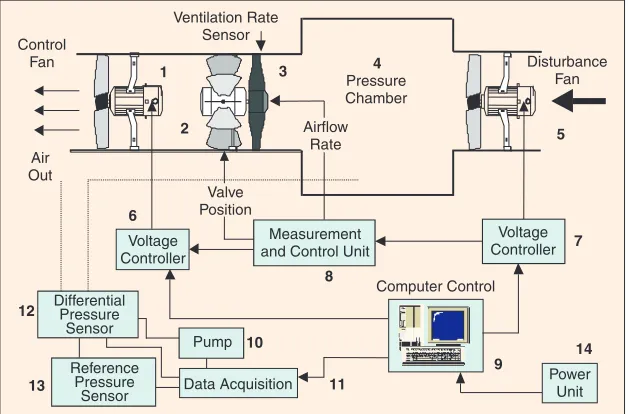
of the fans used in the forced ventilation systems. Fig. 6, for
example, is a diagram of the fan test installation at Leuven.
The model for this system is identified by the SRIV algorithm
as a first-order discrete time TF, and this model has been used
as the basis for PIP and GPC system design. This study
con-firms that the model-based control algorithms offer better
performance than the conventional PID controller in terms of
both the regulation of ventilation rate and the reduction of
energy consumption. In particular, for a 450-mm axial fan, the
normalized mean square errors are as follows: PIP = 1, GPC =
1.64, PID = 5.59. These results were obtained for an airflow
rate of 3000 m
3/h with realistic wind disturbances, but, in
or-der to evaluate their practical robustness, all three
control-lers were optimized for an airflow rate set point in the
neighborhood of 1500 m
3/h, without wind.
Environmental Forecasting
Previous publications from Lancaster illustrate how the
modeling and forecasting procedures outlined above have
been applied to environmental and other time series (e.g.,
[13] and the references therein). Here, we will consider the
results obtained in the case of two practically important
en-2
0
−2
−4
−6
−8
−1 0
0
0 100
100 200
200 300
300 400
400 500
500 600
600 700
700 800
800
T
emper
ature [
C]
°
Outlet Temperature Response and Residuals
[image:9.612.61.335.64.259.2]Time [Tens of Seconds]
Figure 5.
Comparison of the model estimated temperature and the
vironmental examples: first, the famous
series of monthly atmospheric CO
2mea-surements at Mauna Loa in Hawaii, as
shown in Fig. 7, which did much to
pro-mote the current debate on global
warm-ing; and second, the hourly rainfall and
river flow series from the River Ribble
Catchment in northwest England, as
shown in Fig. 8.
Adaptive Forecasting,
Backcasting,
and Interpolation of the
Mauna Loa CO
2Series
It is clear from Fig. 7 that the variations in
atmospheric CO
2at Mauna Loa are
domi-nated by a long-term, upward trend and
an-nual periodicity. As a result, the identified
UC model takes the form
y
t= +
T
tC
t+
e
t(5)
where
T
ta
a t
a t
d
tC
ta
j tt
b
j
j j t
=
+
+
+
=
+
=
∑
0 1 2
2
1 2
and
,cos(
ω
)
,(sin
ω
jt
)
(6)
and
y
tdenotes theCO
2. As shown, the trend
T
tis identified as
a polynomial in time
t
, with unknown but
constant
parame-ters, combined with a residual signal
d
tthat models the
me-dium-term, stochastic deviations about this polynomial
trend. The annual seasonality is modeled by the periodic
component
C
t: this is of a standard trigonometric (Fourier)
form but with stochastically time-varying parameters (TVPs)
a
j t,,
b
j t,,
j
=
1 2. This type of relationship will model any peri-
,
odic behavior defined by the frequencies
ω
j,
j
=
1 2, and the
,
TVPs allow for the estimation of changes in the amplitude
and phase of these seasonal variations. In the present CO
2example, the frequency
ω
1=
2
π
/
12
is the fundamental
fre-quency associated with the 12-month seasonal cycle, and
ω
2=
2
π
/ is its first harmonic. The spectrum of the data sug-
6
gests that the other harmonics are insignificant and can be
omitted. The TVPs
d
t,
a
j t,,
b
j t,,
j
=
1 2 in this UC model are
,
identified and modeled as simple random walk processes in
an associated set of stochastic state equations (see [13]).
The hyper-parameters (e.g., noise variance ratios) in this
state-space model are estimated by a special form of
optimi-zation in the frequency domain (see [12] and [13]) and the
recursive KF and FIS algorithms are then used for
forecast-ing, backcastforecast-ing, and interpolation of the series.
Typical results are shown in Figs. 9 and 10. For this
analy-sis, the estimation data set consisted of the first 313 samples
(1958(1)-1985(5)) of the 504 data set, but with two years of
these data between 1971(8) and 1973(8) omitted to show
how the algorithms interpolate over such a gap. For
valida-Control Fan
Air Out
6
12
13
10
11 8
9
14 7 5 4
3 1
2
Voltage Controller
Differential Pressure
Sensor
Reference Pressure
Sensor
Pump
Data Acquisition
Measurement and Control Unit Valve
Position
Pressure Chamber Ventilation Rate
Sensor
Disturbance Fan
Voltage Controller
Computer Control
Power Unit Airflow
[image:10.612.239.553.64.271.2]Rate
Figure 6.
Schematic layout of the test chamber and associated control equipment.
2.5
2
1.5
1
0.5
0 0
0 50
50 100
100 150
150 200
200 250
250 300
300 350
350 400
400 450
450
Flo
w
Rainfall-Flow Data for River Hodder at Hodder Place
6
4
2
0
Rainf
all
Time [h]
Figure 8.
Hourly rainfall (lower panel) and flow (upper panel)
series for the River Hodder at Hodder Place in the River Ribble
Catchment of northwest England.
370
360
350
340
330
320
310
1960 1965 1970 1975 1980 1985 1990 1995 2000
Carbon Dio
xide [ppm]
Date
[image:10.612.313.551.291.473.2] [image:10.612.313.551.500.696.2]Atmospheric Carbon Dioxide at Mauna Loa, Hawaii, 1958-2000
tion purposes, true multistep-ahead forecasting is carried
out in the short term (three years ahead) and long term
(14.4 years ahead to 1999(12)), respectively, based only on
the estimation data set, with the model optimized on the
ba-sis of these same limited data (306 samples). The top panel
in Fig. 9 shows the two-year interpolation results, whereas
the lower panel shows the three-year-ahead forecasts. In
both cases, the results are excellent, with very small errors
between the interpolates/forecasts (full lines) and the data
(dashed lines, not used in the analysis). The estimated
stan-dard error bounds (95% confidence intervals) are shown as
dotted lines. Fig. 10 shows the last 5.5 years of the
14.4-year-ahead forecast. Here, the data (again not used in
the estimation or forecasting) are plotted as circular points
and the forecast as a solid line, with the standard error
bounds shown dotted. Given the very long
forecasting interval, these results are quite
remarkable and show how predictable this
important series can be if sufficiently
pow-erful forecasting algorithms are used. As far
as the authors are aware, these are the best
forecasting results produced so far for this
series.
Adaptive Flow Forecasting
in the Ribble Catchment
Once again, the scientific literature
abounds with different models of
rain-fall-flow processes in river catchments.
These vary considerably in complexity
from those based on continuum mechanics
(solved approximately via finite difference
or finite element spatiotemporal
discre-tization methods) [29] through conceptual
models such as TOPMODEL [30] to
hy-brid-metric-conceptual (HMC) grey-box
models such as IHACRES (e.g., [31]), which
are similar in structure and complexity to
the DBM model equivalent [32]. The main
aim of the River Ribble study [33] was
threefold: first, to obtain DBM models
relat-ing rainfall to the river flows measured in
the Ribble catchment; second, to evaluate
the performance of a state-adaptive,
KF-based approach to forecasting, with
the state dynamics defined by these DBM
models; and finally, to compare this
state-adaptive approach with its
predeces-sor at Lancaster, the parameter-adaptive
forecasting system developed for the
Sol-way River Purification Board as a flood
warning system for the town of Dumfries in
Scotland (e.g., [34]). Another, secondary
objective following from the development
of the Lancaster adaptive radar calibration (ARC) system
for the National Rivers Authority/Environment Agency
[35] was to consider how well forecasting performance
using weather radar measured rainfall compared with the
performance using more conventional ground-based
methods.
In the case of a uniform sampling interval of one hour,
SRIV identification and estimation yields the following
dis-crete-time TF model between the gauged rainfall
r
tand the
measured flow
y
tfor the River Hodder at Hodder Place in the
Ribble catchment during December 1993:
y
b
b z
a z
a z
g r
t
=
t t+
+
+
+
−
− − −
0 1
1
1 1
2
2 4
1
{
}
ξ
.
(7)
335
330
325
1971 1971.5 1972 1972.5 1973 1973.5 1974 1974.5
Carbon Dio
xide [ppm]
Carbon Dio
xide [ppm]
Interpolation and Forecasting Results
355
350
345
340
1985 1985.5 1986 1986.5 1987 1987.5 1988 1988.5
[image:11.612.60.369.64.253.2]Date
Figure 9.
Two-year interpolation (upper panel) and three-year-ahead forecasting
(lower panel) results for the Mauna Loa CO
2series.
380
375
370
365
360
355
350
1995 1995.5 1996 1996.5 1997 1997.5 1998 1998.5 1999 1999.5 2000 Date
Carbon Dio
xide [ppm]
Long-Term 14 Year-Ahead Forecast, 1986-2000 (Last Five Years Shown)
Figure 10.
Long-term, 14.4-year-ahead forecast of the Mauna Loa CO
2series,
[image:11.612.60.369.287.510.2]Here,
g r
{
t−4}
is a nonlinear function of the rainfall delayed by
four sampling intervals to introduce the pure (advective)
time delay between the occurrence of the rainfall and its
first measured effect on the river flow. The noise level on
flow data is normally quite large, and the noise term
ξ
tis
in-troduced here to reflect the combined effects of
measure-ment noise, unmeasured disturbances, and imperfections
in the model.
In this case, SDP estimation shows that a rainfall
nonlinearity is present and takes the form
u
t−4=
g r
{
t−4}
= ⋅
c f y
{ }
t⋅
r
t−4(8)
where
u
tis termed the “effective rainfall” (or “rainfall
ex-cess”) and
c
is a scale factor chosen conventionally so that
the volume of the effective rainfall is equal to the total
stream flow volume over the estimation period. Equation
(8) shows that the rainfall affects the flow via a
multiplica-tive nonlinearity between
r
t−4and a nonlinear function of
flow
f y
{ }, where
ty
tis acting as a surrogate for the soil
mois-ture, which is difficult to measure [9]. The estimated
nonlin-ear function shows that the SDP is small for low flows (low
soil moisture) and increases, but with diminishing slope, for
high flows. Consequently, the effective rainfall is lower than
the actual rainfall for low soil moisture, since it tends to be
absorbed by the dry soil under these conditions. At high
flow (high soil moisture), however, the rainfall is much more
effective in inducing flow variations.
Based on this SDP identification analysis and subsequent
parametric estimation, the rainfall-flow nonlinearity is
parametrized using a power law
f y
{ }
t=
y
tθ
to approximate
f y
{ }. The SRIV estimates of the associated parameters, as
twell as the TF parameters, are shown in Table 1. This also
in-cludes some parameters that are derived from
decomposi-tion of the TF model into the following parallel connecdecomposi-tion of
two first-order processes (e.g., [9]):
b
b z
a z
a z
z
z
0 1
1
1 1
2 2
1
1 1
2
2 1
1
1
1
+
+
+
=
+
+
+
−
− − − −
β
α
β
α
(9)
where
α
iand
β
i,
i
=
1 2 are, respectively, the eigenvalues of
,
the TF denominator and the associated residues in the
par-tial fraction expansion of the TF. The latter define the
weighting or “partitioning” associated with this
decomposi-tion. It is clear from (8) and (9) that the effective rainfall
u
t−4can be partitioned into two parallel pathways resulting in
two component flows that, when added together, yield the
total measured river flow. In effect, therefore, the
decompo-sition provides estimates of two “unobserved” (“latent” or
“hidden”) flow states and their associated rainfall-flow
dy-namics.
The estimates in Table 1(b) reveal that the two pathways
have very different dynamics. The “quick-flow” pathway has
a total travel time (
T
i+ δ
) of 7.5 hr, whereas the “slow-flow”
pathway has a total travel time of 77 hr. The associated
par-tition percentages of 60% and 40%, respectively, suggest
that more of the effective rainfall affects the quick-flow
path-way than the slow-flow pathpath-way. Note, however, that if the
uncertainty in the parameter estimates is taken into
ac-count using MCS analysis (see previous discussion and [8]),
then some of the derived parameters in Table 1 have wide
confidence intervals and non-Gaussian distributions. In
par-ticular, and not surprisingly, the slow-flow dynamics are
much more poorly defined than the quick-flow dynamics.
As we have stressed, an important aspect of DBM
model-ing is the physical interpretation of the model. Given the
de-rived parameters in Table 1, the most obvious physical
interpretation of the model (9) is that the effective rainfall
af-fects the river flow nonlinearly via two main pathways. First,
the initial rapid rise in the hydrograph, following an
instanta-neous rise in effective rainfall, derives from the quick-flow
pathway, probably as the aggregate result of the many
sur-face processes active in the catchment. The subsequent long
tail in the recession of the hydrograph is associated mainly
with the slow-flow component, probably as the result of
wa-ter displacement within the groundwawa-ter system.
For flow forecasting purposes, the complete catchment
model for the River Ribble is formulated in terms of
rain-fall-flow models such as (7), together with flow-flow TF
mod-els that route the flow down the river system. All of these TF
models are then combined into a set of stochastic state
equations with a state vector
x
t. In the case of the
rain-fall-flow models, such as (7), the associated state variables
are defined as the latent states defined by decompositions
such as (9), and the rainfall inputs are the effective rainfall
series, such as
u
t. The estimate
x
$
tof the state vector
x
tand,
from this, the recursive estimate
y
$
tof the river flow
y
tcan
Table 1. (a) Model parameter estimates
(to three decimal places).
Parameter Estimates
$
.
( .
);
$
.
( .
)
a
1= −
1 739 0 015
a
2=
0 743 0 014
$
.
( .
);
$
.
( .
)
b
0=
0153 0 006
b
1= −
0149 0 005
$
.
;
$
.
;
$
.
;
$
.
α
1=
0 986
α
2=
0 753
β
1=
0 006
β
2=
0147
$
.
;
$
.
( .
)
c
=
0 847
ϑ
=
0160 0 0001
(b) Derived physically meaningful parameters for (9).
Physically
Meaningful Derived
Parameters
Slow Flow
Quick Flow
SSG,
G
i0.40
0.60
Residence time,
T
i73 hr
3.5 hr
Advective delay,
δ
4 hr
4 hr
[image:12.612.311.551.65.325.2]then be obtained from the associated KF algorithm (see
[11], [33], and [36]), whose stochastic hyper-parameters
(variance ratios) are estimated by maximum likelihood
opti-mization based on prediction error decomposition [37]. The
resulting four-step-ahead forecasting results are obtained
from the prediction step in the KF update equations and are
shown graphically in Fig. 11.
The forecasting performance shown in Fig. 11 can be
im-proved a little if the noise
ξ
tin (7) is modeled as an AR
pro-cess and introduced into the state-space description (thus
increasing its dimension to include the additional
stochas-tic states). Even without this improvement, however, the
performance is good, and this is reflected in the statistical
properties of the forecast errors, which have a mean value
near zero (0.0032 mm
⋅
hr
-1) and a standard deviation
σ
e4=
0132
.
mm
⋅
hr
-1
. The coefficient of determination based
on the variance of the four-step-ahead prediction errors is
R
420 871
=
.
, compared with
R
420 484
=
.
for the naïve
(persis-tence) forecast, where the predicted four-hour-ahead flow is
equal to current flow.
Conclusions
This article has briefly reviewed the main aspects of the
ge-neric DBM approach to modeling stochastic dynamic
sys-tems and shown how it is being applied to the analysis,
forecasting, and control of environmental and agricultural
systems. The advantages of this inductive approach to
mod-eling lie in its wide range of applicability. It can be used to
model linear, nonstationary, and nonlinear stochastic
sys-tems, and its exploitation of recursive estimation means
that the modeling results are useful for both online and
offline applications. To demonstrate the practical utility of
the various methodological tools that underpin the DBM
ap-proach, the article also outlined several typical,
practical examples in the area of environmental and
agricultural systems analysis, where DBM models
have formed the basis for simulation model
reduc-tion, control system design, and forecasting.
How-ever, the same methods have been used in many
other applications in diverse areas of science and
social science. Recent applications include:
•
Engineering
: the delta operator modeling and
autostabilization of the Harrier VSTOL aircraft
in its most difficult transitional mode between
hovering and normal flight [7], [16], the
model-ing and control of interurban traffic systems
[38], and both model reduction and control of
an industrial gasifier system [39].
•
Ecology
: the modeling of limit cycling
behav-ior in blowfly population dynamics [7], [14].
•
Biology
: DBM modeling has revealed new
as-pects of the dynamics associated with
stomatal behavior in plants [40]; the chaotic
electrical activity in the axon of a squid has
also been modeled [41], [42].
•
Business Data Analysis and Forecasting
: UC modeling
and forecasting of microeconomic and business data
for the credit card company Barclaycard, U.K. [43]
•
Macroeconomics
: where DBM modeling yields some
thought-provoking, and rather topical, insights into
the relationship between government spending,
pri-vate capital expenditure, and unemployment in the
United States between 1948 and 1998 [44].
Acknowledgments
The authors are grateful to the United Kingdom
Biotechnol-ogy and Biological Sciences Research Council for its
sup-port, through Research Grants 89/E06813 and 89/MMI09731,
together with the Ph.D. studentship 98/B1/E/04226. The
au-thors would also like to thank all the past and present
mem-bers of the Environmental Systems and Control Group in
CRES at Lancaster University who have contributed to the
research described in this article, as well as Prof. Daniel
Berckmans and his staff in the Laboratory for Agricultural
Buildings Research at the Katholieke Universiteit Leuven,
Belgium.
References
[1] K.J. Beven, “Phrophecy, reality and uncertainty in distributed hydrologi-cal modelling,”Adv. Water Resources, vol. 16, pp. 41-51, 1993.
[2] K. Keesman and G. Van Straten, “Set membership approach to identifica-tion and predicidentifica-tion of lake eutrophicaidentifica-tion,”Water Resources Research, vol. 26, pp. 2643-2652, 1990.
[3] S. Parkinson and P.C. Young, “Uncertainty and sensitivity in global carbon cycle modelling,”Climate Res., vol. 9, pp. 157-174, 1998.
[4] K. Hasselmann, “Climate-change research after Kyoto,”Nature, vol. 390,
pp. 225-226, 1997.
[5] I. Seginer, “Some artificial neural network applications to greenhouse en-vironmental control,”Comput. Electron. Agriculture, vol. 18, pp. 167-186, 1997.
2.5 2 1.5 1 0.5 0
State-Adaptive Four-Step Ahead Forecasting: River Hodder at Hodder Place
0 50 100 150 200 250 300 350 400 450 Time [h]
Flo
[image:13.612.61.335.63.285.2]w [mm/h]