The growth and development of Sheffield's industrial
structure, 1880-1930.
LEWIS, M. J.
Available from Sheffield Hallam University Research Archive (SHURA) at:
http://shura.shu.ac.uk/20174/
This document is the author deposited version. You are advised to consult the publisher's version if you wish to cite from it.
Published version
LEWIS, M. J. (1989). The growth and development of Sheffield's industrial structure, 1880-1930. Doctoral, Sheffield Hallam University (United Kingdom)..
Copyright and re-use policy
IN III! Mill
Sheffield City Polytechnic Library
SHEFFIELD CITY
POLYTECHNIC
LIBRARYCOLLEGIATE CRESCENT
REFEREIMCE-dNLY
^HALLAM^
S'7v^C<
ENCLOSE W IT H ITEM If date o n ly given this is BLDSC return date
,s given below. '•( z.. declare I: that this item is required oniy fo r purposes o f f )nvate.s.tu d y.o r.research; PLEASE SIGN BELOW
ProQuest Number: 10700011
All rights reserved
INFORMATION TO ALL USERS
The quality of this reproduction is dependent upon the quality of the copy submitted.
In the unlikely event that the author did not send a com plete manuscript and there are missing pages, these will be noted. Also, if material had to be removed,
a note will indicate the deletion.
uest
ProQuest 10700011
Published by ProQuest LLC(2017). Copyright of the Dissertation is held by the Author.
All rights reserved.
This work is protected against unauthorized copying under Title 17, United States C ode Microform Edition © ProQuest LLC.
ProQuest LLC.
789 East Eisenhower Parkway P.O. Box 1346
The Growth and Development of Sheffield's Industrial Structure, 1880-1930.
by
M.J. Lewis, BSc (Econ), MSc (Econ)
A thesis submitted to the Council for National Academic Awards in partial fulfilment of the requirements for the degree of Doctor of Philosophy.
Sponsoring Establishment: Department of Historical & Critical Studies, Sheffield City Polytechnic.
k • — *****£ .• *
*V
T h
ABSTRACT
The Growth and Development of Sheffield*s Industrial Structure,
1880-1930
by
M.J. Levis
Contents
Preface
1. Introduction: A Theory of Business Strategy 2. The Business Structure of Sheffield's Iron and
Steel Industry, 1880-1901
3. Economic Change, the Constraints to Growth and the Crisis of Sheffield in the 1880's
4. Businessmen and Change: The Resource Response of Sheffield Firms 1880-1914
5. Products and Markets: The Response of Sheffield Firms, 1880-1914.
6. The Marketing Strategy of the Firm: Three Sheffield Case Studies
7. The Political Economy of Iron and Steel: Tariff Reform in Sheffield
8. War and Business Development: Sheffield 1914-1920 9. Businessmen and the State: Sheffield in War arid
Depression, 1914-1930 Appendices
Preface.
1
Introduction, A Theory Of Business Strategy.
Alford has claimed that there is a need to examine the role of the entrepreneur and the firm ’’within the broader context of the development of business structure and strategy,”^- This thesis will explore the structural features of Sheffield's business system between 1880 and 1930 from the point of view of a theory of business strategy. It is not the intention to offer another history of the Sheffield steel industry,^ but rather to concentrate on the properties and changing characteristics of a key industrial sector in a major' industrial city, an area of the British economy which has come under increasing scrutiny by economic historians concerned with Britain’s long-term industrial decline. The study of industrial structure requires an analysis of firm populations and the interconnections between business components both economically and politically. Furthermore, this study examines the response of business firms to the changing economic environment they faced, thus, as a starting point, we need to develop a theory of business strategy which will aid our understanding of the development of firms and business systems. Therefore, this work adopts a dual approach by studying business development both from the point of view of individual firms and from the view of firms as part of a wider business system.
development of or managerial guidance of ... enterprise as a population" of firms. Thus we should view the firm "both as a totality and as a member of a population" of firms.^ Chapter 2 sets out the methodological framework for the reconstruction of Sheffield's business system c.1880-1901, and starts to explore the characteristics of the industrial sectors identified, especially the survival of small-scale firms. This then sets up the basis for exploring business strategy in following chapters. In particular, the cutlery trades demonstrate a system overwhelmingly confined to small, private, competing firms and the effects of this on business strategy are analysed in Chapters 4, 5 and 6. Essentially, it is argued that Sheffield's system was characterised by a process of uneven development in the light Sheffield trades. However, what are the theoretical parameters for studying business strategy?
within the firm and to external changes in the market configuration facing firms. For example, Chapter 3 examines the competitive constraints on Sheffield firms and considers the question of a crisis in the industry in the 1880's which placed increasing pressures on businessmen faced with change.
Certainly, recent contributions to the methodological
c
concerned with the growth and development of the firm as an historical process then this framework has its limitations.^
An alternative line of approach is therefore required and here the theory of business strategy, developed by Scott Moss,1-^ will be explored and utilised. The value of this work to the business historian lies in the fact that Moss specifically locates firm theory within an historical context. The antecedents of this theory are to be found in the works of Chandler, Penrose, and Andrews, x who all integrate the theory of the firm with historical experience. Commenting on the contribution of these studies to our understanding of business history, Coleman claims that "all such work has an historical dimension in that it seeks to relate the firm’s decision-making process over time to the frameworks of markets and institutions in which it takes place. What then is the theory of business strategy and how can it be applied to the historical evolution of the firm?
physical resources are defined as the firm’s tangible assets, plant, equipment, stocks of raw materials, semi-finished and finished goods etc.; while human resources include the firm's endowment of skilled and unskilled labour, clerical, administrative, financial, legal, technical and managerial staff. It therefore follows that the firm's resource composition will essentially "determine the range of activities undertaken by the firm."1^
firm
.^
Given the emphasis on the organisational structure, what is the composition of this structure? In other words, who are the economic actors who organise business decision making? Of course, the economic actor refers to the entrepreneur and the theory of entrepreneurship has fascinated economists and historians from Marshall and Schumpeter onwards. The entrepreneur is associated with the growth of the firm and the entrepreneurial role in economic development and as Loasby claims, "Entrepreneurship is connected with change" although "there are many kinds of change, and correspondingly many concepts of the entrepreneurial f u n c t i o n . T h u s the concept of the entrepreneur provides the business historian with a minefield of theoretical complexity. According to Gasson, there is a need to integrate both an indicative and functional analysis of entrepreneurship and provide some basic theoretical observations concerning entrepreneurial performance.^ B u t what is the role of the entrepreneur?
organises, controls, plans and coordinates the operations of the business enterprise. ^ However, as Gasson argues, managerial specialism is not necessarily identical to individual entrepreneurship, as functions can be delegated to managers, and therefore a further function of the entrepreneur is the ability to distribute r e s p o n s i b i l i t y . ^ Thus, as Hannah
claims, in relation to the development of managerial structures in the inter-war years, "The proliferation of functional specialists was important’* because it allowed central management to delegate "routine” and "administrative*1 functions allowing the higher echelons of management to concentrate on planning, policy strategy and supervision of the various units of the firm.2°
"diffused entrepreneurship’1, a consequence of which ”is that hardly anybody is acting as an entrepreneur all the time,” Also, diffused entrepreneurship is entrepreneurship diluted with other business functions.^ The integration of the indicative and functional approach to the question of entrepreneurship will provide a framework for assessing the contribution and function of business organisation in Sheffield's iron and steel sector.
Central to discussions on entrepreneurship are the motives underlying managerial decision making within the business organisation. Here again the theory of business strategy provides an analytical base for the business historian. Theories of managerial motivation are often postulated in terms of "a universal goal for managers"-^ ranging from neo classical profit maximisation models to behavioural hypothesis concerned with growth, sales or utility as the principle target of entrepreneurial endeavour.However, as Moss points out, these are highly simplistic models of firm behaviour and "The cost of this simplicity is the heroic assumption that a single assumption can describe the hopes, desires and ambitions of all individuals in a wide variety of circumstances.” Indeed, before these abstract criterion can be realised, the overriding objective of the firm is to survive. Neo-classical theory however, does not reflect the fact that the firm as a business entity "should survive a day longer than its ability to earn at least normal p r o f i t s . T h u s the notion of survival
is central to the formulation of economic strategy by the business organisation. For example the decision to expand and diversify business activities is related to the prime objective of survival in the face of the internal and external constraints facing the firm at a given moment in time.
Such a conclusion, relating as it does to the primary survival motive of the firm, would seem to be relevant to the analysis of the iron and steel industry in the period 1880 to 1914. Iron and steel firms were faced with increasing pressures to innovate and reorganise in the face of market, financial, resource development and technological constraints. Hyde, for example, referring to the period after 1850, claims that faced with a changing economic and technical environment, the iron master "made innovations to ensure his s u r v i v a l . T h i s in turn reflects the indicative qualities of entrepreneurship; namely the ability to effectively identify and to develop policies to overcome such constraints. Thus, it will be argued that firms operate in an environment of constant change and are subject to both internal and external constraints. As Hartman and Wheeler point out, utilising a neo-Schumpetarian model,^
The competitive environment in which firms operate is one of struggle and motion. It is a dynamic selection environment, not an equilibrium one. The essential forces of growth are innovation and selection, with augmentation of capital stocks more or less tied to the process.^
changes in the environment lead to changes in the "production rules" under which firms operate and the organisational structure^ of the business firm. Therefore, economic development is "promoted by repeated shifts in favour of firms whose decision rules are favourably attuned to the economic environment" and where entrepreneurial decision making is "crucial to the process.
The ability of the firm to tackle the constraints thrown up by a changing economic environment will in turn depend on Moss's notion of the organizational structure of the business enterprise. As Hannah claims, it was management that was the critical factor in the realisation of scale and market economies. ^ Chandler's excellent work on the rise of managerial capitalism in American business enterprise^ reflects the importance of organisation to managerial success:
As long as an enterprise belonged in an industry whose markets, sources of raw materials, and production processes remained relatively unchanged few entrepreneurial decisions had to be reached. In that situation such a weakness (the centralised organisational structure) was not critical, but where technology, markets, and sources of supply were changing rapidly, the defects of such a structure becomes obvious. ^
Thus, as Marshall noted, the firm has to organise its production and marketing activities "in an environment of uncertainty and change.
Therefore, the organisational structure of the firm may well be crucial to the survival and continued prosperity of the business concern, in the face of changes in the constraints under which firms operate in the short-run. According to Moss,
the constraints will be enhanced when the firm faces growing competitive pressures. Such constraints are "conceptually, problems which arise in the day-to-day operations of the firm, and which cannot be handled within the routine procedures adopted for these operations." Constraint changes are associated with changes "in the conditions of supply of inputs (ie, factors of production) or increasing pressure on existing plant and equipment or the existing administrative structure of the f i r m . F u r t h e r m o r e , Moss argues that competitive pressures are associated with business uncertainty, which in turn is related to a "lack of information on the part of entrepreneurs. This uncertainty may well engender a degree of "inaction," excessive caution and entrenched conservatism by businessmen faced with change.^
much information, and the role of management is to develop systems which prioritise information for managerial decision making.
Given then that market information is a key aspect of business organisation the functional parameters of the firm are not only routed through the circuit of production but also
j r
through the function of market exchange.40 It therefore follows that information is part of the firm’s economic resource base which needs to be developed and controlled in relation to changes in the economic environment facing firms. Thus, although the commodity, information, is not a physical resource of the firm, as defined by Moss, nevertheless it relates directly to the determination of the business activities undertaken by the firm. For example, how management, through its channels of information, perceives new geographical or product areas of market demand may well shape the type of product the firm produces, the technology and labour input that is utilised, the firm’s marketing strategy and the organisational parameters of the firm.
For example, a decision to enter new markets may well induce a number of strategic decisions by management. Firstly, it may require an expansion of productive capacity; an expansion of the firm’s stock of physical and human resources. Secondly, a shift in product design; in other words changes in the physical composition of commodities. Thus products have readily definable characteristics which are shaped by market
preferences and by the techniques of production
.^
Thirdly, changes in the marketing and production organisation of the firm. As Gassson claims, "To overcome... the obstacles to trade, market making activities are required."^® The firm may well require to increase its output of information to customers through advertising and developing market contacts or by establishing direct sales outlets. By the same reasoning, the firm will also require to increase its inputs of information flows via the development of organisational structures for directing transport and administration functions, monitoring and screening of quality, dispatch etc. Attached to this is the need to extend information flows to adequately monitor production costs, market prices and demand fluctuations. These developments also require an extension of the firm’s resource base devoted to such functions: more technically trained managers,^ accountants, office workers, salesmen etc., together with the introduction of office equipment for coordinating business activity.market-ignorance of the participants.”-^ Thus the market acts as a sounding board for devising strategies in a world of limited and imperfect knowledge. Such arguments clearly undermine two central concepts of the neo-classical theory of the firm; firstly, that the external environment is taken as given and secondly, that there is perfect knowledge.
As to the first assumption, the external environment needs to be reconstructed and the competitive nature of the market defined, which is the task of Chapter 2. In the case of the perfect knowledge assumption then this poses a basic problem for historians; firms operate in an environment of uncertainty and change and a basic condition of capitalist economies is the uncertainty of future outcomes.^ Thus, as Jones argues, the concept of the firm employed in neo-classical theory tends to abstract from most of the characteristics of the real world firm. The neo-classical firm simply converts inputs into outputs within given cost and revenue parameters.^ This static vision of the firm abstracts from the concept of business strategy in different historical epochs and the changing external environment and constraints facing firms.
Returning to Moss's concept of constraints, then there is obviously a need to analyse these factors more fully. Moss identifies three possible constraints to firm development. Firstly, limitations of the firm's resources which prevent expansion when there is "unsatisfied demands for its outputs or which result in underutilisation of resources because other,
complementary, resources are fully utilised.” Secondly, limitations of the firm’s administrative structure which are in turn related to ’’inadequate or incomprehensible information flows.” Thirdly, market limitations which restrict the firm expanding in relation to its resource base "because the demands for its outputs are growing too slowly or because it is unable to acquire the necessary inputs to sustain the existing or growing activities of the firm.”^
These constraining factors are analysed in the context of the Sheffield iron and steel sector, but they also relate to general studies of British economic and business development, particularly in relation to the assumed failings of late nineteenth century entrepreneurs.-^ For example, in terms of the organisational limitations of large scale British firms before 1914, Payne has claimed that "management remained only loosely centralised and organisational change was desperately slow even in the vertical c o m b i n e s . F u r t h e r m o r e , Alford argues that higher echelons of management were hampered in their attempt to wrest control over policy making from lower management, before 1945, "by the standard of accounting practices and the undeveloped state of knowledge on
c
r
which was growing less rapidly than those served by its competitors.” The consequence of this, was slower growth and investment and the retention of outmoded and less productive plant and equipment
.^
However, a smaller market is in itself related to business activity and Supple notes, that "Mass markets simultaneously shape and are shaped by business„ c o
policies and structures.
These factors are discussed in relation to human and resource development throughout this work, especially in Chapters 3-6. However, the above historical illustrations are relevant to the theory of business strategy in the sense that they suggest that British entrepreneurs failed to tackle the internal and external constraints facing them. Such arguments have been directed at the alleged failure of British entrepreneurs particularly in the period 1870 to 1914.-^ Somehow they lacked the indicative qualities emphasised by Casson and failed to generate adequate response mechanisms to changing market circumstances. Summarising MossJs earlier argument, growing competitive pressures will lead firstly to changes in the constraints under which firms operate in the short-run; and secondly increasing competition may well lead to business uncertainty which may well engender excessive caution in formulating an effective strategy. But what response can the firm make to the increasing competitive constraints placed on it?
It is possible to identify three broad sets of changes:
resource development, market expansion and structural change. Resource development, of course, refers to changes in the firm’s physical and human resources. For example, changes in the type and quality of labour utilised in the production process will constitute a change in the firm’s human resource base. This has obvious connotations for the study of business response in Sheffield firms where the issue of managing the firm’s labour input, in terms of a skilled workforce, was a key area of the firm’s management strategy. In turn, this will rebound on the firm’s physical resource base; in other words, decisions to change the capital-labour mix of the firm through increased mechanisation may overcome the supply constraint of limited skilled workers and thus change the pattern of the firm’s human resources. Thus changes in the physical and human resource base are causally interrelated, as shown in Chapter 5.
undeveloped colonial markets for trade expansion.^ These arguments reflect an inadequate market response by businessmen faced with competitive constraints^ and this will be examined in relation to the marketing strategies of Sheffield firms.
However, it must be pointed out that the market expansion response is not divorced from changes in the firm’s resources and structural change.^2 The marketing strategy of the firm cannot be separated from the development of the firm's physical and human resources and the structural and organisational changes which accompany market expansion. The type of product produced and the techniques utilised will shape both the institutional market structure adopted and the form of competitive strategy instigated. This can be illustrated by taking the development of standardised production techniques as an example.
exchange, Moss invokes Adam Smith's famous dictum that the division of labour is limited by the extent of the market. Therefore, the physical properties of commodities, shaped by
the technological parameters of production and exchange, as the capability of increasing the number of firms or consumers "with which any one firm can trade, and which increases the volume of commodities which the firm has to sell or requires to buy, will increase the opportunities to secure economies of specialisation in exchange.
Exchange economies, in this example, refer to reductions in transaction costs as a consequence of standardised production. Standardisation allows purchasers to buy the output of manufacturers "located at considerable distances from them without incurring the costs of prior inspection ... and ... the costs of agreeing a transaction are very much lower and do not require direct contact between producer and user."^ Therefore, the development of standardisation (a resource change) is related to structural developments in the firm; in this example the expansion of the firm forward into direct mechanisms of exchange. Indeed, according to one commentator of Britain's marketing performance in the late nineteenth century, "The major innovation in selling overseas after 1870 was the control by manufacturers of the channels of distribution." In their
/
The firm thus constitutes a number of distinct functions and if we assume that a firm is geared towards growth then as the firm expands the various functions may well be prone to internal imbalances. For example, investment in new technology which increases the scale of operations may well outpace the existing market mechanism for creating effective demand. Similarly, before undertaking capacity investment, firms must be aware of market conditions, which requires an effective knowledge of markets and competitive trends. These imbalances are constructed into a theoretical analysis by Moss who defines the response process in terms of focussing and inducement effects. Focussing effects are directed towards "imbalances arising from the resources and administrative structure of the individual firm." Thus focussing effects occur because of purely internal factors relevant to the firm’s physical and
a?
human resources.
'
Historically, focussing effects within firms has often led to the development of products and markets which generate general demands for their outputs. Supply factors "dominated the demand factors in order to create extensive markets in which economies of specialisation could be secured in exchange as well as production.In contrast, inducement effects "turn on technological linkages among the productive activities of different firms and forces arising from competition among firms." These factors then focus the direction of management initiative on new markets and methods of producing commodities for existing
markets "and so pre-empt internal imbalances as objects of managerial attention.” Inducement effects are characterised as external to the firm; they "are forced upon the firm as a result of events taking place outside the firm.” Nevertheless, the business response will in turn depend upon the internal resources and organisational structure of the firm.^
The concept of focussing and inducement effects clearly relate to the earlier argument concerning the need not only to study internal changes but also to look at the firm in its broader external environment. As Moss points out these effects "are crucial to the analysis of ... those strategies involving either the expansion of existing activities of the firm or related diversification.”^ However, if it is technology which determines markets, and competitive pressures are strong, the firm’s external response may in itself not be sufficient. The type of physical commodity produced, the cost effective nature of the technology utilised, the speed of dispatch and the ability to meet consumer specifications turn on the ability of management to focus in on specific constraints. Essentially, then, to maintain markets products have to compete and this effectively "means change: the development of new designs, of new standards of performance and so on.” Thus, "product change is central to economic growth simply because without it, demand is unlikely to grow."^
political system, 1870-1914, "and the consequential negative role of government in this period, has been overlooked far too long in the literature. The political response of Sheffield's business community to issues such as protection, government intervention, and rationalisation are taken up in Chapters 7 and 9 where the relationship between local and national political economy is considered. However, we now turn to a reconstruction of the Sheffield steel industry before 1914, moving from the theoretical world of business strategy to the historical world in which real firms operated.
Notes and References
1. 8.W.E. Alford, "Entrepreneurship, Business Performance and Industrial Development", Bus. Hist., vol.19, no.2, (1977), p.116
2. See for. example the excellent studies by S. Pollard, A History of Labour in Sheffield (1959); G. Tweedale, Sheffield Steel and America: A Century of Technological Interdependence 1830-1930 (1987).
3. D.F. Channon, The Strategy and Structure of British Industry (1973), p.v. See also L. Hannah, The Rise of the Corporate Economy, (London 1983), p.8.
4. P. Mathias, "Business History and Management Education", Bus. Hist., vol.15, no.2, (1975), p.4
5. It is not the intention here to engage the rather confusing and circular arguments concerned with defining what business history actually is. See for example A.H.Cole, "What is Business History?", in K.A. Tucker (ed.), Business History: Selected Readings (1977).
b. There is now general agreement that systematic historical studies of business behaviour, structures, and policies, and of their consequences for the economy as a whole ... are ... of considerable relevance to a broader understanding of economic processes." B. Supple, "Introduction: Approaches to Business History", in B. Supple (ed.), Essays in British Business History (1978), p.l.
7. See D.C. Coleman, "The Uses and Abuses of Business History", Bus. Hist., vol.24, no.2, (1987), pp.141-56; and L. Hannah, Corporate Economy, p.6.
9. For a broader discussion of these arguments see R. Lloyd-Jones & M.J. Lewis, Manchester and the Age of the Factory (1988), pp.194-6.
10. S. Moss, An Economic Theory of Business Strategy (1981).
11. A.D. Chandler, Strategy and Structure, Chapters in the History of the American Business Enterprise (1962); The Visible Hand: The Managerial Revolution in American Business (1977); E. Penrose, The Theory of the Growth of the Firm (1959); P.W.S. Andrews, Manufacturing Business (1949).
12. Coleman, "Uses and Abuses”, pp.151-2. 13. Moss, Business Strategy, p.14
14. Ibid., p.16. 15. Ibid., p.17. 16. Ibid., pp.17-18. 17. Ibid., p. 18. 18. Ibid., p. 19.
19. Ibid., p. 21. See Hannah, Corporate Economy, p.153, on managerial diseconomies of scale.
20. B.J. Loasby, ”The Entrepreneur in Economic Theory”, Scottish Jnl. of Political Economy, vol.29, no.3 (1982), p.244.
21. M. Casson, The Entrepreneur: An Economic Theory (1981), pp.22-3. 22. Chandler, Strategy and Structure, p.11.
23. Casson, The Entrepreneur, p.23.
24. This fits Moss s definition of the organisational structure of the firm.
25. Casson, The Entrepreneur, pp.23-4.
26. L. Hannah^ ‘Managerial Innovation and the Rise of the Large-Scale Company in Interwar Britain, Econ. Hist. Rev., vol.27, no.2 (1974), p.258, also notes that firms could not rely solely on external managerial expertise but "increasingly developed by the training of functionalist specialists and departmental managers within the manufacturing enterprises themselves."
27. Casson, The Entrepreneur, p.29.
28. Ibid., p.35. We could also mention here the ability to absorb risk; as Payne claims, a legitimate task of entrepreneurs is to reduce risk to a minimum. See P.L. Payne, "Industrial Entrepreneurship and Management in Great Britain", in The Cambridge Economic History of Europe, vol.7 (1978), p.184.
29. Alford, "Entrepreneurship",p.117. 30. Moss, Business Strategy, p.28.
31. For a discussion of these various theories see Ibid., pp.28-31; M.C. Sawyer, Theories of the Firm (1979); R. Marris, "Why Economics Needs a Theory of the Firm", Econ. Jnl.,vol.82, (1972); R. Jones, Supply in a Market Economy (1976).
32.Moss, Business Strategy, pp.28-9.
33. C.K. Hyde, Technological Change and the British Iron Industry 1700- 1870 (1973), p.163.
34. The neo-Schumpetarian approach is associated with the work of Nelson and Winter and "focuses on the evolutionary growth path generated by the aggregated actions of individual firms searching for new and profitable production techniques." See, for example, R. Nelson & S. Winter, "Towards an Evolutionary Theory of Economic Capabilities", American Economic Association Papers and Proceedings, vol.63 (1973).
35. R.S. Hartman & D.R. Wheeler, "Schumpetarian Waves of Innovation and Infrastructure Development in Great Britain and the United States: The Kondratieff Cycle Revisited", Research in Economic History, vol.4 (1979),
d.43.
36. Referred to by Hartman and Wheeler as "a change in regimes", Ibid., p.43.
37. Ibid., pp.43-4.
38. Hannah, Managerial Revolution", p.254;
39. Chandler emphasises the development of managerial hierarchies who once they had successfully carried out their function of administrative coordination became themselves a source of permanence, power and continued growth. Cnandler, Invisible Hand, p.12. This would seem to contrast markedly with the British experience.
40. Chandler, Strategy and Structure, p.41.
41. See Loasby, The Entrepreneur in Economic Theory", p.235. 42 Moss, Business Strategy, p.38.
43. Ibid., p.32. Such a proposition, fits the alleged failings of late nineteenth century entrepreneurs.
44. Casson, The Entrepreneur, p.168. 45. Ibid., d.166.
46. P.J. Riden, "The Iron Industry", in R.A. Church, The Dynamics of Victorian Business (1986), p.78, claims that historians of the industry have "devoted more attention to technology and production than sales and distribution."
47. The product of the firm has recognizable, physically specified characteristics, and is a physical resource of the firm. For example, it will be argued, in Chapters 4 and 5, that the type of labour input to the production of commodities determines the physical composition of the good in the market.
48. Casson, The Entrepreneur, p.165.
49. See S. Pollard, The Genesis of Modem Management, pp. 157-8; also M.J. Lewis, "G.T. Clarke and the Dowlais Iron Company: An Entrepreneurial Study", Unpublished MSc. (University of Wales, 1983), Ch.2.
50 I. Kirzner, Competition and Entrepreneurship (1973). See Loasby, "The Entrepreneur in Economic Theory , p.243.
51. See Joan Robinson, The Accumulation of Capital (1956), p. 181 who remarks that "Tomorrow lies in the future and cannot be known."
52. R. Jones, Market Economy, p.22. 53. Moss, Business Strategy, pp.38-9.
54. See, D.S. Landes, The Unbound Promethius (1969), esp. Ch.4. The lack of a dynamic response by British entrepreneurs has reappeared in interpretations of Britain's post-1945 decline. See, for example, R.E. Rowthom & J.R Wells, De-industrialisation and Foreign Trade, (1985); K. Smith, Britain's Economic Crisis (19841^
55. P.L. Payne, "The Emergence of the Large-Scale Company in Great Britain", Econ. Hist. Rev, vol.20, no.3 (1967) p.534.
56. Alford, ’’Entrepreneurship", p.128.
57. P. Temin, "The Relative Decline of the British Steel Industry, 1880- 1913", in H. Rosovsky (ed.), Industrialisation in Two Systems: Essays in Honour of Alexandra Gerschenkron (1966), p.142.
(ed.), Essays, p.18.
59. For a broader analysis of these arguments see P.L. Payne, British Entrepreneurship in the Nineteenth Century (1974), pp.45-56; "Industrial Entrepreneurship , pp.201-11
60. See, E. Hobsbaum, Industry and Empire (1969), p.191; M. Kirby, The Decline of British Economic Power Since 1870 (1981), p.8;
61. This is taken up in relation to Sheffield firms in Chapter 5.
62. As Moss, Business Strategy, p.39, claims, "resource and market limitations cannot usefully be analysed separately.
63. Ibid., pp.123, 125-7. 64. Ibid., p.129.
65. S.J Nicholas, "The Overseas Marketing Performance of British Industry 1870-1914", Econ Hist Rev , vol.37, no.4 (1984), p.505.
66. As G. Stigler, The Organisation of Industry (1968), p.131, claims, the firm is engaged in a number of distinct operations: purchase, storage, production, marketing, selling and distribution.
67. Moss, Business Strategy, P.62. 68. Ibid., p.128.
69. Ibid., pp.62-3. 70. Ibid., p.64.
71. Smith, Economic Crisis, p.41. Thus product and process innovation are crucial to our understanding of business and market development. See N. Rosenberg, Inside the Black Box: Technology and Economics (1982), pp.4, 237.
72. This takes up Payne’s call for a "proper assessment" of entrepreneurial performance by reference to business records. Payne, British Entrepreneurship, p.51.
73. J. Turner, The Politics of Business", in J. Turner (ed.) Businessmen and Politics: Studies of Business Activity in British Politics 1900-1945 (1984), P.i:
74. B Elbaum and W. Lazonick (eds.), The Decline of the British Economy (1986), p.2
75. S. Pollard, Britain's Prime and Britain’s Decline: The British Economy 1370-1914 (1989), p.259.
2
The Business Structure of Sheffield's Iron and Steel Industry,
1880-1901.
By 1880, few observers would deny Sheffield its premier role as the major iron and steel producing centre in Britain. Sheffield's industrial structure revolved around a myriad of distinct though interlocking trades, ranging from basic steel production to heavy engineering and armaments, and the light
industries of cutlery and tool fabrication. Thus industrial
structure constituted a mixture of both light and heavy industry producing iron and steel products for both the consumer and capital goods markets:
On the heavy side of the industry, Sheffield was the home of the great works ... On the lighter side, Sheffield crucible steel ... remained the worlds finest material for knives, tools, and machine parts ... perhaps best known of all were the cutlery and silver plating firms.
retention of a business organisation which retained the
principles of family control. This chapter outlines a system of
small competing firms which forms the basis for later chapters on business strategy.
By 1880, Sheffield could boast some of the largest steel and heavy engineering firms in the world, household names such as Vickers, Charles Cammell's, Firth's, and John Browns.^ These firms expanded rapidly in the second half of the nineteenth century, the number of workers employed by Browns, for example, increasing from 200 in 1856 to 5,000 by 1872.^ By 1907, four heavy steel producers, based in Sheffield, were listed amongst the largest 104 manufacturing employers in the UK.° In the light trades, large cutlery producers such as George Wostenholme1s, and Joseph Rodgers & Co. had established
small firms and ’’any full understanding of economic movement and development’1 is largely influenced by the interaction of
10
these conflicting elements.x This view is reinforced by
Timmins, who observes that even by 1900, ’’the day of the small-scale steel firm was by no means at an end."-^
Thus in order to examine the structure and pattern of change in Sheffield’s iron and steel sector, what is required is a reconstruction of firm populations over time. How dominant was the large-scale firm, was there any discernible tendency towards increased concentration, and what was the pattern of development in terms of survival, exit and entry rates? The primary data source for this reconstruction is the Sheffield rate books-1-'1 which provide a mine of information on the numbers and size of iron and steel firms in the city. The books give a detailed description of property, the location of the property, the owners and or occupiers, the rateable value (RV), and whether the property is fully or partly utilised. RV's are thus utilised as a proxy for the fixed capital assets of the firm.-^ Furthermore, by detailed cross-referencing with the local trade and commercial directories, it is possible to provide a breakdown of the numerous trades which made up the complex system of business organisation in the metal industries.
Table 2:1: A Profile of Sheffield firms, 1880.______________ No of firms Total RV Average size per firm
(£)
(£)
319 133,700 419
[image:37.612.53.497.71.696.2]Christopher Johnson & Co. (RV £274) combined cutlery production
with steel and tool production
.^
Given this structural characteristic, there is an obvious need to simplify the industrial classification and provide a working definition of the term industry in relation to the Sheffield trades. Sargent Florence defines an industry as any
kind of transactions, products or processes, usually
specialised in by a number of plants which do not necessarily perform much of any other kind of transaction. Furthermore, he distinguishes between basic producers and fabricators, the former "refining or producing the raw material and the latter "converting and assembling it into the final product."-^ It thus follows that there are three rules for industrial classification: differences in type of product produced; differences in selling markets; differences in technical
processes. These rules for classification have been analysed by
Nightingale who defines an industry as "any grouping of firms which operate similar processes within a given planning h o r i z o n . T h i s definition of industry thus mirrors Moss’s definition of the firm, which is defined in terms of the physical and human resources which constitute the business enterprise.
divisions between the industries are based on the following criteria. Firstly, basic producers (B) are defined on the grounds that they produce the basic raw material for finishing
elsewhere. Secondly, G and TE are distinguished by the fact
? 0 that one is a consumer good and the other a capital good. Hence they produce different goods and sell to different markets. GT is a catch-all category which includes firms producing both capital and consumer goods. However, a distinction based on technical processes is more problematic, due to the fact that similar techniques were used in all four categories
.^
For example, as indicated throughout this work, the use of skilled labour as a human resource of the firm was a key characteristic of Sheffield firms, although firms in the [image:40.613.43.494.55.702.2]? 9 heavy steel sector tended to employ more unskilled resources. ^ For example, Thomas Vickers referred to the small-scale and high labour input of producing steel ingots in the crucible, in comparison to the less labour intensive operations of the small number of firms producing by the Siemens process. J
Table 2:2: Industrial Classification of 319 Sheffield firms in 1880
Industrial No % Total RV
7
/o Av. RVtype (£) (£)
3 60 18.8 21,107 15.8 351.3
G 97 30.4 14,832 11.1 152.9
TE 148 46.4 94,923 70.9 641.4
cr 14 4.4 2,838 2.2 202.7
Total 319 100. Ci 133,700 100.0 419.1
Source: Rate Books, 1880; Directory 1880.
Table 2:2 indicates that the largest sector was TE which represented 46% of all firms and accounted for 71% of the total RV. Furthermore, 90 TE firms were integrated, confirming
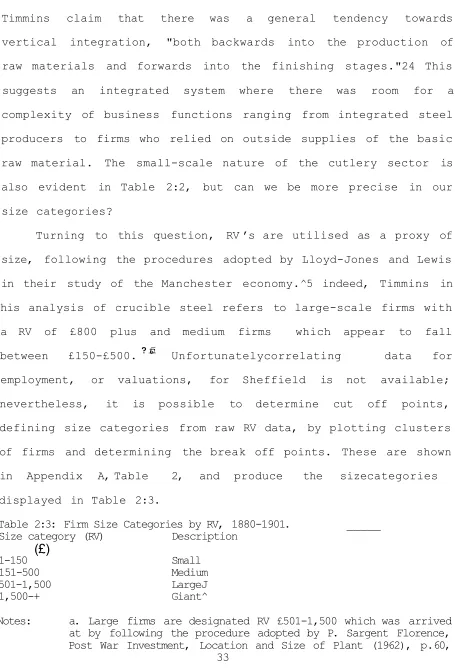
Timmins claim that there was a general tendency towards vertical integration, "both backwards into the production of raw materials and forwards into the finishing stages."24 This suggests an integrated system where there was room for a complexity of business functions ranging from integrated steel producers to firms who relied on outside supplies of the basic raw material. The small-scale nature of the cutlery sector is also evident in Table 2:2, but can we be more precise in our size categories?
Turning to this question, RV ’ s are utilised as a proxy of size, following the procedures adopted by Lloyd-Jones and Lewis in their study of the Manchester economy.^5 indeed, Timmins in his analysis of crucible steel refers to large-scale firms with a RV of £800 plus and medium firms which appear to fall
? fci
[image:41.612.44.499.32.703.2]between £150-£500. ° Unfortunately correlating data for employment, or valuations, for Sheffield is not available; nevertheless, it is possible to determine cut off points, defining size categories from raw RV data, by plotting clusters of firms and determining the break off points. These are shown in Appendix A, Table 2, and produce the size categories displayed in Table 2:3.
Table 2:3: Firm Size Categories by RV, 1880-1901. _____ Size category (RV) Description
(£)
1-150 Small
151-500 Medium
501-1,500 LargeJ
1,500-+ Giant^
who defined size categories by a multiplication process, the multiplier being 3.
b. A further category "Giant” was introduced to capture the large producers at RV £1,500 plus.
Utilising the RV data as size categories, the 1880
industrial structure is reconstructed and presented in Table
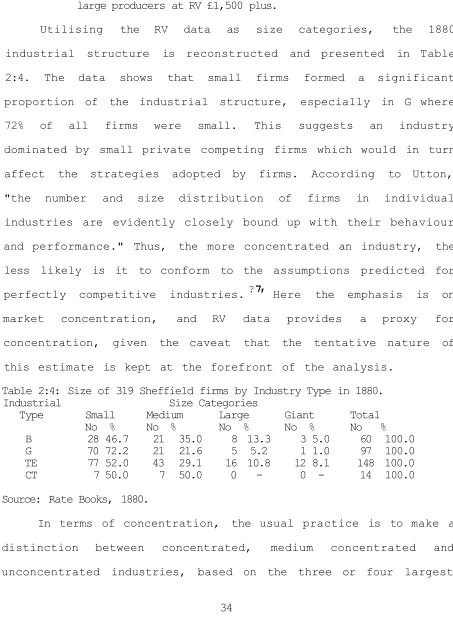
2:4. The data shows that small firms formed a significant proportion of the industrial structure, especially in G where 72% of all firms were small. This suggests an industry dominated by small private competing firms which would in turn affect the strategies adopted by firms. According to Utton, "the number and size distribution of firms in individual industries are evidently closely bound up with their behaviour and performance." Thus, the more concentrated an industry, the less likely is it to conform to the assumptions predicted for
? 7
[image:42.612.40.493.80.698.2]perfectly competitive industries.
'
Here the emphasis is on market concentration, and RV data provides a proxy for concentration, given the caveat that the tentative nature of this estimate is kept at the forefront of the analysis.Table 2:4: Size of 319 Sheffield firms by Industry Type in 1880.
Industrial Size Categories
Type Small Medium Large Giant Total
No % No % No % No % No %
B 28 46.7 21 35.0 8 13.3 3 5.0 60 100.0 G 70 72.2 21 21.6 5 5.2 1 1.0 97 100.0 TE 77 52.0 43 29.1 16 10.8 12 8.1 148 100.0
CT 7 50.0 7 50.0 0 - 0 - 14 100.0
Source: Rate Books, 1880.
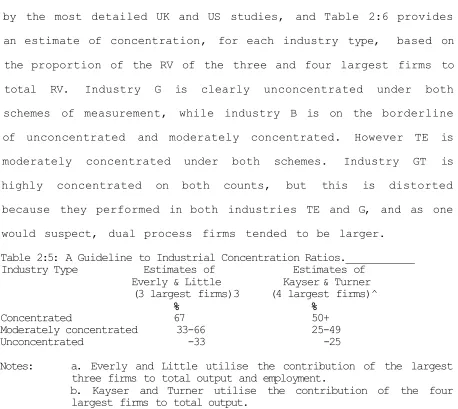
In terms of concentration, the usual practice is to make a distinction between concentrated, medium concentrated and unconcentrated industries, based on the three or four largest
firms in the industry.^ Table 2:5 shows the estimates offered by the most detailed UK and US studies, and Table 2:6 provides an estimate of concentration, for each industry type, based on the proportion of the RV of the three and four largest firms to total RV. Industry G is clearly unconcentrated under both schemes of measurement, while industry B is on the borderline of unconcentrated and moderately concentrated. However TE is moderately concentrated under both schemes. Industry GT is highly concentrated on both counts, but this is distorted because they performed in both industries TE and G, and as one would suspect, dual process firms tended to be larger.
Table 2:5: A Guideline to Industrial Concentration Ratios.__________ Industry Type Estimates of Estimates of
Everly & Little Kayser & Turner (3 largest firms)3 (4 largest firms)^
% %
Concentrated 67 50+
Moderately concentrated 33-66 25-49
Unconcentrated -33 -25
Notes: a. Everly and Little utilise the contribution of the largest three firms to total output and employment.
b. Kayser and Turner utilise the contribution of the four largest firms to total output.
Source: R. Everly and I.M.D. Little, Concentration in British Industry (1960), p.51; G. Kayser and D.F. Turner, Antitrust Policy: An Economic and Legal Interpretation (1959), pp. 295-7. See also R. Lloyd-Jones and M.J. Lewis, Manchester and the Age of the Factory (1988), p. 164, who also utilise these categories.
Table 2:6: Concentration of the Three and Four Largest firms in Sheffield,
1880a __
Industry Type % of 3 largest firms % of 4 largest firms
to total RV to total RV
B 35.2 29.8
G 28.8 24.5
TE 44.9 38.4
GT 51.9 41.3
This clearly represents an highly competitive structure, although the dominance of large firms such as John Browns and Vickers in industry TE, companies which expanded rapidly on the basis of armaments production, would suggest a larger degree of power by these firms in this sector. Nevertheless, an industry based on small-scale firms would have the following characteristics. Firstly, as Sargent Florence claims, "the smaller the scale of operation and the fewer the total number of persons dividing and diffusing their labour, the less chance there is for all of them being made use of as s p e c i a l i s t s . " ^
Thus we would expect a highly diverse division of labour, and as shown in Chapter 4, an intense sub-division of labour was a major feature of the light Sheffield trades, which shaped the human resource response of the firm in terms of the introduction of mechanisation and in wage negotiations. Furthermore, we would expect little collusion of business activities, in terms of wage and price fixing, in an industry composed of large numbers of small-scale units. This view is supported in Chapter 4, although the competitive pressures of large Sheffield producers in the area of marketing, especially in the sale of high quality tools, is emphasised in Chapters 5 and 6.
Secondly, we would expect an high failure rate of small firms given the growing competitive pressures and periods of severe depression which affected the industry prior to 1914.^ G.I.H. Lloyd, in an excellent account of the cutlery industry,
written in 1913, refers to the historical incidence of small- scale firms in this industry "and under such conditions it is unusual to find any great degree of permanence in the case of an individual firm." However, he noted that amongst the largest cutlery firms in 1913 there were several who could trace their origins, from small family beginnings, over a continuous period of one and two centuries.^ Amongst these were the large firms of Joseph Rodgers, James Dixon & Sons, and George Wostenholmes.^2 Similarly, firms producing steel and tools could trace their history back a number of generations. For example Marsh Bros, could trace its history to 1761, and Daniel Doncaster’s to 1829 and a number of large firms such as Brown's and Cammell's had started from small beginnings.^
Appendix A, Table 5 provides a biographical profile of
the 319 firms constituting the 1880 population. Of these firms, 212 or 66.5% of the 1880 population survived to 1901. However, what is remarkable is the high percentage of small firms which survive; 59% of all small firms in 1880 surviving to 1901. Even in cutlery, an industry dominated by small-scale producers, 62% of all small firms survived. This holds out the possibility that small firms provided a resource pool for future growth and development in the industry.^ According to Steindle, there is a negative correlation between mortality rates and the size of the firm; in many cases the small firm fails and never grows to maturity due to the high degree of business r i s k .35 This
Penrose points out, Steindle's analysis is a static or cross- section approach which does not allow for dynamic growth. As she states,
It would seem that at any given time a fair number of small firms would be in existence simply because they were young, and that at a later date the same fipns would have developed into medium-sized or large firms. D
This mirrors Alfred Marshall's trees of the forest analogy, whereby small firms are assumed to follow a path of continuous growth, supplanting new large firms to replace those that stagnate or decay
.^
It is worth recounting that Marshall referred to only a small number of "young trees growing up to maturity" and warned that "many succumb on the way."^ Certainly the growth performance of small firms in industries C and TE appear to confirm Marshall, as shown in Table 2:7. Taking all small firms together a total mobility rate of 17% or one in four is evident from the data. Furthermore, as Lloyd-Jones and Lewis show, it was upward mobility and not entry which sustained the large size category. Overall, industrial structure remained stable with no significant trend towards. ^ Q
specific size categories.'"7
Table 2:7: Rates of Upward Mobility of Small Sheffield firms
1380-1901 "
Industry Type % of small firms
3 14.3
C 15.7
TE 20.8
CT 14.3
Table 2:8 compares industrial structure in 1880 to 1901. What is significant is the retention of large numbers of small producers. The reasons behind this are of course difficult to
[image:46.612.42.492.108.703.2]assess, given the lack of business records on the smaller business unit. However, we can make a number of reasoned points which are supported in following chapters. Firstly, small-scale production allowed flexibility in producing high quality
products to meet demands for order. Thus smaller firms could
more easily switch production processes to meet changes in demand. As W. Lockwood Marsh, the managing director of Marsh Bros.^ remarked in 1954,
The outstanding impression one gets is of the extraordinary resilience and adaptability of a small private firm ... when demands for one particular product
[image:47.612.43.496.330.695.2]... disappeared, those in charge for th^ moment always seemed capable of striking out a new line.^1
Table 2:8: Shifts in Industrial Startups ty Industry T/pe 18801901 Size
Category Industry Type B
1880 1901 1880 C 1901 1880IE 1901 1880cr 1901 No % NO % No % NO % No
j
/o No % No % No %Snail 28 46.7 31 48.4 70 72.2 69 66.4 77 52.0 80 47.3 7 50.0 13 50.0 Madiun 21 35.0 21 32.8 21 21.6 25 24.0 43 29.1 56 33.1 7 50.0 11 42.3 Large 8 13.3 9 14.1 5 5.2 10 9.6 16 10.8 17 10.1 0 0.0 2 7.7 Giant 3 5.0 3 4.7 1 1.0 0 0.0 12 8.1 16 9.5 0 0.0 0 0.0 Total 60 100.0 64 100.0 97 100.0 104 100.0 148 100.0 169 100.0 14 100.0 26 100.0 Source: Rate Books 1880., 1901.
equal quality, remedy mistakes and "are more willing to work to ... instructions ... he knows their customers requirements better than they do."^
Secondly, the use of outwork as the mainstay of the light trades fostered a business system that was conducive to small-
scale production. Outwork was particularly common in smaller
firms who could rely on sub-contracting to reduce the fixed capital costs of operation. However, larger manufacturers combined inwork with outwork due to the more "intricate11 nature of the plant and e q u i p m e n t . A s will be argued later, this partly accounts for the slow adoption of mechanisation and mass production techniques in the cutlery and tool trades, and the use of outwork was a key element in an industry producing low volume, high quality produce. Thirdly, as Pollard argues, the capital costs of setting up business were in all probability low, and credit formed the basis of the smaller firm.^ Indeed, the high entry rate of small firms between 1880 and 19014^ would support the view that in an industry with a heavy labour intensity the capital costs of starting business were low.^
Furthermore, in all probability firms were directly routed into the circuit of exchange via a specific merchanting function. Most firms producing steel and cutlery and tool products were also listed in the directory as merchants, and most were recorded in the rate books as operating warehouses.4^ This would suggest that small firms were as much merchants as manufacturers which reinforces the notion that credit was a key
element in the chain of production. The merchanting function of the Sheffield trades requires more extensive examination. However, evidence to the 1893 Select Committee on the Sweating System noted the existence of numerous ’’factors or merchants” in the cutlery trades who operated from a central warehouse, they did "not employ workmen direct, but they obtain orders and give them out to the little master, who is himself a w o r k m a n . T h a t firms could expand their exchange and manufacturing functions is emphasised by the firm of T.A Ashton, who in 1880 operated a small cutlery workshop and warehouse in Norfolk Street, Sheffield, RV £48, and were described as cutlery manufacturers and merchants. By 1901, the firm had expanded to RV £198, largely by adding warehouses and retail shops to its workshops.
Finally, the rentier base of Sheffield’s business system needs to be considered. The renting of space and power by larger manufacturers, in the light trades, to workers and small
SO
masters is well known. w However, firms themselves were directly linked into a rentier system which encompassed the majority of Sheffield’s trades. Appendix A, Table 6, provides a breakdown of the 1880 population of firms by renting or owner-
S1
small-scale category showed a marked tendency towards renting, accounting for 56.6% of all small firms.
Thus, a characteristic of small firms was the very fact they were rentiers which provided an easy route to circumvent the capital costs of entering the industry and held out opportunities for small capitalists. Furthermore, the lower fixed costs attached to renting may well have provided the firm with a buffer against the risks attached to business. Indeed,
the numerous advertisements in the Sheffield newspapers for rented business premises are suggestive that there was an ample supply of space for small business as the following examples illustrate:
To let. Large shop ... with engine power, smith’s hearth with blast, hardening furnace and office, suitable for a
saw hardener or machinist.
To let. Shoreham Electro-Plate Works ... recently built at great cost ... fitted with plant and machinery of the most modern construction. ^
To let. 10 hole melting furnace, with steel warehouse and offices, in centre of town. ^
The emphasis which has been placed on the small firm should not however detract from the considerable expansion of the heavy sector of the industry, especially firms in armaments which found a growing domestic demand for its output after 1880.^° Appendix A, Table 7, shows the expansion of the RV of the giant firms of 1880, and those large firms which were mobile upwards between 1880 and 1901. Of the 20 firms in this sample, 14 firms show an increase in RV, and overall there was a 64.7% increase in the total RV of these firms between 1880 and 1901. In particular, the firms of Charles Cammell’s and
Vickers expanded rapidly as they moved into the production of bulk steel for ship-plate and armaments; the RV of the former increasing by 120% and the latter by 354%; by 1901, Vickers was
the largest firm in the City. That a large firm such as Vickers
could exert a considerable influence in relations with Government contractors was emphasised by the agent of Beardshaw’s in 1900 who complained that government contracts were excluded from the firm by the '’favour” given to the representatives of Vickers and by price undercutting.-^
"disarranged" trade as "the management remains the same, the capital is only owned by a large body of men instead of by one or two."-^
As Lloyd-Jones claims, the example of Sheffield tends to fit in with comparative studies of business in the USA and Germany which characterises British business structure in terms of the slow pace of mergers, the failure of family firms to assume public limited status, "and the consequent resilience of family control in the affairs of the firm."^ Certainly the evidence from the rate books for 1880, which listed those who paid the rate, would indicate a high degree of family involvement in the management of the firm.^ This is supported by the available business evidence from company records. The records surveyed and their business activities are shown in Appendix A, Table 8, which clearly indicates that apart from the firm of Burgon & Ball, which converted to a public limited in 1 8 9 8, ^ the firms retained their individual status through
r o
the adoption of private limited status.0-3 Thus firms could adopt limited liability without altering the existing managerial structure of the business. As the management of Spear & Jackson remarked in 1905, "this company was converted into a private limited company, the partnership practically remaining as before.
One feature of this was the use of retained profits and family capital in the process of business expansion. The existing owners of the firm financed expansion by issuing new
share capital to the existing members. For example, the share capital of the firm of Spear & Jackson was largely held by J.K. Wilson, the managing director and executor of the will of J.F. Jackson, a founding partner in the concern. In 1907, the share capital of the firm was increased by the creation of 10,000 new ordinary shares of £1 each, raising capital from £75,000 to £85,000. Furthermore, mortgage debentures were issued to directors as a form of capital investment, this liability increasing from £20,000 in 1906 to £30,000 by 1909. Indeed, for
a firm clearly orientated to the retention of the existing
managerial structure, the Companies Act of 1907, provided an opportunity to restrict outside capital, limiting share holders to 50 and prohibiting the subscription of the public for share
or debenture stock.^ The importance of family capital was
clearly evident in the case of Edgar Allen & Co. As the major shareholder, William Edgar Allen, remarked in 1907,
my Co-Directors ... considered my first duty was to invest my money in Edgar Allen & Co. Ltd. preference shares because they wanted more working capital for plant etc. , and I have locked up thousands of pound^s the firm was owing me by leaving it to Edgar Allen & Co.
debenture shares was further evident with the company mortgaging its plant to the total of £25,000 on its incorporation in 1893, and borrowing at 5% interest on the capital.
^
Indeed the firm of Cooper Bros & Co. had from its incorporation excluded the use of outside capital, including in its articles of association in 1895 the power to raise capital by issuing debenture stock, preference, or guaranteed shares. However, no shares were to be transferred by any member of thec o
company other than the family directors, T. & J.W. Cooper. ° This evidence supports the general proposition of Thomas, that prior to 1914 the demand for external funds was small, and even in boom periods not more than 10% of real home investment was
aq
financed by market borrowing. 7
Sanderson, saw manufacturers, by Spear & Jackson in 1908, saw the retention of the existing managerial structure, the firm being run as a loose subsidiary, Spear & Jackson controlling
71 the marketing end of operations. ' x
The recruitment of family members within the managerial structure of the firm is further emphasised in these case studies. For example, even in a firm such as Spear & Jackson, which was managed by a board of director executors, the role for family members was important. Thus, in 1911, D. Jackson Haggie, the grandson of J.B. Jackson, was appointed as manager of the sales department, having been trained in the various
7 ?