Theoretical Analysis of Mechanical Vibration for Offshore
Platform Structures
Saeed A. Asiri1, Yousuf Z. AL-Zahrani2
1
MENG Graduate Office, Department of Production and Mechanical Systems Design, Engineering College of King Abdulaziz University, Jeddah, KSA
2
Department of Production and Mechanical Systems Design, Engineering College of King Abdulaziz University, Jeddah, KSA
Email:
Received September 19, 2013; revised October 17, 2013; accepted November 15, 2013
Copyright © 2014 Saeed A. Asiri, Yousuf Z. AL-Zahrani. This is an open access article distributed under the Creative Commons Attribution License, which permits unrestricted use, distribution, and reproduction in any medium, provided the original work is properly cited. In accordance of the Creative Commons Attribution License all Copyrights © 2014 are reserved for SCIRP and the owner of the intellectual property Saeed A. Asiri, Yousuf Z. AL-Zahrani. All Copyright © 2014 are guarded by law and by SCIRP as a guardian.
ABSTRACT
A new class of support structures, called Periodic Structures, is introduced in this paper as a viable means for isolating the vibration transmitted from the sea waves to offshore platform structures through its legs. A passive approach to reduce transmitted vibration generated by waves is presented. The approach utilizes the property of periodic structural components that create stop and pass bands. The stop band regions can be tailored to cor-respond to regions of the frequency spectra that contain harmonics of the wave frequency, attenuating the re-sponse in those regions. A periodic structural component is comprised of a repeating array of cells, which are themselves an assembly of elements. The elements may have differing material properties as well as geometric variations. For the purpose of this research, only geometric and material variations are considered and each cell is assumed to be identical. A periodic leg is designed in order to reduce transmitted vibration of sea waves. The effectiveness of the periodicity on the vibration levels of platform will be demonstrated theoretically. The theory governing the operation of this class of periodic structures is introduced using the transfer matrix method. The unique filtering characteristics of periodic structures are demonstrated as functions of their design parameters for structures with geometrical and material discontinuities, and determine the propagation factor by using the spectral finite element analysis and the effectiveness of design on the leg structure by changing the ratio of step length and area interface between the materials is demonstrated in order to find the propagation factor and fre-quency response.
KEYWORDS
Vibrations Attenuation; Periodic Structures; Offshore Platforms; Periodic Legs
1. Introduction
Offshore construction is the installation of structures and pipelines in a marine environment for the production and transmission of oil and gas (see Figure 1).
Construction in the offshore environment is a danger-ous activity and where possibly the construction is mod-ular in nature with the individual modules being assem-bled on shore and using a Crane Barge to lift the modules into place. Offshore structures can be designed for
[image:1.595.349.499.604.718.2]bays or in the open sea, many kilometers from shorelines. The oil and gas exploration platforms are the best exam-ple of offshore structures that can be placed in water depths of 2 kilometers or more. These structures may be made of steel, reinforced concrete or a combination of both. They are more than 6500 offshore installations around the world in 53 countries approximately (see Figure 2). Offshore platforms have many uses including oil explo-ration and production, navigation, ship loading and un-loading, and supporting bridges and causeways. Offshore oil production is one of the most visible of these applica-tions and represents a significant challenge to the design engineer. These offshore structures must function safely for design lifetimes of twenty years or more and are sub-ject to very harsh marine environments. Some important design considerations are peak loads created by hurricane wind and waves, fatigue loads generated by waves over the platform lifetime and the motion of the platform. The platforms are sometimes subjected to strong currents which create loads on the mooring system and can induce vor-tex shedding and vorvor-tex induced vibration [1].
[image:2.595.316.533.564.719.2]Offshore platforms suffer from different kinds of me-chanical vibrations due to exposure to water waves, wind, severe environmental conditions, helicopter landing, im-pact boats, the intensity level of consequences of failure machinery etc. One of the major sources of such me-chanical vibrations on offshore platforms is the impact of sea waves on to the platform’s legs. These mechanical impacts are transferred through the platform’s legs from the bottom up to the highest top end of such a structure, which consist of employee’s offices, accommodations, measurement instruments, piping, and heavy machinery. The aim will be minimized these vibrations on offshore platforms caused by the impact of the sea wave transmis-sion to the offshore platforms through the platform’s leg structure; we try to make a good solution to provide a better isolation of mechanical vibration by using the pe-riodic structure technique [1].
Figure 2. Examples of offshore rigs, drilling and production platforms.
2. Literature Review
The basic idea underlying the whole concept of periodic structures is that when a wave is traveling in a medium and meets a transition in that medium characteristic, part of it will propagate through the new medium and another part will reflect into the old one. In a regular structure the wave is expected to travel without any change until it reaches the boundaries of that structure, but when the structure exhibits a change it its geometry and/or material properties, the incident waves will divide as described before. A part of the reflected wave will interact with the incident wave in a manner that will characterize the in-terference. When constructive interference occurs, the frequency is characterized by being the pass band of the structure; while, if they destructively interfere, the fre-quency ischaracterized by being the stop band of the structure. If the structure setup is repeated for several times, it is known a periodic structure. The destructive effects will show more significantly when the repetitions of the structural unit increase in number because as the part of the wave that propagates incorporates other simi-lar changes in the medium, another part of it is destructed and so on.
In his paper reviewing the research performed in the area of wave propagation in periodic structures, Mead [2] defined a periodic structure as a structure that consists fundamentally of a number of identical structural com-ponents that are joined together to form a continuous structure. Examples of periodic structures can be seen in satellite solar cells, wings and fuselages of aircraft, petro-leum pipelines, railway tracks, and many others. An illu-stration.
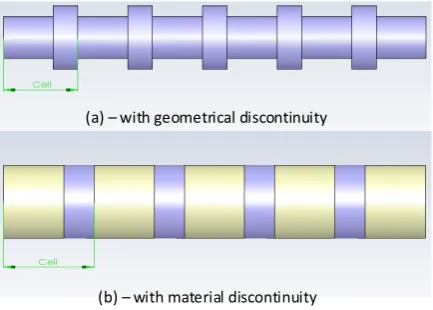
If a simple periodic bar is presented in Figure 3(a) with geometrical discontinuity and Figure 3(b) with ma-terial discontinuity.
[image:2.595.58.292.568.709.2]In general, when a wave propagating in a structure en-counters a change in the geometry and/or the material properties, the wave is split into two components; a prop-
Figure 3. Typical examples of periodic structures.
(a) – with geometrical discontinuity
agating component and a reflected component. The re-flected part interacts with the propagating part in a man-ner that is decided by the phase difference between them. Studies of the characteristics of one-dimensional peri-odic structures have been extensively reported [1-14]. These structures are easy to analyze because of the simplicity of the geometry as well as the nature of coupling between neighboring cells.
Cremer [15] presented a derivation of an expression that could describe the steady state vibration of an infi-nite beam uniformly supported on impedances. That for-mulation allowed for the analysis of the structures with fluid loadings easily. Later, Gupta [16] presented an anal-ysis for periodically-supported beams that introduced the concepts of the cell and the associated transfer matrix. He presented the propagation and attenuation parameters’ plots which form the foundation for further studies of one-dimensional periodic structures. Faulkner and Hong [17] presented a study of mono-coupled periodic systems. Their study analyzed the free vibration of the spring- mass systems as well as point-supported beams using analytical and finite element methods.
Mead and Yaman [18] presented a study of the re-sponse of one-dimensional periodic structures subject to periodic loading. Their study involved the generalization of the support condition to involve rotation and displace-ment springs as well as impedances. The effects of the excitation point as well as the elastic support characteris-tics on the pass and stop characterischaracteris-tics of the beam are presented. Later, Mead, White and Zhang [19] proved that the power transmission in both directions of a simply supported beam excited by a point force was equal re-gardless of the excitation location.
The most common damping technique studied in pe-riodic structures was through the introduction of random disorder. The concept of wave localization phenomenon was introduced to the study of mechanical wave propa-gation by Kissel [20] through the use of the transfer ma-trix approach. Using the concept of periodic structures, Ruzzene and Baz [21] used shape memory inserts into a one dimensional rod, and by activating or deactivating the inserts they introduced a periodicity which in turn localized the vibration near to the disturbance source. Later, they used a similar concept to actively localize the disturbance waves traveling in a fluid-loaded shell [22]. Asiri et al. [23] emphasized is placed on developing a new class of these periodic structures called active peri-odic struts, which can be used to support gearbox sys-tems on the airframes of helicopters. When designed properly, the passive periodic strut can stop the propaga-tion of vibrapropaga-tion from the gearbox to the airframe within critical frequency bands, consequently minimizing the effects of transmission of undesirable vibration and sound radiation to the helicopter cabin. The theory governing
the operation of this class of passive periodic struts is introduced and their filtering characteristics are demon-strated experimentally as a function of their design pa-rameters. Asiri [24] presented a new class of periodic mounts for isolating the vibration transmission from ve-hicle engine to the car body and seats. Later, Asiri etal. [25] studied experimentally the dynamic response of offshore platforms with periodic legs while this paper is an analytical study of the same model.
3. A periodic Beam Model
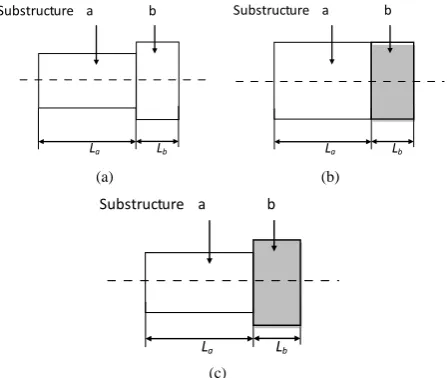
The periodic structures are made of the assemblies of the periodic cells shown in Figure 4. Each of these unit cells consists of two substructures a and b which can be either of the same material withdifferentcrosssectionsFigure 4(a), made of different materials with the same cross section Figure 4(b) and both made of different materials with the different cross sections, Figure 4(c).
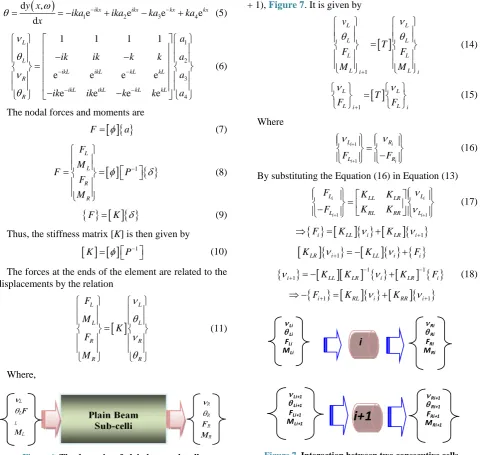
For a beam shown in Figure 5, the equation of motion (EOM) may be shown to be considering a beam section with uniform properties
0
EIν′′′′ +ρ νA= (1) Which has the solution
(
,)
1e 2e 3e 4eikx ikx kx kx
v xω =a − +a +a − +a (2) The nodal displacements of the element are given by
(a) (b)
[image:3.595.314.538.424.613.2](c)
Figure 4. Unit asymmetric CELLS of periodic structure.
Figure 5. Shaft geometry.
Substructure a b
Lb
La
Lb
La
Substructure a b
Lb La
L L R R ν θ δ ν θ = (3)
The evaluating the solution at the left and right nodes,
Pa
δ = (4) In Figure 6, Where ν and θ define the lateral dis-placement and rotational disdis-placement with subscripts L
and R denoting the left and right sides of the cell. Also, F
and M define the nodal force and the nodal momentwith subscripts L and R denoting the left and right sides of the cell.
Apply Boundary Conditions to evaluate the P
(
)
1 2 3 4
d ,
e e e e
d
ikx ikx kx kx
y x
ika ika ka ka
x
ω
θ = = − − + − − +
(5)
1
2
3
4
1 1 1 1
e e e e
e e e e
L
L
ikL ikL kL kL R
ikL ikL kL kL R
a
a
ik ik k k
a
a
ik ik k k
ν θ ν θ − − − − − − = − − (6)
The nodal forces and moments are
[ ]
{ }
F = φ a (7)
[ ]
1{ }
L L R R F M F P F M
φ − δ
= = (8)
{ }
F =[ ]
K{ }
δ (9) Thus, the stiffness matrix [K] is then given by[ ] [ ]
1K = φ P− (10) The forces at the ends of the element are related to the displacements by the relation
[image:4.595.333.539.84.240.2][ ]
L L L L R R R R F M K F M ν θ ν θ = (11) Where,Figure 6. The dynamics of plain beam sub-cell.
[ ]
11 12 13 14
21 22 23 24
31 32 33 34
41 42 43 44
K K K K
K K K K
K
K K K K
K K K K
= (12) 11 12 21 22 LL K K K K K = , 13 14 23 24 LR K K K K K = , 31 32 41 42 RL K K K K K =
and
33 34 43 44 RR K K K K K =
L LL LR L
R RL RR R
F K K
F K K
ν ν
=
(13)
When considering a series of cells, one may derive a relation between consecutive left-ends of elements (I to i + 1), Figure 7. It is given by
[ ]
1
L L
L L
L L
L i L i
v T F F M M ν θ θ + = (14)
[ ]
1 L LL i L i
T F F ν ν + =
(15)
Where 1 1 i i i i L R L R F F
ν + ν
+
=
−
(16)
By substituting the Equation (16) in Equation (13)
1 1
i i
i i
L LL LR L
RL RR
L L
F K K
K K F ν ν + + = −
(17)
{ }
Fi[
KLL]
{ }
νi[
KLR]
{ }
νi+1⇒ = +
[
KLR]
{ }
νi+1 = −[ ]
KLL{ } { }
νi + Fi{ }
[
][
] { } [
1] { }
11
i KLL KLR i KLR Fi
ν − ν −
+ = − + (18)
{ }
Fi+1[
KRL]
{ }
νi[
KRR]
{ }
νi+1 [image:4.595.60.541.271.726.2]⇒ − = +
Figure 7. Interaction between two consecutive cells.
{ }
[
]
{ }
[
] [ ][
{
]
{ }
[
]
{ }
}
[
]
{ }
[
][ ][
]
{ }
[
][
]
{ }
[
] [
][ ][
]
{ }
[
][
]
{ }
1
1 1
1
1
1
1
i RL i
RR LL LR i LR i
RL i RR LL LR i
RR LR i
RL RR LL LR i
RR LR i
F K
K K K K F
K K K K
K K F
K K K K
K K F
ν ν
ν ν
ν
+
− −
−
−
−
−
= −
− − +
= − +
−
= − +
−
(19)
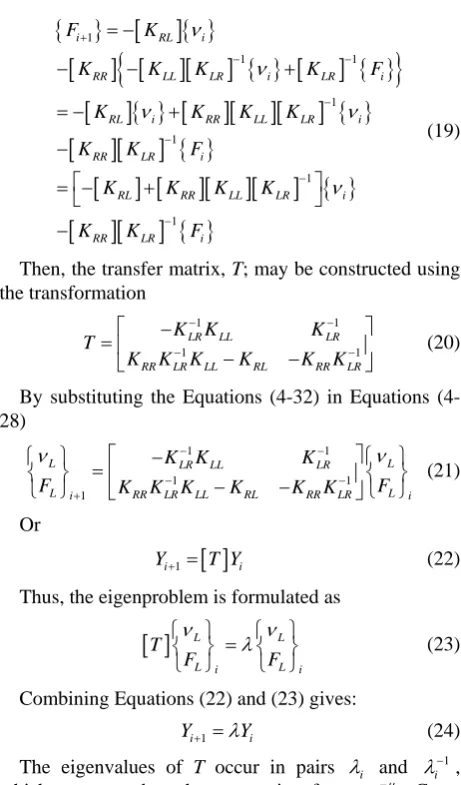
Then, the transfer matrix, T; may be constructed using the transformation
1 1
1 1
LR LL LR
RR LR LL RL RR LR
K K K
T
K K K K K K
− −
− −
−
= − −
(20)
By substituting the Equations (4-32) in Equations (4- 28)
1 1
1 1
1
L LR LL LR L
L i RR LR LL RL RR LR L i
K K K
F K K K K K K F
ν − − ν
− −
+
−
=
− −
(21)
Or
[ ]
1
i i
Y+ = T Y (22)
Thus, the eigenproblem is formulated as
[ ]
L LL i L i
T
F F
ν ν
λ
=
(23)
Combining Equations (22) and (23) gives:
1
i i
Y+ =λY (24)
The eigenvalues of T occur in pairs λi and
1
i
λ− , which correspond to the attenuation factor e−µ. Com-bining the eigenvalue pairs results in a relation by which one may determine µ . By definition of the hyperbolic cosine,
( )
eµ +e−µ =2 cosh µ (25) Or
1
1 e e 1
cosh cosh
2 2
i i
µ µ λ λ
µ= − + − = − + −
(26)
( )
eµ eα βi
λ= = +
(27)
Significant Meaning of the Eigenvalues λ and λ−1 of
[T]
Combining Equations (26) and (27) gives:
1
K K
Y + =λY (28)
Indicating that the eigenvalue λ of the matrix [T] is the ratio between the state vectors at two consecutive cells.
Hence, one can reach the following conclusions: If |λ| = 1, then YK+1=YK and the state vector propagates
along the structure as is. This condition defines a “Pass Band” condition.
If |λ| < 1, then YK+1 < YK and the state vector is atte-nuated as it propagates along the structure. This condition defines a “Stop Band” condition.
A Further explanation of the physical meaning of the eigenvalue λ can be extracted by rewriting it as:
eµ eα βi
λ= = +
(29) Where µ is defined as “Propagation constant” which is a complex number whose real part (α) represents the loga- rithmic decay of the state vector and its imaginary part (β) defines the phase difference between the adjacent cells.
Therefore, the equivalent condition for the pass and stop bands can be written in terms of the propagation constant parameter (α and β) as follows:
1) If α= 0 (etal. µ is imaginary), then we have “Pass Band” as there is no amplitude attenuation.
2) If α ≠ 0 (etal. µ is real or complex), then we have “Stop Band” as there is amplitude attenuation defined by value of α.
[image:5.595.57.288.78.471.2]The association of the propagation factor to pass and stop bands can be illustrated in Figure 8.
Figure 9 displays the decay and phase components of the corresponding Propagation Constant µ.
Furthermore, Figure 9(b) demonstrates clearly the “pass and stop bands” are developed. Note that the im-aginary part of the propagation constant (µ) which quan-tifies the phase difference between the wave propagation at adjacent cells is shown to increase gradually from 0 to
π. With phase difference between 0 and π, waves will
propagate along the periodic structure indicating a “Pass Band”. But, when the phase difference becomes π, de-structive interference occurs between adjacent cells and wave propagation along the structure is completely stopped indicating “Stop Band”.
4. Results
To better understand and demonstrate the characteristics
Figure 8. Propagation factor block diagram. Stop Band Pass
Band
Attenuation
Propagation
real imag
µ µ= +µ
0 real
[image:5.595.313.536.569.718.2](a)
[image:6.595.61.287.78.301.2](b)
Figure 9. Stop and pass bands of a periodic structure; (a) Real part of propagation constant; (b) Imaginary part of propagation constant.
of periodic structures, a MATLAB program was used for the cell geometry shown in Figure 5, to determine the attenuation characteristics. The materials were selected
as Aluminum (a) with E = 70 GPa and ρ= 2700 Kg/m3
and Special Rubber, Mearthane Durethane (b) with E = 0.000345 GPa and ρ= 1150 Kg/m3, the lengths La and Lb were chosen to be 30 mm, 10 mm respectively, where the
La, Lb and LC denote the length of the Aluminum material, a length of Rubber material and the length of one cell respectively. Also Da and Db were chosen to be 50 mm and 44 mm respectively, Where the Da and Db denote the diameter of the Aluminum material and Db a diameter of Rubber material in the periodic structure. The propaga-tion parameter for a periodic beam cell obtained is shown in Figure 10, and the magnitude of Frequency Response Function (FRF) shown in Figure 11.
In three cases design and choosing of periodic struc-ture and implementing by MATLAB program as follows: Fixed area Interference (Da/Db) and changing the length of the Cell (Lb/LC), Changing area Interference (Da/Db) either (solid section or hollow section) and fixed length of the Cell (LC) and Changing both the area Interference (Da/Db) between materials and the length of the Cell (Lb/LC).
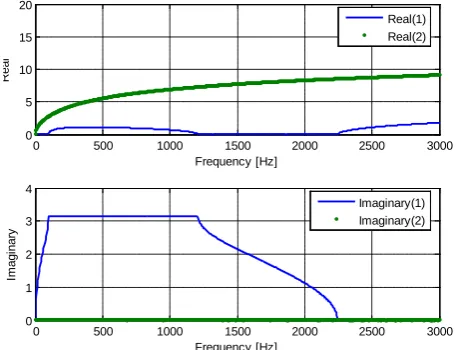
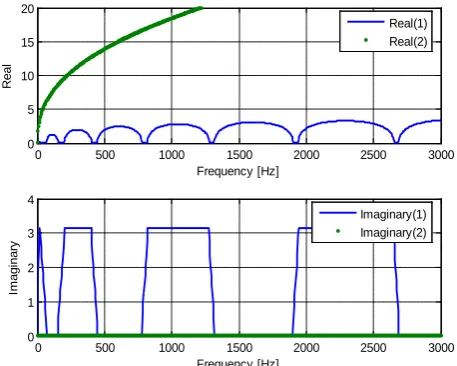
Figures 12 through 15 show the effect of the changing geometry of the cell, by increasing and decreasing the length lab, on the width and intensity of the stop band of the periodic structure. Fixed Area Interference, (Da/Db) and changing in the length of the cell, (La/Lb). As shown in Table 1.
[image:6.595.308.538.83.266.2]Figures 16 through 20 show the effect of geometry of the cell, by changing Area Interference (solidsectionand
Figure 10. Propagation parameter for a periodic beam cell: near field, propagating.
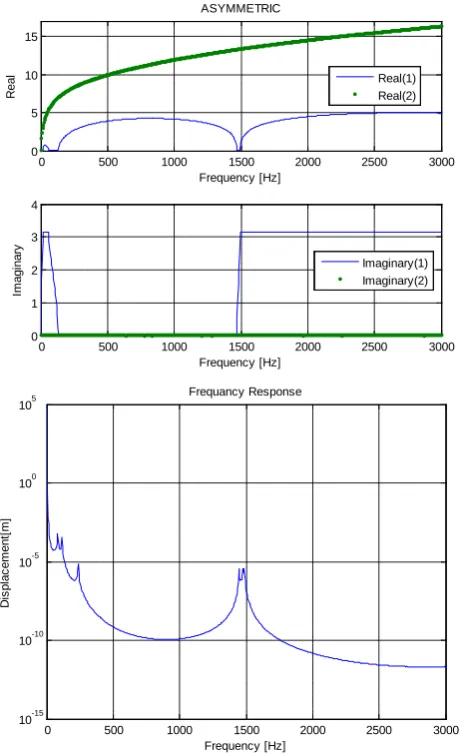
hollowsection) between materials (Aa/Ab) and fixed the length of cell (La/Lb). As shown in Tables 2-4).
The Figures 21 through 24 indicate that increasing the diameter ratio at the discontinuity (Da/Db) results in im-proving the attenuation characteristics of the structure particularly over a wide frequency range. Increases the amplitude of decaying factor, increase the no. of stop band and increase the cut-off frequency.
5. FEM
This section exhibit the result of periodic structures with geometrical and material discontinuity by using finite ele- ment method, for a material propertiesshown in Table 5.
5.1. Periodic Structures (Aluminum and Plastic)
The frequency response of periodic structure composed of 3-, 5-, and 7-cells as shown in Figure 23, the periodic beam composed of greater numbers of cell exhibit the attenuation regions more clearly.
5.2. Periodic Structures (Aluminum and Rubber)
This material is very weak and more effective to atte-nuate the propagation factor over a wide frequency range and has a damping ratio 0.5, It’s clear from Figure 24 the frequency responses almost zero.
6. Conclusions
This dissertation has presented the fundamentals govern-ing the operation of a new class of structures for the legs of offshore platform structure which are exposed to the sea waves. The proposed new class of structures as it was investigated to be periodic in nature; it generated unique dynamic characteristics that make the structures act as
0 200 400 600 800 1000 1200 1400 1600 1800 2000 0
0.5 1 1.5 2
ASYMMETRIC
R
eal
Frequency [Hz]
0 200 400 600 800 1000 1200 1400 1600 1800 2000 0
1 2 3 4
Im
agi
nar
y
Frequency [Hz] π
Stop Band Pass Band
0 500 1000 1500 2000 2500 3000
0 2 4 6 8
R
eal
Frequency [Hz]
Real(1) Real(2)
0 500 1000 1500 2000 2500 3000
0 1 2 3 4
Im
agi
nar
y
Frequency [Hz]
Figure 11. Magnitudes for 1, 3 and 5 cells structures.
mechanical filters for wave propagation. The effect of such unique characteristics of this class of structures in controlling the wave propagation from the sea wave to offshore platform structures was demonstrated theoreti-cally in the spectral domains.
[image:7.595.310.537.82.332.2]The theoretical equations that govern the operation of
Figure 12. A schematic sketch and stop-pass bands of the periodic structure, (Lb/LCell = 0.08).
Figure 13. Stop-pass bands of the periodic structure, (Lb/LCell
= 0.2).
this class of periodic structures are developed using the transfer matrix method. The basic characteristics of the transfer matrices of periodic structures are presented and related to the physics of wave propagation along these structures. The unique filtering characteristics of the pe-riodic structures are demonstrated for various structure configurations. The effect of the design parameter of the structures on their dynamic behavior is investigated for structures with geometrical and material discontinuities at three cases:
Fixed area Interference (Da/Db) and changing length of the Cell (Lb/LC), changing area Interference (Da/Db) ei- 0 500 1000 1500 2000 2500 3000
10-10 10-8 10-6 10-4 10-2 100 102 104 106
D
is
pl
ac
em
ent
[m
]
Frequency [Hz] Frequency Response Function (FRF)
0 500 1000 1500 2000 2500 3000 10-10
10-8 10-6 10-4 10-2 100 102 104 106
D
is
pl
ac
em
ent
[m
]
Frequency [Hz]
0 500 1000 1500 2000 2500 3000 10-10
10-5 100 105
D
is
pl
ac
em
ent
[m
]
Frequency [Hz]
Da
Db
Lb
La LCell
b a
0 500 1000 1500 2000 2500 3000
0 5 10 15 20
R
eal
Frequency [Hz]
0 500 1000 1500 2000 2500 3000
0 1 2 3 4
Im
agi
nar
y
Frequency [Hz]
Real(1) Real(2)
Imaginary(1) Imaginary(2)
0 500 1000 1500 2000 2500 3000
0 5 10 15 20
R
eal
Frequency [Hz]
0 500 1000 1500 2000 2500 3000
0 1 2 3 4
Im
agi
nar
y
Frequency [Hz]
Real(1)
Real(2)
[image:7.595.309.538.375.550.2]Figure 14. Stop-pass bands of the periodic structure, (Lb/LCell
[image:8.595.320.526.83.311.2]= 0.43).
Figure 15. Stop-pass bands of the periodic structure, (Lb/LCell
= 0.54).
Table 1. Fixed area Interference and change the length of cell (LC).
No. Da, mm
Db,
mm
La,
mm
Lb,
mm
LCell,
mm Fr = La/Lb Lb/LCell 1 60 45 60 5 65 12 0.08
2 60 45 60 15 75 4 0.2
3 60 45 60 45 105 1.33 0.43
4 60 45 60 70 130 0.86 0.54
ther (solid section or hollow section) and fixed length ofthecell (LC) change both the area Interference (Da/Db) between materials and length of the Cell (Lb/LC).
[image:8.595.59.288.309.492.2]The periodic structures have been shown to be an ex-tremely effective means to filter the vibration transmis-sion through the structures. It is found that the passive periodic structures can attenuate the propagation of waves
Figure 16. A schematic sketch and stop-pass bands of the periodic structure, (Da/Db = 0.87).
Figure 17. Stop-pass bands of the periodic structure, (Da/Db
= 1.82).
Figure 18. Stop-pass bands of the periodic structure, (Da/Db
= 2.5).
0 500 1000 1500 2000 2500 3000
0 5 10 15 20
R
eal
Frequency [Hz]
0 500 1000 1500 2000 2500 3000
0 1 2 3 4
Im
agi
nar
y
Frequency [Hz]
Real(1) Real(2)
Imaginary(1) Imaginary(2)
0 500 1000 1500 2000 2500 3000
0 5 10 15 20
R
eal
Frequency [Hz]
0 500 1000 1500 2000 2500 3000
0 1 2 3 4
Im
agi
nar
y
Frequency [Hz]
Real(1) Real(2)
Imaginary(1) Imaginary(2)
Da
Db
Lb
La LCell
b a
0 500 1000 1500 2000 2500 3000 0
5 10 15 20
R
eal
Frequency [Hz]
0 500 1000 1500 2000 2500 3000 0
1 2 3 4
Im
agi
nar
y
Frequency [Hz]
Real(1) Real(2)
Imaginary(1) Imaginary(2)
0 500 1000 1500 2000 2500 3000
0 5 10 15 20
R
eal
Frequency [Hz]
0 500 1000 1500 2000 2500 3000
0 1 2 3 4
Im
agi
nar
y
Frequency [Hz]
Real(1) Real(2)
Imaginary(1) Imaginary(2)
0 500 1000 1500 2000 2500 3000 0
5 10 15 20
R
eal
Frequency [Hz]
0 500 1000 1500 2000 2500 3000 0
1 2 3 4
Im
agi
nar
y
Frequency [Hz] Real(1) Real(2)
[image:8.595.317.528.353.506.2] [image:8.595.317.524.548.705.2] [image:8.595.56.287.561.642.2]Figure 19. A schematic sketch and stop-pass bands of the periodic structure, (Da/Db =1.08).
Figure 20. Stop-pass bands of the periodic structure, (Da/Db
[image:9.595.310.537.196.636.2]= 6.67).
Table 2. Change areas (solid section) and fixed the length of cell (LC).
No. Da,
mm
Db,
mm Da/Db Aa/Ab AContact
La,
mm
Lb,
mm
1 40 46 0.87 0.76 1256 40 10
2 40 22 1.82 3.31 380 40 10
3 40 16 2.50 6.25 201 40 10
Table 3. Change areas (hollow section) and fixed the length of ell (LC).
No Da, mm
Db,
mm Db2 Da/Db Aa/Ab AContact
La,
mm
Lb,
mm 1 40 40 3 1.08 1.01 1249 40 10 2 40 36 30 6.67 4.04 311 40 10
Table 4. Change areas and also change the length of cell (LC).
Da Db1 Db2 Da/Db Aa/Ab AContact La Lb Lcell Lb/LCell
40 16 8 5.00 8.33 151 40 10 50 0.20
40 16 0 2.50 6.25 201 50 13 63 0.21
Figure 21. Propagation factor with frequency response of periodic structure at area contact 151 mm2.
over a broad frequency band extending in most of the considered cases between (0 - 3000) and (0 - 10,000) Hz.
The periodic beams were fabricated at different cells number to provide a better understanding of wave me-chanics by using Finite Element Method. As a result in- Da
Db1
Lb
L
a
LCell
b a
Db2
0 500 1000 1500 2000 2500 3000
0 5 10 15 20
ASYMMETRIC
R
eal
Frequency [Hz]
0 500 1000 1500 2000 2500 3000
0 1 2 3 4
Im
agi
nar
y
Frequency [Hz]
Real(1) Real(2)
Imaginary(1) Imaginary(2)
0 500 1000 1500 2000 2500 3000
0 5 10 15 20
ASYMMETRIC
R
eal
Frequency [Hz]
0 500 1000 1500 2000 2500 3000
0 1 2 3 4
Im
agi
nar
y
Frequency [Hz]
Real(1) Real(2)
Imaginary(1) Imaginary(2)
0 500 1000 1500 2000 2500 3000
0 5 10 15
ASYMMETRIC
R
eal
Frequency [Hz]
Real(1) Real(2)
0 500 1000 1500 2000 2500 3000
0 1 2 3 4
Im
agi
nar
y
Frequency [Hz]
Imaginary(1) Imaginary(2)
0 500 1000 1500 2000 2500 3000 10-15
10-10 10-5 100 105
D
is
pl
ac
em
ent
[m
]
[image:9.595.60.288.399.592.2] [image:9.595.57.287.660.738.2]Figure 22. Propagation factor with frequency response of periodic structure at area contact 201 mm2.
[image:10.595.58.289.85.462.2]Figure 23. The frequency response of periodic structure (Aluminum and Plastic) at 3, 5 and 7 cells.
Figure 24. The frequency response of periodic structure (Aluminum and Rubber) at 3, 5 and 7 cells.
Table 5. Material properties.
Material Density Modulus
of Elasticity Wave Speed
Aluminum 2700 kg/m3 71 Gpa 5128 m/s
Plastic 1520 kg/m3 3 Gpa 1405 m/s
MearthaneDurethane 1150 kg/m3 0.000345 Gpa 17/s
creasing the destructive interference phenomena by in-creasing the number of cells, causes more attenuation of waves.
This approach is applicable for wide applications, any system exposed to the vibrations by design and imple-menting (tailor) the proper solution to provide attenua-tion phenomenon.
REFERENCES
[1] A. Alghamdi, S. Asiri and A. Mohammed, “Wave Me-chanics And Dynamic Response Of The Experimental Model For Offshore Platform With Periodic Legs,” Mas-ter Thesis, King Abdulaziz University, Jeddah, 2008.
[2] D. J. Mead, “Free Wave Propagation in Periodically Sup- ported, Infinite Beams,” Journal of Sound and Vibration, Vol. 11, No. 2, 1970, pp. 181-197.
[3] L. Brillouin, “Wave Propagation in Periodic Structures,” Dover, New York, 1953.
[4] L. Brillouin, “Wave Propagation in Periodic Structures,” 2nd Edition, Dover, New York, 1946.
[5] D. J. Mead, “Vibration Response and Wave Propagation in Periodic Structures,” ASME Journal of Engineering for Industry, Vol. 93, No. 3, 1971, pp. 783-792.
[6] D. J. Mead, “Wave Propagation and Natural Modes in Periodic Systems: I. Mono-Coupled Systems,” Journal of Sound and Vibration, Vol. 40, No. 1, 1975, pp. 1-18.
0 500 1000 1500 2000 2500 3000 0
5 10 15
ASYMMETRIC
R
eal
Frequency [Hz]
0 500 1000 1500 2000 2500 3000 0
1 2 3 4
Im
agi
nar
y
Frequency [Hz]
Real(1) Real(2)
Imaginary(1) Imaginary(2)
0 500 1000 1500 2000 2500 3000 10-15
10-10 10-5 100 105
D
is
pl
ac
em
ent
[m
]
Frequency [Hz] Frequancy Response
1.00E-18 1.00E-17 1.00E-16 1.00E-15 1.00E-14 1.00E-13 1.00E-12 1.00E-11 1.00E-10 1.00E-09 1.00E-08 1.00E-07 1.00E-06 1.00E-05 1.00E-04
0 2000 4000 6000 8000 10000
D
is
pl
ac
em
ent
,m
Excitation Frequency, Hz Periodic Beams, with 3, 5 and 7 Cells
1.00E-19 1.00E-17 1.00E-15 1.00E-13 1.00E-11 1.00E-09 1.00E-07 1.00E-05
0 2000 4000 6000 8000 10000
D
is
pl
ac
em
ent
, m
[image:10.595.308.539.321.384.2] [image:10.595.75.266.512.711.2][7] D. J. Mead and S. Markus, “Coupled Flexural-Longitudi- nal Wave Motion in a Periodic Beam,” Journal of Sound and Vibration, Vol. 90, No. 1, 1983, pp. 1-24.
[8] D. J. Mead, “Loss Factors and Resonant Frequencies of Periodic Damped Sandwiched Plates,” ASME Journal of Engineering for Industry, Vol. 98, No. 1, 1976, pp. 75-80.
[9] D. J. Mead, “A New Method of Analyzing Wave Propa-gation in Periodic Structures; Applications to Periodic Ti- moshenko Beams and Stiffened Plates,” Journal of Sound and Vibration, Vol. 104, No. 1, 1986, pp. 9-27.
[10] D. J. Mead, “Wave Propagation in Continuous Periodic Structures: Research Contributions from Southampton,”
Journal of Sound and Vibration, Vol. 190, No. 3, 1996,
pp. 495-524.
[11] D. J. Mead and N. S. Bardell, “Free Vibration of a Thin Cylindrical Shell with Periodic Circumferential Stiffen-ers,” Journal of Sound and Vibration, Vol. 115, No. 3, 1987, pp. 499-521.
[12] C. H. Hodges, “Confinement of Vibration by Structural Irregularity,” Journal of Sound and Vibration, Vol. 82, No. 3, 1982, pp. 441-444.
[13] C. H. Hodges and J. Woodhouse, “Vibration Isolation from Irregularity in a Nearly Periodic Structure: Theory and Measurements,”Journal of the Acoustical Society of America, Vol. 74, 1983, pp. 894-905.
[14] J. F. Doyle, “Wave Propagation in Structures,” Springer, New York, 1997.
[15] L. Cremer, M. Heckel and E. Ungar, “Structure-Borne Sound,” Springer-Verlag, New York, 1973.
[16] G. Gupta, “Natural Flexural Waves and the Normal Mo- des of Periodically-Supported Beams and Plates,” Journal
of Sound and Vibration, Vol. 13, No. 1, 1970, pp. 89-111.
[17] M. Faulkner and D. Hong, “Free Vibrations of a Mono- Coupled Periodic System,” Journal of Sound and Vibra-tion, Vol. 99, No. 1, 1985, pp. 29-42.
[18] D. J. Mead and Y. Yaman, “The Harmonic Response of Rectangular Sandwich Plates with Multiple Stiffening: A Flexural Wave Analysis,” Journal of Sound and Vibra-tion, Vol. 145, No. 3, 1991, pp. 409-428.
[19] D. J. Mead, R. White and X. M. Zhang, “Power Trans-mission in a Periodically Supported Infinite Beam Ex-cited at a Single Point,” Journal of Sound and Vibration, Vol. 169, No. 4, 1994, pp. 558-561.
[20] G. J. Kissel, “Localization Factor for Multichannel Dis-ordered Systems,” Physical Review A, Vol. 44, No. 2, 1991, pp. 1008-1014.
[21] M. Ruzzene and A. Baz, “Attenuation and Localization of Wave Propagation in Periodic Rods Using Shape Memo-ryinserts,” Unpublished, 2000.
[22] M. Ruzzene and A. Baz, “Control of Wave Propagation in Periodic Composite Rods Using Shape Memory Inserts,”
Journal of Vibration and Acoustics, Vol. 122, 2000, pp. 151-159.
[23] S. Asiri, A. Baz and D. Pines, “Active Periodic Struts for a Gearbox Support System,” Smart Materials Structures, Vol. 15, No. 6, 2006, pp. 1707-1714.
[24] S. Asiri, “Vibration Attenuation of Automotive Vehicle Engine Using Periodic Mounts,” International Journal of Vehicle Noise and Vibration, Vol. 3, No. 3, 2007, pp. 302-315.