Munich Personal RePEc Archive
How Rational are the Expected Inflation
Rate in Australia?
Paradiso, Antonio and Rao, B. Bhaskara
8 February 2011
Online at
https://mpra.ub.uni-muenchen.de/28696/
1302 words
How Rational are the Expected Inflation Rate in Australia?
Antonio Paradiso
Department of Economics
University of Rome La Sapienza, Rome (Italy)
B. Bhaskara Rao
School of Economics and Finance
University of Western Sydney, Sydney (Australia)
Abstract
This paper uses the methodology of Pearce (1979) and Bhagestani and Noori (2008) to show that the expected rate of inflation by the market participants in Australia is more rational than the household survey forecasts by the Melbourne Institute.
Keywords: ARIMA Forecasts, Expected Inflation Rate, Survey data, Australia.
1. Introduction
In this paper we investigate the rationality of inflation (CPI) expectations of Australian agents with the methodology of Pearce (1979) and to Baghestani and Noori (1988). Pearce explains the importance of measuring the expected rate of inflation to estimate important
macroeconomic relationships such as the Phillips curve or its variant the new Keynesian Phillips curve.
We use of two different measures of expectations: the official survey measure of Melbourne Institute (MEL), and the measure obtained by the financial markets expectations as a spread between nominal 10-year bond yield and 10-year capital indexed bond
(SPREAD). MEL is further explained in the data appendix and is similar to the well known Michigan survey in the USA. These two measures are compared with univariate time series (ARIMA) of CPI-inflation to generate a forecast for the sample period 2005Q1 – 2010Q1. This is interesting because this period is characterized by huge economic fluctuations and a sharp world recession in 2008-2009. The ARIMA model, which makes use only the past inflation rates as the information set available to agents, is used as a benchmark model to evaluate the rationality of the expectations. This univariate model is considered a suitable benchmark by Nelson (1972) and Pearce (1979). Obviously, in reality the information set is composed by other economic variables such as, for example, output gap, capacity utilization, the rate of changes of oil price, various monetary aggregates, etc. If ARIMA model’s forecast performance is better than MEL and SPREAD, we can conclude that these expectations are not rational. Our results show that, for the period 2005Q1 – 2010Q1, MEL is not rational whereas SPREAD outperforms the ARIMA model.
2. ARIMA model estimation
In this section we construct the ARIMA model for 1978Q1 – 2004Q4 period. The plot and statistical tests (available upon request by authors) indicate that inflation rate is non
various potential models identified and comparison using an information criteria, and (3) diagnostic checking of the residuals to test for autocorrelations of the residuals. The results are reported in Table 1. All the coefficients estimated are significant at least at the 5% level. The Q-statistics for residuals, calculated at different lags, are below the 1% critical value confirming that the residuals are white noise.
Table 1: ARIMA (3,1,4) Model for Inflation (
)1 1 2 2 3 3 4 4
t
c
t t t t
Intercept -0.083 (2.90)
1
(t-stat in parenthesis) 0.242 (2.53)2
(t-stat in parenthesis) 0.199 (2.05)3
(t-stat in parenthesis) 0.194 (2.01)4
(t-stat in parenthesis) -0.945 (54.22)2
Adj R
0.487Ljung-Box Statistics for
residuals
(significance levels in
parentheses)
Q(8) = 2.12 (0.71)
Q(16) = 8.42 (0.75)
Q(24) = 15.04 (0.77)
Because the Melbourne Institute (MI) inflation expectation measures the expected rate of inflation for four quarters ahead by consumers, we adopt the following strategy of
Baghestani and Noori (1988). The ARIMA model is estimated for 1978Q1 – 2004Q4 and used to generate ex-ante forecasts for the following four quarters (one year). These four forecasts are averaged and then used as a measure of the yearly forecast for 2005Q1. This forecast matches the 2005Q1 forecast of MEL. A new ARIMA model is then estimated for 1978Q1 – 2005Q1 and the updated coefficients are used in the same manner explained above to generate the yearly forecast of inflation for 2005Q2. The procedure is repeated until the last yearly forecast for 2010Q1.These forecasts are then compared with the corresponding
quarter’s actual inflation rate. Therefore, our ARIMA model generates the expected rate of
relationships like the new Keynesian Phillips curve, in which such forward-looking expectations play an important role.
3. Comparison between ARIMA, Melbourne Survey and SPREAD
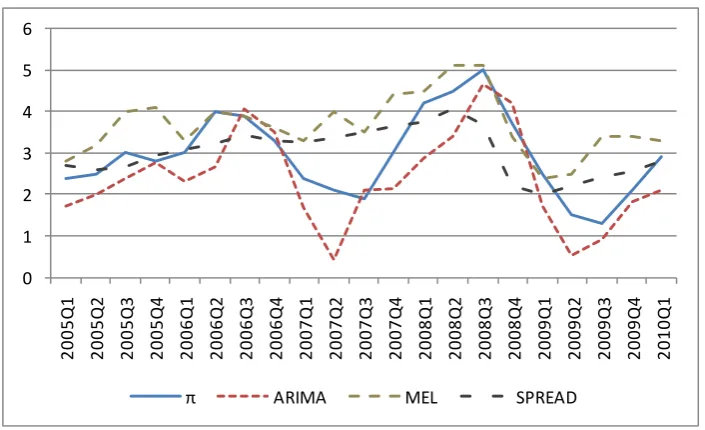
Figure 1 plots the inflation forecasts with ARIMA, MEL, and SPREAD. ARIMA seems to mimic well the inflation dynamic with the exception of the first quarters of 2007. MEL
[image:5.595.122.475.368.583.2]behaves well until 2005-2006 period, but fails to explain the reduction of inflation in 2007. However, it explains well inflation rate of 2008, and deviates from the actual inflation rate somewhat during 2009-2010. SPREAD seems to trace better the average dynamic of inflation but somewhat less satisfactory in explaining cyclical oscillations.
Figure 1: Forecasts comparison between MEL, ARIMA, and SPREAD
0 1 2 3 4 5 6 2 0 0 5 Q 1 2 0 0 5 Q 2 2 0 0 5 Q 3 2 0 0 5 Q 4 2 0 0 6 Q 1 2 0 0 6 Q 2 2 0 0 6 Q 3 2 0 0 6 Q 4 2 0 0 7 Q 1 2 0 0 7 Q 2 2 0 0 7 Q 3 2 0 0 7 Q 4 2 0 0 8 Q 1 2 0 0 8 Q 2 2 0 0 8 Q 3 2 0 0 8 Q 4 2 0 0 9 Q 1 2 0 0 9 Q 2 2 0 0 9 Q 3 2 0 0 9 Q 4 2 0 1 0 Q 1
π ARIMA MEL SPREAD
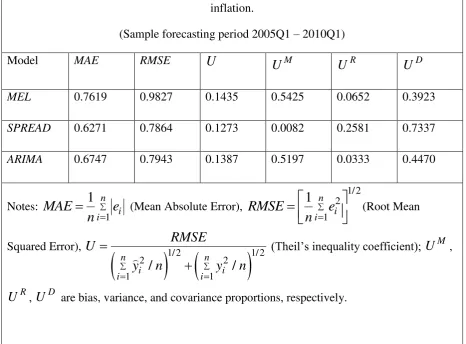
Table 2 reports various forecasting evaluation statistics, viz., mean absolute error (MAE), root mean squared error (RMSE) and Theil’s inequality coefficient (U)—which are commonly used in the literature to evaluate the accuracy of forecasts from alternative models like ARIMA, MEL, and SPREAD. These statistics indicate that during our test sample period of 2005Q1 – 2010Q1, MEL produces the worst forecasts. All the standard evaluation
variance (
U
R), it produces better forecasts than the ARIMA forecasts in that it has the minimum coefficient of bias (UM).Table 2: Forecast statistics for the Melbourne survey, SPREAD, and ARIMA model of inflation.
(Sample forecasting period 2005Q1 – 2010Q1)
Model MAE RMSE
U
MU
U
RU
DMEL 0.7619 0.9827 0.1435 0.5425 0.0652 0.3923
SPREAD 0.6271 0.7864 0.1273 0.0082 0.2581 0.7337
ARIMA 0.6747 0.7943 0.1387 0.5197 0.0333 0.4470
Notes:
1
1
n i iMAE
e
n
(Mean Absolute Error),1/2 2
1
1
n i iRMSE
e
n
(Root MeanSquared Error),
1/ 2
1/ 22 2
1
/
1/
n n
i i
i i
RMSE
U
y
n
y
n
(Theil’s inequality coefficient); M
U
,R
U
,U
D are bias, variance, and covariance proportions, respectively.4. Conclusion
Data Appendix
Data Source. Sample 1978Q1 – 2010Q4
Variable Definition Source
Consumer Price Inflation (year-over-year).
Reserve Bank of Australia.
1
( )
t t
MELE Melbourne Institute Survey of Consumer inflation expectations (one year ahead median expected price change).
This survey is based on a random sample of 1200-1400 households. Respondents are asked a range of questions among their expected inflation rate one year ahead. These qualitative responses are converted into quantitative ones. The questions in this survey are similar to those in the U.S. Michigan survey.
Melbourne Institute Survey of
Consumer Inflation
1
( )
t t SPREAD
E
Inflation expectations calculated as Nominal 10-year bond yield, deflated by yield on 10-year capital indexed bond.
References
Baghestani, H. and Noori, E. (1988) On the rationality of the Michigan monthly survey of inflationary expectations, Economics Letters, 27, 333-335.
Box, G. E. P. and Jenkins, G. M. (1976) Time series analysis: Forecasting and control, San Francisco Holden-Day.
Nelson, C. R. (1972) The prediction performance of the FRB-MIT-PENN model of the U.S. Economy, American Economic Review, 62, 902-917.