Munich Personal RePEc Archive
Migration and Tourist Flows
Nuno, Carlos Leitão and Muhammad, Shahbaz
ESGTS, Polytechnic Institute of Santarém and CEFAGE- University
of Évora, Portugal, COMSATS Institute of Information of
Information Technology, Lahore, Pakistan
9 November 2011
MIGRATION AND TOURIST FLOWS
Nuno Carlos Leitão
ESGTS, Polytechnic Institute of Santarém and CEFAGE- University of Évora,
Portugal. Email: [email protected]
Muhammad Shahbaz
COMSATS Institute of Information Technology Lahore, Pakistan. Email:
Abstract
This study considers the relationship between immigration and Portuguese
tourism demand for the period 1995-2008, using a dynamic panel data approach.
The findings indicate that Portuguese tourism increased significantly during the
period in accordance with the values expected for a developed country. The
regression results show that income, shock of immigration, population, and
geographical distance between Portugal and countries of origin are the main
determinants of Portuguese tourism.
Key words: Tourism demand; panel data; immigration and Portugal.
1. Introduction
When the economic geography was revisited in the 1990s some authors such as
Krugman (1991) explained the relationship between North and South by
introducing mobility between regions. This process involves the phenomenon of
migration. Portugal is located in the South of Europe and we are seeing an
increase in immigration. The process of immigration in Portugal is relatively
recent.
With globalization, many nations have liberalized their trade policies
and trade barriers removed. The relationship between tourism and immigration
in Portugal has not been investigated till yet. Immigration and tourism have a
complex and dynamic nature. One reason for this descriptive relation is
associated with the reasons for the visit, in the case of immigration (foreign
population in the country) involves family and friends (Jackson, 2003 and Yuan
et al. 1995). The studies by Dwyer et al (1992), Hollanger (1982), Oigenblick
and Kirschenbaum (2002), Fischer (2007) and Seetaram (2008) showed that
immigration promotes tourism. In other words, immigrants are key drivers of
the host country.
International tourism stimulates economic growth, income,
employment opportunities and government revenues. According to the World
Tourism Organization (WTO), the number of international tourists increased
from 25 million in 1950 to 160 million in 1970 in 1990, 689 million in 2001,
Both immigration and tourism have increased in recent decades.
According to United Nation (2002) international migration in the world has
increased from 154 million in 1990 to 175 million in 2000.
The per capita income, price index, geographical distance and their
cultural surroundings (borders) are other explanatory variables, commonly used
with greater frequency as determinants of tourism demand. The empirical
studies (Gray, 1982, Kulendran and Wilson 2000, 2007 Dougan, Phakdisoth
and Kim 2007) indicated that trade and tourism are positively correlated.
Trade and the phenomenon of migration is a major player in the
international economics. The study of tourism and migration helps to explain
the mobility of the population. Migration flows are associated in large measure
to the improvement of living conditions. Either tourism or migration is
associated with the location advantages (Illes 2004, Michalkóe Váradi 2003).
The historical and cultural proximity reduces transaction costs and
promotes the phenomenon of migration.
In empirical studies of the tourism demand (Kulendran and Wilson
2000, Eilat and Einav 2004, 2007 and Kim Phakdisoth, Mervan and Payne 2007,
Vogt 2008, Fischer 2007 and Seetaram 2008) confirms the importance of
relative price, geographical distance and bilateral trade. The inclusion of the
variable immigration - stock of immigrants is not as usual in empirical studies.
Kirschenbaum (2002) pointed out that immigration has a positive impact on
tourism demand in host countries.
This paper uses an unbalance panel data for international tourist flows
to Portugal, from 16 countries, for the period 1995-2008. The structure of the
paper is as follows. Section 2 presents the literature review and empirical
studies. In section 3, we present the hypothesis. Section 4 shows the
methodology. Section 5 presents the econometric model. The final section
provides conclusions.
2. Immigration
According to the European Union (2007) and the Regulation no.
862/2007 of the European Parliament, the concept of immigration involves the
movement to a host country for a period exceeding one year. The phenomenon
of immigration in Portugal can be explained in four stages. The first phase
emerges after the colonial period between 1975 and 1985. The Portuguese, from
the former colonies, returned to their homeland, but also watched the arrival of
African immigrants in Cape Verde, Guinea-Bissau and Angola. Cape Verde
migratory movements had already begun in the 1960s. The second phase
occurred in 1986 and ended in the 1990s. This phase is characterized by cultural
and linguistic proximity, i.e., Brazilian immigrants. The third migratory phase
emerges in the late 1990´s and ends at the beginning of the millennium,
Eastern European countries. A fourth phase started in the early years of the
current decade in which we can mention the following: i) the period of
economic crisis, in which we observe a decrease of immigration from Eastern
Europe; ii) the balance from Portuguese speaking countries (PALOPS); iii) new
entry of Brazilian immigrants.
In Figure 1, the main foreign residents in Portugal are displayed. The Brazilian,
Cape Verdean and Ukrainian residents are the ones that stand out, followed by
[image:6.612.151.471.330.510.2]Romanians.
Figure 1
Source
Source: Portuguese Border Services and
authors’ calculation
Figure 1 Foreign Residents Major Nationalities (2000)
3. Literature Review and Empirical Studies
The studies of tourism and migration have been developed
independently of one another up to second half of the twentieth century (Bell 24%
12% 12%
6% 6% 6% 5%
29% 0% 5% 10% 15% 20% 25% 30% 35% Braz il Ukrai ne Cape Ve rde Rom ania Ango la Gui nea B
and Ward 2000). Tourism as a form of temporary international migration can,
like other types of movement, shift in the distribution of population.
Tourist visits can take place for various reasons: holidays, business trips,
visit to friends and relatives, and others.
O'Reilly (1995) evaluated the relationship between migration and
tourism. The author identified five categories: expatriates, residents, seasonal
visitors, migrants and tourists.
Williams and Hall (2000) referred that interdisciplinary exists between
tourism and immigration. The literature tends to make the following points of
convergence: i) tourism and the labour market in the host country, ii) tourism
and migration, iii) tourism and entrepreneurship.
Clarke (2004) referred that there is a convergence between immigration
and leisure activities in the host country. In turn, the link between tourism and
immigration involves family and friends (Jackson, 1990, 2003 and Yuan et al.
1995). More recently, Lew and Wong (2002) demonstrated the importance of
the internationalization of migration associated with the labour market
(opportunities) and other forms of migration, the networks (family and friends,
VFR). Tourism can be explained by international migratory movements.
Tourism as a form of temporary international migration can be explained by the
movements and structural changes in the distribution of the population.
Oigenblick and Kirschenbaum (2002) admitted that tourism is a
In recent decades, the phenomenon of migration, trade and tourism has
gained many adherents in academia as Kulendran and Wilson (2000), Eilat and
Einav (2004), Phakdisoth and Kim (2007), Mervar and Payne (2007), Vogt
(2008), and Fischer (2007). These studies showed that immigration and
international trade seem to promote tourism.
The literature review of empirical tourism demand (VFR) (Crouch,
1994; Witt and Witt, 1995; Mervar and Payne, 2007; Lim, 1997 and Carrey,
1991) suggested that demand for tourism (dependent variable) can be measured
by tourist arrivals. The number of overnight stays in hotel establishments by
country of residence has also been used as the dependent variable.
In terms of explanatory variables, empirical models of tourism demand
using income from tourists, service prices, exchange rates and geographical
distance. The classic empirical studies such as Jud and Joseph (1974), Fuji and
Mark (1981) and Carrey (1991) pointed out that it is the most important
variable to explain the demand for tourism.
The link between immigration and tourism is usually explained by two
trends: the push-pull forces and social capital.. The decision is based mostly in
the economic characteristics of the host country (exchange rates, market
knowledge and prices). Economic factors affect the motivation of immigrants.
Foreign residents in a host country reduce transaction costs and develop
we can infer that the variable has a positive impact on migration with statistical
significance.
A substantial attention has been given to the relationship between
migrations, which has a significant influence on tourism arrivals. The questions
from here to: Is international migrations sustaining VFR?
Other exogenous variables are also considered such as geographical
distance or transportation costs (Phakdisoth and Kim, 2007; Allen and Yap,
2009, and Leitão 2010), infrastructures (Seetanah, 2006, and (Phakdisoth and
Kim, 2007), population (Hanafiah and Haruin, 2010; Leitão, 2010), common
language (Eilat and Einav, 2004).
The use of panel data for empirical studies applied to tourism demand,
or VFR is recent (Ledesma-Rodriguez et al. 2001; Naude and Saayman, 2005;
Roger and Gonzalez, 2006; Maloney and Rojas, 2005; Khadaroo and Seetanah,
2007; Garínz- Muñoz, 2007; Mervar and Payne, 2007; Phadisoth and Kim,
2007, Brida and Risso, 2009 and Leitão, 2010).
Ledesma-Rodriguez et al. (2001) applied the panel data to analyze the
short and long-run elasticises for visitors of Tenerife. The study of Naude and
Saayman (2005) used a panel data for the period 1996-2000. The authors
identified the determinants of tourism arrivals (VFR) in 43 African countries.
Roget and Gonzalez (2006) studied the determinants for rural tourism demand
Maloney and Rojas (2005) used a dynamic panel data to analyse
Caribbean destinations.
Garínz- Muñoz and Montero-Martin (2007) applied a GMM-DIF
proposed by Arellano and Bond (1991) to evaluate inbound Germany tourism in
Spanish destination for the period 1991-2003.
Recently, Mervar and Payne, (2007) used dynamic estimates to explain
the determinants of tourism demand i.e. the lagged dependent variable. Also
Phadisoth and Kim (2007) specify a panel of static data and dynamic
(GMM-DIF) applied to the demand for tourism in Laos. They concluded that
transportation costs, risk associated with the destination, bilateral trade and
geographical distance are the main determinants of tourism in Laos.
Brida and Risso (2009) used a dynamic panel data study of the
Germany demand for tourism in South Tyrol. The dynamic panel approach
analyses the short and long-run effects. Brida and Risso (2009) concluded that
the cost of travel and the relative price have a negative and significant impact
on tourism demand. The authors also showed that the lagged dependent variable
(tourism demand, VFR) has a positive and relevant effect on actual demand,
reflecting according to the authors the loyalty of Germany tourists.
The study of Leitão (2010) specifies a static and dynamic panel data
(GMM-System) for tourism demand in Portugal for the period 1995-2006. The
GMM-System proposed by Blundell and Bon (1998, 2000) is an alternative to
The author concluded bilateral trade, immigration, border, and
geographical distance between Portugal and countries of origin are the main
determinants of tourism demand.
4. Methodological approach and model specification
We use a regression to analyze the relationship VFR-migration. Before
presenting the results of our estimations, we discuss the dependent variable and
explanatory variables, describe the data model and address the hypothesis.
A gravity model will be used in estimating the relationship between
immigration and international tourism to and from Portugal. Tourism is
significant source of exports revenues for any country. Since the pioneering
studies (Tinbergen, 1962; Poyhonen, 1963) pointed out that geographical
distance is an important determinant of international trade. In this study we use
a panel data methodology. The panel data analysis permits us to use more
informative data and it accounts for unmeasured time-invariant determinants.
This study uses a dynamic panel data (GMM-System). In static panel data
models, Pooled OLS, fixed effects (FE) and random effects (RE) estimators
have some problems like serial correlation, heteroskedasticity and endogeneity
of some explanatory variables.
The estimator GMM- system (GMM-SYS) permits the researchers to solve
the problems of serial correlation, heteroskedasticity and endogeneity for some
explanatory variables. These econometric problems were resolved by Arellano
2000), who developed the first differenced GMM (GMM-DIF) estimator and
the GMM system (GMM-SYS) estimator. The GMM-SYS estimator is a system
containing both first differenced and levels equations. The GMM-SYS
estimator is an alternative to the standard first differenced GMM estimator. To
estimate the dynamic model, we applied the methodology of Blundell and Bond
(1998, 2000), and Windmeijer (2005) to small sample correction to correct the
standard errors of Blundell and Bond (1998, 2000). The GMM system estimator
is consistent if there is no second-order serial correlation in the residuals (m2
statistics). The dynamic panel data model is valid if the estimator is consistent
and the instruments are valid.
4.1 Econometric Model: Explanatory Variables and Data
Model Description
For the researchers, the visiting friends and relatives (VFR) are the most
common variable used in creating econometric models of VFR, beside the total
duration of visiting friends and relatives thousands of night per year1. In this
study, the regression of VFR in Portugal is from 16 different countries2
between the years 1995-2008. The data used to create the total number of visits,
as dependent variable, are annually collected from INE- National Institute of
Statistics. Our panel data is unbalanced.
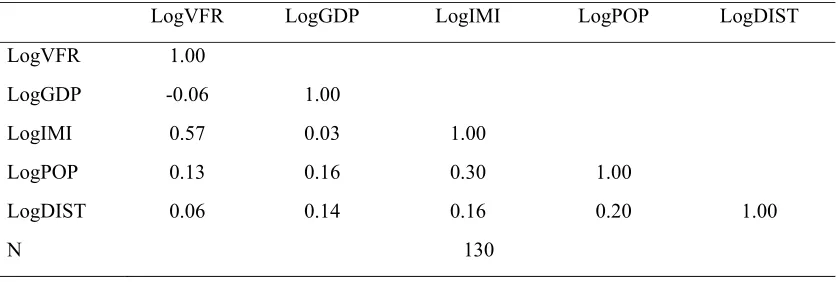
1 In appendix we present the correlation matrix between variables.
2 The countries selected are Austria, Belgium, Brazil, Canada, Czech Republic,
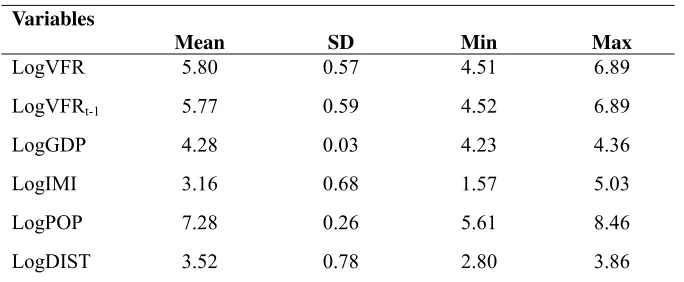
First all the descriptive for panel data is presented in the following table.
Table 1 Descriptive statistics for panel
Variables
Mean SD Min Max
LogVFR 5.80 0.57 4.51 6.89
LogVFRt-1 5.77 0.59 4.52 6.89
LogGDP 4.28 0.03 4.23 4.36
LogIMI 3.16 0.68 1.57 5.03
LogPOP 7.28 0.26 5.61 8.46
LogDIST 3.52 0.78 2.80 3.86
Source: INE, Border Services, World Bank and authors’ calculation.
Following the literature review, we consider that visiting friends and
relatives (demand for travel exports) in Portugal is a function of income,
migration stock, population, and geographical distance.
VFR GDP IMI POP DIST
f
VFRit it1, , , , (1)
Where, VFRit is the number of foreign tourist arrivals; VFRit-1 lagged
dependent variable permits to analyse long run effects; GDP is the income in
tourist generating countries; IMI is the number of migrants from various
countries living in Portugal; POP is the total population in countries;
A series of hypothesis were formulated, considering how the selected
Hypothesis 1: There is a positive impact on the visiting friends and relatives in
the long run.
Phakdisoth and Kim (2007), Brida and Risso (2009), and Leitão (2010)
defended the idea that lagged tourism demand (VFRt-1) has a positive impact on
the economy.
Hypothesis 2: Tourism demand will be influenced by income of the tourist from
countries of origin.
GDP, is the gross domestic product per capita in the country of origin of tourist,
expressed in constant 2000 US$ was collected from the World Bank. According
to the literature, we expect that the number of foreign tourist arrivals to increase
in Portugal as the income in tourists’ origin country increase.
Hypothesis 3: Immigration flows play an important role in sustaining tourism.
The stock of immigration collected from the Border Services "Serviço de
Fronteiras", (Ministry of Internal Affairs), corresponds to legal immigrants in
Portugal.
According to previous studies, Dwyer et al. 1993, Seetaram 2008, and
Oigenblick and Kirschenbaum (2002), Fischer (2007) tourism and immigration
Hypothesis 4: Population changes in a country could positively sustain tourism
flows
According to the literature (Witt and Witt, 1995; Oigenlick and Kirschenbaum,
2002; Hanafiah and Harun 2010) we expect a positive sign. The population data
has been collected from World Bank.
Hypothesis 5: Tourism increases if transportation cost decreases.
DIST is the geographical distance between Portugal and the tourist generating
countries. According to the literature we expect a negative sign for this variable.
4.2 Model Specification
it i it
it
X
t
VFR
0
1
(9)Where VFRit is the total number visits by foreign nationality to
Portugal, X is a set of explanatory variables. All variables are in the logarithm
form; ηi is the unobserved time-invariant specific effects;
t captures acommon deterministic trend;
it is a random disturbance assumed to be normal,and identical distributed (IID) with E (
it)=0; Var (
it)=
2
0
.
The model can be rewritten in the following dynamic representation:
it i it
it it
it
VFR
X
X
t
4.2.1 Times-Series Properties of the Variables in the Panel
Before estimating the panel regression model, we realize a test for unit
root of the variable. Following the literature we apply a battery of unit root tests:
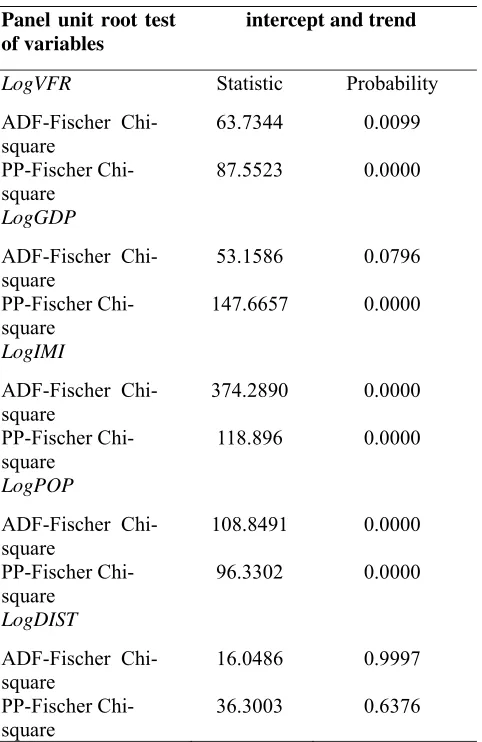
ADF-Chi square, and PP-Chi square. The table 2 presents the results of
[image:16.612.189.430.265.636.2]different panel unit root test (ADF-Fisher Chi square, PP- Fischer Chi square).
Table 2 Panel unit root test results
Panel unit root test of variables
intercept and trend
LogVFR Statistic Probability
ADF-Fischer Chi-square 63.7344 0.0099 PP-Fischer Chi-square 87.5523 0.0000 LogGDP
ADF-Fischer Chi-square
53.1586 0.0796
PP-Fischer Chi-square
147.6657 0.0000
LogIMI
ADF-Fischer Chi-square 374.2890 0.0000 PP-Fischer Chi-square 118.896 0.0000 LogPOP
ADF-Fischer Chi-square
108.8491 0.0000
PP-Fischer Chi-square
96.3302 0.0000
LogDIST
ADF-Fischer Chi-square
16.0486 0.9997
PP-Fischer Chi-square
36.3003 0.6376
The most important model variable such as the visit friend (LogVIST), income
per capita (LogGDP), stock of immigration (LogIMI), and population (LogPOP)
do not have unit roots, i.e are stationary, with individual effects and individual
trend specifications.
5. Empirical Results
This section presents the estimation using GMM-System estimator
proposed by Arellano and Bover, (1995) and Blundell and Bond, (1998, 2000).
We used STATA econometric software to estimate the model. The model
presents consistent estimates, with no serial correlation the Arellano and Bond
test for M2. The specification Sargan test shows that there are no problems with
the validity of instruments used. The GMM system estimator is consistent if
there is no second-order serial correlation in the residuals (M2 statistics). The
dynamic panel data are valid. The Windmeijer (2005) finite sample correction is
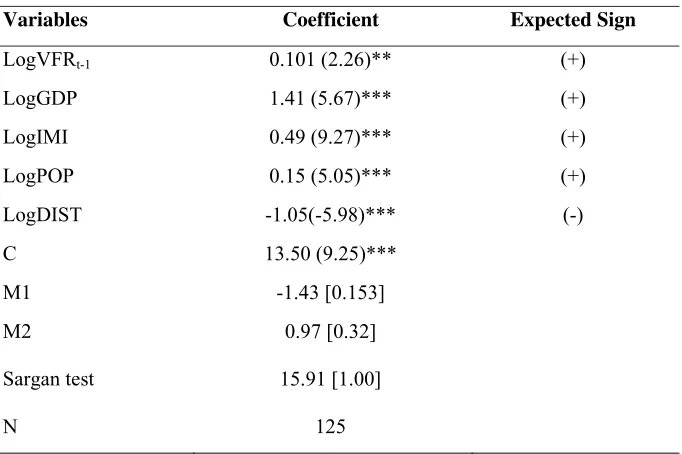
used. In the table 3 we can observe the relationship between tourism demand
and immigration. The general performance of the equations is satisfactory.
All explanatory variables are significant (LogGDP, LogIMI, LogPOP, and
LogDIST at 1% level); the coefficient (LogVFRt-1) is significant at 5%level.
For Lagged dependent variable (LogVFR t-1), the expected sign is positive
on Portuguese economy. Brida and Risso (2009), and Leitão (2010) also found
a positive sign for lagged dependent variable.
As expected, the variable LogGDP has a significant and positive effect
on tourism demand. Phakdisoth and Kim (2007), and Brisa and Risso (2009)
[image:18.612.138.479.277.504.2]also found this result.
Table 3 GMM-System
Variables Coefficient Expected Sign
LogVFRt-1 0.101 (2.26)** (+)
LogGDP 1.41 (5.67)*** (+)
LogIMI 0.49 (9.27)*** (+)
LogPOP 0.15 (5.05)*** (+)
LogDIST -1.05(-5.98)*** (-)
C 13.50 (9.25)***
M1 -1.43 [0.153]
M2 0.97 [0.32]
Sargan test 15.91 [1.00]
N 125
The null hypothesis that each coefficient is equal to zero is tested using one-step
robust standard error. T-statistics (heteroskedasticity corrected) are in round
brackets. P-values are in square brackets; ***/**/*- statistically significant at
the 1 per cent, 5 per cent, and 10 per cent levels. AR (2) is tests for first-order
asymptotically distributed as N(0,1) under the null hypothesis of no serial
correlation (based on the efficient two-step GMM estimator). The Sargan test
addresses the over-identifying restrictions, asymptotically distributed X2 under
the null of the instruments’ validity (with the two-step estimator).
Source: INE, Border Services, World Bank and authors’ calculation.
The variable the migrant stock (LogIMI) is positively related to the
dependent variable. Oigenblick and Kirschenbaum, (2002); Fischer, (2007) and
Seetaram, (2008) showed that the level of tourism depends not only on the
population of origin country, but also on the migration flows.
The variable population (LogPOP) finds a positive sign, as we
expected, and corresponds to the results of Hanafiah and Harun (2010), and
Leitão (2010). A 1% increase in population of the origin country would increase
0.15% foreign tourist arrivals to Portugal.
The coefficient of LogDIST (Distance) validates the hypothesis 5. This
result confirms the importance of the neighbourhood. Following Phakdisoth and
Kim (2007), we can conclude that international tourism demand is directly
influenced by the distance from the countries of origin of tourists and tourism
destination country.
6. Conclusions
immigration using dynamic panel data in case of Portugal. The GMM –system has
rarely been applied to tourism analysis. Our results supported the hypothesis that
there is a positive correlation between immigration and tourism demand. This result
is in line with in existing literature such Dwyer et al. (1993); Oigenblick and
Kirschenbaum, (2002), Fischer (2007) and Seetaram, (2008). The econometric
models showed that GDP per capita, and population which determines the ability to
travel, these explanatory variables have a positive impact on VFR visit. For
geographical distance, the results indicated that it has a negative influence on
inflows, as expected. Generally, the econometric model is in line with the results
with previous empirical studies. Finally, although the use of more recent
econometrical techniques should at least be compared, and it would be dangerous to
generalize from this empirical study, it may be preferable to use the GMM approach
in empirical visiting friends and relatives (VFR) or tourism demand, rather than
static panel data (pooled OLS, fixed effects, and random effects).
[image:20.612.98.517.505.646.2]Appendix
Table 4 Correlation Matrix
LogVFR LogGDP LogIMI LogPOP LogDIST
LogVFR 1.00
LogGDP -0.06 1.00
LogIMI 0.57 0.03 1.00
LogPOP 0.13 0.16 0.30 1.00
LogDIST 0.06 0.14 0.16 0.20 1.00
Source: INE, Border Services, World Bank and authors’ calculation.
0
.5
1
1.
5
Dis
tan
c
e
abov
e m
edian
0 .5 1 1.5
Distance below median
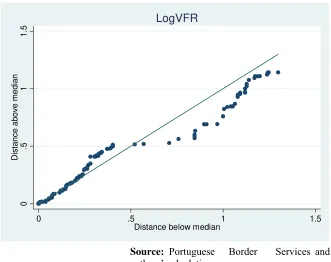
LogVFR
[image:21.612.141.472.158.420.2]Source: Portuguese Border Services and authors’ calculation
0
.2
.4
.6
.8
1
Den
s
it
y
4 5 6 7
LogVFR
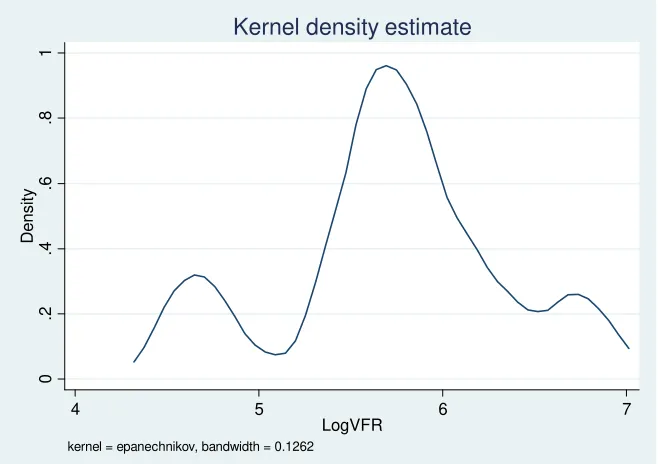
kernel = epanechnikov, bandwidth = 0.1262
Kernel density estimate
[image:22.612.142.471.139.371.2]Source: Portuguese Border Services and authors’ calculation
Figure 3 Dependent variable Kernel density
References
Allen, D., Yap, G., .2009. “Modelling Australian domestic tourism demand: A panel data approach”, 18th World IMACS/MODSIM Congress, Cairns, Australia, http://mssanz.org.au/modsim09.
Arellano, M., Bond, S., .1991. “Some tests of specification for panel data: Monte Carlo evidence and an application to employment
equations”, The Review of Economic Studies, 58: 277-297.
Bell, M., Ward, G.2000. “Comparing temporary mobility with permanent migration“, Tourism Geographies, 2(1): 87-107.
Blundell, R., Bond, S. 1998. “Initial conditions and moment restrictions in dynamic panel data models”, Journal of Econometrics, 87(1): 115-143.
Blundell, R., Bond, S. 2000. “GMM estimation with persistent panel data: an application to production functions”, Econometric Reviews, 19(3): 321-340.
Brida, J. G., Risso, W. A. 2009. “Tourism as a factor of long-run economic growth: An empirical analysis for Chile”, European Journal of Tourism Research. 2(2): 178-185.
Carey, K. 1991. “Estimation of Caribbean tourism demand”, Allanlk Economic Journal, 19(3): 32-40.
Clarke, N. 2004. “Mobility, fixity, agency: Australia’s working holiday programme,”, Population, Space and Place, 10(5): 411−420.
Crouch, G. I. 1994. “The study of international tourism demand: a survey of practice”, Journal of Travel Research, 32 (4): 41-55.
Dougan, J. 2007. “Analysis of Japanese tourism demand to Guam”, Asia Pacific Journal of Tourism Research, 12 (2): 79-88.
Dwyer, L., Burnley, I., Murphy, P., Forsyth, P. 1992. “Tourism – Immigration interrelations”. Report Prepared for Bureau of Immigration Research.
Eilat, Y., Einav, L. 2004. “Determinants of international tourism: A three-dimension panel data analysis”, Applied Economics, 36-12: 1315-1327..
Fischer, A.M. 2007. “Measuring income elasticity for Swiss money demand: what do the cantons say about financial innovation”,
European Economic Review, 51(7): 1641-1660.
Fuji, E., Mark, J.1981. “Forecasting Tourism Demand: Some
Garín-Muñoz, T., Montero-Martin, L.F. 2007. “Tourism in the Balearic islands: a dynamic model for international demand using panel data”, Tourism Management, 28(5): 1224-1235.
Gray, H. P. 1982. “The demand for international travel by United States and Canada”, International Economic Review, 7: 83-92.
Hanafiah, M.H.M., Harun, M.F.M. 2010. “Tourism demand in
Malaysia: A cross-sectional pool time-series analysis”, International Journal of Trade, Economics, and Finance, 1(1): 80-83.
Hollander, G.1982.”Determinants of demand for travel to and from Austrália”, Bureau of Industry Economics, Working Paper No. 26.
Jackson, A. 2003. “The detention of asylum seekers in the UK: bail for immigration detainees”, Feminist Review, 73 (1): 118-122.
Jackson, R. T. 1990.” VFR tourism: Is it underestimated?”, Journal of Tourism Studies, 1 (2): 10–18.
Jackson, R.T. 2003. “VFR tourism: is it underestimated?”, The Journal of Tourism Studies, 14 (1): 17‐24.
Jud, G. D., Joseph. H. 1974. International demand for Latin American tourism, Growth and Change: 25 - 31.
Khadaroo, J., Seetanah, B. 2007. “Transport infrastructure and tourism development”, Annals of Tourism Research, 34(4): 1021–1032.
Krugman, P. 1991. “Increasing returns and economic geography”,
Journal of Political Economy, 99: 483– 499.
Kulendran, N., Wilson, K. 2000. “Is there a relationship between
international trade and international travel?”, Applied Economics, 32: 1001-1009.
Ledesma-Rodriguez, F. J., Navarro-Ibanez, M., Perez-Rodriguez, J. V. 2001. “Panel data and tourism: A case study of Tenerife”, Tourism Economics, 7: 75-88.
Lew, A. A., Wong, A. 2002. “Tourism and the Chinese diáspora”. In C.M. Hall and A.M. Williams, eds., Tourism and Migration: New Relationships Between Production and Consumption: 205-219.
Lim, C. 1997. “Review of international tourism demand models”, Annals of Tourism Research, 24: 835-849.
ll´es, S. 2004. “Foreigners in Hungary: Migration from the European Union“, Working Papers on Population, Family and Welfare 5
(Budapest: HCSO Demographic Research Institute).
Maloney, W.F., Rojas, G.M. 2005. “How elastic are sea, sand and sun? Dynamic panel estimates of the demand for tourism?”, Applied Economics Letters, 12: 277-280.
Mervar, A. Payne, J. 2007. “An analysis of foreign tourism demand for Croatian destination: Long-run elasticity estimates”, Working Paper: 1-20.
Michalk´o, G., V´aradi, Z. 2004. “Croatian shopping tourism in
Hungary: Case study of Barcs, Turizam, 6(4): 351–359.
Naudé, W., Saayman, A. 2005. Determinants of tourists arrivals in Africa: A panel data regression analysis”, Tourism Economics, 11(3): 365-391.
O’Reilly, K. 1995. “A new trend in European migration: contemporary British migration to Fuengirola”, Costa del Sol, Geographical Viewpoint, 23: 25-36.
Oigenblick, L., Kirschenbaum, A. 2002. “Tourism and immigration: Comparing alternative approaches”, Annals of Tourism Research, 29(4): 1086–1100.
Phakdisoth, L., Kim, D. 2007. “The determinants of inbound tourism in Laos“, ASEAN Economic Bulletin, 24 (2): 225-237.
Roget, F. M., Gonzalez, X. A. R. 2006.“Rural tourism demand in Galicia, Spain”, Tourism Economics. 12: 21–31.
Seetanah, B. 2006. “Analysing Transport Capital as a Determinant of Tourist Arrival in a Co-integration and Error Correction Framework”,
International Review of BusinessResearch Papers, 2(2): 15-29.
Seetaram, N. 2008. “Mauritius aviation and tourism, implications for Leisure travel”. Ashgate Publishing Ltd., UK.: 313-321.
Tinbergen, J. 1962. “Shaping the world economy. New York”, The
Twentieth Century Fund Inc.
Vogt, M. 2008. “Determinants of the demand for US exports and imports tourism”, Applied Economics, 40 (6): 667-672.
Williams, A. M., Hall, C. M. 2000. “Tourism and migration: new
relationships between production and consumption”, Tourism Geographies, 2(1): 5-27.
Windmeijer, F. 2005. “A finite sample correction for the variance of linear efficient two-step GMM estimators”, Journal of Econometrics, 126 (1): 25-51.
Witt, S. F., Witt, C. A. 1995. “Forecasting tourism demand: A review of empirical research”, International Journal Forecasting 11: 447–475.
Yuan, T., Fridgen, J.D., Hsieh, S., O’Leary, J. T. 1995. “Visiting friends and relatives travel market: The Dutch case”, Journal of Tourism Studies, 6 (1): 19-26.