
Mathematical Modeling of the Efficiency Gadolinium
Based Neutron Converters
Djamshed Alievich Abdushukurov
Physical Technical Institute, Academy of Science of Republic of Tajikistan, Dushanbe, Tajikistan Email: [email protected]
Received April 8, 2013; revised May 8, 2013; accepted May 15, 2013
Copyright © 2013 Djamshed Alievich Abdushukurov. This is an open access article distributed under the Creative Commons Attribution License, which permits unrestricted use, distribution, and reproduction in any medium, provided the original work is properly cited.
ABSTRACT
Procedures of mathematical modeling of thin solid-state converters of neutrons are described and converters a foil from natural gadolinium and its 157 isotopes are viewed. Algorithms of calculation of absorption of neutrons in a material of converters, probabilities formation of secondary electrons, probability of an exit of electrons from a material of the converter and efficiency of converters are given. Calculation is made for various thicknesses of converters, and vari- ous wavelengths of neutrons. The optimal converter thicknesses are chosen.
Keywords: Mathematic Modeling; Neutron Converter; Gadolinium
1. Introduction
Mechanisms for detecting neutrons in matter are based on indirect methods. Neutrons are neutral; they do not in- teract directly with the electrons in matter. The neutrons can cause a nuclear reaction. The process of neutron de- tection begins when neutrons, interacting with various nuclei, initiate the release of one or more charged parti- cles. The products from these reactions, such as protons, alpha particles, gamma rays, electrons and fission frag- ments, can initiate the detection process. For detection of neutrally charged neutrons, it is necessary to use con- verters of neutron radiation. These converters will con- verse radiations of neutrons to the charged radiation, which can be in further detected with various detectors.
For an optimal choice of the converter foil material, the following properties should consider:
A large neutron capture-cross section is needed in order to achieve high detection efficiency with mini- mum foil thickness.
The range of the neutron-induced charged primary particles should be large compared with the converter foil thickness.
The converter material should possess small cross- section of activation. Daughter isotopes occurring as result of activation should not create the significant background.
The γ-ray sensitivity of the detector material should be low.
Converters of neutron radiation play a determining role at designing detectors of neutron radiation. They define the key parameters of detectors, such as the efficiency, the spatial resolution and so on. Among the solid-state converters of thermal neutrons the highest efficiency of registration has received using the Gadolinium based converters, and especially, its 157 isotope. As a result of radiating capture of thermal neutrons by nucleus of Gado- linium the internal conversion and Auger electrons are radiated.
Idea of using thin Gadolinium foils to convert neutrons radiation into charged particles and count the conversion products in a solid-state detector was originally proposed by Feigl and Rauch [1,2]. They used natural Gd and pure
l57Gd convertor foils and measured the exit probabilities
and the energy distributions of the escaping electrons with Si surface barrier detectors.
Mathematical modeling allows to prospect, without special material cost, to carry out search the most suit- able configuration of converters and the optimum geo- metrical ratio. It in turn allows refusing from realization of superfluous development and researches.
2. Model Calculation
variables. These are the followings:
Probabilities of thermal neutrons capture by nucleus of the converter, which depends on its thickness, and the cross-section of interaction. The cross-section of interaction in turn depends on isotope composition of the converter and energy or wavelength of neutron.
Probabilities of creation of the secondary charged par- ticles, in our case of internal conversion and Auger electrons.
Probabilities of exit of the created electrons from the substance of the converter, which depends on, free path length of electrons in a converter substance and thickness of converter.
Energies of the secondary electrons are discrete values and are formed with the certain probability. At calcula- tion of probability of exit it is necessary to take into ac- count emission of each electron with its characteristic energy and its weight factor (probability of formation). In that specific case efficiency can be described by the fol- lowing expression [3,4]
i n j e i i e i i
W P L D E N H Re L
(1)where Wi is the efficiency of registration of the absorbed
with the probability Pn(σLj) neutron absorption, which
caused formation of electrons De(EiNi) with the discrete
energies and probability of formation, probability of es- cape of electrons from a material of converter He(ReiLi)
in view of the maximal free path length of electrons in a substance of the converter and its thickness. Generally probabilities are necessary for summarizing, so calcula- tions are made for 446 discrete energies of electrons with the energies in the range from 0.9 up to 1000 keV.
n j e i i e i i
W P L D E N H Re L
(2)Modeling was realized by examining the simple geo- metrical model, the plane-parallel foils. The calculations for thermal neutrons with fixed energies, which corre- spond to the neutron wavelength of 1, 1.8, 3 and 4 Å were carried out; also both the thickness of converters from 1 µm to 40 µm, and isotopic composition of con-verter (for natural Gd and 157Gd) were varied. In the cal-
culation all electrons (appeared as a result of neutron capture act) are taken into account which are able to exit an infinite plane-parallel plate of the converter. The ratio of the number of electrons exiting from the foil to the number of incident neutrons is referred to as the effi- ciency of the converter.
Conventionally we divide the thickness of a foil into more thin components. For each elementary layer we count the probability of neutrons absorption with the fixed energy. Efficiency of the converter will be determined by the multiplication of probabilities of neutron absorption and probability of the electron exit from the converter. The choice of the model was made from the following
assumptions: all electron emissions are isotropic, the length of free path for any fixed energy of electrons (Rei)
is constant (fluctuation of power losses in the end of path is neglected). Then the density of probability to find elec- trons in the material forms is a sphere with radius equal to Rei (for each fixed energy). If the center of the sphere
is crossed by the plane, two identical hemispheres are formed, which correspond to the electron escape to the forward and backward hemisphere, thus the volume of hemispheres could be considered as the probability of an electron output. In this case total probability is 100%, and exit to the one of hemispheres is 50%. If we begin to cross a sphere with a step much less than Rei, segments
will be formed whose volume will be equal to probability of the electron presence. The step of iterations should be less than Rei. The volume of a segment and accordingly
probability of the electron escape becomes equal to zero in the intersection of a sphere by the plane at the distance
Rei. The sum of probabilities of electron escapes for all
energies, taking into account their weight contribution will determine the total electron escape probability [5,6].
[image:2.595.320.522.423.699.2]Probability of neutron absorption Pn(σLj). In calcu- lations, of the probability of neutron absorption for each elementary layer, as a result of reaction of inelastic in- teraction (n, γ), it is necessary using database on cross- section of neutron interaction [7] for each fixed energies. In the Figure 1 the dependence of cross-section (barn) of
neutron radiation capture on the energy of incident neu- trons (eV), for natural Gadolinium and the same de- pendence for its 157 isotope are shown. Arrows indicate energy of neutrons for which we will carry out our cal- culations. As one can see, with the reduction of energy of neutrons the cross-section of interaction strongly in- creases. Especially it increases in the region of cold and ultra cold neutrons.
The scheme of algorithms calculation of neutron ab- sorption in a converter material is shown in Figure 2. In
the beginning the select of a material of the converter (natural Gadolinium or its 157 isotope), and a neutron wavelength is necessary. In calculations we are use four fixed neutron energies; these are conform for neutrons with wavelengths of 1, 1.8, 3 and 4 Å. After a select of parameters from a database data about cross section of neutron interaction with materials [7] retrieved.
Calculation of neutron absorption is made for each se- lected layers. The attenuation of the narrow collimated neutron beam in thin layer materials is governed by the exponential law
0exp
x A
F F N L (3)
Figure 2. Calculation algorithm diagram of absorption path of neutrons in substance.
where Fx and F0 are the neutron flux density after and
before its passage through the layer of the material with the thickness L, correspondingly, NA is the number of
nucleus in the volume of 1 cm3, σ- is full microscopic
cross-section of neutron interaction with the nuclei of material.
Results of calculations of neutron absorption in con- verters made from natural Gadolinium and its 157 iso- tope are shown in the Figure 3. Figure show that at 30
microns thickness of the natural Gadolinium converter the neutrons with the wave length above 1.8 Å are ab- sorbed completely. For its 157 isotope for neutrons with the wave lengths >1.8 Å the same absorption happens at 8 microns thickness of the converter.
Probability of electrons formation De(EiNi). In the reaction of 157Gd neutron capture, 7937.33 keV energy is
emitted. In total 390 gamma lines with energy ranges from 79.5 up to 7857.670 keV with line intensity of 2 × 10⁻⁸ up to 139 gamma-quanta on 100 captured neutrons
are emitted. In Figure 4, the histogram showing depend-
ence of gamma quantum intensity on the energy is pre- sented [8].
[image:3.595.59.290.346.703.2]The low-energy gamma quanta are present at the spec- trum and during their emission electrons from atomic subshells (so-called internal conversion electrons) are ra- diated with a high probability. The nuclear removes its
[image:3.595.320.522.413.697.2]Figure 4. Histogram of dependence of intensity of gamma- quanta with energy for the reaction of 157Gd (n, γ) 158Gd by 100 neutrons (input data).
excitation by radiating a gamma-quantum, but also a close located electron can be irradiated too. Usually K-electron (electron from K-subshell) is emitted, but also electrons from the higher subshells (like L, M, N and so on) can be emitted too. Vacancy of electrons (an electronic hole), formed as a result of this process, is filled by another electron from a higher level. This process is accompanied by radiation of X-ray quantum, or radiation of Auger- electron.
In Figure 5, scheme of algorithms for calculation of
the internal conversion electrons are show. First of all it’s necessary to define energies and quantity of gammas quanta’s emitted in the reaction of radiation capture of neutrons by Gadolinium nuclear (Figure 4). This data can
obtain from the data-base [9]. Energy of internal conver- sion electrons equal to energy of gammas minus of bind- ing electrons energies of atomic subshells (K, L, M...). For calculation of quantity of internal conversion elec-trons it’s necessary to define of internal conversion coef-ficients for Gadolinium for each atomic subshells.
In Figure 6, result of calculation of energy and quantity
of internal conversion electrons shown.
Probability exit of electrons from a converter De(EiNi)*He(ReiLi). The probability of exit of electrons from a converter substance can be considered on the ba-sis of Bethe-Bloch theory. For realization of calculations it is important to have exact data on brake ability of var-ious substances for the charged particles. Brake ability is average speed of lose of energy by charged particles in any point along their tracks.
Calculations of exit probability of isotropic emitting electrons, originated in the 157Gd (n, γ) 158Gd radiation
capture reaction, are conducted. In Figure 6 one can see
contributions of electrons of different energetic groups. Calculations were made for conditionally fixed point of
Figure 5. Diagram of algorithms for calculation of internal conversion electrons.
Figure 6. Intensity of internal conversion electrons emitted in the reaction 157Gd (n, γ) 158Gd depending on their energy by 100 neutrons (output data).
conversion of neutrons having coordinate (X = 0, Y = 0). The scheme of algorithm calculation of ability an elec- trons exit from the converter is shown in Figure 7. For
calculations of probabilities of electrons output from sub- stance the data about internal conversion and Auger ( Fig-ure 6) downloaded. For each discrete energy of an
elec-tron the database [10] about of free length (Re) elecelec-tron in substance were used. For each elemental stratum prob- ability of an exit of electrons is yielded, for calculation the data on Re and intensity of electrons used.
In the Figure 8 contribution of 4 groups of electrons
Figure 7. Scheme of algorithm calculation of ability an electrons exit from the converter body.
Figure 8. Probability of exit of isotropic emitting secondary electrons from Gadolinium foils of various thicknesses, in view of their intensity (output data).
first group the least energetic and therefore having small ranges in the substance, and in the fourth one the most energetic electrons are placed.
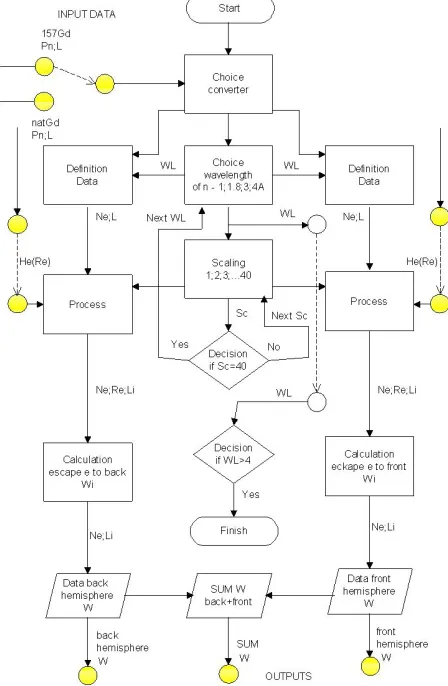
Efficiency of converter W. Calculations of converters
efficiency have been executed for the foils makes of natu- ral Gadolinium and it 157 isotopes, for four fixed wave- lengths of neutrons 1, 1.8, 3 and 4 Å. Calculation were performs for geometry of an exit of electrons in a back, forward hemisphere and their sum for different thickness of the converter.
The scheme of algorithms of calculation is given in
Figure 9. In the beginning the select of the type of con-
verter and a neutron wavelength was made. The thick- ness of the converter is divided into thin elemental stra- tums. For each stratum the corresponding data on ab- sorption of neutrons (Pn, L) download. During calcula- tion to each stratum conventionally co-ordinates X0, Y0 appropriated, the data on probability of an exit of elec- trons (He(Re)) is download. The data gained on each stratum tots. At modeling efficiency calculations sepa- rately for geometry of an exit of electrons in a forward and back hemisphere and their sum were made.
Results of calculations of neutron absorption in con- verters made from natural Gadolinium and its 157 iso- tope are shown in the Figures 10 and 11. Figures show
that at 30 microns thickness of the natural Gadolinium converter the neutrons with the wave length above 1.8 Å are absorbed completely. For its 157 isotope for neutrons with the wave lengths >1.8 Å the same absorption hap- pens at 8 microns thickness of the converter.
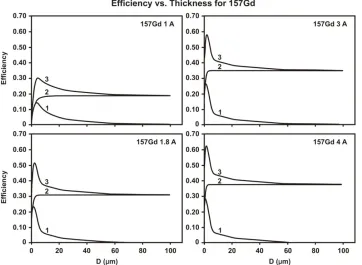
In order to detect thermal neutrons by the 157Gd con-
verters we could limit by the thickness of 5 microns of
[image:5.595.63.285.392.567.2]Figure 10. Dependence of the neutron registration efficiency of the natural Gadolinium converter on its thickness. Curves 1 and 2 correspond to emission of electrons into the front and back hemisphere, respectively, curve 3 is their sum.
Figure 11. Dependence of the neutron registration efficiency of the 157 isotope of Gadolinium converter on its thickness. Curves 1 and 2 correspond to emission of electrons into the front and back hemisphere, respectively, curve 3 is their sum.
the converter, if there no technological restrictions. It should be taken into account that the majority of elec- trons emitted in the reaction of radiating capture of neu-
[image:6.595.120.482.395.660.2]micron.
3. Conclusions
Mathematical modeling of efficiency of registration of thermal neutrons by the foil converters made from natu- ral Gadolinium and its 157 isotope is carried out. Algo- rithms of calculations of absorption of neutrons in sub- stance of the converter, probability of formation of sec- ondary electrons and probability of an exit of electrons from the substance of converter are described.
Processes of neutron absorption in the material of a converter and the probability of secondary electron es- capes were examined. Calculation was made for con- verters with the various thicknesses. We have chosen the most optimal converter thicknesses, both from natural Gadolinium and from its 157 isotopes. While using con- verters from natural Gadolinium, it is possible to obtain total efficiency of 10%, 21%, 26%, 30%, correspond- ingly for the neutrons with wavelengths of 1, 1.8, 3 and 4 Å with converter thickness of 24, 7, 5, 4 microns. For the converters with 157 isotopes, it is possible to reach total efficiency of registration up to 27%, 45%, 49%, 52% for the neutrons with the wavelengths 1, 1.8, 3 and 4 Å with the thickness of converter 5, 3, 2, 2 microns, respectively. The received results are in good agreement with the ex- perimental data [3].
REFERENCES
[1] H. Rauch, F. Grass and B. Feigl, “Ein Neuartiger fur Langsame Neutronen,” Nuclear Instruments and Methods, Vol. 46, 1967, pp. 150-153.
[2] B. Feigl and H. Rauch, “Der Gd-Neutronenzahler,” Nu-
clear Instruments and Methods, Vol. 61, No. 3, 1968, pp.
349-356. doi:10.1016/0029-554X(68)90250-4
[3] D. A. Abdushukurov, “Gadolinium Foils as Converters of Thermal Neutrons in Detectors of Nuclear Radiation,” In:
Physics Research and Technology, Nova Science Pub-
lishers Inc., New York, 2010, pp. 1-124.
[4] D. A. Abdushukurov, “Application of the Gadolinium Foils as Converters of Thermal Neutrons in Detectors of Nuclear Radiation,” In: C. C. Tompson, Ed., Gadolinium:
Compounds, Production and Application, Chapter 2,
Se-ries: Chemical Engineering Methods and Technology,
Nova Science Publishers Inc., New York, 2010, pp. 53- 141.
[5] D. A. Abdushukurov, A. A. Djuraev, S. S. Evteeva et al., “Model Calculation of Gadolinium- Based Converters of Thermal Neutrons,” Nuclear Instruments and Methods in
Physics, Vol. 84B, 1994, p. 400.
[6] D. A. Abdushukurov, M. A. Abduvokhidov, D. V. Bon- darenko, et al., “Modeling the Registration Efficiency of Thermal Neutrons by Gadolinium Foils,” Journal of In-
strumentation, Institute of Physics Publishing and SISSA.
Archives of Los Alamos National Laboratory USA, 2007, 2007, pp. 1-19.
http://arxiv.org/ftp/physics/papers/0611/0611225.pdf [7] Evaluated Nuclear Data File, “IAEA-NDS,” ENDF.
http://www.nndc.bnl.gov/exfor3/endf00.htm
[8] “Thermal Neutron Capture Gammas by Target, NDS, IA EA.”
http://www-nds.iaea.org/oldwallet/tnc/ngtblcontentbyn.sh tml
[9] Bricc 2.0a, “Band-Raman International Conversion Coef- ficients,” BNL. http://www.nndc.bnl.gov/bricc/


![Bambara and Maninka Manding Languages Written Corpora Project (“Projet des corpus écrits des langues manding : le bambara, le maninka”) [in French]](data:image/gif;base64,R0lGODlhAQABAIAAAP///wAAACH5BAEAAAAALAAAAAABAAEAAAICRAEAOw==)