Munich Personal RePEc Archive
REAL Exchange Rate Misalignment and
Economic Performance of WEST
AFRICAN MONETARY
ZONE:Implications for macroeconomic
unionisation
Raji, Rahman Olanrewaju
Canterbury International High Sch., Lekki Lagos Nig.
15 March 2012
Online at
https://mpra.ub.uni-muenchen.de/37385/
1
Real Exchange Rate Misalignment and Economic Performance of West African Monetary Zone:
Implications for macroeconomic unionisation
†
Raji, Rahman Olanrewaju
Abstract
The study assessed the real exchange rate misalignment and economic performance of WAMZ economies to determine its implications on economic unionization. The study uses Generalised Method of Moment of Dynamic Panel Estimation Method and supported with Cross Country Correlation Approach which comprises Gambia, Ghana, Guinea, Liberia, Nigeria and Sierra Leone covering the period from 2000 commencement of the zone to 2010 from international financial statistics of international monetary fund.
The study discovered that the zone experiences asymmetrical correlations between real exchange rate misalignment and economic performance while the inclusion of equilibrium real exchange rate revealed a symmetrical relationship with economic performance. Further revelation in the study happened to be the cross country correlations which unveiled that four countries emerged to have a moderate degree of symmetrical relationship using some macroeconomic variables such real exchange rate, misaligned real exchange rate, openness, inflation and output. The study concluded by admonishing the zone to commence with four promising economies such as a Gambia, Ghana, Nigeria and Sierra Leone.
1
Keywords: WAMZ, misalignment real exchange rate, currency union
JEL Classification: C33, F31, F36, F43
1
†
2
1.Introduction
Theory of comparative advantage is the genesis of international trade indicating that for living standard to be improved or an economy to grow and expand developmentally such an economy needs to be opened i.e. calling presence of external economy. In an external economy, international finance plays crucial roles where there is presence of external factors over the economy generates an influence which is hard to manage and control. Globally, the international finance of real exchange rate instability has adverse effects on economic performance of most economies due to inability to achieve expected realistic exchange rate and price stability. The real exchange rate emerges as a crucial variable as a result of exchange rate policy for countries entering trade liberation which calls for effective and efficient exchange rate management. Wrong exchange rate policies turn out to be harmful to the economies. Presence of overvalued exchange rate resulted to increase living standard above productivity level and an undervalued exchange rate resulted in excess in the current account of balance of payment and
depresses the living standard.
However, the problems of exchange rate variability and misalignment lead countries or region to currency area in order to eliminate the costs such as creating towards ensuring internal and external balance in the form of full employment and balance payment equilibrium respectively. Currency union or monetary integration enhances easy currency convertibility and less exchange rate risk. With credible monetary integration, it encourages policy stability which promotes economic growth. When countries decide towards monetary union, their national currencies will be abandoned which leads to loss of exchange rate as a policy tool while the monetary policy is handled by a common central bank i.e. member nations of the union lose the control of their national monetary policy as well as loss of
seigniorage. This implies that a country joining a currency union will not be able to change the price of its currency (by devaluation and revaluation), to determine the quantity of the national money in circulation or to change the short run interest rate and not only that there is no likelihood of any assurance of liquidity support in time of crisis for domestic commercial banks. The cost of monetary union in currency area literature referred to as the presence of asymmetric shocks. Despite, optimal currency area (OCA) is expected to discharge element of benefits to nations joining the union by outweighing the cost
associated with currency area. The potential benefits of currency union are: an improved price stability, reduced exchange rate variability, reduced transportation cost, improved price transparency, interest on saving from pooling of foreign exchange reserve, resources savings from centralization of monetary policy and dynamic gains. In addition, monetary union’s benefits include creation of a large regional market, enhancement of healthy economic competitiveness, increase in intra-regional trade via lower transaction cost and reduction of exchange rate uncertainties.
3
African Monetary Zone (WAMZ) by establishing a common monetary and exchange rate policy by January 2003. Prior to the adoption of a single currency, the creation of an economic and monetary union
requires a high degree of convergence of economic policies and performance. It implies that member countries would need to fulfill various economic criteria geared towards greater convergence of economic policies. The convergence of the economies is measured by four criteria namely; inflation, interest rate, exchange rate stability and sustainability of fiscal position in which all member countries had agreed to embark upon in order to achieve a single currency in their zone.
In spite of the various studies towards assessing monetary union in West African monetary Zone, to our knowledge, there is hardly any concrete empirical study that has been investigated to assess the impact of real exchange rate on economic performance as an implication for macroeconomic unionisation in the zone. Studies such as Alagidede, Tweneboah and Adam (2008) based on nominal exchange rate and price convergence in WAMZ countries while Tamsir Chan (2010) investigated real exchange rate misalignment in West African Monetary Zone (WAMZ) countries. Consequently, a research gap thus exists.
Thus, the present study tends to seek an answer if equilibrium real exchange rate and real exchange rate misalignment of participating countries have importance in the determination of macroeconomic out turn in the WAMZ countries which could imply significant losses when the countries involved give up of control for the period of a declaration of second monetary zone in West African region between 2000 and 2009. The objective is to investigate the equilibrium real exchange rate and misaligned real exchange rate in WAMZ after the identification of the economic fundamentals that could affect movement of equilibrium real exchange rate in the zone. Lastly, the implication of misaligned RER on economic
development across WAMZ countries is also assessed. This paper is divided into five sections, section two reviews literature survey in the area of monetary and economic union. While section three specifies the model and exposes some econometric issues of RER misalignment estimation and economic growth model using Keynesian approach, section four discusses results and finally, section five provides conclusion.
2. Literature survey
Several authors on the research of Optimum Currency Areas (OCA) discussed that such area constitutes economies with similar kinds of economic shocks as well as free mobility of factors within the area. For optimum currency area to be adopted, literature asserts that meeting OCA criteria are
necessary and sufficient conditions where countries involved can share single currency with absence of an adverse effect. In entering OCA, it is meaningful for an economy to abandon its own currency provided certain conditions that make the functioning of nominal exchange rate less appealing.
Mundell (1961),McKinnon (1963) and Kenen (1969) asserted that three criteria need to be
satisfied before OCA could be established in a region, namely, mobility of factors associated with Mundell (1961), openness to trade criteria forwarded by McKinnon and diversification of individual economies criteria connected with Kenen (1969).
4
balance in the form of full employment and balance of payment equilibrium respectively. He related optimum currency areas to labour market. The achievement of internal and external balance is possible through the mobility of factors of production within the area, the more mobile factors are in the region forming a monetary union, the less the effect adverse shocks on an economy so far factors can migrate from the affected area to the unaffected area where equalisation of factor costs will tend to equate inflation rates within the area.
McKinnon (1963) emphasised the significance of open economies and internal price stability in an OCA. He argued that the more a region is opened to trade, the less effective the nominal exchange rate since, most prices are determined at the regional level as well as the higher the financial integration, the less it needs exchange rate variations.
Kennon (1969) suggested that for OCA to be established the degree of product or industry diversification is a crucial element towards assessing the costs and benefits of a currency union. The more diversified an economy is, the less it suffers from economic shocks.
Scitovsky (1958) stated that the common currency arrangement would tend to make some nations similar that such single currency would encourage a greater volume of trade among the member countries of such currency union since transaction costs would be reduced and uncertainty in the
movement of exchange rate would completely be eliminated such could stimulate trade. He posited that where there was an evolving single market due to currency union, volume of intra-union trade would increase, economic divergence would decrease and each nation would become more like each other, eliminating or reducing asymmetric shocks that might result to OCA criteria be gradually indigenized.
Masson and Pattillo (2001) and Frankel and Rose (1998) concluded in their findings over currency union that optimum currency areas were to some extent endogenous and that currency union might be of help to make the shocks hitting member nations more symmetric which might expand intra-union trade.
Beetsma and Bovenberg (1995) discovered that under fiscal leadership, monetary union might discipline fiscal and monetary policies which could lead to reduction in inflation; taxes and public
spending .These disciplining effects of monetary union which rose with number of fiscal players in the union were likely to raise welfare. They noted that a larger monetary union with an optimally designed common central bank could raise welfare even if the fiscal authorities fall to care about inflation. In conclusion, optimum price stability weight of the common central bank converges to that, in the second best, if the union becomes infinitely large.
5
Bjorksten, Grimes, et.al (2004) focused on a study using Taylor Rule where the study revealed that inflation in New Zealand and Australian economies was highly correlated. The rule evidence suggested that the cost to New Zealand associated with abandoning its independent currency and monetary policies might not be substantially greater than the cost connected with individual Australian states not having independent monetary policies. The implication submitted was that shocks to the Australian economy transmitted to New Zealand as a result of similarity in the inflation rates as well as employment gap cycles across the two economies.
Foresti (2007) designed a study towards monetary integration in Latin American countries. The study revealed absence of monetary integration even at a sub-regional level. He noted that the structural shocks correlation between countries strengthened the impression that Latin American was with low level of economic synchronizations and integration. The correlation levels showed negative or low implying that there was high presence of likelihood of asymmetric shocks for Latin American Countries.
Masson (2006) investigated currency union in African. The investigation concluded that asymmetries across African countries would make even regional currency much less a single African because of undesirable presence for some countries despite potential doubling of trade.
Fourie and Santana-Gallego (2009) verified the gain from currency union membership in southern Africa. The study indicated that aggregate countries stood to gain substantially from single currency where these benefits were greater for a select few. In Southern African Development
Community such as Malawi, Mozambique, Zambia, Zimbabwe were economies that were predicated to have benefit from larger trade flow provided they adopted south Africa’s rand i.e. south African currency as union’s currency. He further stated that there was no great gain in ECOWAS adopting common
currency but some African countries could have small gain from trade in “dollarization” while adoption “Euro” can bring significant gain for some African economies like Algeria and Libya.
Carmignani (2009) examine the endogenous optimal currency area case study of Central African Economic and Monetary Community (CAEC). His study highlighted that the degree of synchronization of business cycle across CAEC countries between 1960 and 2007 which remained low. Such implied that CEAC currency union was not as endogenous as the expectation would be from previous empirical studies. The weak endogeneity effect could be traced to poor channels of transmission and poor intra-regional trade which signaled macroeconomic policies across union members failed to converge.
Buiguit and Valev (2005) verified eastern and southern Africa monetary integration using a structural Vector Auto -regression Analysis. His study discovered that supportive evidence was relatively weak towards a broad monetary union encompassing all countries in the region when decomposing the economic shocks experienced by eastern and southern African countries into supply and demand
6
Houssa Romain (2004) examined monetary union in West Africa and asymmetric shocks. His study hinted there was a positive demand shocks correlation between French speaking countries except for Togo and Niger as well as presence of such with English speaking countries except for Gambia which displayed asymmetric demand shocks with Nigeria. Supply shocks were less correlated and more
asymmetric between these countries reflecting the different specialisation in commodity goods produced in West African Nations. The implication suggested presence of some costs for a monetary union in the region, West Africa.
Debrun, Masson and Pattillo (2003) asserted that West Africa currency union: rationale and sustainability. The study observed that the costs of sacrificing monetary autonomy were often more than offset by the gains deriving in the partial separation of macroeconomic powers (monetary and fiscal powers). This implied that large economies with relatively ambitious public spending objectives would not be attractive partners in the union due to the pressure that would be on the common central bank, creating excessive inflation in the union. The study emphasised fiscal discipline among member nations would result to desirability and sustainability of a currency union critically. In conclusion, the desirability of an ECOWAS monetary union called for a strong fiscal surveillance procedure both at transition phrase and after establishment of the union.
Akinbobola and Akinlo (2005) examined whether or not ECOWAS constitutes OCA. The study adopted VAR modeling technique to investigate where the conclusion revealed that a low trade link exists among member nations of ECOWAS with their export competitive rather than complimentary. The study observed that sub-region could not effectively form a successful OCA due to the asymmetric disturbance of real exchange rate shocks as well as the low degree of openness across the countries.
Ogunkola (2005), he attempted to evaluate the variability of a single monetary zone in ECOWAS countries. The study reported that historically CFA zone of west African economies by low standard deviation of real exchange rate shocks have been empirically characterised; there was no wide variation of real exchange rate shocks among those economies while opposite existed in the case of non-CFA zone nations with high standard deviation of real exchange rate shocks are historically characterised in the region which ruled out possibility of a viable two-speed monetary union unless drastic policy reforms and strong political commitment were in place.
7
it favoured non-WAMZ nation to run a less distortive fiscal policy after the inclusion of other members of ECOWAS.
Tamsir (2009) assessed macroeconomic convergence and optimal currency area criteria of WAMZ. The OCA criteria examined were openness synchronization shocks and labour mobility. The study showed that openness criteria did well but conclusion implied absence of macroeconomic convergence criteria.
Balogun (2008) identified an alternative recommendation of macroeconomic convergence criteria for WAMZ. The study realised that substantial macroeconomic losses had been associated with monetary autonomy reflected in the wide divergence of outcomes from set benchmarks without much prospects due to absence of international binding monetary policy coordination framework. Further exchange rates failed to perform stability role envisioned by traditional OCA theory within the intra-WAMZ export but translated into higher domestic inflation. In this study, trade gravity model with dummies in the regression was inclusive which confronted that central monetary policy would be more effective than nationally differentiated policies even with the presence of strongly asymmetric hocks produced. The strong convergence of aggregate output/demand pattern between WAMZ economies based on trade gravity model which emerged as possible positive attribute of countries participating in efficient currency areas, the study concluded.
Balogun (2009) further high-lightened the determinants of inflation in WAMZ economies where the study discovered that macroeconomic ( price) stabilisation around a desire target was not attained in which monetary policy instrument determinants of inflationary divergence were the pursuit of distorted interest rates, exchange rates. There were overvaluation and expansionary monetary policies which penalised credit and accentuated output supply/demand gap.
Anokye M.A, Daniel Agyapong and Gyamfi E.N (2010) investigated the dynamic macroeconomic convergence in the WAMZ countries where the study found emerging convergence in exchange rate of four candidate countries (Ghana, Gambia, Nigeria, and Sierra-Leone) but high distance to convergence and divergence in Guinea and Liberia as well as a high degree of divergence and distance to convergence amongst inflation rates in the zone. The study advised the WAMZ union to be postponed till 2015 due to their unpreparedness for single currency in the zone.
Balogun (2007) realised that independent monetary and exchange rate policies have been relatively ineffective in influencing domestic activities due to counter-productivity in WAMZ. The study showed that expansionary monetary policy contributed more to fuelling prices than did to economic growth as well as adverse effects of interest rate policy towards GDP. The study also posited that
exchange rate devaluation manifests mainly in domestic inflation without effect on growth. In conclusion, the study recommended that WANZ countries would be better off to surrender its independence over these policy instrument to the planned regional body under appropriate monetary union arrangement.
8
prices. The study further found that deviation from purchasing power parity (PPP) were offset by an increase in real exchange rate (depreciation) to restore equilibrium calling for well coordinated macroeconomic policies and minor divergence in prices and exchange rates to eliminate excessive arbitrage profits that may arise.
Tamsir Chan (2010) assessed real exchange rate misalignment in WAMZ countries. The study revealed that across WAMZ nations between 2000 and 2005, real exchange rate variability has increased substantially with uneven degree of real exchange rate across the zone. The study finalised that the increase in misalignment of real exchange rate 2000and 2005 rose the cost associated with entering into monetary union in the zone.
However, this study will compliment from the methodological angle by exploring panel data approach and Generalised Method of Moment (GMM) through the GMM dynamic panel estimation method to investigate the correlation between real exchange rate misalignment and economic
performance of WAMZ countries. Most existing studies used least square methods, descriptive statistics and Vector autoregressive (VAR) modeling technique in their empirical assessments.
3. Model specification
3.1Theoretical framework
In this research work, the study intends to adopt the concept of inter-temporal model of the determinants of real exchange rate. By this framework as a guide will permit the study to separate the effect of short run and long run determinants of real exchange rate and compute the real exchange rate. “Effective real exchange rate is the relative price of tradable to non-tradable which for given
(equilibrium) sustainable values of other relevant variables such taxes, international prices and
technology result in the simultaneous attainment of internal and external equilibrium”. Edward (1989)
Effective real exchange rate can be defined as:
q
it=E ∙P
x*
α∙Р
m*
1αР
n………eq.(1) whereР
n
is the domestic price level of non-tradable,
E
is nominal exchange rate in form of domestic unit.P
x*
is the world price level of exportable,Р
m*
is the world price level of importable. α and 1α refer tom ratio of exportable and importable in the world price level respectively. An increase in RER is here depreciation and decrease in RER implies appreciation.q
it =RER can be generally expressed as a function variables by adopting Edward 1989 and decomposed9
q
it=αW
it+β
Z
it +µ
it ………eq.(ii) whereq
it is the log of RER of a country i at time t,W
it is avector of variables for country i at time t which capture real or structure or long run determinants of RER ,
Z
it is a vector of variables for country i at time t which captures the monetary source or transitoryfactors or short run determinants of RER and
µ
it is the error term for country i at time t.An expanded linear version of above equation (1) can be written as:
q
it =θ+
α
(
term of trade (tot), opentrade (open), real productivity (Prod), government expenditure(govt), trade Balance (nki)
)
+β
(
inflation (inf), money supply shock (m2), output shock (m3))…………
eq.(iii)Terms of trade improvement would raise the consumption of tradable thereby increase labour supply in tradable and reduce labour supply to non-tradable. This leads to an increase in relative price of non-tradable, hence, RER appreciates, and term of trade is defined as price of exports divided by price of import. Openness is included since a shift in a country’s trade policy towards greater
liberalization leads to an increase in demand for tradable goods. The RER is required to depreciate in order to switch the demand from tradable goods towards non-tradable goods and then restore the equilibrium. The RER is positively related to the degree of trade liberalization. Labour productivity is proxy to be real GDP per capita income. If traded goods productivity relative to non-traded goods productivity is growing faster at home than abroad, home currency should appreciate in real terms (Balassa-Samuelson effect). Government consumption is proxied to be fiscal policy. Increase in fiscal policy on non-tradable goods appreciates RER. Higher sustainable net capital inflows ensure higher sustainable domestic absorption. Where there is an increase in interest rate either due to a rise in international interest rate or an increase in expected real depreciation of RER will increase the demand for saving and hence reduces absorption.
qit =θ + α1logtot + α2logopen + α3logprod + α4loggovt + α5lognki + β 1loginf + β2 logm 2
+ β 3logm 3
………..eq.(iv)
Adopting a linear specification for fundamental equation (iv), it can be solve for RER in the following above equation with the sign of derivatives as indicated above: whereθis constant, α1 >0, α2<0, α3>0,
α4>0, α5 >0, β 1<0, β2 <0
However, misalignment indicators are then constructed, where misaligned RER is defined as:
Misit= (
q
it-αW
it) =(β
Z
it +µ
it)………….
eq.(v)A sustainable increase in any of these components would lead to an equilibrium RER
10
linear combination of variables that proxy the flexible price RER due to the short run shock proxies and the errors terms of the regression according to Razin and Collins (1997).
From the above equation (iii), the actual RER is composed of two key components which are medium to long run fundamentals (term of trade, open trade, productivity, net capital inflow, and government) and monetary variables (transitory variables). Therefore, RER misalignment is the deviation of actual RER from its (fundamentals) equilibrium RER. That is,
RER misalignment = βZit + µit ………. Eq. (v).
It implies that misaligned RER is the sum of transitory or monetary variables and error terms. Equation (iv) indicates the point at which misaligned RER can be decomposed into the effect of transitory factors, error term and the extent to which the fundamental determinants of RER are deviated from the
sustainable value or equilibrium value
3.2Estimating Growth Regression: the Time series Approach: The Model Specification
The study investigates the channel through which the misaligned RER operate in WAMZ whether through the aggregate demand or supply channel. Following Keynesian income approach the standard framework for demand side of economic growth in an open economy is as follows:
Y=C+I+G+(X-M) ………..(vi) where Y,C,I,G,X and M indicate economic growth, consumption, investment, government expenditure, export and import respectively. Private sector consumption is a positive function of income and negative function of real interest rate while investment is a negative function of real interest rate. Government expenditure is the exogenous factor known to be a stock and net export is a negative function of RER.
To estimate real economic growth, equation (i) can be manipulated as follows:
Y=+ (-)b1(r-p e
) (-b2)(q)+b3(g)+
µ
t…………..eq.(vii)Y=-b1(r-p e
)-b2 (q) +b3 (g) +
µ
t………eq. (viii)r,q,p,e,g, and
µ
t imply nominal interest rate, real exchange rate, expected inflation rate ,governmentexpenditure and error term. Nominal interest rate is a function of money supply, subsisting (r-pe) by money supply equation three can be derived as:
Y= + b1(m)-b2(q)+b3(g)+Ut………eq.(ix)
Thus, the money supply has positive impact on real income. With an increase in nominal money supply, nominal interest rate falls. Investment depends on real interest rate where a fall in nominal interest rate
improves investments; there is an increase in real income. Hence, the study adopts the following growth regression in the case of panel data analysis.
11
dlogy = d1logy t-1+ d2logms +d3log govt +d4log rer + d5logopen +d6loginf+ d7log tot +d8log prod +d9log misr
+d10logerer +
µ
t……eq. (xi)The symbols are defined as follows y is the real GDP growth, yt-1 is the lag of real GDP growth,
ms is the money supply, govt is the real government spending, rer is the real exchange rate, open is the real export +import, tot is the term of trade, prod is the real productivity, misr is the real exchange rate misalignment, erer is the equilibrium real exchange rate. The variables’ symbols defined are to determine their impact on the economic performance of WAMZ countries. The study is expected that d1, d6 and d9
will be negative while d2, d4 , d7 and d8 will be positive.d3 is indeterminate depending on whether or not
government consumption crowds out private investment, if the government spending crowds out private investment, d3 will be negative and positive, otherwise. d4 is indeterminate depending on whether the
real exchange rate operates through the aggregate demand or supply channel. If it is positive, it operates through the aggregate supply and negative, it is otherwise. d5 is indeterminate whether real openness is
import dependent or not. If it is negative, the economy is import dependent and if it is positive, it indicates that export boost the output growth rate.
The estimation method proposed is Generalised Method of Moment (GMM) which addresses the issue of endogeneity and unobserved country characteristics. The study applies GMM to ensure presence of the first order lag of the dependent variable as explanatory in order to consider the possible appearance of endogeneity. The instrumental variables applied are lagged values of the explanatory variable, misaligned RER and other independent variables as instruments in order to avoid weak instrumentation
3.3. Panel Data Approach to Misaligned RER and economic performance in WAM:
The dynamic panel model specification
The study also explores panel data analysis whether the correlation targeted holds within the WAMZ. To account for problem endogeneity and unobserved country specific effects, the study adopts Generalized Method of Moment (GMM) dynamic panel estimation method which comprises of six countries between 2000 and 2010.
Yit=
α
0+α
1Yt-1 +α
2(X 3) +
µ
i+ Xt+ε
t ………eq.(xiii)Where y represents economic performance,
µ
iis a period-specific effect;µ
i is the unobserved countryspecific factors. The time-specific effect,
µ
iallows controlling the international conditions that changeover time and affect the growth performance of countries in the sample while µiaccounts for unobserved
country-specific factors that both drive growth and are potentially correlated with explanatory variables
12
estimators are assessed by specification test known as the Sargen test of over- identifying restriction test, the overall validity of the instruments, failure to reject the null hypothesis gives support to the model.
3.3. Data
The study focuses on six countries in West African Monetary Zone namely, Gambia, Ghana, Guinea, Liberia, Nigeria and Sierra Leone targeting towards currency union in the year 2015. The full sample series are from the inception year of the zone, April, second quarter, 2000 to fourth quarter of 2010 in order to find out how convergent or symmetrical macroeconomic indicators of the countries are towards currency union in the zone. The study uses a set of data to estimate the system equation, simple linear regression model to determine real exchange rate in order to estimate misaligned real exchange rate and Generalized Method of Moment (GMM) so as to evaluate growth using dynamic panel estimation method which comprises of six countries between 2000 and 2010 obtained from the International Financial statistics, IMF. The set of data consists of real exchange rate( nominal effective local currency exchange rate multiplied by the domestic price index of the respective economy of the zone to the price index of the US), real income growth (GDP growth), productivity ( real GDP per employee, real GDP is at constant prices of year ), government expenditure ( a ratio of government spending on GDP), openness (a ratio of the sum of exports and imports to GDP), trade balance (a ratio of difference between exports and imports to GDP), term of trade(standard ratio of prices of export and import), inflation rate (growth rate of consumer price index), money supply shock (change in ratio of broad money supply (m2) to GDP), output shock(percentage change in GDP) and financial development ( a ratio of broad money supply to GDP )
4. Estimation
4.1. Estimation of real exchange rate misalignment
To address the measure of real exchange rate misalignment, the first task is to establish the real exchange rate equilibrium. There is no simple answer to what determines the real exchange rate
misalignment. Estimating real exchange rate equilibrium and the extent of real exchange rate misalignment remain one of the most challenging empirical problems in open economic
macroeconomics. The fundamental problem is that the equilibrium value of real exchange rate is not observable while the misaligned RER is referred to as deviation of actual RER from unobservable equilibrium. The unobservable equilibrium real exchange rate was estimated and the result is shown in table 1.
To generate equilibrium rate and misaligned RER, the study takes misalignment to be percentage deviation of real exchange rate and its estimated equilibrium value from equation:
qmt= (qetqt) where qet is equilibrium RER and qt is the actual or observed RER and qmt is misaligned RER
in percentage.
There are two categories of models being estimated in this section towards real exchange rate using least squared estimation method, firstly long term real exchange which compresses of real
13
real exchange rate which then study used towards estimating real exchange rate misalignment while the second model incorporates short term determinants of real exchange rate (output shock, inflation and money supply shock). The study is expected to observe the real factors having significant impact in the long term real exchange rate while monetary factors would have an importance influence in the short term real exchange rate.
Table 1 indicates the panel regression of long term real exchange rate on the long term factors, the outcome of the regression is quite interesting and consistent with the model developed above. An evaluation of this result shows that all the co-efficient of explanatory variables including a lagged value are statistically significant except openness whose significant level is beyond normal percent. It should be noted that all the explanatory variables have right signs according to economic theory. It implies that the explanatory variables depreciate real exchange rate in West African Monetary Zone. Table 2 incorporates the fundamental factors and short term factors of real exchange rate. The evaluation suggested that inclusion of inflation; money supply shock and output shock have an important influence on the real factors of real exchange rate where openness and trade balance happened to be contrary to economic theory indicating wrong signs. This implies presence of instability in openness and trade balance across the zone, WAMZ. Money supply shock appreciates real exchange rate while inflation and output shock depreciates real exchange rate in the zone. The transitory explanatory variables in the model are all at statistically significant level of five per cent likewise permanent explanatory variables happen to be statistically significant as well. The implication of presence of short term real exchange rate determinants is that WAMZ nations are addressing their exchange rate problems in the short run by
Table2 Real Exchange Rate and its determinants of
WAMZ countries using panel data technique
Variables coefficient tstatistics
Constant -56.7 -1.29*
Log real exchange rate(-1) -0.30 -1.60*
Log real productivity (-2) -8.74 -1.52*
Log government spending -22.5 -2.05*
Log trade openness(-2) 3.90 1.57*
Log trade balance(-2) 12.52 2.31**
Log inflation(-2) 13.52 2.14**
Log money supply shock(-1) -3.04 -0.72
Log output shock 9.24 1.69**
R-squared 0.47 D.W statistics 2.3 F-statistic 1.88
Table1 Long Run Determinants Of Real Exchange
Rate in WAMZ Countries using Panel Data Technique
Variables coefficient tstatistics
Constant -51.41 -9.06***
Log real exchange rate(-1)
0.19 11.06***
Log real productivity
-1.09 -1.43*
Log government spending(-1)
-6.61 -6.60***
Log trade openness
-0.44 -1.23
Log trade balance(-1)
-1.22 -1.54*
14
pursuing stable exchange rate and monetary policies as correlation estimation indicates presence of symmetrical relationship in the zone.
4.2Cross country correlation of WAMZ countries
The study further examines cross country correlations for some open macroeconomic key variables (output growth rate, real exchange rate, misaligned real exchange rate, openness and inflation) for WAMZ nations in order to understand the common macroeconomic policies in the zone.
Openness shock correlation coefficients
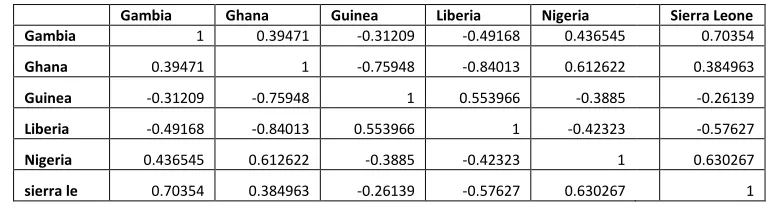
[image:15.842.235.618.336.439.2]The correlation coefficients show that openness for the four countries in the study are correlated moderately except Guinea and Liberia having symmetrical aligned within themselves but asymmetrical with the rest one in the zone. It suggests that Gambia, Ghana, Nigeria and Sierra Leone are symmetrically aligned. It indicates presence of common policy towards their open trade in the zone. The table below indicates the correlation of openness shock.
Inflation correlation coefficients
From inflation’s correlation coefficient, countries like Gambia, Ghana, Nigeria and Sierra Leone are symmetrical aligned. The coefficient is quite low indicating presence of low correlation. It symbolizes that these countries in WAMZ have not been able to achieve better improvement towards fairly monetary policies in their zone. The below implies the evaluated correlation of inflation
Gambia Ghana Guinea Liberia Nigeria Sierra Leone Gambia 1 0.39471 -0.31209 -0.49168 0.436545 0.70354
Ghana 0.39471 1 -0.75948 -0.84013 0.612622 0.384963
Guinea -0.31209 -0.75948 1 0.553966 -0.3885 -0.26139
Liberia -0.49168 -0.84013 0.553966 1 -0.42323 -0.57627
Nigeria 0.436545 0.612622 -0.3885 -0.42323 1 0.630267
sierra le 0.70354 0.384963 -0.26139 -0.57627 0.630267 1
Gambia Ghana Guinea Liberia Nigeria Sierra Leone
Gambia 1 0.058928 -0.19338 -0.08308 0.352174 0.129299 Ghana 0.058928 1 -0.6244 0.051587 0.417113 -0.46367
Guinea -0.19338 -0.6244 1 -0.15704 -0.16276 0.647501
Liberia -0.08308 0.051587 -0.15704 1 -0.0484 -0.05566 Nigeria 0.352174 0.417113 -0.16276 -0.0484 1 0.023599 Sierra
15
Output shock correlation coefficients
Correlation coefficient of output happens to be mixed, each country is correlated at least with one country (Gambia-Nigeria), (Ghana- Nigeria), and (Guinea, Ghana and Sierra Leone) but the correlations show low coefficients, despite poor correlation, there is still an asymmetrical misalignment. This is a serious evaluation in the sense for monetary policy to have a short run impact, that is a stabilization effect, then based on this finding, there is no way for a common monetary policy to affect this dominating output shock. The table under shows the correlation findings of output shock
Gambia Ghana Guinea Liberia Nigeria
Sierra Leone
Gambia 1 -0.06839 -0.1706 -0.2098 0.642027 -0.5218 Ghana -0.06839 1 0.30429 -0.0168 0.255562 -0.3001 Guinea -0.17065 0.30429 1 -0.4981 -0.07258 0.40804 Liberia -0.20985 -0.01684 -0.4981 1 -0.47028 -0.1693 Nigeria 0.642027 0.255562 -0.0725 -0.4702 1 -0.563
Sierra
Leone -0.52187 -0.30012 0.40804 -0.1693 -0.563 1
Real Exchange Rate Correlation Coefficients
Except for Ghana and Sierra Leone, the real exchange rate for all WAMZ countries are all
symmetrical aligned which indicates presence of similar exchange rate policy. This was in contrary with the study evaluated by Addison, Okopo-Afari and Kinful (2005). The correlation table of real exchange rate is indicated below.
Gambia Ghana guinea Liberia Nigeria Sierra Leone
Gambia 1 0.497703 0.335146 0.503061 0.669704 0.598384
Ghana 0.497703 1 0.286969 0.376769 0.715864 -0.20631
Guinea 0.335146 0.286969 1 0.129763 0.357674 0.397999 Liberia 0.503061 0.376769 0.129763 1 0.345385 0.45265
Nigeria 0.669704 0.715864 0.357674 0.345385 1 0.312158 sierra
16
Misaligned Real Exchange Rate Correlation coefficients
Misaligned real exchange rate correlation coefficients happened to be mixed in the zone except Guinea having positive correlation with the three nations in the zone (Gambia, Ghana, Nigeria and Sierra Leone) , and with that, the coefficients are quite low while Nigeria and Ghana are symmetrical, and Sierra Leone and Gambia are also symmetrical. It suggests that all the countries in the zone are facing different determinants of real exchange rate at different periods which call for better improvement in monetary policies. Under is the correlations table of real exchange rate misalignment
Gambia Ghana guinea Liberia Nigeria Sierra Leone
Gambia 1 -0.5422 0.197647 0.51878 -0.26708 0.772264
Ghana -0.5422 1 0.289205 0.23868 0.616377 -0.30936
Guinea 0.197647 0.289205 1 0.41588 0.519285 0.726678
Liberia -0.51878 0.23868 -0.41588 1 -0.29315 -0.54823
Nigeria -0.26708 0.616377 0.519285 0.29315 1 -0.01421
Sierra leone 0.772264 -0.30936 0.726678 0.54823 -0.01421 1
Growth Analysis
4.3. Real Exchange Rate Misalignment and Economic Growth
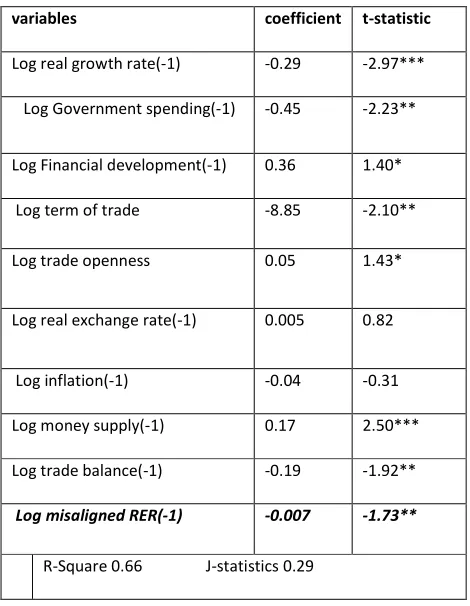
This section empirically investigates the impact of real exchange rate misalignment on economic growth of WAMZ countries using panel data analysis and generalized method of moment towards the zone monetary union. Prior to the analysis of the study growth rate regression results, the study would mention that the specification test-Sergan test of over-identifying restrictions validate the study regressions for inference i.e. the study instruments are not correlated with error term. The explanatory variables are grouped into four, namely structural policies (financial development, trade openness, and government, money supply), stabilisation policies (real exchange rate, misaligned RER, inflation-price instability) and external factors (term of trade and trade balance) as well as lagged of dependent variable. From the baseline equation of growth regression, table 3, there is presence of positive sign between growth rate and the following explanatory parameters in the model such as financial development, trade openness, supply of money and real exchange rate. Where financial development at first lag and openness with five per cent of statistical significance level ,that a
17
conclude the baseline model, sixty six percent of the variation in the growth rate is explained by the variables tested.
Regarding the study variable of interest, the study discovered that there is a negative correlation and statistical significance at five percent level between misaligned real exchange rate at first lag (-0.007, its coefficient) and economic growth of WAMZ countries in the study. This implies economic growth decline in response to increase in misaligned real exchange rate in WAMZ zone. It may be inferred that in order to boost growth in the zone, it is advisable for policy makers to over-value their currencies in economic sense, depreciating the currencies beyond its equilibrium level may enhance export to economic growth but the study found that large undervaluation may hurt the economic growth. This further leads the study to evaluate the possible effects on growth of RER overvaluation and undervaluation as well as different movements in exchange rate effects on growth rate through the inclusion of both misaligned real exchange rate and equilibrium real exchange rate in the study model.
Table 3, Real exchange rate misalignment and economic growth: baseline regression
variables coefficient tstatistic
Log real growth rate(-1) -0.29 -2.97***
Log Government spending(-1) -0.45 -2.23**
Log Financial development(-1) 0.36 1.40*
Log term of trade -8.85 -2.10**
Log trade openness 0.05 1.43*
Log real exchange rate(-1) 0.005 0.82
Log inflation(-1) -0.04 -0.31
Log money supply(-1) 0.17 2.50***
Log trade balance(-1) -0.19 -1.92**
Log misaligned RER(-1) -0.007 -1.73**
[image:18.595.176.411.330.633.2]18
4.3.1. Growth and Misaligned Real Exchange Rate for controlling Equilibrium Real Exchange Rate
With respect to different movements in the exchange rate effects on growth rate, following Edward (1989) that changes in the country international competitiveness can be attributed to
productivity shifts in trade sector, more favourable term of trade, change in taxation, among other factors. These justified changes as Edward (1989) calls them constitute an equilibrium phenomenon. However, there is unjustified deviation of the actual RER from its equilibrium level or so called
misaligned RER. To distinguish both types of shifts in RER, it is important to control for the equilibrium real exchange rate as said by Aguirre and Calderson (2005)
The study includes equilibrium real exchange rate in its growth equation in order to differentiate the effects of these different movement in the exchange rate i.e. equilibrium vs. disequilibrium movement in the real exchange rate. To contrast whether measure of misalignment captures only disequilibrium and their effects on growth, it becomes relevant to include equilibrium real exchange rate in the study regression equation. Otherwise, the omission of the equilibrium real exchange rate in our growth equation may yield inconsistent estimates for the misaligned real exchange rate indicator as explained by Aguirre and Calderson (2005)
From table 4, the study incorporates the equilibrium real exchange rate and misaligned real
exchange rate in its baseline regression, the equilibrium real exchange rate has a positive and significant coefficient of 0.009 at five percent statistical significant level. While misaligned real exchange rate at first lag has negative significant impact on economic growth of -0.007 at five percent statistically significant level. It implies that growth is hampered by disequilibrium real exchange rate. According to Edward (1989) and Aguirre and Calderson (2006) believed that the positive correlation between growth and equilibrium real appreciation of the country currency may be driven by technology improvement in the traded sector of the home country, improvement in term of trade among others.
It is quite interesting to observe that incorporation of equilibrium real exchange rate into the baseline equation changes the regression outcome of the model leading the entire parameters to be statistically significant. Real exchange and inflation are not statistically significant in the baseline equation while at controlling equilibrium real exchange rate equation, real exchange rate coefficient is 0.005 and inflation coefficient at second lag is -0.14 statistically significant at five percent and ten percent level respectively. To conclude the controlling equilibrium real exchange rate model, seventy three percent of the variation in the growth rate is explained by the variables tested. This indicates that equilibrium real exchange rate plays an economic influence towards economic growth in the WAMZ countries.
19
Table4, Real exchange rate misalignment and economic growth: controlling for equilibrium Real exchange rate
4.3.2. Effects of Real Exchange Rate Undervaluation and Overvaluation on Growth
The possible effects on growth of RER overvaluation and undervaluation evaluate whether this impact depends on the size of the deviation from equilibrium level. In order to test these hypotheses the study introduces the dummy variables. Variable P takes the value of 1 when the real exchange rate is overvalued and 0 otherwise. The variables of overvaluation and undervaluation of RER as qm +=
(q-xbB)(pt) and qm-= (q-xbB).(1-Pt) respectively . The baseline regression is now modified by incorporating
real exchange rate overvaluation and undervaluation instead of misaligned real exchange rate including controlling for equilibrium real exchange rate. In this modified baseline equation, q m+ (q m- ) takes
positive (negative) values when the real exchange rate is over (under) valued and 0 otherwise. qm+ in the
modified equation will be negative and significant if growth expect to be hindered by real exchange rate overvaluation. q m- will be positive (negative) if real exchange rate undervaluation boosts (harms)
economic growth. The study output is shown in table 5 of growth tables. variables coefficient tstatistics
Log real growth rate(-1) -0.28 -3.19***
Log Government spending(-1)
-0.44 -2.24**
Log Financial development(-1)
0.34 1.43*
Log term of trade -11.83 -3.11***
Log trade openness 0.06 1.64*
Log real exchange rate 0.005 1.94**
Log inflation(-2) -0.14 -1.36*
Log money supply(-1) 0.18 3.16***
Log trade balance(-1) -0.16 -1.71**
Log Equilibrium RER 0.009 1.87**
Log misaligned RER(-1) -0.007 -1.83**
20
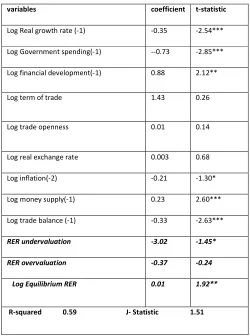
The study performs growth regression for real exchange rate overvaluation and undervaluation as well as equilibrium real exchange rate which discloses that coefficient of overvaluation is negative and statistically insignificant in the equation, while coefficient of undervaluation is negative (-3.02) and significant at five percent level. It implies that the larger degree of real exchange rate undervaluation, the lower the economic growth of the economies, WAMZ zone. The growth effect may be positive for small to moderate degree of real exchange rate undervaluation and negative for larger degree of undervaluation as observed in the table 5. Hence, there is positive and significant coefficient for movement in the equilibrium real exchange rate. By implication economic growth may be enhanced by an equilibrium real appreciation while equilibrium real exchange rate depreciation slows down growth and small undervaluation of local currency raise growth prospect. It is quite appalling to notice real exchange rate overvaluation and undervaluation having an influence on economic growth in which the presence of term of trade, openness and real exchange rate in the regression model are statistical insignificance while these three parameters have positive coefficients in the modified growth equation of effect.
Table 5, Effects of Real Exchange Rate Undervaluation and Overvaluation on Growth
variables coefficient tstatistic
Log Real growth rate (-1) -0.35 -2.54***
Log Government spending(-1) --0.73 -2.85***
Log financial development(-1) 0.88 2.12**
Log term of trade 1.43 0.26
Log trade openness 0.01 0.14
Log real exchange rate 0.003 0.68
Log inflation(-2) -0.21 -1.30*
Log money supply(-1) 0.23 2.60***
Log trade balance (-1) -0.33 -2.63***
RER undervaluation -3.02 -1.45*
RER overvaluation -0.37 -0.24
Log Equilibrium RER 0.01 1.92**
[image:21.595.173.423.364.700.2]21 Concluding Remarks
The study examines the real exchange rate misalignment and economic performance of WAMZ countries to determine the implications of economic unionization of the zone. The analyses are
performed using data derived from international financial statistics, international monetary fund, where panel data estimation was used. The ordinary least square of Panel Generalised Method of Moments model is used to estimate the real exchange rate equation in order to determine equilibrium real exchange rate and real exchange rate misalignment. The study adopts Generalised Method of Moments panel data approach so as to estimate the growth regression equation and cross country correlation approach to assess the degree of symmetrical existence among the WAMZ countries.
The study reveals through panel regression of long term real exchange rate that explanatory variables depreciate real exchange rate in WAMZ zone with fundamental determinants. The presence of monetary factors (inflation, money supply shock and output shock) influenced the real factors of real exchange rate leading to contraction of economic theory (wrong signs of openness and trade balance) in which economic implication stags as presence of instability in openness and trade balance across the zone. The transitory explanatory variables in the zone imply that the zone addresses its exchange rate problems in short run by pursuing stable exchange rate and monetary policies.
Regarding the study variable of interest, the study discovered that there is a negative correlation between misaligned real exchange rate and economic performance at its first lag which implies that economic performance declines in response to increase in real exchange rate misalignment. The inclusion of equilibrium real exchange rate in order to differentiate the effects of these different movement in exchange rate, the study reveals that presence of equilibrium contributes positive
correlation while misaligned real exchange rate is negative indicating that economic growth is hampered by misalignment in real exchange rate.
The growth regression of over-valuation and under-valuation of real exchange rate indicates negative relationship, the larger degree of undervaluation, the lower the economic performance of the
economies in zone. This calls for small degree of undervaluation of local currencies in the zone to raise growth prospect in the zone.
The implication of the study is subjected to assessment towards similar patterns of shocks creating substantial symmetrical alignments that presume good candidates for currency union. With respect to assessments which happen to be obtained mixed outcomes, it is advisable for WAMZ to commence with four most promising countries such as The Gambia, Ghana, Nigeria and Sierra Leone. It should be noted that credible institutions that can enhance effective surveillance with stringent rules towards imposing sanctions for non-compliance are strictly applied.
22 Reference
Addison, E.K.Y., Okopo-Afari ,M. and Kinful (2005) “Term of Trade and Real Exchange Rate Shocks and Implications for WANZ” working Paper, Bank of Ghana.
Aguire, A. and Calderson ,C. (2005) “Real Exchange Rate Misalignment and economic Performance” http:// www.bcentral.cl/eng/stdpub/studies/workingpaper
Akinbobola, T.O . and Akinlo, A.E. (2005) “Should The West African Countries Form A Currency union?” SAJEMS, NS8 (2005) No.3
Alagidede, Tweneboah and Adam (2008) “Nominal Exchange Rate and Price Convergence in the West African Monetary Zone” International Journal of Business and Economics, Vol.7, No.3, 181-198
Anokye, M.A., Daniel, Agyapong and Gyamfi, E.N .(2010) “Dynamic Macroeconomic Convergence in West African Monetary Zone” International Business and Management, Vol.1, No.1.pp31-40,
www.cscanada.net
Arellen, M. and Bover, O. (1995) “Another look at the Instrumental Variable Estimation of Error Components Models” Journal of Econometric 68(1); 29-51
Balogun, E. D. (2009) “Determinants of West African Monetary Zone (WAMZ) countries global export trade: do foreign reserve and independent exchange rates matter?” Munch Personal RePECs Archive.
Http: //mpra.ub.uni-muenchen.de/4308
Balogun, E.D. (2007) “Monetary Policy and Economic Performance of West African Monetary Zone Countries" Munich Personal RePECs Archive. Http:
//mpra.ub.unimuenchen.de/4308
Balogun, E.D. (2008) “An Alternative Reconsideration of Macroeconomic Convergence Criteria for West African Monetary Zone” Munch Personal RePECs Archive. Http:
//mpra.ub.unimuenchen.de/4308
Beetsma , M.Y. and Bovenberg , A.Lans (1995) “Monetary Union without Fiscal Coordination may discipline policy- makers” Joint Research Unit, CNRS-EHESS-ENS, Paris.
Bjorsten, Nils., Grimes, Arthur., Ozer, karagedukli and Christopher, Planter (2004) “What can the Taylor rule tells us about a currency union between New Zealand and Australia?” Discussion Paper series, Reserve Bank of New Zealand, June
23
Buigut, S. K. and Valev, N.T. (2005) “Eastern and Southern African Monetary Integration: A structural Vector Auto- regression Analysis” working Paper, Andrew Young School of Policy Studies, Georgia State University.
Carmignani (2009) “Endogenous Optimal Currency Area: the case study of the Central African Economic and Monetary Community” School Economic Discussion Paper No.39, The University of Queenland, Australia, June.
Debrun., Masson and Pattillo (2003) “west African Currency Unions: Rational and Sustainability” CESIFO, Economic Studies
Edward, S. (1989) “Real Exchange Rate, Devaluation and Adjustment” Cambridge, Mass The MIT Press.
Foresti, Pasquale (2007) “Is Latin America an Optimal Currency Area? Evidence from a Structural Vector Auto regression Analysis” MPRA
Fourie and Santana-Gallego (2009) “Measuring the gain from currency union membership in South Africa” by Trade Law Centre for southern Africa, TRALAC
Frankel, J. and Rose, A. (1998) “The endogeneity of the Optimal Currency Areas Criteria” Economic Journal, Vol. 108 No. 449, 1009-1025.
Hefeker, C. (2003) “fiscal Reform and Monetary Union in West Africa” HWWA, Discussion PAPER 224, Hambury Institute of International Economics, ISSN 1616-4814
Houssa, R. and Leuven, K.U. (2004) “Monetary Union in West Africa and Asymmetrical shocks: A dynamic structural factor model approach” The Centre for the Study of African Economies Working paper 217, 2004, Oxford University, forthcoming in Journal of Development Economics
Jayaraman ,T.K .(2004) “A Single Currency for the Pacific Island Countries: A stepwise Approach “Asia Pacific Development Journal, Vol.11 No. 1, June
Kenen, P.B. (1969) “The theory of Optimum Currency Areas: an eclectic view” in R. Mundell and A. Swoboda (eds.) monetary problems of the international economy, pp.41-60 (Chicago, Illinois, University of Chicago Press)
Masson, P.A. and Pattillo, C. (2001) “Monetary Union in West Africa (ECOWAS): is it desirable and how could it be achieved?” Occassional Paper No.204, Washington,D.C Institutional Monetary Fund
Masson, Paul R. (2006) “Currency Unions in Africa: Is the trade effect substantial enough to justify their formation? “ A preliminary version was presented at the (The annual GTAP, Global Economic Analysis Conference, UNECA, Addissa Abba, June 15-17.
24
Mundell, R.A. (1961) “A theory of optimum Currency Areas” American Economic Review Vol.51, Sept., pp.657-65
Ogunkola, Olawale (2005) “An Evaluation of the viability of a Single Monetary Zone in ECOWAS” AERC Research Paper 147, Nairobi, January.
Razin, O. and Collins, S.M. (1997) “Real Exchange Rate Misalignment and Growth” NBER working paper 6174 http:// www.nber.org/papers/w6174
Scitovsky, T. (1958) “Economic Theory and Western European Integration” London, Allen and Unwin
Tasmir, Chan. (2009) “Is WAMZ an Optimum Area (OCA)?” journal of Monetary and Economic Integration.