Biodiversity Conservation and the Poor: Practical Issues
beyond Global Conferences
Esther W. Dungumaro
Institute of Development Studies, University of Dar es Salaam, Dar es Salaam, Tanzania. Email: [email protected]
Received May 22nd, 2013; revised June 25th, 2013; accepted July 9th, 2013
Copyright © 2013 Esther W. Dungumaro. This is an open access article distributed under the Creative Commons Attribution License, which permits unrestricted use, distribution, and reproduction in any medium, provided the original work is properly cited.
ABSTRACT
The paper focuses on biodiversity—an issue that easily gets left out of consideration because it is hard to measure. While efforts to reduce over-fishing or conservation of water resources are relatively easy to discuss in quantitative terms, biodiversity in terms of plant species is usually covered by crude and even invalid figures. The paper begins by providing a brief historical overview of attempts to define biodiversity, going back to the early efforts in Africa to deal with conservation and showing how definitions have evolved overtime and how they have shaped conservation efforts. While the main focus of the paper is biodiversity conservation and the poor, the paper makes references to the World Summit on Sustainable Development (WSSD) and other important global conferences including the World Conference on Environment and Development and Convention on Biological Diversity. The paper finds that international confer- ences by and large do not adequately address the issue of biodiversity and the poor. The limited commitment shown by political leaders at the conferences should be a reason for global and local authorities to create an environment that en-ables communities to meet their daily needs, foster development and conserve biodiversity.
Keywords: Biodiversity; Conservation; Conferences
1. Introduction
Delegates at the 2003 World Summit on Sustainable De- velopment (WSSD) in Johannesburg wisely avoided high-sounding resolutions or unrealistic targets, prefer- ring to leave the agenda for the future more open-ended and depending on voluntary initiatives. While this may seem as if the world is letting up on the necessary care of its future survival, previous attempts at setting specific and often absolute targets have created their own back- lash. For instance, failure to reach any significant, even modest progress on Agenda 21—the resolutions passed at the 1992 World Conference on Environment and De- velopment in Rio de Janeiro—has left behind a wide- spread sense of cynicism.
Although interpretations of the WSSD recommenda- tions vary, we read the outcome of the Johannesburg meeting not to be just negative. The limited commitment to sustainable development shown by political leaders at the summit should be a reason for everyone to step up pressures to do something. Mega conferences like the ones in Rio de Janeiro and Johannesburg are not the breeding ground for new and exciting initiatives. These
are better produced in the wake of such gatherings, whether in response to new opportunities or sentiments of blighted hope. This, therefore, may be an opportune time for the international community to find new ways of doing things and new modes of institutional cooperation.
The paper specifies the interest by relating the focus on biodiversity to the conditions of the poor. This is not an admission that the poor constitute a greater threat to biodiversity than other social groups do. Rather the atten- tion on the poor is due to the relationship of the poor to biodiversity, again, more difficult to get a handle on than the impacts of transnational corporations or governments. The assumption is that biodiversity and the poor continue to be one of the trickier issues to deal with.
2. Historical Overview of Attempts to
Define Biodiversity
From “Preserving Eden” to “Saving Earth from Hell”
Although we commonly speak of biodiversity in both professional and popular discourse today, the concept is relatively new. Biodiversity has gained currency only in the past two decades or so. It made its way into policy debates in the United States in the late 1980s after the Office of Technology Assessment of the US Congress published a major report on technologies to maintain biological diversity [1]. It reached international accep- tance a few years later as negotiations began for the Con- vention on Biological Diversity (CBD)1.
Prior to the CBD, issues of biodiversity were covered under the more general rubric of conservation, which fo- cused more on fauna than flora. Moreover, it emerged in the colonies, especially those in Africa belonging to Brit- ain, drawing on 19th century environmentalism in the United States and Europe. For instance, some of the best- known national parks in the world were first gazetted in the 1920s: Serengeti as early as 1921, Ngorongoro Crater in 1928. These efforts represented one aspect of overall colonial policy that was not necessarily mainstream: the idea that Africa constituted the closest humankind is to Eden and that it needed protection from human interfer- ence; hence, conservation instead of modernization and civilization which were the main pillars of that policy.
In its early days conservation paid attention to the preservation of species in their original habitat without considering the implications for human beings living in or nearby these protected areas. In the Ngorongoro Crater, for example, conservationists aimed at separating parks and people—the Maasai being a case in point.
The emergence of biotechnology and genetic engi- neering as major fields of both research and business has placed biodiversity in a new perspective. With commer- cial biodiversity prospecting in the past fifteen years or so, animals, plants, even microorganisms, have acquired a new value [2]. The whole issue of property rights to na- ture took on a special significance in the negotiations leading up to the CBD in the first half of the 1990s [3]. Using genetic material from wild animals to improve livestock, and preserving plants in gene banks for me- dicinal and other purposes, has given biodiversity a much broader significance. Returns on investment in biodiver- sity prospecting have been relatively poor. However, original and uncontaminated genetic material has a defi-
nite value not only among environmentalists but also those involved in business. [4] reflect this perspective of the value of original genetic material when defining bio- diversity as “a contemporary term referring to the variety of organisms of all kinds in a given habitat”, implying the presence of a healthy plant and animal association resistant to exogenous stress such as ecological disrup- tions caused by humans.
The breadth of definition of biodiversity is clear in the 1987 OTA2 report and is echoed in a World Bank docu- ment devoted to the relationship between biodiversity and agriculture [5]. It encompasses three distinct dimen- sions: 1) at the micro level, the importance of genetic variation within a given species; 2) at the meso level, the value of species diversity and the functions particular species perform in a given ecosystem; and 3) at the macro level, ecosystems diversity, i.e. a landscape inter- spersed with croplands, grasslands, and woodlands being more diverse than one occupied by only a single type of landscape.
This definition is also reflected in the programs under the CBD that were negotiated in the early 1990s. As the most authoritative international agreement in this field, the parties to this convention have committed themselves to the objective of protecting not only individual species but also habitats. Brazil, for instance, has gone as far as declaring biodiversity part of its national heritage and has claimed sovereign control over it. It is important to note, however, that at the global level the CBD has languished for lack of both political and financial support. In con- trast, the Convention on International Trade in Endan- gered Species of Wild Fauna and Flora (CITES), another legal mechanism at the global level aimed at stemming the threats to endangered species around the world, has enjoyed much greater success both financially and po- litically. This suggests that it is easier to mobilize politi- cal and other forms of support for biodiversity if it is tied to conservation of animal species. The latter arouse stronger feelings than talk about conserving just plant species.
As animals and plants have taken on growing com- mercial value due to both scarcity and new technologies, the definition of biodiversity has changed in three im- portant respects. It is no longer narrowly confined to conservation of wild game in their habitat. It includes also plants and even microcosms that help sustain biodi- versity. Nor is it any longer just a preservation of species in their natural habitat without considering implications for human beings around the protected areas. The defini- tion of biodiversity is no longer merely a statement of its scientific properties but includes also reference to institu- 1The Convention on Biological Diversity (CBD) with three objectives
(namely conservation of biological diversity; sustainable use of the components of biological diversity; fair and equitable sharing of the benefits arising out of the utilization of genetic resources) entered into
tional and political aspects thereof. Preserving Eden is no longer the most adequate metaphor. More relevant is the idea that we are all engaged in salvaging the Earth from becoming Hell. In sum, biodiversity has become embed- ded in a much more complex and multifaceted process and definitions thereof reflect this new reality.
3. Operationilizing the Concept of
Conserving Biodiversity
3.1. From Separation to Integration
The conservation of biodiversity becomes easier to un- derstand if and when biodiversity is considered for its economic and aesthetic value. Despite the ability to “manufacture” nature in our laboratories, there is still need to preserve nature’s own way of crafting genetic material. Otherwise, we will be worse off not only in terms of resources but we will also be making it harder for future generations to enjoy what nature would have offered them. At the present, neglect or negative conduct upon biodiversity reduces our ability to utilize nature’s resources for agricultural, industrial, or medicinal pur- poses. It is difficult to place value to the services pro- vided to humankind by various ecosystems or species, but its magnitude is not in question. An example is the use of plants in making drugs. At least 25 percent of all prescription drugs in the United States are derived from plants, a figure that has been on the increase in the past two decades. Their estimated value today is approxi- mately $20 billion.
Aesthetic motivations also play their part in the debate about biodiversity. Although such motivations tend to focus foremost on rare species and their habitats, e.g. the Big Five (elephants, rhinoceros, lions, giraffes and buf- falos) on the African savanna and the bald eagle or the bison in North America, attention has also increasingly been paid to more general or indirect threats to biodiver- sity that are potentially more sweeping in scope, e.g. in- dustrial pollution.
In the global context, the United States stands out among industrial societies as remarkably dependent on natural resource use. Its per capita consumption of non- renewable resources is as high as twice that of other in- dustrialized nations. This is not a luxury afforded the poorer nations of the world, which, like the United States of America, are highly dependent upon on their own nat- ural resources. In Africa, for example, food security is linked with access to genetic resources in two ways. First, plants and herbs in the wild often constitute alternative foods at times of famine. Second, these genetic resources provide the basis for developing improved varieties. It is no surprise that developing countries are among the most concerned with the loss of genetic material, whole spe-
cies, and even habitats. Following the first international conference devoted to environmental conservation in Stockholm 1972, the total land area of the world set aside as protected reserves or parks rose by almost fifty per cent in the period 1974-1984 [6]. Most of this expansion took place in developing countries. Nine such countries have reserved 10 per cent or more of their total land as protected areas3.
The growing public interest in avoiding biodiversity losses means that the issue has taken on greater political and economic significance. Above all, dealing with bio- diversity has meant the evolution of new approaches to both policy formulation and implementation. Three ob- servations on this issue are particularly relevant. The first is the inclusion of human beings in the policy equation. For a long time, the policy was to treat conservation as an objective that benefited from excluding the human factor. Separation of people and parks was the standard in the earlier periods of creating and managing conserva- tion projects. This has changed in the past twenty years. People are now treated as an integral part of conservation with the realization that they can do both harm and good. Efforts must be made to provide incentives for the latter to happen. Allowing people to share in the revenue of conservation efforts has become an especially popular mechanism for achieving this objective. This new ap- proach reflects the negative experience of earlier efforts that ignored and marginalized people living in the vicin- ity of protected areas and parks. Without adequate atten- tion to creating local beneficiaries in conservation efforts, chances for success remain remote [7].
The second observation is the ensuing shift from a top- down to a bottom-up approach to conservation efforts. When scientists and conservation officials pretty much owned the policy arena alone, they could create blue- prints that were delivered by agencies from high up. The World Conservation Strategy launched by the Interna- tional Union for the Conservation of Nature (IUCN) in 1980 is a case in point. It was a vision of conservation that reflected the biologists’ view and assumed that it could—and would—prevail. For instance, one passage reads, “ultimately the behavior of entire societies towards the biosphere must be transformed if the achievement of conservation objectives is to be achieved” quoted in [8]. Such grand social manipulation schemes have, fortu- nately, been abandoned today in favor of smaller scale activities that involve local people. Most notable among these has been the CAMPFIRE4 project in Zimbabwe, which has served as a model for many others, especially
3These countries are: Benin, Bhutan, Botswana, Central African
Re-public, Costa Rica, Rwanda, Senegal, Tanzania, and Zimbabwe (Har-rison et al. 1984).
4Community Areas Management Programme for Indigenous
in neighboring African countries [9-11]. In this and other projects, two important innovations have been made. The first is that revenue is paid directly to the local commu- nity. The second is that on a controlled basis, the local population has access to the protected areas to hunt cer- tain wild animals.
The underlying assumption of this new approach is that part ownership of the whole process of managing conservation projects will induce people to take biodi- versity more seriously. It is not always clear, however, whether these people are to blame if conservation does not happen. In many countries, the local population, es- pecially its poorer segment, is being marginalized by commercialization of land on which it lives. In Southeast Asia, for instance, for commercial interests the rain forest is being harvested against the will of the local people [12]. In Brazil, small farmers have been forced to destroy biological diversity and move to smaller and smaller ar- eas against their will [13]. In places where the local peo- ple have been given a fair chance, the prospects for suc- cess have increased. The Makalu-Barun National Park Project in Nepal is a case in point. It focuses on biodiver- sity conservation through a participatory approach. Peo- ple are treated as a resource to promote both environ- mental and cultural conservation through sustainable means. Especially important in this case is the extent to which local institutions have been incorporated and used in the implementation of projects.
The third observation is that governments and interna- tional agencies are no longer the only organizations of importance in the biodiversity conservation field. The number of environmental non-governmental organiza- tions (NGOs) at the national level in each country has grown exponentially in the past twenty years. Some of these are scientific in their pursuits, while others are more focused on the practical issues of conservation and development. Not all of them are specifically concerned with biodiversity, but, directly or indirectly, the bulk of them are. In addition, there has been a tremendous in- crease in the number of community-based organizations devoted to biodiversity issues. Many of these are in- volved in projects aimed at providing income to local households, while at the same time paying attention to conserving nature.
The implication of these changes is that the political and organizational landscape in the biodiversity field has become much more complex. In the old days, politiciza- tion of conservation used to take place at policy imple- mentation. Formulating policies typically occurred in an insulated institutional setting, e.g. a ministry headquar- ters. Today, politicization begins at the point of policy formulation. Participatory approaches assume that every stakeholder should have the opportunity to make a con-
tribution or input already at the stage of problem identi- fication and problem solving. We shall now look at the post-WSSD context.
3.2. Practical Issues in Conservation
The integration of “parks” with “people” on one hand, and conservation with development on the other has en- hanced public consciousness about biodiversity issues (see Figure 1). Initially the two issues were treated as opposites on a spectrum [14].
The WSSD process has been instrumental in steering the discourse in this direction. For many years, econo- mists and conservationists had little to say to each other. Attempts at creating a middle ground in the name of eco- logical economics [15] have not born the fruits that its architects were hoping for. Instead, in the past few years, it is the neo-liberal economists who have come to occupy the middle ground, largely as a result of a redefinition of their enterprise toward a greater focus on poverty allevia- tion. With its new focus on poverty, the World Bank has played a particularly important role in achieving this shift [16].
The result is that the conservation community has found itself on the defense. Although one should not pay too much attention to the wordings coming out of resolu- tions adopted by international gatherings like the WSSD, it is quite remarkable that the Johannesburg Declaration does not make reference to conservation at all. The docu- ment is draped in the language of poverty eradication and sustainable development. One has to read between the lines for any suggestion that natural resources deserve conservation.
Growth with equity suggests that economic develop- ment should focus on equal distribution of natural re- sources. This “growth-with-equity” perspective is in many respects an echo from previous decades, but con- stitutes the political reality in which conservation issues are treated. As [17] argues, conservationists must be able to develop alternatives or otherwise be consigned to ir- relevance. There seem to be two immediate steps that they can take in order to provide themselves with an op- portunity to become more relevant to the ongoing politi- cal discourse on biodiversity issues. One is to think of whom to partner with. Another is to disaggregate the category of poor people. Conservation and poverty alle- viation will require different approaches depending on hich group of poor people is being targeted.
As suggested above, the organizational landscape that
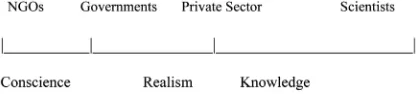
is relevant to biodiversity has undergone significant changes in recent years. It is more complex and requires of each actor a more thorough understanding of con- straints and opportunities as well as greater pragmatism or flexibility in their approach to action. The line-up of principal actors may be summarized as follows:
Figure 2 does not necessarily imply that the distance between NGOs and scientists is always longer than is the case with other actors. It is mainly meant to highlight the fact that each set of actors operates with a dominant logic. NGOs take a morally higher ground because more than any of other actors, they are driven by a desire to do well. Voluntarism and charity all imply a definite measure of self-sacrifice that is more easily incorporated into NGOs and social movements (the ultimate in terms of acting on the basis of conscience) than into other types of organi- zation. Scientists, on the other side, justify their own professional pursuit predominantly in terms of knowl- edge generation and application. They do have a con- science too, but their professional reputation is driven more by what research they do and how well they do it. Scientists and representatives of NGOs do not always agree, but they have demonstrated in recent years that they have the ability to work together.
Governments may not be quite the “new boys on the block” but their participation in the conservation field has taken place in response to concerns initially ex- pressed by NGOs and scientists. The “Limits to Growth” scenario was an important input into the 1972 Stockholm Conference and the debate that followed it [18]. The Brundtland report that was produced in the mid-1980s was also very much the result of inputs from scientists and NGO representatives [19]. Governments have be- come increasingly compelled to listen to the voices of others on these issues. As both the Rio Conference in 1992 and the WSSD demonstrate, however, governments take a pragmatic or realistic view of things even if they may be party to high-sounding phrases in official decla- rations. This leaves them easily susceptible to accusa- tions of hypocrisy.
Private sector representatives are the ones considered the real newcomers as the older members of the conser- vation community are still suspicious of their intentions. NGO representatives, in particular, scorn them for bring- ing profit considerations to the debate. Scientists may be less vocal on this matter, but they have their own reser- vations stemming from e.g., controversies over intellec- tual property rights.
It is not difficult to see that this situation lends itself to intensified struggles over policy agenda. Both NGOs and scientists feel threatened because they do not possess the money or political power to set the agenda. They typi- cally must play within the confines of terms set by gov-
Figure 2. Principal actors interested in biodiversity and the poor.
ernments and, to an increasing extent, by transnational corporations. The fact that their voice is not heard as much and that governments and private sector represen- tatives take a very pragmatic view of the conservation issues angers and alienates them. This is a “trap” that Sanderson is warning against reluctance to create part- nerships with others, because they act with different mo- tive is not likely to aid the conservation cause.
Conservationists, like other stakeholders, need to tack- le poverty issues. The challenge before them is how to do that without losing their concern over the degradation of biodiversity. They may be upset by the fact that the WSSD language is not as strong as that of the 1992 CBD5. One of the inevitable consequences of main- streaming an issue, however, is that it becomes part of a broader agenda with multiple objectives. While this may be read as constraining, the integration of conservation into mainstream development discourse also produces its own opportunities. We believe that members of the con- servation community can make a major contribution by disaggregating the concept of the “poor” in relation to biodiversity.
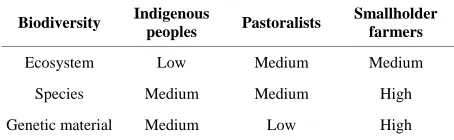
The indigenous people are of concern here. The life- style of the indigenous peoples who live in tropical for- ests has changed little, although it is increasingly threat- ened by what is going on around them. The Indians in the Amazon and the Maasai of East Africa and the Somali in the Horn of Africa are cases in point. The indigenous people’s contribution to biodiversity degradation includ- ing species extinction and habitat change has generally been due to increasing pressures of meeting their imme- diate demands. However, the threats to biodiversity that the indigenous people will have vary from other groups notably pastoralist and smallholder farmers. It may be helpful to create a matrix that illustrates how the three components of biodiversity—genetic, species, and eco- system diversity—are affected by the socio-economic activities of the three mentioned groups. This comparison is done to assess the contribution of indigenous people as compared to other two groups on biodiversity degrada- tion and conservation. With a view to identifying where the primary challenges in tackling biodiversity issues among the indigenous people, the levels of risk are re-
5The CBD calls for species loss to be stopped, while the Plan of
ferred to as high, medium, or low, as shown in Table 1. The levels of risk reflect the probability that the in- digenous people themselves will be incurring losses of biological diversity. Since the indigenous people do not live and work in complete isolation from other actors, they may be adversely affected by activities of these oth- er actors.
As these peoples get more affected by broader eco- nomic and social processes, there is an increasing likeli- hood for loss of species and genetic material. Efforts by “green” corporate entities like Ben and Jerry to buy in- gredients for their ice cream manufacturing direct from indigenous groups in the Amazon are noble and prefer- able from a biodiversity point of view, but they do have the effect of changing their attitude to the environment. Above all, particular species begin to take on a commer- cial value in the minds of the indigenous people. As [20] points out, there are many pitfalls inherent in this process, even if it has definite economic benefits to the indige- nous groups. One is clearly that this may stimulate appe- tite for extraction to a point where renewal may become a less attractive option. In this kind of scenario, one can- not rule out that both species and genetic material may be lost to an extent never witnessed before.
Indigenous wild plants are often important and rele- vant to local farmers but their existence is threatened as more and more land is taken up for cultivation. They are not only eaten by members of local households but also sold in the local market [21]. With less room for indige- nous species, ecosystems variety is at risk. For instance, the landscape changes character as cultivated land takes the place of wetlands or woodlands. This is a process that has taken place historically in all societies, but it is only now reaching places, such as sub-Saharan Africa, where independent smallholder farmers still hold out.
4. Are the Poor People Taken Seriously?
In spite of all the rhetoric that stresses participatory de- velopment, stakeholder involvement, and “bottom-up” approaches, the indigenous people remain ignored and excluded in two important respects that limit the extent to which they are taken seriously in the post-WSSD period. The first is that their own views on the issues of biodi- versity are rarely, if ever, included in research and stud- ies aimed at providing solutions to these problems. The second is that external resources reach the poor in a pa- tronizing and benevolent manner that limits their oppor- tunity to enhance their own standing in society. How money and other resources are channeled to the indige- nous people, therefore, is another relevant issue to con- sider.
The third is integrative sustainability.
[image:6.595.309.536.103.173.2]The premise of the integrative sustainability science is “holistic” in the sense that it considers the effects of the
Table 1. Risks to various components of biodiversity.
Biodiversity Indigenous
peoples Pastoralists
Smallholder farmers
Ecosystem Low Medium Medium
Species Medium Medium High
Genetic material Medium Low High
system as a whole. It presupposes that knowledge is al- ways incomplete, because the object of research is itself a moving target [14].
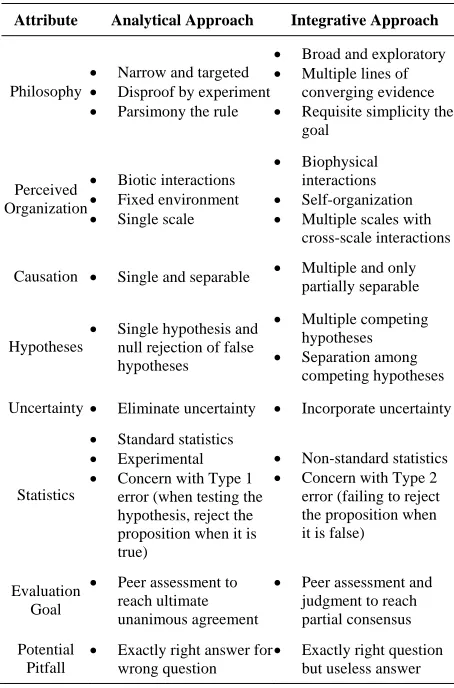
[22] has summarized the difference between the ana- lytical and integrative approaches to science as shown in
Table 2.
It is worth noting that representatives of the “hard” sciences, especially those who work in systems terms, have been in the forefront of the development of a sus- tainability science. They have felt the limitations of a rigid reductionist approach more than those in the social sciences who work on softer issues.
There is also a second type of integration emerging focused on how modern science can better relate to local or indigenous knowledge. The latter is typically informal and not yet systematized in ways that make it easily ac- cessible to outsiders. This is a major reason why this form of knowledge tends to get left out in scientific dis- course, not the least by social scientists who ought to be in the forefront of respecting local knowledge and hus- bandry. It is important to recognize that local or indige- nous knowledge is more than just “folk wisdom”. [21] presents the Bukusu people in western Kenya and eastern Uganda’s own systemic view of plants, which is different and more relevant to their needs than the Linnaean clas- sification system that has guided Western science for 250 years. While the latter stresses the notion of ecological niches, the Bukusu people perceive a broader role and place for plants in the transformation of all aspects of their community. Plants form part of a complex network of requirements for human welfare. A plant, therefore, does not exist in isolation but is an embodiment of inter- relationships involving the physical, biological and social aspects of their existence.
Table 2. Two approaches to the science of ecology.
Attribute Analytical Approach Integrative Approach
Philosophy
Narrow and targeted
Disproof by experiment
Parsimony the rule
Broad and exploratory
Multiple lines of converging evidence
Requisite simplicity the goal
Perceived Organization
Biotic interactions
Fixed environment
Single scale
Biophysical interactions
Self-organization
Multiple scales with cross-scale interactions
Causation Single and separable Multiple and only partially separable
Hypotheses
Single hypothesis and null rejection of false hypotheses
Multiple competing hypotheses
Separation among competing hypotheses
Uncertainty Eliminate uncertainty Incorporate uncertainty
Statistics
Standard statistics
Experimental
Concern with Type 1 error (when testing the hypothesis, reject the proposition when it is true)
Non-standard statistics
Concern with Type 2 error (failing to reject the proposition when it is false)
Evaluation Goal
Peer assessment to reach ultimate unanimous agreement
Peer assessment and judgment to reach partial consensus
Potential Pitfall
Exactly right answer for wrong question
Exactly right question but useless answer
Source: adjusted from [22].
for a change in the relations among scientists themselves as well as between them and people with local knowl- edge that is relevant to the task of protecting biological diversity. In this respect, it is a governance issue both inside the scientific community and in its relations with other actors or stakeholders in the conservation commu- nity.
5. Conclusion
The paper has discussed the definitions and evolvement of biodiversity conservation. It has been clearly shown that the definition has changed from simply conserving nature without consideration of the needs of the popula- tion to meet their daily needs to conservation and devel- opment. The local community forms an integral part of biological conservation and sustainable development. A meaningful involvement of the poor people will not only ensure that their economic interests are taken onboard but also their social and cultural values. From the paper it is evident that WSSD and other global conferences did not adequately address the issue of biodiversity conser- vation and the poor. This observation raises an important
question. How can sustainable development be achieved in the absence of biodiversity conservation and adequate involvement of the local community? How could the in- ternational community overlook such an important aspect (biodiversity) for both socioeconomic development and sustainable development? The Brundtland Report argued that it is unrealistic to deal with environmental issues without adequate consideration of other factors [23]. It is important that both global and local authorities create an environment that enables communities to meet their daily needs, foster development and conserve biodiversity.
REFERENCES
[1] Office of Technology Assessment (OTA),“Technologies to Maintain Biological Diversity,” Office of Technology Assessment, Washington DC, 1987.
[2] A. Kiriro and C. Juma, “Gaining Ground: Institutional Innovations in Land-Use Management in Kenya,” ACTS Press, Nairobi, 1991.
[3] L. Naughton-Treves and S. Sanderson, “Property, Politics and Wildlife Conservation,” World Development, Vol. 23, No. 8, 1995, pp. 1265-1276.
doi:10.1016/0305-750X(95)00045-E
[4] A. William and C. E. Little, “Encyclopedia of Environ- mental Studies,” Facts on File, Inc., New York, 2001.
[5] World Bank, “Biodiversity and Agriculture: Implications for Conservation and Development,” The World Bank, Washington DC, 1996.
[6] K. R. Miller, “The Natural Protected Areas of the World,” In: J. A. McNeely and K. R. Miller, Eds., National Parks,
Conservation and Development, Smithsonian Institution
Press, Washington DC, 1984, pp. 20-23.
[7] Y. Ntiamoa-Baidu, “Indigenous vs. Introduced Biodiver- sity Strategies: The Case of Protected Area Systems in Ghana,” African Biodiversity Series, World Wildlife Fund, Washington DC, 1995.
[8] D. Allen, “How to Save the World: Strategy for World Conservation,” London, Kogan Page, 1980.
[9] J. Murombedzi, “Decentralization or Recentralization? Implementing CAMPFIRE in the Omay Communal Lands of the Nyaminyami District,” Working Paper, Center for Applied Social Sciences, University of Zim-babwe, Harare, 1992.
[10] K. A. Hill, “Interest Groups and the Politics of the Envi- ronment: Wildlife Conservation Policy, the State, and Organized Interests in Zimbabwe,” Ph.D. Dissertation, Department of Political Science, University of Florida, 1993.
[11] C. C. Gibson, “Politicians and Poachers,” Cambridge University Press, New York, 1999.
doi:10.1017/CBO9780511625640
[13] J. Muller, “Rural Poverty, Empowerment and Sustainable Livelihoods,” Ashgate, Hants, 1991.
[14] E. W. Dungumaro and G. Hyden, “Challenges and Op- portunities to Climate Change Adaptation and Sustainable Development among Tanzanian Rural Communities,”
Sustainability in Debate, Special Issues on Climate, Sus-
tainability and Development in Semi-Arid Regions, Vol. 1,
No. 2, 2010, pp. 79-92.
[15] R. Costanza, “Ecological Economics: The Science and Management of Sustainability,” Columbia University Press, New York, 1991.
[16] World Bank, “World Development Report 2000,” The World Bank, Washington DC, 2000.
[17] S. Sanderson, “The Future of Conservation,” Foreign
Affairs, Vol. 81, No. 5, 2002, pp. 162-173.
doi:10.2307/20033275
[18] D. H. Meadows, D. L. Meadows, J. Randers and W. W.
Behrens III., “The Limits to Growth,” Viking Press, New York, 1972.
[19] International Centre for Environment and Development, “Our Common Future,” ICED, London, 1987.
[20] J. Clay, “Buying in the Forest: A New Program to Market Sustainably Collected Tropical Forest Products Protecting Forests and Forest Residents,” In: K. H. Redford and C. Padoch, Eds., Conservation of Neotropical Forests, Co- lumbia University Press, New York, 1993.
[21] C. Juma, “Managing Biological Diversity in Kenya,” In: A. Kiriro and C. Juma, Eds., Gaining Ground, ACTS Press, Nairobi, 1991, pp. 125-154.
[22] C. S. Holling, “Two Cultures of Ecology,” Conservation
Ecology, Vol. 2, No. 2, 1998, pp. 1-25.