Munich Personal RePEc Archive
Environment and economic development:
determinants of an EKC hypothesis
Halkos, George
University of Thessaly, Department of Economics
2011
Online at
https://mpra.ub.uni-muenchen.de/33262/
Environment and Economic Development:
Determinants of an EKC
George E. Halkos
Department of Economics
University of Thessaly, Greece
Abstract
In this paper we examine the concept of an Environmental Kuznets Curve (EKC) hypothesis in a critical way aiming to justify its existence as well as to propose policies compatible with sustainable development. For this reason, we make use of a data set on CO2 emissions for 32
countries over a 36 year time period. For this balanced panel database, we apply a number of econometric methods to estimate the income-environment relationship. Our results indicate the existence of N-shaped relationship between economic development and pollution. However we show that the turning points calculated by panel data analysis may not reveal the actual turning points valid for individual countries. In our case and using different countries from different geographical regions we found a mixture of monotonic or inverted U-shape or N-shape behaviour. Countries are heterogeneous with different stochastic regression coefficients. This implies that the use of the total N-shape income-environment relationship by policy makers may be misleading with serious policy ineffectiveness implications.
Keywords: Environmental Kuznets Curve; Panel Data; CO2 emissions.
1. Introduction
Kuznets (1955) showed that during the various economic development stages, income disparities first rise and then begin to fall. Degradation tends to be higher in many middle income countries in comparison to less developed countries. The environmental Kuznets curve
(hereafter EKC) hypothesis proposes that there is an inverted U-shape relation between environmental degradation and per-capita income. In this paper, we examine the concept of an
environmental Kuznets curve in a critical way with an eye towards proposing policies compatible with sustainable development. Environmental damage seems to be lower in the most developed countries compared to many middle-income countries and higher in many middle-income
countries compared to less developed countries.
A number of alternative theories of the economy-environment relationship exist and are
presented in Everett et al. (2010). Namely, the limits theory defines the economy-environment relationship in terms of environmental damage hitting a threshold beyond which production is so badly affected that the economy gets smaller. The new toxics view relies on the idea that
emissions of existing pollutants are decreasing with further economic growth but the new pollutants substituting for them increase. This view questions the existence of turning points
and considers the possibility that environmental damage continues to increase as economies grow (Everett et al., 2010). Similarly the race to bottom theory states that international competition initially leads to increasing environmental damage, up to the point when
developed countries start reducing their environmental impact but also export polluting activities to poorer countries. The net effect, in the best case scenario, is a non-improving
situation. Finally, the Porter’s Hypothesis refers to growth and environment as a false dichotomy and finds that well-designed environmental policy can increase R&D into resource efficient products and processes, resulting in improved business competitiveness and
Empirical formulations of the environment-income relationship and the exploration of
the EKC hypothesis rely on the econometric specifications that consist of an environmental damage indicator as depending on an economic variable representing economic development like GDP/c in level, square and cubic values as independent variables. Due to lack of data
different variables have been used so far in empirical modelling to approximate environmental damage like air pollutants (SOX, NOX, CO2, PM10, CO, etc.), water pollutants
(e.g. toxic chemicals discharged in water, etc.) and other environmental indicators (e.g. deforestation, municipal waste, energy use, urban sanitation and access to safe drinking water).
This paper is organised as follows. Section 2 discusses the existing theoretical and empirical work. Section 3 comments on the reasons for justifying an EKC, while section 4
presents the econometric models used in this study. The empirical evidence is presented in section 5. The final section concludes the paper.
2. Previous work
A number of authors have estimated econometrically the EKC using OLS analysis. The
EKC estimates for any dependent variable (e.g. SO2, NOX, deforestation, etc.) peak at income
levels, which are around the world’s mean income per capita. Income as expected is not normally distributed but skewed (with a lot of countries below mean income per capita). Arrow
et al. (1995), Ekins (1997) and Ansuategi et al. (1998) provide a number of reviews and critiques of the EKC studies. Stern et al. (1996) identified a number of problems with some of
the main EKC estimators and their interpretation. They mention among other econometric problems, the mean-median income problems, the interpretation of particular EKCs in isolation from other environmental problems, the assumption of unidirectional causality from
asymptotic behaviour. Stern (1998) reviews these problems in detail and shows where
progress has been made in empirical studies.
Cropper and Griffiths (1994) and Selten and Song (1994), conclude that the majority of countries in their analyses are below their estimated peak levels for air pollutants and thus
economic growth may not reduce air pollution or deforestation. This implies that estimating the left part of EKC is easier than estimating the right hand part. Thus, use of OLS is not likely to
yield accurate estimates of the peak levels.
The differences in the extracted relationships as well as in the estimated turning points may be attributed to the econometric models’ functional form used and the adoption of static
or dynamic analysis. Stern and Common (2001) find that sulfur emissions per capita are a monotonic function of income per capita, when they use a global sample and an inverted
U-shape function of income when they use a sample of high-income countries only. They calculate a much larger in size turning point ($ 908178) compared with the total sample, again implying a monotonic EKC. Halkos (2003), using the same database but proposing a dynamic
model formulation finds much lower turning points in the range of $2805-$6230 and inverted U-shape curves.
At the same time the inclusion of other independent variables in the model formulation, affects significantly the estimated relationship. Roca et al. (2001) claim that estimated EKC is weaker when more explanatory variables are used together with income. Empirical evidence
is not clear and mixed results have been found (Galeotti et al., 2006; He and Richard, 2010; Chuku, 2011).
A number of studies found a linear and monotonic relationship between environmental damage and income per capita. Akbostanci et al. (2009) examined the income–environment relationship in the case of Turkey using time series and provincial panel data for the periods
between carbon dioxide emissions and income in the case of times series analysis. Similarly,
Fodha and Zaghdoud (2010) found a monotonically increasing relationship between CO2
emissions and GDP for Tunisia and for the period 1961-2004.
Other researchers have found an inverted-U shaped relationship with turning points
ranging from $823 to $79,000, implying a possible separation of environmental damage from economic development (Grossman and Krueger, 1995; Holtz-Eakin and Selden 1995; Cole et
al., 1997; Stern and Common 2001; Halkos, 2003; Galeotti et al., 2006). Fodha and Zaghdoud (2010) found an inverted-U shaped relation with a turning point of $1,200 for SO2 for Tunisia and the period 1961-2004. Panayotou (1993; 1995; 1997) employed cross sectional data and
GDP in nominal US $ (1985). The equations for the pollutants considered were logarithmic quadratics in income per capita. Deforestation was estimated against a translog function in
income/c and population density. All the curves estimated were inverted U’s with turning point for deforestation at $823 per capita. Finally, He and Richard (2010) using parametric, semi-parametric and non-linear models found weak evidence of the EKC hypothesis for the
relationship between CO2 emissions and GDP in the case of Canada and for the period
1948-2004.
Stern et al. (1996) claim that the mix of effluent has shifted from sulphur and NOX to CO2
and solid waste, in a way that aggregate waste is still high and even if per unit output waste has declined, per capita waste may not have declined. Regressing per capita energy consumption on
income and temperature gave them an inverted U-shape relationship between energy and income. Energy consumption peaked at $14600. The authors claim that the results depend on
the income measure used. If income in PPP is used, the coefficient on squared income was positive but small and insignificant. If income per capita was measured using official exchange rates, the fitted energy income relationship was an inverted U-shape with energy
Others have found an N-shape relationship (Friedl and Getzner, 2003; Martinez-Zarzoso
and Bengochea-Marancho, 2004) which shows that the release of environmental damage from economic development may be temporary (He and Richard, 2010). Grossman and Krueger’s (1991, 1995) and Shafik and Bandyopadhyay (1992) suggest that at high-income levels, material
use increases in a way that the EKC is N-shape. Friedl and Getzner (2003) found an N-shaped relationship between CO2 and GDP for Australia and for the time period 1960-1999.
Akbostanci et al. (2009) found an N-shaped relationship in the case of SO2 and PM10
emissions in their panel data analysis.
3. Reasons justifying the EKC
A number of recent EKC studies consider the factors, which cause an inverted U-shape
pattern. A first reason is the improvement in environmental quality as the result of the change in the technological mode of production (de Bruyn, 1997; Han and Chatterjee, 1997) or of the exportation of “dirty industry” to less developed or developing countries (Rock, 1996; Suri
and Chapman, 1998; Heerink et al., 2001; Lieb, 2003).
Another reason is the role of preferences and regulation on the emissions profile of
polluters. In the formalization of the transition to the low-pollution state there is a group of authors that provide significant analyses of the role of preferences and regulations on the emissions profile of polluters (Lopez, 1994; McConnell, 1997; Stokey, 1998). The better
institutional set up in the form of credible property rights, regulations and good governance may create public awareness against environmental degradation (Dinda et al., 2000). They
claim that technological improvements, structural economic change and transition and increase in spending on environmental R & D accompanied with increasing per capital income are important in determining the nature of the relationship between economic growth
The levels of several pollutants per unit of output in specific processes have declined in the
developed countries over time with the use of strict environmental regulations. Pollution will stop increasing and start to decrease with economic growth because some constraints will become non-binding (Lieb, 2003). Stokey (1998) shows that pollution increases linearly with
income until the threshold is passed and cleaner technologies can be used. The implied pollution-income path may be an inverse-V with a sharp peak taking place at the point where
a continuum of cleaner technologies becomes available. Jaeger (1998), similarly to Stokey, finds that the pollution income relationship is an inversed-V. Jaeger relies on the assumption that at low levels of pollution consumers’ taste for clean air is satisfied and marginal benefit
of additional environmental quality is zero. Similarly, Jones and Manuelli (1995) using an overlapping generations model and determining economic growth by pollution regulations
and market interactions show that depending on the decision making institution the pollution-income relationship may have an inverted V shape, but it could also be monotonically increasing or a “sideways-mirrored S”.
Andreoni and Levinson (2001) suggest another explanation due to the technological link between consumption of a desired good and abatement of its undesirable byproducts
(pollution). Torras and Boyce (1998) argue that the greater equality of incomes results in lower level of environmental degradation. This claim is challenged by Scruggs (1998). Demand for environmental quality increases with income implying environmental quality is a
normal good. Poor people have little demand for environmental quality but as society gets richer its members intensify their demands for a healthier and cleaner environment (Lieb,
2003).
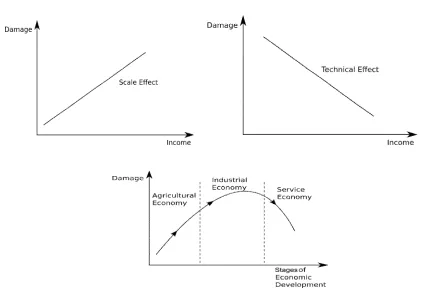
Natural progression of economic development goes from clean agricultural to polluting industrial and to clean service economies. Specifically, economic development is associated
relationship. Namely, the scale effect, the composition effect and the technical effect
(Grossman and Krueger, 1995; Dinda, 2004; Everett et al., 2010). The scale effect has a negative influence as more output results in more adverse effects for the environment. Simply higher quantities of output demand more natural resources in the production processes and
lead to more emissions and by-products leading to environmental damage. At the same time the composition effect may have a positive influence on the environment offsetting (even
partially) the adverse effects. The idea is that as economic output increases the structure of the economy tends to shift from agricultural activity to industrial economy which is pollution-intensive and then to service economy which are less damaging the environment. Figure 1
shows the mentioned effects graphically.
[image:9.595.66.489.377.675.2]
In analyzing long time-series, the three effects in continuation lead to an initial stage of
economic development which has a negative effect on the environment due to scale effect followed up by changes in the structure of the economy as well as in the production methods that take place at the next stages of development which have positive effects on the
environment and are due to composition and technical effects.
Similarly, environmental damage could enlarge through the scale effect as increasing
volumes of exports increase the size of the economy. But trade can enrich environment through composition and/or technical effects. As income rises through trade, environmental regulation is becoming stricter encouraging pollution reducing innovations. According to
Dinda (2004) the composition effect is attributed to two hypotheses. First the displacement hypothesis according to which the pollution intensive industries migrate from countries with
stricter environmental standards to those with less strict standards. In this way rich countries are likely to be net importers of pollution intensive goods. The extracted inverted U-shape curve may be the result of changes in international specialization with that trade liberalization
to lead to more pollution intensive industries in less developed economies as developed economies implement stronger environmental standards. Second the pollution haven hypothesis refers to the case where multinational firms (mainly involved in highly polluting
activities) move to countries with less strict environmental regulations. This hypothesis states that low environmental regulations may be source of comparative advantage and may lead to
changes in trade patterns (Dinda, 2004).
4. Econometric methods and Data used
The basic model to be estimated may be written as:
it it it i t it
where Yit is the dependent variable; Xit is a k-vector of explanatory variables; and εit are the
disturbance terms for i = 1,2,…M cross-sectional units in periods t = 1,2,…T. The parameter α corresponds to the overall constant in the model while δi and γt represent cross-section and
period specific effects (random or fixed) respectively.
Both fixed and random effects are inefficient in the presence of heteroskedasticity (Baltagi, 2001). In order to take into account heteroskedasticity and various patterns of
correlation between the residuals, Generalized Least Squares (GLS) specifications may be used. For estimating β the GLS estimator is given as:
1 1 1
ˆ (X )
(2) We have applied panel data methods to estimate the above equation. The first method
employed is the fixed effects (hereafter FE), which allows each individual country to have a different intercept treating the αi and γi as regression parameters. This practically implies that
the means of each variable for each country are subtracted from the data for that country and the mean for all countries in the sample in each individual time period is also deducted from the observations from that period. Then Ordinary Least Squares is used to estimate the
regression with the transformed data.
The second model is the random effects (hereafter RE) in which the individual effects are
treated as random. In this model the αi and γi are treated as components of the random
disturbances. The residual from an OLS estimate of the model with a single intercept are used to construct variances utilized in a GLS estimates (for further details see Hsiao, 1986). If the
effects αi and γi are correlated with the explanatory variables then the random effects model
cannot be estimated consistently (Hsiao, 1986, Mundlak, 1978).
indicates that the RE model is estimated inconsistently due to correlation between the
independent variables and the error components. If there are no other statistical problems the FE model can be estimated consistently although the estimated parameters are conditional on the country and time effects in the selected sample of data (Hsiao, 1986). In the case of
coefficient heterogeneity FE and RE estimates in a static formulation are consistent in the absence of other misspecification (Stern, 2010).
In our case, we analyze CO2/cemissions in a sample of 32 countries for the period
1971-2006. We have performed Box-Cox tests in order to test the linear against the logarithmic functional form of the relationship between CO2/c and GDP/c. The model proposed here is
estimated as:
(CO2/c)it = αi + γt + β1 (GDP/c)it + β2 (GDP/c))2it + β3 (GDP/c))3it + εit (3)
where the αi’s are country specific intercepts and the γi’s are time specific intercepts and the
countries are indexed by i and time periods by t. CO2/c is carbon dioxide emissions per capita
in tons and εit is a disturbance term. Our sample consists of the 32 countries with full record
on CO2 and GDP per capita information for the period 1971-20061. The database used has
1152 observations per variable. GDP per capita has been used in international prices (2005 US dollars) and the data have been obtained from OECD (2008). The CO2 data have been
obtained from the IEA (2010).
5. Empirical evidence
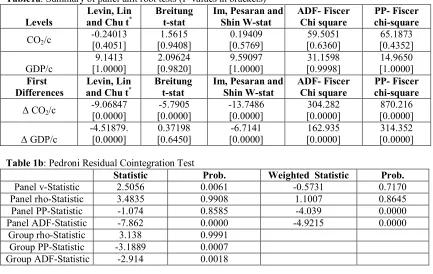
Table 1a presents the results of a number of unit root tests on the variables of interest (i.e. CO2/c and GDP/c). From this table it can be seen that there is evidence against non-stationarity
in levels. Specifically, in all cases and according to the tests adopted, our variables are I(1).
That is, they are stationary in first differences and non-stationary in levels in all levels of
statistical significance. Similarly Table 1b presents the Pedroni Cointegration Tests. In seven of
[image:13.595.65.498.168.442.2]the eleven cases we reject the null hypothesis of no cointegration at the conventional statistical significance level of 0.05.
Table1a: Summary of panel unit root tests (P-values in brackets)
Levels and Chu tLevin, Lin * Breitung t-stat Im, Pesaran and Shin W-stat ADF- Fiscer Chi square chi-square PP- Fiscer
CO2/c -0.24013 [0.4051] [0.9408] 1.5615 [0.5769] 0.19409 [0.6360] 59.5051 [0.4352] 65.1873
GDP/c [1.0000] 9.1413 [0.9820] 2.09624 [1.0000] 9.59097 [0.9998] 31.1598 [1.0000] 14.9650
First
Differences and Chu tLevin, Lin * Breitung t-stat Im, Pesaran and Shin W-stat ADF- Fiscer Chi square chi-square PP- Fiscer
Δ CO2/c -9.06847 [0.0000] [0.0000] -5.7905 -13.7486 [0.0000] [0.0000] 304.282 [0.0000] 870.216
Δ GDP/c -4.51879. [0.0000] [0.6450] 0.37198 [0.0000] -6.7141 [0.0000] 162.935 [0.0000] 314.352
Table 1b: Pedroni Residual Cointegration Test
Statistic Prob. Weighted Statistic Prob.
Panel v-Statistic 2.5056 0.0061 -0.5731 0.7170
Panel rho-Statistic 3.4835 0.9908 1.1007 0.8645
Panel PP-Statistic -1.074 0.8585 -4.039 0.0000
Panel ADF-Statistic -7.862 0.0000 -4.9215 0.0000
Group rho-Statistic 3.138 0.9991 Group PP-Statistic -3.1889 0.0007 Group ADF-Statistic -2.914 0.0018
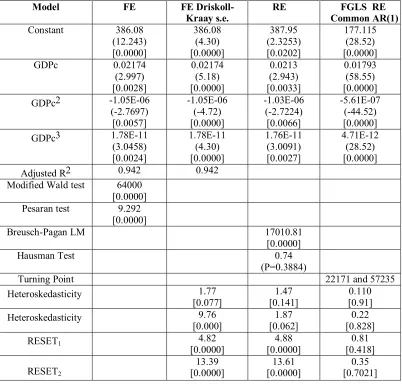
Next, Table 2 presents the panel data model results. Fixed and random effects were estimated first. These models were estimated also with time and country dummies but the results
were insignificant. The diagnostic tests for the fixed and random effects models show a number of problems. As the Hausman test shows country intercepts and GDP/c are correlated in the global model. The test shows that the random effects formulation is consistently estimated. This
suggests that there are omitted variables, which are correlated with GDP/c. Looking at the Breusch-Pagan Lagrange multiplier test for random effects we reject the null hypothesis in
favour of the random effects model and we find significant differences across countries. Similarly, the Pesaran’s test of cross sectional independence leads to rejection of the null hypothesis and there is cross-sectional dependence implying the estimation of the Driskoll-Kraay
rejection of homoskedasticity.
We have estimated a number of other panel data analysis methods. As we face problem of heteroskedasticity, generalized least squares were estimated with panel specific AR(1) as well as generalized least squares with common AR(1) coefficients for all panels and heteroskedastic
panels in both cases. Between the two estimations, the latter performed better. The results are presented in the last column of Table 2. The model passes the diagnostic tests and indicates the
[image:14.595.66.468.349.733.2]presence of an N-shaped curve, and parameter estimates as well as t-statistics are all statistically significant. The turning points are calculated at $22175 and $57231. Although the first is well within the sample the latter is above the maximum value of GDP/c in the sample ($52152).
Table 2: Panel data model estimates (figures in parentheses are t statistics and in brackets P-values)
Model FE FE Driskoll-
Kraay s.e. RE Common AR(1) FGLS RE
Constant 386.08 (12.243) [0.0000] 386.08 (4.30) [0.0000] 387.95 (2.3253) [0.0202] 177.115 (28.52) [0.0000]
GDPc 0.02174
(2.997) [0.0028] 0.02174 (5.18) [0.0000] 0.0213 (2.943) [0.0033] 0.01793 (58.55) [0.0000] GDPc2 -1.05E-06
(-2.7697) [0.0057] -1.05E-06 (-4.72) [0.0000] -1.03E-06 (-2.7224) [0.0066] -5.61E-07 (-44.52) [0.0000]
GDPc3 1.78E-11
(3.0458) [0.0024] 1.78E-11 (4.30) [0.0000] 1.76E-11 (3.0091) [0.0027] 4.71E-12 (28.52) [0.0000]
Adjusted R2 0.942 0.942
Modified Wald test 64000 [0.0000] Pesaran test 9.292
[0.0000]
Breusch-Pagan LM 17010.81
[0.0000]
Hausman Test 0.74
(P=0.3884)
Turning Point 22171 and 57235
Heteroskedasticity 1.77
[0.077] [0.141] 1.47 [0.91] 0.110
Heteroskedasticity 9.76
[0.000] [0.062] 1.87 [0.828] 0.22
RESET1 4.82
[0.0000] [0.0000] 4.88 [0.418] 0.81 RESET2
13.39
In the same table four more diagnostic tests are presented in the last four rows. The first
two are tests for heteroskedasticity while the last two for specification errors. The first test is a regression of the squared residuals on Xs while the second test is essentially a Glejser test. In most cases but the last there is heteroskedasticity problem. The last two tests refer to the
specification error and are applied by regressing the residuals on the squared fitted values and on the cubic fitted values. The results of these RESET tests imply that the equations of our
model are not misspecified only in the last case.
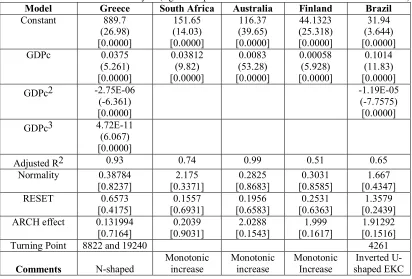
Moreover, an individual (country) time series analysis has been performed in order to see how much the total extracted relationship (N-shape) represents individual countries. First
[image:15.595.80.492.474.753.2]all the variables of the countries considered were tested for stationarity and were all I(1). Table 3 shows that the picture is unclear. Greece shows N-shape behaviour but at the same
time South Africa, Australia and Finland show a monotonic relationship and Brazil an inverted U-shaped relationship. This raises the issue of heterogeneity as discussed analytically in Dijkgraaf and Vollebergh (2005).
Table 3: Individual time series analysis (figures in parentheses are t statistics and in brackets P-values)
Model Greece South Africa Australia Finland Brazil
Constant 889.7 (26.98) [0.0000] 151.65 (14.03) [0.0000] 116.37 (39.65) [0.0000] 44.1323 (25.318) [0.0000] 31.94 (3.644) [0.0000]
GDPc 0.0375
(5.261) [0.0000] 0.03812 (9.82) [0.0000] 0.0083 (53.28) [0.0000] 0.00058 (5.928) [0.0000] 0.1014 (11.83) [0.0000] GDPc2 -2.75E-06
(-6.361) [0.0000]
-1.19E-05 (-7.7575)
[0.0000] GDPc3 4.72E-11
(6.067) [0.0000]
Adjusted R2 0.93 0.74 0.99 0.51 0.65
Normality 0.38784
[0.8237] [0.3371] 2.175 [0.8683] 0.2825 [0.8585] 0.3031 [0.4347] 1.667
RESET 0.6573
[0.4175] [0.6931] 0.1557 [0.6583] 0.1956 [0.6363] 0.2531 [0.2439] 1.3579 ARCH effect 0.131994
[0.7164] [0.9031] 0.2039 [0.1543] 2.0288 [0.1617] 1.999 [0.1516] 1.91292
Turning Point 8822 and 19240 4261
6. Conclusions and Policy Implications
Economic growth leads to higher pollution. This scale effect has several explanations. The demand for environmental quality is higher with higher income levels because of the potential damage irreversibility and higher demand for environmental quality requires stricter
environmental regulations (Lieb, 2003). Our results indicate the existence of an N-shaped relationship between economic development and pollution in the form of CO2 emissions as
shown in Figure 2. The N-shape curve has the first turning point at $22171 and the next at $57235. The first is well within the sample while the second is outside the sample size maximum value ($52156). This implies that the reduction of environmental damage from
economic development may be temporary and CO2 emissions will increase indefinitely above
the income level of $57235.
0 100 200 300 400 500 600
0 10000 20000 30000 40000 50000 60000 70000 80000 90000
GDP_c
C
O
2_
c
Em
is
si
on
s
CO2_c
Figure 2: The extracted N-shape curve for the sampled countries
We also find that the turning points calculated by panel data analysis may not reveal the actual turning points (if any) that arise for individual countries. In our case and using different countries from different geographical regions we found a mixture of monotonic, or inverted
Lieb (2003) claims that the downturn part of the N-shape may be due to a shock while
the upturn part due to an equilibrium relationship. Lieb presents a thoughtful explanation for the final upturn of the extracted N-shape curve. This may be justified by the completion of the internalization of the pollution externality as well as that the abatement opportunities are
exhausted. Lieb also claims that there is lower thermodynamics bound on material and energy use per unit of GDP as well as that at higher incomes the control methods applied exhibit
decreasing and not anymore increasing returns to scale.
A number of policies may be followed. The need for technology transfer to help developing countries to achieve sustainability emerges. To reduce pollution levels many
developing countries expect technology transfers in the form of foreign direct investment from developed countries. These clean and updated technologies will reduce environment
damage by controlling emission levels. The main idea is that abatement technologies in developed countries are cleaner and more advanced. As developing countries have no financial resources to import and use these technologies at commercial cost this implies that
developed countries should transfer or facilitate the transfer of these technologies to less developed or developing countries. The impact of this technology transfer depends on the
type of industrial activity. That is, in the energy sector these transfers will be more beneficial for the environment compared to other industries such as textiles, etc. It should be emphasized that transfer of information must accompany these technology transfers on know-how and
skills to enable countries to design or modify their own technologies.
Environmental policy may be a significant initiative for innovation. As air pollution is
References
Akbostanci, E., Turut-Asik, S., and Tunc, G. I., (2009). The relationship between income and environment in Turkey: is there an environmental Kuznets curve, Energy Policy, 37: 861-867.
Andreoni J. and Levinson A., (2001). The simple analytics of the environmental Kuznets curve,
Journal of Public Economics, 80: 269-286.
Ansuategi A., Barbier E.B. and Perrings C.A., (1998). The Environmental Kuznets Curve, in: Van den Bergh, J.C.J.M. and Hofkes, M.W. (Eds) Theory and Implementation of Economic Models for Sustainable Development, Kluwer.
Arrow K., Bolin B., Costanza R.. Dasgupta P., Folke C., Holling C.S.Jansson B-O, Levin S., Maler K- G, Perrings C. and Pimentel D., (1995). Economic growth, carrying capacity and the environment,
Science, 268: 520-521.
Baltagi, B. H., (2001). Economic analysis of panel data, (2nd ed.). New York: Wiley.
Chuku A., (2011). Economic development and environmental quality in Nigeria: is there an environmental Kuznets curve?, MPRA Paper 30195, University Library of Munich, Germany.
Cole, M.A., and Elliot, R.J.R. (2003). Determining the trade-environment composition effect: the role of capital, labour and environmental regulations, Journal of Environmental Economics and Management, 46 (3): 363-383.
Cropper M. and Griffiths C., (1994). The interaction of pollution growth and environmental quality,
American Economic Review, 84(2): 250-254.
De Bruyn, S.M., van den Bergh, J.C.J.M., and Opschoor, J.B., (1998). Economic growth and
emissions: reconsidering the empirical basis of Environmental Kuznets Curves, Ecological Economics, 25: 161-175.
Dijkgraaf, E., and Vollebergh, H.R.J., (2005). A test for parameter homogeneity in CO2 panel EKC
estimates, Environmental and Resource Economics, 32: 229-239.
Dinda S., D. Coondos and Pal M., (2000). Air quality and economic growth: an empirical study,
Ecological Economics, 34: 409-423.
Dinda, S., (2004). Environmental Kuznets curve hypothesis: A survey, Ecological Economics, 49: 431-455.
Ekins P., (1997). The Kuznets curve for the environment and economic growth: examining the evidence, Environment and Planning, 29: 805-830.
Everett T., Ishwaran M, Ansaloni GP and Rubin A., (2010). Economic growth and the environment, MPRA Paper 23585, University Library of Munich, Germany.
Fodha, M., and Zaghdoud, O., (2010). Economic growth and pollution emissions in Tunisia: An empirical analysis of the environmental Kuznets curve, Energy Policy, 38: 1150-1156.
Friedl, B., and Getzner, M., (2003). Determinants of CO2 emissions in a small open economy,
Galeotti, M., Lanza, A., and Pauli, F., (2006). Reassessing the environmental Kuznets curve for CO2 emissions: a robustness exercise, Ecological economics, 57: 152-163.
Grossman G. and Krueger A., (1991). Environmental impacts of a North American Free Trade Agreement, NBER Working Paper 3914, National Bureau of Economic Research, Cambridge MA.
Grossman G. and Krueger A., (1995). Economic growth and the Environment, Quarterly Journal of Economics 110: 353-377.
Halkos G.E., (2003). Environmental Kuznets Curve for sulphur: Evidence using GMM estimation,
Environment and Development Economics.
Han X., and Chatterjee L., (1997). Impacts of growth and structural change on CO2 emissions of
developing countries, World Development, 25: 395-407.
He J., and Richard P., (2010). Environmemtal Kuznets curve for Co2 in Canada, Ecological Economics, 69: 1083-1093.
Heerink, N., Mulatu A. and Bulte E., (2001). Income inequality and the environment: aggregation bias in environmental Kuznets curves, Ecological Economics, 38: 359-367.
Holtz-Eakin, D., and Selden, T.M., (1995). Stoking the fires: CO2 emissions and economic growth,
Journal of Public Economics, 57: 85-101.
Hsiao C., (1986). Analysis of panel data, Cambridge University Press, Cambridge UK.
IEA, (2010). CO2 Emissions from Fuel Combustion – Highlights 2010, International Energy Agency.
http://www.iea.org/co2highlights
Jaeger W., A theoretical basis for the environmental inverted-U curve and implications for international trade, Williams College, Working Paper, 1998
Jones, L.E., Manuelli, R.E., 1995. A Positive Model of Growth and Pollution Controls. NBER Working Paper No. 5205.
Kuznets, S., (1955). Economic growth and income inequality, American Economic Review, 58: 231-244.
Lieb C.M., (2003). The Environmental Kuznets Curve: A survey of the empirical evidence and the possible causes. University of Heidelberg Depart of Economics, Discussion Paper Series No 391.
Lopez R., (1994). The environment as a factor of production: the effects of economic growth and trade liberalization, Journal of Environmental Economics and Management, 27: 163-184.
Martínez-Zarzoso I. and Bengochea-Morancho A., (2004). Pooled mean group estimation of an environmental Kuznets curve for CO2, Economics Letters, 82(1): 121-126.
McConnell K.E., (1997). Income and demand for environmental quality’, Environment and Development Economics, 2:383-399.
Mundlak Y., (1978). On the pooling of time series and cross section data, Econometrica, 46: 69-85. OECD, (2008). National Accounts of OECD Countries, OECD, Paris.
stages of economic development, Working Paper WP238, Technology and Employment Programme, International Labor Office, Geneva.
Panayotou T., (1995). Environmental degradation at different stages of economic development, in: I. Ahmed and J. A. Doeleman (eds.) Beyond Rio: The Environmental Crisis and Sustainable Livelihoods in the Third World, MacMillan, London.
Panayotou, T., (1997). Demystifying the environmental Kuznets curve: turning a black box into a policy tool, Environment and Development Economics, 2(4): 465-484.
Selten, T. and D. Song, (1994). Environmental quality and development: is there a Kuznets curve for air pollution emissions? Journal of Environmental Economics and Management, 27:147-162.
Roca, J., Padilla, E., Farre, M., Galletto, V., (2001). Economic growth and atmospheric pollution in Spain: discussing the environmental Kuznets hypothesis, Ecological Economics, 39: 85-99.
Rock M.T., (1996). Pollution intensity of GDP and trade policy: can the World Bank be wrong?,
World Development, 24: 471-479.
Scruggs L.A., (1998). Political and economic inequality and the environment, Ecological Economics,
26: 259-275.
Shafik, N. and Bandyopadhyay S., (1992). Economic growth and environmental quality: time series and cross-country evidence, Background paper for the World Development Report 1992, The World Bank, Washington DC.
Stern D. I., Common M.S., and Barbier E.B., (1996). Economic growth and the environmental degradation: the environmental Kuznets Curve and sustainable development, World Development 24: 1151-1160.
Stern D.I., (1998). Progress on the environmental Kuznets curve?, Environment and Development 3: 175-198.
Stern, D. I. and Common M.S., (2001). Is there an environmental Kuznets curve for sulphur?, Journal of Environmental Economics and Management, 41: 162-178.
Stern D.I., (2010). Between estimates of the Environmental Kuznets Curve, Centre for Applied Macroeconomic Analysis, The Australian National University CAMA Working Paper 4/2010.
Stokey N.L., (1998). Are there limits to growth?, International Economic Review, 39: 1-31.
Suri V. and Chapman D., (1998). Economic growth, trade and energy: implications for the environmental Kuznets curve, Ecological Economics, 25: 195-208.
Torras M. and Boyce J.K., (1998). Income, inequality and pollution: a reassessment of the environmental Kuznets curve, Ecological Economics, 25:147-160.