E U R 5 2 8 2 e
COMMISSION OF THE EUROPEAN COMMUNITIES
DETERMINATION OF 25 ELEMENTS IN BIOLOGICAL
STANDARD REFERENCE MATERIALS
BY NEUTRON ACTIVATION ANALYSIS
byG. GUZZI, R. PIETRA and E. SABBIONI
1974
Joint Nuclear Research Centre Ispra Establishment - Italy
LEGAL NOTICE
This document was prepared under the sponsorship of the Commission of the European Communities.
Neither the Commission of the European Communities, its contractors nor any person acting on their behalf:
make any warranty or representation, express or implied, with respect to the accuracy, completeness, or usefulness of the information contained in this document, or that the use of any information, apparatus, method or process disclosed in this document may not infringe privately owned rights; or
assume any liability with respect to the use of, or for damages resulting from the use of any information, apparatus, method or process disclosed in this document.
This report is on sale at the addresses listed on cover page 4
at the price of B.Fr.120.
Commission of the European Communities D.G. XIII - C.I.D. 29, rue Aldringen L u x e m b o u r g
D e c e m b e r 1974
EUR 5282 e
DETERMINATION OF 25 ELEMENTS IN BIOLOGICAL STANDARD REFERENCE MATERIALS BY NEUTRON ACTIVATION ANALYSIS by G GUZZI. R. PIETRA ands E. SABBIONI
Commission of the European Communities
Jo.nt Nuclear Research Centre - Ispra Establishement (Italy) Luxembourg. December 1974 - 3S Pages - 4 Figures - B.Fr. 120.—
» Standard and Certified Reference Materials » programme of the JRC includes the determination of trace elements in complex biological samples delivered by the U.S. National Bureau of Standards : Bovine Liver (NBS SRM 1577), Orchard Leaves (NBS SRM 1571) and Tomato Leaves.
The study has been performed by the use of neutron activation analysis. Due to the very low concentration of some elements, radiochemical group or elemental separation procedures were necessary
EUR 5282 e
DETERMINATION OF 25 ELEMENTS IN BIOLOGICAL STANDARD REFERENCE MATERIALS BY NEUTRON ACTIVATION ANALYSIS by G. GUZZI, R. PIETRA ands E. SABBIONI
Commission of the European Communities
Joint Nuclear Research Centre - Ispra Establishement (Italy) Luxembourg. December 1974 - 38 Pages - 4 Figures - B.Fr. 120.—
·· Standard and Certified Reference Materials » programme of the JRC includes the determination of trace elements in complex biological samples delivered by the U.S. National Bureau of Standards : Bovine Liver (NBS SRM 1577), Orchard Leaves (NBS SRM 1571) and Tomato Leaves.
The study has been performed by the use of neutron activation analysis. Due to the very low concentration of some elements, radiochemical group or elemental separation procedures were necessary.
EUR 5282 e
DETERMINATION OF 25 ELEMENTS IN BIOLOGICAL STANDARD REFERENCE MATERIALS BY NEUTRON ACTIVATION ANALYSIS by G. GUZZI, R. PIETRA ands E. SABBIONI
Commission of the European Communities
Joint Nuclear Research Centre - Ispra Establishement (Italy) Luxembourg. December 1974 - 38 Pages - 4 Figures - B.Fr. 120.—
<■ Standard and Certified Reference Materials » programme of the JRC includes the determination of trace elements in complex biological samples delivered by the U.S. National Bureau of Standards : Bovine Liver (NBS SRM 1577), Orchard Leaves (NBS SRM 1571) and Tomato Leaves.
The paper describes the techniques used to analyse 25 elements. Computer assisted instrumentai neutron activation analysis with high resolution Ge(Li) spectrometry was considerably advantageous in the determination of Na, K, Cl, Mn. Fe. Rb and Co and in some cases of Ca, Zn, Cs, Sc and Cr. For low contents of Ca, Mg, Ni and Si special chemical separation schemes, followed by Cerenkov counting have been developed. Two other separation procedures allowing the determination of As, Cd, Ga, Hg, Mo, Cu, Sr, Se, Ba and Ρ have been set up. The first, the « simplified » one involves the use of high resolution Ge(Li) detectors, the second, the more « complete » one
involves a larger number of shorter measurements performed by simpler and more sensitive techniques, such as Nal(TI) scintillation spectrometry and Cerenkov counting.
The results obtained are presented and discussed.
- ■ - ■ *
The paper describes the techniques used to analyse 25 elements. Computer assisted instrumental neutron activation analysis with high resolution Ge(Li) spectrometry was considerably advantageous in the determination of Na, K, Cl, Mn, Fe, Rb and Co and in some cases of Ca, Zn, Cs, Sc and Cr. For low contents of Ca, Mg, Ni and Si special chemical separation schemes, followed by Cerenkov counting have been developed. Two other separation procedures allowing the determination of As, Cd, Ga, Hg, Mo, Cu, Sr, Se, Ba and Ρ have been set up. The first, the « simplified » one involves the use of high resolution Ge(Li) detectors, the second, the more « complete » one involves a larger number of shorter measurements performed by simpler and more sensitive techniques, such as Nal(TI) scintillation spectrometry and Cerenkov counting.
The results obtained are presented and discussed.
The paper describes the techniques used to analyse 25 elements. Computer assisted instrumental neutron activation analysis with high resolution Ge(Li) spectrometry was considerably advantageous in the determination of Na, K, Cl, Mn, Fe, Rb and Co and in some cases of Ca, Zn, Cs, Sc and Cr. For low contents of Ca, Mg, Ni and Si special chemical separation schemes, followed by Cerenkov counting have been developed. Two other separation procedures allow ng the determination of As, Cd, Ga, Hg, Mo, Cu, Sr, Se, Ba and Ρ have been set up. The first, the « simplified » one involves the use of high resolution Ge(Li) detectors, the second, the more « complete » one involves a larger number of shorter measurements performed by simpler and more sensitive techniques, such as Nal(TI) scintillation spectrometry and Cerenkov counting.
E U R 5 2 8 2 e
COMMISSION OF THE EUROPEAN COMMUNITIES
DETERMINATION OF 25 ELEMENTS IN BIOLOGICAL
STANDARD REFERENCE MATERIALS
BY NEUTRON ACTIVATION ANALYSIS
by
G. GUZZI, R. PIETRA and E. SABBIONI
1974
Joint Nuclear Research Centre Ispra Establishment - Italy
ABSTRACT
« Standard and Certified Reference Materials » programme of the JRC includes the determination of trace elements in complex biological samples delivered by the U.S. National Bureau of Standards : Bovine Liver (NBS SRM 1577), Orchard Leaves (NBS SRM 1571) and Tomato Leaves.
The study has been performed by the use of neutron activation analysis. Due to the very low concentration of ome elements, radiochemical group or elemental separation procedures were necessary.
The paper describes the techniques used to analyse 25 elements. Computer assisted instrumental neutron activation analysis with high resolution Ge(Li) spectrometry was considerably advantageous in the determination of Na, K, Cl, Mn, Fe, Rb and Co and in some cases of Ca, Zn, Cs, Sc and Cr. For low contents of Ca, Mg, Ni and Si special chemical separation schemes, followed by Cerenkov counting have been developed. Two other separation procedures allowing the determination of As, Cd, Ga, Hg, Mo, Cu, Sr, Se, Ba and Ρ have been set up. The first, the « simplified » one involves the use of high resolution Ge(Li) detectors, the second, the more « complete » one involves a larger number of shorter measurements performed by simpler and more sensitive techniques, such as Nal(TI) scintillation spectrometry and Cerenkov counting.
CONTENTS
1. INTRODUCTION 5
2. PROCEDURES 6 2. 1 Materials and Equipment 6
2.2 Counting and Data P r o c e s s i n g 7 2 . 2 . 1 Gamma Ray S p e c t r o m e t r y 7 2 . 2 . 2 Cerenkov Counting Technique 8
2 . 3 Instrumental Neutron Activation Analysis 1 1
1 1
2 . 4 Destructive Activation Analysis
2 . 4 . 1 Determination of Ca, Mg, Ni, Si 1 1
2 . 4 . 2 Radiochemical Separation Schemes 12 a) Dissolution and Distillation P r o c e d u r e 12
b) Simplified Separation Scheme ; 3
c) Complete Separation Scheme 14
3. RESULTS 19
4. DISCUSSION 27
4. 1 Dissolution and Distillation 27 4.2 Determination of Ca, Mg, Ni, Si 28
4. 3 Simplified Separation Scheme 29 4 . 4 Complete Separation Scheme 30
1. INTRODUCTION
The "Standard and Certified Reference M a t e r i a l s " p r o g r a m m e of the Joint R e s e a r c h Centre includes, amongst other studies, the d e t e r m i n a -tion of t r a c e elements in complex biological samples such as Bovine L i v e r (NBS SRM 1577), O r c h a r d Leaves (NBS SRM 1571) and Tomato Leaves (NBS m a t e r i a l ) .
F o r its high sensitivity to a great number of elements of biological and toxicological concern, neutron activation analysis has been used to p e r f o r m this study.
Computer aided i n s t r u m e n t a l neutron activation analysis together with high resolution Ge(Li) s p e c t r o m e t r y has been considerably advantageous in the determination of Na, K, Cl, Mn, F e , Rb, Co, and in some c a s e s of Ca, Zn, Cs, Sc, and C r as well. Other elements such as As, Cd, Ga,· Hg, Mo, Cu, Sr and Se a r e p r e s e n t in such low concentrations that radio-chemical group separation p r o c e d u r e s were n e c e s s a r y before counting t h e i r activities.
F o r low contents of Ca, Mg, Ni and Si special chemical separation s c h e m e s , followed by Cerenkov counting, have been developed.
2. PROCEDURES
2. 1 Materials and Equipment
U . S . National Bureau of Standards SRM 1577 (Bovine L i v e r ) ,
SRM 1571 (Orchard Leaves) and Tomato L e a v e s , a l s o p r e p a r e d by the NBS, were used for analysis.
F o r the elements where satisfactory consistent values w e r e obtained (7 8)
in Bow-en's Kale i n t e r c o m p a r i s on e x e r c i s e ' , this m a t e r i a l was u s e d as a standard. F o r all other e l e m e n t s , weighed amounts of element to be d e t e r m i n e d were used as synthetic s t a n d a r d .
I r r a d i a t i o n s were performed in the ISPRA-1 r e a c t o r .
F o r s h o r t - l i v e d nuclides (t # $ 15 h) 200 mg s a m p l e s w e r e i r r a d i a t e d for 5 min in a pneumatic facility at a t h e r m a l neutron flux of
12 , 2
5 x 1 0 n / c m s. F o r Ca, Mg, Ni and Si determination, 200 m g s a m p l e s were i r r a d i a t e d in the s a m e facility for 2 h.
F o r longlived nuclides 200 mg s a m p l e s w e r e i r r a d i a t e d for 48 h in a n -13 2 other pneumatic facility at a t h e r m a l neutron flux of 10 n / c m s.
Samples and standards were sealed in high purity quartz ampoules for long i r r a d i a t i o n s or in small polyethylene vials for s h o r t e r i r r a d i a t i o n s . Before opening, the quartz ampoules were cooled in liquid n i t r o
-gen to d e p r e s s eventual internal p r e s s u r e s .
Materials used in chemical separation a r e :
Acid aluminium oxide (AAO), chromatographic grade by Woelm, E s c h
-wege, Germany;
- Hydrated antimony pentoxide (HAP) by C a r l o E r b a , Milan, Italy; - Cuprous sulphide (CUS) by C a r l o E r b a , Milan, Italy;
- Tin dioxide (TDO) by Carlo E r b a , Milan, Italy;
All other reagents of Analar Grade a r e used.
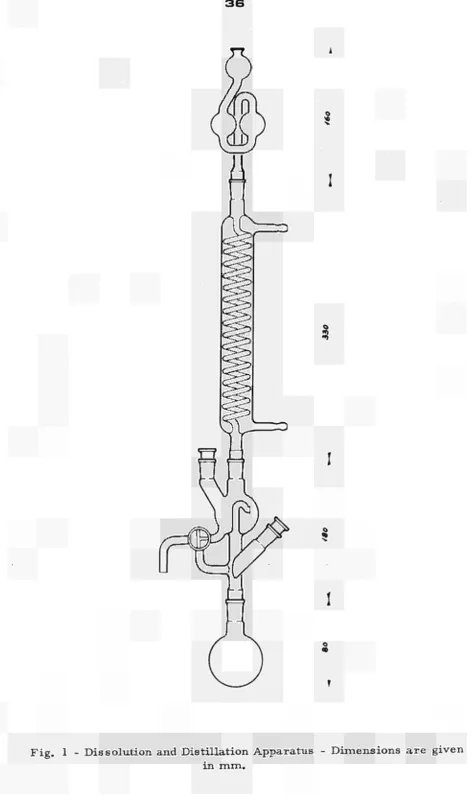
The apparatus used for the dissolution and distillation of biological (9)
m a t e r i a l s was a modified version of the one proposed by Bethge and used by Sjöstrand and Sivasankara Pillay et al. . It is shown in
F i g . 1.
2. 2 Counting and Data P r o c e s s i n g
The i r r a d i a t e d samples and standards were m e a s u r e d either by means v
of gamma ray s p e c t r o m e t r y , or by the Cerenkov counting technique.
2 . 2 . 1 Gamma Ray Spectrometry
3
The counting equipment used for this study was a 18 cm coaxial Ge(Li) detector alternatively connected either with a s m a l l Laben 70 computer or with a Laben 4096 channel a n a l y s e r .
Laben 70 has a 8 K m e m o r y capacity (16 bit) and performs the acquisi-tion of gamma ray spectra, their elaboraacquisi-tion and the printing out of the r e s u l t s . P e r i p h e r a l s include a 4096 channels analog-to-digital converter, an amplifier, an oscillographic display, a real time clock and an Olivetti TE 300 t e l e p r i n t e r .
Data reduction is accomplished by analysing successive sections of 128 channels. Each section is composed of the last 64 channels of the p r e -ceeding section, plus 64 new channels, thus avoiding the loss of peaks
fall-(2) ing between two sections .
Only half of the m e m o r y (2048 channels) of the Laben multichannel ana-l y s e r is currentana-ly used. To avoid gain shifts during ana-long counting periods, a s p e c t r u m stabiliser has been connected to the a n a l y s e r . Both counting equipments are provided with a 1 keV/channel gain setting.
on punched paper tapes and then p r o c e s s e d in batch mode by m e a n s of an IBM 370/165 computer.
An alternative to this mode of operation is the possibility of using an i n -teractive on-line p r o c e s s i n g through an IBM 1070 S y s t e m connected to the central computer, which allows the immediate reduction of the g a m ma s p e c t r a and the printing out of the r e s u l t s on an IBM 2741 t e l e t y p e -w r i t e r .
(3)
The computer p r o g r a m called GRETEL , developed through the y e a r s as experience has progressed, p e r f o r m s the automatic finding of g a m m a peaks p r e s e n t in the s p e c t r a and gives all peak p a r a m e t e r s ( l i m i t s , c e n -troid, net a r e a , FWHM, e r r o r , energy attribution).
With batch processing either qualitative or quantitative analysis is possible. This last one is c a r r i e d out using special " o r i e n t e d " l i b r a r i e s which a r e p r e p a r e d for each p a r t i c u l a r problem by the analyst himself. B e s i d e s , a drawing of the s p e c t r u m is obtained showing whether it has
(4)
been c o r r e c t l y p r o c e s s e d , or not.
When chemical separation p r o c e d u r e s a r e p e r f o r m e d , low resolution s p e c t r o m e t r y (Nal(Tl) detectors) has been p r e f e r r e d due to its highest sensitivity. Q u a r t z & Silice 3 x 3 " integral lines connected with Laben 512 channel a n a l y s e r s were used. Also in this c a s e , the g a m m a s p e c t r a can either be punched on paper tapes and p r o c e s s e d in batch mode, or p r o c e s s e d on-line with the central c o m p u t e r .
Each counting s y s t e m is equipped with automatic s a m p l e c h a n g e r s , controlled by the multichannel a n a l y s e r s or by the Laben 70 m i n i c o m
puter, which allow repetitive cycles of m e a s u r e m e n t s without any o p e r a -tor intervention.
2 . 2 . 2 Cerenkov Counting Technique
ν
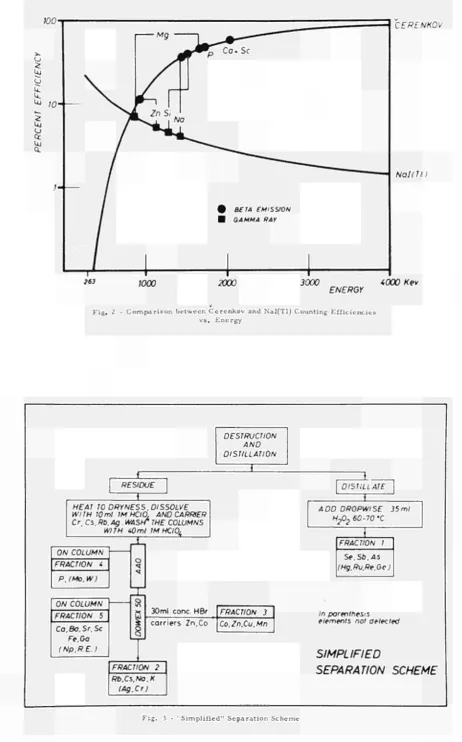
The percent Cerenkov counting efficiency v e r s u s β energy and the Nal(Tl) efficiency versus gamma energy, a r e given in F i g . 2 . As an example, -the values for Ca-»Sc, Mg, Na, Ρ , Si and Zn a r e also r e p o r t e d .
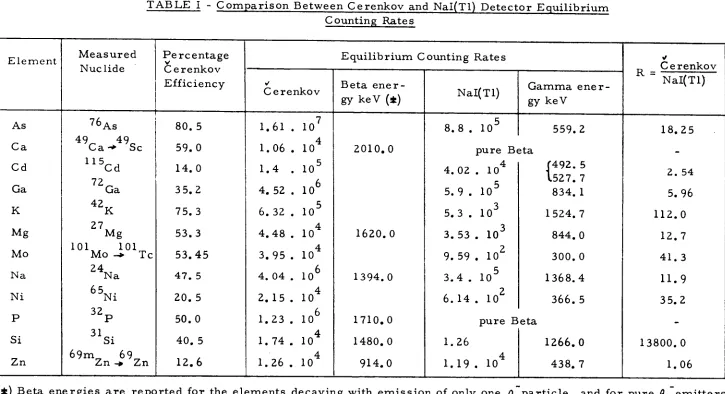
Table I gives the equilibrium counting r a t e s of both techniques for the e l e -ments m e a s u r e d by the Cerenkov method in this study.
T A B L E I - C o m p a r i s o n B e t w e e n C e r e n k o v and N a l ( T l ) D e t e c t o r E q u i l i b r i u m C o u n t i n g R a t e s
E l e m e n t
As C a Cd Ga K Mg Mo Na Ni Ρ Si Z n
M e a s u r e d N u c l i d e
7<>AS 4 9C a »4 9S c
U 5C d 7 2G a
4 2κ
" M g
101 , 101 Mo -»- Tc
2 4N a N i
3 2p
S i
6 9 m 6 97
Z n -» Z n
P e r c e n t a g e C e r e n k o v E f f i c i e n c y
8 0 . 5 5 9 . 0 1 4 . 0 3 5 . 2 7 5 . 3 5 3 . 3 5 3 . 4 5 4 7 . 5 2 0 . 5 5 0 . 0
4 0 . 5 1 2 . 6
•
C e r e n k o v
1.61 . 1.06 . 1.4 . 4 . 5 2 . 6 . 3 2 . 4 . 4 8 . 3 . 9 5 . 4 . 0 4 . 2 . 1 5 . 1.23 . 1.74 . 1.26 .
io7
i o4
i o5
i o6
i o5
i o4
i o4
iob
i o4
iob
i o4
i o4
E q u i l i b r i u m C
B e t a e n e r gy keV (*)
2 0 1 0 . 0
1 6 2 0 . 0
1 3 9 4 . 0
1 7 1 0 . 0 1 4 8 0 . 0 9 1 4 . 0
ounting R a t e s
N a l ( T l ) G a m m a e n e r gy keV
8 . 8 . 1 05 5 5 9 . 2
p u r e B e t a 4 . 0 2 . 1 04
5 . 9 . 1 05
5 . 3 . 1 03
3 . 53 . 1 03
9 . 5 9 . 1 02
3 . 4 . 1 05
6 . 1 4 . 1 02
( 4 9 2 . 5 1527.7 834. 1 1 5 2 4 . 7
8 4 4 . 0 3 0 0 . 0 1 3 6 8 . 4 366. 5 p u r e B e t a
1.26 1 2 6 6 . 0 1.19 . 1 04 4 3 8 . 7
„ C e r e n k o v R ;—:—
N a l ( T l )
1 8 . 2 5
2. 54 5 . 9 6 1 1 2 . 0
1 2 . 7 4 1 . 3 1 1 . 9 3 5 . 2
1 3 8 0 0 . 0 1.06
(*) B e t a e n e r g i e s a r e r e p o r t e d for the e l e m e n t s d e c a y i n g with e m i s s i o n of only one β p a r t i c l e , a n d for p u r e β " e m i t t e r s . No Ά e n e r g i e s a r e i n d i c a t e d in c a s e of e m i s s i o n of s e v e r a l Û .
[image:14.842.36.761.81.475.2]11
2. 3 Instrumental Nuclear Activation Analysis (INAA)
The i r r a d i a t e d samples and standards were t r a n s f e r r e d to polyethy lene vials and counted with a Ge(Li) detector for 30 min (short i r r a d i a tions) after a 1 h decay, and for 5 h (long i r r a d i a t i o n s ) after a 10 days decay.
Short i r r a d i a t e d s a m p l e s , after a decay of at least 2 weeks, were counted ν 32
again to m e a s u r e the Cerenkov radiation of Ρ induced in the walls of the polyethylene vials.
Two weeks decay a r e largely sufficient to allow the shortlived i n t e r -.24 38 42 ,
fering radionuclides ( Na, Cl, K) to reach decay to negligible l e v e l s .
Na, K, CI and Mn were d e t e r m i n e d by INAA with short i r r a d i a t i o n s . F e , Rb, Co and Zn were determined by INAA with long irradiations in Bovine Liver; F e , Rb, Co, C r , C s , Ba, Ca, Sb and Sc in Orchard Leaves and finally Fe, Rb, Co, C r , C s , Ca, Sb, Ba and Sc in Tomato L e a v e s .
Non destructive analysis of phosphorus by INAA has recently been applied
(6)
by Sabbioni et a l . for biochemical applications. The presence of i n t e r fering radionuclides with different s p e c t r a l shapes can be detected by a change of the ratio of the channels counting r a t e s . We have additionally checked the radiochemical purity of the i r r a d i a t e d sample by repeating
32 the m e a s u r e m e n t after a few days and checking for the expected Ρ d e cay.
2. 4 Destructive Activation Analysis
2. 4. 1 Determination of Ca, Mg, Ni and Si
a) Determination of Mg and Ni:
1. Dissolve the i r r a d i a t e d sample (200 mg) with 5 ml of fuming HNO
1 S
2. Evaporate again and dissolve with 10 m l of 0. 1 M HNO containing
++
50 ¡ug c a r r i e r of Ni . P a s s through an HAP column (10 m m dia. and 40 m m long) and a Dowex 50x8 column (8 m m dia. and 2. 5 m m
long). Wash both columns with 40 m l of 0. 1 M HNO .
3. Mg and Ni a r e eluted from Dowex column with 20 m l of 3 M HNO .
4. The eluate is m e a s u r e d with the Cerenkov counting technique to
27 ίί ζ
determine immediately Mg, and after two or m o r e h o u r s Ni. 49 49
b) Determination of Ca (measurement of Sc from Ca decay):
1. Dissolve as for Mg and Ni with 5 ug c a r r i e r of Sc
2. Evaporate and dissolve with 10 m l of 6 M HC IO . Wait 2 h for the 49 49
decay of Ca into Sc, then a b s o r b e on a Dowex 50x8 column (8 m m dia. and 40 m m long) and wash with 20 m l of 10 M HCl.
49
3. Sc is eluted with 20 ml of 6 M H F .
4. Count the eluate with Cerenkov technique.
c) Determination of Si:
1. Dissolve the sample as for the preceding s e p a r a t i o n s .
2. Bring to a l m o s t dryness and add 10 mg of sodium s i l i c a t e plus 10 m l of concentrated HCIO .. F i l t e r the SiO^ and wash with 50 m l of
con-4 2 centrated HCIO.. 4
3. Dissolve again the SiO with 20 m l of 6 M HF and count with the
v
Cerenkov technique.
2 . 4 . 2 Radiochemical Separation Schemes
a) Dissolution and Distillation P r o c e d u r e :
The dissolution - distillation p r o c e d u r e for biological m a t r i c e s in
1 3
1. Add 2 ml of concentrated H SO , 5 m l fuming HNO and 10 mg c a r r i e r of Au to 100-300 mg of i r r a d i a t e d s a m p l e , contained in the
dissolution flask (see Fig. 1 ).
2. Boil for 10 min and collect the distillate in the upper r e s e r v o i r of the flask.
3. Cool and recycle the distillate. 4. Boil for 10 min under reflux.
5. Boil for 10 min collecting the distillate. 6. Cool and add 5 ml fuming HNO .
7. Repeat operations 2. , 3. , 4. , 5. 8. Cool and add 10 m l H O dropwise.
9. Distill until fumes of SO appear, collect the distillate. 10. Cool and add 5 ml concentrated HBr.
11. Distill until fumes of SO a p p e a r , collect the distillate. 12. Repeat operations 10. and 11. twice.
13. Wash the cooling s y s t e m and the distillation flask three or four times with 6 M HCl.
The dissolution distillation of the i r r a d i a t e d samples takes n o r
-mally 3. 5 h.
b) Simplified Separation Scheme:
The procedure is outlined in F i g . 3 and its four steps a r e described below:
1. After the dissolution - distillation procedure has been performed, collect together the distillates of the fuming HNO , of the H_0 , of the HBr and the washing solutions, heat to 60-70 C and add 35 ml of H O dropwise to remove b r o m i n e . The remaining solution makes up FRACTION 1 (As, Hg, Sb, Se, Re, Ru, Ge).
2. Dry the distillation residue, cool and dissolve with 10 ml of 1 M HCIO , adding 20 mg c a r r i e r of C s , Rb, Ag and C r . P a s s through
1 4
e a c h of 10 m m in dia. and 100 m m in length.
3 . Wash the columns with 40 m l of 1 M HCIO, to obtain FRACTION 2
4
(Na, K, Rb, C s , Ag, C r ) .
4. Wash the Dowex 50 column with 30 m l of 47% H B r containing c a r
r i e r s of Co and Zn to elute FRACTION 3 (Co, Zn, Cu, Mn). AAO
column and Dowex 50 column a r e r e s p e c t i v e l y FRACTION 4 ( P , Mo,
W) and FRACTION 5 (Ca, Ba, S r , Sc, F e , Ga, Np).
Two h o u r s a r e n o r m a l l y n e c e s s a r y to p e r f o r m t h i s s e p a r a t i o n .
The five fractions a r e m e a s u r e d e i t h e r with Ge(Li) o r with Nal(Tl) d e
t e c t o r s , after 5 h d e c a y , to d e t e r m i n e Cu, Ga, N a , K, A s , and a f t e r
2 8 days decay to m e a s u r e l o n g e r l i v e d n u c l i d e s . FRACTION 4 i s a l s o
m e a s u r e d with C e r e n k o v technique for Ρ d e t e r m i n a t i o n .
Table II shows in a synthetic way how the m e a s u r e m e n t s a r e p e r f o r
m e d and gives an idea on the counting t i m e s involved.
c) C o m p l e t e S e p a r a t i o n S c h e m e :
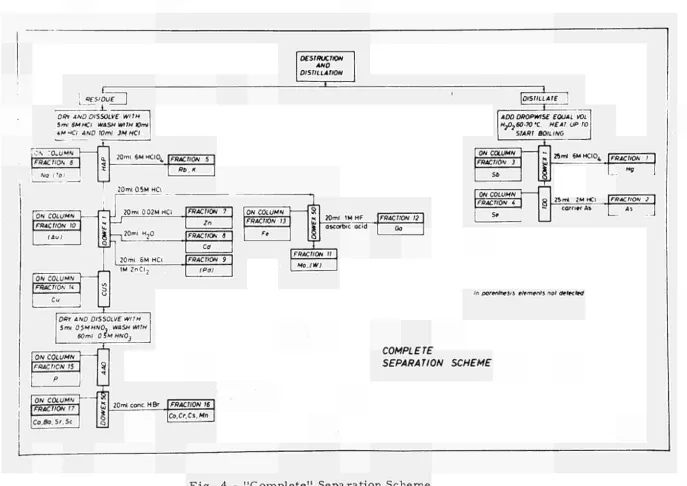
The p r o c e d u r e i s s c h e m a t i s e d in F i g . 4 and p r o v i d e s a s e l e c t i v e s e p a
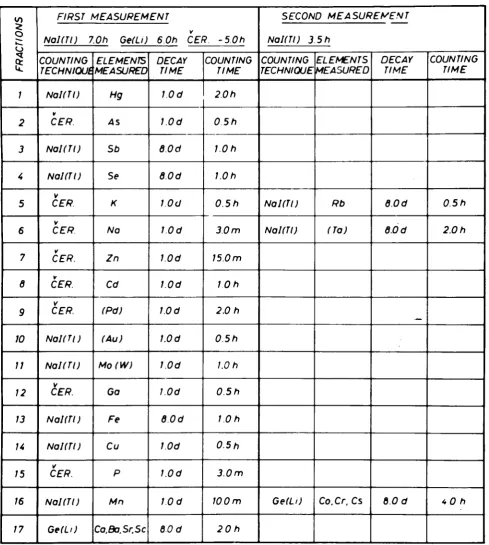
r a t i o n of longlived nuclides into 17 f r a c t i o n s .
The different s t e p s a r e p r e s e n t e d below.
1. After having p e r f o r m e d the dis s ohità on d i s t i l l a t i o n p r o c e d u r e , c o l
l e c t t o g e t h e r the d i s t i l l a t e s of the fuming HNO , of the H O , of the
S) Lé Lá
H B r and the washing solutions, h e a t up to 6 0 7 0 C, adding d r o p s of
H O up to 35 m l to drive off b r o m i n e .
2. P a s s the d i s t i l l a t e portion (about 60 m l ) t h r o u g h two s u p e r p o s e d
columns of Dowex 1x8 in c h l o r i d e f o r m and TDO. Both c o l u m n s
have a d i a m e t e r of 7 m m and a height of 30 m m .
3 . E l u t e Hg (FRACTION 1) from Dowex with 2 5 m l of 6 M H C 1 04.
4 . Elute As (FRACTION 2) from TDO with 2 5 m l of 2 M HCl and 2 M
N a ^ H A s O , .
TABLE II Counting T i m e s Involved in the M e a s u r e m e n t of F r a c t i o n s Obtained by the "Simplified" Separation Scheme
1
o
;2
3
A
5
FIRST MEASUREMENT
Nal(TI) 2.0h
Ge(Li) 0.5h
CER. 2.0m
COUNTING
TECHNIQUE
Nal(Tl)
Ge(Li)
Nal(Tl)
CER.
Nal(Tl)
ELEMENTS
MEASURED
As
(Hgfie.Ru.Ge,
Na.K
Cu
Ρ
(Pa.Mo.W)
Ga
DECAY
TIME
5.0h
5.0h
5.0h
5.0h
5.0h
COUNTING
TIME
0.5h
0.5h
l.Oh
2.0m
0.5h
SECOND MEASUREMENT
Nal(TI) 3.0h
Ge(Li) 6.0h
COUNTING
TECHNIQUE
Nal(Tl)
Ge(Li)
Nal(Tl)
Ge(Li)
ELEMENTS
MEASURED
Sb.Se
Rb.Cs
(Ag.Cr)
Co, 2 η
Ca,Ba,Sr,Sc
Fe(Np,R.E)
DECAY
TIME
2.0 d
6.0 d
Õ.Od
Õ.Od
COUNTING
TIME
2.0 h
4.0h
1.0h
2.0h
Ul [image:19.842.113.774.164.466.2]1 6
5. The columns of Dowex 1 and TDO which have r e s p e c t i v e l y r e t a i n e d Sb and Se r e p r e s e n t FRACTION 3 and FRACTION 4.
6. Dry the distillation residue, cool and dissolve with 5 m l 6 M HCl. P a s s through superposed columns of HAP (12 m m dia. , 50 m m long), Dowex 1x8 (10 m m dia. , 80 m m long) in chloride form and CUS
(12 m m dia. and 80 m m long). In o r d e r to complete the elution of non-absorbed e l e m e n t s , wash the columns with 10 m l 6 M HCl, 20 m l of 4 M HCl and 10 m l of 3 M HCl.
7. The Rb (FRACTION 5) is eluted from HAP with 6 M HCIO .
FRACTION 6 contains Na and Ta retained on HAP.
8. F r o m the Dowex 1 column elute:
a) F e , Mo, Ga, W with 20 m l of 0. 5 M HCl, b) Zn with 20 ml of 0. 02 M HCl (FRACTION 7), c) Cd with 20 m l of H O (FRACTION 8),
d) Pd with 20 m l of 6 M HCl and 1 M ZnCl (FRACTION 9).
C»
The Dowex 1 column containing Au is the FRACTION 10.
9. P a s s the fraction containing F e , Mo, Ga, W through a Dowex 50x8 column (7 m m dia. , 30 mm long) in chloride f o r m . Wash with 10 m l of 0. 5 M HCl: the eluate contains Mo and W (FRACTION 11).
Elute Ga with 20 m l of 1 M HF with 5% a s c o r b i c acid (FRACTION 12). Dowex 1 column containing Fe is the FRACTION 13.
10. The CUS column containing Cu is the FRACTION 14.
11. The non-absorbed fraction from the t h r e e s u p e r p o s e d columns is dried, dissolved with 5 ml of 0. 5 M HNO and p a s s e d through a set of two superposed columns (12 m m dia. , 100 m m long) of AAO and Dowex 50x8 in hydrogen form. Wash with 60 m l of 0. 5 M HNO .
12. The AAO column containing Ρ is the FRACTION 15.
13. Co, Cr, Cs and Mn (FRACTION 16) a r e eluted from Dowex 50 with
1 7
column (FRACTION 17).
The complete separation is performed in about five hours.
1 8
TABLE ΙΠ - Counting Times Involved in the M e a s u r e m e n t of F r a c t i o n s Obtained by the "Complete" Separation Scheme
to o
5
; 2 3 A 5 6 7 6 9 10 11 12 13 14 15 16 17 FIRST MEASUREMENTNaKTl) 7.0h Ge(Li) 6 Oh CER. -5.0h
COUNTING TECHNIQUt Nal(TI) CER. NaKTl) NaKTl) V CER. CER CER. CER. V CER. NaKTl ) NaKTl) V CER. NaKTl) NaKTl) CER. NaKTl) Gei Li) ELEMENTS MEASURED Hg AS Sb Se Κ Na Zn Cd (Pd) (Au) Mo(W) Ga Fe Cu Ρ Mn
Ca.Ba. Sr, 5 c
DECAY TIME 1.0d I.Od 6.0 d 60d 1 Od I.Od I.Od I.Od I.Od I.Od I.Od I.Od 60d I.Od I.Od 1 Od
6 0 d
COUNTING TIME 2.0 h 05h 1.0h 1.0h 0.5h 3.0 m 15.0m 10h 2.0 h 0.5h 1.0 h 0.5h 10h 0.5 h 3.0m 100 m 20h SECOND MEASUREMENT
NaKTl) 3 5h
COUNTING TECHNIQUE
Na I (Tl)
NaKTl) Ge(Li) ELEMENTS MEASURED Rb (Ta)
Co. Cr, Cs
DECAY TIME 6.0 d 6.0 d 6.0 d COUNTING TIME 0.5 h 2.0 h
4 0 Λ
1 9
3 . R E S U L T S
In n e u t r o n a c t i v a t i o n a n a l y s i s often the d e t e r m i n a t i o n s of d i f f e r e n t e l e m e n t s a r e p e r f o r m e d in a s i n g l e s a m p l e . F r o m the b e g i n n i n g to the e n d of t h e a n a l y s i s a d e l a y of s o m e m o n t h s m a y be n e c e s s a r y . As a c o n s e q u e n c e it a p p e a r s p r o b l e m a t i c to go b a c k to e v e n t u a l a c c i d e n t a l e r r o r s o c c u r r e d d u r i n g the a n a l y s i s of the s a m p l e . In c a s e s in w h i c h t h e s e e r r o r s c a n n o t be s t a t e d , a s t a t i s t i c a l t r e a t m e n t of the d a t a o b t a i n e d c o u l d be h e l p ful to s u g g e s t e v e n t u a l o u t l i e r s . As a n i n d i c a t i o n of a n o m a l o u s d a t a the
(12)
Dixon T e s t w a s u s e d .
T h e e x p e r i m e n t a l s i n g l e m e a s u r e m e n t s , a s s u m i n g t h a t t h e y b e l o n g to a n o r m a l d i s t r i b u t i o n , a r e a r r a n g e d in i n c r e a s i n g o r d e r , a s f o l l o w s :
Χ 1 έ X2 ^ *x n'
a c c o r d i n g to the n u m b e r η of d a t a a v a i l a b l e , d i f f e r e n t r a t i o s a r e c a l c u l a t e d if e i t h e r x. o r χ a r e s u s p e c t e d to b e out of the d i s t r i b u t i o n . R, r e f e r s
I n 1
t o x , a n d R„ r e f e r s to χ .
1 2 η
X2 ' " i
If η <. 7 R, =
1 χ - χΊ
η 1
X2 _ X1
If 7 < η < 10 R, =
1 χ - x n - 1 1
X3 "Xl
If 10 < η £ 13 R =
1 χ - x n - 1 1
X3 "Xl
If n > 13 R, =
1 x - x . n - 2 1
R2
R2
R 2
V
X - X
η n - 1
χ - X η 1
X - X
n n-1 χ - χ
η 2
X - X
n n - ¿
χ - χ
η 2
χ - χ _
η η - 2
χ - χ ,
η 3
A s s u m i n g a c o n f i d e n c e l e v e l of 9 5 % t h e r a t i o s R a n d R a r e c o m p a
r e d w i t h t h e c o r r e s p o n d i n g f i g u r e s of t h e D i x o n t a b l e f o r a g i v e n η : DT
If R, > DT a n d / o r R > DT
sa
the suspected values χ. or χ a r e rejected and new r a t i o s a r e c a l c u
-1 η
late d with the η - i values.
T h e test is repeated until R. a n d / o r R a r e g r e a t e r than D T . ..
1 2 (n - 1)
The estimated mean X of the η - i values is then c a l c u l a t e d together 2
with its standard deviation s and its variance s .
The above mentioned operations a r e automatically p e r f o r m e d by a c o m puter p r o g r a m called MEAVAR, set up at the JRC Scientific Data P r o c e s s i n g C e n t r e .
The confidence limits a r e then calculated
w h e r e : —= is the m e a n deviation l/n
η is the number of individual m e a s u r e m e n t s (after the Dixon T e s t is applied)
t is the Student's factor depending on the n u m b e r of d e g r e e s of freedom and on the chosen confidence level (in this c a s e
95%).
The percentage relative standard deviation:
100 . s
(2) X
which has been p r e f e r r e d over the p r e c i s i o n , and the p e r c e n t a g e a c c u r a c y
i o o . / x - x /
( 3 )X
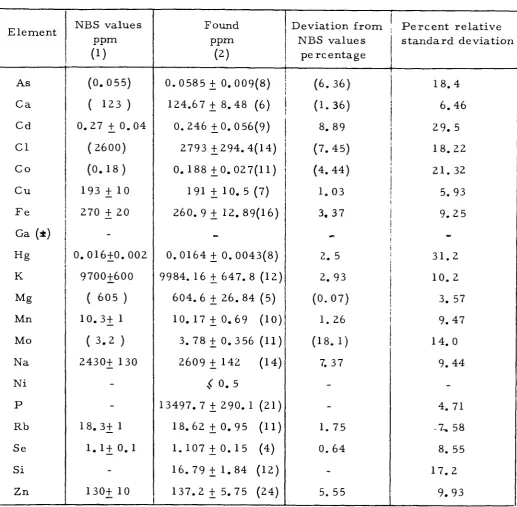
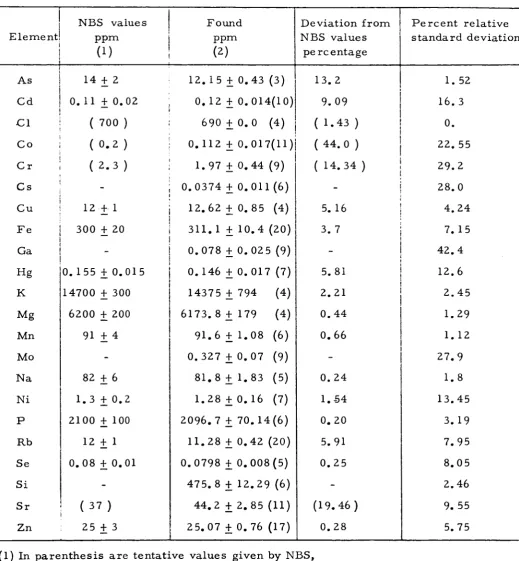
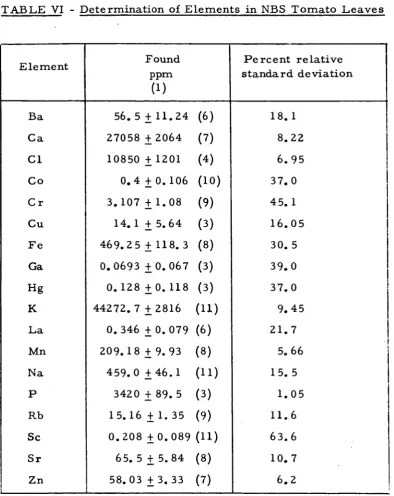
(only calculated in case of NBS certified values X) a r e p r e s e n t e d in the Tables IV, V and VI, which report the r e s u l t s obtained by this l a b o r a t o r y for Bovine Liver, Orchard Leaves and Tomato L e a v e s .
In the first column of the tables the symbols of the a n a l y s e d e l e m e n t s
a r e reported. In the second one certified or tentative values given by the
-Ξ Ι
lumn r e p r e s e n t s the percentage deviation from NBS values obtained by (3): the actual percentage a c c u r a c y is significant only when NBS c e r t i
fied values exist. Column five r e p r e s e n t s the percentage relative standard deviation, obtained by (2), related to the set of m e a s u r e m e n t s performed in this laboratory.
ss
T A B L E IV D e t e r m i n a t i o n of E l e m e n t s i n NBS S R M 1577 ( B o v i n e L i v e r )
T*] 1 P m p r i t
J—á J- V> X Í I V - 1 1 1 ·
A s C a C d C l C o C u F e
Ga (*)
J H g
I ¡ κ! Mg
ι
Ι Μ η
Mo N a Ni Ρ R b Se Si Z n
NBS v a l u e s p p m ( i )
( 0 . 0 5 5 )
( 1 2 3 )
0 . 2 7 + 0 . 0 4
( 2 6 0 0 )
( 0 . 1 8 )
193 + 10
270 + 20
0 . 0 1 6 + 0 . 0 0 2
9700+600
( 6 0 5 )
1 0 . 3 + 1
( 3 . 2 )
2430+ 130
1 8 . 3 + 1
1.1+ 0 . 1
130+ 10
F o u n d p p m
(2)
0 . 0 5 8 5 + 0 . 0 0 9 ( 8 )
1 2 4 . 6 7 + 8 . 4 8 (6)
0 . 2 4 6 + 0 . 0 5 6 ( 9 )
2 7 9 3 + 2 9 4 . 4 ( 1 4 )
0 . 188 + 0 . 0 2 7 ( 1 1 )
191 + 1 0 . 5 (7)
2 6 0 . 9 + 1 2 . 8 9 ( 1 6 )
0 . 0 1 6 4 + 0 . 0 0 4 3 ( 8 )
9 9 8 4 . 16 + 6 4 7 . 8 (12)
6 0 4 . 6 + 2 6 . 8 4 (5)
1 0 . 1 7 + 0 . 6 9 (10)
3 . 7 8 + 0 . 3 5 6 (11)
2609 + 142 (14)
N< 0 . 5
1 3 4 9 7 . 7 + 2 9 0 . 1 (21)
1 8 . 6 2 + 0 . 9 5 (11)
1 . 1 0 7 + 0 . 1 5 (4)
1 6 . 7 9 + 1 . 8 4 (12)
1 3 7 . 2 + 5 . 7 5 (24)
D e v i a t i o n f r o m N B S v a l u e s
p e r c e n t a g e
( 6 . 3 6 )
( 1 . 3 6 )
8 . 8 9
( 7 . 4 5 )
( 4 . 4 4 )
1 . 0 3
3 . 3 7
""
2. 5
2 . 9 3
( 0 . 0 7 )
1. 26
( 1 8 . 1 )
7. 37
1 . 7 5
0 . 6 4
5. 55
P e r c e n t r e l a t i v e s t a n d a r d d e v i a t i o n
1 8 . 4
6 . 4 6
2 9 . 5
1 8 . 2 2
2 1 . 32
5 . 9 3
9 . 2 5 _
3 1 . 2
1 0 . 2
3 . 57
9 . 4 7
1 4 . 0
9 . 4 4
4 . 71
7, 58
8. 55
1 7 . 2
9 . 9 3
(*) D u e t o t h e d i s h o m o g e n e i t y t h e v a l u e i s n o t r e p o r t e d ( s e e t e x t ) ,
(1) In p a r e n t h e s i s a r e t e n t a t i v e v a l u e s g i v e n b y N B S ,
[image:26.595.37.555.98.605.2]S 3
TABLE V - Determination of Elements in NBS SRM 1571 (Orchard Leaves)
j Element ι i i ! As C d C l C o C r C s C u F e Ga Hg Κ Mg Mn Mo N a N i Ρ Rb Se Si S r Zn NBS values ppm
( i )
14 + 2 0. 11 + 0.02
( 700 ) ( 0.2 )
( 2 . 3 )
*"
1 2 + 1 300 + 20
-0. 155 + -0.015 14700 + 300
6200 + 200 9 1 + 4
-8 2 + 6 1.3 + 0.2 2100 + 100
12 + 1 0.08 + 0.01
-( 3 7 ) 25 + 3
Found ppm
(2)
12.15 + 0.43 (3) 0. 12 + 0.014(10)
690 + 0.0 (4)
0.112 + 0.017(11) 1.97 + 0.44 (9) 0.0374 + 0.011 (6)
12.62 + 0.85 (4) 311.1 + 10.4 (20) 0.078 + 0.025 (9) 0.146 + 0.017 (7) 14375 + 794 (4) 6173.8 + 179 (4)
91.6 + 1.08 (6) 0.327 + 0.07 (9) 81.8 + 1.83 (5)
1.28 + 0.16 (7) 2096.7 + 70.14(6)
11.28 + 0.42 (20)
0.0798 + 0.008(5) 475.8 + 12.29 (6)
44.2 + 2.85 (11)
25.07 + 0.76 (17)
Deviation from NBS values
percentage
13.2
9.09 ( 1 . 4 3 )
( 44. 0 ) ( 1 4 . 3 4 )
_
5.16
3 . 7 -5.81 2.21 0.44 0.66 -0.24 1.54 0.20 5.91 0.25
-( 1 9 . 4 6 ) 0.28
P e r c e n t relative standard deviation 1. 52 16.3 0. 22. 55 29.2 28.0 4.24 7.15 42.4 12.6 2.45 1.29 1. 12 27.9 1.8 13.45 3.19 7.95 8.05 2.46 9.55 5.75
(1) In parenthesis are tentative values given by NBS,
Ξ 4
TABLE VI - Determination of Elements in NBS Tomato L e a v e s
Element B a C a C l Co C r Cu F e Ga Hg K L a Mn N a Ρ R b Sc S r Zn Found ppm (i)
56.5 + 11.24
27058 +2064 10850 +1201
0.4 + 0.106 3.107 + 1 . 0 8
14.1 + 5 . 6 4 469.25 + 118.3 0.0693 + 0 . 0 6 7 0.128 + 0 . 118 44272.7 +2816
0.346 + 0 . 0 7 9 209.18 + 9.93
459.0 + 4 6 . 1
3420 + 8 9 . 5 15.16 + 1. 35
0.208 + 0 . 0 8 9 65. 5 + 5.84
58.03 + 3 . 3 3
(6) (7) (4) (10) (9) (3) (8) (3) (3) ( H ) (6) (8)
(n)
(3) (9)
( i i )
(8) (?)
P e r c e n t relative standard deviation
18.1
8.22
6 . 9 5 37.0 4 5 . 1 16.05 30. 5 39.0 37.0 9.45 2 1 . 7
5.66 1 5 . 5
1.05 11.6 6 3 . 6
10.7
6 . 2
(1) F i g u r e s in parenthesis a r e the number of d e t e r m i n a t i o n s per
ss
- Bovine Liver
The accuracy is good for the elements certified by the NBS while the deviation from the suggested values is fairly good. Only for Mo the deviation is l a r g e r than 10%. The relative standard deviation for ten elements is better than 10%; for As, Cd, Cl, Co, Hg, Mo, Se and Si it exceeds 10%. This could be due either to the s m a l l number of determinations performed, or to the low content of these elements in the sample.
The analysis of Ga has given r i s e to two s e r i e s of results c o r r e s p o n -ding to the two different s p e c i m e n s :
1 - 7 2 0.13 ; 0. 13 ; 0. 15 ; 0. 16 ; 0. 18; 0.22 ; 0.23 ; 0.31 ppm
I - 649 0.0066 ; ^ 0.01 ; 0.05 ; 0.009 ppm.
An estimated mean value has not been reported for this element.
- O r c h a r d Leaves
The accuracy is b e t t e r than 10% for all the certified e l e m e n t s , except As
15)
As (13. 2%). The value for this last element is in fact still doubtful
. The deviation from the NBS uncertified elements is generally l a r g e ,
except for chlorine.
The relative standard deviation is better than 10% for 13 elements; for Cd, Co, Cr, C s , Ga, Hg, Mo and Ni it exceeds 10%. The concentra-tions of these elements in the sample a r e very low and in some cases such as for Cd, Mo and Ni is n e a r to the sensitivity limits of our tech-nique .
- Tomato Leaves
During the course of certification a n a l y s e s , the homogeneity of the m a -(44)
Ξ 6
2 7
4 . DISCUSSION
4. 1 Dissolution and D i s t i l l a t i o n
Reagents c u r r e n t l y u s e d for wet ashing of o r g a n i c m a t e r i a l s a r e
H SO , HNO , HCIO and H O , mainly u t i l i s e d in two components mix
t u r e s such as H SO H O , H SO HNO , HCIO HNO , HNO
Ú ^ iL iL Lé ^χ D Q ~> Z>
H . O . 2 2
A m o r e detailed d e s c r i p t i o n of the different d i s s o l u t i o n methods and of
the d e s t r u c t i o n m e c h a n i s m s of the o r g a n i c m a t e r i a l s can be found in the (!6)
l i t e r a t u r e .
In o r d e r to avoid eventual explosions HCIO has b e e n left out of our
wet ashing p r o c e d u r e m i x t u r e s .
When the u s e of Η SO, was n e c e s s a r y for s u c c e s s i v e d i s t i l l a t i o n s in o u r
2 4 3
s e p a r a t i o n s c h e m e s , the m i x t u r e Η SO HNO was u s e d to d i s s o l v e
o r g a n i c s a m p l e s . In the s e l e c t i v e d e t e r m i n a t i o n of Ca, Mg, Ni and Si
v/e have u s e d the m i x t u r e fuming HNO H O .
J υ Lá
The advantage of obtaining a r a p i d organic m i n e r a l i s a t i o n by Η SO
and HNO is partly d i m i n i s h e d by the difficulty of r e m o v i n g Η SO ,
«5 Lá TC
B e s i d e s , for m a t e r i a l s r i c h in Ca, the eventual p r e c i p i t a t i o n of CaSO
could i n c o r p o r a t e o t h e r e l e m e n t s .
In our working conditions we have n e v e r noted the f o r m a t i o n of such
p r e c i p i t a t e s . During the dissolution phase a quantitative d i s t i l l a t i o n is
only obtained for CI, Br and I. Ge, Ru and Os d i s t i l l a t e only p a r t i a l l y ,
while As and Se p a r t l y d i s t i l l a t e in the p r e s e n c e of l a r g e quantities of
c h l o r i d e s which a r e n o r m a l l y a b s e n t in biological m a t e r i a l s . In o r d e r to
avoid p o s s i b l e l o s s e s of m a t e r i a l through v o l a t i l i s a t i o n during d i s s o l u
tion, the distillate obtained during this o p e r a t i o n , is c o l l e c t e d t o g e t h e r
with the products of s u c c e s s i v e d i s t i l l a t i o n s with H O and H B r .
Ξ 8
c e s s a r y to extend its boiling p e r i o d in o r d e r to obtain c o m p l e t e m i n e r a
l i s a t i o n .
D i s t i l l a t i o n of volatile e l e m e n t s in H SO H B r solution is a p r o c e d u r e
c u r r e n t l y u s e d by s e v e r a l authors* ' . We h a v e , h o w e v e r , r e
peated the d i s t i l l a t i o n r e c o v e r y t e s t s with r a d i o a c t i v e t r a c e r s b e c a u s e
modifications of the a p p a r a t u s and of the p r o c e d u r e s w e r e u n a v o i d a b l e .
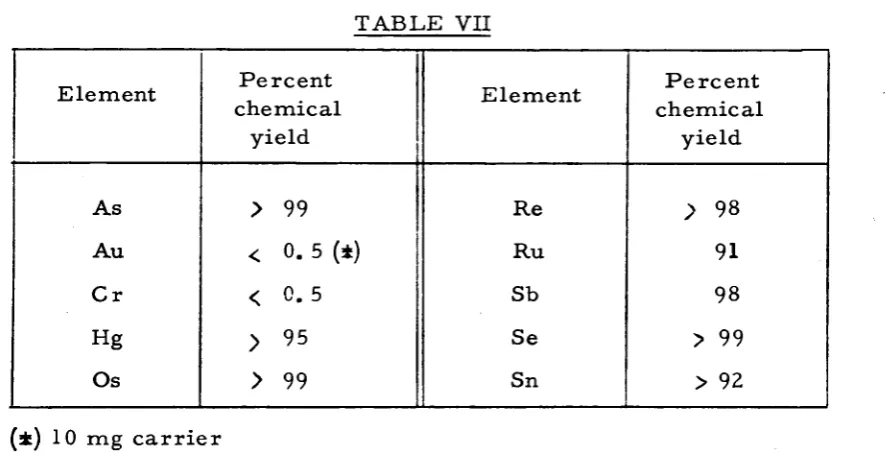
In Table VII r a d i o c h e m i c a l y i e l d s for volatile e l e m e n t s obtained in
this l a b o r a t o r y a r e given, t o g e t h e r with t h o s e of s o m e e l e m e n t s which
could b e c o m e volatile in p a r t i c u l a r c o n d i t i o n s .
TABLE VII
E l e m e n t
As
Au
C r
Hg
Os
P e r c e n t c h e m i c a l
yield
> 99
< 0. 5 (*)
< 0 . 5
> 95
> 99
E l e m e n t
Re
Ru
Sb
Se
Sn
P e r c e n t c h e m i c a l
y i e l d
> 98
91
98
> 99
> 92
(±) 10 m g c a r r i e r
To p e r f o r m a quantitative d i s t i l l a t i o n (>95%) of Ru it was n e c e s s a r y
to u s e KIO in the l a s t distillation s t e p . 82
G e n e r a l l y , the p r e s e n c e of B r does not allow the d i r e c t counting of the
d i s t i l l a t e . Br i s d r a w n away by h e a t i n g up to 60 C with H O . Also CI, Lá Lá
I and Os v o l a t i l i s e in t h e s e conditions.
4 . 2 D e t e r m i n a t i o n of Ca, Mg, Ni and Si
A n a l y s i s of Ca, Mg, Ni and Si by n e u t r o n a c t i v a t i o n and C e r e n k o v (20)
counting technique has been r e c e n t l y s e t up in this l a b o r a t o r y . N e u t r o n
[image:32.595.72.515.290.519.2]Ξ 9
t i v e in t h i s c a s e .
ν 49 49
T h e C e r e n k o v c o u n t i n g e f f i c i e n c i e s a r e 59% for C a -* S c , 5 3 . 3 % for
? 7 A ^ ^ Ί
Mg, 2 0 . 5% f o r Ni a n d 4 0 . 5% for Si ( s e e T a b l e I). As a c o n s e -v
q u e n c e , the counting s e n s i t i v i t y of t h e C e r e n k o v t e c h n i q u e c o m p a r e d to t h e a r e a of the m o s t p r o m i n e n t g a m m a p e a k s of the s a m e r a d i o i s o t o p e o b t a i n e d by 3 " x 3 " N a l ( T l ) d e t e c t o r s is i n c r e a s e d a b o u t 13 t i m e s for Mg,
49
3 5 t i m e s for Ni, 13y800 t i m e s for Si. Sc b e i n g a p u r e b e t a - e m i t t e r , the
47
i n c r e a s e of s e n s i t i v i t y c o m p a r e d to C a c a n be a s s u m e d to be a b o u t 1_,000 t i m e s c o n s i d e r i n g t h e a c t i v i t i e s a t s a t u r a t i o n .
49 27 65 In the e x a m i n e d b i o l o g i c a l s a m p l e s the a c t i v i t i e s of Se, Mg, Ni 31 24 56 42 38 82 32
a n d Si a r e m a s k e d by t h o s e of Na, Mn, K, C I , B r , Ρ and o t h e r s . T h e i n t e r f e r i n g a c t i v i t i e s a r e r e m o v e d by s e l e c t i v e s e p a r a t i o n s w i t h good d e c o n t a m i n a t i o n f a c t o r s , a s d e s c r i b e d a b o v e .
4 . 3 S i m p l i f i e d S e p a r a t i o n S c h e m e
T h e n u m b e r of e l e m e n t s w h i c h c a n be d e t e r m i n e d in the s t u d i e d s a m p l e s by n o n - d e s t r u c t i v e a n a l y s i s a n d g a m m a r a y s p e c t r o m e t r y is r a t h e r l i m i t e d . Due to p o s s i b l e i n t e r f e r e n c e s , the i d e n t i f i c a t i o n of s o m e e l e m e n t s i s a l s o doubtful.
24 32 R a d i o n u c l i d e s s u c h a s N a , a m o n g the s h o r t - l i v i n g o n e s , a n d Ρ
a m o n g l o n g e r l i v e d r a d i o i s o t o p e s r e s t r i c t t h e u s e of g a m m a r a y s p e c t r o -46 65 65 , 85 m e t r y ; b e s i d e s , Sc i n t e r f e r e s w i t h Zn, Zn i n t e r f e r e s with S r ,
1 2 4 ^ . , 134^
Sb w i t h C s , e t c .
T o a v o i d t h e s e d r a w b a c k s we h a v e s e t u p a s i m p l i f i e d s e p a r a t i o n p r o c e d u r e .
of AAO
In t h i s l a b o r a t o r y p r o b l e m s i n v o l v i n g the p r e s e n c e of g r e a t q u a n t i t i e s in bi
(21) 32
3 0
24 42
In this scheme the elution of Na and K allows the d e t e r m i n a t i o n 72 64
of Ga and Cu. We also have carefully avoided that m i x t u r e s of Sc and Zn, Zn and Sr arid Sb and C s were in the s a m e fraction.
The residue, dissolved in 1 M HCIO is p a s s e d through AAO where P , Mo
and W a r e retained, then through Dowex 50 where Ca, Ba, Sr, Sc, F e , Ga, (22 Np, Co, Zn, Cu a r e absorbed while Na, K, Rb, C s , Ag and C r a r e eluted .
If Cu m u s t be determined, a further s e p a r a t i o n is obtained by eluting (38)
Co, Zn and Cu from Dowex 50 with concentrated H B r . The composition of the mixture of radionuclides on the r e s i n is such, that it.can be counted by a Ge(Li) d e t e c t o r .
We have noticed that the behaviour of C r and F e s o m e t i m e s differs from the expected one. C r in some c a s e s is partially a b s o r b e d on the Dowex 50 column, while about 5% of F e is eluted from the s a m e column. With the simplified separation s c h e m e it has been possible to d e t e r m i n e five short-lived isotopes (Na, K, Cu, Ga and As) and t h i r t e e n long-lived isotopes (P, Ca, Ba, Sr, Sc, F e , Rb, C s , C r , Co, Zn, Sb and Se).
4 . 4 Complete Separation Scheme
The scope of this separation p r o c e d u r e is twofold:
a) i n c r e a s e the n u m b e r of elements to be determined;
b) i n c r e a s e the sensitivity by the use of l e s s selective but highly sensitive
counting techniques.
ν
The use of the Cerenkov countings, in p a r t i c u l a r , r e q u i r e s m o r e s e l e c
tive separation p r o c e d u r e s . To avoid e r r o r s due to incomplete s e p a r a t i o n s , the control of the decay of the radioisotopes to be d e t e r m i n e d is r e c o m m e n ded. As a consequence, only s h o r t - l i v e d radionuclides w e r e d e t e r m i n e d by
us with this counting technique.
3 1
( 1 & 2 3-38^ r a d i o c h e m i c a l a p p l i c a t i o n s , a r e r e p o r t e d in the l i t e r a t u r e
O u r s e p a r a t i o n s c h e m e t a k e s a d v a n t a g e of the ionic e x c h a n g e of a n i o n i c a n d c a t i o n i c r e s i n s and of the a b s o r p t i o n p r o p e r t i e s of s o m e i o n i c p r e
-(39) c i p i t a t e s s t u d i e d in t h i s l a b o r a t o r y .
T h e d i s t i l l a t i o n r e s i d u e s in 6 M H C l a r e p a s s e d t h r o u g h H A P , Dowex 1 a n d CUS c o l u m n s . On the H A P c o l u m n Na, Rb, K a n d T a a r e r e t a i n e d ; t h e a p p a r e n t d i s a g r e e m e n t b e t w e e n w h a t w a s s t a t e d by G i r a r d i a n d S a b b i o
-(35)
n i ( 7 5 % of Rb r e t a i n e d ) and t h i s w o r k (100% of Rb r e t a i n e d ) is due to t h e g r e a t e r quantity of H A P u s e d in the p r e s e n t p r o c e d u r e s .
T h e elution of Rb a n d K with 6 M H C I O , and c a r r i e r s , a l l o w s the 4
ν
c o u n t i n g of the two e l e m e n t s with the C e r e n k o v t e c h n i q u e with a c o n s i d e r a b l e i n c r e a s e of s e n s i t i v i t y . A l s o N a , r e t a i n e d on H A P c a n be c o u n t e d in t h e s a m e w a y .
T h e p a s s a g e t h r o u g h Dowex 1 a n d the e l u t i o n in h y d r o c h l o r i c m e d i a b a s e d (41)
o n the s t u d i e s of K r a u s and N e l s o n is a s t e p c o m m o n l y u s e d by u s a n d by s e v e r a l o t h e r l a b o r a t o r i e s .
F r a c t i o n s c o n t a i n i n g Zn, C d a n d P d a r e a l l c o u n t e d with t h e C e r e n k o v t e c h n i q u e .
T h e 0 . 5 M H C l f r a c t i o n c o n t a i n i n g F e , Ga and Mo m u s t be f u r t h e r s p l i t into t h r e e d i f f e r e n t f r a c t i o n s a s the p r e s e n c e of F e ( c o l o u r e d s o l u
-V '
t i o n ) e i t h e r gives r i s e to t h e q u e n c h i n g p h e n o m e n o n d u r i n g C e r e n k o v 99
c o u n t i n g for Ga d e t e r m i n a t i o n , o r d o e s not a l l o w the a n a l y s i s of Mo, t h i s r a d i o i s o t o p e h a v i n g its h i g h e r p e a k (140 keV) a t the e n e r g y of a
59
g a m m a p e a k of F e .
(39) C u i s s e l e c t i v e l y r e t a i n e d on CUS .
32
T h e e l u a t e of t h e t h r e e c o l u m n s m a i n l y c o n t a i n s Ρ which is in t u r n r e t a i n e d t o g e t h e r with P a on A A O .
(42)
C a , B a , S r , S c , C o , C r , a n d C s a r e a b s o r b e d on Dowex 50 and (43)
3 8
It s e e m e d to us not convenient to further split the eluates into other groups as the gamma spectra a r e sufficiently equilibrated to be counted with Ge(Li) d e t e c t o r s . Besides, the s e p a r a t i o n could become e x t r e m e l y long and complicated.
The distillate is p a s s e d through Dowex 1 which r e t a i n s Sb and Hg (39)
and through TDO where Se and As a r e absorbed* . The elution of Hg is s o m e t i m e s n e c e s s a r y due to the p r e s e n c e of l a r g e amounts of Sb; As m u s t
ν
be removed from TDO if Cerenkov countings m u s t be p e r f o r m e d .
The complete separation scheme allowed the d e t e r m i n a t i o n of Na, K, Zn, Ga, Cu, As among the short-lived elements (up to 24 h) and of Rb, C s , Cd, F e , Mo, Ca, Ba, Sr, Sc, Co, C r , Sb, Hg, Se and Ρ among the long-lived e l e m e n t s .
The lack of adequate standards of Au, Pd, and W has not allowed t h e i r determination even if their presence in some s a m p l e s has been noticed.
ACKNOWLEDGEMENTS
3 3
5. REFERENCES
(1) P . D . LA FLEUR; J . Radioanal. Chem. 19,(1974), 227
(2) G. BERT OZ ZI, F . GIRARDI, G. GUZZI, G. Di COLA; J.
Radio-anal. Chem. 15,(1973), 637-646
(3) G. GUZZI, J. CUYPERS; Report EUR-5117 e (1974)
(4) G. BERTOZZI, G. DI COLA, F . GIRARDI, G. GUZZI; Report EUR-5045 f (1973)
(5) G. GUZZI, R. PIETRA, E. SABBIONI, F . GIRARDI; J. Radioanal. Chem. 20, (1974), 751-767
(6) E . SABBIONI, L. CLERICI, F . GIRARDI, F . CAMPAGNARI;
J. Radioanal. Chem. 14,(1973), 159-169
(7) H. J. M. BOWEN; Analyst,92,(1967), 124
(8) H . J . M . BOWEN; J. Radioanal. C h e m . , 19,(1974), 215
(9) P . O . BETHGE; Anal. Chim. Acta, 10, (1954), 317
(10) B. SJÖSTRAND; Anal. C h e m . , 36, (1964), 814
(11) K. K. SIVASANKARA PILLAY, C C . THOMAS J r . , J. A. SONDEL, C . M . HYCHE; Anal. Chem. ,43, (1971), 1914
(12) W . J . DLXON; B i o m e t r i c s , 74,(1953)
(13) G.H. MORRISON, N . M . POTTER; Anal. C h e m . , 44, (1972), 839
(14) E . DAMSGAARD, K. HEYDORN;"3rd Nat. Symposium on Recent Development in Neutron Activation Analysis", Churchill College, Cambridge (July, 1973)
(15) J. J. M. DE GOEIJ, V. P . GUINN, D. R. YOUNG, A. J. MEARNS;
L R . I . Report 133-73-09
(16) T. T. GORSUCH;'The Destruction of Organic Matter", Pergamon
P r e s s , London, 1970
3 4
(18) P . O . WESTER, D. BRUNE, K. SAMSAHL; Int. J . Appi. Radio-tion Isotope s, 15, (1964), 59
(19) W. MAENHAUT, F . ADAMS, J . HOSTE; J. Radioanal. C h e m . ,
6, (1970), 83
(20) E . SABBIONI, R. PIETRA, F . GIRARDI; to be published
(21) E. SABBIONI, R. PIETRA, F . GIRARDI; J. Radioanal. C h e m . , 4, (1970), 289
(22) F . NELSON, T. MURASE, Κ. A. KRAUS; J. C h r o m a t . , 1 3 , (1964),
503
(23) K. SAMSAHL, D. BRUNE, P . O . WESTER; Report AE-124, (1963)
(24) F . GIRARDI, M. MERLINI; "L'Analyse p a r Radioactivation et s e s Applications aux Sciences B i o l o g i q u e s " , P r e s s e s Univ. de F r a n c e P a r i s , (1964), 23
(2 5) A . A . SMALES, D. MAPPER; ibidem, 157
(26) G. AUBOIN, J. DIEBOLT, E . JUNOD, J. LAVERLOCHERE; P r o c . 2nd Intern. Conf. M o d e m Trends in Activation A n a l y s i s , T e x a s A. and M. University, College Station, T e x a s , (1965), 344
(27) W. BOCH-WERTHMANN, W. SCHULZE; ibidem, 120
(28) Ph. ALBERT, M. CUYPERS, A. LESBATS, E . MIGNONSIN; ibidem, 310
(29) S. F . PETERSON, A. TRA VESI, G.H. MORRISON; P r o c . I n t e r n . Conf. Modern Trends in Activation Analysis, G a i t h e r s b u r g ,
Maryland, 1, (1968), 624
(30) A. FOURCY, M. NEUBURGER, C. GARREC, A. F E R , J . P . GAR REO; ibidem, 160
3 5
(32) P . VAN DEN WINKEL, A. SPEECKE, J . J . HOSTE; "Nuclear A c
tivation Techniques in the Life Sciences", IAEA, Vienna, (1967), 159
(33) R. E . JERVIS, Κ. Y. WONG; ibidem, 137
(34) W . J . ROSS; Anal. C h e m . , 36, (1964), 1114
(35) W. GEBAUHR; Radioch. Acta, 4, (196 5), 191
(36) G. PINTE; CEA - R 3267, (1967)
(37) J. CUYPERS, F . GIRARDI, F . MOUSTY; J. Radioanal. C h e m . ,
17, (1973), 115
(38) E . P . MIGNONSIN; J. Radioanal. C h e m . , 19, (1974), 33
(39) F . GIRARDI, R. PIETRA, E . SABBIONI; J. Radioanal. C h e m . , 5,
(1970), 141
(40) F . GIRARDI, E. SABBIONI; J. Radioanal. C h e m . , 1, (1968), 169
(41) K . A . KRAUS, F . NELSON; A m e r . Soc. Testing Mat. Techn.
Pubbl. N. 195, (1958), 27
(42) F . W . E . STRELOW; Anal. C h e m . , 32, (I960), 1185
(43) F . NELSON, D . C . MICHELSON; J. C h r o m a t . , 25, (1966), 414
3 6
o
: — ι
§
[image:40.595.54.531.34.839.2]« »
3 7
too·
i .
UJ
u
E
kl JQ.
δ
( j
Q:
Uj α
CERENKOV
NaKTl )
263 1000 2000 3000
ENERGY 4000 Kev
Fig. 2 Comparison between Cerenkov and Nal(Tl) Counting Efficiencies vs. Energy
DESTRUCTION AND DISTILLATION
I
RESIDUE
J_
HEAT TO DRYNESS, DISSOLVE WITH 10ml IM HCIO, AND CARRIER Cr Cs.Rb.Ag. WASH* THE COLUMNS
WITH 40ml IM HCIO,
ON COLUMN FRACTION A
P. (Mo. W)
O
ON COLUMN
FRACTION 5
Ca.Ba.Sr.Sc Fe.Ga (Np.R.E)
i
p
L
30ml cone. HBr carriers Zn,Co
FRACTION 2 Rb.Cs.Na.K
(Ag.Cr)
FRACTION 3 Co, 2n, Cu. Μη
DISTILLATE
*
ADD DROPWISE 35ml
H202 60-70'C
\
FRACTION 1 Se.Sb.As (Hg.Ru.Re.Gc)
In parenthesis elements not detected
SIMPLIFIED
SEPARATION SCHEME
[image:41.595.68.531.63.806.2] [image:41.595.97.522.63.413.2]DESTRUCTION
AND
DISTILLATION
31
RESIDUE
OR* AND DISSOLVE WITH Sml SM HCl WASH WITH 10ml *M *CI AND 10ml 3M HCl
c\ :O^UMN {FRACTION S
NO. (?01
20ml 6M HCI04 {FRACTION
Rb.K 5
20ml 0.5M HCl
ON COLUMN
| FRACTION 10 (Au)
20ml 0 02M HCl
. 20ml H20
20ml 6M HCl
ON COLUMN I
FRACTION H j
Cu
IM Z n C I ,
FRACTION 7
Zn
FRACTION β
Cd
FRACTION 9
tPd)
OR* AND DISSOLVE WITH Sml 05MHN0*. WASH WITH
SO ml 0 SM HNO,
\0N COLUMN \FRACTICN IS
ON COLUMN FRACTION
w"T— •L·
- f f i
Co.Bo. Sr. Sc
20ml cone. HBr FRACTION IS Co.Cr.Cs.Mn
ON COLUMN \FRACWN 13
Ft
X
20ml 1M HF ascorbic acid
{FRACTION 12
Ga
FRACTION II
Mo.lW)
DISTILLATE
ADD DROPWISE EQUAL VOL HjOjSO-70'C. HEAT UP TO
START BOILING
ON COLUMN FRACTION 3
So
25ml 6MHCI0f c ¡FRACTION I
Hg
ON COLUMN FRACTION «
s*
25ml 2M HCl earner As
l FRAC HON 2 I
L
AiJ
u
CDIn partnthtiii tlrmrnts nol drlKltd
COMPLETE
SEPARATION SCHEME
[image:42.842.91.778.49.535.2]NOTICE T O THE READER
All scientific and technical reports published by the Commission of the European Communities are announced in the monthly periodical "euro-abstracts". For subscription (1 year : B.Fr. 1 025,—) or free specimen copies please write to :
Office for Official Publications of the European Communities
Boîte postale ,1003 Luxembourg
SALES OFFICES
The Office for Officiai Publications sells all documents published by the Commission of the European Communities at the addresses listed below, at the price given on cover. When ordering, specify clearly the exact reference and the title of the document.
UNITED KINGDOM
H M Stationery Office P.O. Box 569
London S E . 1 — Tel. 01 -928 69 77, ext. 365
ITALY
Libreria dello Stato Piazza G Verdi 10
00198 Roma — Tel ( 6 ) 85 08 CCP 1 / 2 6 4 0
BELGIUM
Moniteur belge — Belgisch Staatsblad Rue de Louvain 4 0 - 4 2 — Leuvenseweg 4 0 - 4 2 1000 Bruxelles — 1 0 0 0 Brussel — Tel. 12 00 26 CCP 5 0 - 8 0 — Postgiro 5 0 - 8 0
Agency :
Librairie européenne — Europese Boekhandel Rue de la Loi 244 — Wetstraat 244 1040 Bruxelles — 1040 Brussel
DENMARK
JH. Schultz — Boghandel Montergade 1 9
DK 1116 København K — Tel 14 11 95
NETHERLANDS
Staatsdrukkerij- en uitgeveri/bedrr/f Christoffel Plantijnstraat
's-Gravenhage — Tel ( 0 7 0 ) 81 45 11 Postgiro 42 53 0 0
UNITED STATES OF AMERICA
European Community information Service 2100 M Street. N W .
Suite 707
Washington. D C , 20 037 — Tel 296 51 31
FRANCE
Service de vente en France des publications des Communautés européennes — Journal officiel 26. rue Desaix — 75 732 Pans - Cedex 1 5 · Tel (1) 306 51 0 0 — CCP Paris 2 3 - 9 6
SWITZERLAND
Librairie Payot 6, rue Grenus
1211 Genève — T e l 31 89 50 CCP 12-236 Genève
GERMANY (FR)
Verlag Bundesanzeiger 5 Köln 1 — Postfach 108 006 Tel ( 0 2 2 1 ) 21 03 4 8
Telex: Anzeiger Bonn 0 8 882 5 9 5 Postscheckkonto 8 3 4 0 0 Köln
SWEDEN
Librairie CE Fritze 2, Fredsgatan Stockholm 16
Post Giro 193, Bank Giro 7 3 / 4 0 1 5
GRAND DUCHY OF LUXEMBOURG
Office for Official Publications of the European Communities B o t t e postale 1 0 0 3 — L u x e m b o u r g Tel. 4 79 41 — CCP 1 9 1 - 9 0 ·
Compte courant bancaire BIL 8 - 1 0 9 / 6 0 0 3 / 2 0 0
IRELAND
Stationery Oftice — The Controller Beggar's Bush
Dublin 4 — T e l 6 5 4 01
SPAIN
Libreria Mundi-Prensa Castello 37
Madrid 1 — Tel. 275 51 31
OTHER COUNTRIES
Office for Official Publications of the European Communities B o l t e p o s t a l e 1 0 0 3 — L u x e m b o u r g Tel 4 79 41 — CCP 1 9 1 - 9 0
Compte courant bancaire: BIL 8 - 1 0 9 / 6 0 0 3 / 2 0 0
O F F I C E F O R O F F I C I A L P U B L I C A T I O N S O F T H E E U R O P E A N C O M M U N I T I E S
B o i t e p o s t a l e 1 0 0 3 — L u x e m b o u r g 6758