Counseling and Psychological Services
Dissertations Department of Counseling and Psychological Services
Spring 5-3-2010
The Lived Experience of Economically Disadvantaged, Black
The Lived Experience of Economically Disadvantaged, Black
Students Attending Predominantly White, Elite Private Boarding
Students Attending Predominantly White, Elite Private Boarding
Schools
Schools
Tameka R. Jackson
Georgia State University
Follow this and additional works at: https://scholarworks.gsu.edu/cps_diss
Part of the Student Counseling and Personnel Services Commons
Recommended Citation Recommended Citation
Jackson, Tameka R., "The Lived Experience of Economically Disadvantaged, Black Students Attending Predominantly White, Elite Private Boarding Schools." Dissertation, Georgia State University, 2010. https://scholarworks.gsu.edu/cps_diss/51
This dissertation, THE LIVED EXPERIENCE OF ECONOMICALLY
DISADVANTAGED, BLACK STUDENTS ATTENDING PREDOMINANTLY WHITE, ELITE PRIVATE BOARDING SCHOOLS, by TAMEKA R. JACKSON, was prepared under the direction of the candidate’s Dissertation Advisory Committee. It is accepted by the committee members in partial fulfillment of the requirements for the degree Doctor of Philosophy in the College of Education, Georgia State University.
The Dissertation Advisory Committee and the student’s Department Chair, as representatives of the faculty, certify that this dissertation has met all standards of excellence and scholarship as determined by the faculty. The Dean of the College concurs.
____________________________ ________________________
Julie Ancis, Ph.D. Gwendolyn T. Benson, Ph.D.
Committee Chair Committee Member
____________________________ ________________________
Greg Brack, Ph.D. Jonathan Orr, Ph.D.
Committee Member Committee Member
____________________________ Date
____________________________ JoAnna F. White, Ed.D.
Chair, Department of Counseling and Psychological Services
_____________________________ R. W. Kamphaus, Ph.D.
AUTHOR’S STATEMENT
By presenting this dissertation as a partial fulfillment of the requirements for the
advanced degree from Georgia State University, I agree that the library of Georgia State University shall make it available for inspection and circulation in accordance with its regulations governing materials of this type. I agree that permission to quote, to copy from, or to publish this dissertation may be granted by the professor under whose direction it was written, by the College of Education‘s director of graduate studies and research, or by me. Such quoting, copying, or publishing must be solely for scholarly purposes and will not involve potential financial gain. It is understood that any copying from or publication of this dissertation which involves potential financial gain will not be allowed without my written permission.
NOTICE TO BORROWERS
All dissertations deposited in the Georgia State University library must be used in
accordance with the stipulations prescribed by the author in the preceding statement. The author of this dissertation is:
Tameka Regina Jackson 4800 Westlake Parkway, #903
Sacramento, CA 95835
The director of this dissertation is:
Dr. Julie Ancis
Department of Counseling and Psychological Services College of Education
Tameka Regina Jackson
ADDRESS: 4800 Westlake Parkway, Unit 903 Sacramento, CA 95835
EDUCATION:
Ph.D. 2010 Georgia State University Counseling Psychology
M.A. 2004 George Washington University Community Counseling
B.A. 2000 Rutgers University Communication
PROFESSIONAL EXPERIENCE:
2009 - Present Psychology Intern, Multicultural Immersion Program (MIP) University of California- Davis
2006 - 2008 Instructor of Record
Georgia State University, Atlanta, GA
2004 - 2005 Individual Therapist
Kidd International, Washington, DC
PROFFESIONAL SOCIETIES AND ORGANIZATIONS:
2005 - Present American Psychological Association 2004 - Present Chi Sigma Iota
2002 - 2005 American Counseling Association
PRESENTATIONS AND PUBLICATIONS:
Ancis, J., Jackson, T., & Watson, L. (2009) Trauma and Women’s Legal Experiences: The Role of Counseling Psychologists. Symposium conducted at the 2009 South Eastern Regional Counseling Psychology Conference. Athens, GA.
Ancis, J., Gardener, N., Jackson, T., Kinnard, J., & Raque-Bogdan, T. (2007). A Feminist Exploration of Women’s Experiences with Divorce Custody Cases. Poster session conducted at the 2007 American Psychological Association Conference. San Francisco, CA.
Selem, M. & Jackson, T. (2006, March). Mental Health Barriers for Latinas.
Presentation conducted at the 2006 Association for Women in Psychology Conference. Ann Arbor, MI.
Edmonds, E. A., Jackson, T., Wright-Cunningham, K. P., & Lanthier, R. (2004, April). Minority Adolescents: Analyses of Parental Involvement. Poster session conducted at the 2004 Convention of the Eastern Psychological Association. Washington, DC.
Lanthier, R., Wright-Cunningham, K. P., Edmonds, E. A., Jackson, T. (2004, March). Testing a decision model for parental involvement in adolescents’ schools. Poster session conducted at the 2004 Convention of the Society for Research on Adolescence.
ABSTRACT
THE LIVED EXPERIENCE OF ECONOMICALLY DISADVANTAGED, BLACK STUDENTS ATTENDING PREDOMINANTLY WHITE, ELITE PRIVATE
BOARDING SCHOOLS by
Tameka R. Jackson
The purpose of this phenomenological study was to explore the lived experiences of
economically disadvantaged, Black students attending predominantly White, elite private
boarding schools. Data were collected utilizing semi-structured interviews with 9
participants, with each interview lasting approximately 90 minutes. The recursive method
of data collection and analysis was informed by six steps outlined by Creswell (1998), as
well as Consensual Qualitative Research (CQR) methods (Hill, Thompson, & Williams,
1997). Findings revealed 9 themes associated with participants' experiences: classroom
experiences, value of Black peer networks, caught between two worlds, racial
perceptions, desire to connect with people of all races, socioeconomic challenges, living
away from home challenges, impact of peers on level of success, and significance of
relationships with Black faculty. Practice and research implications for Black students
attending private school, as well as for private school faculty and administrators, are
THE LIVED EXPERIENCE OF ECONOMICALLY DISADVANTAGED, BLACK STUDENTS ATTENDING PREDOMINANTLY WHITE, ELITE PRIVATE
BOARDING SCHOOLS by
Tameka R. Jackson
A Dissertation
Presented in Partial Fulfillment of Requirements for the Degree of
Doctor of Philosophy in
Counseling Psychology in
the Department of Counseling and Psychological Services in
the College of Education Georgia State University
Copyright by Tameka Regina Jackson
ii
ACKNOWLEDGEMENTS
I am so thankful for all of the support, love, and encouragement that I have received throughout my life journey which have led me to this point. First and foremost, To God be the glory, for it is his love and grace which has allowed me to keep the faith and persevere, despite the many obstacles and challenges in this process. I am eternally grateful for the love and support from my parents, Rosemary and Toney Jackson. Thank you for always believing in me, praying for me around the clock, reminding me of my worth, endlessly sacrificing on my behalf, and for providing me with a blue print for living an authentic, courageous, and Christ centered life. I am forever indebted to you and love you dearly. To my brother Toney, I cherish our relationship and am so grateful for all of your encouragement in this process. Love ya Tone! PopPop, Nana, & Grandaddy, I wish you were here to see this!! I know you are looking down on me smiling.
I am blessed to be surrounded by a supportive village of friends, colleagues, and mentors. Special thanks to Dr. Sherrie Proctor for all of your wisdom, mentorship and support. Thank you to Telsie for being a motivational coach in this process. Our weekly check ins helped to me stay encouraged and grounded. To “Tony D”, thank you for being an angel in my life, for always believing in me, and for your compassionate spirit and overflowing love. I am so excited that we have been able to reconnect. Special shout out for the endless hours of data transcription you did (for free) and for creating the most amazing data analysis program!! Dr. Joe Hill, thanks for always “looking out”, continually affirming me, and for all of your support.
Thank you to my dynamic dissertation committee. To Dr. Julie Ancis, my major advisor for the past four years, I am so appreciative for your steadfast belief in me and continual affirmation. Thank you for modeling continued excellence in academia, providing me with emotional support, nurturing my vision, and for holding me accountable to this point. Dr. Greg Brack, thank you for always lifting my spirits with your level of authenticity and kindness. Thanks for providing me with an exemplary model of social justice advocacy. Dr. Jonathan Orr, thanks for affirming my strengths and challenging me to take my research to the next level. I admire your passion for what you do and ability to always keep it real! Dr. Gwen Benson, I look up to you and truly value your strong voice, powerful presence, scholastic achievements, and beautiful spirit.
I acknowledge the phenomenal students who shared their voices with me for this study. Thank to New Jersey SEEDS for granting me access to the students and for nurturing me as a young employee, fresh out of college. It was during my time at SEEDS when I gave birth to a vision which has paved the way for where I stand today.
iii
TABLE OF CONTENTS
Page
List of Tables ... iv
Chapter 1 PSYCHOSOCIAL EXPERIENCES OF LOW INCOME, BLACK STUDENTS ATTENDING PREDOMINANTLY WHITE, ELITE PRIVATE HIGH SCHOOLS...1
Introduction...1
Review of the Literature ...2
Conclusion ...17
References ... 20
2 THE LIVED EXPERIENCE OF ECONOMICALLY DISADVANTAGED, BLACK STUDENTS ATTENDING PREDOMINANTLY WHITE, ELITE PRIVATE BOARDING SCHOOLS...34
Introduction ...34
Method ...38
Results ………...………49
Discussion ……….66
Recommendations and Implications ...73
Limitations and Direction for Future Research ...74
Conclusion ...76
References ...77
iv
LIST OF TABLES
Table Page
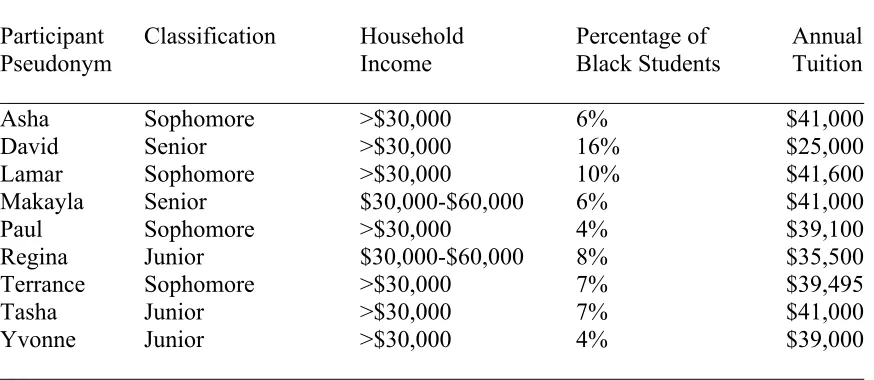
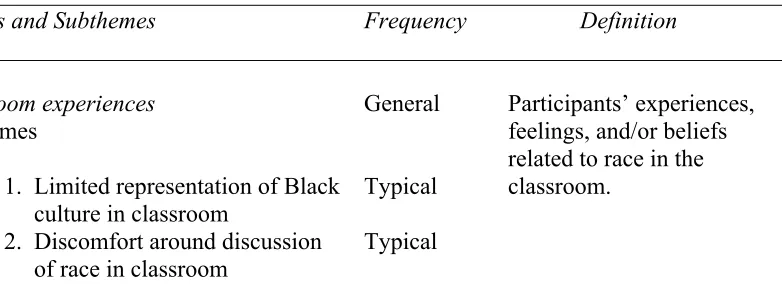
1 Participant Demographics ………...40 2 Themes, Subthemes, Frequency and
CHAPTER 1
PSYCHOSOCIAL EXPERIENCES OF LOW INCOME, BLACK STUDENTS ATTENDING PREDOMINANTLY WHITE, ELITE PRIVATE HIGH SCHOOLS
A growing number of high school students from minority and disadvantaged
backgrounds are being admitted to and attending predominately White, elite,
independent1 high schools (Cookson & Persell, 1985; Jones-Wilson, Arnaz, &Asbury;
Griffin, 2000). Strong evidence exists that students from minority and disadvantaged
backgrounds benefit academically from attending these private schools (Coleman &
Hoffer, 1987; Coleman, Hoffer, & Kilgore, 1982; DeCuir-Gunby, 2007; Slaughter &
Johnson, 1988). However, as chronicled in Ronald Suskind’s (1998) book: A Hope in the
Unseen, there is some evidence that students from minority and disadvantaged
backgrounds often encounter psychosocial challenges in transitioning to these
institutions. Studies have found that African American and Black2 students at
predominantly White, independent schools often experience marginalization; feel
unrepresented in the school culture, including the curriculum; and feel alienated from
their Black peers outside of the independent school context (Ascher, 1986; Cookson &
Persell, 1991; Cooper & Datnow, 2000; Datnow & Cooper, 1997; Decuir-Gunby, 2007;
Herr, 1999; Horvat & Antonio, 1999; Proweller, 1999). These challenges may impact self
esteem, stress levels, self efficacy, and aspects of identity development, as well as
students’ academic functioning and social adjustment (Arrington, Hall & Stevenson,
2003; Cooper & Datnow, 2000; DeCuir-Gunby, 2007; Spencer, Kim, & Marshall, 1987).
1 The terms independent school and private school are used interchangeably in this work, and no distinction
is intended.
2 The terms Black and African American are used interchangeably here, with no distinction intended. For
Despite the given challenges, many Black students still demonstrate resilience and
academic success in these environments (Datnow & Cooper, 1997; Griffin, 2000;
Ratteway, 1990).
Black Students and Public Schools
Numerous studies and national reports have documented the continuous decline of
public education, particularly in inner city communities (Jennings & Rentner, 2006;
Slaughter & Schneider, 1986; Smarick, 2008). Despite the progress and enormous
promise of Brown versus the Board of Education (Brown v. Board of Education, 1954)
the struggle for educational equality has not yet been realized, particularly for ethnic
minorities living in poor urban communities (Gardner & Talbet-Johnson, 2001). Children
from poor families are more likely to attend schools that have fewer resources and less
experienced teachers (Darling-Hammond, 1996). In many inner city communities, Blacks
constitute a major percentage of the resident population. Studies have shown that students
in inner city schools tend to perform less well than their peers from more affluent schools
on academic measures, such as statewide achievement tests (e.g., ACT and SAT) (Hurd,
2000; Roach, 2001; Rothstein, 2004). These students poor performance on academic
measures can cause some to raise questions about the quality of education in urban
schools, while others place blame on the students. Whether educators blame the
educational system or the students, the fact remains that great disparities exist between
the performances of those in urban communities, versus those in more affluent
communities (Gardner & Miranda, 2001). Black students in poor school districts face
challenges that place them at increased risk for academic failure. Some of these
lack of community resources, and lack of parental involvement (Bennett & LeCompte,
1998; Rothstein, 2004, Neckerman, 2007). The combined impact of these challenges has
caused many Black parents in inner cities to seek alternative educational opportunities for
their children. Many Black parents are choosing to send their children to private schools
for a more rigorous education because of their dissatisfaction with the public school
system (Freedman, 2004; McKinnon, 2003).
Black parents are drawn to independent schools because they seek an
environment that offers small student-teacher ratio, a sense of caring, and a perceived
high quality education. For many Black parents, the perceptions of independent schools
are quite favorable based on the offering of superior resources, individualized attention,
enhanced nurturing, and a somewhat better shield from negative peer pressure, drugs, and
danger (Torry, 1992, as cited in Jones-Wilson et al., 1992). Three studies (Cooper &
Datnow, 2000) in the Washington metropolitan area confirmed these results by
identifying the following top five reasons parents in the area rejected public schools, (a)
perceived lack of discipline, (b) poor curriculum standards, (c) large
schools/over-crowding, (d) teachers’ lack of interest, and (e) difficulty getting good teachers.
Moreover, Black parents are selecting private schools based on a desire for their
children to benefit from the cultural capital provided within integrated environments.
Numerous studies over the last seven years have shown that Black students in private
schools have higher standardized test scores and higher college enrollment rates than
their peers in public schools (Gardner & Miranda, 2001; Schneider & Shouse, 1992;
Slaughter & Johnson, 1988). The level of educational motivation that private and public
of the difference in academic performance. Cookson and Persell (1991) suggest that
many within the Black community see education as a realistic “channel of attainment”.
Many Black parents are convinced that self reliance and ambition, coupled with the
cultural capital benefits afforded through an elite private school education, will offer their
children greater financial success, than relying on the relatively more limited resources of
public schools (Ottley, 2005).
History of Independent Schools
To understand the prevailing culture within elite private schools, it is necessary to
review the fundamentals upon which these schools were established. The elite private
school movement in the United States has its origin in New England. The most elite
independent boarding and day schools were established between 1833 and 1906 to
educate boys only. These schools became known as the “select 16” (Cookson & Persell,
1991). When they were founded, the fundamental belief system within these schools was
strongly aligned with deeply held republican virtues, namely individualism and
meritocracy. Accordingly, personal virtue, as opposed to communal interests and public
service was revered (Saveth, 1988). The mission of these schools was to prepare
primarily White males for college and to facilitate entry into a “well educated and
cultivated” elite that would carryout the core values set by the founding fathers and
would lead the United States to a high standing and distinct position in the world. Their
roster of distinguished graduates (i.e., Franklin Delano Roosevelt, John F. Kennedy, and
George H. W. Bush) continues to contribute to the schools’ aura of privilege.
Attendance at a private school has long been believed to place children on a path
disproportionately to those who enter the most highly respected colleges, acquire high
earning jobs, become chief executive officers, serve on corporate boards, and become
directors of foundations and corporations” (Saveth, 1988, p. 373). Although originally
developed for upper class White males, these schools have since opened their doors to
females and increasing numbers of ethnic minorities.
Independent Schools and Blacks
Historically, the alternatives to public education for Black students have been
extremely restricted. Prior to the 1960s, Black students were prohibited from attending
some of the nation’s most elite independent schools. In response to the political climate,
including the civil rights movement of the 1960’s, Dartmouth College and the
Rockefeller foundation developed A Better Chance (ABC) (Slaughter & Johnson, 1988)
program, with the mission to increase the number of academically talented minority
students who could benefit from the advantage of a quality education in one of the select
sixteen, independent schools. Over the next several years, 100 more preparatory schools
had opened their doors to Black and other ethnic minority students for the first time
(Zweigenhaft & Domhoff, 1991).
Today, many independent schools have realized that the demographic changes
within the U.S. population have made it critical for the student body to be more
representative of society. With the diversification of the workforce and globalization
shifts, it is essential that students are able to work within a multi-racial and multi-ethnic
population. As such, many of these schools have created outreach offices to specifically
earmarked for ethnic minority students (Speede-Franklin, 1988; Datnow & Cooper,
2000).
Based on the increased recruitment efforts targeting students of color, as well as
Black parents recognizing the social and economic advantages associated with an
independent school education, it may be expected that numbers of Black students would
be high. On the contrary, based on data from the National Association of Independent
Schools (NAIS), enrollment of students of color in independent schools has not changed
in the past 16 years. In 1992 the percentage of Black students in independent schools was
5.3%. By 2008, the number had only increased to 5.9%. While there may be several
possible explanations for the low numbers of Black students in independent schools, one
explanation that has not been explored extensively at the micro level involves the
subjective, lived experiences amongst these students in independent schools.
The Black Experience in Independent Schools
Despite the increased recruitment efforts for minority students and the educational
benefits associated with a private school education, research has shown that Black
students find it difficult to feel comfortable in predominantly White, elite independent
schools (Slaughter & Johnson, 1988; Cookson & Persell, 1991; Datnow & Cooper, 1997;
Zweigenhaft & Domhoff, 1991). Within the literature, experts have coined terms and
expressions such as “other,” “racelessness,” “outsider within,” and “the burden of acting
White” to illustrate what Black students often endure as students within these settings
(Datnow & Cooper, 1997; Fordham, 1991; Slaughter & Johnson, 1988). A number of
outsiders, as they are alienated from the cultures of these schools (Ottley, 2007;
Schneider & Shouse, 1992).
Thompson and Schultz (2003) indentified several specific psychological
challenges faced by many students from minority and economically disadvantaged
backgrounds who attend predominantly White, elite private schools. One challenge
concerns the experience of being racially visible and socially invisible. While everyone in
the predominantly White setting is clearly aware of whom the “kids of color” are, a
number of people in the school community are only interested in these students insofar as
they adhere to White cultural norms. Many Whites in these settings are not interested in
knowing about the “total life” of a child of color. The communities and cultures of
students of color are often not acknowledged or celebrated in the same way as those
which adhere to the traditional Eurocentric norms prevalent within these environments.
While many students of color become important to the community as a symbol of the
school’s commitment to diversity, these students often feel personally neglected and
devalued. Schools often demand that students of color respect the values of the school
without reciprocity in valuing the cultures of students of color (Ottley, 2007; Smith,
2008).
Another challenge noted by Thompson & Shultz (2003), is the burden of
explaining oneself to White people. Often times, students of color are asked to educate
White students. They are often asked to be culturally representatives for their race and
many times carry the additional burden of explaining to White students and faculty the
importance of race consciousness in this country. In this same vein, economically
opportunity to attend a prestigious private school (Slaughter & Johnson, 1988). It can be
incredibly painful for students of color to be constantly reminded about “what an
opportunity this is” when they feel socially isolated or misunderstood in this setting.
Rarely are students affirmed by faculty for taking the risk to come to a school which
presents several psychosocial challenges.
The psychosocial challenges which have been cited in the literature may
negatively affect academic and social functioning (Gray-Little & Carsels, 1997;
Schneider & Shouse, 1992; Slaughter & Johnson, 1988; Spencer, Kim, & Marshall,
1987). Additionally, the impact of these challenges may contribute to acculturative stress.
In this context, acculturation refers to the modification of the culture of economically
disadvantaged, minority students as a result of contact with the elite, predominant White
culture which exists within many of these schools. Acculturative stress can refer to
general psychological distress and decline in the psychological and social functioning of
students, as expressed in anxiety, depression, low self-esteem, helplessness, irritability,
eating disorders, identity confusion, and reduced motivation (Tartakovsky, 2007).
The psychological challenges experienced by students of color in these settings
relates to the intersection of race and social class in elite private schools. Both race and
class are salient factors in defining institutional cultures and students’ social and
educational experiences. Racial differences are reinforced by class divisions; the
powerful, often subtle interaction of race and class operate to maintain a society that is
highly stratified. This is particularly apparent in schools of the White power elite. Thus, it
is critical to explore how issues of race and social class influence Blacks adolescents’
a paucity of research considers the impact of class on Black experiences within these
environments (e.g. De-Cuir-Gunby, 2007; Ginwright, 2000; Ogbu, 2003). Pettigrew
(1981) persuasively argued that an interactive model of race and class has more
explanatory power than traditional race and class models of inequity. He wrote:
Race and social class increasingly interact to produce critical effects that cannot
be explained by simply combining the main effects of the two factors. This is not
to assert, of course, that there are no important direct effects, but to advance the
hypothesis that an increasing number of important outcomes require an interactive
perspective. For instance, the model contends that the total condition of being
black and poor is greater than the sum of its two racial and class parts. (p.245)
Pettigrew further suggested that the interaction of being both Black and poor
produces more disadvantages than would either aspect alone. The scope of this writing
and existing research does not consider what it is like to be Black and non upper class in
an upper class, predominantly White environment, such as a prep school. Being a Black
person in an upper class academic institution is a unique experience. Black prep school
students have the opportunity to observe and, to some degree, become part of a class that
is generally closed to outsiders. Yet, because they are Black and often economically
disadvantaged, they are often not fully accepted or they have difficulty “fitting into”
upper-class White culture (Zweigenhaft & Domhoff, 1991). No matter what their
instrumental achievements, Black students often remain “outsiders within” (Collins,
1986).
The “outsider” status within the academic environment often extends into other
arenas. Many Black students in these institutions have reported feeling “doubly
marginalized”, as they often find themselves caught between two cultures: the school’s
culture and the culture in which they were raised (Cookson & Persell, 1991; Datnow &
Cooper, 2000; Scneider & Shouse, 1992). Cookson & Persell (1991) suggested that this
marginalization may cause emotional and practical difficulties for some young Black
prep school students. Attending an elite, private school often forges distance between
Black students and their parents and friends, and may block them from fully participating
in the lives and lifestyles of their parents and peers (Ascher, 1986; Zweigenhaft &
Domhoff, 1991). In a study by Zweigenhaft & Domhoff (1991), the authors found that
Black prep students in elite schools became aware of how much they had changed when
they went home. Some recounted painful experiences and hostility from their friends
back home that demonstrated the gap between the two worlds in which they found
themselves. Whether or not they experienced hostility back home, as time passed the
students found that they had fewer things in common with their old friends, and they
found themselves feeling lonely when they did go home.
Given their doubly marginalized status, the normal pressures on young
adolescents to fit in with their peers are heightened for economically disadvantaged,
Black students. Students struggle with the questions of “acting White” when they adopt
the culture and values dominant at the institution in which they spend the majority of
their time. They face being considered “wanna-bes” by their peers if they develop
relationships with classmates outside of their race (Fordham & Ogbu, 1986; Ottley,
friends if they fail to maintain close ties with the youth in their neighborhoods. The social
pressures and associated acculturative stress (Datnow & Cooper, 1998) may impact Black
students’ social and academic functioning.
The struggle for these students caught between two worlds is expressed by Neira
(1998):
When trying to live in two worlds, one is in peril of not belonging to either of
them. One is left in a state of confusion…Being put in the position of changing
one’s character every morning and every afternoon to adapt to two different
worlds endangers one’s identity. (Neira, 1998, p. 337)
In response to the cultural dissonance which accompanies double marginalization,
Blacks often implement strategies to accomplish self-transformations in transitions
between two different worlds. Hemmings (1998) labeled these strategies as (a)
self-negation (self-negation of physical and symbolic ties with other relatives and other Blacks);
(b) self-fragmentation (feeling most comfortable amongst other Blacks, but rejecting
some aspects of Black cultural identity in interactions with the majority culture); and (c)
self-synthesis (synthesis of multiple selves, including ethnicity, gender, and social class,
into a harmonious whole).
Impact of Structural Components on Outsider Status
One structural aspect which promotes the “outsider status” for Black students is
evident in how the schools facilitate racial integration. Feagin (1996) suggested that
racial integration at predominantly White institutions is less about a bi-directional
acculturation process; instead it is achieved through a one way assimilation process. This
minority students bring to the school. Bringing Black students into historically White
schools has usually meant an aggressive emphasis on fitting them into White social and
cultural molds. This one way assimilative process requires that Black students adopt
White views, norms, and practices, at the expense of celebrating their own cultural
uniqueness. It is perpetuated through the maintenance of Euro-centrically based curricula,
a lack of racial and ethnic diversity at the administrative and faculty levels, and social
practices which align with White, upper class cultures.
Another cultural aspect which exists within many private school settings is the
notion of colorblindness. Many teachers in these schools continue to adhere to this notion
and therefore view all children as the same, despite racial differences. Faculty in
independent schools often conspire consciously or subconsciously to maintain the status
quo in their classrooms despite the presence of Black students. This phenomenon has
been referred to as dysconcious racism (Ladson-Billings, 1994); defined as “an uncritical
habit of mind that justifies inequity and exploitation by accepting the existing order of
things as given” (King, 1991, p. 133).
Recent findings (Ottley, 2005) with private school teachers revealed an interest in
treating all students equally, and not focusing on racial and cultural diversity. This belief
that race should not be considered when planning curriculum or in interactions with
students of color has resulted in an absence of a racial perspective in school contexts.
While this approach is often viewed as equitable, it is potentially damaging and tends to
trivialize diversity as being something that is just "skin deep," thereby sending the
message to students that since "we are more alike than different" there is no need to
perpetuate the "myth of sameness" (Hardy, 1989), which discourages a critique of how
race may impact who is deemed to be successful in school, how school may be
experienced differently by students based on their community membership, and what
members of the entire school community may learn about people different from
themselves. The myth of sameness invalidates the unique experiences of students of color
whose ethnic identity places them outside of the mainstream. Further, it prevents the
stories and voices of Black students from being integrated into the curriculum in a
meaningful way and devalues the contributions of diverse perspectives.
Failure to attend to racial differences is often preserved within a “culture of
niceness”. In a study about Blacks and private school experiences, Ottley (2005)
described this system as a veneer that maintains the status quo by masking issues of
difference within the school. This biased cultural system keeps the students and adults in
the school from engaging in difficult conversations, based on the appearance that
everyone is “nice” at the school. The culture of niceness can lead to a bubble syndrome, a
lack of exposure to realities of the societal ills, diverse students, and experiences that
exist outside the immediate walls of the school’s community. The bubble syndrome
allows negative stereotypes to go unchallenged and increases the challenges for Black
students whose realities lie outside the bubble of the school. The culture of niceness,
compounded with the bubble syndrome, minimizes the significance of race and creates a
silence on issues which are pertinent to the lived experiences of Black students in these
environments. Silence in regard to race and racism does not prevent Black students from
effectively cope, as they will not have the resources to draw upon when needed (Castro
Atwater, 2008; Lewis, 2001; Neville, 2000).
Stress and Private Schools
Adolescence is a developmental period when children may be particularly
vulnerable to the negative effects of stress (Colten & Gore, 1991).Stress is a clear risk
factor for mental health disorders, which have been estimated to affect approximately one
in five children ages 9 to 17 years (U.S. Department of Health and Human Services,
1999). For students in academically rigorous environments, like elite private schools, the
potential for stress can increase significantly and impact academic motivation and
performance (Suldo, Shaunessey, & Hardesty, 2008). Much of the research in this area
has examined the stress associated with high academic demands, but has not looked at
how race-related or social class-related pressures impacts the existing stress.
In recent years, there has been an abundance of research that examines the effects
of social class and race, particularly racism on Blacks (Clark, Anderson, Clark, &
Williams, 1999; Utsey, Ponterotto, Reynolds, & Cancelli, 2000; Williams, Neighbors, &
Jackson, 2003). Most of the work in this area, however, examines the impact of
race-related stressors on Black’s health status (Fang & Myers, 2001; Williams, Yu, Jackson, &
Anderson, 1997). Overwhelmingly, results from this body of work have suggested a link
between greater perceived racism (a type of race-related stress) and lower negative health
symptoms (e.g., Bowen-Reid & Harrell, 2002).
Findings from the emerging body of research on college racial climates have
suggested that Black college students attending predominantly White institutions (PWIs),
White setting (Ancis, Sedlacek & Mohr, 2000; Schwitzer, Griffin, Ancis, Thomas, 1999)
and that this additional stress affects their adjustment process (Edmunds, 1984;
Henderson, 1988; Prillerman, Myers, & Smedley, 1989). Findings from a comparative
study of students attending historically Black colleges and universities and predominantly
White colleges and universities, indicate that beyond individual characteristics such as
intelligence, academic preparation, and intensity of personal ambition, more contextual
factors such as quality of life at the institution, race relations on campus, and
relationships with faculty and friends significantly impact Black students’ academic
achievement (Allen, 1992; Fisher & Hartmann, 1995; Carter, 2007).
Although much of this research has focused on college and university settings,
researchers have begun to explore the effect of race-related stress on the adjustment of
Black students in independent secondary schools. Recent research conducted by the
National Association of Independent Schools (NAIS) found that 75% of Black students
had to make special efforts to fit into their private school communities, 82% had negative
experiences at their schools based on race, and 62% thought that they did not belong in
their school (Arrington et. al, 2003). These numbers speak to the impact of racial climate
within these environments upon Black students’ psychosocial experiences. The normative
stressors which accompany adolescence are significantly increased for students of color
in elite private school settings given additional factor of race and social class related
stress. It is important to gain a deeper understanding of the experiences of these students
in order to improve the climates of these schools and to provide adequate services to
address such stressors
The boarding school experience can present challenges for all students, regardless
of race or ethnicity. A person who leaves home to reside in a new place for educational
reasons experiences an interruption of daily life and encounters a completely new
environment. Accompanying this experience is often the loss of the familiar and
distancing from the support normally provided by family, friends, and the community.
Students must adjust and conform to a completely new lifestyle, develop new
relationships, learn new rules and regulations, and pursue new academic subjects (Fisher,
Frazer, & Murray, 1984; Fisher, Frazer, & Murray, 1986). The combination of these
factors can contribute to enormous pressure for adolescents, given less direct access to
support from parents and family. This experience requires that students take
responsibility for a greater proportion of their daily decisions. The “school experience”
for a boarding student does not end at the traditional time of three o’clock in the
afternoon. Instead, “school life” is extended twenty-four hours per day as school rules
and routines remain in effect. Students are not only coping with adjustment to a new
school, but also must learn to be more self reliant and independent (Fisher, Frazer,
Murray, 1984).
According to the National Center for Educational Statistics, only 4% of student in
private boarding schools are Black. As such, the social costs of attending predominantly
White, elite private boarding schools are substantial for Black students (Alexander-Snow,
1999; Datnow & Cooper, 1996; Oliver, 1995). While the process of isolating students
from their natural environments may make the socialization process to boarding school
easier, it can also increase the level of vulnerability for students, especially for students
students have reported feeling caught between two cultures and as a result, doubly
marginalized. This can often lead to feelings of alienation from both the culture of the
school and that of the students’ own family and friends. Black student’s weaker social
relationships with teachers at elite White boarding schools, compared to those of their
White counterparts, suggests a lack of connection that can negatively impact academic
performance and motivation (Alexander-Snow, 1999).
Coupled with race, socioeconomic status is another factor which can contribute to
the “normal” pressures associated with the boarding school experience and can further
alienate students within this environment. Much of the data on Blacks in private
schooling focuses on day schools, as opposed to an exclusive look on boarding school
experiences. Given the collective nature of Black culture and the significance of the
community on youth development, being isolated from these support systems may bring
about unique challenges for Black students. These challenges need to be understood so
that private schools can examine the extent to which the needs of these students are being
met. Additionally, identifying the needs of this population, based on race and class, can
assist with the development of services which can maximize academic and social
functioning.
Future Research
It is clear that Black students face a unique set of challenges within elite,
predominantly White independent schools. Much of the research, however, speaks about
the given experiences in a homogenized manner. In other words, differences based on
socioeconomic backgrounds, family background and type of independent school are not
race-related experiences of Black students, the intersection of race and class has not been
discussed as extensively. There is little research which explores the differences between
challenges faced by Black students from affluent families versus those from
economically disadvantaged families. While similar philosophies may exist within day
and boarding schools, the actual experiences of Black students may vary, based on this
context.
Another gap in the current literature is evidenced through the primary focus of
students attending private day schools, rather than private boarding schools. Research is
needed to explore the specific challenges that may accompany the private boarding
school experience for economically disadvantaged Black students in order to develop
strategies for maximizing success, emotional well being and inclusion. These
environments are limited in terms of the usual sources of support available to Black
students via the community, peers, parents, and extended family. Such research may help
schools identify which aspects enhance and/or hinder the development of students whose
cultural identities lie outside of the majority.
Another area that has not been fully explored concerns the variables which
contribute to coping and adjustment for students in these settings. Despite the challenges
which exist for many Black students in elite private schools, many students demonstrate
resilience and high academic success (Cooper & Datnow, 2000; Schneider, B. & Shouse,
R. 1992; Slaughter & Johnson, 1988). Research that addresses contributing variables can
be especially useful for recruitment efforts, increasing the attrition rates for Black
students in these settings, and providing guidance for private schools on how to maximize
Finally, qualitative data on this topic is limited and the current knowledge on this
issue relies more heavily on quantitative statistics and the use of forced choice questions.
While numerical data is useful, there is a need to understand the experience more
thoroughly through rich descriptions, from the voices of those experiencing the
phenomenon. Although independent schools have reached out to recruit students of color
that does not guarantee that those students will be accepted into the well-established
communities of privilege that exist in elite private schools. It is not enough to
aggressively recruit students of color alone. Rather, elite private schools must work
earnestly to understand the unique needs of Black students and make these students feel
like true members of the community, rather than outsiders within.
Given that much of the data on this topic is somewhat outdated and limited in its
References
Alexander-Snow, M. (1999). Two African American women graduates of historically
white boarding schools and their social integration at a traditionally white
university. The Journal of Negro Education, 68(1), 106-120. doi:
10.2307/2668213
Allen, W. R. (1992). The color of success: African American college student outcomes at
Predominantly White and historically Black public colleges and universities.
Harvard Educational Review, 62, 26-44. Retrieved from
http://www.hepg.org/main/her/Index.html
Ancis, J. R., Sedlacek,W. E., & Mohr, J. J. (2000). Student perceptions of campus
cultural climate by race. Journal of Counseling and Development, 78, 180-185.
Retrivieved from http://www.counseling.org/Publications/Journals.aspx
Anderson, L. P. (1991). Acculturative stress: A theory of relevance to Black Americans.
Clinical Psychology Review, 11, 685-702. doi: 10.1016/0272-7358(91)90126-F
Arrington, E. G., Hall, D. M., Stevenson, H. C. (2003) The success of African-American
students in independent schools. Independent School, 62(4), 11-20. Retrieved
from http://www.nais.org/publications/
Ascher, C. (1986). Black students and private schooling. Urban Review, 18(2), 137-145.
doi: 10.1007/BF01108434
Bennett, K.P., & LeCompte, M.D. (1998). The way schools work. New York: Allyn &
Bacon.
Exclusion, Segregation, and Inclusion: Guest Editors' Introduction. Remedial and
Special Education, Vol 26(2), pp. 66-69. doi: 10.1177/07419325050260020101
Bowen-Reid, T. L., & Harrell, J. P. (2002). Racist experiences and health outcomes: An
examination of spirituality as a buffer. Journal of Black Psychology, 28, 18-36.
doi: 10.1177/0095798402028001002
Brown v. Board of Education, 347 U.S. 483. (1954).
Carter, D. J. (2007). Why the Black kids sit together at the stairs: The role of identity-
affirming counter-spaces in a predominantly White high school. The Journal of
Negro Education. 76(4), 542-555. Retrieved from www.jstor.org.
Carter, R. L. & Goodwin, A. L. (1996). Racial identity and education. In: L. Darlington
Hammond (Ed.), Review of research in education (pp. 291-336). Washington,
D.C.: American Research Educational Association.
Castro Atawar, S. A. (2008). Waking up to difference: Teachers, color-blindness, and the
effectson the students of color. Journal of Instructional Psychology, 35(3),
246-253.Retrieved from http://www.projectinnovation.biz/jip_2006.html
Clark, R., Anderson, N. B., Clark, V. R., &Williams, D. R. (1999). Racism as a stressor
for Blacks: A biopsychosocial model. American Psychologist, 54, 805-816. doi:
10.1037/0003-066X.54.10.80
Cokely, K. (2003). What do we know about the motivation of African American
students? Challenging the “anti-intellectual” myth. Harvard Educational Review,
73, 524-558. Retrieved from http://www.hepg.org/main/her/Index.html
Cole, E. R. & Omari, R. S. (2003). Race, class, and the dilemmas of upward mobility for
10.1046/j.0022-4537.2003.00090.x
Coleman, J., Hoffer, R., & Kilgore, S. (1982). High school achievement. New York:
Basic Books.
Coleman, J., & Hoffer, T. (1987). Public and private high schools. New York: Basic
Books.
Collins, P. H. (1986). Learning from the outsider witbin: The sociological significance of
Black feminist thought. Social Problems, 33, 14-32. doi:
10.1525/sp.1986.33.6.03a00020
Colten, M. & Gore, S. (1991). Adolescent stress: Causes and consequences. New York:
Aldine de Gruyter.
Cookson, P.W. & Persell, C.H. (1991). Race, class, and the dilemmas of upward mobility
for African Americans. Journal of Social Issues, 59(4), 785-802. doi:
10.1046/j.0022-4537.2003.00090.x
Cooper, R. & Datnow, A. (2000). In: Schooling students placed at risk: Research, policy,
and practice in the education of poor and minority adolescents. Sanders, Mavis
G.; Mahwah, NJ, US: Lawrence Erlbaum Associates Publishers, pp. 187-205.
[Chapter]
Darling-Hammond, L. (1996). The right to learn and the advancement of teaching:
Research, policy, and practice for democratic education. Educational Researcher,
23(6), 5-17. doi: 10.3102/0013189X025006005
Datnow, A. & Cooper, R. (1997). Peer networks of African American students in
independent schools: Affirming success and racial identity. Journal of Negro
Datnow, A. & Cooper, R. (2000). Creating a climate for diversity? The institutional
response of predominantly white independent schools to African-American
students. In: Schooling students placed at risk: Research, policy, and practice in
the education of poor and minority adolescents. Sanders, Mavis G.; Mahwah, NJ,
US: Lawrence Erlbaum Associates Publishers, pp. 207-228. [Chapter]
DeCuir-Gunby, J. T. (2007) Negotiating identity in a bubble: A critical race analysis of
African American high school students’ experiences in an elite, independent
school. Equity & Excellence, 40, 26-35. doi:10.1080/10665680601093507
Dukes, R. M. & Martinez, R. (1997). The effects of ethnic identity, ethnicity, and gender
on adolescent well-being. Journal of Youth and Adolescence, 26, 503-514.
doi: 10.1023/A:1024525821078
Edmunds, G. J. (1984). Needs assessment strategy for Black students: An examination of
stressors and program implications. Journal of Non-White Concerns in Personnel
and Guidance, 12, 48-56. Retrieved from http://search.ebscohost.com
Fang, C. Y., & Myers, H. F. (2001). The effects of racial stressors and hostility on
cardiovascular reactivity in African American and Caucasian men. Health
Psychology, 20, 64-70. doi: 10.1037/0278-6133.20.1.64
Feagin, J. (1996). The Agony of Education: Black Students in White Colleges and
Universities New York: Routledge.
Felsten, G., &Wilcox, K. (1992). Influences of stress and situation-specific mastery
beliefs and satisfaction with social support on well-being and academic
performance. PsychologicalReports, 70, 291-303. doi:
Fisher, B. & Hartmann, D. J. (1995). The impact of race on the social experience of
college students at a predominantly White university. Journal of Black Studies,
26(2), 117-133. doi: 10.1177/002193479502600202
Fisher, S., Frazer, N., & Murray, K. (1984). The transition from home to boarding
school: A diary Style analysis of the problems and worries of boarding school
pupils. Journal of Environmental Psychology, 4, 211-221. doi:
10.1016/S0272-4944(84)80042-0
Fisher, S., Frazer, N., & Murray, K. (1986). Homesickness and health in boarding school
Children. Journal of Environmental Psychology, 6, 35-47. doi:
10.1016/S0272-4944(86)80033-0
Fordham, S. (1991). Peer proofing academic competition among black adolescents:
"Acting white" black american style. In C. Sleeter (Ed.), Empowerment through
multicultural education (pp. 69-94). Albany: State University of New York Press.
Fordham, S. & Ogbu, J. U. (1986). Black students’ school success: Coping with the
“burden of acting White”. The Urban Review. 18(3), 176-206.
Freedman, S. (2004, May 19). Increasingly, African-Americans take flight to private
schools. The New York Times, p. B11. Retrieved from www.newyorktimes.com
Gardner, R. & Miranda, H. A. (2001). Improving outcomes for urban Black students
Journal of Negro Education, 70(4), 255-263. Retrieved from http://www.jstor.org
Gardner, R., & Talbert-Johnson, C. (2001). School reform and desegregation: The real
deal or more of the same? Education and Urban Society, 33(1), 74-87. Retrieved
Garrity, T. F.,&Ries, J. B. (1985). Health status as a mediating factor in the life
change-academic performance relationship. Journal of Human Stress, 11, 118-124.
Retrieved by http://search.ebscohost.com
Ginwright, Shawn A. (2000). Identity for sale: The limits of racial reform in urban
schools. Urban Review, 32(1), pp. 87-104. doi: 10.1023/A:1005194802544
Gougis, R. A. (1986). The effect of prejudice and stress on the academic performance of
Black-Americans. In U. Neisser (Ed.), The school achievement of minority
children: New perspectives (pp. 145-158). Hillsdale, NJ: Erlbaum.
Gray-Little, B. & Carsels, R. A. (1997). The effects of racial dissonance on academic
Self-esteem and achievement in elementary, junior high, and high school students.
Journal of Research on Adolescence, 7(2), 109-132. doi:
10.1207/s15327795jra0702
Griffin, J. B. (1999). Human diversity and academic excellence: learning from
Experience. Journal of Negro Education. 68(1), 72-79. Referred from
http://www.jstor.org
Hardy, K. V. (1986). The theoretical mythofsameness: A critical issue in family therapy
training and treatment. Journal of Psychotherapy & the Family, 6(1), 17-33.
Retrieved from http://www.ifta-familytherapy.org/journal.html
Hemmings, A. (1998). The self-transformations of African American achievers. Youth &
Society, 29(3), pp. 330-368. doi: 10.1177/0044118X98029003004
Henderson, P. L. (1988). The invisible minority Black students at a Southern White
university.Journal of College Student Development, 29, 349-355. Retrieved from
Herr, E. L. (1999). Theoretical perspectives on the school-to-work transition: Reactions
and Recommendations. The Career Development Quarterly, Vol 47(4), 359-364.
Retrieved from http://associationdatabase.com/aws/NCDA/pt/sp/Home_Page
Herr, K. (1999). Private power and privileged education: De/constructing
institutionalized racism. International Journal of Inclusive Education, 3(2),
11-129. Retrieved from http://www.tandf.co.uk/journals/tf/13603116.html
Hill, C. E., Thompson, B. J., & Williams, E. N. (1997). A guide to conducting consensual
qualitative research. The Counseling Psychologist, 25, 517-572. doi:
10.1177/0011000097254001
Horvat, E. M. & Antonio, A. L. (1999). “Hey, those shoes are out of uniform”: African
American girls in an elite high school and the importance of habitus.
Anthropology & Education Quarterly, 30(3), 317-342. doi:
10.1525/aeq.1999.30.3.317
Hurd, H. (2000). Washington update. Black Issues in Higher Education. 17(16), pp. 8-11.
Retrieved from www.jbhe.org
Jennings, J. & Rentner, D. S. (2006). How public schools are impacted by "No Child Left
Behind". Education Digest, 72 (4), 4-9. Retrieved from http://www.eddigest.com/
Johnson-Bailey, J. (2004). Enjoining positionality and power in narrative work:
Balancing contentious and modulating forcesIn K. de Marrais and S. Lapan
(Eds.), Foundations for research: Methods of inquiry in education and the social
sciences. Mahwah, NJ: Lawrence Erlbaum Associates, Publishers, (p. 123-138).
Jones-Wilson, F. C., Arnez, N. L., Asbury, C. A. (1992). Why not public schools.
King, J. (1991). Dysconscious racism: Ideology, identity, and the miseducation of
teachers. Journal of Negro Education, 60, 133-146. doi: 10.2307/2295605
Ladson-Billings, G. (1994). The dreamkeepers: Successful teachers of African American
Children. San Franciso: Jossey-Bass.
Lewis, A. E. (2001). There is no “race” in the schoolyard: Color-blind ideology in an
(almost) all White school. American Educational Research Journal, 38(4),
781-811. doi: 10.3102/00028312038004781
McAllister, G. J. (2000). Cross-cultural competency and multicultural teacher education.
Review of Educational Research, 70(1), 3-24. doi: 10.2307/1170592
McKinnon, J. (2003). The Black population in the United States: March 2002 Current
Population Reports, (Series P20-541). Washington, DC: U.S. Census Bureau.
Merriam, S. B. (2000). Qualitative research and case study applications in education.
San Francisco: Jossey-Bass.
Moustakas, C. (1994). Phenomenological research methods. Thousand Oaks: Sage
Publications.
National Center for Education Statistics, U.S. Department of Education, & Institute of
Education Sciences. (2004). Characteristics of private schools in the United
States: Results from the 2001-2002 private school survey (NCES 2005-305).
Washington, DC: U.S. Government Printing Office.
Neckerman, K. M. (2007). Schools Betrayed: Roots of failure in inner city education.
University of Chicago Press: Chicago, IL
Neira, C. (1988). Building 860. Harvard Educational Review, 58(2), 337-342. Retrieved
Neville, H. (2000). Construction and validation of the color-blind racial attitudes scale
(CoBRAS). Journal of Counseling Psychology, 47(1), 59-70.
doi: 10.1037/0022-0167.47.1.59
Neville, H. A., Heppner, P. P., &Wang, L. (1997). Relations among racial identity
attitudes, perceived stressors, and coping styles in Black college students. Journal
of Counseling & Development, 75, 303-311. Retrieved from
http://www.counseling.org/Publications/Journals.aspx
Ogbu, J. U. (2003). Black American students in an affluent suburb: A study of academic
disengagement. Mahwah, NJ: Lawrence Erlbaum Associates Publishers.
Oliver, D. F. (1995). Going away to school. Independent School. 54(3), 56-61. Retrieved
from http://www.nais.org/publications/
Ottley, L. A. (2005). Outsiders within: The lived experience of African American students
at the Shipley school. Retrieved from ProQuest Digital Dissertations.
(AAI3175651)
Ottley, L. A. (2007). Outsiders within: improving the experience of students of color in
Independent schools. Independent School, 66, 114-124. Retrieved from
http://www.nais.org/publications/
Pettigrew, T. (1981). Race and class: An interactive view. Daedalus, 110, 235-255.
Retrieved from http://www.mitpressjournals.org
Prillerman, S. L. (1988). Coping with a stressful transition: A prospective study of Black
student adjustment to a predominantly White university. Unpublished doctoral
Prillerman, S. L., Myers, H. F., & Smedley, B. D. (1989). Stress, well-being, and
academic achievement in college. In G. L. Berry & J. K. Asamen (Eds.), Black
students: Psychological issues and academic achievement (pp. 198-217).
Thousand Oaks, CA: Sage.
Proweller, A. (1999). Shifting identities in private education: Reconstructing race at/in
the cultural center. Teachers College Record, 100(4), 776-808.
doi: 10.1111/0161-4681.00016
Ratteray, J. D. (1990). African-American achievement: A research agenda emphasizing
independent schools.In: Going to school: The African-American
experience. Lomotey, Kofi (Ed.); Albany, NY, US: State University of New York
Press, pp. 197-207.
Reardon, S. F. & Yun, J. T. (2002). Private school racial enrollments and segregation.
Cambridge, MA: Harvard Education Press.
Riable, J. & Neito, S. (2003). Beyond categories: The complex identities of adolescents.
In M. Sadowski (Ed.), Adolescents at school: Perspectives on youth, identity, and
education (pp. 145-161). Cambridge, MA: Harvard Education Press.
Roach, R. (2001). SAT Minority Achievement Gap Persists. Black Issues in Higher
Education.. 18(16), p. 12. Retrieved from: http://www.jbhe.com/
Rothstein, Richard. (2004). Class and schools : Using social, economic, and educational
reform to close the Black-white achievement gap. New York: Teachers College
Press.
D.Slaughter & D. Johnson (Eds.), Visible now: Blacks in private schools (pp.
55-69). Westport, CT: Greenwood.
Saveth, E. (1988). Education of an elite. History of Education Quarterly, 28 (3), 367-
386. Retrieved from http://www.historyofeducation.org/
Sellers, R. M., Morgan, L., & Brown, R. N. (2001). A multidimensional approach to
racial identity: Implications for Black children. In A. Neal-Barnett (Ed.), Forging
Links: Clinical-development perspectives on Black children (pp. 23-56).
West Port, CT: Praeger.
Schneider, B. & Shouse, R. (1992). Children of color in independent schools: An analysis
of the eighth grade cohort from the National Education Longitudinal Study of
1988. Journal of Negro Education, 61(2), 223-234. Retrieved from
http://www.jstor.org
Schwitzer, A. M., Griffin, O. T., Ancis, J. R. & Thomas, C. R. (1999). Social adjustment
Experiences of African American college students. Journal of Counseling and
Development. 77, 189-197. Retrieved from
http://www.counseling.org/Publications/Journals.aspx
Slaughter, D. & Johnson, D. (Eds.). (1988). Visible now: Blacks in private schools. New
York: Greenwood Press.
Slaughter, D. T. & Schneider, B. (1986). Newcomers: Blacks in private schools. (Final
report to the National Institute of Education, Grant No. NIE-G-82-0040, Project
Smarick, A. (2008). Wave of the Future: Why charter schools should replace failing
urban schools. Education Next, 8(1), 38-45. Retrieved from
http://educationnext.org/
Smith, D. (2008). The lived experience of African American parents of middle school
boys at a predominantly White elite private school (Doctoral dissertation).
Georgia State University, Atlanta, GA.
Speede-Franklin, W. (1988). Ethnic diversity: Patterns and implications of minorities in
independent schools. In D. Slaughter & D. Johnson (Eds.), Visible now: Blacks in
private schools (pp. 21-31). Westport, CT: Greenwood Press.
Spencer, M. B., Kim, S., & Marshall, S. (1987). Double stratification and psychological
risk: Adaptation processes and school achievement of black children. Journal of
Negro Education, 56(1), 77-87. doi: 10.2307/2295385
Steel, C. (1997). A threat in the air: How stereotypes shape intellectual identity and
performance. American Psychologist, 52, 613-629. doi:
10.1037/0003-066X.52.6.613
Strauss, A. L., & Corbin, J. M. (1990). Basics of qualitative research: Grounded theory
procedures and techniques (2nded.). Newbury Park, CA: Sage.
Suldo, S. M., Shaunessey, E., & Hardesty, R. (2008). Relationships among stress, coping,
mental health in high-achieving high school students. Psychology in the schools.
45(4) 273-290. doi: 10.1002/pits.20300
Suskind, R. (1998). Hope in the unseen: An American odyssey from inner city to the Ivy
Tartakovsky, E. (2007). A longitudinal study of acculturative stress and homesickness:
High-school adolescents immigrating from Russia and Ukraine to Israel without
parents. Social Psychiatry and Psychiatric Epidemiology, 42(6), 485-494. doi:
10.1007/s00127-007-0184-1
Tatum, B. D. (2003). “Why are all the Black kids sitting together in the cafeteria?” And
other Conversations about race. New York, NY: Basic Books.
Torry, S. (1992). Public school-private school debate tugs emotions, purse strings.
The Washington Post, p. B1. Retrieved from www.washingtonpost.com
Thompson, M. & Schultz, K. (2003). The psychological experiences of students
of color. Independent School Magazine. Summer 2003. Retrieved from
http://www.nais.org/publications/
United States Department of Health and Human Services (1999). Retrieved from
http://www.hhs.gov/about/hhshist.html
Utsey, S. O. (1998). Assessing the stressful effects of racism: A review of
instrumentation. Journal of Black Psychology, 23, 269-288. doi:
10.1177/00957984980243001
Utsey, S. O., Ponterotto, J. G., Reynolds, A. L.,& Cancelli, A. A. (2000). Racial
discrimination, coping, life satisfaction, and self-esteem among African
Americans. Journal ofCounseling and Development, 78, 72-78. Retrieved from
http://www.counseling.org/Publications/Journals.aspx
Williams, D. R.,Yu,Y., Jackson, J. S., & Anderson, N. B. (1997). Racial differences in
physical and mental health: Socioeconomic status, stress and discrimination.
Williams, D. R., Neighbors, H. W., & Jackson, J. S. (2003). Racial/ethnic discrimination
and health: Findings from community studies. American Journal of Public
Health, 93, 200-208. Retrieved from http://ajph.aphapublications.org/
Yang, P. Q., Kayaardi, N. (2004). Who chooses non-public schools for their children?
Educational Studies, 30(3), pp. 231-249. doi: 10.1080/0305569042000224198
Zweigenhaft, R. L. & Domhoff, G. W. (1991). Blacks in the White establishment. New
CHAPTER 2
THE LIVED EXPERIENCE OF ECONOMICALLY DISADVANTAGED, BLACK
STUDENTS ATTENDING PREDOMINANTLY WHITE, ELITE PRIVATE
BOARDING SCHOOLS
Black parents have historically been public school advocates but many now many
feel that the quality of education at public schools, particularly in inner city communities,
has significantly declined (Slaughter & Schneider, 1986). This decline has been reflected
in numerous studies and national reports (Jennings & Rentner, 2006; Slaughter &
Schneider, 1986; Smarick, 2008) and has influenced a number of Black parents,
specifically in urban centers, to seek alternatives to public school education. Historically,
the alternatives to public education for Black students have been extremely restricted.
Prior to the 1960s, Black students were prohibited from attending some of the nation’s
most elite independent schools. Today, however, an increasing number of Black parents
are taking advantage of private school education. Many attend parochial schools, private
day schools, and an increasing number of Black students are enrolling in predominantly
White, elite, independent boarding schools. These schools offer several advantages,
including higher teacher expectations, resources, achievement and college attendance
rates (Coleman & Hoffer, 1987; Decuir-Gunby, 2007; Ottley, 2007;) and in many cases a
shield from drugs, danger, and negative influences which exist within many inner city
communities (Torry, 1992). The evidence to indicate that students from minority and
disadvantaged backgrounds benefit academically from attending these private schools is
strong (Coleman & Hoffer, 1987; Coleman, Hoffer, & Kilgore, 1982; DeCuir-Gunby,
schools has become more diverse in recent decades than in the past, it is still considerably
less diverse than the public school population. According to the National Center for
Education Statistics (2007), nationally there are only 4% percent of Black students within
boarding schools.
Despite the benefits associated with private school education and the increased
recruitment efforts of students of color, research has shown that predominantly White,
elite, independent schools are often places where Black students find it difficult to feel
comfortable (Cookson & Persell, 1991; Datnow & Cooper, 1997; Zweigenhaft &
Domhoff, 1991). Within the literature, experts have coined terms and expressions such as
“other”, “racelessness”, “outsider within”, and “the burden of acting White” to illustrate
what Black students must endure as students within these settings (Datnow & Cooper,
1997; Fordham, 1985). A number of qualitative studies have explained that Black
students and their families often feel like outsiders, as they are alienated from the cultures
of these schools (Ottley, 2007; Schneider & Shouse, 1992).
As chronicled in Ronald Suskind’s (1998) book: A Hope in the Unseen, there is
some evidence that students from minority and disadvantaged backgrounds often
encounter psychosocial challenges in transitioning to these institutions. Studies have
found that Black students at predominantly White, independent schools often experience
marginalization, feel unrepresented in the school culture, including the curriculum, and
feel alienated from their Black peers outside of the independent school context (Ascher,
1986; Cookson& Persell, 1991; Cooper & Datnow, 2000; Datnow & Cooper, 1997;
Decuir-Gunby, 2007; Horvat & Antonio, 1999; Proweller, 1999). The implications of