Educational Policy Studies Dissertations Department of Educational Policy Studies
12-18-2014
Building Community in Schools: Narratives of Possibilities and
Building Community in Schools: Narratives of Possibilities and
Limitations in Critical Friends Groups
Limitations in Critical Friends Groups
Shannon Kersey
Follow this and additional works at: https://scholarworks.gsu.edu/eps_diss
Recommended Citation Recommended Citation
Kersey, Shannon, "Building Community in Schools: Narratives of Possibilities and Limitations in Critical Friends Groups." Dissertation, Georgia State University, 2014.
https://scholarworks.gsu.edu/eps_diss/115
ACCEPTANCE
This dissertation, BUILDING COMMUNITY IN SCHOOLS: NARRATIVES OF POSSIBILITES AND LIMITATIONS IN CRITICAL FRIENDS GROUPS, by SHANNON KERSEY, was prepared under the direction of the candidate’s Dissertation Advisory Committee. It is accepted by the committee members in partial fulfillment of the requirements for the degree Doctor of Philosophy in the College of Education, Georgia State University.
The Dissertation Advisory Committee and the student’s Department Chair, as representatives of the faculty, certify that this dissertation has met all standards of excellence and scholarship as determined by the faculty. The Dean of the College of Education concurs.
_________________________ _______________________ Dr. William Curlette, Ph.D. Dr. Jami Berry, Ph.D. Committee Co-Chair Committee Co-Chair
_________________________ ________________________ Dr. Randall F. Dobbs, Ed.D. Dr. Hayward Richardson, Ed.D. Committee Member Committee Member
_________________________ Date
___________________________________ Dr. William Curlette, Ph.D.
Chair, Department of Educational Policy Studies
___________________________________ Dr. Paul A. Alberto, Ph.D.
AUTHOR’S STATEMENT
By presenting this dissertation as a partial fulfillment of the requirements for the
advanced degree from Georgia State University, I agree that the library of Georgia State University shall make it available for inspection and circulation in accordance with its regulations governing materials of this type. I agree that permission to quote, to copy from, or to publish this dissertation may be granted by the professor under whose direction it was written, by the College of Education's director of graduate studies and research, or by me. Such quoting, copying, or publishing must be solely for scholarly purposes and will not involve potential financial gain. It is understood that any copying from or publication of this dissertation, which involves potential financial gain will not be allowed without my written permission.
NOTICE TO BORROWERS
All dissertations deposited in the Georgia State University library must be used in accordance with the stipulations prescribed by the author in the preceding statement.
The author of this dissertation is:
Shannon Noell Kersey 302 Cutty Sark Way Alpharetta, Georgia, 30005
The director of this dissertation is:
Dr. Jami Berry
Department of Educational Policy Studies College of Education
CURRICULUM VITAE
Shannon Noell Kersey
ADDRESS: 302 Cutty Sark Way Alpharetta, Georgia 30005
EDUCATION:
Ph.D. 2014 Georgia State University Educational Policy Studies Certification 2003 Georgia State University
Educational Leadership M.A. 2001 Georgia State University
English Literature and Composition Certification 1998 Georgia State University
Secondary English Teaching Certification B.A. 1997 Georgia State University
English
PROFESSIONAL EXPERIENCE:
2011-Present Principal, Alpharetta High School Fulton County Public Schools 2010-2011 Assistant Principal, Curriculum
Fulton County Public Schools
2008-2010 Instructional Services Director (6-12) City Schools of Decatur
2007-2008 Coordinator of Teacher Development Gwinnett County Public Schools 2004-2007 Assistant Principal
Gwinnett County Public Schools 1998-2004 English Teacher
Clayton County & Gwinnett County Public Schools
PRESENTATIONS AND PUBLICATIONS:
Kersey, S. (2011, February). Building community in schools: What happens when we don’t assume adults know how to collaborate? Session presentation at Phi Delta Kappan’s International Conference, Atlanta, Georgia.
Kersey, S., Heath, S. & Van Soelen, T. (2010, December). The intersection of peer observation and teacher evaluation.
Kersey, S., Heath, S. & Van Soelen, T. (2010, December). Desperately seeking standards: School improvement and teacher evaluation. Session presentation for the annual Learning Forward National Conference, Atlanta, Georgia.
Van Soelen, T. & Kersey, S. (2010, January). Welcome to the world café: Building community in City Schools ofDecatur. Session presentation at the City Schools of Decatur annual Celebration of Professional Learning Conference, Decatur, Georgia.
Kersey, S. & Van Soelen, T. (2009, December). Developing learning communities through skilled facilitative
leadership. Session presentation at the annual National Staff DevelopmentCouncil Conference, St. Louis, Missouri.
Kersey, S. (2008, March). Connecting staff development to student achievement through data-driven decisions, actions and evaluations. Session presentation at the meeting of Data Administrators, Gwinnett County Public Schools, Lawrenceville, Georgia.
Kersey, S. (2007, June). Awakening teacher leadership. Session
presentation at the annual Summer Leadership Conference for Gwinnett County PublicSchools, Athens, Georgia.
Kersey, S. (2006). Designing professional learning using a faculty strengths assessment. Georgia State University, Guest Speaker; College of Education; Educational Leadership Department, Atlanta, Georgia.
PROFESSIONAL SOCIETIES AND ORGANIZATIONS
2011-Present National Association of Secondary School Principals 2004-Present Association for Supervision and Curriculum Development 2009-Present Georgia Association of Educational Leaders
2009-Present Georgia Association of Curriculum and Instruction Supervisors 2003-Present Georgia Staff Development Council
2007-Present National School Reform Faculty
2003-Present National Staff Development Council/Learning Forward 2008-Present Phi Delta Kappa International
BUILDING COMMUNITY IN SCHOOLS: NARRATIVES OF POSSIBILITES AND LIMITATIONS
IN CRITICAL FRIENDS GROUPS
by
SHANNON NOELL KERSEY
Under the Direction of Dr. Jami Berry
ABSTRACT
This study examined one particular type of Professional Learning Community (PLC)
called a Critical Friends Group (CFG). School improvement experts strongly encourage
educational leaders to cultivate Professional Learning Communities in schools; however, the
problem arises in the assumption many school leaders hold that adults know how to learn
together and how to effectively collaborate. Training for Critical Friends Groups is specifically
designed to address this assumption as well as reveal to participants what the characteristics of a
Professional Learning Community are and moreover what it requires to cultivate a true learning
community. Therefore, the researcher examined how participants experienced a professional
development program called a Critical Friends Group Coaches’ Institute. The purpose of the
study was to understand the types of circumstances that lead to transformational learning for
CFG participants and how participation in a CFG contributed to professionally significant,
approach. The researcher utilized a variety of qualitative data collection strategies including
participant observations, participant questionnaires, participant interviews, and document
analysis during a five day professional development training program called a Critical Friends
Group Coaches’ Institute. The results of this study indicate that participation in a Critical
Friends Group Coaches’ Institute provides educators with professionally significant
transformational moments that work together to teach educators the skills and dispositions
needed to be effective members of a PLC and contributing members to a collaborative culture.
Moreover, the results of the study indicate that participation in a Critical Friends Group Coaches’
Institute reveals to participants what the characteristics of a Professional Learning Community
are and what changes in their own educational practice and in their own school community need
to take place in order to effectively build community in schools.
INDEX WORDS: Communication, Collaboration, Professional learning community, Critical
BUILDING COMMUNITY IN SCHOOLS: NARRATIVES OF POSSIBILITES AND LIMITATIONS
IN CRITICAL FRIENDS GROUPS
by
Shannon Noell Kersey
A Dissertation
Presented in Partial Fulfillment of Requirements for the
Degree of
Doctor of Philosophy
in
Educational Leadership
in
Educational Policy Studies
in
the College of Education Georgia State University
Copyright by Shannon Noell Kersey
ii
ACKNOWLEDGMENTS
First and foremost, I would like to express my sincere appreciation and heartfelt gratitude to my loving family for their unwavering support of me throughout this very long academic journey. To my parents, Ronnie and Marilyn Noell, thank you for instilling in me a strong work ethic and goal oriented disposition that carried me through this process. Thank you for all the hours you devoted to watching my children so I could attend classes, study or write. Without your loving support, I would not have been able to see this dream through.
To my devoted husband, Scott, thank you for always supporting my ambitions and sharing my time with both work and school commitments. I know that often it has been
challenging to navigate our lives around my schedule; your sacrifice and support enabled me to accomplish my goals. You have always empowered me and uplifted me. I love you and am so grateful for all you have done for me.
To my first born son, Brannon, thank you for always encouraging me and so strongly believing in me. You always understood when I had to miss a ballgame or team party in order to write. There were several times when I thought I just could not possibly make the time to finish, but you would not let me give up. I will always be grateful for your selfless support and loving encouragement.
To my precious Braydon, thank you for your sweet interruptions and all the time you, too, spent in the “dissertation room” just to be with me. You helped me through many a lonely day of writing just by being close to me. Thank you for loving me so much and for being so proud of me.
I also wish to express my appreciation and gratitude to my committee chair, Dr. Jami Berry, and my dissertation committee members for guiding me through this process by providing feedback, patience and wisdom. Finally, I would like to extend a special thank you to the
iii
TABLE OF CONTENTS
LIST OF TABLES ... iv
LIST OF FIGURES ...v
1 THE PROBLEM ...1
Research Questions ...2
Purpose ...3
Significance of the Study ...3
Assumptions and Limitations ...4
Overview of the Study ...5
2 REVIEW OF THE LITERATURE ...9
3 METHODOLOGY ...32
Conceptual Framework ...32
Participants ...33
Instruments ...36
Procedures ...38
Expectations ...41
4 RESULTS ...59
5 CONCLUSION ...202
Discussion ...204
Implications ...223
REFERENCES ...231
iv
LIST OF TABLES
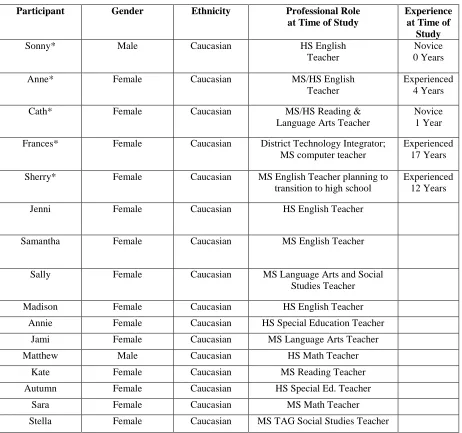
Table 1: Participant Information ...36
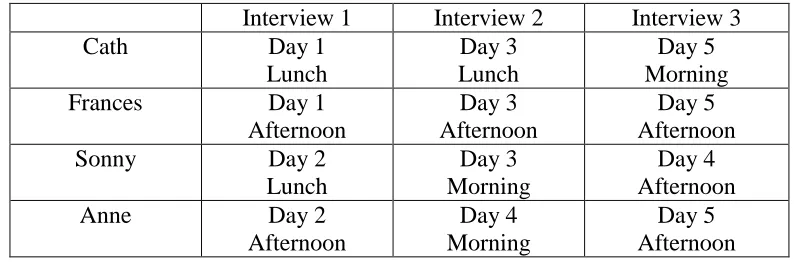
Table 2: Participants Interview Schedule ...43
Table 3: Day1, Agenda Critical Friends Groups Coaches’ Institute ...63
Table 4: Day1, Affinity Mapping Protocol Data ...73
Table 5: Goals of July 8 – 12, 2013, Critical Friends Groups Coaches’ Institute ...77
Table 6: Day 1: Agenda Coded with Goals ...77
Table 7: Day 1: Questions and Assumptions Protocol ...78
Table 8: Reflections Template ...105
Table 9: Critical Friends Group Coaches’ Institute Day 2 Agenda ...111
Table 10: Critical Friends Group Norms ...112
Table 11: Day 2, Listening Set Aside Groups ...120
Table 12: Day 3, Probing Questions for Ranking Activity ...142
Table 13: Day 3, Equity Playing Cards ...143
Table 14: Critical Friends Group Coaches’ Institute – Day 4 Agenda ...165
v
LIST OF FIGURES
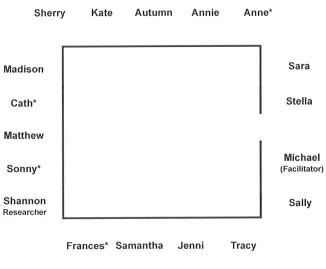
Figure 1: Day 1, Initial Set Up of Room and Seating of Participants ...62
Figure 2: North, South, East, West Compass Points ...83
Figure 3: Micro Lab Participant Groups ...84
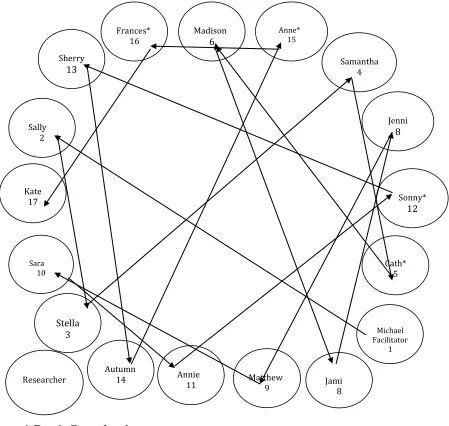
Figure 4: Day 1, Group Juggle ...89
Figure 5: Day 2, Set Up of Room and Seating of Participants ...106
Figure 6: Day 2, Tuning Protocol Seating of Participants ...117
Figure 7: Day 2, Learning from Play – Zones of Comfort, Risk & Danger ...124
Figure 8: Day 2, Looking at Work Session Tuning Protocol ...127
Figure 9: Day 3, Set Up of Room and Seating of Participants ...138
Figure 10: Day 3, Consultancy Framing Question Groups ...140
Figure 11: Day 3, Probing Question Checking Groups ...145
Figure 12: Day 3, Learning from Play Say, Say, Do ...152
Figure 13: Day 3, Dilemma Protocols ...153
Figure 14: Day 3, Looking at Work Session 1 Consultancy ...154
Figure 15: Day 3, Looking at Work 2 Tuning Protocol ...158
Figure 16: Day 4, Set Up of Room and Seating of Participants ...163
Figure 17: Day 4, Groups Final Word Text Protocol ...166
Figure 18: Day 4, Looking at Work 2 Tuning Protocol ...170
Figure 19: Day 4, Learning from Play: Change Activity ...178
Figure 20: Day 4: Paired Conversation ...180
Figure 21: Day 4, Looking at Work Session 2...181
Figure 22: Day 4, The Paseo ...185
Figure 23: Day 5, Set Up of Room and Seating of Participants ...188
Figure 24: Day 5, Coffee Talk Protocol Round 1 ...192
Figure 25: Day 5, Coffee Talk Protocol Round 4 ...192
vi
ABBREVIATIONS
CFG Critical Friends Group
NSRF National School Reform Faculty
PLC Professional Learning Community
1 THE PROBLEM
School improvement experts consistently charge educational leaders with establishing
Professional Learning Communities in schools citing that improving the collaboration and
positive relationships among the adults in the building improves the culture of the school, and,
consequently, student learning (Barth, 2001; Darling-Hammond, 1996; Dufour & Eaker, 2008,
1998; Dufour & Fullan, 2013; DuFour, R., Eaker, R., DuFour, R., & Many, T., 2010; Drucker,
1992; Hargreaves & Fullan, 2012; Joyce & Showers, 1995; Killion and Hirsh, 2007; Kruse,
Louis & Bryk, 1994; Lieberman and Miller, 2011; Louis, Kruse, & Raywind, 1996; Macdonald
& Shirley, 2009; Newmann & Wehlage, 1995; Senge, 1990). Indeed, an overarching premise
found in educational literature claims that improving school culture is the key to successful
school change. Often, the recommendation is that school leaders cultivate Professional Learning
Communities, commonly referred to as PLCs, in order to positively impact school culture (Barth,
2001; Dufour & Eaker, 2008, 1998; DuFour, R., Eaker, R., DuFour, R., & Many, T., 2010;
Dufour & Fullan, 2013; Dumas, 2010; Hargreaves & Fullan, 2012; Killion and Hirsh, 2007).
Unfortunately, PLC continues to remain a pejorative term for many educators. In fact, a
disturbing trend has emerged in schools as an unintended consequence of the pervasive push
from education experts toward establishing Professional Learning Communities
(Thompson-Grove, 2005; Hargreaves and Fullan, 2012).
Too few educational researchers and too few professional development programs provide
school based leaders with the practical tools and necessary facilitation skills to actually cultivate
a professional learning culture. Consequently, without practical guidance and a deep
understanding into the complexity of building an effective learning community, many school
leaders simply place teachers on teams, require the teams to meet once or twice a week, call this
community where teachers can improve their instruction and assessment practices (Dufour and
Eaker, 2008; Hargreaves and Fullan, 2013). Essentially, many school leaders do not truly
understand the characteristics of a learning community. As Fullan (2006) asserted, there are
many examples of PLCs that are implemented superficially, without an awareness of the depth
that is needed for producing an impact on learning. Moreover, as Hargreaves and Fullan
acknowledged, PLC processes “have been imposed simplistically and heavy-handedly by
overzealous administrators” (p. 128) resulting in teachers often feeling resentment toward the
PLC mandate. Indeed, many school leaders lack the practical skills and overlook the pragmatic
steps they must take in order to set up the structures and processes imperative for teachers to be
able to effectively collaborate, engage in professional dialogue, and share their knowledge and
expertise with each other.
Research Questions
This study offers one example of a teacher focused school improvement program
described and interpreted through the voices of educators themselves. The following primary
research questions and sub-questions guided the study.
The primary research question is:
How do educators participating in a 5-Day Critical Friends Group Coaches'
Institute conceptualize their experiences?
The research sub-questions are:
1) How do educators participating in a 5-Day Critical Friends Group Coaches' Institute
2) How do educators participating in a 5-Day Critical Friends Group Coaches' Institute
describe and interpret changes, if any, in themselves?
3) How do educators participating in a 5-Day Critical Friends Group Coaches' Institute
describe and interpret changes, if any, in their learning community?
Purpose
Training for Critical Friends Groups (CFG) is specifically designed to address the
assumption that adults know how to learn together as well as reveal to participants the
characteristics of a Professional Learning Community (PLC) and what it requires to cultivate a
true learning community (Bolam et al., 2005; Dufour & Eaker, 2008, 1998; Dufour & Fullan,
2013; Kruse, Louis, & Bryk, 1994; Moore and Carter-Hicks, 2014; Stoll et al., 2006). Therefore,
the purpose of this study was to examine how participants experienced a professional learning
program called a Critical Friends Group Coaches' Institute and how participants’ experiences
impacted the way they interpreted themselves and their roles as members of a Professional
Learning Community.
Significance of the Study
In her comprehensive review of research on the impact of Critical Friends Groups, Key
(2006) highlighted significant gaps in the research. First, she argued that while there is anecdotal
evidence that participation in a CFG is transformational for participants, there is no research that
has examined the types of circumstances that lead to pivotal professional moments for CFG
participants and thus how participation in CFGs contribute to these significant transformational
moments. A significant aspect, then, of studying a five day CFG Institute was the exploration
types of circumstances that lead to "pivotal professional moments" (Key, 2006). Key also noted
that most of the CFGs that have been studied are connected to the Coalition of Essential Schools
and have not been studied separate from that large reform. In Georgia, most CFG Institutes are
conducted separate from any large-scale reform effort, so this study is significant for CFG
research in that regard as well. Finally, this study is significant for district and school-based
educational leaders because it highlights the common mistake practitioners make of assuming
that placing teachers on team will be effective automatically when, in fact, teachers need to be
trained how to work effectively on teams.
Assumptions and Limitations
As DuFour and Fullan (2013) described it, if school leaders are going to advocate for a
learning communities approach, then they are obligated to create systematic structures that make
teacher collaboration meaningful. They advocated that leaders must ensure that teachers have
time available to meet during the contractual day, that clear priorities are established for teacher
collaboration, that teams have the appropriate knowledge base available to make decisions, that
training is provided and differentiated for teams, that teams have access to templates and models
to inform their work, and that clear expectations are laid out for teams to use to assess the quality
of their work. Too often, these structures are not in place, yet the term PLC is still used to
describe the leadership intention. So, whileschool improvement experts consistently encourage
educational leaders to cultivate Professional Learning Communities in schools, the problem
arises in the assumption many school leaders hold that adults know how to learn together and
how to effectively collaborate. Without explicitly teaching educators the skills and dispositions
assumptions, beliefs, expectations and habits that represent the norm for most educators,
attempts to implement the PLC process effectively will continue to fall short. Thus, the primary
research questions that guided this study sought to expose and clarify the experiences necessary
in order to teach educators how to collaborate and how to build community in schools.
Overview of the Study
Discovering and defining my epistemology and theoretical perspective started with
identifying my own assumptions and what I believe to be my purpose in my work and research
regarding schooling and public education. My assumptions include that the interactions and
relationships among the adults in a school building are central to the success and learning of the
students in a school building. Furthermore, I believe learning is primarily a social activity and
improving the culture of a school requires as much understanding, effort, and attention as
curriculum, instruction, and assessment. With these assumptions and beliefs clearly articulated
and at the forefront of my thinking, I have been able to identify my epistemology and theoretical
perspective, an important part of my work as a researcher. My epistemology is constructionism,
more specifically social constructionism. My theoretical framework is symbolic interactionism.
Being able to make the statement above about my epistemology with any sense of clarity
required intense reflection and is based on multiple readings of Crotty’s chapter entitled
“Constructionism: The Making of Meaning” in his 1998 text entitled The Foundations of Social
Research: Meaning and Perspective in the Research Process. While this chapter is filled with
passages, phrases, citations, and allusions that all worked together to illuminate and clarify my
understanding of social constructionism, the following passages were the most poignant in terms
constructionism as “the view that all knowledge, and therefore all meaningful reality as such, is
contingent upon human practices, being constructed in and out of interaction between human
beings and their world, and developed and transmitted within an essentially social context” (p.
42). This definition encompasses so much of the core values and beliefs I hold in terms of
learning being a social activity and knowledge being constructed as opposed to being discovered.
Another essential point Crotty made is that constructionism takes the “object very seriously” (p.
48). This is important for me as a researcher because I value the act of humans sharing multiple
perspectives, differing interpretations, and various points of view, all skills that are highlighted
during the CFG training. While I may value and even promote one interpretation or perspective
over another, I most fundamentally value each individual’s need to understand and make his/her
own claim about an object, experience, or belief. Consequently, I embrace Symbolic
Interactionism as my theoretical perspective. The assumptions inherent in this theoretical
perspective are that humans act toward things on the basis of meanings these things have for
them, and these meanings are derived from social interactions of one with others (DeMarrais and
Roulston, 2006).
I more specifically embrace social constructionism as my epistemology based on my
intense interest in understanding culture (more specifically school cultures) and my deep belief
that one is born into (inducted into) one’s culture, which has profound implications, often
invisible, to the individual. Crotty explicated this notion precisely when he wrote, “social
constructionism emphasizes the hold our culture has on us; it shapes the way in which we see
things (even the way we feel things!) and gives us a quite definite view of the world” (p. 58).
Finally, being able to distinguish the difference between constructionism and constructivism was
conceded that the terms in the literature are not always consistent, he offered the distinction that
constructivism focuses on the meaning-making activity of the individual mind interacting with
the world whereas constructionism focuses on the collective generation of meaning shaped by
the conventions of language and other social processes (p. 58). Because of this distinction and
clarification, I situate myself clearly with constructionism as I have a strong belief in the power
of language as well as a strong belief that knowledge is constructed through social interactions
which can be hindered or enhanced based on social processes in place in one’s culture or
organization. Moreover, social interactionism desires to understand culture from the perspectives
of the actors who interpret their world through and in social interaction and seeks to explain the
set of understandings and symbols that give meaning to people’s interactions (DeMarris and
Roulston, 2006).
A social constructionism epistemology with a symbolic interactionism theoretical
perspective informs my work in that it explains why I desire to study Professional Learning
Communities (PLCs) and the effect that a specific training program has on the teachers and
administrators who construct the learning community. More specifically, I desire to understand
the effect of the Critical Friends Group Coaches’ Institute training program on the knowledge,
attitudes, skills, aspirations, and beliefs of the participants. I value shared and collective
knowledge construction, so studying closely the process of how a group shares and makes
meaning is of extreme interest to me. Because of my theoretical perspective, the research
questions I pursued focused on illuminating and understanding the interpretations, interactions,
practices, perceptions, and attitudes that worked together and interacted to define the culture of a
learning community. My research uncovered how a specific professional development program
share how they perceived and constructed themselves and their learning throughout the course of
the training, and I documented pivotal moments of change using the KASAB framework
recommended by professional development expert, Joellen Killion (2008), executive director for
Learning Forward (previously The National Staff Development Council). Joellen Killion’s
Theory of Change model, referred to as KASAB, is described in her 2008 publication Assessing
Impact: Evaluating Staff Development. Killion argued that it is important to track and understand
what sort of changes and in what order change is occurring throughout professional development
programs. She specifically encouraged researchers to track changes in: Knowledge, Attitude,
Skills, Aspirations, or Behavior (KASAB). Killion’s KASAB conceptual framework guided my
research coding and analysis and assisted me with framing my research questions as well as
2 REVIEW OF THE LITERATURE
The high stakes accountability movement in public education has encouraged many
educational leaders to focus their resources for school improvement efforts and professional
learning programs on improving teacher knowledge and skills in their deficit areas of curriculum,
instruction and assessment. What has resulted from this increased emphasis on standards-based
instruction and standardized test scores is a significant increase in what McDonald and Shirley
(2009) called alienated teaching. They described alienated teaching as “a consequence of
ever-intensifying new policy mandates at the district, state and federal levels that undermine
[teachers’] own moral purpose and sense of efficacy” (p. 3).
Indeed, in many schools, educational leaders are so focused on improving test scores that
there has been an alarming decrease in the examination and focus on teacher efficacy and on
what happens outside of the classroom, for example in the faculty meeting rooms, hallways,
teacher’s lounge, and school parking lots. Stated more explicitly, school improvement efforts and
professional learning programs do not often spend tremendous resources on either improving the
school’s positive, professional, learning culture or improving the skills and dispositions needed
in order for teachers to work effectively on teams in order to develop meaningful relationships
and an effective professional community of adult learners. According to Dufour and Eaker
(1998), the flaw in this approach is that individual learning does not ensure organizational
learning or an enhanced ability to achieve common purpose (p. 262). Moreover, as PLC experts
Dufour and Fullan (2013) argued, the implementation of the PLC process requires a systematic
approach to changing school culture that is doable, but also undeniably difficult. There is a
smaller body of PLC research related to a specific type of Professional Learning Community
changes needed to establish a collaborative, professional culture, where teachers learn together,
reflect and exchange ideas regarding the craft of teaching as members of community,
(Armstrong, 2003; Careiso, 2005; Curry, 2003; Dunne and Honts, 1998; Dunne, Nave & Lewis,
2000; Key, 2006; Kruse, Louis & Bryk, 1994; Little, Gearhart & Kafka, 2003; Louis, Kruse &
Raywind, 1996; Kelley, 2012; Moore & Carter-Hicks, 2014; Nave, 2000; Newman & Wehlage,
1995; Seaford, 2003; Theiss, 1998; Thompson-Grove, 2005; Williams, 2012); however,
establishing such a collaborative learning culture is complex work and often implemented poorly
(Dufour & Eaker, 2008; Hargreaves & Fullan, 2012).
Hargreaves (1994) pointed to this concern arguing that rather than providing teachers
with the resources for meaningful collaboration, often educational leaders mandate structural
reforms without any accompanying attention to culture, which inadvertently creates a kind of
“contrived collegiality” that serves to only reinforce teacher cynicism (p. 186). Indeed, the
cynicism that has emerged among teachers regarding “collaboration” and “Professional Learning
Communities” is disconcerting and due in large part to poor implementation as well as the
recurring pattern of educational leaders trying to implement structural changes without intensely
focusing on shifting the school culture (DuFour and Eaker, 2008; Dufour & Fullan, 2013;
Dumas, 2010; Hirsh and Killion, 2007). As Curry (2008) distinctly pointed out, educational
reformers often over simplify “how teacher communities function, thereby obscuring the
complex cultural, organizational, political, and interpersonal dynamics at play within different
kinds of teacher communities” (p. 737).
Cultivating a Collaborative Culture
Dufour and Eaker (2008) defined a school’s culture as the assumptions, beliefs, values,
metaphor of cultivating a garden to describe the complex process of cultivating a school’s
culture. He wrote, “a garden is non-linear with some elements dying out as others are being born.
A garden is influenced by both internal and external factors. Its most vital elements occur
underground and are not readily visible. Most importantly, a garden is fragile and very high
maintenance.” Thus, as this metaphor illustrates, building a learning culture is an ongoing, ever
changing process that requires consistent, skilled and focused attention. Unfortunately, too few
educational leaders give this complex process the attention it deserves despite the abundant
literature on the imperative of establishing learning cultures in schools and the consistent rhetoric
that establishes the understanding that improving collaboration and positive relationships
between the adults in the building improves the culture of the school and student learning (Barth,
2001; Darling-Hammond, 1996; Dufour & Eaker, 2008, 1998; DuFour, R., Eaker, R., DuFour,
R., & Many, T., 2010; Dufour & Fullan, 2013; Drucker,1992; Joyce & Showers, 1995; Killion
and Hirsh, 2007; Kruse, Louis & Bryk, 1994; Louis, Kruse, & Raywind, 1996; Macdonald &
Shirley, 2009; Newmann & Wehlage, 1995; Senge, 1990).
Indeed, an overarching ideology in educational research signifies that improving school
culture is the key to successful school change. For example, Fullan (in Sparks, 2003) argued that
when educational leaders “fail to focus on changing the culture of a school,” reform efforts will
not be imbedded and consequently will fail. Thus, when developing a school improvement plan
that intends to improve teacher practice and student learning, it is imperative to understand and
improve the culture of the school, particularly in regard to teacher efficacy and faculty
relationships. True school reform requires the knowledge, skills, and effort of the entire school
community. A gap in the literature lies in the practical steps and pragmatic guides school-based
collaboration, engage in professional dialogue, and share their knowledge and expertise with
each other. As outlined, educational literature abounds that stresses how important it is to
establish a positive, professional school culture, and often the recommendation is that school
leaders cultivate Professional Learning Communities (PLCs); however, there are too few
educational researchers and too few professional development programs providing school based
leaders with the practical tools and necessary facilitation skills to actually cultivate such a
culture. Without practical guidance and a deep understanding into the complexity of building an
effective learning community, many school leaders simply place teachers on teams, call the
teams PLCs and believe they have done their due diligence in cultivating a learning culture.
Dufour and Eaker (2008) addressed this issue directly stating that because,
The team structure is so essential to creating the collaborative culture of a PLC, it is important that educators come to a common understanding of the meaning of the word team. Bringing a group of teachers together on a regular basis does not make them a team. Asking them to work on the same task does not make them a team. Even working toward the same goal may not make them a team. (p. 179)
In actuality, building collaborative teams is extremely hard work and requires strategic
effort and specialized skills (DuFour & Eaker, 2008; Dufour & Fullan, 2013; Eaker, R., DuFour,
R., & Many, T., 2010; Gideon, 2002; Hargreaves, 2003; Hirsh and Killion, 2007; Hord, 2004;
Joyce, 2004; McLaughlin & Talbert, 2001; Schmoker, 2004). Educators have to work to build
effective teams where collegial relationships flourish in schools if we hope to have school
cultures where effective instructional strategies can be imbedded. Fullan suggested that, “the
single factor common to successful change is that relationships improve. If relationships
improve, schools get better” (Sparks, 2003). Thus, a crucial component of building effective
teams and establishing a positive school culture is the willingness of teachers to be observed,
Essentially, school reform works when there is focused attention on improving curriculum and
instruction, and this requires teachers to examine, together, what and how they teach (WestEd,
2000). Just as importantly, though, teachers must be encouraged to examine how others teach
and practice new strategies in their classrooms. In fact, Joyce (1998) argued that a new
instructional technique must be implemented at least fifteen times before it can be imbedded.
Such conversations regarding the art and craft of teaching require teachers to trust one another
enough to observe each other and talk openly about their work. This ability to open oneself and
one’s classroom up to the critical comments, perceptions and reflections of other adults in the
building is no easy call to action and assumes teacher efficacy, teacher expertise and collegial
trust. In fact, breaking down the detrimental tradition of teacher isolation is one of the most
formidable barriers to school improvement (DuFour and Eaker, 2008; DuFour & Fullan, 2013;
Hord, 2004; Newmann & Wehlage, 1995; Lortie, 1975).
In an interview with Sparks, Barth (2002) expressed that “when we value craft
knowledge, we develop a school culture hospitable to learning. A central part of the work of the
school based reformer is to find ways to honor, reveal, exchange, and celebrate the craft
knowledge that resides in every schoolhouse.” One way to set the foundation of a learning
culture is to explicitly ask teachers to identify an area of expertise. Hirsh and Killion (2007)
highlighted Dall’Alba and Sandberg’s definition of expertise as “a teacher’s ability to learn from
analysis of practice in collaboration with others using student results as the standard for
excellence” (p. 87). However, identifying teacher expertise is only the beginning of the process.
In order to ensure that teachers’ craft knowledge and expertise are revealed and shared,
educational leaders must set the expectation and then provide the time, opportunities and training
the building. Fullan (2001) argued that “knowledge sharing and construction is the hallmark of
21st century educators. Hirsh and Killion (2007) agreed, believing that “using their collective
expertise, teachers have the capacity to solve most of the challenges they face in ways that are
contextually appropriate and frequently independent of additional resources” (p. 88). This
exchange of ideas will help to create meaningful professional relationships which are just as
important as student achievement. Barth advocated, “What leaders can do is help create a culture
that places as high a value on our relationships with one another and what we can learn from one
another as it does on getting youngsters to high performance” (Sparks, 2002). This notion of
valuing relationships within a school provides segue to another element of cultivating a learning
culture, that is, the deprivatization of practice.
We want teachers to implement research based instructional strategies, but as Joyce
noted, “it’s very difficult to get classroom implementation of new practices when you’re offering
things to people who work as individuals” (Sparks, 1998). Dufour (2003) added to this
commentary when he facetiously expressed, “I am unaware of any credible research that
suggests the best strategy for school improvement is to ensure that every teacher works in
isolation.” Sadly, that is what teachers often do. In fact, many teachers have misinformed
perceptions of what sort of teaching and learning is occurring in the classrooms of the teachers in
their same building, on their same hallway (Darling-Hammond et al., 2009). Such private
practice is detrimental to the quality of learning in the school, both student learning and adult
learning. This common culture of isolation in the teaching profession adds additional barriers to
reform efforts striving to improve collegial relationships and collaboration. Essentially, too often,
school administrators assume that adults in the building already know how to learn together and
together is an assumption and one that is too often made with detrimental consequences to
educational leaders’ benevolent intentions to cultivate Professional Learning Communities
(PLCs), which are hailed as structures school leaders should implement to increase student
learning.
What is a Professional Learning Community?
What, then, is a Professional Learning Community (PLC)? The term PLC refers to a
group of people sharing and critically interrogating their practices in an on-going reflective,
collaborative, learning oriented way (Toole and Lewis, 2002). Hord, a recognized expert on and
prolific writer regarding PLCs, defined a Professional Learning Community as:
One in which the teachers in a school and its administrators continuously seek and share learning, and act on their learning. The goal of their actions is to enhance their effectiveness as professionals for students’ benefit, thus, this arrangement may also be termed communities of continuous inquiry and improvement. (1997, p. 1)
Additionally, in one large-scale, multisite study of professional learning in which the researchers
investigated the question of whether PLCs are worth promoting, Bolam, McMahon, Stoll,
Michael, and Wallace (2005) defined eight characteristics of a PLC including such key elements
as shared values, vision and norms, mutual trust, respect and support, openness, networks and
partnerships, inclusive membership, collective responsibility for student learning, reflective
professional inquiry, collaboration focused on learning, and group as well as individual
professional learning. DuFour and Eaker (1998, 2002, 2008) offered similar characteristics of
PLCs including shared mission, vision and values, collective inquiry, collaborative teams, action
orientation and experimentation, continuous improvement, and results orientation. These
characteristics of PLCs neither magically appear in schools nor flourish easily, and before such
must be a focus for school improvement. In support of this claim is a study conducted by the
Center on Organization and Restructuring of Schools, which examined twenty-four schools
across the United States that had demonstrated progress in organizational restructuring. Two of
their research findings important for this dissertation study include data suggesting that teachers’
sense of professional community is a primary factor associated with responsibility for student
learning and findings that suggest most national, state and local policies designed to increase
teacher’s job performance are misdirected and should emphasize changing climate and culture
(Louis, 1994).
Another study conducted by Kruse, Louis and Bryk (1994) illuminated the benefits that
schools enjoy when they develop strong professional communities; furthermore, these
researchers discussed the structures, conditions, and resources imperative for sparking and
developing professional community in schools. Their findings were based on survey data
collected from fifteen restructuring schools studied by the Center on Organization and
Restructuring of Schools at the University of Minnesota. The authors stated that the schoolhouse
must be the focus of school reform and thus their research focused on professional communities
firmly embedded in the school, in contrast to communities fostered by professional networks and
other larger reform organizations beyond the school. They argued that a “school-based
professional community can offer support and motivation to teachers as they work to overcome
the tight resources, isolation, time constraints and other obstacles they commonly encounter in
schools” (Kruse et al., 1994, p. 4). They went on to identify five critical elements of strong
professional learning community in schools: (a) reflective dialogue, (b) de-privatization of
practice, (c) collective focus on student learning, (d) collaboration, and (e) shared norms and
elements to be cultivated in the school: (a) time to meet and talk, (b) physical proximity, (c)
interdependent teaching roles, and (d) communication structures and teacher empowerment.
Furthermore, they identified the social and human resources that must be fostered to enhance
professional community: (a) openness to improvement, (b) trust and respect, (c) cognitive and
skill base, and (d) supportive leadership and socialization. The research findings from the study
derived from the analysis of survey data of only fifteen schools, and the researchers
acknowledged that the sample size was small. One intriguing finding in their study is that high
schools in particular face greater challenges concluding that “high school educators must work
harder to forge bonds across departments if they are to move forward toward meaningful
school-wide goals” (Kruse et al., p. 6).
Another finding of Kruse, et al. is that school size does not seem to be a significant factor
in the level of professional community observed but gender does seem to be a factor in that
schools with a larger percentage of women on the faculty tend to develop a stronger sense of
professional community. According to Kruse, et al., “women tend to pay more attention to
interpersonal relations than men typically do, and women are more likely to cooperate and
encourage the development of community” (Kruse, et al., p. 6). The researchers concluded that,
“human resources…are more critical to the development of professional community than
structural conditions” (Kruse, et al, p. 6). This study lends credence to scholars and educators
such as Barth, Hargreaves, MacDonald & Shirley who argued that structural elements receive
too much emphasis in school reform and attention to improve culture, climate, and interpersonal
relationships receive too little attention. Kruse, Louis and Bryk’s article was a seminal cry in the
1990’s for an increased emphasis on building professional learning communities in schools – a
Establishing professional learning communities in schools essentially is about positively
changing school climate and culture and improving relationships and communication among the
adults in a school (Barth, 2001; Darling-Hammond, 1996; Dufour & Eaker, 2008, 1998; Dufour,
R., DuFour, R., Eaker, R. & Many, T., 2010; Dufour & Fullan, 2013; Drucker,1992; Joyce &
Showers, 1995; Killion and Hirsh, 2007; Kruse, Louis & Bryk, 1994; Louis, Kruse, & Raywind,
1996; Macdonald & Shirley, 2009; Newmann & Wehlage, 1995; Senge,1990). School
administrators and teachers must begin by learning how to establish an effective professional
learning community. The emphasis must shift and educators must be willing to learn, unlearn
and relearn how to collaborate together in teams, in other words how to participate as members
of community.
Critical Friends Groups
How do educatorslearn the skills and dispositions needed to be members of a
professional learning community? One of the most effective ways seems to be participation in a
professional development process called a Critical Friends Group (Caresio, 2005; Curry, 2003,
2008; Key, 2006; Kelley, 2012; Moore & Carter-Hicks, 2014; Nave, 2000; Thompson-Grove,
2005; Williams, 2012). A Critical Friends Group (CFG) is a particular type of school-based
professional learning community with a foundational belief that teachers must lead school
change and school improvement (Curry, 2008). In contrast to reform efforts that have emerged in
the current high-stakes accountability climate of education, which tend to alienate teachers by
treating them as technicians to implement ideas of others, CFGs stand apart by honoring the
expertise of teachers and asking teachers to construct their own learning through a cycle of
In 1995, the Annenberg Institute for School Reform at Brown University initiated The
Nation School Reform Faculty (NSRF), a network of educators committed to pursuing adult
learning in the service of student achievement. Originally, the Annenberg Institute funded the
work of NSRF including the training of Critical Friends Group coaches who were members of
faculties in schools that applied to become participants in the NSRF program. The original NSRF
developers had formerly worked as the professional development team for the Coalition for
Essential Schools (CES), and one of the core philosophies of CES was that teachers and
principals in local schools know what their needs are and do not need outside experts mandating
particular pedagogical practices or specific teaching strategies (Nave, 2000). Therefore, the
foundational aspect of NSRF is in regard to process as opposed to content. NSRF started as an
initial cohort of eighty Critical Friends Groups (CFGs) in sixty schools in 1995, grew to more
than 1000 CFGs in nine hundred schools by 2002 and has since grown into a much larger
network of educators “consisting of tens of thousands of practitioners in schools and districts
across the nation, operating out of 39 regional Centers of Activity in 26 States” (NSRF, 2007).
Bill Nave was hired near the end of the first year of NSRF in order to evaluate the effectiveness
of the program, and his priority before designing the evaluation was to understand the theory
underpinning the program. With Nave’s guidance, NSRF crafted and refined their Theory of
Action. Nave (2000) described this foundational theory of action and highlighted the expected
outcomes of CFG work as the original designers intended:
CFG work is expected to create a strong professional collegial community that will support its members as they reflect on their work, both individually and collectively. This reflection and discussion is expected to result in the creation of new professional knowledge about teaching and learning. As this new knowledge is created, teachers are expected to apply it by modifying their pedagogy.
expected to lead to cognitive dissonance. The result is expected to be a more focused and more reflective attempt at improving their practice. This recursive cycle will lead to continuous improvement in CFG teachers’ practice, with the practice becoming more adaptive over time. (p. 9)
In January of 2000, NSRF relocated to Harmony Education Center. The location, staff, and
budgetary privileges NSRF enjoyed through Annenberg ended, and as the organization has
grown and expanded, aspects have changed; however, NSRF claims to remain rooted in its core
beliefs. Gene Thompson-Grove, one of the 1995 founding members of NSRF, captured the
essence of what it means to be a member of a Critical Friends Group in an inspirational keynote
speech delivered at the first annual National School Reform Faculty Winter Meeting. The NSRF
Winter Meeting is an annual conference experience different from most any other as conference
attendees are inducted into a learning community for the duration of the conference and spend
their time together engaging in examining authentic student and adult work and conducting peer
observations about facilitation.
Thompon-Grove (2005) exclaimed that participation in a Critical Friends Group is one of
the few reform efforts that empower teachers to assume leadership in issues that truly matter in
their schools and districts. The most poignant language Thompson-Grove expressed in her
speech that captures the fundamental spirit of CFGs reads:
In NSRF, we believe that there is an enormous amount of untapped expertise in schools – that teachers, kept isolated from each other by structures and strong cultural norms, need and deserve access to the time and processes that will help them to learn with and from each other. (p. 5)
Thompson-Grove recognized that the beliefs of the educators in NSRF go against the norms of
the education profession – norms that “implicitly communicate that by the end of our second
year of teaching, we should stop asking for help, and should at least pretend that we know
that underlie NSRF and CFGs such as: (a) making it a habit to unearth assumptions, (b) making
our most challenging problems about students public, (c) being comfortable with being
uncomfortable, (d) slowing down long enough to become reflective practitioners, (e) gaining a
capacity for ambiguity, and (d) learning to frame good questions.
Thompson-Grove also described key aspects of CFGs that distinguish CFGs from other
teams of teachers. Members of CFGs keep students and their learning at the center, make time
for reflective dialogue, value collaboration and inquiry, pay attention to the norms, values and
decisions that drive the work, and they assume that everyone in the group will make their
practice public. She also illuminated the importance of protocols to assist in building trust in a
learning community and distinguished protocol use in CFGs from using protocols as icebreakers
and team builders. This distinction is integral to the work of building collaborative cultures. The
author spoke to the notion that there are only participants in CFGs – it is essential that
individuals do the work. Essentially, she articulated a disturbing trend in the push toward
establishing professional learning communities. She stated, “as our work expands and grows, it
has been more and more difficult to maintain high standards of quality for our work – to stay true
to what we know – to hold on to our principles” (Thompson-Grove, p. 7). This emphasis on
maintaining fidelity to the work is what research of CFGs can help educators explore.
Over the past several decades, research studies have been commissioned to study Critical
Friends Groups and individual researchers have studied CFGs as well (Armstrong, 2003; Dunne
and Honts, 1998; Dunne, Nave & Lewis, 2000; Little, Gearhart, Curry, Kafka, 2003; Kelley,
2012; Moore & Carter-Hicks, 2014; Seaford, 2003; Theiss, 1998; Tice, 1999; Van Soelen,
Williams, 2012). For example, in order to provide concrete information about how, and how
study of CFGs that was started during the 1997-98 school year to determine the effectiveness in
meeting both interim and long-term objectives. The Annenberg Institute conducted a
theory-based evaluation, which assumes that every program is theory-based on a theory about how and why it
will work. The theory underpinning Critical Friends Groups is that teachers seek each other’s
advice about professional issues and problems, and as members of CFGs, teachers can count on
most staff members to help out anywhere, anytime (Little, Gearhart & Kafka, 2003).
Armstrong (2003) explored Critical Friends Groups (CFGs) at three urban, mid-western
high schools, each with a population of 1000-1500 students. This study was imbedded in the
larger study that the Annenberg Institute initiated in the fall of 1995. The larger National School
Reform Faculty (NSRF) evaluation design included collecting interview and observation data
once a year for three years from five teachers each in fifteen schools. Armstrong’s study
complemented this larger data collection by providing a more in-depth case study of nine
teachers in three urban schools where each school was in its second year of implementation of
the program. Armstrong’s study sought to answer three questions: What were the experiences of
reflective practice and collegiality for participants in three CFGs? What particular activities
supported reflective practice or collegiality? How can reflective practice and collegiality be more
effectively supported? Significantly, Armstrong defined reflective practice as “the process of
learning within the context of one’s work which includes problem setting, inquiry, reframing and
experimentation…it includes both reflection about one’s practice as well as action or practice
based on that reflection” (p. 194). The nine teachers in the study committed to two years in
which they met monthly with 7-15 other teachers to (1) discuss issues related to their personal
teaching practice (2) observe and be observed by a peer partner monthly and (3) develop a
Armstrong (2003) concluded that despite significant differences in school climate, each
CFG program was able to assist teachers in building collegiality and supporting reflective
practice (p. 194). A finding and significant limitation of CFGs in this study was that “the
program was more successful in supporting reflection activities than it was at supporting
changed practice” (p. 195). One of Armstrong’s conclusions was that a weakness of CFGs is that
the reflection does not translate to a change in practice – and although there is a built-in portfolio
component intended to provide accountability to this end, the portfolio was not effective in
Armstrong’s contexts. Moreover, Armstrong concluded that a weakness in CFGs is that the level
of conversation often remains at a topical, technical level. Interestingly, one of the topics
Armstrong did not refer to in the study is that of the teams going through the process of
developing norms. In CFGs, the development of shared norms is integral to actually pushing the
conversation deeper and assisting participants with moving the work to more rigorous, honest
and meaningful levels; without emphasis on this component of norm development, the topical,
technical level of the conversations will persist. Ultimately, Armstrong (2003) concluded that
success in a CFG depends on the degree to which group participants are able to keep the program
meaningful and rigorous.
Curry’s (2005) research study investigated how teachers’ professional inquiry
communities at the high school level constitute a resource for school reform and professional
development. Specifically, Curry studied six Critical Friends Groups in a single comprehensive
high school using video-based, qualitative methods and multi-case study design. Interestingly,
the study encompassed data from six CFG groups but focused most fully on the complex social
and organizational dynamics at play within one focal CFG determined to be a case of mature
2) What kinds of teacher development opportunities are constructed through CFG practice? 3)
What possibilities and limitations reside in CFG practices that might influence the potential of
these groups to serve as engines for instructional improvement and/or school wide reform? This
case study indicated that CFGs promote collegial ties across departments and curricular
coherence. The CFGs were not productive as the staff perceived diminishing returns over time.
Of interest to note is that these were mandatory CFGs, which according to many educators who
support this work, undermine the spirit of a true CFG. Curry (2005) concluded that CFGs were
insufficient as a resource for transforming a high school. Curry’s study added to the development
of this dissertation inquiry because it highlighted a common pitfall of school administrators
mandating that teachers be in a “PLC” without providing the proper training or coaching for
teachers regarding how to be in a PLC, specifically facilitation skills. Simply putting educators
together on a team and calling the group a PLC, or CFG, is highly problematic and certainly
worth further investigation and research. As Curry noted, “despite members’ apparent preference
for teacher-managed professional development, evidence suggested that CFGs suffered from
members’ (especially coaches’) lack of expertise with regard to both content matter and group
facilitation processes” (p. 283-284). The need for skilled facilitation is certainly an area worth
further investigation because without skilled facilitation, the ability to implement CFGs with
fidelity is compromised.
Van Soelen (2003) engaged in a qualitative research study examining a Critical Friends
Group made up of six novice teachers in a suburban Georgia middle school. This study sought to
explore what happens when a CFG of novice teachers is honored for each member’s individual
inquiries. The unique element of this study is that one of the initial members, Polly, decided to
juxtapose Polly’s experiences as an isolated novice teacher with the collaborative, supportive
experiences of the novice teachers who chose to participate in a specific learning community
called a CFG. These paralleled stories worked to illuminate the support CFGs can offer.
Essentially, this particular CFG, led by a skilled facilitator, functioned as a reciprocal mentoring
community for novice teachers.
Careiso’s (2005) qualitative case study examined the perspectives of seven participants of
one Critical Friends Group in a suburban middle school, specifically investigating how
involvement in a CFG learning community affected teacher members’ perspectives of their
pedagogy. The members of this CFG selected a specific district goal as a yearlong meeting
focus. Members of the group met monthly, discussed instruction, analyzed student and adult
work and conducted peer observations. Careiso’s study explored the following questions: One,
how do members of the Critical Friends Group think participating in the group has affected the
pedagogy of the other members? Two, how has the Critical Friends Group affected members’
perspectives of their own classrooms? The research findings were that membership of the group
affected each member by giving them new ideas, strategies, and constructive feedback and
“turned their teaching philosophy and views of teaching completely around for them” (p. 111).
Several statements made by Careiso (2005) regarding her study were problematic. For
example, in chapter one, Careiso wrote, “the main purpose of a CFG is to change teachers’
practices the first year and affect whole-school change during the second year” (p. 1). This is not
what the NSRF Theory of Action outlines for the intended purpose of a CFG (Nave, 2000).
Additionally, Careiso wrote, “no research has been conducted that examines only one CFG or
looks closely at the perspectives of each participant.” This inaccurate statement misrepresents the
closely at its participant’s perspectives. Additionally, Careiso (2005) questioned the two-year
Annenberg study of CFGs citing that it “had deficits in pinpointing weaknesses or strengths
because of the diversity of each group” (p. 8). Again, Careiso seemed not to represent the
intended spirit and philosophy of CFGs, since valuing different perspectives and using structured
protocols to uncover divergent perspectives is a hallmark of a CFG. Ultimately, Careiso’s (2005)
dissertation seemed to be quite formulaic, lacked an individualized, authentic voice and did not
seem to build on previous CFG research findings.
Williams’ (2012) mixed methodology study examined what impact, if any, the
implementation of the Critical Friends Group PLC model would have on teachers’ perceptions of
their school as a professional learning community, on professional growth and development,
instructional practices, and student achievement of teachers in a small, urban, high school in the
mid-south. The specific research questions assumed that change would occur and were
articulated in this manner:
1. What changes in teachers’ perceptions of their school as a professional
learning community occurred as a result of teacher participation in a CFG?
2. What changes in professional growth and development occurred as a
result of teacher participation in a CFG?
3. What changes in instructional practices occurred as a result of teacher
participation in a CFG?
4. What changes in student achievement occurred as a result of teacher
participation in a CFG?
Quantitative results from Williams’ study revealed that there were some changes in
included reflective dialogue, de-privatization of practice, cognitive skill base and interdependent
teaching roles. Qualitative results revealed that a majority of the teachers had changed their
perception of their school as a PLC, and that CFGs created a more cohesive community among
teachers. Additionally, all teachers interviewed reported changes in their professional growth and
development and changes in some aspect of their instructional methods and approaches to
classroom dilemmas. The results were inconclusive on the impact of CFGs on student
achievement in this study. Importantly, Williams’ study reinforced that the implementation of
PLCs through the CFG model “provides a structured framework to begin the process of
reorganizing schools into learning communities.” (p.119)
One specific finding from Williams’ study important for this research study is that
participation in a CFG increases the effectiveness of group processes and self-managing teams.
Williams’ analysis of the data indicated that teacher collaboration was heightened and that CFGs
promoted group problem solving processes such as information sharing and building
commitment to instructional changes and decisions. (p. 120) An important detail in Williams’
research design that cannot be underestimated in this field of study is the number of trained CFG
coaches who were part of the school’s implementation of CFGs. The researcher, Williams,
served as an Assistant Principal in the school and coordinated that thirteen faculty members and
herself attended a Critical Friends Group Coaches’ Institute prior to implementation of CFGs in
the school. Moreover, Williams created five groups of faculty members to implement
interdisciplinary CFGs, and each of the five groups included two trained CFG coaches.
According to Williams, “the coaches used protocols learned during training to facilitate the
meetings and to ensure a democratic process took place.” (p. 95) Additionally, Williams
the level and type of support needed. Williams understood the skills and dispositions necessary
to successfully implement the CFG model for building professional learning communities in
schools. Consequently, she took steps in her school to ensure that there would be a higher level
of successful implementation. Essentially, she did not assume that the adults in her school knew
how to collaborate effectively. Although the need for trained CFG facilitators was not an explicit
recommendation in her summary of her research findings, Williams’ belief in this practice was
certainly implicit in the design of her study.
Kelley’s (2012) study used a narrative inquiry approach to examine her work with
Critical Friends Groups over the span of a decade. Kelley analyzed collaboration and reflection
of a single CFG across time as well as her role and development as a CFG coach. Kelley’s study
addressed two research questions: (a) How did the Critical Friends Group professional
development approach influence collaboration among teachers participating from a high school
in the local reform movement, and (b) How did these teachers use reflective practices in the
construction of their personal practical knowledge? One of the greatest values of this study is
that it is one of the few CFG studies to track participation in a CFG longitudinally over a decade.
Kelly provided insight into the challenges that CFG participants face when new administration
comes on board to lead school without knowledge and commitment to the CFG process.
Moreover, Kelley tracked her own journal reflections as a CFG coach across a decade,
illuminating how challenging yet rewarding that facilitation role can be. She also illustrated how
experience and practice with facilitation improves over time and can expand to a role of training
other educators in the art and craft of being a CFG coach. Significantly, for my goals in sharing
my own research findings, Kelley set precedent by sharing and analyzing her data