OPTIMIZING THE EFFICIENCY OF OSCILLATING WATER COLUMN
(OWC) WAVE ENERGY CONVERTER USING GENETIC ALGORITHM
Perumal Nallagownden, Hussam. M. M. Alhaj and Muhammad Bilal Sarwar
Electrical and Electronic Engineering Department, Universiti Teknologi Petronas, Sri Iskandar, Perak, MalaysiaE-Mail: [email protected]
ABSTRACT
The Oscillating Water Column (OWC) based wave energy converter has now been developed in different part of the world. The OWC converter is a combination of pneumatic system, mechanical system and electrical system. The overall efficiency of OWC is depended on the three systems efficiencies. Maximizing each of these system efficiency can maximize the overall efficiency. This paper, describes a method to maximize the pneumatic system efficiency using optimization technique based on Genetic algorithm. This method involves an extraction of maximum incident wave energy corresponding to the wave height, determining of the best deep water length and maximizing the applied damping ratio which can lead to an increase in the pneumatic system efficiency. The result shows that the lower the number of the wave group, the maximum is the wave energy, that can be extracted and, optimum plane solidity and the water deep length can increase efficiency of OWC.
Keywords: OWC, genetic algorithm, wave energy, converter.
INTRODUCTION
Harnessing energy from different renewable energy sources is getting more attention globally in recent years to realize better economic, environmental, and social objectives. The main environmental concern is rising level of CO2 emission which lead to climate change in the world. One of the potential renewable energy sources that contain a substantial amount of energy is ocean wave [1-3]. The waves are produced by wind action and travels over long distance with small amount of energy losses. The harnessed energy from ocean wave energy is estimated in the worldwide at about 1000 TWh/year [4].
The possibility of converting wave energy into electrical energy has inspired inventors to invent different wave energy converters (WEC), however, WEC in general are divided into three main groups. They are oscillating water columns (OWC), overtopping devices and oscillating bodies [5]. The advantage of OWC technologies are the simplicity of constructing on the land, less maintenance, robustness and easy to excess its electrical part and no special wire is needed [6],this makes it possible for it to be developed in full-scale prototypes in different location in the world, located on the shoreline or near shore [7-11]. The OWC is a device that converts the incident wave movement into pneumatic energy [12], then this pneumatic energy can be converted into mechanical energy using turbine and lastly the mechanical energy converted to electrical energy using a generator. Several papers discussing the efficiency of the OWC have been presented [1, 2, 13 and 14]. However, most of these papers address the performance of the turbine [14-17] or the control performance which relate the turbine and the generator efficiency [1, 4, 13, 18 and 19] but the overall efficiency is a combination of all conversion efficiencies.
Thus, this paper addresses the efficiency of the pneumatic system. The study optimizes some of the parameter that effect the pneumatic system efficiency in the conversion of the wave energy to the pneumatic energy by proposing a method based on genetic algorithm (evaluation technique).
The objective of this paper is to determine the best water depth that can maximize the incident wave energy related to the wave height and also to determine the best plane solidity ratio that can maximize the applied damping, and, therefore, the pneumatic power output and the overall efficiency.
Oscillating water column (OWC)
Figure-1. Oscillating water column (OWC).
Figure-2 shows the characteristic parameters of the wave. The maximum elevation above the still Water level (SWL) of the wave profile is called the wave crest and the part with the lowest depression is called the wave trough. The distance between the SWL and the crest or the trough is called the amplitude of the wave and the distance from the trough to the crest is called the wave height (H).
The distance between successive points crest to crest or trough to trough is defined as the wavelength (L) and the distance between SWL and the seabed is known as the water depth (h) [13].
Figure-2. Characteristic parameters of the wave.
OWC incident wave power characteristics
The wave power of the incident waves of converter, � was computed, using Equation. (1) to Equation. (8) as follows [20]
�= � �
where � is the group velocity; and �is the mean wave energy density per unit horizontal area, which is given for a given sea statues by Equation. (2) [20]
�= ��
Where is the water density given by kg/m³, g is gravitational constant (9.81 m/s2) and � is wave height by m.
The group velocity is given as,
� =
With
= ( +sinh �ℎ ) �ℎ
Where h is the water depth, k is the wave number
and C is the corresponding wave celerity,
=��
Where � is the angular frequency, which is obtained from the dispersion relationship.
� = �� × �� ℎ �ℎ
� = √�� × �� ℎ �ℎ
�= �� × ( +sinh �ℎ ) × �ℎ √�� × �� ℎ �ℎ�
It can be seen from Equation. (8) the incident wave power is related to the water depth, thus, the best water depth that give the maximum power should be known in the design stage to improve the OWC converter efficiency. Therefore, genetic algorithm is presented to determine the best water depth corresponding to wave height and maximum power.
Parameters influencing performance of oscillating water column OWC
� = � �� � + ���� + ��
Where , is applied force at time �, is mass of the body, is a damping, � is displacement and � is the spring constant. The spring restoring constant � is given as � = � � where � is the free surface area of the OWC, is the density of water and � is the coefficient of gravitational acceleration [20]. From Equation. (9) there are two main quantity that affect the mechanical-mass spring damping OWC model, first the mass of OW and the frequency independent mass, secondly, the system damping, this consist of components damping due to the wave radiation and losses called the secondary damping, and the turbine applied damping which extract the energy from the OWC [20]. Based on Curran et al [20-22] the applied damping directly affect the pneumatic power output of OWC and therefore is important to adjust the value of the applied damping in order to obtain optimum power output of OWC.
However, there are some parameter affecting the applied damping and therefore, the overall pneumatic power output. Based on [20-22] the applied damping to the OWC by the turbine is given as in Equation. (10) as follow:
A= ∆
By assuming the incompressibility of the air and Mach number of less than 0.5 and the conservation of the mass flow Equation.(10) can be written as in Equation.(11) [21].
A= ∆
Where ∆ is the total pressure drop, and are the cross-sectional areas at the water column surface and the duct turbine respectively and and are the respective air velocity.
Based on Equation. (12) [20-22], Equation. (11) can be expressed in term of damping ratio as in Equation. (13)
R= ∗/∅
Where ∗ is non dimensional equivalent of the pressure and ∅ is non dimensional equivalent of the flow rate
A= �(
∗
∅ )
Where � is rotational velocity given as �=� � , T is tip diameter. In further detail Equation. (13) can be written in Equation. (14)
A= � � � − ℎ ( ∗
∅ )
is air density, ω is rotational speed of the turbine,AR is the column – duct ratio and is given as AR=AAAC and the turbine duct is given as AA= DT −
h where h is hub to tip ratio and is given ash =DH
DT and DH is hub diameter.
From the result of the characteristics of R in [20-22] the R can be calculated based on the number of the rotor planes �� and each plane solidity � as in Equation. (15) [1-3].
R= ( ∗
∅ ) = . ���� �
The solidly � is give as � = and is total
blade area in plain view per plane, in addition, the number . is proposed by curran et al [20] in order to consider the scale affects due to the variation in Reynolds number (Reynolds number (Re) is a dimensionless quantity that is used to help predict similar flow patterns in different fluid flow situations) [23, 24].Substituting Equation. (15) in Equation. (14) the applied damping can be expressed as Equation. (16) and Equation. (17)
A= � � � − ℎ �
A= . � � � − ℎ ���� �
It can be seen from Equation. (16) and Equation. (15) the applied damping is a function of number of the design parameter which are �, T, R, ℎ , �� and �
Furthermore, the pneumatic power output (air compressons pneumatic type) of OWC is given as in Equation. (18) [22].
p e a ic= ∆ = A −�
Where is air flow, Substituting Equation. (16) or Equation. (17) in Equation. (18) the pneumatic power output of OWC ( p e a ic ) can be written as in Equation. (19) and Equation. (20)
Wp e a ic= . ω DTAR − h NPtan σ VA
In general, the overall efficiency can be given as in Eq. (21)
� = ��������
Where ����the efficiency of the OWC,�� is the turbine efficiency and�� is the electrical generator efficiency. Furthermore, the efficiency of the OWC can be written as in equation (22)
����= ( p e a ic
� ) %
Therefore, the incident wave energy and the damping ratio can affect the overall efficiency. From Equation. (16) and Equation. (17) the pneumatic power output of OWC is a function of the applied damping and therefore is a function of these following parameters �, T, R, ℎ , �� and �. Thus, optimum selection of theses parameters can improve the OWC performance, therefore, the aim of this paper is to propose optimization method based on Genetic algorithm (GA) optimization technique to determine the optimal plane solidity �, that maximize the damping ratio � in Equation. (15) and consequently maximize the OWC pneumatic power as in Equation. (19).
Genetic algorithm optimization
There are a lot of optimization problems that are hard to be solved in real world applications and several mathematical optimization algorithms have been developed and presented for optimization in general based on conventional deterministic method such as, nonlinear optimization methods [21], linear optimization methods [22], or mixed integer programming [23] and decomposition methods [24]. However, these conventional techniques are most likely to converge to a local optimal solution rather than the global solution for most of the problems that have many local minima [25]. To approach such problems, several concepts of evolutionary algorithms (EA) [26] [27] have been introduced for optimization in the past decades. The basic idea behind Evolutionary algorithm comes from the principles of biological evolution [28].
Genetic algorithms (GA) were first introduced by John Holland in the 1970s (Holland 1975) inspired from evolutionary biology which the species evolve via inherited variation through mutation, recombination, or some other process [25], [26]. GA is a combination of modeling, searching and optimizing tool. By natural selection, the fittest survive and reproduce, thereby transmitting their genetic material to future populations.
The chromosomes are represented by a fixed-length bit string in the traditional Genetic algorithm. Each a particular feature of an individual is assumed to have a position in the string represented it, and the value kept in that location represents how that feature is stated in the solution. Generally, the string is “evaluated as a collection of structural features of a solution that have little or no interactions”. The analogy may be drawn directly to genes in biological organisms. Each gene represents an entity that is structurally independent of other genes [27].
The standard genetic algorithm contains process as follows: randomly an initial population of individuals is generated. Each evolutionary step is called a generation, then, the decoding of each individuals in the current population are performed and evaluated based on some predefined quality criteria known as the fitness, or cost function. According to their fitness a few individuals are selected to create a new population or the next generation. Holland’s original fitness-proportionate selection is the simplest method of several selection methods that currently in use, in Holland’s selection method the individuals are selected with a probability depend on their relative fitness. In each new generation the best fit or good individuals have more chance of reproducing as compared to low-fitness individuals which are more likely to vanish [27], [28]. The general steps of genetic algorithm are shown in Figure-3 and more detail about Genetic algorithm can be found in [27], [28].
Genetic algorithm has many advantage as compare to the traditional method such as does not require any derivative information, deals with a large number of variables, well suited for parallel computers and optimizes with continuous or discrete variables, these advantage make it popular and has been used in different optimization problem such as in [29-30].
RESULT AND DISCUSSIONS
In this paper, three cases are studied and presented to evaluate the performance of genetic optimization technique and to determine the best water deep length that can give Maximum wave power. The study is carried out using MATLAB simulation software
for three different Wave heights. Wave height and water deep length affect the wave power as shown in Equation. (8) and, therefore, genetic algorithm is applied to determine the water deep length that can give maximum output wave power. This problem is a single optimization problem, the variable parameters are the wave height H and the water deep h, fixed parameters are the water density given by kg/m³, and g, is gravitational constant (9.81 m/s2), the boundary constraint is shoreline water deep length. Furthermore, the GA population size that has been used is 30 with number of generation equal to 100. The results of the optimization for the three cases are shown in Table-1 and Figure-4 to Figure-12.
Figure-4. Evaluation of wave power for wave height Figure-5. Evaluation of wave power for wave height equal to 0.5 m and 2 wave number. equal to 0.5 m and 3 wave number.
Table-1. Maximum and minimum wave power for wave height equal to 0.5 m.
Number Wave in the Group
Maximum Wave Power W/M
Water Deep Distance Related To Maximum
Power (M)
Minimum Wave Power W/M
Water Deep Distance Related To
Minimum Power (M)
2 46.8225 0.5871 39.4702 8.8339
3 32.2460 0.3027 23.6468 8.8085
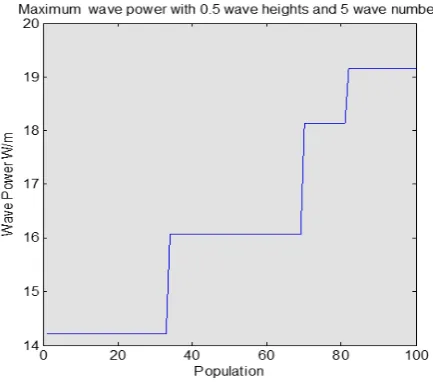
5 19.1546 0.1410 14.1881 3.0488
Figure-4 to Figure-6 shows the convergence curves of the maximum power for wave height equal to 0.5 m with different wave number in the group, it can be seen from the Figure 5 that the algorithm converge faster to the maximum power when the number of wave is equal to three as compared to Figure 4 and Figure 6 where the number of the wave is equal to two and five respectively.
Figure-6. Evaluation of wave power for wave height Figure 7 Evaluation of wave power for wave height equal to 0.5 m and 5 wave number. equal to 1.5 m and 2 wave number.
Figure-10. Evaluation of wave power for wave height. Figure-11. Evaluation of wave power for wave height equal to 2.5 m and 2 wave numbers. equal to 2.5 m and 3 wave numbers.
Figure-7 to Figure-9 shows the performance of the algorithm to determine maximum wave power and best water deep length for wave has height equal to 1.5 m. Figures 7 and 8 shows the convergence to the maximum power for wave has number equal to two and three and can be seen the algorithm converge faster in both case as compared to Figure-9 where the wave number is equal to five, which approximately converge in less than 10 populations. The highest achievable best fitness is 430.0738 W is obtained by wave number equal to 2 and the corresponding water deep is 0.5212 m.
Figure-12. Evaluation of wave power for wave height equal to 2.5 m and 5 wave numbers.
This study is useful for designer to achieve an optimal incident wave power by best location of OWC based on the water deep length with respect to wave number in the group and height. From the last three Figures Figure-10 to 12 maximum incident wave power is 1.2011e+03 (W) when the number of the wave is equal to
Table-2. Maximum value of damping ratio.
Number of the Rotor Plane ��
Maximum Damping Ratio ��
Plane Solidity � Related to Maximum Damping Ratio
Minimum Damping Ratio ��
Plane Solidity � Related to Minimum Damping Ratio
2 1.0356 0.4956 0.2563 0.1524
From Table-2 the maximum damping ratio is 1.0356 with optimum Plane Solidity � equal to 0.4956 based on optimization method used, where the optimum relation between ∗ is non dimensional equivalent of the pressure and ∅ is non dimensional equivalent of the flow rate is given as in Equation. (21)
∗= . ∅
Figure-13. Convergences to maximum damping ratio.
Figure-13 shows the performance of the optimization method with different population size and can be seen from Figure-13 that, in the beginning of the optimization the population have fluctuation in the global optimum which lead to say that the damping ratio optimization problem has many local optimality, however, in the end of the population the optimization method converge to the maximum value of the damping ratio which can maximize the overall OWC efficiency.
CONCLUSIONS
In this paper the performance of genetic algorithm to optimize the water deep length to determine the maximum incident wave power and best plane solidity value that can give maximum damping ratio has been
investigated, by studying the incident wave power behavior when the wave height has different value. The maximum wave power output as a function of the water deep and wave height is obtained using MATLAB simulations based on the proposed optimization method. The results shows that the number of the wave in the wave groups influence the incident wave power and the maximum incident power obtained is equal to 1.2011e+03 (W) when the number of the wave is equal to two, wave
height equal to 2.5 m. The optimal water deep length related to maximum power was found to be equal to 0.3632 m. The maximum damping ratio is found to be 1.0356 with plane solidity equal to 0.4956. Selection of the plane solidity and the water deep are important to maximize the pneumatic power in OWC. The proposed optimization method can help in the selection of the optimum values and improves the performance of the pneumatic system efficiency.
ACKNOWLEDGEMENTS
The authors gratefully acknowledge Universiti Teknologi Petronas (UTP) for providing the facilities and grant for financial support.
REFERENCES
[1] M. Amundarain, M. Alberdi, A. J. Garrido, and I. Garrido, "Modeling and Simulation of Wave Energy Generation Plants: Output Power Control," Industrial Electronics, IEEE Transactions on, vol. 58, pp. 105-117.
[2] M. Veigas, M. López, and G. Iglesias, "Assessing the optimal location for a shore line wave energy converter," Applied Energy, vol. 132, pp. 404-411.
[3] López, J. Andreu, S. Ceballos, I. Martínez de Alegría, and I. Kortabarria, "Review of wave energy technologies and the necessary power-equipment," Renewable and Sustainable Energy Reviews, vol. 27, pp. 413-434.
power generation plants," in Compatibility and Power Electronics, 2009. CPE '09. pp. 117-122.
[5] S. M. Lattanzio and J. T. Scruggs, "Maximum power generation of a wave energy converter in a stochastic environment," in Control Applications (CCA), IEEE International Conference on, pp. 1125-1130.
[6] D. G. Dorrell, J. R. Halliday, P. Miller, and M. Find later, "Review of wave energy resource and oscillating water column modelling," in Universities Power Engineering Conference. UPEC 2004. 39th International, pp. 649-653 vol. 1.
[7] A. F. d. O. Falcão, "Wave energy utilization: A review of the technologies," Renewable and Sustainable Energy Reviews, vol. 14, pp. 899-918, 4//.
[8] N. Bønke K, "Prototype wave power stations in Norway," in Proceedings of International Symposium on Utilization of Ocean Waves, In: McCormick, pp. 34-45.
[9] S. Ohneda H, Shinbo O, Sekihara S, Suzuki K, Kubota H, et al, "Construction procedure of a wave power extracting caisson breakwater," in Proceedings of 3rd Symposium on Ocean Energy Utilization, pp. 171–9.
[10]F. o. A. d. O., "The shoreline OWC wave power plant at the Azores," in Proceedings of 4th European Wave Energy Conference, pp. p. 42–7.
[11]M. S. Whittaker TJT, Raghunathan S., "review of the Islay shore line wave power station," in Proceedings of (First) European Wave Energy Symposium; pp. p. 283-6.
[12]M. A. Ormaza, M. A. Goitia, I. G. Hernandez, and A. J. G. Hernandez, "Wells turbine control in wave power generation plants," in Electric Machines and Drives Conference, 2009. IEMDC '09. IEEE International, pp. 177-182.
[13]M. Amundarain, M. Alberdi, A. J. Garrido, I. Garrido, and J. Maseda, "Wave energy plants: Control strategies for avoiding the stalling behaviour in the Wells turbine," Renewable Energy, vol. 35, pp. 2639-2648, 12//.
[14]V. Jayashankar, S. Anand, T. Geetha, S.
Santhakumar, V. Jagadeesh Kumar, M. Ravindran, et
al., "A twin unidirectional impulse turbine topology
for OWC based wave energy plants," Renewable Energy, vol. 34, pp. 692-698, 3//.
[15]J. K. Watterson and S. Raghunathan, "Numerical Analysis of Wells Turbine Aerodynamics," Journal of Propulsion and Power, vol. 15, pp. 253-259, 1999/03/01.
[16]A. Brito-Melo, L. M. C. Gato, and A. J. N. A. Sarmento, "Analysis of Wells turbine design parameters by numerical simulation of the OWC performance," Ocean Engineering, vol. 29, pp. 1463-1477, 9//.
[17]P. Puddu, M. Paderi, and C. Manca, "Aerodynamic Characterization of a Wells Turbine under Bi-directional Airflow," Energy Procedia, vol. 45, pp. 278-287, //.
[18]M. A. Ormaza, M. A. Goitia, A. J. Garrido
Hernandez, and I. Garrido Hernandez, "Neural control of the Wells turbine-generator module," in Decision and Control, held jointly with the 2009 28th Chinese Control Conference. CDC/CCC 2009. Proceedings of the 48th IEEE Conference, pp. 7315-7320.
[19]S. S. Rao and B. K. Murthy, "Control of Induction Generator in a Wells Turbine Based Wave Energy System," in Power Electronics and Drives Systems, 2005. PEDS. International Conference, pp. 1590-1594.
[20]López and G. Iglesias, "Efficiency of OWC wave energy converters: A virtual laboratory," Applied Ocean Research, vol. 44, pp. 63-70, 1//.
[21]W. H. Swann, "A survey of non-linear optimization techniques," FEBS Letters, vol. 2, Supplement 1, pp. S39-S55, 3//.
[22]I. Kuzle, M. Zdrilic, and H. Pandzic, "Virtual power
plant dispatch optimization using linear
programming," in Environment and Electrical
Engineering (EEEIC), 2011 10th International
Conference, pp. 1-4.
to Unit Commitment problem," in IPEC, Conference on Power and Energy, pp. 25-30.
[24]G. Adomian, "A review of the decomposition method in applied mathematics," Journal of Mathematical Analysis and Applications, vol. 135, pp. 501-544, 11/1/.
[25]K. Y. Lee and F. F. Yang, "Optimal reactive power
planning using evolutionary algorithms: a
comparative study for evolutionary programming, evolutionary strategy, genetic algorithm, and linear programming," Power Systems, IEEE Transactions on, vol. 13, pp. 101-108.
[26]A. P. Alves da Silva and P. J. Abrao, "Applications of evolutionary computation in electric power systems," in Evolutionary Computation, 2002. CEC '02. Proceedings of the Congress, pp. 1057-1062.
[27]M. Dabrowski and A. Rudenski, "Application of evolutionary algorithms for optimisation of electric machines," in Computational Electromagnetics (CEM), 6th International Conference, pp. 1-2.
[28]S. Sumathi and P. Surekha, Computational
intelligence paradigms theory and applications using MATLAB. Boca Raton: CRC Press.
[29]K. Deb, Multi-objective optimization using
evolutionary algorithms. Chichester; New York: John Wiley and Sons.