African-American Studies Theses Department of African-American Studies
Spring 5-11-2013
"Who Says Storm Is The Only Black Superheroine?": An
"Who Says Storm Is The Only Black Superheroine?": An
Interpretative Textual Analysis Of The Black Superheroine
Interpretative Textual Analysis Of The Black Superheroine
Grace D. Gipson
Georgia State University
Follow this and additional works at: https://scholarworks.gsu.edu/aas_theses
Recommended Citation Recommended Citation
Gipson, Grace D., ""Who Says Storm Is The Only Black Superheroine?": An Interpretative Textual Analysis Of The Black Superheroine." Thesis, Georgia State University, 2013.
https://scholarworks.gsu.edu/aas_theses/19
This Thesis is brought to you for free and open access by the Department of African-American Studies at
by
GRACE D. GIPSON
Under the Direction of Jonathan Gayles
ABSTRACT
The study examines how race and gender stereotypes in popular culture shape the perception of
the Black superheroine. This study also explores stereotypes and gender roles and how they impact Black
female and male college students’ ages 18-38 and their imagination of the Black superheroine. As the
sta-tus of popular culture grows, the generation of today’s college student still remains regular consumers.
Thus it was necessary to use a convenience sample of thirty-two African American male and female
col-lege-age students from four African American Studies undergraduate courses at Georgia State University
that took part in a Superheroine questionnaire, in which they designed their own Black superheroine. This
research employs an interpretative textual analysis research design to collect and analyze the data in which
significant themes, phrases, and sentences are extracted.
by
GRACE D. GIPSON
A Thesis Submitted in Partial Fulfillment of the Requirements for the Degree of
Master of Arts
in the College of Arts and Sciences
Georgia State University
2013
Copyright by Grace Deneice Gipson
by
GRACE D. GIPSON
Committee Chair: Jonathan Gayles
Committee: Sarita Davis
Osizwe Raena Harwell
Electronic Version Approved:
Office of Graduate Studies
College of Arts and Sciences
Georgia State University
DEDICATION
This project is dedicated to my two favorite ‘superheroines’, my Mama Doris Gipson and my
Grandma Susie Gipson (RIP). First let me say, Mama thank you for taking this journey along with me!! Your
love and dedication is a major part of why I am the budding scholar that I am today. Grandma, you believed
in me from day one and made sure to let me know; this I will never forget. Your sweet spirit is a part of what
got me through, and I am forever grateful. It soothes my spirit and soul to know that you are looking down
on me SMILING!! Even though you are only here with me in spirit, you have never left my side.
As I have matriculated through this program I am strengthening my voice, and as I move forward in
my academic career I aim to give a true voice to these Black female superheroines. I also dedicate this to
the ancestors whose soldiers, which I stand on. Thank you for your sacrifice, dedication, and commitment,
which empowers me day after day. And to the Black women superheroines that exist, and those not yet
created…THIS IS FOR YOU!!
“Images and imagery have always played a major role in our lives. What we can imagine, we can often create. What we can imagine ourselves as, we can often become. Everything, even our concept of God, comes from the imagination. But what happens when our collective imagination is limited intentionally or vicariously? What happens when we are unable to see ourselves in the im-age of a mother, father, doctor, lawyer, plumber, hero, superhero, or a god? What happens when the images to which we are exposed are those that limit our human potential?”
~A New Direction in Original American Mythology (1992)
ACKNOWLEDGEMENTS
I must acknowledge my committee (known as the “Dream Team”) for their time and amazing efforts. Each of
you may have played a different role in this project, but you all had the same goal in mind. Thank you Dr. Osizwe
Harwell for your ongoing wisdom and knowledge. You definitely had the magic touch in making theory “crystal clear”
for me. Thank you for helping me to achieve an outcome that not only reflects my capabilities, but one that also has
the ability to cultivate change in others. Also I would like to thank Dr. Sarita Davis for being that listening ear, God
knows you probably saw my name come up on your caller ID more times than you can remember. I truly enjoyed our
‘Dancing Goat’ sessions, one of my “homes away from home.” Finally, I must express a special thank you to my
the-sis chair, Dr. Jonathan Gayles. You have seen my writing grow from having to “control my words” to “mastering my
craft”. Thank you for your unwavering and enthusiastic support in this thesis project and for believing in me!! You all
are truly my THESIS DREAM TEAM!! Your knowledge, commitment, and attention to detail were so very invaluable
throughout this process.
I also must give thanks to the following professors/faculty and staff Drs. Akinyele Umoja, Audrea Dunham,
Makungu Akinyela, Maurice Hobson, and Lashawnda Pittman your guidance, support and wisdom is priceless!!
Thank you to Tiffany Bullock, Marquel Mosby, and Mrs. Belinda Futrell you guys definitely worked many miracles for
me, and I am FOREVER indebted to you!! And last, Kaniqua Robinson thank you for taking the time (during your
doctoral program) to read and make suggestions to my document, trust me you are a God-send!!
Also I am truly grateful to be able to have been in the midst of some awesome women, Lauren Fannin, Tiara
Banks, Chloe Jackson, and Cynthia McKinney each and every one of you ROCK!! You guys just don’t know the
im-pact that you had on my life during this thesis journey!! Those late nights truly paid off!! WE DID IT!!
Finally, I would like to thank all of the Georgia State University students who took the time to create and
share their personal creation stories with me; your superheroines have left an indelible mark on my life and I am sure
TABLE OF CONTENTS
ACKNOWLEDGEMENTS………..v
LIST OF TABLES………ix
CHAPTER 1: INTRODUCTION……….1
Background………..1
Problem Statement……….4
Purpose………...6
Significance of the Study………...6
Research Questions………..8
Theoretical Conceptual Framework………..8
Chapter Summary………..……..11
Definition of Terms………..………12
CHAPTER 2: LITERATURE REVIEW………..14
What is ‘Popular Culture’ and Why is it Important?...14
Significance of the Comic Book………..………....18
Examining the ‘Superhero’………19
Female & Black Superheroes: The Good, the Bad, and the Ugly………...21
Black Women (Gender) in Popular Culture………..…………23
Media & Racial Stereotyping……….………...27
Objectification & Misrepresentation (Depiction and Portrayal)………….………….31
Chapter Summary………35
CHAPTER 3: METHODS………36
Research Design………...………..…....36
Procedure………...………39
Instrument………..40
Preliminary Data Analysis………..41
Reliability & Validity………...42
Chapter Summary………...…………...42
CHAPTER 4: FINDINGS……….………43
Participant Demographics……….………43
Data Analysis………46
Major Properties Hair………48
Character Weight/Height………....50
Powers………………..………...51
Secret Identity………...………54
Weakness……….…………..56
Sidekick………..…...60
Love Interest………...…...61
Main Enemy/Enemies……….…….64
Character Background………..………..67
Superhero Beginnings………..……..71
Hideout/Getaway……….………..……...76
Body Type……….……..78
Skin Complexion..……….80
Costume………...………...82
CHAPTER 5: DISCUSSION………..…...87
IMPLICATIONS, LIMITATIONS, STRENGTHS, RECOMMENDATIONS FOR FUTURE RESEARCH AND CONCLUSION………...98
Implications………..….………..98
Limitations………98
Strengths………..99
Recommendations for Future Research………...100
Conclusion………...102
REFERENCES……….106
APPENDICES………...121
Appendix A: Recruitment Announcement………..………..……...121
Appendix B: Screening Form………...122
Appendix C: Informed Consent………...123
Appendix D: Superhero Creator Questionnaire………..………125
Appendix E: Tables……….126
LIST OF TABLES
Table 5.1 Summary of Demographic Breakdown………44
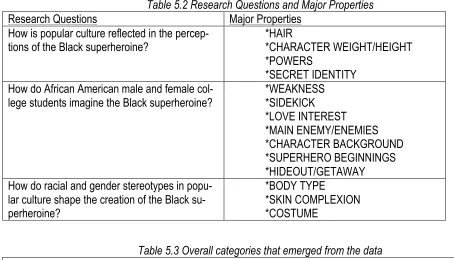
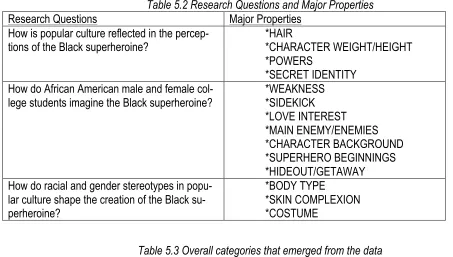
Table 5.2 Research Questions and Major Properties….………....47
Table 5.3 Overall Categories that Emerged from the Data…………………47
Table 5.4 Different Hairstyles and Lengths……….………..48
Table 5.5 Superheroine Weight from Male Participants………………..50
Table 5.6 Superheroine Weight from Female Participants……………….50
Table 5.7 Types of Powers separated by Gender………52
Table 5.8 Types of Weakness……….56
Table 5.9 Superheroine Love Interest………62
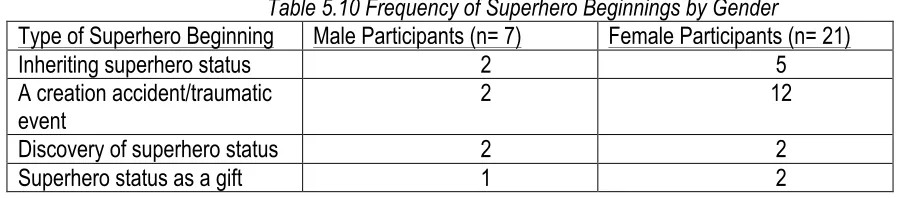
Table 5.10 Frequency of Superhero Beginnings by Gender………..72
CHAPTER 1: INTRODUCTION
Comic books have often been dismissed as less relevant pop culture texts. However, academic
scholars are now re-considering comic books and graphic novels as complex texts deserving of serious
scholarly study. Even though specific research on comic book characters has begun to emerge there still
remains a need to fill the gap, which includes further examination of the Black superheroine character.
These complex characters and their stories offer an opportunity to move beyond the surface narrative of
the comic book pages. One might say the most fascinating aspect about the comic book world is that this
particular medium has a way of strategically telling a variety of narratives from a diverse group of
charac-ters. Furthermore, there is a need for this type of research to take place in order to specifically examine the
Black superheroine in comic books. This is the case especially now that recently Black superheroines are
slowly becoming specific topics of interest and study.
Background
Superheroes have played a significant role in “presenting idealized projections of ourselves as
physically powerful, amazing and fantastic versions of ourselves; as well as serving as a roadway to
escap-ist fantasy or funhouse mirror reflections of our desires to create bigger-than-life personas that can exert
our will and power in the world” (Nama, 2009, pg. 134). Overall, the superhero plays a huge role, both
posi-tively and adversely, in the formation of our thoughts, beliefs, and ideas within popular culture.
As a life long fan of comic books and superheroes, I have always been eager to see what female
(particularly Black) character might grace the cover or be featured in the latest issues of Marvel or DC
en-terprise. Unfortunately, this does not happen frequently. In spite of this disappointment, it should be noted
that there are quite a few Black superheroines who serve as Black female representations. They include
such characters as Monica Rambeau (“Captain Marvel II”), Misty Knight, Martha Washington, Raquel Ervin
(“Rocket”), and the more popular Storm from the X-Men series. At the very least, focusing on Black women
Black superheroines in popular culture may seem like they ‘kick an awful lot of butt’ a closer look reveals
that their roles have not departed from the typical stereotypes; essentially these characters are at risk of
descending into madness, drug abuse, and other social ills as they are fated to navigate the confines of
poverty and war with infinite resolve (Saini, 2009). The question is then asked, “What are comic book artists
communicating about Black women to younger male and female readers who participate in the cultural
uni-verse of superheroes?” So, this research has the potential to expose adherence to or departure from typical
racial and gender stereotypes and potentially influence young Black females and males to step outside the
“White” mainstream and create alternate viewpoints.
Since the genre’s inception, women have always played a role as superheroes in graphic novels
and comic books, and simultaneously they have also been constant subjects of controversy. Within the
var-ious storylines of these popular comic books and graphic novels, the role of women have primarily been
described as supporting characters with limited leadership roles. “They are almost always subordinate to
their male counterparts. When in battles, they faint, overexert themselves, and worry about smudging their
makeup” (Sievers, 2003, pg. 10). Despite this, there have been some small improvements made in their
physical appearance and character portrayal. Because of some of these superheroine characters being
physically strong and capable of defeating bad guys, they send the message that women in general are
neither weak nor passive. Lavin (1998) and Rimmels (1995) both agree that comics today are showing
improvements by including more strong, competent, independent heroines. Consequently, even though
these small steps are being made toward more varied representations of the Black female heroine within
popular culture, these Black female characters are still depicted through racial and gender stereotypes.
Although gender is the most prominent characteristic in analyzing heroines; an additional analysis of race is
needed to fully examine the Black superheroine.
So often in today’s society Black women have been tagged as ‘superwomen’. For example, in
Wal-lace challenges the sexism that Black women face in the Black community and society. It would be one of
the first books to critique the interactions between systems of race and patriarchy that were in place.
Wal-lace explains that there is this “intricate web of mythology” that encloses the Black woman. And what
emerges is what she describes as:
“…a woman of inordinate strength, with an ability for tolerating an unusual amount of misery and heavy, distasteful work…the quintessential mother with infinite sexual, life-giving, and nurturing re-serves…essentially she is a superwoman” (Wallace, 1979, pg. 107).
Because of this limiting image of a strong woman that Wallace describes, it is very difficult to
relin-quish this myth of the ‘superwoman’ and just simply be a Black woman. In conjunction with the
superwom-an status, the strong superwom-and sturdy “built Ford tough” archetype has been used as a universal metaphor of
Black womanhood (Muhammad, 2012). In a 2009 interview with The Root, the late popular feminist
writ-er/author Erica Kennedy once said being a Black woman (feminist) was “tapping into our unique female
attributes and living authentically instead of defining ourselves by male standards of success" (pg. 2). This
call for self-definition and authenticity, even in 2012, remains an urgent issue in today’s popular culture
de-pictions. In addition, this same thought can be applied towards the Black superheroine as this character
should not be defined by the norms of White male and female superheroes, nor raced and sexed
stereo-types. Instead the Black superheroine character should be given an original and or authentic identity.
Cooper (1995) further explains this notion of the Black woman’s place in society,
“In a period of itself transitional and unsettled, her status seems one of the least ascertainable and definitive of all forces which make for our civilization. She is confronted by both woman question and a race problem, and as yet an unknown or unacknowledged factor in both” (pg. 45).
Essentially Black women already have an organically grown, traditional model of female power that
they use to move through the world, however the expectations that are placed upon them are often times
exhausting (Parks, 2010). Even today, according to Guy-Sheftall (1995) Black women must deal with the
simultaneous struggle for not just black liberation, but gender equality as well. “The Black woman needs an
pg. 176). In today’s society there is an unfortunate imbalance for Black women to live an original life in the
midst of being defined by any and everyone in society, frequently in unpleasant ways (i.e., stereotypes of
black women being labeled as fat, unattractive, angry, mean-spirited, broke, uneducated, materialistic, sick,
unmarriageable or emasculating).
Such extremes as the superwoman, Jezebel, Sapphire, Mammy, and others are representations of
how common stereotypes are turned into archetypes and become the ideas that we learn about regarding
contemporary American social structure (Dunne, 2007). As it relates to comic books and graphic novels,
they typically consist of a unique blend of complex narratives and visual art, which make them very popular
and appealing. However this form of art embeds and reinforces numerous stereotypes about women —
stereotypes about the “ideal” feminine body image: long hair, large breasts, thin waist, toned buttocks, and
long legs. Unfortunately, these stereotypes are misleading because they are setting a culturally limited
standard for beauty in women; and now that superhero characters are being portrayed in Hollywood films, a
cult following of readers (both youth and adults) is beginning to emerge and becoming attracted to these
comic books. Ultimately over eighty years after the first female appearance in a comic book1, it is
impera-tive to present more useful, grounded, and humane representations rather than racial and gendered
stereo-types. This is especially particular for Black women who are subject to race and gender stereotypes in pop
culture representations across genres and in real life.
Problem Statement
For the purpose of this study, popular culture was defined as the collection of arts, entertainment,
beliefs and values that are shared by large sections of society. According to Black feminist scholar Patricia
Hill Collins (2005), “everyday behavior becomes the cultural stuff that is mined by Black popular culture and
a mass media with an insatiable appetite for new material” (pg. 17). Thus I am led to ask the following
1 Fantomah not only was she the first female comic character to appear in comic books she would also be
question, “What would I know about Black women if everything I learned came from popular culture
repre-sentations and depictions?” As Singer (2002) indicates, “the stereotypes through which American popular
culture often interprets and represents racial identity operate not only as tools of defamation but also as
vehicles for far more subtle manipulations of race” (pg. 107). So it is important to understand the impact
that popular culture has on how we define ourselves as well as others. More specifically, there has been
much discussion on high rates of body image disturbance among Western (including African American)
girls and women (ex. Cash & Henry, 1995; Rodlin, Silberstein & Striegel-Moore, 1984) and it is not
uncom-mon for researchers and activist to place at least part of the blame for this discontent on the media and its
heavily idealized images of female beauty (ex. Anderson & DiDomenico, 1992; Becker & Hamburg, 1996;
Thompson & Heinberg, 1999; Tiggemann & Pickeing, 1996; Wegner, Hartmann, & Geist, 2000).
In accordance with the theme of Black women (gender) in popular culture it should be
acknowl-edged that feminism and feminist media studies tend to privilege gender, White women in particular, over
other social categories of experience, such as race and class (hooks, 1990;Dines, 1995; Dines & Humez,
2003). Nevertheless, Black feminist scholars have acknowledged the neglect which women of color,
specif-ically Black women, have experienced through their selective inclusion in the writings of feminist cultural
analysis (hooks, 1990; Bobo & Seiter, 1991; Valdivia, 1995). It is from this perspective that we begin our
discussion of the Black superheroine representation in popular culture. Scholars have studied black female
representation in a variety of media contexts. Meyers (2004) used discourse analysis to examine the
repre-sentation of violence against African American women in local TV news coverage during “Freaknik,” a
spring break ritual held in Atlanta, Georgia, throughout the 1990s. This study would conclude that the news
“portrayed most of its victims as stereotypic Jezebels whose lewd behavior provoked assault” (p. 95).
Andi Zeisler (2008) co-founder and editorial/creative director of Bitch: Feminist Response of Pop
Culture magazine further states that popular culture cannot be shelved as just another way to entertain the
create unattainable ideals and standards that people cannot possibly hope to achieve. An intervention is
necessary in order to create alternative narratives and storylines of the Black superheroine and to bring
together Black women’s reality—their lived experiences—within their portrayal in popular culture (George,
2004). Thus it is significant to examine the relationship between popular culture images and racial & gender
stereotypes. The barrier that once existed between high and low cultures “has been whittled away to the
thinnest of shards” and has become a context of not only social, but academic value and influence (Zeisler,
2008, pg. 5). As a result, popular culture provides a domain of analysis for the Black superheroine
(DeGraffenreid, 2011).
Purpose
The purpose of this study is to examine how race and gender stereotypes in popular culture shape
how the Black superheroine is imagined and understood through an interpretative textual analysis
ap-proach. The study explores stereotypes and gender roles within popular culture and how they influence
Black female and male college students’ perception of the Black superheroine. A qualitative research
ap-proach is used to identify participants’ physical characteristics of a Black superheroine and discuss their
interpretation of these identifiers. Also allowing the students’ to speak for themselves, they (students) will
be able to explain the origins and significance of their selected superhero characteristics in the context of
popular culture. As a result, I hope this study leads to a greater awareness of Black female stereotypes in
popular culture as well as advocate present and future scholars to further critique and analyze these
imag-es.
Significance of the Study
The significance of this study lies not only in the analysis and critique of popular culture, specifically
comic books, and the problematic racial and gender representations in these texts; but rather in its ability to
fill a gap in current research specifically about depictions and portrayals of Black superheroines. As a
the researcher identifies with the challenges of race and gender roles within today’s society. Unfortunately,
African American women have been forced to combat dual stereotypes of race and gender (Yarbrough &
Bennett, 2000). When these images repeatedly present over-simplified conceptions about social and
gen-der roles, occupational pursuits, or other aspects of life, their influence on human development becomes a
cause for concern.
Furthermore, this research explores how representations of racial and gender stereotypes in the
media are of great importance because of their impact on the socialization of young adults (Fitzpatrick &
McPherson, 2010). Few sources (Inness, 1999; Knight, 2010; Madrid, 2009; Ryan, 2006; Saini, 2009),
par-ticularly outside the academy, have specifically addressed the Black superheroine. In many regards, the
literature focuses on a select group of male superheroes. And although this serves as an important source
of information, it does not tackle the various questions concerning the Black superheroine within popular
culture. In addition, previous research on this topic has criticized Black superheroines for being
one-dimensional and perpetuating several stereotypes, including that of the mythical superwoman and the
hy-per-emotional, overly aggressive Black woman (Johnson, 2003).
Finally, despite the fact that there are more representations of African American females available
for consumption within mass media and popular culture, the substance of these images has changed little
over the past century (Gillespie, 1993; Staples, 1994; Weinberg and Williams, 1988: Wyatt, 1991). Existing
research (Inness, 1999; Knight 2010; Madrid, 2009) has not provided a diverse discussion that expounds
on the relationship of race and gender as it relates to the Black superheroine in popular culture. The
exoti-cizing of African American women as wild, sexually promiscuous, and amoral continues to be normalized
by descriptors that are widely circulated, accepted, and used to frame ideas about this population (hooks,
1992). Exploring these gender and racial roles and stereotypes, amongst college age students will allow for
them to either reframe and/or re-examine their perceptions and their influence, within popular culture. Thus,
Afri-can AmeriAfri-can Studies. Further research will add to the discipline of AfriAfri-can AmeriAfri-can Studies as it further
explores issues of racial and gender differences and stereotypes in relation to popular culture. This
re-search will also help to identify potential messages and approaches that can be used to educate the
dy-namics of Black female body images and also demonstrate the importance of examining Black-oriented
comic book narratives within popular culture that have been overlooked by the mainstream literature. In
addition it takes into consideration the concern and relationship of gender (particularly female) and racial
differences, which is seldom addressed in prior research.
Research Questions
1) How is popular culture reflected in the perceptions of the Black superheroine?
2) How do African American male and female college students imagine the Black superheroine?
3) How do racial and gender stereotypes in popular culture shape the creation of the Black
super-heroine?
Theoretical/Conceptual Framework
This research study used sociologist Patricia Hill Collins’ concept the “new racism”, as a
frame-work, which is introduced in her 2005 text Black Sexual Politics: African Americans, Gender, and the New
Racism. Collins (2005) reminds us of the relationship, for African Americans, between gender and race is
deepened, thus producing a Black gender ideology that forms ideas about Black femininity and Black
mas-culinity. With such hypersexual images as hip-hop artist’s Nicki Minaj’s exposed breasts, thin waist, and
large buttocks in the music videos “Beez in the Trap” and Nelly’s provocative and controversial “Tip Drill”
video, Black women stand at the “crossroads” of derogatory race and gender roles and images. These
im-ages are also occasionally used to show that there is nothing about Black women’s features that makes
them inherently different, more masculine, more sexual, or more abnormal than other women. However,
media and popular culture have placed these features under a microscope to be further scrutinized. This is
an ideal example of how the intersection of race and gender can outline certain thoughts of what it means
Collins asserts that there is a complex interconnection between racism and sexism. As a result of
this challenging connection finding solutions has been problematic without seeing both on equal terms.
Col-lins (2005) explains that we are in a post-civil rights era, and sexism is treated as a secondary issue to
re-solve once the more demanding problems of racism has been re-solved. As a result, issues of gender have
now emerged as a prominent feature of the new racism. Therefore it is crucial to recognize the social,
polit-ical, and global issues involved in depicting racial and gender roles within pop culture, particularly the Black
female (superheroine).
Collins defines the concept of the “new racism” as an issue that deals with gender-specific
con-tours of racism.More specifically, it can be defined as racism, which is based upon cultural rather than
bio-logical values with roots in signification, ideas, and mythologies. The new racism is a concept that focuses
on African Americans and the relationship between gender and race. Race and gender are two themes
frequently discussed within popular culture scholarship. The concept of the “new racism” is applicable to
pop culture and the Black superheroine and allows for further examination of the politics of gender-specific
experiences and its relationship with racial inequalities. As a whole, Collins (2005) views racism as a
“gen-der-specific phenomenon” in which both racism and sexism have an effect on the other and must be dealt
with as a joint effort and not separately. This affects individual’s cultural beliefs as well as individual’s sense
of themselves as men and women.
This concept of the new racism plays a role in how African Americans engage Black gender roles
and stereotypes within popular culture as well as social and political issues (both global and domestic)
with-in society. Swith-ince this research study sought to examwith-ine racial and gender stereotypes as well as explore
gender roles impact within popular culture, as it relates to the Black superheroine, this concept spoke to
how external images are internalized and acted upon. Using Collins concept of the new racism, I analyzed
how popular culture messages, which are communicated as their own reality, impact Black female and
describe the attributes of the Black superheroine, and explain the importance of these characteristics in the
context of Black women’s geo/political/social reality, and explore the significance of these attributes in the
contemporary context of the Black female lived experience. Thus asking the following question, “How do
Black men and women college students imagine the Black superheroine in popular culture?”
Research has shown that television, particularly entertainment programming, is the most important
source of information and socialization for African American adolescents and young adults (Comstock and
Scharrer, 1999; Hazel-Ford Tess and Sarvela, 1992). According to Collins (2005), Black popular culture
has seen a significant amount of growth within mass media, thus creating alarming gender and racial
ideo-logies. With such celebrities as Jennifer Lopez, Nikki Minaj, Karrine Steffans, Rhianna, and Kim Kardashian
appearing in film/television, magazines and music videos their sexualized physicality demonstrates how the
concept of the new racism can be seen as subordinate, objectified, limited, and hyper-sexualized standards
for women. In essence, the Black superheroine has also been subjected to these same standards, but just
in the format of comic books.
It should be noted that stereotypical images of African American women frequently include physical
depictions, which provide implied messages about what is considered attractive (Townsend, Thomas,
Neilands, & Jackson, 2010). The misrepresentations of Black women, in popular culture, is a long-standing
image that has been present since the slavery era and the creation of the Jezebel stereotype of the
hyper-sexualized, de-valued black woman. Unfortunately, the Black superheroine has become victim to these
gender and racial ideologies that exist within popular culture.
When examining stereotypical images of African Americans, particularly women, the role of
eco-nomics, politics, demography, class relations, and racist ideologies in the prevalent patterns of stratification;
and the role of black leadership and cultural strategies in reducing inequality should be considered. Collins
(2005) explains, “globalization, trans-nationalism, and the growth of hegemonic ideologies within mass
African-Diasporic societies” (pg. 54). Popular culture’s influence on the self-perception of young women
and men is apparent in all cultures; however, the degree to which it affects Black college females and male
will be the main focal point for this particular study. Therefore, by moving race and gender into the center of
analysis this will highlight African Americans interaction within their communities as well as reveal new
an-gles of vision on popular culture as well as how these systems interconnect (Collins, 2005).
Overall, Collins' work recommends a more progressive type of politics for Black Americans. This
includes an honest discourse about the way stereotypical imagery and controlling racist, gender, and sexist
ideology have harmed African Americans in the past. This can also lead to a discussion of how African
Americans might progress beyond these ideas and their manifestations to become active change agents in
their own communities. By using the new racism as a conceptual framework for this study of the Black
su-perheroine, I hope to cultivate a discussion specifically regarding the connection between popular culture
and gender and racial stereotypes. Making this connection in conjunction to bridging the inequality gaps
could potentially improve the quality of life, and ensure the empowerment of African American to move
for-ward tofor-wards a balance between racial and gender equality.
Chapter Summary
This exploratory study sought to answer the central research question of “How are Black
superher-oines depicted and represented in popular culture?” In order to begin answering the above-mentioned
question, race and gender are two key terms that must be examined [along with its potential influence from
popular culture] together as it relates to the Black superheroine. Although popular culture and comic book
characters are culturally diverse, this research is limited to a focus on the Black superheroine and its
con-nection with popular culture. In Chapter 2 it includes a review of existing literature as it relates to the
histori-cal background and significance of comic books and graphics novels; as well as an examination of the
Black women (gender) in popular culture, media and racial stereotyping, and the objectifications and
mis-representation that can be found within popular culture.
Definition of terms
African American- as used in this research, African American refers to people who live in the
United States and who share a biological and cultural heritage that stems from the continent of Africa. It is
used interchangeably with the term “Black” or “Black Americans” when the situation dictates. It should be
noted that in some cases the term “Black” extends beyond the United States and includes people who were
born and/or who live in the Caribbean and England.
Black superheroine-as used in this research, Black superheroine refers to an ideal, fictional
woman character who is of African descent and who has distinguished courage and/or ability, respected for
her brave deeds and self-sacrificing and virtuous qualities
Comic books- A comic book (often shortened to simply comics) is a type of magazine, which
con-sists of artwork and a creative, oftentimes complex narrative
Graphic novels- The graphic novel represents a more thematically mature body of work than what
might be expected from a comic book. It takes the form of a longer format of several stories related to a
specific themes bound together.
Heroine-a woman who overcomes adversity with little regard for herself; an unique icon whose
dis-tinguishing marks help empower the ordinary masses; an individual who performs a noble deed without
false intentions, but with true purpose.
New racism- racism, which is based upon cultural rather than biological values with roots in
signi-fication, ideas, and mythologies; as used in this research, the concept new racism refers to Patricia Hill
Col-lins text, Black Sexual Politics (2005), "racism and sexism are deeply intertwined, and racism can never be
Popular culture- the collection of arts, entertainment, beliefs and values that are shared by large
sections of society
Race and gender stereotypes-oversimplifications of people and/or groups based on race and
gender that are widely circulated in certain societies.
Superhero- as used in this research, superhero will be defined, according to writer and director of
the Institute for Comic Studies Peter Coogan (2009, pg. 30), as “a heroic character with a selfless,
pro-social mission; with superpowers—extraordinary abilities, advanced technology, or highly developed
CHAPTER 2: LITERATURE REVIEW
In order to complete the current study, a review of the existing literature was necessary. This
chap-ter provides an overview of popular culture and its role as it relates to the superhero and in this case the
Black superheroine. This review includes a discussion as a whole regarding Black women (gender) in
popular culture. Also a brief review of media and racial stereotyping and objectifications and
misrepresenta-tions of Black women and the Black superheroine is also included in the review of literature.
What is ‘Popular Culture’ and Why is it Important?
According to Cultural Studies professor John Storey (2009) popular culture can be summarized in
the six definitions below:
1) A culture widely favored or well liked by many people.
2) The culture that is "left over" when we have decided what high culture is.
3) Equates pop culture with "mass culture" and ideas.
4) As an "authentic" culture of the people (the culture which originates from the people)
5) As a site of struggle between the 'resistance' of subordinate groups in society and the
forces of 'incorporation' operating in the interests of dominant groups in society."
6) The main point to insist on here is the claim that postmodern culture is a culture, which
no longer recognizes the distinction between high and popular culture (pgs. 4-9).
Brummett (1991) also defines popular culture as “involving the aspects of social life most actively
involved in by the public. As the ‘culture of the people’, popular culture is determined by the interactions
between people in their everyday activities: styles of dress, the use of slang, greeting rituals and the foods
that people eat are all examples of popular culture” (pgs. xxi and 41). Similarly Delaney (2007) describes
the term as “the vernacular or people’s culture that predominates in a society at a point in time” (pg. 5). In a
sense, popular culture can be defined and influenced by the people within that culture. Additionally, Browne
that define the people of any society” (pg. 25). Simply put, defining popular culture in one way is difficult.
For the purpose of this study, popular culture is defined as the collection of arts, entertainment, beliefs and
values that are shared by large sections of society. Due to the fact that there is not a singular definition of
popular, it was important for the researcher to define the term to reflect preceding definitions as well as the
complexity of the particular study.
Upon conducting preliminary research, I realized that depending on the particular individual’s
agenda would also determine how popular culture is defined. However theorists have often questioned the
value of popular culture, which is produced for the masses and the fact that it is ultimately created for
commercial gain. For example, Arendt (1961) suggests that popular culture is a "market-driven media that
would lead to the displacement of culture by the dictates of entertainment"(pg. 201). In addition, MacDonald
(1965) argues that "popular culture is a debased, trivial culture that voids both the deep realities (sex,
death, failure, tragedy) and also the simple spontaneous pleasures...the masses, debauched by several
generations of this sort of thing, in turn come to demand trivial and comfortable cultural products" (pg. 93).
Essentially, these theorists view popular culture as inconsequential and lacking significance.
Despite theorists viewing popular culture as irrelevant and of “low culture” there are those who find
it quite compelling and acceptable. In the midst of postmodern blurring of boundaries between high and low
culture, a greater number of scholars (Modleski, 2008, Ross, 1989, Mukerji & Schudson, 1991) have
rec-ognized the importance of studying popular culture in order to better understand our society (Inness, 1999).
There are even those who have also studied and offered their critique of the relationship between
Black-ness with Black Popular Culture. By definition, Stuart Hall explains that Black popular culture is a site for
strategic controversy within a contradictory space (Hall, 1996). Further in his analysis, Hall (1996) also
agrees that Black popular culture cannot be simplified or explained in binary terms. These binaries include
opposition versus homogenization” (pg. 473). Regardless of race and or class, popular culture is definitively
a multifaceted and complex term.
In addition, there are those who strongly feel that popular culture does have some type of value
and merit within academia. The late Ray Browne, founder of Popular Culture Studies, would explore the
idea that “every day culture (popular culture)” could play a positive role in bringing various academic
disci-plines together to form a popular culture movement (Browne, 2004). As a result of this determination,
Browne would develop the Journal of Popular Culture (1967) and the Popular Culture Association (1971).
With the creation of an academic journal and a recognized national organization dedicated and influenced
by popular culture, this has the potential to bridge the gap between the supposed “high and low” cultures.
Since the existence of popular culture it has over time covered a wide assortment of genres which
include, but not limited to, popular music, print, cyber culture, sports, entertainment, leisure, fads,
advertis-ing and television (Delaney, 2007). Accordadvertis-ingly, popular culture clearly conveys such great influence
im-pacting everything from fashion to food to media and even academia. As a source of entertainment and
information, popular culture has recently been intimately connected with education, mass communication,
production and society’s ability to access knowledge (Block, Johnson-Woods, & Campbell, 2012). Such
information emphasizes how crucial the idea of pop culture, whether entertainment or not, is to
understand-ing how people live in the world (Zeisler, 2008). African American youth, in particular, consume all types of
popular culture from television (MTV, BET, HBO), to magazines (VIBE, King, Ebony/Jet), to fashion
(Rocawear, True Religion, Polo, Nike) to film. Nevertheless, the consumers of popular culture that are
be-ing targeted for this particular study, which are young adult African Americans, “can no longer depend on a
deeply textured web of families, churches, fraternal organizations, school clubs, sports teams, and other
community organizations to help them negotiate the challenges of social inequality” (Collins, 2005, pg.
represented and reproduced into becoming social ideologies (Emerson, 2002). As a result, it is very
im-portant to recognize and understand popular culture’s role in the lives of today’s young adults.
Many of the aforementioned values, beliefs, and brands that African Americans endorse seem to
simultaneously encompass everything that they love most about popular culture and everything they fear.
As such it is important that we examine and understand why there is this struggle and how it influences
individual’s perceptions and interpretations. It is important to understand the significant power that visual
images possess in our culture; these images can and do conjure a range of emotions, feelings, and
associ-ations (George, 2004). As seen above, mass media sources such as music, film, television, radio, video
games, and the Internet have become primary sources of popular culture (Delaney, 2007). Allen (2001)
suggested that, for African American, mainstream media as well as the Black-oriented media serve as one
of the most influential sources of information through which African American concepts and identity are
de-veloped and negotiated. Thus, popular culture can be seen as a useful tool to influence the public and
po-tentially shape their collective opinions on a particular subject. Accordingly for the purpose of this study, I
am specifically interested in looking at popular culture and how it influences African American male and
female college student’s viewpoints and interpretations of race and gender, as it relates to the Black
super-heroine.
Zeisler (2008) further defines popular culture as an inescapable idea that is constantly growing. On
a daily basis, we take part as consumers of popular culture. Interestingly, what audiences are primarily
most concerned as it relates life experiences is based on the images, symbols, and narratives that are seen
or heard on radio, television, film, music, and other media (Brooks & Hebert, 2006). It is a key feature of the
leisure interest of many college students, interests that are somewhat manipulated by the media and the
local and social environment (Marsh, 2000). Whether it is in the television shows that we watch, the music
Significance of the Comic Book
Before discussing the actual character of the superhero it is important to discuss the comic books
in which these characters play a role. Interestingly, comic books are popular texts that facilitate a reflexive
discussion regarding different aspects of the culture in which we live in. Despite having a cultural
signifi-cance, comic books are largely underestimated and misunderstood. Much like popular culture, comic books
have fell victim to the critics, who view these books as trivial and insignificant. However, it is important to
realize that even though they have a cultural significance, there is still a gap in the literature across
aca-demic disciplines that specifically focus on a more thorough discussion of the comic book.
The introduction of the comic book format would take place in 1933 with a typical reader age of
18-35 and made of predominately white male consumership. According to comic book scholar Scott McCloud
(1994), comic books serve a purpose as “juxtaposed pictorial and other images in deliberate sequence
in-tended to convey information and/or to produce an aesthetic response in the viewer” (pg. 9). According to
feminist Sherrie Innes (1999), “comic books have been and continue to be one of the most marginalized of
art forms” (pg. 139). Historically comic books and graphic novels have generally been dismissed as less
relevant and inferior pop culture texts. However there are some critics such as Frank McConnell (1992)
who argue that within recent years much of the “best and most human fiction” in American and the world
has appeared not in a ‘novel’, but in the form of a comic book.
Many academic institutions across the world, such as University of Florida, University of Toronto at
Mississauga, and the University of California Santa Cruz, among others have incorporated comic books
(and in some places including graphic novel as well)2 studies within their curriculums and departments.
Alongside formal academic programs and degrees, it is very common to see individual courses, workshops,
and seminars dedicated to comics and graphic novels in many educational institutions (University of
2Comic books and graphic novels are mentioned together, because in some cases they are used
da, 2010). Interestingly, much of the existing criticism of comic books can be found in the newspapers. The
Guardian, in the United Kingdom, regularly covers comic books in its Saturday Review section; and in the
United States, the New York Times run semi-regularly reviews of comic books and graphic novels (Meskin,
2009). For example, in 2002 The Times writer Nick Hornsby would publish a review of a number of comic
books graphic novels.
In opposition to the view of some writers, research has shown that reading comic books does not
replace other kinds of reading (Wertham, 1954). In general, comic book readers, read as much as the
non-comic book reader (Witty, 1941; Heisler, 1947; Bailyn, 1959; Swain, 1948). Additionally Krashen (1993)
suggests that reading comic books as well as other kinds of ‘light reading’ may serve as an important
bridge from everyday conversational language to what Cummins (1991) terms "academic language." Many
comic book texts actually contain more rare words than one might find in an ordinary conversation (Hayes
and Ahrens, 1988), as well as case histories of readers who credit comic books with providing them with
the linguistic basis for reading more difficult texts (e.g. Mathabane, 1986). Overall, despite these books
be-ing viewed as less significant in comparison to the newspaper or traditional novel, comic books and graphic
novels are consistently being discussed both in and outside of the classroom. To reject examining comic
books is to dismiss the intricate narratives that are enclosed within these texts, as well as the controversy
(e.g. the Black superheroine) that exists in today’s society in which they are based upon.
Examining ‘The Superhero’
In addition to examining the comic book as a whole, it is important to examine the actual characters
within these books, the superhero. Whenever the society is under a tremendous depression and there is no
chance of getting out of it, these characters [superheroes] provide an outlook of hope and strength to fight
against the odds through their various stories. For young Americans, the world of comic book superheroes
has been able to provide a sense of justice within popular culture (Vollum & Adkinson, 2003). Moreover,
from their world of reality. Even today, the superhero remains a staple within American fiction. Oftentimes,
these characters regularly attract both acclaim and controversy in the ways they influence and address the
current social and political issues addressed within their storylines. In and out of popular culture,
superhe-roes have been occasionally attacked as proponents of violent behavior and dissident political and social
ideologies; on other occasions, they serve to support and idealize the dominant values of the national
cul-ture. According to Sterling North in a controversial editorial excerpt, these superheroes in comics are:
"Badly drawn, badly written, and badly printed - a strain on the young eyes and young nervous sys-tems - the effects of these pulp-paper nightmares is that of a violent stimulant. Their crude blacks and reds spoils a child's natural sense of colour; their hypodermic injection of sex and murder make the child impatient with better, though quieter, stories. Unless we want a coming generation even more ferocious than the present one, parents and teachers throughout America must band together to break the `comic' magazine" (as cited in Coville, 2004, pg. 1)
Much like the critics of popular culture, comic books have been subjected to similar criticism despite them
presenting messages of social and political significance.
The cultural phenomenon of the superhero has become a mainstay in the realm of American
fanta-sy and mythology since the arrival of mass media and technology in the early twentieth century (Lawrence
& Jewett, 2002). As popular culture draws more attention in society, so does the idea of the superhero and
what it has to offer. Martin (2007) further points out that the popularity of superheroes is increasing, so has
the various media forms through which the lives and adventures of superheroes are disseminated.
Super-heroes, for the most part, are considered good or bad not because of their use of violence, but with regard
to the contexts and motivations that influence their actions (Martin, 2007). Typically, every major superhero
has an origin, myth and super powers, and to varying extents within the context of Lawrence and Jewett’s
(2002) prototype, struggles morally, emotionally and socially in the course of doing good.
According to Chambliss & Svitavsky (2008),“superheroes resemble their pulp forebears in having
secret identities, distinctive garb, and special abilities” (pg. 18). Traditionally, superhero comics have
and while readers are well aware of this most fundamental convention, they are also aware that several
new an incredibly popular comics are erasing the ordinary man (woman) underneath in favor of an even
more excessively powerful and one-dimensional masculine (feminine) ideal (Brown, 1999, pg. 27). And as
a result, these superheroes in popular culture have been given a makeover, but not willingly. Even more so
is the challenge of how comic book and graphic novel artists and creators construct a superhero of color
that fits into this ideal. “The superhero archetype is heavily steeped in affirming a division between right and
wrong, thus superheroes operate within a moral framework, however, Black superheroes in American
com-ic books and, to the lesser extent, in Hollywood films and television are cultural ciphers for accepted
wis-dom regarding racial justice and the shifting politics of Black racial formation in America” (Nama, 2011, pg.
4). Now the role of the superhero as it relates to Black America is more than just fighting various battles
and injustices within their narrative, but also trying to fit into a traditional (i.e. “white”) superhero prototype.
Female & Black Superheroes: The Good, the Bad, and the Ugly…
Historically, female superheroes within comic books and popular culture have typically been
por-trayed as trivial or vacillating characters. Essentially their superpowers were weaker and they had less
con-trol over them, therefore having to be dependent on the assistance of a male hero to guide them in using
their abilities (Sievers, 2003). Women were also portrayed as the girl-Friday, seductive temptress, or
per-haps, the accommodating girlfriend (Lavin, 1998). These stereotypical gender roles were clear
obvi-ous: men alone are competent enough to be successful independently along with being courageous, while
women were seen as subordinate figures in the background. Much of the current scholarship paints a
pic-ture that male heroes are usually presented as being unquestionably more powerful than women. Yet they
wear costumes that cover and protect most of their bodies. Women on the other hand, are written as
weak-er, and presumably less able to protect themselves (Madrid, 2009).
Also Sievers (2003) brings to our attention how “we learn from reading Superman that men are
that women can be superficial and greedy. And we learn from reading comics like Catwoman and Wonder
Woman, that women look really sexy in spandex” (pg. 6). For example, in the 1910s and 1920s many of the
comic book characters such as “Minerva Gump and Ma Feitelbaum” were portrayed as frumpy and
domi-neering housewives; and others as vamps [ex. Tillie the Toiler and Flapper Fanny] (Inness, 1999).
Unfortu-nately, many of these portrayals still exist in today’s female comic book characters. Madrid (2009) further
points out how women take issue with the inequality in today’s society that says a man can wear a sensible
suit and shoes to look appropriate within the professional world, while women are expected to wear a
form-fitting skirt and heels.
Beyond representations of female body and costume, there are many complex gender issues to be
explored in superhero comics’ characterizations and storylines (Weida, 2011). Particularly in Inness’ book,
Tough Girls in Comic Books (1999), she addresses different representations of these female characters
and how different people might perceive them in different ways. In addition, she repeatedly addresses
is-sues of race, ethnicity, class, and sexual orientation and provides the opportunity to explore these topics
due to the fact that the typical superhero in popular culture is white, male, heterosexual, and middle class
which reflects a culture where these are the norms. Inness, unlike prior research, provides a conventional
analysis of the typical “boy-rescues-girl” adventure story, leaving us with a detailed explanation that
sug-gests women can be more capable of leading than men are.
Nama (2011) declares that in spite of a symbolic significance of black superheroes in American
popular culture, it still remains a topic that is unexamined. In Richard Reynolds’ (1992) Super Heroes: A
Modern Mythology although it discusses, in very little detail, Black superheroes he makes it known that
Black superheroes have very little to offer in the way of ideological meaning. Departing from Reynolds,
Bradford W. Wright’s (2003) “Comic Book Nation: The Transformation of Youth Culture in America” offers a
discussion on the importance of superhero comic books to American culture, and suitably addresses on
scrutiny” (Inness, 1999, p. 6-7). Even though both Reynolds and Wright address Black superheroes there is
still very little discussion of the Black superheroine. As a whole, the Black superheroine still remains a topic
that seeks further scholarly research and analysis.
Black Women (Gender) in Popular Culture
Within the African American community, from both adults and youth, popular culture can have an
influence on how we think, feel, and act. However, alternately Blacks have consistently yearned to see
more accurate depictions of themselves in popular culture considering the distorted stereotypical images
that have circulated since antebellum period (George, 2004). Essentially popular culture can be viewed “as
a process through which people circulate and struggle over the meanings of our social experiences, social
relations, and therefore, our selves” (Byers & Dell, 1992, pg. 191). Thus popular culture has become a
con-stant, debated topic of discussion that will forever leave a lasting imprint.
In previous work, researchers have exposed how the erroneous characterization of Black beauty
and culture has created and reinforced this destructive definition of Black beauty that is based on a
patriarchal and American/European ideal. Ardener (1975) further suggests that women and men in
patriarchal, capitalist societies tend to form two distinct circles of experience and interpretation, one
overlapping the other (cited in Krolokke & Sorensen, 2006). The masculine circle converges with the norms
of society, providing a masculine signature and overriding the feminine circle. Women can either try to
translate their points of view into a masculine mode or try to separate alternate models of communication.
Therefore, women‘s perspectives are often not openly articulated. As a result, their expression is muted
(e.g. Orbe, 1998; Collins, 2000).
It should be noted that a preponderance of representations of Black women in popular culture are
firmly grounded in the dominant sexist and patriarchal ideologies surrounding Black womanhood in
American society. Collins (1991) emphasizes that the continued marginalization of Black women is due to
replete with images of White and even Black male comic book superheroes (Brown, 1999, Singer, 2002,
Taylor, 2007, Nama, 2009) there is very little literature that discusses the analysis of race and gender,
specifically as it relates to the Black superheroine in comic books. Women as characters in comic books
have played many different roles and have been drawn in many different ways. In general, the literature on
the representation of women in media/popular culture/comics asserts that besides being underrepresented,
women are also objectified and sex-stereotyped (Greenberg & Collette, 1997, Seidman, 1992, Signorielli,
McLeod, & Healy, 1994, Vincent, Davis & Boruszkowski, 1987). With popular culture constantly evolving, it
is particularly crucial to study the representation of the Black superheroine and the massive influence it has
upon American society (Inness, 1999). Although superheroes, both female and male, are becoming more
diverse racially and ethnically, the relationship between race and gender becomes another piece of the
puzzle that needs to be further investigated.
As for the Black woman, even before the popularity of Marvel Comic X-Men’s Storm there was
another African woman whose image would be exploited in the public eye. It would in fact be personified in
the figure of a single South African woman by the name of Sara Bartmann aka the ‘Hottentot Venus’.
Giddings (1995) notes “the status of black women had been dramatically etched into the annals of science
earlier in the century” (pg. 416). Black women and characters ranging from the ‘Hottentot Venus’ to
Josephine Baker to the contemporary video vixen to even X-Men’s Storm, have demonstrated the range of
how the Black female body has become a focal point of entertainment within popular culture today. More
specifically, “Bartmann’s exhibition helped to lay the foundation of Black female commodification as its
success depended upon colonial and imperial sexual gaze of White audiences” (Story, 2007, pg. 239).
Historically, the Bartmann character provides a real-life image of what is drawn in the comic books.
In examining the Black woman, noted Black feminist scholar Patricia Hill Collins (1996) seeks to
define and specify in scholarly terms a way in which black women can define their own unique experiences.
female experience. Is it womanism (as defined by Alice Walker and/or Dr. Layli Maparyan), Black feminism,
or simply part of the greater feminist experience? As Collins (1996) notes, African-American women
generally do not see a great distinction between the two terms as both terms are affected by the
intersection of racism and sexism. Collins further argues that the debate should shift from issues of naming
to how overlapping themes can be used for the greater good of drawing attention to issues concerning
black women. Therefore, just as the Black woman experience is faced with how it is to be defined, the
Black superheroine character also struggles to be uniquely defined. It is also important to note that the
standard of femininity is reinforced through a Western culture lens that is focused on a supposed ideal
image of white femininity (Brown, 1999). To such a degree, the Black superheroine is an original character
that need not be defined in terms of a White/Eurocentric model. Furthermore, I believe by examining the
Black superheroine within popular culture, I can raise issues that are uniquely important to the numerous
discussions of race and gender.
After 1965, Black women would face an ongoing battle with sexism within Black Civil Rights
organ-izations. With the publication of the Moynihan Report, and the growing Black Nationalist movement, “Black
women underwent an onslaught of sexism at the hands of many prominent Black male figureheads” (Story,
2008, pg. 46). In Toni Cade Bambara’s “The Black Woman: An Anthology”, she ardently confronts the
agency of the Black women and “art, protest, dialogue no longer spring from the impulse to entertain, or to
indulge or enlighten the conscience of the enemy; white people, whiteness, or racism; men maleness, or
chauvinism: America or imperialism… depending on your viewpoint and your terror” (1970, pg. 7).
Further-more, Collins, as pointed out by Story (2008), articulates that the Black woman’s standpoint, as well as the
Black Feminist literary tradition in the United States is a valid and necessary form of scholarship that is
wor-thy of critique and research (pg. 52). This idea becomes critical as we examine the interpretations and roles
In Orbe and Strother’s (1996) semiotic analysis of the biracial title character in Queen, Alex Haley’s
miniseries, they demonstrated how Queen fell in line with “traditional stereotyping of other bi-ethnic
charac-ters as beautiful, yet threatening, inherently problematic, and destined for insanity” (p. 117). Larson’s (1994)
study of Black women on the soap opera All My Children found the show frequently embraced the
matri-arch stereotype. As a matter of fact, the image of the Black woman as oversexed fantasy object,
dominat-ing matriarch, and nonthreatendominat-ing, desexualized mammy figure remains the most persistent in the media
(Edwards, 1993). Just as the news and various television shows play a role in the representation of the
Black woman within the media, a same analysis can be conducted with Black superheroines within comic
books. Hence there is still a need to include a discussion of the Black superheroine within popular culture.
Women of color superheroes, in particular like X-Men’s Storm, Michonne, Vixen, Misty Knight, Captain
Marvel II along with others are even more rare (Knight, 2010). Overall, although this research study does
not deal particularly with feminism in a theoretical sense, regrettably women superheroes still remain
ex-tremely under-represented and under-analyzed in a scholarly sense as well as other forms of popular
cul-ture.
Despite the variety of sources studied in this work, there is no single book that is able to do full
jus-tice to a topic such as the representation of women in popular culture, particularly Black, which permeates
American society and societies across the globe. While most college students are familiar with the token
female superheroes (primarily Wonder Woman, Storm, and Catwoman) these characters often exist in
roles far removed from male counterparts (Weida, 2011). With “tough girls”3 in popular culture, especially
comic books, gradually increasing in the media this offers a great deal about the changing roles available to
women in our society. Now that nontraditional roles are on the rise, women are becoming more tolerant to
3 According to Inness defining ‘tough’ must be a malleable, flexible, and broad term. She would use two