Mohd Salleh, Berhannudin and Esa, Ahmad and Selamat, Asri (2010). Journal of Education, 15 (2010), 46-55, ISBN99917-2=603-9
SPEAKING WITH THEIR FINGERS – ONLINE
Berhannudin Mohd Salleh, Ahmad Esa and Asri Selamat
Abstract
This study looks into the usage of an online forum towards promoting use of the English language among engineering undergraduates at Universiti Tun Hussein Onn Malaysia. Eleven undergraduates from different engineering disciplines participated in an online forum discussing on various topics of common interest over a period of twenty two weeks. An asynchronous online platform was used as the instrument of research and data was collected using document analysis, observation and interviews. Findings reveal that the various participants despite their differences in academic, proficiency and ethnic backgrounds were encouraged by the freedom of use both for academic and socializing purposes. They freely and openly indulged in online communication activities using the English language more frequently and extensively. Participants also used various linguistic features when communicating online. The platform, thus, proves beneficial and may serve as a very useful tool towards assisting students to improve proficiency of the English daily.
1.1BACKGROUND OF STUDY
Internet is now the "in-thing" in education not only at tertiary but secondary and primary institutions all over the world. With more learning institutions getting fully hooked to the Net and many more multimedia computer facilities provided for the educational benefits of the students, the notions of "cyber learning", "virtual classrooms", "e-learning" (Rosenberg, 2001; Jones, 1995) emerged paving ways for more technologically effective means of teaching and learning the English language. Countries like Canada, the United States, and Sweden have already computerized their schools towards producing more computer literate citizens.
With the increased availability of networked computers in every walk of life from classroom to public library, from home to the workplace or Internet café, the opportunities provided for learning online are expanding exponentially. For language learners, the possibility of accessing authentic Second language (L2) materials and "meeting" native and non-native speakers of that language in a virtual environment has never been greater, easier or faster. And yet, for many language learners with access to the appropriate technology, these opportunities are not being optimally exploited. The potential of the Internet to allow learners to communicate not with their machines but with other, real people, both native and non-native speakers of the English language, is too often ignored. Instead, they sit at their computers and use "traditional" Computer Aided Language Learning (CALL) packages to interact with machines rather than with flesh-and-blood; if they access the Web at all. The role of the computer then was only that of an electronic "teacher" rather than as a tool to increase participation in knowledge of different real (and virtual) communities.
As regards the English language, in Malaysia, the position of English is that of a second language and is used extensively. It is a means of communication widely used in all aspects of the Malaysian life including work, education, research, business and many others. In fact, English is the language that any Malaysian cannot do without. Regarded as an important language, it helps in local and international trade and commerce, contributing towards making Malaysia a fully developed nation. It also provides an additional means of access to academic, professional and recreational achievements. Faced with the more challenging era of globalization, IT and knowledge-based environments the English language is definitely a prerequisite for national development and achievements in most respect. The English Language programs in the Malaysian educational curriculums offered at school and tertiary levels thus aim to provide the basis for meeting these needs.
At school level, the English language is only taught for a minimum of eleven years right from the very early stage of primary education (210 minutes per week) until the end of secondary education (200 minutes per week). Very recently, the subject is also introduced at higher secondary level of education with the aim of preparing students with a basic level of English they need prior to entrance into anyone of the local institutions of higher learning. The latest development in the emphasis for mastery of the target language is the use of English as the medium of instruction for Science, Mathematics, Physical Education and Living Skills subjects at all primary schools (Utusan Malaysia, 2000b)
1.2 RELATED PROBLEMS
disappointing where an alarming number of our graduates are still very weak in their command of the English language both in writing and in the spoken form. In many ways, this has contributed greatly towards their poor performance in academic work right up to tertiary level as claimed by many academicians. One of the main reasons for this sad state of affair dated back from the day Bahasa Kebangsaan, the National Language, was officially used as the medium of instruction in almost every aspect of formal matters including education beginning 1982. There was a lot of discontentment among members of the cabinet and the Ministry of Education over the low level of achievement in the command of the English language among school and university students. Furthermore, a sizeable number of students particularly those in the rural areas, could not even utter one complete sentence in English during Sijil Pelajaran Malaysia oral examinations (Malaysia Certificate of Education) after having learnt the language for eleven years since Primary One!. In terms of socio-cultural environment, a sizeable number of our students reside and attend schools in the rural areas, where English is not spoken at all either in the homes or streets. Sometimes, their only exposure to English outside the English classrooms is through television, assuming that they do watch some of the English TV programmes. Many undergraduates, it seems, do not have the necessary ability to communicate in the English language well and are unable to conduct through and high quality research due to their poor command of the target language.
Due to the overly “exam-oriented education system” at school level, many undergraduates in Malaysian schools, colleges and universities are still shy, reticent or plain reluctant to use the language. Both inside and outside the classroom our undergraduates do not use the English language even when warranted to do so for purposes of perhaps refuting to remarks that are against their religious beliefs, expressing opinions in face-to-face oral interactions and other classroom tasks involving speech. For instance, there were times when my Malay students, who are all Muslims, preferred to remain silent to the idea put forward by their non-Muslim classmates that gambling is alright. These students were actually shy and afraid to make mistakes. They fear of being looked down upon, ridiculed, teased and laughed at by their friends hence prefer to “hide” in silence (Bahiyah, 1992). According to Abdul Razak Baginda (cited from The Sun 2001:20) many of our university students are not articulate and rarely challenge their lecturers in academic discussions. They prefer to be spoon-fed just as how they were taught the language when they were in school.
Universiti Malaysia Sabah is slightly more which is nine credit hours. Nevertheless, compared to the total amount of credit hours for all subjects offered at any one particular university, which is between the range of 100 - 120 credit hours, the six hours offered to undergraduates is still considered limited and insufficient since much of the subjects taught at this high level of education necessitates the use of the English language either in the form of reference materials or delivery of instruction. This is due to the fact that most if not all science, technical and engineering subjects including law are offered using the target language by as much as 99 % of instructional delivery time (Profesor Dr. Anuar Zaini cited from Utusan Malaysia, 2000:5). In addition, some subjects offered involved foreign lecturers who use the English language as the medium of instruction. In terms of the learning process and as regards autonomy of use of English, it is a normal scenario in many TESL classroom settings to see lessons being led by the teacher or lecturer. The task of initiating and sustaining interactive and communicative endeavors continues to remain problematic, even to veterans of the communicative method of instruction.
Learning a language requires maximum use of the target language in both transactional and interactional forms of communication (Bygate, 1987). Research have suggested that learners of a second language need more opportunities than they are usually provided for both spoken and written interactions without which learners' L2 language development may actually reach a "plateau" proficiency level and not move beyond it (Swain & Lapkin, 1986; Swain, 1985; Swain & Wong Fillmore, 1984). In a related study on the need for more interaction in L2 learning, Long and Porter (1985) discovered that despite the gap in proficiency level of the English language between N and NNS speakers both could be found to contribute significantly towards effective comprehension of input by means of negotiation where conversational adjustments including clarifications requests, confirmation and comprehension checks were made.
1.3 AIMS OF THE RESEARCH
This study aims to investigate the use of Nicenet, an online conferencing platform, among engineering undergraduates towards promoting greater use of the English language. It also aims to identify how participants learn and socialize when interacting in a virtual Computer-Mediated Conferencing platform widely available in the Internet.
1.4 THEORETICAL FRAMEWORK OF THE STUDY
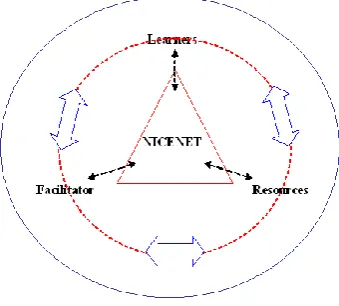
point provided by Nicenet, the CMC tool used in this study, as illustrated in Figure 1 below.
Fig. 1.1: Framework of the Study
Central to the whole setting of the study is Nicenet, the CMC tool used in this study. Positioned in a triangular box, it is flanked by three main components of the CMC-based learning environment; learners, facilitators and resources. Each of these three components is actually linked with each other within the virtual learning platform in the triangular box of Nicenet as represented by the short dashed arrows. These three components are also linked with each other on the outside of the virtual setting as shown by the dotted inner circle. Thus, multiple-way interaction takes place both within and beyond the virtual learning platforms.
Interaction or CMC takes place within and around an electronic system environment provided by the ICT tool used in this study. In this study the scope and nature of interaction is defined by the purpose of participation and simple user-friendliness of the ICT tool. By simple definition, interaction means having the ability to use language appropriately in order to satisfy particular demands (Bygate, 1987). It entails “controlling” one’s own language and having to make one’s own choice such as what to say, how to say it and whether or not to develop it in accordance with one’s intentions, while maintaining the desired relations with others. The notion of wrong or right is not necessarily based on grammatical accuracy but depends on how successfully the outcome or intentions have been achieved as a result of the interaction.
This research was conducted qualitatively. Due to the nature of the research that involved in-depth and descriptive understanding of CMC related phenomena in context-specific settings that are unique and which are at times idiosyncratic and pervasive in nature (Hoepfl, 1997), qualitative approach was deemed most appropriate for the purpose. According to Strauss and Corbin (1990 cited fro m Hoepfl, 1997), qualitative methods can be used to better understand any phenomenon about which little is yet known or to gain in-depth information that may be difficult to convey quantitatively, the latter examining only the surface features.
One of the major features of qualitative data analysis is that it focuses on natural occurring, ordinary events in natural settings so that researchers are able to develop robust conceptualizations of what "real life" is like. They further note the richness and holism of such data provide "thick descriptions" that are vividly nested in real context and have a ring of truth that has a strong impact on the reader.
2.1.1 PARTICIPANTS
For this research, the maximum variation sampling was used. It allows for the capturing of the heterogeneity of the population or the various central themes or principal outcomes that cut across a great deal of ethnographic study. This was necessary in order to ensure that the conclusions derived at adequately represent the entire range of the variation. Data collected and analysis derived out of this kind of maximum variation sampling yielded two kinds of findings. Firstly, high quality, detailed descriptions of each case, which are useful for documenting uniqueness and, secondly, important shared patterns that cut across cases and derive their significance from having emerged out of heterogeneity.
In conducting the sampling, and as a researcher, I first defined the dimensions of variation in the population that was deemed most relevant to the study and systematically selected individuals, times or settings that represented the most important possible variations on the dimensions. The sample size for the study comprises 11 undergraduates who met the criteria and features necessary. They were, basically, three groups of civil, electrical and mechanical engineering undergraduates of Universiti Tun Hussein Onn Malaysia (UTHM) and of mixed ability, different races and gender. Participants were specifically selected based on gender, race and uniqueness of their participation and proficiency of the English language; excellent, average and poor.
2.1.2 DATA COLLECTION
2.1.3 RESEARCH TOOL
For this study, an online conferencing platform freely available in the Internet was used – www.nicenet.org . In order to understand the findings of this study better it is however, useful to first learn about the various learning rooms available in Nicenet. The learning rooms available in Nicenet are Conferencing, Link Sharing, Document, Class Schedule, Class Member, Personal Message, Classes, Class Administration, Edit User Profile and ICA FAQ. However, interaction activities are most plentiful in Conferencing, Personal Message and Document rooms.
Conferencing Room
The main room for conferencing purposes; creating and responding to discussion messages.
Document
For putting up notices or assignment tasks and answer scripts.
Personal Message
For private correspondence like the e-mail.
3.1 FINDINGS OF THE STUDY
This study focused on three major findings. However, this paper shall limit itself to only one of them that covers aspects of Expressions of Ideas and Socializing. Throughout the 22-week study, participants used the online conferencing platform not only for learning purpose but creatively took advantage of the uniqueness of Nicenet to “speak their minds” on matters of crucial and common interest. They freely exchanged opinions on several issues that they would not normally discuss in normal F2F classroom setting and with great enthusiasm!
3.1.1 Politically Sensitive Issues
Message 1: Debate on Sensitive Politically-based Issues
FROM: HCW
1st of all, there are NO unities between the coalition parties within MCA & MIC.
since then,how can the Party unite if they are conflicting each another?
furthermore,a lot of projects such like Bakun never accomplished yet.nevertheless,the government decides to take over it,can we know why the government must take over it?this has never been disclosed in public...bear in mind if we/public talk too much on this issue then we can be regarded as not patriot to the nation.
P/S:this is NOT an anti government movement, i think i have my rights to show my point of views to this Democratic Country i.e Malaysia.
REPLIES (2): [ Hide Replies ]
FROM: JS
hello...
1. do not comment something about what others give before you check what already you give.
2. do not see whose speak but listen what he/she try to say.
tq
In the sample above, participants could be seen exchanging opinions on the conferencing topic which is politics-based “Is Barisan Nasional a Good Party in Malaysia?”, The participants seem to take different stands. The stand taken by HCW is justifiably supported with good reasoning and examples. He was aware that his views on the matter need not necessarily be agreed by others in the forum when at the end of his message he added the precautionary statement “P/S:this is NOT an anti government movement, i think i have my rights to show my point of views to this Democratic Country i.e Malaysia”.
3.1.2 Critical Social Issues
Taking example of the discussion topic “Women causes Raped Cases”, it began with someone initiating a rather provocative and current topic as published in the local dailies then. As in normal situation there were bound to be people who agreed or disagreed with the suggestion made especially the women. In this instance, the topic was actually posted by a female member of the Nicenet class who disagreed with the views made. Hence, in an effort to seek fairness on the matter the particular participant highlighted the matter to the attention of members of the virtual community in Nicenet seeking moral support. Below is one of the replies:
FROM: RAZ
assalamualaikum..
we are not agree with that title which said that WOMEN CAUSE RAPED CASES..what had happened right now in our country was include child from 4-12 years old. why..this because the unresponsibilty
person...MAN(not all man) it is reported that the raped cases was done by their own fathers, brothers.neighbours. why should said that women are the causes for this matter...think back.. i wonder why we never heard about CASES LIKE WOMEN RAPED MAN....
The message above shows that RAZ was unhappy with the seriousness of rape cases happening in Malaysia and in total disagreement with the views made by the public as regards women being the cause of such unwarranted incidences. Thus, in seeking fair and more responsible treatment towards the women folk this RAZ voiced out her disagreement in Nicenet hoping for views and support from others to collaboratively counter the gross accusations made.
3.1.3 “Personal” Educational Issues
In this next example, under the topic “Ex-polytechnic student="2nd class"?????” students worked together in defence of the claim made by some lecturers that they were of lesser quality in terms of academic performance at UTHM. The minute the first posting was put up in Nicenet for discussion by one of the students, all other participants from both my English classes who happened to be former Malaysian polytechnic graduates congregated in the Conferencing Room inside Nicenet to express their displeasure as regards the matter. Their common objectives were to uphold their honor and pride in defence of the unfair allegations thrown at them by several of their engineering lecturers here at the university. Below is a respond to refute the claim as posted by AYS:
Message 3: Refuting to Unfair Criticism by their Lecturers
FROM: AYS
Responding to the call for unity in defence of their honour and dignity of being former polytechnic graduates each of them contributed positively to the on-going discussion by rapidly posting individual messages justifying their support. There was a sense of camaraderie and esprit de corpse - a community of former polytechnic graduates collaborating on an issue that needed unity of thoughts, stand and moral support. The fact that the participants were united and working together in defence of a stand that they strongly believe in provided a learning environment that was authentic, lively and enriching. The importance of such a learning environment is crucial in initiating and sustaining the student’s interest and furthermore it provided a more natural habitat towards meaningful learning.
4.1 CONCLUSIONS
As stated earlier, one of the major problems affecting usage of the target language among Malaysian ESL learners in general and UTHM undergraduates specifically is lack of opportunity.
However, with the availability of a virtual communication platform, like Nicenet, one that is not bonded by physical entity and time, the opportunity is suddenly there for the taking. The participants irrespective of academic ability not only had that enormous chance to communicate using the target language but “speak out” with great enthusiasm when deliberating on certain important issues of common interest. When doing so they also had the chance to discuss the matter from a wider and deeper perspective coupled with global elements of the subject matters at hand. Opportunity here is thus of utmost significance to the findings and importance of the study.
From the day the students enrolled as “Nicenetians”, the participants had been interacting inside the forum continuously right until the end of the 22 weeks. They read or “listened” and responded to the various issues raised inside the forum all by mere keystrokes of the keyboard. The opportunity to be part of an active member delving on communicative matters of intellectual interest was laid down to them at their very doorstep. All of a sudden the once less “talkative” participants were flooded with ideas and suggestions for the virtual audience to digest. These were presented to their readers and listeners in the form of conferencing messages, personal messages, documents and link sharing referrals. According to some of the students they had too much information at their disposal that they had difficulty deciding which ones to read and respond to. Nevertheless, the platform provided them with what they could not possibly acquire through traditional F2F interaction setting.
place beyond the boundaries of locality, time and space. Other than being a potential medium it is the contention of this study to highlight the true potential of a virtual platform such as Nicenet in extending the learning space in new and different ways whereby learning, teaching and social interactions take on more in terms of opportunity and variety. Nicenet has shown that the skills students have acquired through earlier study, work or life experience are now applied in a higher learning setting compatible with a constructivist approach to learning, providing an environment in which the learner can actively construct an internal representation of knowledge by interacting with the material to be learned.. Educational philosopher and sociologist John Dewey argued that "education is life" and that what students learn and the way they learn it needed to be rooted in society (Dewey, 1981). Dewey's pragmatism is focused on engaging students in social concerns and on making education immediately relevant to students, helping them to appreciate the complexity of human social arrangements by getting them outside of the classroom and into the world. Other than for the lack of platform and opportunity the exam-oriented nature of many educational systems also inhibits development of intellectually social interactions among ESL learners. Nicenet thus provides that opportunity and space.
ACKNOWLEDGEMENTS
I would like to thank my students, the focus of this study, for their sincere participation that has been very inspiring. I would also like to thank Nicenet for the wonderful easy-to-use platform that has made this study a success.
REFERENCES
Bygate, M. (1987). Speaking. Oxford. Oxford University Press.
Dewey, J. (1981)The Philosophy of JH Dewey. Chicago: University of Chicago Press.
Hoepfl, M.C. (1997) Choosing Qualitative Research: A Primer for Technology Education Researchers.In Journal of Technology Education. [Online]. Retrieved on 20 Sep 2000 at http://scholar.lib.vt.edu/ejournals/JTE/v9n1/hoepfl.html Jones, S.G. (1995) Understanding Community in the Information Age (Ed.) In
Cybersociety:Computer-mediated Communication and Community. P.11 Long, M.H. and Porter, P.A. (1985) Group Work, Interlanguage Talk, and
Seconda Language Acquisitio' in TESOL QUARTERLY. Vol.19/2. June. p.207-234
Ministry of Education (1999) Smart School. Retrieved on 29 July 2000 at http://202.190.218.3/smartschool/index.html
Rheingold, H. (1993). The virtual community: Homesteading on the electronic frontier. Reading,Mass: Addison-Wesley.
Swain, M. & Lapkin, S. (1986) Immersion French in secondary schools: The goods and the bads.Contact. 5(30). P.2-9
Swain, M. (1985) Communicative Competence: Some Roles of Comprehensible Input andComprehensible Output in its Development. In S. Gass and Madden (Eds.) Input and Second Language Acquisition. Rowley, MA: Newbury House.
Swain, M. & Wong F. L. (1984) Child second language development: Views from the field on theory and research. Paper presented at TESOL Convention, Houston, Texas.
The Sun (2001) “Critical Thinking Essential for Quality Universities”. 14 Jan. p 20