Citation:
Horbel, C and Popp, B and Woratschek, H and Wilson, B (2016) How context shapes value co-creation: Spectator experience of sport events. Service Industries Journal, 36 (11-12). pp. 510-531. ISSN 1743-9507 DOI: https://doi.org/10.1080/02642069.2016.1255730
Link to Leeds Beckett Repository record:
http://eprints.leedsbeckett.ac.uk/3161/
Document Version: Article
The aim of the Leeds Beckett Repository is to provide open access to our research, as required by funder policies and permitted by publishers and copyright law.
The Leeds Beckett repository holds a wide range of publications, each of which has been checked for copyright and the relevant embargo period has been applied by the Research Services team.
We operate on a standard take-down policy. If you are the author or publisher of an output and you would like it removed from the repository, please contact us and we will investigate on a case-by-case basis.
How context shapes value co-creation: Spectator experience of sport
events
Chris Horbel
a*, Bastian Popp
b, Herbert Woratschek
c, and Bradley Wilson
daUniversity of Southern Denmark,
Department of Sociology, Environmental and Business Economics, Niels Bohrs Vej 9, DK-6700 Esbjerg, Denmark,
Tel. +45-6550-4238, [email protected]
bLeeds Beckett University, Carnegie Faculty, School of Sport,
Cavendish Hall 211, Headingley, Leeds, LS6 3QU, UK, Tel. +44-113-81-23173, [email protected]
cUniversity of Bayreuth, Department of Services Management, Universitaetsstrasse 30,
95447 Bayreuth, Germany,
Tel. +49-921-55-3497, Fax +49-921-55-3496, [email protected]
dUniversidad de Los Andes. Facultad de Administración, Building Julio Mario Santo
Domingo. Block SD. Calle 21#01-20, Barrio Las Aguas. Bogota, Colombia; and RMIT University, School of Media and Communication, 124 La Trobe Street, Melbourne, 3000, Australia, and University of Bayreuth, Department of Services Management, Universitaetsstrasse 30, 95447 Bayreuth, Germany,
Tel. +57-1 3394949 ext. 3960, [email protected]
* Corresponding author
Forthcoming in:
The Service Industries Journal,
How context shapes value co-creation: Spectator experience of sport
events
This paper applies the perspective of service-dominant logic, specifically value
co-creation in service ecosystems to the context of sports. It builds on the notion
that co-created value can only be understood as value-in-context. Therefore, a
structural model is developed and tested for different contexts of spectating live
broadcasts of football games during the Fédération Internationale de Football
Association World Cup 2014. The context-specific contributions of the
co-creating actors, spectators’ experience evaluations, and the resulting
context-specific value perceptions from the spectators’ perspective are identified. The
results highlight that the relative influence of the main co-creating actors and the
relative importance of the value dimensions differ across contexts. Service
providers (in sports) should identify how consumers evaluate experience and
which dimensions of value are most important to them in the context under
consideration. This will help them to successfully facilitate value co-creation,
make meaningful value propositions and achieve strategic benefit for themselves.
Keywords: service-dominant logic, service ecosystems, value co-creation,
Introduction
The extant literature on the service-dominant logic (Vargo & Lusch, 2004) has
put the focus on value creation, or more specifically, on value co-creation. In contrast to
traditional production-oriented perspectives, various actors beyond the firm itself are
involved in the process of value co-creation, including the customer (Payne, Storbacka,
& Frow, 2008; Prahalad & Ramaswamy, 2004). Such understanding of value creation
implies a shifting of the roles of the service provider from value delivery to making a
value proposition to the customers. The provider’s offering must then be integrated by
the customer with other market-facing (i.e., service/s from other providers), public (i.e.,
public infrastructure) and his or her personal (e.g., knowledge and skills) resources in
order to create value. Hence, the value determined also depends considerably on the
consumer’s own resource integration processes (Kleinaltenkamp, 2015; Pfisterer &
Roth, 2015).
The perspective of value co-creation in service ecosystems (Lusch & Vargo,
2014; Vargo & Akaka, 2012) almost intuitively implies that the context of the value
creation process plays a pivotal role (Chandler & Vargo, 2011). If the firm or service
provider is no longer seen as the only actor that is responsible for creating value, it
becomes apparent that the value created innumerably depends on the actors
participating in value creation in a particular context. Furthermore, the resources, which
are available to the actors and can be integrated in their value-creation processes, can
vary dramatically depending on the context, in which value creation takes place.
Therefore, value co-creation is also referred to as value-in-context (Chandler & Vargo,
2011).
In some industries, it is quite obvious that value is created through networks of
2001) acknowledge that value is created by several firms or organizations (e.g., sport
teams, league, event organizer, media). In addition, the contribution of the spectators
themselves adds substantially to the value that is finally created. It is clearly visible as
they sing battle chants and songs, perform choreographies or create banners and posters
they show within and around the stadium. Furthermore, sport events can be experienced
in different ways. Besides attending the event at the actual venue, sport events can also
be consumed (in real-time, live) through different types of media, e.g. on television or
via livestreaming. Major events are also often shown in public screening areas or on
larger screens in sports bars.
These different consumption contexts are characterized by the involvement of
different actors (e.g., fellow spectators, providers of food and drink, etc.) and various
resources that can be integrated with the value propositions of other actors.
Consequently, it is believed, that context impacts value creation in two ways. First, the
actors that contribute to the creation of the overall event experience for the spectators
are somewhat unique in each context. Second, due to the availability of different
resources and the unique set of actors involved, the value rendered is also unique and is
heavily dependent on the context, in which spectators experience the sport event. For
the various service providers involved in value creation in a particular context it is
highly relevant to understand to which degree they are able to actually influence the
spectators’ experience of the event. Taking into account that each single actor’s
influence on value is limited, it is highly critical to tailor their value proposition as best
as possible to the needs of the spectators. In order to do this, it is further necessary to
understand, which (aspects or dimensions of) value spectators derive from their
experience. Therefore, this study takes a meso-level perspective of value co-creation for
research questions:
1. How do various actors contribute to spectators’ experience of watching
a sport event in different contexts?
2. How does spectators’ perceived value of watching a sport event differ
across contexts?
While it is clear in the literature that co-created value can only be understood as
a notion derived from ‘value-in-context’ (Chandler & Vargo, 2011), the empirical
research so far has largely neglected a context-specific view. Therefore, this study
makes a significant contribution by empirically investigating how value is created and
perceived by customers in different contexts (Edvardsson, Tronvoll, & Gruber, 2011).
In doing so, this study contributes and extends the existing body of knowledge by
applying the perspective suggested by service-dominant logic, in particular the notion of
value co-creation in service ecosystems (Lusch & Vargo, 2014). This research thereby
also answers recent calls for applications of this new theoretical approach to the study
of sport marketing (Tsiotsou & Vargo, 2015) and sport management (Woratschek et al.,
2014).
Theoretical Background
Value co-creation and value-in-context
Considering value as being co-created implies that value cannot be created
through the activities of one actor, being it a firm or a customer. Hence, the classic
understanding of value that can, ideally, be created through the production processes of
a firm, and delivered by use of markets to customers, who can consume this value and
often even destroy it, does not seem to capture the true nature of value creation and
realization (Vargo & Lusch, 2004, 2008, 2016). While one could argue, that the most
such a perspective must be considered an extreme over simplification, which neglects
crucial aspects of the actual value creation process. The two focal actors (firm and
customer) cannot co-create value without the integration of resources provided by
private, market-facing, public and natural sources (Horbel, 2013; Lusch & Vargo,
2014).
As the sources of resources that are available to the co-creating actors are
dependent on the ‘points in value creation time and space’ (Vargo, 2009, p. 377), it
becomes apparent that the value co-creation process is always unique. Value is therefore
commonly understood as ‘value-in-context’ (Chandler & Vargo, 2011) which is also
inclusive of the particular notion of ‘value-in-social-context’ (Edvardsson et al., 2011).
The contextual nature of value co-creation is captured in the foundational premise (FP)
10, recently also considered an axiom, i.e., an ‘essence’, of service-dominant logic:
‘Value is always uniquely and phenomenologically determined by the beneficiary’
(Lusch & Vargo, 2014, p. 15 (FP 10); Vargo & Lusch, 2016, p. 18 (axiom 4)).
The ‘value-in-social-context’ concept specifically refers to the dependency of
individuals’ value perception on their relative position in society, i.e., the importance of
other social actors (Edvardsson et al., 2011). This perspective is also reflected in Vargo
& Lusch’s (2016) definition of value co-creation as ‘the actions of multiple actors, often
unaware of each other, that contribute to each other’s wellbeing’ (p. 8). It emphasizes
that value co-creation does not always require direct interaction between actors, but
does often also include indirect resource provision and influences of others on value
perception at a subconscious level. It further demonstrates that value is always
co-created in networks (Achrol & Kotler, 1999), also called ‘service systems’ (Maglio,
Vargo, Caswell, & Spohrer, 2009) or ‘service ecosystems’ (Lusch & Vargo, 2014;
self-adjusting system(s) of resource-integrating actors connected by shared institutional
logics (arrangements) and mutual value creation through service exchange’ (Lusch &
Vargo, 2014, p. 24; Vargo & Lusch, 2016, pp. 10-11). ‘Service ecosystems’ can be
interpreted as subsystems of society and it has been suggested to analyze them at
different levels: the intra-level (individual actors), micro-level (dyadic and triadic
structures), the meso-level (midrange structures such as the entire, but specific value
co-creation system) and the macro-level (entire economy or society) (Lusch & Vargo,
2014; Woratschek et al., 2014).
A service ecosystem as a self-adjusting system has the “built-in ability to
regulate itself through self-adjusting processes” (Lusch & Vargo, 2014, p. 164), which
allows them to change its structure according to the context of value co-creation. The
(social) context particularly determines which parts of a larger ecosystem (e.g., an
industry or the entire economy) are activated in a value co-creation process. The
resulting context-specific constellation of actors and their relationships influences how
actors co-create and perceive value in two ways. While other social actors more or less
directly influence the process of value co-creation through interaction, provision of
resources and mutual service exchange, consumer’s value perceptions, at least in part,
also depend on the structural dimension of the wider social context of value creation
(Edvardsson et al., 2011). These structures, i.e., institutions (e.g., norms, meanings,
symbols, laws, practices) and institutional arrangements (interrelated sets of institutions)
are not only essential to facilitate interaction and collaboration in service ecosystems,
but also influence how beneficiaries interpret and determine value (Vargo & Lusch,
2016).
Whilst we acknowledge this twofold influence of context on value co-creation
focused on the influence of the resources contributed by and interactions with
context-specific actors on consumers’ perception of value when experiencing a sport event.
Hence, the specific focus is on how different context-specific constellations of service
ecosystems in terms of the involved actors influence actors’ value creation and
perception.
Context and consumer experience
As this study focuses on the value perceptions of consumers it fits within the
domain of Consumer Culture Theory (CCT) (Arnould & Thompson, 2005). In fact,
service-dominant logic and CCT have been recognized as ‘natural allies’ (Arnould,
2007) in understanding value co-creation. Several researchers have started to link and
converge the perspectives of CCT, consumer experiences and value co-creation (Akaka,
Vargo, & Schau, 2015; Arnould, 2007; Helkkula, Kelleher, & Pihlström, 2012).
Whereas service-dominant logic and its service-ecosystem-perspective focusses
on resource integration and mutual service provision of the co-creating actors, but also
recognizes the facilitating character of institutions and institutional arrangements, CCT
more explicitly focuses on the latter (Akaka et al., 2015). More specifically, it provides
‘a more in-depth understanding of cultural aspects of experience’ (Akaka et al., 2015, p.
212) from the consumer’s perspective. According to CCT, the value consumers derive
from an experience ‘goes well beyond the interaction between service
customer/customers and the service provider’ (Helkkula et al., 2012, p. 11) and includes
existing and imaginary customer practices shaped by consumers’ social contexts
(‘lifeworlds’).
Additionally, CCT points towards the fact, that social structures, for example
common values (Schouten & McAlexander, 1995), as they are embedded within
position within the wider social system influence overall consumer experience (Arnould
& Thompson, 2005; Edvardsson et al., 2011). Vargo and Lusch (2011) support this
perspective and broaden it by suggesting that social structures or ‘institutions’ not only
facilitate the interaction among actors and the evaluation of experiences, but are also
influenced and changed through them. In the sport event example, spectators’
experience is influenced by broader societal norms and values, but often also through
the common values of the fan community (Tsiotsou, 2016). However, these norms and
values are not fixed or pre-existing, but are constantly shaped through the influence of
multiple actors, such as media, sponsors, and the fans themselves.
Conceptual Model of Sport Event Experience
Research context
The sport’s business, in particular a sport event, is selected in this study as it is
an ideal application of contextual value co-creation. It is quite obvious that a customer’s
experience at a sport event depends not only on the game that is played, and the
meaning that he assigns to the game, the team brand, individual players, etc., but also on
his past experiences with the teams playing, the league, tournament, or the sport in
general and various other factors that shape his expectation, such as preceding reports
on television, in newspapers, or in online and social media, and conversations with
friends and family.
For this study, the Fédération Internationale de Football Association (FIFA)
World Cup 2014 has been chosen for developing a conceptual model of spectators’
sport event experience and the value created for and with them. This application is
particularly interesting as spectators commonly experience games of the FIFA World
Cup in different contexts. Due to limited stadium capacities, the financial constraints of
viewed form is through broadcasts. In line with the results of an audience analysis for
the latest FIFA World Cup in 2014 (Gerhard & Zubayr, 2014), we identified four most
relevant contexts for watching broadcasts of the games:
1. ‘Public screening’: Collective spectatorship (Becker, Kautsky, & Widholm,
2014), i.e., spectators watching live broadcasts of sport events in a public place
together with a large (mostly unknown) audience, has become very common as a
way to experience a sport event. Such live public screenings (e.g. at fan parks)
have become particularly popular since the 2006 FIFA World Cup in Germany
and since then have been established as an option to watch big sport events.
During the FIFA World Cup 2014, for example, on average 8.9 per cent (3.30
Mio.) of the German audience watched the games of the German team at a
public screening event (Gerhard & Zubayr, 2014).
2. ‘Bar/ pub/ restaurant’: While watching broadcasts of football matches at a bar,
pub or restaurant has many commonalities with collective spectatorship at a
public screening site, there are some fundamental differences, characterizing
them as a different context. First, these locations provide fans with access to a
broad variety of sport events on a more regular basis than public screenings, for
example during a whole season of a sports league (Weed, 2007). Hence,
spectators are generally more familiar with such viewing sites and the involved
actors. Second, the number of actors contributing the service quality aspects to
the consumption context (e.g., food, drink, security) is often much lower than at
a public screening event. Third, broadcasts in bars, pubs or restaurants are of a
much smaller-scale than a public screening event and hence, this context is
usually characterized by less anonymity of the audience. Spectators have also
On average 8.7 per cent (3.23 Mio.) of the spectators watched the games of the
German national team in such context (Gerhard & Zubayr, 2014).
3. ‘Viewing with others at home’: The social uses of television are well known
(Lull, 1980). Watching live broadcasts of football games often is practiced as a
social experience together with friends and family at home. In fact, over 90 per
cent of the German viewers of the FIFA World Cup 2014 indicated that they
want to share their experience with others (Tomorrow Focus Media, 2014). In
contrast to collective spectatorship in public places or in bars, pubs, and
restaurants, there are usually no pre-defined actors, which contribute the service
quality aspects of the consumption context. However, resources in a
‘home’-context may be similar to the two ‘public’ ‘home’-contexts if, for example home
delivered food and drink are consumed.
4. ‘Viewing alone at home’: While many spectators enjoy the company of others
when watching football games, there are also spectators who watch the live
broadcast of a game alone at home. Notably, even though there is no direct
interaction between actors in such context, value is still co-created, but through
more indirect forms of resource integration and mutual service provision.
Context-specific actors and their contributions to the sport event experience
Our first research question is directed at a better understanding of the
context-specific actors’ contribution to the customer experience. In the case of sport events, a
large number of actors are naturally involved in value co-creation: teams competing in
the game, sponsors providing money and supplies, facility owners providing a sound
stage and venue, caterers offering food and drinks, police and private security firms
ensuring safety, public transport and providers of parking services making sure that
visitors, such as hard core fans of both the own and the opposing team, families,
business guests, occasional spectators, etc. meshing to create an overall event
atmosphere (Uhrich & Benkenstein, 2012). One study cannot do all of these elements
justice. In the context of team sport events, we suggest that three types of actors are
particularly important for value co-creation. First, the opposing teams naturally
contribute to spectators’ experience of the game. Considering the argument of Vargo
and Lusch (2008) that value is always determined by the beneficiary, we conceptualize
the value contribution of the actual game as ‘perceived team performance’. This concept
not only represents the outcome of the game, but also spectator perceptions of team
effort and player enthusiasm during the contest (Gladden & Funk, 2001). Spectators’
subjective evaluation of team performance could, for example, be influenced by their
level of identification with their own team which provides them with additional benefits
and leads to a more positive evaluation of the team’s performance (Fournier, 1998;
Stokburger-Sauer, Bauer, & Mäder, 2008). Moreover, this conceptualization
deliberately focusses on those team-related aspects which both are directly related to the
event experience and can be influenced by the team.
H1: Perceived team performance exerts a positive effect on overall event
experience.
Second, the organizer of the event at the venue, being it the stadium itself, a
public screening area or a bar, is an important contributor to the visitor’s experience as
the organizer considerably determines the context in which spectators are able to create
value through the event experience (Edvardsson, Enquist, & Johnston, 2005). This
notion is supported by research on the importance of ‘servicescapes’ in sport
(Wakefield & Blodgett, 1994)
effect on overall event experience.
Third, visitors’ experience and the value created at a sport event is also heavily
influenced by the fans and spectators themselves (Chang & Horng, 2010). The influence
of other spectators on the individual’s experience can be explained by social identity
theory (Tajfel, 1978). Belonging to membership reference groups or feeling identified,
attracted to, and psychologically involved with aspirational reference groups
strengthens individuals’ self-worth (White, Argo, & Sengupta, 2012). Consequently, the
more spectators feel such feeling of belonging to other fans or spectators, the more will
their contributions influence the individual’s experience. As Uhrich and Benkenstein
(2012) demonstrate, other fans and spectators, especially through their behaviour (e.g.,
by singing battle chants), but also through their appearance (e.g., wearing fan
merchandise) and their mere presence and swelling numbers contribute substantially to
the atmospherics at a sports stadium. Hence, spectator-induced atmosphere which
comprises the stimuli emanating from the spectator and their behaviour is an important
component of sport stadium atmosphere (Uhrich & Benkenstein, 2010, 2012).
It is believed that other spectators equally contribute to viewers’ experiences of
sport games when they watch them in other public places (e.g. public screening areas,
sports bars) or even at their homes together with others on TV. Hence, we expect a
positive influence of ‘spectator-induced atmosphere’ on the spectator’s experience.
H3: Perceived spectator-induced atmosphere exerts a positive effect on
overall event experience.
Our hypotheses H1-H3 postulate that the same three generic types of actors
influence spectators’ experience and hence the value created for and with them across
contexts. However, while the teams performing the game (H1) are the same in all four
involved in co-creating the event experience. For example, the actual actors contributing
service-quality-related aspects of the consumption contexts (i.e., “service providers”;
H2) are at least partly different within the four contexts. Different providers of food and
drinks, security, or hospitality are included in the different scenarios and contribute in
different ways and to different extent. While service staff through more extensive
interaction with the patrons can have considerable influence on overall value when
consuming the event on a screen in a bar, this might be of less importance in a public
screening area and probably even less relevant when spectators watch the game on TV
at home. However, some actors might still be the same across contexts, for example a
stadium announcer whose statements can be heard in the broadcasts of the game.
Clearly, the actual set of other spectators influencing the experience (H3) is also
different across the contexts. Other spectators might be more (e.g., when watching the
game at home with friends) or less (e.g., when watching the game at a public screening
site) known to the individual leading to different types of interaction with them. When a
fan watches the game alone at home on TV, he might have almost no interaction with
other spectators. However, sometimes people may engage with others in
text-messaging, phone calls or fan blogs during the game even if alone.
As a consequence, the actual set of relevant actors and hence, the social structure
of the context changes, when spectators watch the event at home on TV alone or with
others compared to a public setting, for example a live screening in a public place or in
a sports bar. In addition, the interaction with other spectators can take multiple forms
that influence viewers’ experience evaluation and value in very different ways, both
positively and negatively (Wu, 2008). CCT suggests, that consumers’ experiences are
considerably influenced by the social structures they are embedded in (Arnould &
influence of the different types of actors on spectators’ experience and value
perceptions will vary across contexts.
To analyze the salience of different actor contributions to spectators’ experience,
the proposed model will therefore be tested in the four different sport event contexts.
Perceived value-in-context
The conceptualization of co-created value has been rather fuzzy (Grönroos &
Voima, 2013) and hence, approaches to its measurement to this point in time are rather
limited. This article focuses on value from the perspective of one particular group of
actors within the value-creation ecosystem of a sport event, i.e. the spectators.
Consequently, the focus of our second research question is on capturing the value as this
particular group of actors experiences it in different contexts.
Consumers’ motivations are generally regarded as an important driving force for
behavior and can therefore be interpreted as fundamental in co-creating value in a
service exchange. Wang, Min, and Kim (2013) demonstrate that the fulfillment of
spectator motives is the main driver for sport spectators’ wellbeing, which includes
consumers’ pleasure, happiness, and self-actualization. We therefore use the fulfilment
of consumers’ motives for sport spectatorship to conceptualize their perceived value.
Motives that drive fans to attend games and live competitions have been studied
extensively in the past. A variety of motivational scales have been developed such as
the Sport Fan Motivation Scale (Wann, 1995), the Motivation Scale for Sport
Consumption (Trail & James, 2001), the Sport Interests Inventory (Funk, Mahony, &
Ridinger, 2002), and the Sporting Event Experience Scale (Bouchet, Bodet,
Bernache-Assollant, & Kada, 2011). While most studies of sport fan motivation have been
completed for live spectating of sport events at the actual venues, Schafmeister (2007)
compared to the ones outlined pertaining to live attendance. However, additional
motives (intercultural contacts, freedom to move freely around the event venue) have
been identified for a public screening context (Durchholz, 2012).
Furthermore, social identity theory clearly attaches great importance to social
identification in everyday life. Similar to motivations, identification does influence
individual behavior (Tajfel, 1978). Consumers engage in value co-creation processes
with other actors in order to reach a psychological state of perceiving, feeling, and
valuing their belongingness with these actors (Lam, Ahearne, Mullins, Hayati, &
Schillewaert, 2013). Such feelings of belongingness strengthen their self-worth (White
et al., 2012). Hence, event experiences which provide them with such feelings will
support the fulfilment of their need for identification. We therefore assume that the
fulfilment of consumers’ identification with a service provider represents another
[image:17.595.86.507.458.686.2]dimension of the overall value they perceive within the service experience.
Table 1: Motives for Sport Spectatorship
Key Sport Spectatorship Motives Selected Sources
Fun and Entertainment Jamens and Ross (2004); Won and Kitamura (2007); Wann, Melnick, Russel, and Pease (2001)
Atmosphere Uhrich and Benkenstein (2010, 2012)
Physical Attractiveness and Aesthetics Trail, Anderson, and Fink (2003); Wann, Melnick, Russel, and Pease (2001)
Eustress and Tension Funk, Ridinger, and Moorman (2004); Trail, Anderson, and Fink (2003)Wann (1995); Wann, Melnick, Russel, and Pease (2001)
Freedom to Move Around (Durchholz, 2012)
Social Contacts and Interaction Trail, Anderson, and Fink (2003); Wann, Melnick, Russel, and Pease (2001)
Intercultural Contact (Durchholz, 2012)
Identification with Team Donavan, Carlson, and Zimmermann (2005); Schafmeister (2007)
Identification with Sport Event Donavan, Carlson, and Zimmermann (2005); Schafmeister (2007)
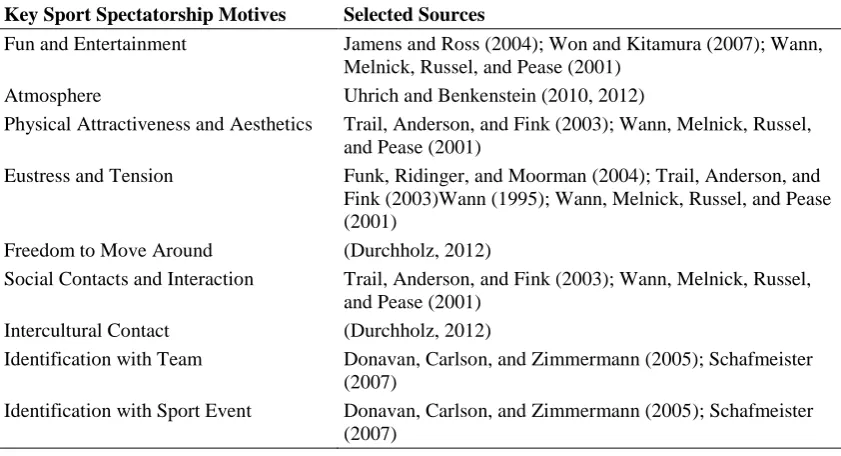
Table 1 provides an overview of the motives of sport spectatorship selected for
discussed in previous research, this selection includes the most relevant motives that
have been studied in relation to the four consumption contexts under investigation in
this study (e.g., stadium, pub, TV).
In line with Macdonald, Wilson, Martinez, and Toossi (2011) who define
‘value-in-use as a customer’s outcome, purpose or objective that is achieved through
service’ (p. 671), we assume that event experience contributes to the satisfaction of the
above presented motives of sport spectators and their identification with sport
event-related targets of identification. We therefore propose the following hypotheses:
H4-12: Event experience positively influences the fulfilment of perceived value
dimensions including ‘fun and entertainment’ (H4),’atmosphere’ (H5),
‘physical attractiveness and aesthetics’ (H6), ‘eustress and tension’ (H7),
‘freedom to move around’ (H8), ‘social contacts and interaction’ (H9),
‘intercultural contact’ (H10), ‘team identification’ (H11), and
‘identification with the event’ (H12).
We further assume that the dimensions of perceived value are differently
affected by spectators’ experience in the four sport event viewing contexts under study.
In each of those contexts, spectators have access to different resources, provided by
different actors. Following FP 6 of the service-dominant logic that “value is co-created
by multiple actors, always including the beneficiary” (Vargo & Lusch, 2016, p. 9), it
can be concluded that the value created for and with spectators is the result of the
integration of resources provided by the specific actors involved. We expect that some
motives can be better fulfilled by integrating particular resources than others. Therefore,
the satisfaction of the different motives has different weight within the overall value
determined by spectators depending on the context.
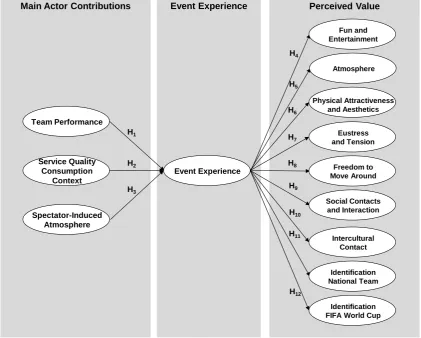
considerations and hypotheses. Thereafter, we assume that consumers’ event experience
is predominantly determined by the contributions of the core actors involved in
co-creating value at a sport event, i.e., by the performance of the team, the provider of the
event venue and the atmosphere that is created by the spectators themselves in this
process. Spectators’ evaluation of the event experience drives their value perception,
which consists of different dimensions representing the fulfilment of their needs relating
[image:19.595.87.509.298.636.2]to their motives and sought levels of identification.
Figure 1: Conceptual Model
Main Actor Contributions Event Experience Perceived Value
Event Experience H4 Fun and Entertainment H5 H12 H6 H7 H8 H9 H10 H11 Atmosphere Physical Attractiveness and Aesthetics Eustress and Tension Freedom to Move Around Social Contacts and Interaction Intercultural Contact Identification National Team Identification FIFA World Cup Team Performance H1 Service Quality Consumption Context H2 Spectator-Induced Atmosphere H3 Empirical Study Methodology
German national team games during the FIFA World Cup 2014 in Brazil. Respondents
were invited by mail and online posts to participate in the survey. The survey addressed
spectators who had not watched the games at the actual event venue, but through live
broadcastings in the different contexts described above. Of the 532 respondents who
participated in the survey, 127 had watched the game at a public screening, 86 in a bar,
pub, or restaurant, 261 at home together with others, and 54 had watched it alone at
their homes.
Participants were first asked whether they had already seen a game of the
German national team at the World Cup and were requested to reveal which game it
was. Respondents who had seen more than one game were asked to choose the game
they remembered best and relate their subsequent answers to this game. In the
following, the game selected by the individual respondent was explicitly mentioned in
all questions of the questionnaire. Through this procedure, data for all seven games of
the German national team was collected whereby slightly more responses were received
for games during the group stage of the tournament.
Using a scale from 1 to 10, all respondents initially were asked to indicate to
what degree the particular game matched their expectation of a perfect football
experience. Thereafter, all other constructs in our sample were measured based on
existing scales from previous studies using seven-point Likert scales ranging from
‘strongly agree’ to ‘strongly disagree’.
Three items were chosen to measure ‘perceived team performance’ (Beccarini &
Ferrand, 2006; Madrigal, 1995). Moreover, based on existing scales for measuring the
quality of servicescapes, particularly in the context of sports (Brady & Cronin, 2001;
Fernandes & Neves, 2014; Wakefield, Blodgett, & Sloan, 1996), three items measuring
each context. We used a rather global-type measure for all services that could be
provided by event organizers and did not get into more detail as the specific services
differ across contexts. ‘Spectator-induced atmosphere’ was measured by three reflective
items adapted from Uhrich and Benkenstein’s (2010, 2012) studies on atmosphere in
sports.
The dimensions of perceived value were measured as the fulfilment of
spectators’ motivations (Durchholz, 2012). In particular, two-item or three-item scales
established from previous research were adapted to measure ‘fun and entertainment’
(James & Ross, 2004; Won & Kitamura, 2007), ‘atmosphere’ (Uhrich & Benkenstein,
2010, 2012), ‘physical attractiveness and aesthetics’ (Trail, Anderson, & Fink, 2003),
‘eustress and tension’ (Funk et al., 2002; Wann, 1995), ‘social contacts and interaction’
(Trail et al., 2003), ‘freedom to move around’ and ‘intercultural contact’ (Durchholz,
2012). Furthermore, identification with the national team and identification with FIFA
were captured. Both were measured using a well-established six-item scale (Donavan,
Carlson, & Zimmermann, 2005; Mael & Ashforth, 1992; Trail et al., 2003). Appendix 1
provides an overview of the items representing all constructs studied.
It was deemed prudent given the exploratory nature of this study to use Partial Least
Squares (PLS) Path Modeling (Hair, Sarstedt, Ringle, & Mena, 2012). The PLS
approach was implemented for several reasons. First, PLS demonstrates excellent
convergence behavior for small sample sizes (Reinartz, Haenlein, & Henseler, 2009).
Second, PLS is not constrained by identification concerns, even if models become
complex (Hair et al., 2012). Third, the PLS algorithm more sensitively handles data that
violates the normality assumption which is common in marketing studies (Henseler,
Ringle, & Sinkovics, 2009).
context, were estimated. For the contexts ‘together with friends at home’ and ‘alone at
home’ some constructs (i.e. ‘service quality consumption context’) and several single
items, which did not apply to the respective context were not included in the
questionnaire and hence, were excluded from the analysis. As a second step, a
multi-group analysis using the parametric approach (Sarstedt, Henseler, & Ringle, 2011) was
conducted in order to compare the models of the contexts ‘public screening’ and
‘bar/pub/restaurant’, as both represent public consumption contexts and therefore the
conceptualizations of all constructs are similar.
Common method variance
Given that our study only includes consumer self-reported data, common
method variance should be explored. We mitigated the propensity to have common
method variance by using procedural remedies such as the use of previously validated
scales, proximal separation between predictor and criterion constructs, and variation of
scale points (Podsakoff, MacKenzie, & Podsakoff, 2012). Moreover, we tested for
common method variance using Harman’s single-factor test (Harman, 1976). This
demonstrated that none of the factors accounted for the majority of covariance among
items thus indicating that common method bias is not a threat to further analyses.
Analysis of measurement models
For each context, the measurement models were estimated separately and
inspected with regards to suitable validity and reliability levels. This was to ensure
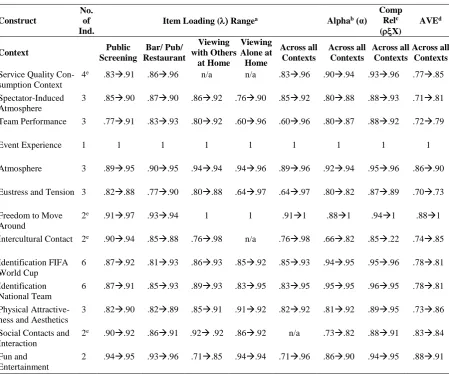
construct and discriminant validity and to determine item suitability. Table 2 reports the
key statistics and loadings for each and across contexts. The assessment of the
measurement models revealed that the vast majority of loadings were acceptable
(>.707) within a range of .71 and .97. Only in the ‘viewing alone at home’ context, two
recommendation of Chin (1998), they were still retained in the analyses. This is
common practice in first time studies and works of an exploratory nature (Wilson,
2010). Construct reliabilities ranged between .85 and .96 (resp. 1 for the single item
construct ‘event experience’). The AVE ranged between .70 and .91 (resp. 1 for the
single item construct ‘event experience’). To assess discriminant validity all square
roots of AVE were calculated and are clearly shown to be greater than the respective
correlations between constructs (Fornell & Larcker, 1981). This was further
corroborated with an inspection of the cross-loadings revealing suitable loadings
[image:23.595.87.537.343.717.2]patterns, i.e., items more strongly loaded on their posited construct.
Table 2: Measurement Model
Construct
No. of Ind.
Item Loading ( Rangea Alphab (α)
Comp Relc
(X)
AVEd
Context Public Screening Bar/ Pub/ Restaurant Viewing with Others at Home Viewing Alone at Home Across all Contexts Across all Contexts Across all Contexts Across all Contexts
Service Quality Con-sumption Context
4e .83.91 .86.96 n/a n/a .83.96 .90.94 .93.96 .77.85 Spectator-Induced
Atmosphere
3 .85.90 .87.90 .86.92 .76.90 .85.92 .80.88 .88.93 .71.81 Team Performance 3 .77.91 .83.93 .80.92 .60.96 .60.96 .80.87 .88.92 .72.79
Event Experience 1 1 1 1 1 1 1 1 1
Atmosphere 3 .89.95 .90.95 .94.94 .94.96 .89.96 .92.94 .95.96 .86.90 Eustress and Tension 3 .82.88 .77.90 .80.88 .64.97 .64.97 .80.82 .87.89 .70.73 Freedom to Move
Around
2e .91.97 .93.94 1 1 .911 .881 .941 .881 Intercultural Contact 2e .90.94 .85.88 .76.98 n/a .76.98 .66.82 .85.22 .74.85 Identification FIFA
World Cup
6 .87.92 .81.93 .86.93 .85.92 .85.93 .94.95 .95.96 .78.81 Identification
National Team
6 .87.91 .85.93 .89.93 .83.95 .83.95 .95.95 .96.95 .78.81 Physical
Attractive-ness and Aesthetics
3 .82.90 .82.89 .85.91 .91.92 .82.92 .81.92 .89.95 .73.86 Social Contacts and
Interaction
2e .90.92 .86.91 .92 .92 .86.92 n/a .73.82 .88.91 .83.84 Fun and
Entertainment
2 .94.95 .93.96 .71.85 .94.94 .71.96 .86.90 .94.95 .88.91
Analysis of structural relations and hypothesis testing
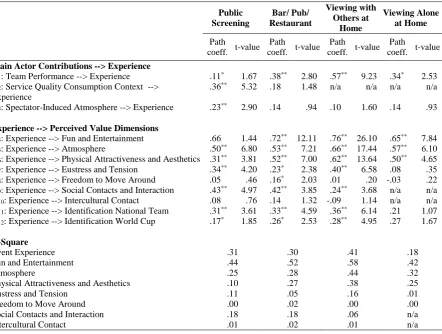
The empirical findings of the structural model estimates and the significance of
the path coefficients using the PLS bootstrapping procedure (Chin, 2010) confirm most
of the hypotheses for each context. However, the results also reveal differences between
the contexts. Regarding the main actor contributions, in the three contexts ‘bar/ pub/
restaurant’, ‘viewing with others at home’, and ‘viewing alone at home’ significant
positive effects of ‘team performance’ on ‘event experience’ have been found, whereas
‘spectator-induced atmosphere’ and ‘service quality consumption context’ have no
significant influence (or do not apply to these contexts). In contrast, reverse effects are
[image:24.595.95.538.373.707.2]observed for the ‘public screening’ context.
Table 3. Empirical Results
Public Screening Bar/ Pub/ Restaurant Viewing with Others at Home Viewing Alone at Home Path
coeff. t-value Path
coeff. t-value Path
coeff. t-value Path
coeff. t-value Main Actor Contributions --> Experience
H1: Team Performance --> Experience .11* 1.67 .38** 2.80 .57** 9.23 .34* 2.53 H2: Service Quality Consumption Context -->
Experience
.36** 5.32 .18 1.48 n/a n/a n/a n/a H3: Spectator-Induced Atmosphere --> Experience .23** 2.90 .14 .94 .10 1.60 .14 .93 Experience --> Perceived Value Dimensions
H4: Experience --> Fun and Entertainment .66 1.44 .72** 12.11 .76** 26.10 .65** 7.84 H5: Experience --> Atmosphere .50** 6.80 .53** 7.21 .66** 17.44 .57** 6.10 H6: Experience --> Physical Attractiveness and Aesthetics .31** 3.81 .52** 7.00 .62** 13.64 .50** 4.65 H7: Experience --> Eustress and Tension .34** 4.20 .23* 2.38 .40** 6.58 .08 .35 H8: Experience --> Freedom to Move Around .05 .46 .16* 2.03 .01 .20 -.03 .22 H9: Experience --> Social Contacts and Interaction .43** 4.97 .42** 3.85 .24** 3.68 n/a n/a H10: Experience --> Intercultural Contact .08 .76 .14 1.32 -.09 1.14 n/a n/a H11: Experience --> Identification National Team .31** 3.61 .33** 4.59 .36** 6.14 .21 1.07 H12: Experience --> Identification World Cup .17* 1.85 .26* 2.53 .28** 4.95 .27 1.67 R-Square
Event Experience .31 .30 .41 .18
Fun and Entertainment .44 .52 .58 .42
Atmosphere .25 .28 .44 .32
Physical Attractiveness and Aesthetics .10 .27 .38 .25
Eustress and Tension .11 .05 .16 .01
Freedom to Move Around .00 .02 .00 .00
Social Contacts and Interaction .18 .18 .06 n/a
Intercultural Contact .01 .02 .01 n/a
perceived value measured as the fulfilment of spectators’ motivations. For all contexts,
significant effects were found for all motivation dimensions except for the ‘intercultural
contact’ and ‘freedom to move around’ items.
The R-square values ranging from .18 to .41 for the latent variable ‘event
experience’ and up to .58 for the constructs measuring ‘perceived value’ indicate a good
predictive capacity of the models. Notably, explained variance of the constructs differs
between the contexts. A detailed overview of the structural model estimates is provided
in Table 3.
Multi-group analysis
In order to check whether there are differences between the path coefficients for
each context, an additional PLS multi-group analysis was undertaken (Sarstedt et al.,
2011). A comparison of the models for the contexts ‘public screening’ and
‘bar/pub/restaurant’ reveals significant differences for the effects of ‘team performance’
on ‘event experience’ (t-value = 1.98, P < 0.05). Moreover, with regard to the perceived
value dimensions, the relationship between ‘event experience’ and ‘physical
attractiveness and aesthetics’ significantly differs between both contexts (t-value = 1.77,
p < 0.10). This clearly demonstrates that the context influences the overall results on
key dependent constructs. The implications for this will now be discussed and avenues
for future research will be outlined.
Discussion and Conclusion
This study undertakes an empirical analysis of value co-creation at the
meso-level to improve our understanding of value determination from the consumer
perspective. It thereby responds to recent calls to apply service-dominant logic, the
service ecosystem approach and value co-creation (Woratschek et al., 2014) to sports
nature of value creation that essentially requires multiple actors, who integrate resources
from various private, market-facing, and public actors as well as from natural sources of
resources (Horbel, 2013; Lusch & Vargo, 2014). By applying this perspective, this
study also takes into consideration that ‘value is a contextually contingent concept’
(Vargo, 2015, p. 14). Context is determined by the specific actors and specific resources
these actors, including the beneficiary (e.g., the customer), have access to
(Kleinaltenkamp, 2015) as well as the institutions and institutional arrangements that
are necessary to facilitate interaction between the actors (Vargo & Lusch, 2016). While
all these elements are important to understand, this study has, as a first step, focused on
the contributions of context-specific actors to sport spectators’ experience and the
resulting context-specific perception of value.
The results of the empirical analysis clearly reveal that both the relative
influence of the contributions of the main co-creating actors on spectators’ experience
and the importance of the dimensions of spectators’ perceived value vary considerably
depending on the context, in which value was co-created. Hence, we were able to
empirically demonstrate, that the context of value creation influences the structure of
the service ecosystem (Chandler & Vargo, 2011). First, the set of co-creating actors
themselves differs across contexts. Second, our study reveals that the relationships
between these actors, both in terms of their strength and the type of resource exchange,
are also significantly shaped by the context. Our results show that those different
service ecosystem constellations lead to different value perception and determination by
the beneficiary (the spectator).
In the public screening context, the performance of the team (H1) only makes a
minor contribution to the overall event experience of spectators. This corresponds with
interaction’ (H9) are the three motives that are best satisfied by public screening
spectators’ experience and hence represent their three most important value dimensions.
These findings are in contrast to research especially in sport economics, which
considers ‘competitive balance’ and the ‘uncertainty of the outcome of the game’ (e.g.,
Schmidt & Berri, 2001), i.e., characteristics of the game and the performances of the
teams, as most important determinants of spectators’ experiences. Our findings indicate
that at least in a public screening context, social aspects dominate the experience and
value perception of spectators whereas game-related characteristics are less important.
In the sports bar context as well as in both viewing-at-home-contexts,
spectators’ experience is most importantly determined by the teams and the perception
of their performance. However, even in these three contexts, value dimensions that
represent the fulfilment of social motives (‘fun and entertainment’ (H4), ‘atmosphere’
(H5)) are the most important dimensions of spectators’ perceived value of the event
experience indicating that social motives are always well satisfied by sport event
experiences, regardless which actors mainly contribute to the experience. ‘Physical
attractiveness and aesthetics’ (H6), i.e., a dimension that is closely connected to the
teams and their performance, represents the third-most important value dimension in
these three contexts. This indicates that, despite the dominance of the value dimensions
that more broadly reflect fun and enjoyment, there is some association between the most
important actor contributions and the value dimensions most highly affected by
spectators’ experience.
Regarding the relative importance of actor contributions for spectators’
experience and the relative importance of the different dimensions of spectators’
perceived value, this study was rather exploratory in nature. However, the reasons for
bar/pub/restaurant) are not as obvious. Our findings indicate, that spectators might seek
and prefer public screenings when they want to interact with their friends and other
people during the game whereas they might choose to watch the games in a sports bar,
pub or restaurant when they are more strongly interested in the game. However, based
on this study we are not yet able to clarify the direction of this effect. On the one hand,
spectators with different preferences might choose the context which provides the most
suitable resources to satisfy the motives (value dimensions) that are most important to
them. Thus, the contexts could stimulate a self-selection mechanism of spectators. On
the other hand, the contextual differences regarding the involved actors and resources
available might lead to different perceptions, both regarding the importance of
particular actors’ contributions to the experience and the level of satisfaction of
particular motives as dimensions of perceived value. We believe that both mechanisms
apply (Vargo & Lusch, 2016) and suggest that future research should reveal the
dominant direction of this effect by investigating the relative strength of these
processes, for example through experiments.
Regardless of this, our findings are important from a practitioner’s perspective
as they indicate that service providers are probably confronted with different spectator
types and expectations depending on the context in which they operate. We recommend
that they should carefully research and identify the core value dimensions that are
important for the experience of their customers in order to successfully contribute to
value co-creation and achieve strategic benefit (Lusch & Vargo, 2014). For example, we
recommend that service providers involved in staging public screening events are aware
that social interactions are important for their visitors and focus on providing them a
platform, which enables viewers to connect and co-create the event experience.
essentially derive value from social interaction (H9) as well as hedonic components such
as atmosphere (H5) and fun and entertainment (H4). Hence, public screenings seem to
offer a surrogate format to experience the event within the broader collective to try and
best recreate actually being within or at the venue. This virtual transformation is very
important for modern societies (especially for mega events where country teams or
national athletes feature) as it builds community and nationalistic identity and
attachment. It assists to support people’s friendly exchanges and enhances city or place
building. The audience can become attached to these viewing monuments. It is further
valuable as it links the people in a real time context with the event. There is a collective
‘we are in it together feeling’. It should be stressed that these events are not always
friendly viewing forums as many cities have culturally diverse communities that may
not always be agreeable with the underlying sporting result or the event itself. Hence,
there is also a potential risk for conflict and social disharmony.
Our findings are further in line with media research which emphasizes that the
presence of co-viewers increases the user’s overall level of enjoyment and enhances the
endurability of the experience (Zhu, Heynderickx, & Redi, 2015). This is a notable
finding, but it must be recognized that this study could be improved by consecutively
garnering information from individuals and also other important viewing dyads (e.g.,
close friends, a family group or even a group of supporters that converge to watch
games together consistently).
Across contexts, ‘intercultural contact’ (H10) is shown to be of limited influence,
which is surprising given the tournament’s international status. However, it could be
due to the fact, that the participants in our study watched the games at a long distance
from the actual event and therefore had only limited opportunity to interact with people
In this study, the flexibility of the data analysis technique PLS has demonstrated
some clear results by highlighting that context really does change the overall predictive
utility of the model and that the drivers are respectively different. Our findings therefore
support the notion of value as ‘value-in-context’ and advise researchers in sport
management pick up this perspective in future studies.
Limitations and further research
We currently consider this an exploratory investigation. Future research should
use larger sample sizes to be able to report effect size differences between contexts
more comprehensively. This should also include the consideration of other
context-specific characteristics. For example, in this research, sample size allowed us to test for
differences regarding the stage of competition (group stage vs. knockout stage) for the
context of ‘watching on TV with friends’. The PLS multi-group analysis (Ringle,
Wende, & Becker, 2015) did not reveal any significant differences of the path
coefficients within the structural model. Further research using larger sample sizes
might have a closer look at more nuanced differences between different games
including additional context-specific aspects (e.g., result of the game, rivalry among
teams).
While this study has taken a meso-perspective of analysis of value co-creation,
we have only taken the customer’s (spectator’s) perspective as a beneficiary from this
process and focused on resource integration and value perception from this point of
view. This perspective should be broadened in future studies and include similar
investigations for other participating actors as in service ecosystems all actors are
connected through mutual service exchange and resource integration.
Considering the context of consumption is a meaningful direction for further
should compare value co-creation at live sport events with the broadcasting contexts
that have been included in this study. Another avenue for future research would be to
look at co-creation of value-in-context at different levels, the intra-level, micro-level
and macro-level in particular, and to combine and discuss insights from these different
levels of analysis (Lusch & Vargo, 2014; Woratschek et al., 2014). This would allow
for a more holistic understanding of event experience and value creation from a service
ecosystems perspective.
We would suggest that further context-within-context research be undertaken.
Some stadiums and telecommunications service providers not allow real-time viewing
of sport on screens or smartphones whilst you are actually at the game itself.
While this study has been focused on an analysis of the contributions and influence of
the actors in different value creation contexts, further research should expand this
perspective by studying the structural dimension of social context, i.e. the influence of
societal norms, values and habits in order to better understand various actors’ value
perceptions (Edvardsson et al., 2011).
Finally, as value creation and perception cannot be understood without an
understanding of context (Vargo et al., 2008), this research should be replicated in other
service contexts.
References
Achrol, R. S., & Kotler, P. (1999). Marketing in the network economy. Journal of
Marketing, 63(Special Issue 1999), 146-163.
Akaka, M. A., Vargo, S. L., & Schau, H. J. (2015). The context of experience. Journal
of Service Management, 26(2), 206-223.
Arnould, E. J. (2007). Service-dominant logic and consumer culture theory: Natural
Arnould, E. J., & Thompson, C. J. (2005). Consumer Culture Theory (CCT): Twenty
Years of Research. Journal of Consumer Research, 31(4), 868-882.
Beccarini, C., & Ferrand, A. (2006). Factors Affecting Soccer Club Season Ticket
Holders’ Satisfaction: The Influence of Club Image and Fans’ Motives.
European Sport Management Quarterly, 6(1), 1-22.
Becker, K., Kautsky, R., & Widholm, A. (2014). Watching football in the fan park:
mediatization, spectatorship and fan identity. In L. Duits, K. Zwaan & S.
Reijnders (Eds.), The Ashgate research companion to fan cultures (pp.
275-288). Farnham: Ashgate.
Bouchet, P., Bodet, G., Bernache-Assollant, I., & Kada, F. (2011). Segmenting sport
spectators: Construction and preliminary validation of the Sporting Event
Experience Search (SEES) scale. Sport Management Review, 14(1), 42-53.
Brady, M. K., & Cronin, J. J. (2001). Some New Thoughts on Conceptualizing
Perceived Service Quality: A Hierarchical Approach. Journal of Marketing,
65(3), 34-49.
Chandler, J. D., & Vargo, S. L. (2011). Contextualization and value-in-context: How
context frames exchange. Marketing Theory, 11(1), 35-49.
Chang, T.-Y., & Horng, S.-C. (2010). Conceptualizing and measuring experience
quality: the customer's perspective. The Service Industries Journal, 30(14),
2401-2419.
Chin, W. W. (1998). The partial least squares approach for structural equation
modeling. In G. A. Marcoulides (Ed.), Modern methods for business research
(pp. 295-336). Mahwah: Lawrence Erlbaum.
Chin, W. W. (2010). How to Write Up and Report PLS Analyses. In V. Esposito Vinzi,
Concepts, Methods and Applications in Marketing and Related Fields (pp.
655-690). Berlin: Springer.
Donavan, D. T., Carlson, B. D., & Zimmermann, M. (2005). The Influence of
Personality Traits on Sports Fan Identification. Sport Marketing Quarterly,
14(1), 31-42.
Durchholz, C. (2012). Ko-Kreation von Werten im Dienstleistungsmanagement: Eine
empirische Analyse des Einflusses anderer Personen bei Sportevents. Berlin:
Springer.
Edvardsson, B., Enquist, B., & Johnston, R. (2005). Cocreating Customer Value
Through Hyperreality in the Prepurchase Service Experience. Journal of Service
Research, 8(2), 149-161.
Edvardsson, B., Tronvoll, B., & Gruber, T. (2011). Expanding understanding of service
exchange and value co-creation: a social construction approach. Journal of the
Academy of Marketing Science, 39(2), 327-339.
Fernandes, T., & Neves, S. (2014). The role of servicescape as a driver of customer
value in experience-centric service organizations: the Dragon Football Stadium
case. Journal of Strategic Marketing, 22(6), 548-560.
Fornell, C., & Larcker, D. F. (1981). Evaluating structural equation models with
unobservable variables and measurement error. Journal of Marketing Research,
18(1), 39-50.
Fournier, S. (1998). Consumers and their brands: Developing relationship theory in
consumer research. Journal of Consumer Research, 24(4), 343-373.
Funk, D. C., Mahony, D. F., & Ridinger, L. L. (2002). Characterizing consumer
motivation as individual difference factors: augmenting the Sport Interest
11(1), 33-43.
Funk, D. C., Ridinger, L. L., & Moorman, A. M. (2004). Exploring Origins of
Involvement: Understanding the Relationship Between Consumer Motives and
Involvement with Professional Sport Teams. Leisure Sciences, 26(1), 35-62.
Gerhard, H., & Zubayr, C. (2014). Die Fußball-Weltmeisterschaft 2014 im Fernsehen -
Daten zur Rezeption und Bewertung. Media Perspektiven(9), 447-455.
Gladden, J. M., & Funk, D. C. (2001). Understanding Brand Loyalty in Professional
Sport: Examining the Link between Brand Associations and Brand Loyalty.
International Journal of Sports Marketing and Sponsorship, 3(1), 67-94.
Grönroos, C., & Voima, P. (2013). Critical service logic: making sense of value creation
and co-creation. Journal of the Academy of Marketing Science, 41(2), 133-150.
Hair, J. F., Sarstedt, M., Ringle, C. M., & Mena, J. A. (2012). An assessment of the use
of partial least squares structural equation modeling in marketing research.
Journal of the Academy of Marketing Science, 40(3), 414-433.
Harman, H. H. (1976). Modern factor analysis (3 ed.). Chicago: University of Chicago
Press.
Helkkula, A., Kelleher, C., & Pihlström, M. (2012). Characterizing Value as an
Experience: Implications for Service Researchers and Managers. Journal of
Service Research, 15(1), 59-75.
Henseler, J., Ringle, C. M., & Sinkovics, R. R. (2009). The use of partial least squares
path modeling in international marketing. In R. R. Sinkovics & P. N. Ghauri
(Eds.), New Challenges to International Marketing (pp. 277-319). Bingley:
Emerald.
Horbel, C. (2013). Service-dominant logic and tourism management. Enriching each
James, J. D., & Ross, S. D. (2004). Comparing sport consumer motivations across
multiple sports. Sport Marketing Quarterly, 13(1), 17-25.
Kleinaltenkamp, M. (2015). Value Creation and Customer Effort - The Impact of
Customer Value Concepts. In J. Gummerus & C. von Koskull (Eds.), The
Nordic School. Service Marketing and Management for the Future (pp.
283-292). Helsinki: Hanken Schools of Economics.
Lam, S. K., Ahearne, M., Mullins, R., Hayati, B., & Schillewaert, N. (2013). Exploring
the dynamics of antecedents to consumer–brand identification with a new brand.
Journal of the Academy of Marketing Science, 41(2), 234-252.
Li, M., Hofacre, S., & Mahony, D. (2001). Economics of Sport. Morgantown, WV:
Fitness Information Technology.
Lull, J. (1980). The Social Uses of Television. Human Communication Research, 6(3),
197-209.
Lusch, R. F., & Vargo, S. L. (2014). Service-Dominant Logic: Premises, Perspectives,
Possibilities. Camebrige: Camebridge University Press.
Macdonald, E. K., Wilson, H., Martinez, V., & Toossi, A. (2011). Assessing
value-in-use: A conceptual framework and exploratory study. Industrial Marketing
Management, 40(5), 671-682.
Madrigal, R. (1995). Cognitive and affective determinants of fan satisfaction with
sporting event attendence. Journal of Leisure Research, 27(3), 205-227.
Mael, F. A., & Ashforth, B. E. (1992). Alumni and their Alma Mater: A Partial Test of
the Reformulated Model of Organizational Identification. Journal of
Organizational Behavior, 13(2), 103-123.
Maglio, P. P., Vargo, S. L., Caswell, N., & Spohrer, J. (2009). The service system is the
Management, 7(4), 395-406.
Payne, A. F., Storbacka, K., & Frow, P. (2008). Managing the co-creation of value.
Journal of the Academy of Marketing Science, 36(1), 83-96.
Pfisterer, L., & Roth, S. (2015). Customer usage processes: A conceptualization and
differentiation. Marketing Theory, 15(3), 401-422.
Podsakoff, P. M., MacKenzie, S. B., & Podsakoff, N. P. (2012). Sources of method bias
in social science research and recommendations on how to control it. Annual
review of psychology, 63, 539-569.
Prahalad, C. K., & Ramaswamy, V. (2004). Co-creating unique value with customers.
Strategy & Leadership, 32(3), 4-9.
Reinartz, W., Haenlein, M., & Henseler, J. (2009). An empirical comparison of the
efficacy of covariance-based and variance-based SEM. International Journal of
Research in Marketing, 26(4), 332-344.
Ringle, C. M., Wende, S., & Becker, J.-M. (2015). SmartPLS 3. Hamburg: SmartPLS.
Retrieved from http://www.smartpls.com
Sarstedt, M., Henseler, J., & Ringle, C. M. (2011). Multigroup Analysis in Partial Least
Squares (PLS) Path Modeling: Alternative Methods and Empirical Results. In
M. Sarstedt, M. Schwaiger & C. R. Taylor (Eds.), Measurement and Research
Methods in International Marketing (pp. 195-218): Emerald Group Publishing
Limited.
Schafmeister, G. (2007). Sport im Fernsehen - Eine Analyse der Kundenpräferenzen für
mediale Dienstleistungen. Wiesbaden: Gabler.
Schmidt, M. B., & Berri, D. J. (2001). Competitive Balance and Attendance - The Case
of Major League Baseball. Journal of Sports Economics, 2(2), 145-167.