International Research Journal of Human Resources and Social Sciences Impact Factor- 3.866
Vol. 3, Issue 5, May 2016 ISSN(O): (2349-4085) ISSN(P): (2394-4218)
© Associated Asia Research Foundation (AARF)
Website: www.aarf.asia Email : [email protected] , [email protected]A STUDY OF CHILD LABOURERS AND THEIR KNOWLEDGE
REGARDING CHILD ABUSE
1. Shalini Yadav,
Research Scholar, Department of Community Medicine, Institute of Medical Sciences, Banaras Hindu University ,Varanasi (UP) India 221005.
2. Dr. Manushi Srivastava,
Assistant Professor, Department of Community Medicine, Institute of Medical Sciences, Banaras Hindu University ,Varanasi (UP) India 221005.
3. Avadhesh Kumar,
Research Scholar, Department of Community Medicine, Institute of Medical Sciences, Banaras Hindu University ,Varanasi (UP) India 221005.
4. Dr. Mona Srivastava,
Associate Professor, Department of Psychiatry, Institute of Medical Sciences, Banaras Hindu University,Varanasi (UP) India 221005.
ABSTRACT
Introduction: - Child abuse is a state of emotional, physical, economic and sexual maltreatment
meted out to a person below the age of eighteen and is a globally prevalent phenomenon. Child
Abuse violates the most basic rights of children and adolescents, which are enshrined in the
Universal Declaration of Human Rights. Violence may take place in homes, schools,
orphanages, residential care facilities, on the streets, in the workplace, in prisons and in places
of detention." Such violence can affect the normal development of a child impairing their mental,
physical and social being. In extreme cases abuse of a child can result in death.
Material & Methods:- Total 250 children who are currently working were randomly selected
from five districts of Uttar Pradesh (Raibareily,Varanasi, Mau, Muzaffarpur, Bhadohi ) as study
subject. A Pre-structured Interview Schedule was used to collect data from the respondents.
Statistical Analysis:- Data was analyzed with the help of statistical software SPSS 16.0 (trial
version).
Results and conclusion:-Result reveals that there are very few respondents who are aware
about the term “Child Abuse” and nearly half of the respondents had faced some kind of abuse
in their lifetime, among which physical abuse is experienced by nearly half of the total
respondents. The result also shows that most of the children were abused by their employer.
Keywords:- Child abuse, Neglect, Physical abuse, Child Labour.
INTRODUCTION
According to WHO: ''Child abuse or maltreatment constitutes all forms of physical and/or
emotional ill-treatment, sexual abuse, neglect or negligent treatment or commercial or other
exploitation, resulting in actual or potential harm to the child's health, survival, development or
dignity in the context of a relationship of responsibility, trust or power.''1
The UN Secretary General's Study on Violence against Children has given the following
overview of the situation of abuse and violence against children across the globe.
WHO estimates that almost 53,000 child deaths in 2002 were due to child homicide. In the Global School-Based Student Health Survey carried out in a wide range of
developing countries between 20% and 65% of school going children reported having
been verbally or physically bullied in school in the previous 30 days. Similar rates of
bullying have been found in industrialised countries.
An estimated 150 million girls and 73 million boys under 18 have experienced forced
sexual intercourse or other forms of sexual violence involving physical contact.
UNICEF estimates that in sub-Saharan Africa, Egypt and Sudan, 3 million girls and
ILO (International Labour Organisation) estimates that 218 million children were
involved in child labour in 2004, of which 126 million were engaged in hazardous work.
Estimates from 2000 suggest that 5.7 million were in forced or bonded labour, 1.8 million
in prostitution and pornography and 1.2 million were victims of trafficking.
Only 2.4% of the world's children are legally protected from corporal punishment in all
settings. 2
India is home to 430 million children, roughly one in five of all children (individuals under age
18) in the world. From the moment they are born, the challenges many of them face are
staggering.3 The government estimates that 40 percent of India's children are vulnerable to
threats such as trafficking, homelessness, forced labor, drug abuse, and crime, and are in need of
protection.4
Some studies limit the term „child abuse‟ to “children who have received serious
physical injury caused willfully than by accident” (Garden and Gray, 1982;5). This definition has not been accepted by the social scientists because of the ambiguities in the word „serious‟ and diversities in „physical injury‟. Kempe and Kempe (1978) have defined child abuse as “a
condition having to do with those who have been deliberately injured by physical assault”. This
definition is limited in scope as it restricts abuse only to those acts of physical violence which
produce a diagnostic injury. Thus, acts of neglect and maltreatment of children which do not
produce an injury but are equally harmful cannot be included in this definition. No definition of
child abuse can be considered valid unless it includes non-physical acts like mental injury and
neglect and ill treatment of a child. Burgess (1979; 143) has given a wider definition of child
abuse. According to him, child abuse refers to “any child who receives non-accidental physical
and psychological injury as a result of acts and omissions on the part of his parents or guardians
or employers …..”. Verbal abuse, threats of physical violence and excessive physical punishment
which do not require medical attention are also included in the definition of child abuse. So this
study was carried out in line with the above definition of Child Abuse experienced by the most
vulnerable group of society i.e. Child Labors.
Research Methodology - Five districts of Uttar Pradesh (Raibareily, Varanasi, Mau,
Muzaffarpur, Bhadohi) has been randomly selected from the map of Uttar Pradesh. In the period
of 3 months from (July-September 2014) by applying snow ball technique we interviewed total
250 study subjects from five sampled district to ensure the representativeness & generability of
the study results. Statistical Analysis: Data was analyzed with the help of statistical software
SPSS 16.0 trial version.
RESULTS & FINDINGS:
Table-1: Socio-demographic profile of the respondents
Socio-demographic Variables (N=250) Frequency Percent (%)
Age 5-9 Year 23 9.2
10-14 Year 227 90.8
Sex Male 211 84.4
Female 39 15.6
Education Illiterate 79 31.6
Primary 116 46.4
Middle 50 20.0
High School 5 2.0
Type of Family Joint 81 32.4
Nuclear 169 67.6
Family Income (Monthly) Less 5000 52 20.8
5000-10000 151 60.4
More than 10000 47 18.8
Residential Area Urban 86 34.4
Rural 133 53.2
Slum 31 12.4
Majority of the respondents (90.8%) are falling under the age group of 10-14 year, and only 9.2
% of the respondents are of 5-9 of years age group. Majority of the respondents are Male which
(46.4%) was educated upto primary level and one third (31.6 %) are completely illiterate. Only
2.0% of the respondent got education up to High School. Data reveals that 67.6% of the
respondents belong to nuclear family and less than half of the respondents which is 32.4% are
from Joint family. Majority of the respondents (60.4 percent) have family income between
5000-10000. It is also visible from the data that more than half of the respondents (53.2 %) are
from rural area and 34.4 % of the respondents are from the urban area.
Table-2:Gender wise distribution of respondents regarding their Knowledge of child abuse or
child exploitation
GENDER Variable (N=250) Knowledge regarding child abuse
Yes No Total
No. (%) No. (%) No. (%)
Male 15 (7.1) 196 (92.9) 211 (100.0)
Female 4 (10.3) 35 (89.7) 39 (100.0)
Total 19 (7.6) 231 (92.4) 250 (100.0)
Table-2 shows very shocking result that only 7.6 % of the respondents are aware about
the term “child abuse” or “child exploitation” and majority of the respondents (92.4%) have no
idea about the word child abuse, which clearly indicates that though they are working as child
laborers but they are totally unaware about the meaning of child abuse. We also see that the
percentage of female respondents‟ knowledge (10.3) is quite higher than the knowledge of male
respondents (7.1).
Table-3 Percentage of victims of child abuse
GENDER
Variable (N=250) Residential Area Yes Are you a victim of child abuse No Total
No. (%) No. (%) No. (%) Female (N=39) Urban 4(50.0) 4(50.0) 8(100)
Rural 7 (35.0) 13(65.0) 20(100) Slum 5(45.5) 6(54.4) 11(100)
16(41.0) 23(59.0) 39(100)
Male (N=211) Urban 34(43.6) 44(56.4) 78(100) Rural 51(45.1) 62(54.9) 113(100) Slum 10(50.0) 10(50.0) 20(100)
95(45.0) 116(55.0) 211(100)
Total Urban 38(44.2) 48(55.8) 86(100) Rural 58(43.6) 75(56.4) 133(100) Slum 15(48.4) 16(51.6) 31(100)
When the interviewer told them about the meaning of child abuse and then it was asked
that whether they have gone through any kind of child abuse ( as told by the interviewer) in their
life till date, the response was totally contradicting with the fact that only 7.6 percent respondents
were having knowledge about the term “child abuse” (as shown in above table no.-2) but in
reality 44.4% of the respondent had experienced child abuse in their life without knowing that
something wrong is happening with them. Most of the victims were male (i.e. male child laborers
are approximately 8 times more than female child laborers) as it can be observe from the above
table that out of total male respondents 45.0 are victim of Child Abuse and majority of them
(50.0) belong to Slum area. If we talk about the area wise prevalence of victims of Child abuse
[image:6.612.70.545.304.399.2]then it is visible from the above table that majority of the victims (48.4) reside in Slum area.
Table-4 Type of child abuse the victims are suffering from
Variable(N=111) Frequency Percentage (%)
Physical 53 47.7
Mental 50 45.0
Sexual 02 1.8
Neglect 06 5.4
Total 111 100.0
Nearly half of the respondent (47.7 percent) said that they were exposed to physical
abuse and 45.0 percent respondent suffered from mental abuse while the percentage of sexual
abuse and neglect was very less which is 1.8 and 5.4 percent respectively.
As in our study only 1.8 percent respondent were subjected to sexual abuse which is
totally contradicting with the study of Sevilay Senol Celik and Media Subasi Baybuga5 in which
[image:6.612.68.547.563.723.2]65% children working on the street said that they have been subjected to sexual abuse.
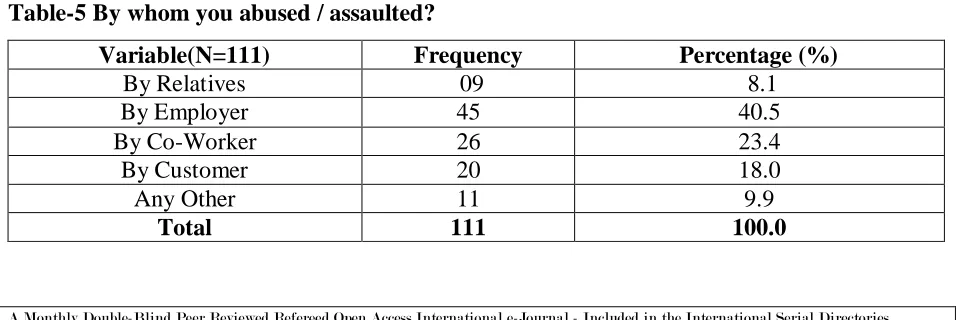
Table-5 By whom you abused / assaulted?
Variable(N=111) Frequency Percentage (%)
By Relatives 09 8.1
By Employer 45 40.5
By Co-Worker 26 23.4
By Customer 20 18.0
Any Other 11 9.9
Most of the child laborers (40.5%) were abused by their employer. While 23.4 percent were
abused by co-worker and 18.0 percent by their customer. Only 8.1 percent respondent stated that
they were abused by their own relatives. The highest figure shows that employer are use to
exploit their employees in any way.
Table-6 Knowledge regarding Organization who works on Child Labour/ child abuse
Residential Area Variable (N=250)
Knowledge regarding Organization
Yes No Total
No. (%) No. (%) No. (%)
Urban 2 (2.3) 84 (97.7) 86(100.0)
Rural 0(0.0) 133(100.0) 133 (100.0)
Slum 0(0.0) 31 (100.0) 31 (100.0)
Total 2(0.8) 248(99.2) 250(100.0)
When the children were asked whether they know any organization that works for the victims of
child abuse, the response was very depressing as only 0.8 percent respondent said yes, rest of the
respondents belonging from Rural & Slum areas were not having any idea about any
organization working in this field. The major finding of this analysis shows that those who were
aware about any organization belong to urban area.
Discussion- Ahmadkhaniha et al. in their study carried out in 2007 had stated that Abuse is a
universal problem, which negatively affects the physiological, psychological and social health of
the victim. UNICEF (2009), Kurt et al (2005), Baybuga and Celik (2004) and Hadi (2000) have
reported the reasons in their studies for working of children on the streets, socioeconomic factors
that contribute to children working on the streets and the various types of abuse that occur .
There is very few research carried out on physical abuse in India. A study of Physical
and Sexual Abuse and Behavioural Problems amongst boys in a Child Observation Home in
Delhi was conducted by Dr. Deepti Pagare, of Community Medicine, Maulana Azad Medical
College, New Delhi, as part of her doctoral dissertation revealed that About three-fourth (76.7%)
of subjects reported physical abuse.7 Similarly A research study in West Bengal conducted by
Save the Children and Tulir in 2006 on child domestic workers revealed that: Almost 70% of the
near about half of the children included in present study reported about physical abuse
experienced by them during their working times at work place.
While this study has not collected data on impact of severe physical abuse on the psyche of the
child but there can be no doubt that the effect of hurt, pain, anger, humiliation and loss of self-
esteem is enormous. Children who have been repeatedly subjected to physical abuse carry these
effects throughout their life and often also end up as perpetrators of violent acts for themselves or
for others.
The subject of child sexual abuse is still a taboo in India. There is a conspiracy of silence around
the subject and a very large percentage of people feel that this is a largely western problem and
that child sexual abuse does not happen in India. The WHO estimates that 150 million girls and
73 million boys under the age of 18 have experienced forced sexual intercourse or other forms of
sexual violence involving physical contact, though this is certainly an underestimated figure.
Much of this sexual violence is inflicted by family members or other people residing in or
visiting a child's family who are often responsible for their care and hence children normally
trust on them. A review of epidemiological surveys from 21 countries, mainly high- and middle-
income countries, found that at least 7% of females (ranging up to 36%) and 3% of males
(ranging up to 29%) reported sexual victimization during their childhood. According to these
studies, between 14% to 56% of the sexual abuse of girls, and up to 25% of the sexual abuse of
boys, was perpetrated by relatives or step parents.9Among different evidence groups, highest
percentage of children who faced sexualabuse were those at work (61.61%).10 Children exposed
to any of the types of abuse may develop mental health disorders. A study by Ahmadkhaniha et
al (2007) found 20.9% of children had been sexually abused and children diagnosed with
depression were 3.2 times more likely to have been sexually abused than children who were not
depressed.
Strength of our study is that the study area which we have selected, consist enough
numbers of child laborers and very few studies have been conducted in this region till now, so
there was a strong need to conduct this kind of study in this particular region. We have taken the
sample which has fair representative data of child laborers from each district.
Potential limitations of our study include that the issue on which we have focused in our
they are aware about the issue and how they interpret the conditions of Child abuse in their daily
life and what they exactly told us. As we have done a cross sectional study so we have to rely on
the data given by the respondents whose mind could be controlled by their employers or parents.
Conclusion
Only a small proportion of child abuse cases are ever reported to the police. One of the
most important reasons why children and their relatives choose not to come forward is a fear that
they will not be treated sympathetically. Indeed, many victims and the adults supporting them
endure terrible experiences that add to their trauma. These can include intimidating interviews by
police officers, degrading and painful medical examinations, and intimidation by perpetrators to
drop charges. Court cases too can be unpleasant experiences for the child since they can last for
years and involve stressful cross-examinations. This paper concludes that children have the right
to be protected against all types of abuse. Children should be educated to increase their
awareness about various types of abuse and they should also be provided with support by
government institutions. Furthermore, preventive measures should be adopted to reduce all types
of abuse against children.
References:
1. World Health Organization (1999): Report of the Consultation on Child Abuse
Prevention; Geneva, http://www.who.int/violence_injury_prevention/violence/neglect/en/
2. International Society for Prevention of Child Abuse and Neglect (2006): World
Perspectives on Child Abuse, Sixth Edition, http://www.ispcan.org
3. The Planning Commission, Government of India, “Report of the Working Group on
Child Rights for the 12th Five Year Plan (2012–2017),”
http://planningcommission.nic.in/aboutus/committee/wrkgrp12/wcd/wgrep_child.pdf
(accessed April 18, 2012), p. 8.
4. The Planning Commission, Government of India, “Report of the Working Group on
Child Rights for the 12th FiveYear Plan (2012 – 2017),” p. 15.
5. Sevilay Senol Celik and Media Subasi Baybuga, “Verbal, physical and sexual abuse among children working on the street”Australian Journal Of Advanced Nursing, Volume
6. Ahmadkhaniha, H., Shariat, S., Torkaman-Nejad, S. and Hoseini-Moghadam, M. 2007.
The frequency of sexual abuse and depression in a sample of street children of one of
deprived districts of Tehran. Journal of Child Sexual Abuse, 16(4):23-35.
7. Pagare, D. et. al. (2004): Sexual Abuse of Street Children Brought to an Observation
Home; Delhi.
8. Save the Children and Tulir (2006): Abuse among Child Domestic Workers- A Research
Study in West Bengal
9. op. cit (3)
10. Ministry of Women and Child Development, government of India, Study on Child