THE RELATIONSHIP BETWEEN PARENTING STYLE AND EARLY
MALADAPTIVE SCHEMAS IN IRAN AND INDIA: THE MEDIATING
ROLE OF AVOIDANCE COPING STYLE
Mahnaz Ghiasi1, Shirin Izadi2,
Maryam Khajouei Nia3, Farzaneh Mohammadi4 1
Ph.D. student of Psychology, University of Alzahra, Tehran, Iran (corresponding author) 2
M.A. of Psychology, Islamic Azad University- Science and Research Branch, Tehran, Iran 3
Ph.D. of Psychology, University of Mumbai, Mumbai, India 4
Ph.D. student of Clinical Psychology, Shahid Beheshti University of Medical Sciences and Health Services
ABSTRACT
Subject: Early maladaptive styles can have effects on the person’s function. Object: Comparing
the mediating role of avoidance coping style in the relationship between fathers and mothers’
parenting style and early maladaptive schemas. Method: The population in Iran included 376
students of the universities of Tehran. In India, also, 101 students of the University of Pune
participated in the study. Findings: Analysis of data indicated that avoidance coping style has a
mediating role in the relationship between fathers and mothers’ parenting style and early
maladaptive schemas in Iran and India.
Keywords: Avoidance coping style, Parenting style, Early maladaptive schemas, schema
approach, attachment
Introduction
It is more than a century (Makoubi, 1992, 2007) that psychologists have investigated a lot
of parental behaviors and have explored their significant impact on the thoughts, behaviors and
emotions of children. In terms of concept, research in this area is influenced by two theoretical
frameworks: one framework is in relation to Balby’s attachment theory (1980) and the works of
Ainsworth et al. (1978). This theory suggests that the nature of children's relationships with the International Research Journal of Human Resources and Social Sciences Vol. 4, Issue 1, January 2017 Impact Factor- 5.414 ISSN(O): (2349-4085) ISSN(P): (2394-4218)
© Associated Asia Research Foundation (AARF)
important people in their lives causes social, emotional and cognitive development. In this
regard, the method of "strange situation" is used to assess the quality of attachment. This method
ends in a secure attachment pattern and three insecure attachment patterns. Another framework is
the researches that examine the attitudes and actions of parents in the parenting process. This
area is affected by Baumrind’s examines (1991) that proposed three patterns of firm,
easy-consuming and authoritarian in relations between parents and children (Baumrind, 1991; Buri,
1991). Darling and Steinberg (1993) showed that parenting styles are structures that reflect the
nature of parent-child relationships.
Although, undoubtedly, there is an interaction between various aspects of parent-child
system, independent analysis of some aspects of parental action is also possible. One of these
aspects is parenting style schema that has a great effect on the parent-child relationships, and is
proposed in Young’s theory of Schema Therapy (1990). Following cognitive theories of
psychological vulnerability, Young presented this theory, in which he also defined early
maladaptive schemas. Young (1999) believes that early maladaptive schemas are in relation to
parenting style schemas, contain pervasive and profound patterns or themes, include memories,
emotions, cognitions, and body feelings, are formed in childhood or adolescence, are continuing
on the path of life, are about the self and in relation to others, and are seriously fail (Young et
al., 2003). With regard to parenting style, people try to use the reactions that can handle various
situations and conditions. Because the extreme excitement can expose some people to frustration,
some maladaptive coping styles and responses are originated in the person early in his life in
order to adapt to his schemas; but, although coping styles help avoidance from the schemas, they
will not improve them (Young et al., 2003). In schema therapy, behavior is not assumed as a part
of schema, but a part of coping responses (Young et al., 2003). One of the recent studies has
shown that safety behaviors can be divided into avoidance safety behaviors and contain low
self-disclosure and avoidance from eye contact (Plasencia et al., 2011). People often use automated
processes to avoid schemas coming up and then to avoid experiencing the emotion associated
with these schemas. Schema avoidance has three sorts, cognitive, emotional, and behavioral
avoidance. Cognitive avoidance refers to the automatic efforts to stop thoughts and mental
pictures that may incite painful schemas. Emotional avoidance is automatic or voluntary efforts
toblock or numb the feelings. Behavioral avoidance is the patient’s tendency for escape
Gonzalez Diez et al., (2012) found that avoidance coping style has a moderating role in the
relationship between the maladaptive schemas of adhesion and self-sacrifice. Khajooeinia and
Savani (2014) in a study reported that there is a correlation between subscales of avoidance
coping style and early maladaptive schemas. In an examination done by Can Gok and Gençöz
(2012), it was found that the domains of rejection schema and impaired limitations have
significant relation to avoidance coping style. On the other hand, coping styles had mediating
role in the relationship between the domains of schema and life satisfaction and psychological
damage. The findings show that people who get too little care and too much support get higher
scores in schemes.
Guntyand Buri(2008) in an examination of the parent’s function on three components of
kindness, control, and authority and formation of maladaptive schemas expressed that parent’s
function is a significant predictor for some domains of schemas such as disconnection / rejection
and impaired autonomy. Harris and Curtin (2002) in a study on the relationship among
recognition of parenting styles, early maladaptive schemas, and symptoms of depression in
young adults found that symptoms of depression and recognized parenting styles (in relation to
the components of kindness, control, and authority) have relations to each other through the
mediating role of Young’s schemas. The four schemes that most of the variance was accounted
for were: defectiveness / shame, low self-control, vulnerability and dependence / incompetence.
Wright et al. (2009) reported that the formation of the schemas can be influenced by parenting
styles and these formed schemas will be one of the reasons for psychological damage in the
future. According to Sheffield, Waller, Emanuelli et al. (2005) negative parenting style has
relationship with the formation of early maladaptive schemas.
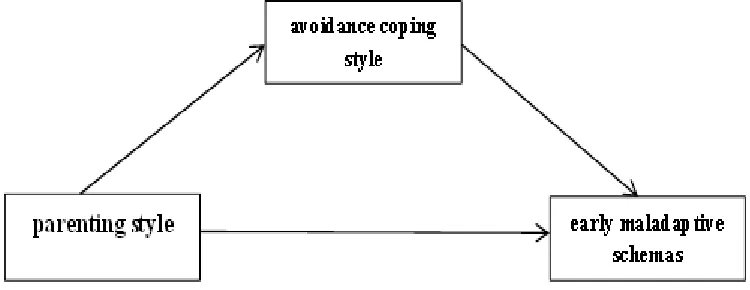
The relations of parenting style, avoidance coping style, and early maladaptive schemas are
shown in figure 1. Given the fact that the processes among these three variables have great
influence on the person’s function, it is necessary to study the relations among them. On the other hand, the schemas and coping styles are highly related to any society’s culture. Therefore,
the present study aims at comparing the relation of father and mother’s parenting style and early
maladaptive schemas to the mediating role of avoidance coping style in two counties of Iran and
Figure 1: Mediating role of avoidance coping style in the relationship between parenting style and early maladaptive schemas
Materials and Methods
The selected society for Iran consisted of students from universities in Tehran. In this
regard, the universities of Shahid Beheshti, Shahed, Kharazmi, and the University of Applied
Science and Technology, unit 31, were selected. The sample size included 376 students aged 18
to 56 years (mean = 24.32, SD = 6.77). Sampling was carried out using multi-stage cluster
sampling. In order to do the study in India, University of Pune was selected from the universities
of Pune. The sample size included 101 students aged 20 to 40 years (mean= 22.13, SD= 4.34).
Multi-stage cluster sampling was used for sampling.
Young Parenting Inventory (YPI): Young Parenting Inventory (1994) is an instrument to
recognize the roots of schemas in childhood, and reflects childhood environment that shaped the
schemas. This questionnaire has 72 items, in which the respondents respond to the questions
based on his parent’s treatment to him. 6-degree Likert scale was assumed for Young’s parenting
inventory. If in childhood, stepfather, stepmother, grandfather, grandmother or someone else as a
substitute for the respondents’ parents in their home, the questions should be answered according
to their treatments. Sheffield et al. (2005) reported Cronbach’s alpha to be 0.70 – 0.92 through
factor analysis. Also, the results of retest indicated high reliability and the structure’s validity
was achieved at an acceptable level. Yazdandoost et al. (2007), through split-half method,
reported reliability coefficient of 0.69 and 0.80 for the mother’s forma and the father’s form
Young Schema Questionnaire (YSQ- S3) (short form 3):Young Schema Questionnaire
(short form 3) assesses the schemas and has 90 items and evaluates all 18 schemas assumed by
Young. This questionnaire is according to 6 degrees of Likert scale (Young, 2005). The
reliability of the 75-item questionnaire (1998) was reported to be from 0.60 to 0.96 in the studies
of Sadooghi et al. (2008); Ahi et al. (2006); Welburn et al. (2002); Waller et al. (2001); Baranoff
et al. (2006); Rijkeboer et al. (2005); Cecero et al. (2004); Retin Meyer (1997); Rijkeboer, Van
Den Berg (2006); Li et al. (1999); and Glaser et al. (2002).Ghiasi et al. (2009) reported
Cronbach’s alpha of 0.94 for 90-item version. Schmidt et al. (1995) calculated the Dysfunctional
Attitude Scale correlation with long-form of this questionnaire to be 0.60 and in the study of
Rijkeboer et al. (2005) the discrimination was reported to be 87%.
Young-Rygh Avoidance Inventory (YRAI): Young-Rygh Avoidance Inventory has 41
items and is designed in 6 degrees to assess avoidance coping styles. Avoidance coping style is
often a universal trait that can be used to avoid any schema. According to this questionnaire,
avoidance coping styles are: deliberately not to think about unpleasant things, substance abuse,
denial of illness, extreme control and reasonability, suppression of anger, physical and
psychological symptoms, withdrawal and alienation from the people, denying memories,
avoidance by sleeping / lack of energy, distraction by engaging in various activities, self-relax
(eating, shopping, etc.), passive avoidance from unpleasant emotions, passive distraction –
dream, …, and avoidance from unpleasant situations (2005). Yazdandoost et al. (2007)
calculated the reliability of 0.79 for this questionnaire.
Demographic Characteristics Inventory: Demographic Characteristics Inventory contains
gender, age, marital status, education.
Findings
Descriptive statistics and hierarchical regression methods were used to analyze data. First,
normality and linearity of data was evaluated by Kolmogorov-Smirnov test and linear correlation
test; and desirability of these two assumptions was attained. The outlier data was omitted from
total data.
In relation to demographic information, as seen in table 1, in Iran and India respectively
72.30% and 66.30% of the sample consisted of women and 27.60% and 33.70% of the sample
and 1.44 in India. Marital status in Iran and India respectively consisted of 67% and 84.20%
[image:6.612.90.514.118.224.2]single and 27.90% and 15.80% married.
Table 1: demographic information of the sample in Iran and India education marital status sex SD Mean Single (%) Married (%) Male (%) Female (%) 41 / 1 27 / 14 % 67 % 90 / 27 % 60 / 27 % 30 / 72 Iran 44 / 1 71 / 16 % 20 / 84 % 80 / 15 % 70 / 33 % 30 / 66 India
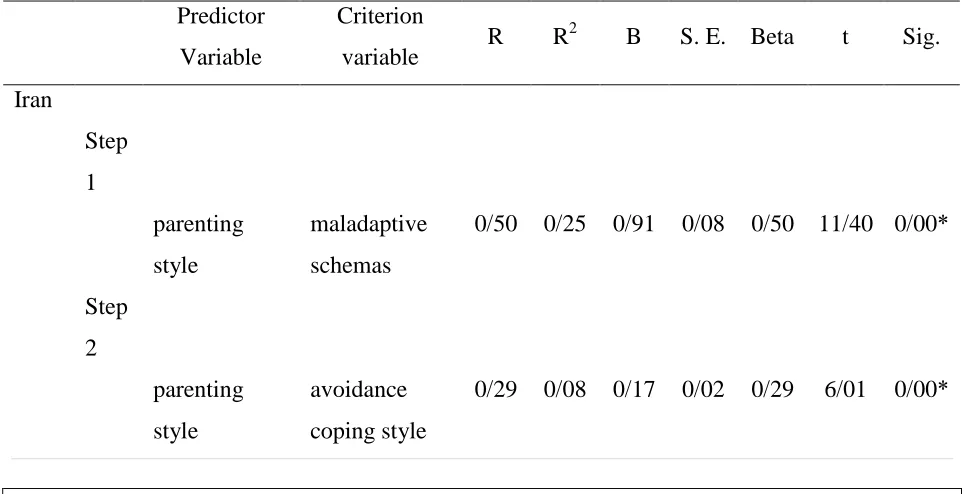
As seen in table 2, three steps of regression are significant both in Iran and in India.
Besides, reduction of beta coefficient in Iran is observed from the first step (0.50) to the third
step (0.35). In India, also, beta coefficient shows a significant reduction in the third step (0.48)
compared to the first step (0.59) (P < 0.05). These results indicate that avoidance coping style
has mediatory role in the relation between the mother’s parenting style and early maladaptive
schemas in both Iran and India.
Table 2: Hierarchical regression analysis to examine mediating role of avoidance coping style in the relationship between the mother’s parenting style and early maladaptive
schemas in Iran and India
Predictor
Variable
Criterion
variable R R 2
B S. E. Beta t Sig.
Iran Step 1 parenting style maladaptive schemas 50 /
0 0/25 0/91 0/08 0/50 11/40 0/00*
Step 2 parenting style avoidance coping style 29 /
[image:6.612.65.548.472.719.2]Step
3
parenting
style maladaptive
schemas 0/70 0/49
64 /
0 0/06 0/35 9/24 0/00*
avoidance
coping style
53 /
1 0/11 0/50 13/05 0/00*
India
Step
1
parenting
style
maladaptive
schemas
59 /
0 0/35 1/01 0/13 0/59 7/30 0/00*
Step
2
parenting
style
avoidance
coping style
43 /
0 0/18 0/30 0/06 0/43 4/80 0/00*
Step
3
parenting
style maladaptive
schemas 0/63 0/39
83 /
0 0/15 0/48 5/58 0/00*
avoidance
coping style
59 /
0 0/21 0/24 2/80 0/00*
P<0.05**
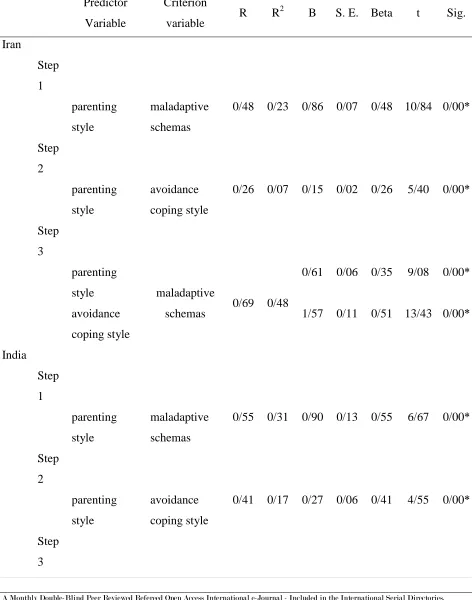
As seen in table 3, regression analysis in all three steps is significant in both Iran and India.
Beta coefficient reduced in the sample of Iran in the third step (0.35) compared to the first step
(0.48). In India, also, beta coefficient reduced from the first step (0.55) to the third step (0.44)
(P<0/05). Therefore, avoidance coping style has mediatory role in the relation between the
Table 3: Hierarchical regression analysis to examine mediating role of avoidance coping style in the relationship between the father’s parenting style and early maladaptive
schemas in Iran and India
Predictor
Variable
Criterion
variable R R 2
B S. E. Beta t Sig.
Iran Step 1 parenting style maladaptive schemas 48 /
0 0/23 0/86 0/07 0/48 10/84 0/00*
Step 2 parenting style avoidance coping style 26 /
0 0/07 0/15 0/02 0/26 5/40 0/00*
Step
3
parenting
style maladaptive
schemas 0/69 0/48
61 /
0 0/06 0/35 9/08 0/00*
avoidance
coping style
57 /
1 0/11 0/51 13/43 0/00*
India Step 1 parenting style maladaptive schemas 55 /
0 0/31 0/90 0/13 0/55 6/67 0/00*
Step 2 parenting style avoidance coping style 41 /
0 0/17 0/27 0/06 0/41 4/55 0/00*
Step
parenting
style maladaptive
schemas 0/60 0/37
72 /
0 0/14 0/44 5/04 0/00*
avoidance
coping style
65 /
0 0/21 0/27 3/06 0/00*
P<0.05**
Conclusion
The objective of the present study was to compare the mediating role of avoidance coping
style in the relationship between father and mother’s parenting style and early maladaptive
schemas in Iran and India.
Data analysis resulted in the significant mediating role of avoidance coping style in the
relationship between the father and mother’s parenting style and early maladaptive schemas in
Iran and India. The findings of this study was compatible with the findings by Sheffieldet al.
(2005), Wright, et al. (2009), Guntyand Buri(2008), Khajooeinia and Savani (2014), Baranoffand
Tian (2006), Harris and Curtin (2002), Cangog and Gankaz (2012), and Gonzalez Diezet al.
(2012).
Bowlby(1980) believes that the disorders that occur in the early stages of growth are
effective in subsequent periods and makes the person vulnerable against threats. Insecure
attachment and formation of schemas that are resulted from parent-child relationship are
assumed as one of the results of the created vulnerability. Because in these circumstances,
bothersome emotions and cognitions are formed, the person tends to avoidance coping strategy
to avoid them (Salavati and Yekeyazdan doost, 2010). This getaway is effective in the short term
but in the long run it will lead to staying and strengthening of sustainable and stable themes, such
as early maladaptive schemas. The more of this strategy, the early maladaptive schemas become
more durable, and even it is possible that conditioned schemas (Young et al., 2003) that are
associated with the unconditioned schemas be created.
In some families in Iran, from the early childhood, emphasis is placed on maintaining
interpersonal relationships especially with close people and also on emotional inhibition. The
child internalizes the issue that he should block his emotions and expressing his real wills. In
these environments, the people are possible to tent to maladaptive strategies such as avoidance
coping strategy. In India, also, since in many families, the husband and wife live with their
expectations that govern such relationships and to maintain restraint, some may use this strategy.
But in the long run, this strategy strengthens their schemas.
In the present study, the experimental evaluation of the relationships among the variables
was impossible. Besides, because some of the students of the universities of Tehran were from
other cities of Iran, the influence of culture could not be controlled. It is suggested that in further
studies the effect of schema mentality along with other variables in this study. Moreover, it is
useful to study the model of the variables of the schema therapy theory.
Acknowledgements
The researchers of the present study would like to appreciate sincere cooperation of the
authorities of the universities of Shahid Beheshti, Shahed, Kharazmi, and the University of
Applied Science and Technology, unit 31, and Pune University, and all the students who
answered the questionnaires.
References
Ahi, gh., Salimi Zadeh, M. K. and Borj Ali, A. (2007). The standardization of Young Schema
Questionnaire- Short Form. Master’s thesis, University of allameh Tabatabaee, Iran.
Ainsworth, M.S., Blehar, M.C., Waters, E. and Wall, S., (1978), “Patterns of attachment: A
psychological study of the strange situation”. Oxford, UK: Erlbaum.
Baranoff, J., Oei, T.P.S, Cho, S.H. and Kwon, S., (2006), “Factor structure and internal
consistency of the Young Schema Questionnaire (short form) in Korean and Australian
samples”, Journal of Affective Disorder, 93, pp. 133- 140.
Baumrind, D., (1991), “Parenting styles and adolescent development”. In: Brooks-Gunn, J.,
Lerner, R., Peterson, A.C. (Eds.). The Encyclopedia of Adolescence.
Bowlby, J., (1980), “Attachment and loss: Sadness and depression. New York: Basic Books. Buri, J.R., (1991), “Parental Authority Questionnaire, Journal of Personality and Social
Assessment, 57, pp. 109-110.
Can Gok, A. and Gençöz, T., (2012), “Associated factors of psychological well-being: early
maladaptive schemas, schema coping processes, and parenting styles”, A thesis submitted to
Cecero, J.J., Nelson, J.D. and Gillie, J.M., (2004), “Tools and tenets of schema therapy : Toward
the construct validity of the Early Maladaptive Schema Questionnaire- Research Version
(EMSQ-R)”, Journal of Clinical Psychology and Psychotherapy, 11, pp.344-357.
Darling, N.S. and Steinberg, L., (1993), “Parenting style as context: An integrative model”,
Psychological Bulletin, Vol. 1113, No. 3, pp. 487-96.
Ghiasi, m., Neshat doost, H. T., molavi, H. and Salavati, M. (2009). The psychometric properties
of Persian version of Young Schema Questionnaire- S3 in two groups of non- clinical and
clinical samples. The article in press.
Glaser, B.A., Campbell, L.F., Calhoun, G.B., Bates, G.M. and Petrocelli, J.V., (2002), “The early
maladaptive schema questionnaire- short form: a construct validity study”, Measurement
and Evaluation in Counseling and Development, Vol. 35, No. 1, pp. 2-13.
Gonzalez Diez, Z., Calvete Zumalde, E. and Orue Sola,I., (2012), “Early maladaptative schemas
and social anxiety: the moderating effect of avoidant Vs. overcompensation coping”,
Abstracts of the 20th European Congress of Psychiatry. European Psychiatry, Vol. 27, No.
1, pp. 1.
Gunty, Buri., (2008), “Parental practices and the development of maladaptive schemas” Online
submission, Paper presented at the Annual Meeting of the Midwestern Psychological
Association (Chicago, IL, May 2008), pp. 33.
Harris, A.E. and Curtin, L., (2002), “Parental perceptions, early maladaptive schemas, and depressive symptoms in young adults”, Journal of Cognitive Therapy and Research, Vol. 26,
No. 3, pp. 405-416.
Khajouei Nia, M. and Sovani, A., (2014), “Cross Cultural Comparison Role of Early
Maladaptive Schemas and Coping Styles between Women with Depressive Symptoms in
Iran and India”, Journal of Applied Environmental and Biological Sciences, Vol. 4, No. 2,
pp. 57-67.
Lee, C.W., Taylor, G. and Dunn J., (1999), “Factor structure of the schema Questionnaire in a
large clinical samples”, Journal of Cognitive Therapy and Research, Vol. 23, No. 4, pp.
441-451.
Maccoby, E.E., (1992), “The role of parents in the socialization of children: An historical overview”, Developmental Psychology, Vol. 28, No. 6, pp. 1006-1017.
Maccoby, E.E., (2007), “Historical Overview of Socialization Research and Theory. New York,
Plasencia, M.L., Alden, L.E. and Taylor, C.T., (2011), “Differential effects of safety behaviour subtypes in social anxiety disorder”, Behaviour Research and Therapy, 49, pp. 665-675. Rijkeboer, M.M. and Van Den Bergh, H., (2006), “Multiple group confirmatory factor analysis
of the young schema- Questionnaire in a Dutch clinical versus Normal population”, Journal
of Cognitive Therapy and Research, Vol. 30, No. 3, pp. 263- 278.
Rijkeboer, M.M., Van Den Bergh, H. and Van Dan Bout, J., (2005), “Stability and discriminative power of young schema questionnaire in a Dutch clinical versus no clinical population”,
Journal of Behavior Therapy and Experimental Psychiatry, 36, pp. 129-144.
Rittenmeyer, G.J., (1997), “The relationship between early maladaptive schemas and job burnout among public school teachers”, Dissertations Abstract International 58, 5A.
Sadughi, Z., Agilar- Vafaee, M., Rasool Zadeh Tabatabaee, K., and Isfahanian, N. (2009). The
factor analysis of Young Schema Questionnaire- short form in Iranian . non- clinical
sample. Journal of Psychiatry and Clinical Psychology, 2, pp. 2214- 219.
Salavati, M. and Yazdandoost, R. (2007). Schema therapy. Tehran: Danjeh.
Schmidt, N.B., Joiner, T.E., Young, J.E. and Telch, MJ., (1995), “The schema Questionnaire:
Investigation of psychometric properties and the hierarchical structure of a measure of
maladaptive schemas”, Journal of Cognitive Therapy and Research, Vol. 19, No. 3, pp.
295-321.
Shah, R. and Waller, G., (2000), “Parental style and vulnerability to depression: the role of core beliefs”, Journal of Nervous and Mental Diseases, Vol. 188, No. 1, pp. 19-25.
Sheffield, A., Waller, G., Emanuelli, F., Murray, J. and Meyer, C., (2005), “Links between
parenting and core beliefs- preliminary psychometric validation of the Young Parenting
Inventory”, Journal of Cognitive Therapy and Research, Vol. 29, No. 6, pp. 791- 806.
Waller, G., Meyer, C. and Ohanian, V., (2001), “Psychometric properties of the long and short
versions of the Young schema Questionnaire: Core Beliefs Among Bulimic and Comparison
Women”, Journal of Cognitive Therapy and Research, Vol. 25, No. 2, pp. 137-147.
Welburn, K., Coristine, M., Dagg, P., Pontefract, A. and Jordan S., (2002), “The schema
Questionnaire-short form: Factor analysis and relationship between schemas and
Wright, M.O., Crawford, E. and Castillo, D.D., (2009), “Childhood emotional Maltreatment and
later psychological distress among college students: The mediating role of maladaptive
schemas”, Child abuse and neglect, Vol. 33, No. 1, pp 59-68.
Yazdandoost, R., Atef, V.,Mohammad, K. and Salavati, M. (2007). Dominant schemas and
effectiveness of schema therapy for women with borderline personality disorder. Ph.D.
thesis in Clinical Psychology. Tehran Psychiatric Institute, Tehran University of Medical
Sciences and Health Services.22. Young, J.E., (2005), “Schema therapy-complete packet”,
Cognitive centers of New York and Connecticut.
Young, J.E., (1990), “Cognitive therapy for personality disorders: A schema focused approach.
Sarasota, FL: Professional Resource Press.
Young, J.E., (1994), Young Parenting Inventory. New York: Cognitive Therapy Centre.
Available from http://www.schematherapy.com.
Young, J.E., (1998), “Young schema questionnaire Short Form. New York: Cognitive Therapy
Center.
Young, J.E., (1999), “Cognitive therapy for personality disorders: A schema focused approach”
(rev. Ed). Sarasota, FL: Professional Resources Press.
Young, J.E., Klosko, J.S. and Weishaare, M.E., (2003), “Schema therapy, a practitioner’s guide”.
New York: Guilford Press.
Young, J.E. and Rygh, J., (1994), “Young- Rygh Avoidance Inventory”. New York: Cognitive