Application of a New Spirometric Reference Equation and
Its Impact on the Staging of Korean Chronic Obstructive
Pulmonary Disease Patients
Yong Il Hwang, Eun Ji Kim, Chang Youl Lee, Sunghoon Park, Jeong Hee Choi, Yong Bum Park,
Seung Hun Jang, Cheol Hong Kim, Tae Rim Shin, Sang Myeon Park, Dong-Gyu Kim,
Myung-Goo Lee, In-Gyu Hyun, and Ki-Suck Jung
Division of Pulmonary, Allergy and Critical Care Medicine, Department of Internal Medicine, Hallym University Medical Center, Anyang, Korea.
Received: February 22, 2011 Revised: May 4, 2011 Accepted: May 6, 2011
Corresponding author: Dr. Ki-Suck Jung, Division of Pulmonology, Allergy and Critical Care Medicine, Department of Internal Medicine, Hallym University Medical Center, 896 Pyeongchon-dong, Dongan-gu, Anyang 431-070, Korea.
Tel: 82-31-380-3715, Fax: 82-31-380-3973 E-mail: [email protected]
∙ The authors have no financial conflicts of interest.
© Copyright:
Yonsei University College of Medicine 2012 This is an Open Access article distributed under the terms of the Creative Commons Attribution Non-Commercial License (http://creativecommons.org/ licenses/by-nc/3.0) which permits unrestricted non-commercial use, distribution, and reproduction in any medium, provided the original work is properly cited.
Purpose: A new spirometric reference equation was recently developed from the first national chronic obstructive pulmonary disease (COPD) survey in Korea. How-ever, Morris’ equation has been preferred for evaluating spirometric values instead. The objective of this study was to evaluate changes in severity staging in Korean COPD patients by adopting the newly developed Korean equation. Materials and Methods: We evaluated the spirometric data of 441 COPD patients. The presence of airflow limitation was defined as an observed post-bronchodilator forced expiratory volume in one second/forced vital capacity (FEV1/FVC) less than 0.7, and the sever-ity of airflow limitation was assessed according to GOLD stages. Spirometric values were reassessed using the new Korean equation, Morris’ equation and other refer-ence equations. Results: The severity of airflow limitation was differently graded in 143 (32.4%) patients after application of the new Korean equation when compared with Morris’ equation. All 143 patients were reallocated into more severe stages (49 at mild stage, 65 at moderate stage, and 29 at severe stage were changed to moder-ate, severe and very severe stages, respectively). Stages according to other reference equations were changed in 18.6-49.4% of the patients. Conclusion: These results in-dicate that equations from different ethnic groups do not sufficiently reflect the air-flow limitation of Korean COPD patients. The Korean reference equation should be used for Korean COPD patients in order to administer proper treatment.
Key Words: Spirometry, reference equation, COPD, diagnosis, stage
INTRODUCTION
Chronic obstructive pulmonary disease (COPD) is characterized by airflow limita-tion which is not fully reversible.1 Spirometry is essential for diagnosis and provides
a useful description of the severity of pathological changes in COPD patients. The ratio of forced expiratory volume in one second (FEV1) to forced vital capacity
spi-hospitals affiliated with Hallym University Medical School, in Korea. Stable COPD patients who visited any of the five hospitals and took the spirometry test at least one time in 2006 were enrolled. The presence of airflow limitation was defined as observed post-bronchodilator FEV1/FVC less
than 0.7. Patients who showed parenchymal change such as lung fibrosis and volume loss or pleural thickening upon chest radiography were excluded. Patients with bronchiec-tasis were also excluded.
Methods
Each of the five hospitals used the same type of spirometer for all subjects. Spirometry was performed by specially trained technicians according to the 1994 American Thorac-ic Society recommendations.7 The study protocol was
ap-proved by the ethics committee of Hallym University Sa-cred Heart Hospital, in Anyang, Korea.
We applied the new Korean spirometric equation to all subjects. We evaluated the change of disease severity by adopting the new Korean equation in COPD patients and obtained new predictive spirometric values. We were thus were able to reclassify the disease severity.
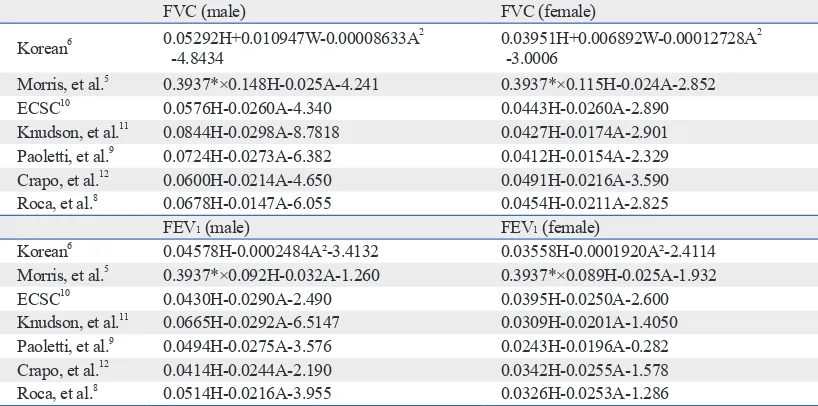
We also applied another five western reference equations to our study subjects. We compared the disease severities of each reference equation. The severity of airflow obstruction was classified according to the GOLD guidelines. The ref-erence equations used in this study are shown in Table 1.8-12
All data are expressed as means and standard deviations or frequencies. A chi-square test was performed to assess rometric cut-point (e.g. post-bronchodilator FEV1/FVC <0.7)
has been used for diagnosing COPD, after the Global Initia-tive for Chronic ObstrucInitia-tive Lung Disease was introduced.2,3
GOLD recommended a simple classification of disease se-verity into 4 stages based on airflow limitation using the spe-cific FEV1 cut-points (e.g. <80, 50, or 30% predicted).1
Interpretation of spirometry is based on comparisons of data obtained in an individual patient or subject with refer-ence (predicted) values. Ideally, the referrefer-ence values are calculated with equations derived from measurements ob-served in a representative sample of healthy subjects in a general population.4 Morris’ reference equation, which was
derived from a large number of Mormons,5 has been used
as a reference equation for spirometry in Korea.
Recently, a new reference equation for spirometry was developed from the first national COPD survey in Korea. The survey was conducted in conjunction with the second Korean National Health and Nutrition Examination Survey (Korean NHANES II).6 Notwithstanding, Morris’ equation
is still used for spirometric reference values. The objective of this study was to evaluate changes in disease severity stag-ing among Korean COPD patients by adoptstag-ing the newly developed Korean equation.
MATERIALS AND METHODS
Study subjects
[image:2.595.85.494.496.699.2]We constructed a COPD patient cohort retrospectively in 5
Table 1. Reference Equations Examined in the Present Study
FVC (male) FVC (female)
Korean6 0.05292H+0.010947W-0.00008633A2
-4.8434 0.03951H+0.006892W-0.00012728A
2 -3.0006
Morris, et al.5 0.3937*×0.148H-0.025A-4.241 0.3937*×0.115H-0.024A-2.852
ECSC10 0.0576H-0.0260A-4.340 0.0443H-0.0260A-2.890
Knudson, et al.11 0.0844H-0.0298A-8.7818 0.0427H-0.0174A-2.901
Paoletti, et al.9 0.0724H-0.0273A-6.382 0.0412H-0.0154A-2.329
Crapo, et al.12 0.0600H-0.0214A-4.650 0.0491H-0.0216A-3.590
Roca, et al.8 0.0678H-0.0147A-6.055 0.0454H-0.0211A-2.825
FEV1 (male) FEV1 (female)
Korean6 0.04578H-0.0002484A²-3.4132 0.03558H-0.0001920A²-2.4114
Morris, et al.5 0.3937*×0.092H-0.032A-1.260 0.3937*×0.089H-0.025A-1.932
ECSC10 0.0430H-0.0290A-2.490 0.0395H-0.0250A-2.600
Knudson, et al.11 0.0665H-0.0292A-6.5147 0.0309H-0.0201A-1.4050
Paoletti, et al.9 0.0494H-0.0275A-3.576 0.0243H-0.0196A-0.282
Crapo, et al.12 0.0414H-0.0244A-2.190 0.0342H-0.0255A-1.578
Roca, et al.8 0.0514H-0.0216A-3.955 0.0326H-0.0253A-1.286
ECSC, European Coal and Steel Community; FVC, forced vital capacity; FEV1, forced expiratory volume in one second; H, height (cm); A,
age (years); W, weight (kg).
classified into GOLD stage 2 or 3 irrespective of the refer-ence equation used. Interestingly, 15.4% of the study subjects were classified as GOLD stage 4 after adopting the new Ko-rean equation. This figure is the highest among the equations.
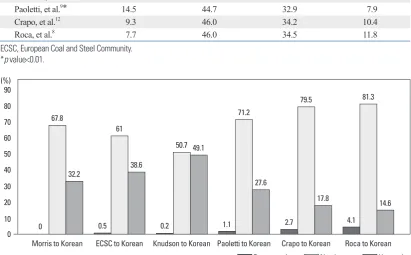
We also evaluated changes in the GOLD stages after ap-plying the new Korean reference equation, which were ini-tially obtained from other reference equations. The changes in GOLD stages occurred in 18.6% to 49.4% of the sub-jects. Most were moved into more severe stages (Fig. 1).
Comparison between the new Korean equation and Morris’ equation
The mean FEV1 and FVC of the predicted values were 58.9±
22.2% and 88.2±21.3% respectively, when using Morris’ equation. When the new Korean equation was applied, the values of FEV1 and FVC of the predicted value decreased
to 49.7±18.7% and 76.6±18.3%, respectively. The numbers of COPD patients of each stage are illustrated in Fig. 2.
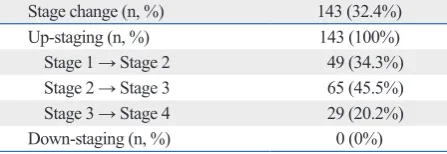
A total of 143 subjects (32.4%) were classified differently in their GOLD stages after application of the new Korean equation when compared with Morris’ equation (Table 3). the change of disease severity by comparing them with the
new Korean equation. A p-value of <0.05 was considered statistically significant.
RESULTS
A total 819 subjects were initially screened as having pre-bronchodilator FEV1/FVC <0.7. After meticulous review of
chest radiographies by five pulmonologists, a total of 203 sub-jects were excluded. Then, subsub-jects without post-bronchodila-tor spirometry results were excluded. A total of 441 subjects were enrolled in this study in the end (male : female=379 : 62). The median age of the subjects was 68 year of age (range 40-100 years). The mean values of FEV1 and FVC in men
were 1.47±0.60 L and 2.99±0.90 L, respectively.
Distribution of the severity of airflow obstruction according to each reference equation
[image:3.595.99.511.448.703.2]The GOLD stages of the study subjects according to each reference equation are shown in Table 2. Most of them were
Table 2. Distribution of GOLD Stages according to Each Equation (%)
Stage 1 Stage 2 Stage 3 Stage 4
Korean6 6.8 40.8 37.0 15.4
Morris, et al.5* 17.9 44.4 29.8 8.8
ECSC10* 18.6 46.3 29.5 5.7
Knudson, et al.11* 25.2 43.3 26.5 5.0
Paoletti, et al.9* 14.5 44.7 32.9 7.9
Crapo, et al.12 9.3 46.0 34.2 10.4
Roca, et al.8 7.7 46.0 34.5 11.8
ECSC, European Coal and Steel Community. *p value<0.01.
Fig. 1. Changes of COPD stage after application of the newly developed Korean equation. COPD, chronic obstructive pulmonary disease; ECSC, European Coal and Steel Community.
0 10 20 30 40 50 60 70 80 90 (%)
Morris to Korean ECSC to Korean Knudson to Korean Paoletti to Korean Crapo to Korean Roca to Korean Down staging No change Up staging 0
32.2 38.6
49.1
27.6
17.8 14.6
67.8
61
50.7
71.2
79.5 81.3
stages obtained by traditional reference equations, especial-ly Morris’ equation. This change occurred in 32.4% of COPD patients. All patients were reallocated into more severe stag-es. Therefore, the proportion of severe to very severe pa-tients was changed from 38.6% to 52.4% (Table 2). This finding is contrary to the conventional concept that Asian spirometry values are lower than European-Americans,14,15
but is predictable because the normal value from the new Korean reference equation is greater than that of Morris’ equation.6 Similar results were found for the GOLD stages
obtained by other reference equations (Fig. 1). These find-ings confirm the importance of reference equations for indi-vidual ethnicities.
In 2001, a new Korean reference equation for spirometry was developed in the Korean NHANES II;6 however, this
new equation is not used routinely in practice and is used only for research purposes. A detailed review of the factors explaining why the new Korean equation is not used rou-tinely, however, was beyond the scope of this study. To our knowledge, this study was the first to compare the different reference equations for spirometry in COPD patients in Ko-rea. Oh, et al.16 reported that the application of the newly
developed Korean equation affected the interpretation of the spirometric data. They found that 23.2% of subjects were interpreted differently after application of the new Ko-rean equation. Their study included a large number of healthy subjects who performed spirometry for the purpose of preoperative screening. Taking in consideration these re-sults altogether, it showed indirectly that application of equations from different ethnic groups did not sufficiently reflect pulmonary function, especially in diseased persons.
We used the fixed ratio of post-bronchodilator FEV1/FVC
less than 0.7 for the diagnosis of COPD. However, because the process of aging does affect lung volumes, there has All of them were reallocated into more severe stages (49 at
stage 1, 65 at stage 2, and 29 at stage 3 were changed to stage 2, stage 3 and stage 4, respectively).
DISCUSSION
Spirometry is essential for diagnosis of COPD and provides a useful description of the severity of pathological changes in COPD patients. The spirometry result should be inter-preted by comparison with reference (predicted) values. Predicted values should be obtained from studies of ‘‘nor-mal’’ or ‘‘healthy’’ subjects with the same anthropometrics (e.g. sex, age and height) and, where relevant, ethnic char-acteristics of the patient being tested.4 Application of
differ-ent reference values in nonasthmatic young adults showed a marked difference in both predicted FVC and FEV1.13 It is
also known that Asian-Americans have a significantly low-er FVC and FEV1 than European-Americans for the same
height, independent of level of fitness or length of residence, representing a true physiologic difference between ethnici-ties.14 That being so, there was a concern that the use of
[image:4.595.89.498.66.214.2]ref-erence equations based on other ethnicities might lead to misinterpretation of the spirometric data, especially in a dis-eased person. We found that the application of the new Ko-rean reference equation for spirometry changed the GOLD
Table 3. Changes of GOLD Stages from Morris’ Equation to the New Korean Equation
Stage change (n, %) 143 (32.4%)
Up-staging (n, %) 143 (100%)
Stage 1 → Stage 2 49 (34.3%)
Stage 2 → Stage 3 65 (45.5%)
Stage 3 → Stage 4 29 (20.2%)
[image:4.595.57.281.277.354.2]Down-staging (n, %) 0 (0%)
Fig. 2. Distribution of COPD severity according to the newly developed Korean equation and Morris’ equation. COPD, chronic obstructive pulmonary disease.
0 (%)
10 20 30 40 50
Stage 1 Stage 2 Stage 3 Stage 4
Korean Morris 6.8
40.8
37
15.4 17.9
44.4
29.8
ACKNOWLEDGEMENTS
The study was designed and the protocol developed by YI Hwang, EJ Kim. CY Lee, S Park, JH Choi, YB Park, SH Jang, CH Kim, TR Shin, SM Park, DG Kim, MG Lee, IG Hyun were responsible for coordinating the study. KS Jung worked as principal investigators. The results were interpret-ed by YI Hwang and KS Jung. The manuscript was draftinterpret-ed by YI Hwang and EJ Kim. All authors gave substantial criti-cal input in revising the manuscript.
REFERENCES
1. Fromer L, Cooper CB. A review of the GOLD guidelines for the diagnosis and treatment of patients with COPD. Int J Clin Pract 2008;62:1219-36.
2. Fabbri LM, Hurd SS; GOLD Scientific Committee. Global Strate-gy for the Diagnosis, Management and Prevention of COPD: 2003 update. Eur Respir J 2003;22:1-2.
3. Celli BR, MacNee W; ATS/ERS Task Force. Standards for the di-agnosis and treatment of patients with COPD: a summary of the ATS/ERS position paper. Eur Respir J 2004;23:932-46.
4. Pellegrino R, Viegi G, Brusasco V, Crapo RO, Burgos F, Casaburi R, et al. Interpretative strategies for lung function tests. Eur Respir J 2005;26:948-68.
5. Morris JF, Koski A, Johnson LC. Spirometric standards for healthy nonsmoking adults. Am Rev Respir Dis 1971;103:57-67. 6. Choi JK, Paek D, Lee JO. Normal predictive values of spirometry
in Korean population. Tuberc Respir Dis 2005;58:230-42. 7. Standardization of Spirometry, 1994 Update. American Thoracic
Society. Am J Respir Crit Care Med 1995;152:1107-36.
8. Roca J, Sanchis J, Agusti-Vidal A, Segarra F, Navajas D, Rodri-guez-Roisin R, et al. Spirometric reference values from a Mediter-ranean population. Bull Eur Physiopathol Respir 1986;22:217-24. 9. Paoletti P, Pistelli G, Fazzi P, Viegi G, Di Pede F, Giuliano G, et al.
Reference values for vital capacity and flow-volume curves from a general population study. Bull Eur Physiopathol Respir 1986; 22:451-9.
10. Standardized lung function testing. Report working party. Bull Eur Physiopathol Respir 1983;19 Suppl 5:1-95.
11. Knudson RJ, Lebowitz MD, Holberg CJ, Burrows B. Changes in the normal maximal expiratory flow-volume curve with growth and aging. Am Rev Respir Dis 1983;127:725-34.
12. Crapo RO, Morris AH, Gardner RM. Reference spirometric val-ues using techniqval-ues and equipment that meet ATS recommenda-tions. Am Rev Respir Dis 1981;123:659-64.
13. Roca J, Burgos F, Sunyer J, Saez M, Chinn S, Antó JM, et al. Ref-erences values for forced spirometry. Group of the European Com-munity Respiratory Health Survey. Eur Respir J 1998;11:1354-62. 14. Korotzer B, Ong S, Hansen JE. Ethnic differences in pulmonary
function in healthy nonsmoking Asian-Americans and European-Americans. Am J Respir Crit Care Med 2000;161:1101-8. 15. Aelony Y. Ethnic norms for pulmonary function tests. Chest
1991;99:1051.
been a concern of over diagnosis of COPD in the elderly, especially of mild disease, when using fixed ratio. Using the lower limit of normal (LLN) values for FEV1/FVC is one
possible way to minimize the potential misclassification of these patients.17-22 There were some reports that showed the
use of LLN criteria for COPD decreased the prevalence of COPD.21,22 We also reassessed the presence of airflow
ob-struction using the LLN criteria, for which a reference equa-tion had been recently developed.21 Only three patients showed
a FEV1/FVC ratio above the LLN. Interpretation of the
spi-rometry results of these three patients was altered into a re-strictive ventilator pattern instead of an obstructive pattern. All of them were older than 80 years. This finding confirms the importance of the application of ethnicity-based refer-ence equations as well as the use of the LLN for airflow ob-struction.
This study has some limitations. Since this study was ret-rospectively designed, the change of COPD stage did not affect management strategies according to the guideline (i.e. regular use of bronchodilator or adding inhaled cortico-steroids, etc.). More importantly, the impact of COPD on an individual patient depends not just on the degree of air-flow limitation, but also on the severity of symptoms (espe-cially breathlessness and decreased exercise capacity). Spi-rometry for measuring pulmonary function in this study reflects only the degree of airway limitation. Spirometric staging is a pragmatic approach aimed at practical imple-mentation and should only be regarded as an educational tool and a general indication to the initial approach to man-agement. Since we did not evaluate the severity of symp-toms in this study, we could not conclude that management strategies by application of the newly developed Korean reference equation had any benefits on management of COPD patients compared with Morris’ equation.
125-33.
20. Ra SW, Oh JS, Hong SB, Shim TS, Lim CM, Koh YS, et al. Ef-fect of the changing the lower limits of normal and the interpreta-tive strategies for lung function tests. Tuberc Respir Dis 2006;61: 129-36.
21. Celli BR, Halbert RJ, Isonaka S, Schau B. Population impact of different definitions of airway obstruction. Eur Respir J 2003; 22:268-73.
22. Hwang YI, Kim CH, Kang HR, Shin T, Park SM, Jang SH, et al. Comparison of the prevalence of chronic obstructive pulmonary disease diagnosed by lower limit of normal and fixed ratio criteria. J Korean Med Sci 2009;24:621-6.
16. Oh YM, Hong SB, Shim TS, Lim CM, Koh Y, Kim WS, et al. Ef-fect of a new spirometric reference equation on the interpretation of spirometric patterns and disease severity. Tuberc Respir Dis 2006;60:215-20.
17. Hardie JA, Buist AS, Vollmer WM, Ellingsen I, Bakke PS, Mørkve O. Risk of over-diagnosis of COPD in asymptomatic el-derly never-smokers. Eur Respir J 2002;20:1117-22.
18. Hankinson JL, Odencrantz JR, Fedan KB. Spirometric reference values from a sample of the general U.S. population. Am J Respir Crit Care Med 1999;159:179-87.