INCOME VS FREQUENCY OF USING THE TECHNOLOGY
ORIENTED BANKING SERVICES
Dr. S. Valli Devasena, Assistant Professor of Commerce, Mother Teresa Women’s University,
Kodaikanal-624 102, India.
ABSTRACT
The customer choice and awareness have been increasing tremendously during this
decade due to more open economy, the advent of information technology and media
revolution, besides hectic competition for resources by banks. As markets have become
increasingly competitive, customers can now immediately go elsewhere if they do not get
what they want. Continuous improvement, gaining the competitive edge, increased market
share, higher profits-none of these things is possible unless businesses can find new ways of
maintaining the loyalty of existing customers.
It takes only a few incidents and direct experiences for the knowledgeable customers to
form an opinion about the quality of the services and the quality of the product offered.
Hence, “customer service is not being viewed as just a business strategy but should become a corporate mission.”
Introduction
Technology has brought a complete paradigm shift in the functioning of banks and delivery of banking services. Gone are the days when every banking transaction required a visit to the bank branch. Today, most of the transactions can be done from the home and customers need not visit the bank branch for anything. Technology is no longer an enabler, but a business driver. The growth of the internet, mobiles and communication technology has added a different dimension to banking. The information technology (IT) available today is being leveraged in customer acquisitions, driving automation and process efficiency, delivering ease and efficiency to customers.
Raja et al. (2008) evaluated the impact of e-payment system on the business opportunities. They identified that due to the growth of internet users, various electronic payment mechanisms had been developed to cater the diversity of applicants. The researchers classified the e-payments into three main groups, namely, cash like systems, check like systems, and hybrid systems which were further classified into credit cards, debit cards check like systems, and hybrid systems which were further classified into credit cards, and electronic cheques. They identified three main issues related to e-payment were security issues, low interest among businessmen, and heavy reliance on traditional payment methods. They also analyzed that there were technical and cultural problems which hinder the path of e-payments. However, to make e-payments more effective, security threats should be reduced; and people should be realized that traditional payment methods were more time consuming than electronic payment methods. They should also be realized that plastic card payments were more convenient, easier and more secure than cash or cheques.
Sarangapani and mamtha (2008b) studied the impact of information technology on banking sector and its security related aspects. Due to recent developments in banking industry and with introduction of basel-i and ii implementation; customers are more demanding now and it requires innovation in banking services. The researchers found that now the banking industry has been more customer-oriented with unlimited market place, extensive product breadth and e-enabled services provided to the customers. The it initiatives in banking industry have resulted into reduction of time. Introduction of negotiated dealing system, screen based trading and RTGS for online settlement of inter-bank transfers of fund had also resulted into safe, secure and quick movements of funds. The authors also studied e-security aspects of banking which pose damage and threat to the existing e-banking system. It includes unauthorized access to computer system or network, stealing information, e-mail bombing, data diddling, denial of service, viruses, etc. The authors concluded that existing legal framework was adequate to meet the challenges of e-banking; and it had become essential to create awareness of e-banking among customers, banks and society. Different attempts have been made by the researchers to give a close look to the concept of electronic banking. The review of literature provided that e-banking services have a negative impact on banks’ profitability in the short run because of increased capital costs on account of technical
impact on the profitability of banks in the long run. Despite the increasing importance of e-banking services, the research pertaining to e-e-banking in indian context has been limited. While concluding, it can be said that e-banking services are complementary to the existing branch network and not a substitute to it
Statement of the Problem
With the advent of technology and increasing use of smartphone and tablet based devices, the use of Mobile Banking functionality would enable customer connect across entire customer life cycle much comprehensively than before. With this scenario, current mobile banking objectives of say building relationships, reducing cost, achieving new revenue stream will transform to enable new objectives targeting higher level goals such as building brand of the banking organization. Emerging technology and functionalities would enable to create new ways of lead generation, prospecting as well as developing deep customer relationship and mobile banking world would achieve superior customer experience with bi-directional communications. Among digital channels, mobile banking is a clear IT investment priority in 2013 as retail banks attempt to capitalise on the features unique to mobile, such as location-based services.
In this paper an attempt is made to trace the extent of variation between income level of the respondents and frequency in using Techo based services of the banks
Objectives of the Study
To trace the income level of the respondents in the study area
To find the variation between income level of the respondents and frequency in
using Techo based services of the banks and
To offer suggestions
Methodology
The study is based on primary data and survey method. The opinion of the respondents are collected through interview schedule
Sampling Design
Technology plays a vital role in banking industry. Due to the advantages of easy access, no place boundary, anywhere and anytime solutions and so on attracts the users towards Techno services. Though the benefits are more these facilities are often preferred by high income society because of want of techno facility which the customer should have i.e. computer, internet facility and or smart phone. Hence and attempt is made in this paper to know the extent of influence of income over the usage of techno services of banks and frequency of usage level.
Analysis of the study includes income wise classification of the respondents, their usage level frequency and application of ANOVA to test the variation between income group and frequency of using the technology oriented banking services
I Income wise classification of Respondents
Table 1 shows the income wise classification of the respondents Table 1
Income wise classification
Annual income No of respondents Percentage
Upto 1,00,000 26 10
1,00,001-3,00,000 53 70
3,00,001-5,00,000 12 10
Above 5,00,001 9 10
Total 100 100
Source: primary data
Highest income earners fall in the income group of Rs1,00,001-3,00,000
II Frequency of Using the Technology Oriented Banking Services
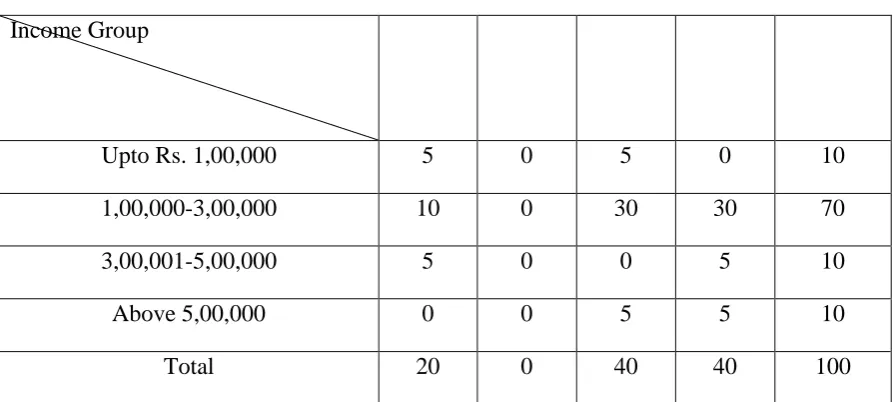
Table 2 shows that evidence between income group and frequency of using the technology oriented banking services
Table 2
Income group and Frequency of using Technology Oriented Banking Services
frequency of using banking
services Weekly Fortnig
htly
Monthl y
Freque
Income Group
Upto Rs. 1,00,000 5 0 5 0 10
1,00,000-3,00,000 10 0 30 30 70
3,00,001-5,00,000 5 0 0 5 10
Above 5,00,000 0 0 5 5 10
Total 20 0 40 40 100
[image:5.595.67.515.79.280.2]III Application of ANOVA Test
[image:5.595.103.530.371.550.2]Table 3 shows the Anova test and its results
Table 3 ANOVA Test
Source of variation
Sum of squares Degrees of freedom
Mean sum of squares
Variation ratio
Between columns
Ssc = 275
Sse = 2350
4 -1 = 3
16 -4 = 12
Msc = 91.67
Mse = 195.83
Fr = 0.47
Total 368.92 15
The test statistic is fr = msc/mse = 0.47
Ndf = 3, 12
Table value of f at 5% level = 4.26
Ho is accepted at 5% level since the calculated value of f < the table value of f. Therefore, there is no significant evidence between income group and frequency of using the technology oriented banking services.
Suggestion and Conclusion
bank acted as an independent information silo, and multi-channel banking (ATMs, Net banking, tele-banking, etc) was almost non-existent. With the entry of new players and multiple channels, customers have become more discerning and less 'loyal' to banks. Given the various options, it is now possible to open a new account within minutes. Or for that matter shift accounts within a couple of hours. This makes it imperative that banks provide best levels of service to ensure customer satisfaction. But Cost pressures come into play when banks are not able to afford the cost of a certain service or initiative although they want to or need to have it in place. This is primarily because the cost structure at the backend is not efficient enough to offer that kind of service to the marketplace.
Hence, today banks have to look much beyond just providing a multi-channel service platform for its customers. There are other pressing issues that banks need to address in order to chalk-out a roadmap for the future:
Cost reduction
Product differentiation Customer-centric services
References
1. Banking Theory and Law Practice, Tata McGraw Hill Publications, 2009, Rajesh.R Sivagnanasithi
2. Banking Theory Law and Practice, Margham Publications, 2012 Edition, Santhanam. B
3. Banking Theory and Law Practice, Sultan Chand & Co, 2010 Edition, Sundaram and Varshney
4. Research Methodology Methods and Techniques, New Age Publications, 2009 Edition,
5. C.R.Kothari. Vaidya (2011): “Emerging Trends on Functional Utilization of Mobile
Banking in Developed Markets in Next 3-4 Years”
7. Tiwari, Rajnish; Buse, Stephan and Herstatt, Cornelius (2007): Mobile Services in Banking Sector: The Role of Innovative Business Solutions in Generating Competitive
Advantage, in: Proceedings of the International Research Conference on Quality, Innovation and Knowledge Management, New Delhi, pp. 886–894.
8. Tiwari, Rajnish; Buse, Stephan and Herstatt, Cornelius (2006): Customer on the Move: Strategic Implications of Mobile Banking for Banks and Financial Enterprises, in: CEC/EEE 2006, Proceedings of The 8th IEEE International Conference on E-Commerce Technology and The 3rd IEEE International Conference on Enterprise Computing, E-Commerce, and E-Services (CEC/EEE'06), San Francisco, pp. 522– 529.
9. Tiwari, Rajnish; Buse, Stephan and Herstatt, Cornelius (2006): Mobile Banking as Business Strategy: Impact of Mobile Technologies on Customer Behaviour and its
Implications for Banks, in: Technology Management for the Global Future - Proceedings of PICMET '06.
10. Owens, John and Anna Bantug-Herrera (2006): Catching the Technology Wave:
Mobile Phone Banking and Text-A-Payment in the Philippines
11. Ovum Analyst Research, European Retail Banking Investment Strategies (2013): [3]
12. The Himalayan Times:
http://www.thehimalayantimes.com/fullNews.php?headline=Dollar+at+historic+high