http://ijmms.hindawi.com © Hindawi Publishing Corp.
ON HYPERGEOMETRIC GENERALIZED NEGATIVE
BINOMIAL DISTRIBUTION
M. E. GHITANY, S. A. AL-AWADHI, and S. L. KALLA
Received 24 June 2001
It is shown that the hypergeometric generalized negative binomial distribution has mo-ments of all positive orders, is overdispersed, skewed to the right, and leptokurtic. Also, a three-term recurrence relation for computing probabilities from the considered distri-bution is given. Application of the distridistri-bution to entomological field data is given and its goodness-of-fit is demonstrated.
2000 Mathematics Subject Classification: 62E15, 62F10.
1. Introduction. A certain mixture distribution arises when all (or some) parame-ters of a distribution vary according to some probability distribution, called themixing distribution. A well-known example of discrete-type mixture distribution is the neg-ative binomial distribution which can be obtained as a Poisson mixture with gamma mixing distribution.
Let X has a conditional Poisson distribution with parameter λ, that is, X has a conditional probability mass function (pmf)
f (x|λ)=P (X=x|Λ=λ)=λx!xe−λ, x=0,1, . . . , λ >0. (1.1)
Now suppose thatΛis a continuous random variable with probability density function (pdf)
g(λ)=α
a(α+1)p−a Γ(p) λ
p−1e−(α+1)λ1F1(a;p;λ), λ >0, a, p, α >0, (1.2)
where
1F1(a;b;z)=
∞
n=0 (a)n (b)n
zn
n! (1.3)
is the confluent hypergeometric function, also denoted byM(a, b, z), see Abramowitz and Stegun [1]. Here,(a)ndenotes thePochhammer’s symbol:
(a)0=1, (a)n=a(a+1)···(a+n−1), n=1,2, . . . (1.4)
and(a)n=Γ(a+n)/Γ(a)fora >0 whereΓ(·)denotes the gamma function. Bhattacharya [2] showed that the unconditional pmf ofX, that is,
f (x)=P (X=x)= ∞
is given by
f (x)=αa(α+1)p−a(p)x x!(α+2)x+p 2F1
a, x+p;p; 1 α+2
, x=0,1,2, . . . , (1.6)
where
2F1(a, b;c;z)=
∞
n=0
(a)n(b)n (c)n
zn
n! (1.7)
is the hypergeometric function, also denoted by F (a, b;c;z), see Abramowitz and Stegun [1].
We use the notation HGNB(α, a, p)to denote thehypergeometric generalized neg-ative binomialdistribution with pmf (1.6).
Special cases. (i) Ifa=p,then, using [1, formula (15.1.8), page 556],
2F1(a, b;a;z)=2F1(b, a;a;z)=(1−z)−b, (1.8)
withb=x+aandz=1/(α+2), (1.6) reduces to
f (x)=(a)x x!
α
α+1
a
1− α α+1
x
, x=0,1,2, . . . (1.9)
which is the pmf of negative binomial distribution with parametersa >0 and success probabilityθ=α/(α+1)∈(0,1).
(ii) Ifa=2,p=1, then, see the appendix, using the relation
2F1(2, b; 1;z)=(1−z)−b
1−zbz−1
, (1.10)
withb=x+1 andz=1/(α+2), (1.6) reduces to
f (x)=α2 x+α+2
(α+1)x+3, x=0,1,2, . . . (1.11)
which is the pmf of Poisson-Lindley distribution with parameter α considered by Sankaran [7].
(iii) Ifa=1, p=2, then, see the appendix, using the relation
2F1(1, n+2; 2;z)= 1 (n+1)z
(1−z)−(n+1)−1, n=0,1,2, . . . , (1.12)
withn=xandz=1/(α+2), (1.6) reduces to
f (x)=α(α+1)
1
(α+1)x+1− 1 (α+2)x+1
, x=0,1,2, . . . (1.13)
The negative binomial distribution provides a more flexible alternative to the Poisson distribution particularly when the variance of the data is significantly larger than the mean. Johnson et al., [4, Chapter 5], provides a comprehensive survey of the applications and generalizations/extensions of the negative binomial distributions.
The discrete Poisson-Lindley distribution was shown by Sankaran [7] to provide, for particular data sets, better fit than other discrete distributions such as negative binomial, Poisson and Hermite distributions. Yet, no attempt has been made to study the properties of this distribution analytically.
The aim of this paper is to investigate some important properties of the hyperge-ometric generalized negative binomial distribution. These include existence of mo-ments as well as properties of statistical measures such as the index of dispersion, skewness, and kurtosis. Also, a recurrence relation for calculating probabilities from the considered distribution is given. Finally, the distribution is fitted to entomological field data and its goodness-of-fit is demonstrated.
2. Moments and associated measures. We start this section by showing that the HGNB distribution has moments of all positive orders.
Theorem2.1. For allα, a, p >0, theHGNB(α, a, p)distribution has moments of all positive orders
µr=E Xr
=
r
n=0
S(r , n) (p)n (α+1)n2F1
a,−n;p;−α1
r=1,2, . . . , (2.1)
whereS(r , n)are the Stirling numbers of the second kind
S(r , n)= 1 n!
n
i=0
n i
(−1)i(n−i)r. (2.2)
Proof. SinceX|Λ=λhas a Poisson distribution with parameterλ, then
EX(X−1)···(X−n+1)|Λ=λ=λn. (2.3)
Hence, the factorial moments ofX, that is,µ[n]=E[X(X−1)···(X−n+1)], are given by
µ[n] =E
EX(X−1)···(X−n+1)|Λ]=EΛn. (2.4)
Making use of the following integral, see Erdély [3], ∞
0 e
−sttb−11F1(a;c;qt)dt=Γ(b) sb 2F1
a, b;c;q
s
, (2.5)
provided Reb,Res >0, Res >Req,|s|>|q|, we obtain
EΛn=α
a(α+1)p−a Γ(p)
∞
0 λ
n+p−1e−(α+1)λ1F1(a;p;λ)dλ
= αa(p)n (α+1)n+a2F1
a, n+p;p; 1 α+1
.
Now using [1, formula (15.3.4), page 559]:
2F1(a, b;c;z)=(1−z)−a2F1
a, c−b;c; z z−1
, (2.7)
withb=n+p, c=p, z=1/(α+1), and the definition of hypergeometric function, respectively, we obtain
µ[n] = (p)n (α+1)n2F1
a,−n;p;−1 α
= (p)n (α+1)n
n
k=0
(a)k(−n)k (p)k
(−1/α)k
k! , (2.8)
which is finite.
Finally, sinceS(r , n),n=0,1, . . . , r, are finite andµr=
r
n=0S(r , n)µ[n], the theo-rem follows.
Special cases. (i) If a=p, then, using (1.8) with b = −n and z= −1/α, (2.1) reduces to
µr=
r
n=0
S(r , n)(a)n
αn (2.9)
which is therth moment of the negative binomial distribution with pmf (1.9). (ii) Ifa=2,p=1, then, using (1.10) withb= −nandz= −1/α, (2.1) reduces to
µr= r
n=0
S(r , n)n! n+α+1
(α+1)αn (2.10)
which is therth moment of the Poisson-Lindley distribution with pmf (1.11). (iii) Ifa=1,p=2, then, see the appendix, using the relation
2F1(−n,1; 2;z)= −(2)n!
nz
(1−z)n+1−1, n=0,1,2, . . . (2.11)
withz= −1/α, (2.1) reduces to
µr= r
n=0
S(r , n)n! α+1
αn −
α (α+1)n
(2.12)
which is therth moment of the generalized mixture of geometric distributions with pmf (1.13).
Theorem2.2. For alla, p, α >0, theHGNB(α, a, p)distribution is overdispersed, skewed to the right, and leptokurtic.
Proof. The characteristic function ofX∼HGNB(α, a, p), see [2, page 28], is given by
ψX(t)=E
eitX= 1−(eit−1)/(α+1) a−p
1−(eit−1)/αa , i=
−1,−∞< t <∞. (2.13)
are given by
κ1=α(αa++pα1),
κ2=a(α+1)3−(a−p)α2(α+2)
α2(α+1)2 ,
κ3=a(α+1)4(α+2)α−3(α(a−+p)α1)3 3(α+2)(α+3),
κ4=a(α+1)5
(α+3)2−3−(a−p)α4(α+2)(α+4)2−3
α4(α+1)4 .
(2.14)
Recall that the index of dispersion (ID), skewness (β1), and kurtosis (β2) ofX, respectively, are given by
ID=κ2 κ1,
β1=κ3 κ23
, β2=3+κ4 κ22
. (2.15)
It follows that
ID=a(α+1)3−(a−p)α2(α+2) α(α+1)(a+pα) >1,
β1=a(α+1)4(α+2)−(a−p)α3(α+2)(α+3) a(α+1)3−(a−p)α2(α+2)3/2 >0,
β2=3+a(α+1)5
(α+3)2−3−(a−p)α4(α+2)(α+4)2−3
a(α+1)3−(a−p)α2(α+2)2 >3,
(2.16)
proving the theorem.
Remarks. (i) Ifa=p, the index of dispersion does not depend on a while the skewness and kurtosis depend ona.
(ii) Expressions for the index of dispersion, skewness and kurtosis for the negative binomial distribution with pmf (1.9), Poisson-Lindley with pmf (1.11) and generalized mixture of geometric distributions with pmf (1.13), respectively, are obtained when (a, p)≡(a, a), (2,1), (1,2).
Figures3.1,3.2, and3.3, respectively, show the index of dispersion, skewness, and kurtosis of the HGNB(1, a, p)distribution for selected values ofaandp.
3. Recurrence relation. The following theorem provides a recurrence relation for calculating probabilities.
Theorem3.1. For allα, a, p >0, theHGNB(α, a, p)distribution satisfies the recur-rence relation
(x+1)f (x+1)= a+x
α+1+
p+x−a α+2
f (x)− p+x−1
(α+1)(α+2)f (x−1), (3.1) where
f (−1)=0, f (0)=
α
α+1
aα+1
α+2 p−a
0 1 2 3 4 5 α
1 2 3 4 5 6
Index
o
f
d
ispersion
Figure3.1. The index of dispersion of the HGNB(α, a, p)distribution when (a, p)≡(a, a) (−),(1,2) (···),(2,1) (−−−).
0 1 2 3 4 5
α 1.4
1.9 2.4 2.9
Skewness
Figure3.2. The coefficient of skewness of the HGNB(α, a, p)distribution when(a, p)≡(1,1) (−),(1,2) (···),(2,1) (−−−),(2,2) (−.−).
0 1 2 3 4 5
α 6
7 8 9 10 11 12 13
Kurtosis
Proof. Using [1, formula (15.2.11), page 558]:
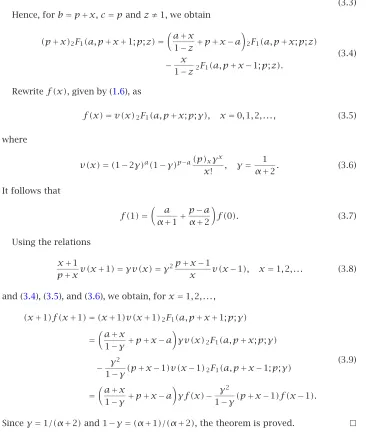
(c−b)2F1(a, b−1;c;z)+(2b−c−bz+az)2F1(a, b;c;z)+b(z−1)2F1(a, b+1;c;z)=0. (3.3) Hence, forb=p+x,c=pandz≠1, we obtain
(p+x)2F1(a, p+x+1;p;z)= a+x
1−z+p+x−a
2F1(a, p+x;p;z)
− x
1−z2F1(a, p+x−1;p;z).
(3.4)
Rewritef (x), given by (1.6), as
f (x)=v(x)2F1(a, p+x;p;γ), x=0,1,2, . . . , (3.5)
where
v(x)=(1−2γ)a(1−γ)p−a(p)xγ x
x! , γ=
1
α+2. (3.6)
It follows that
f (1)=
a
α+1+ p−a α+2
f (0). (3.7)
Using the relations
x+1
p+xv(x+1)=γv(x)=γ
2p+x−1
x v(x−1), x=1,2, . . . (3.8)
and (3.4), (3.5), and (3.6), we obtain, forx=1,2, . . . ,
(x+1)f (x+1)=(x+1)v(x+1)2F1(a, p+x+1;p;γ)
=a+x
1−γ+p+x−a
γv(x)2F1(a, p+x;p;γ)
−1γ−2γ(p+x−1)v(x−1)2F1(a, p+x−1;p;γ)
= a+x
1−γ+p+x−a
γf (x)−1γ−2γ(p+x−1)f (x−1).
(3.9)
[image:7.498.70.436.120.553.2]Sinceγ=1/(α+2)and 1−γ=(α+1)/(α+2), the theorem is proved.
Table 4.1 shows the values off (x) of HGNB(1, a, p)using the above recurrence relation when(a, p)≡(1,1), (1,2), (2,1), (2,2).
Table4.1. Calculatingf (x)of HGNB(1, a, p)using the recurrence relation (3.1).
x f (x)
(a, p)≡ (1,1) (1,2) (2,1) (2,2)
0 0.500000 0.333333 0.375000 0.250000
1 0.250000 0.277778 0.250000 0.187500
2 0.125000 0.175926 0.156250 0.125000
3 0.062500 0.100309 0.093750 0.078125
4 0.031250 0.054270 0.054688 0.046875
5 0.015625 0.028565 0.031250 0.027344
6 0.007813 0.014711 0.017578 0.015625
7 0.003906 0.007508 0.009766 0.008789
8 0.001953 0.003805 0.005371 0.004883
9 0.000977 0.001919 0.002930 0.002686
10 0.000488 0.000965 0.001587 0.001465
In the following, the HGNB(α, a, p)distribution is fitted to this data. The method of moments estimators ofα, a, p, respectively, are given by ˆα=5.550266×10⁻⁴, ˆ
a=8.46876×10⁻⁸, ˆp=5.2342.
In calculating the chi-square statisticχ2=m
i=1(oi−ei)2/ei, where oi(ei)are the observed (expected) frequencies, m=13 after combining the observed (expected) frequencies corresponding to counts 12 to 25, as did McGuire et al. [5], that is,o13=15 and e13=14.87(14.55) for NB(HGNB). Also, the degrees of freedom are given by m−t−1 wheret=2(3)is the number of estimated parameters for NB(HGNB).
FromTable 4.2, we observe that fitting the HGNB distribution gives an improvement over fitting the NB distribution as judged by the chi-square value.
Appendix. In the following, we make use of the following well-known relations of hypergeometric functions:
2F1(a, b;c;z)=(1−z)−b2F1
c−a, b;c; z z−1
. (A.1)
(see [1, formula (15.3.5), page 559])
2F1(−n,1;m;z)= −n!(z(m)−1)m−2
nzm−1
(1−z)n+1− m−2
k=0
(n+1)k k!
z
z−1 k
, (A.2)
wheren=0,1,2, . . . , m=1,2, . . . ,and form=1 the sum on the right-hand side is 0 (see [6, formula (179), page 466]).
Proof of(1.10). Using (A.1) witha=2,c=1, and the definition of the hypergeo-metric function, respectively, we obtain
2F1(2, b; 1;z)=(1−z)−b2F1
−1, b; 1; z z−1
=(1−z)−b
1−zbz−1
Table4.2. Fitting negative binomial (NB) and hypergeometric generalized negative binomial (HGNB) distributions to the frequency distribution of Eu-ropean corn borer larvaePyrausta nubilalis(Hnb.) in field corn.
Count per plot Observed frequency Expected frequency
xi oi ei
NB HGNB
0 10 8.92 8.62
1 18 22.96 22.54
2 39 35.37 35.14
3 33 42.32 42.36
4 42 43.34 43.59
5 56 39.92 40.24
6 36 34.01 34.31
7 26 27.31 27.52
8 19 20.92 21.04
9 19 15.42 15.46
10 7 11.02 11.00
11 4 7.66 7.62
12 4 5.21 5.15
13 4 3.47 3.41
14 2 2.27 2.22
15 1 1.47 1.42
16 2 0.94 0.90
17 1 0.59 0.56
18 0 0.20 0.35
19 0 0.12 0.21
20 0 0.08 0.13
21 0 0.05 0.08
22 0 0.03 0.05
23 0 0.02 0.03
24 0 0.01 0.02
25 1 0.41 0.02
Total 324 324 324
χ2 14.55 14.23
df 10 9
P-value 0.149 0.114
Proof of(1.12). Using (A.1) witha=n+2,b=1,c=2, and (A.2) withm=2, respectively, we obtain
2F1(1, n+2; 2;z)=2F1(n+2,1; 2;z)
=(1−z)−12F1
−n,1; 2; z z−1
=(1−z)−1 −1 (n+1) z/(z−1)
1−z−z1 n+1
−1
=(n+11)z(1−z)−(n+1)−1.
(A.4)
Proof of(2.11). Using (A.2) withm=2,we obtain
2F1(−n,1; 2;z)= −(2)n!
nz
(1−z)n+1−1. (A.5)
References
[1] M. Abramowitz and I. Stegun,Handbook of Mathematical Function, 2nd ed., Dover, New York, 1972.
[2] S. K. Bhattacharya,Confluent hypergeometric distributions of discrete and continuous type with applications to accident proneness, Calcutta Statist. Assoc. Bull.15(1966), 20– 31.
[3] A. Erdély,Higher Transcendental Functions, vol. I, McGraw-Hill, New York, 1953. [4] N. L. Johnson, S. Kotz, and A. W. Kemp,Univariate Discrete Distributions, 2nd ed., John
Wiley & Sons, New York, 1992.
[5] J. U. McGuire, T. A. Brindley, and T. A. Bancroft,The distribution of European corn borer larval Pyrausta nubilalis (Hbn.) in field corn, Biometrics13(1957), 65–78.
[6] A. P. Prudnikov, Yu. A. Brychkov, and O. I. Marichev,Integrals and Series, vol. 4, Gordon and Breach Science Publishers, New York, 1992.
[7] M. Sankaran,The discrete Poisson-Lindley distribution, Biometrics26(1970), 145–149.
M. E. Ghitany and S. A. Al-Awadhi: Department of Statistics and Operations
Re-search, Faculty of Science, Kuwait University, P.O. Box5969, Safat13060, Kuwait
S. L. Kalla: Department of Mathematics and Computer Science, Faculty of Science,