accuracy, completeness, or usefulness of the information contained in this document, or that the use of any information, apparatus, method, or process d i s c l o s e d i n t h i s rtnrumpn. m n v n n . τητΓτησ.» τγτ.νη.<*ϊν ruam«-*, rinhfc· nr
Assume any Iiahility with respect to the use of. or for damages resulting
f tl Γ . Γ . . . . T T T T T
siliäville
This document was reproduced on the basis of the best available copy.iffiieaiai^
mmm Srffia
!
f Ι Ρ ΰ i
lift iïlfiu Κ .ή! (í.i¡:.s¡i."-tíufcí. 3^_8 UUi3' Bij "9' iiiflVf Piíirllv n»Sft_HFUÎS ϋ*ΚΪ3ίΓ'*{ι tipi
h»**tf "it»';·.
European Atomic Energy Community - EURATOM Joint Nuclear Center - lspra Establishment (Italy) Scientific Data Processing Center - CET1S
Brussels, September 1968 - 102 Pages - 2 Figures - FB 150
In this report a comparison of some methods for solving the eigen-problem of a matrix is given. An attempt has been made to establish the «efficiency», on the basis of computing time and accuracy, of each method by carrying out «experimental, calculations on «representative> problems for which exact results are known.
EUR 4055 e
A COMPARISON OF METHODS FOR COMPUTING THE EIGENVALUES AND EIGENVECTORS OF A MATRIX
by 1. GALL1GAN1
European Atomic Energy Community - EURATOM Joint Nuclear Center - lspra Establishment (Italy) Scientific Data Processing Center - CET1S
Brussels, September 1968 - 102 Pages - 2 Figures - FB 150
on the above test-matrices are presented.
In order to pick out the «best» methods we collect a list of matrices with different «condition numbers» which form a representative sample of those which occur in practice. Some relationships between these
«condition numbers» are discussed.
EUROPEAN ATOMIC ENERGY COMMUNITY - EURATOM
A COMPARISON OF METHODS FOR COMPUTING THE
EIGENVALUES AND EIGENVECTORS OF A MATRIX
by
I. GALLIGANI
1 9 6 8
«efficiency», on the basis of computing time and accuracy, of each method by carrying out «experimental» calculations on «representative» problems for which exact results are known.
In order to pick out the «best» methods we collect a list of matrices with different «condition numbers» which form a representative sample of those which occur in practice. Some relationships between these «condition numbers» are discussed.
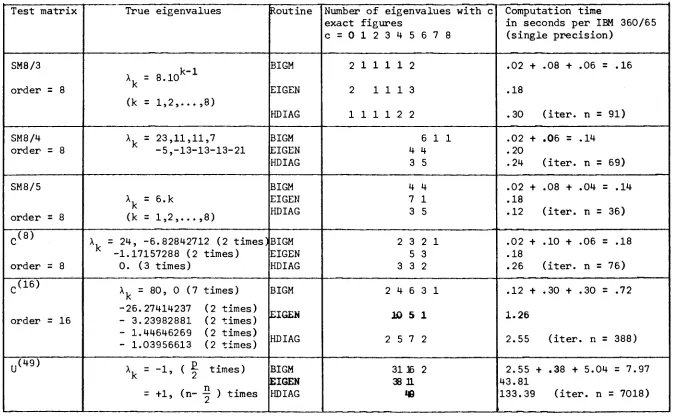
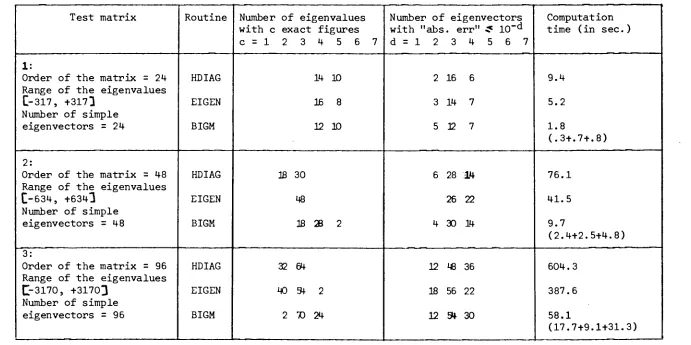
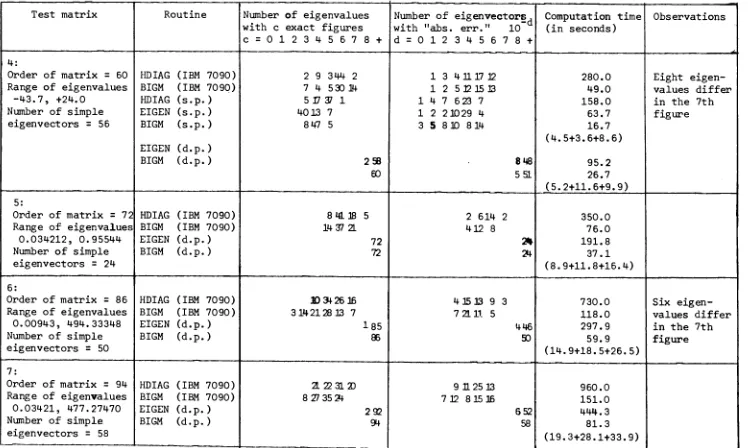
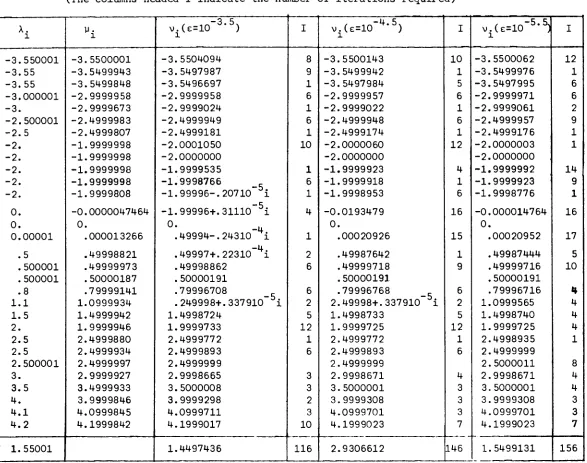
Finally the results of some computational experiments carried out on the above test-matrices are presented.
KEYWORDS
a matrix is given. An attempt has been made to establish the "efficiency", on the basis of computing time and accuracy, of each method by carrying out "experimental" calculations on "representative" problems for which exact re-sults are known.
In order to pick out the " best " methods we collect in Chapter I a list of matrices which form a representative sample of those which occur in practice.
Any computing problem is "ill conditioned" if values to be computed are very sensitive to small changes in the data. It is convenient to have some numbers which define the condition of a matrix with respect to the eigenproblem. These condition-numbers and some :relationships between them are discussed in Chapter II.
The results of some computational experiments carried out on the above test-matrices are presented in Chapter III. The methods compared for the eigenpro-blem of symmetric matrices are the Jacobi, threshold Jacobi, Givens-House-holder and Rutishauser schemes. The numerical experiments reported in Chapter III §1 give a more realistic picture of the accuracy of the above methods than that obtained by "a-priori error analysis", and make apparent the "efficiency" of the Givens-Householder method for determining the eigen-values of general symmetric matrices. The Rutishauser method is efficient
for determining the eigenvalues of symmetric band matrices.
As far as vectors are concerned the threshold Jacobi method and the Jacobi method give almost exactly orthogonal vectors. The Givens-Householder method
(with inverse iteration) gives accurate eigenvectors, but eigenvectors corresponding to multiple or close eigenvalues may be far from orthogonal.
For non-Hermitian matrices the QR method and the Laguerre method are compared. The numerical experiments reported in Chapter III §2 and §3 lead to the follow-ing conelus ion :
a) for finding all eigenvalues, the Laguerre method is troublesome because of the difficulty in finding "convenient" convergence-parameters;
c) the Laguerre method is useful for finding some eigenvalues (especially the eigenvalues with largest modulus) and may be faster than the QR method for matrices with multiple eigenvalues when a convenient choice of the "convergence-parameters" has been made.
We have considered the iterative method of Wielandt for determining the eigen-vectors of non-Hermitian matrices. The accuracy of each computed eigenvector lying in the linear m-fold subspace spanned by the true eigenvectors which correspond to an eigenvalue of multiplicity m has been tested.
CHAPTER I
A list of test-matrices for the eigenproblem
INTRODUCTION
As test-matrices w usually take matrices which form a representative sample
of those which occur in practice, are general enough as to put sufficient strain on the numerical methods we have to test, and give the solution of the eigenproblem in closed form.
In §1 we give a list of test matrices with known eigenvalues.
In §2 we give a list of special test matrices. Important classes of special test matrices are the unitary matrices, the circulant matrices and the Frobenius matrices.
In §3 the tridiagonal test-matrices are considered.
When we are interested to generate test-matrices with a prescribed distribution of the eigenvalues, it is convenient to resort to matrices generated by
Test matrix SM4/1
4
■2 1
0 2
4
0
1
1 0
0 1
4 2
2 4
λ2 = 3
λ4 = 7
Test matrix SM4/2
0.67
0.13
0.12
0.11
0.13
0.96
0.14
0.13
0.12
0.14
0.31
0.16
0.11
0.13
0.16
0.15
Test matrix SM4/3
([l], page 269)
5
■5 5
0
5 5
16 8
8 16
Test matrix SM4/4
(C1]» Page 302)
0
7
7
21
C\.
=
λ3 =
0.0479716838
0.3111488671
0.6384911230
1.0923883260
λ1 = λ2 = 2·6 5 7 2 8 0 7 3 λ3 = λ^ = 26.34271928
1 1 1
2 3 4
3 6 10
4 10 20
λ = 0.03801601
λ2 = 0.4538345
λ3 = 2.2034461 λ„ =26.304703
Test matrix SM5/1 [6]
0.81321
0.00013
0.00014
0.00011
0.00021
0.00013
0.93125
0.23567
0.41235
0.41632
0.00014
0.23567
0.18765
0.50632
0.30697
0.00011
0.41235
0.50632
0.27605
0.46322
0.00021
0.41632
0.30697
0.46322
0.41931
λ = 1 λ =
2 λ = 3
λ = 4 λ =
5
-0.29908
0.01521
0.41985
0.81321
4 3 2 1
6 0 0 7 4 6 3 5
4 3 6 5 8 7 7 9
λ = 7 . 5 1 3 7 2 4 1 5 5 λ = 4 . 8 4 8 9 5 0 1 2 0
O
λ^ = 1.327045605 λ^ = -1.096595181
The eigenvectors of the test matrix SM5/2 are:
v^^ Ξ (-0.245877938, -0.302396039, -0.453214523, -0.577177153, -0.556384583)
ν Ξ (-0.550961956, -0.709440339, 0.340179132, 0.0834109534, 0.265435677)
ν Ξ (-0.547172795, 0.312569920, -0.618112077, 0.115606593, 0.455493746)
ν Ξ (0.341013042, -0.116434620, -0.019590671, -0.682043035, 0.636071214)
vc Ξ (0.469358072, -0.542212195, -0.544452403, 0.425865662, 0.0889885036) ο
Test matrix SM5/3
φ.}, page 255)
1 1 1
1 1 1
2 3 4 5
1 3 6 10 15
1 4 10 20 35
1 5 15 35 70
λ = 0.01083536 λ = 0.18124190
λ3 = 1·
λ = 5.51748791 λ^ =92.29043483
Test matrix SM6/1
L
71
1 2 3 0 1 2
2 4 5 - 1 0 3
3 5 6 - 2 - 3 0
0 - 1 - 2 1 2 3
1 0 - 3 2 4 5
2 3 0 3 5 6
λ = 12.41133643 λ2 = 12.41133642 λ = 0.2849864395
Ο
λμ = 0.2849864365 Xc = -1.696322849
ο
λ„ = -1.696322851
ν Ξ (0.170061798, 0.178584630, -0.138066492, 0.295915130, 0.565489671, 0.716086465)
ν3 = (0.669545567, -0.395331735, 0.136726362, -0.288372768, 0.463372193, -0.280810985)
ν Ξ (0.013164189, 0.259286123, -0.199515430, -0.728887389, 0.551154856, -0.240296694)
vc Ξ (0.503951797, 0.074032290, -0.529160563, -0.313202308, -0.521389692, ο
0.300995029)
ν, Ξ (0.391015688, -0.080878210, -0.418685666, -0.446284472, -0.520371701, D
0.441940292)
Test matrix SM6/2 (£l], page 237)
0 1 6 0 0 0
1 0 2 7 0 0
6 2 0 3 8 0
0 7 3 0 4 9
0 0 8 4 0 5
0
o
o
9 5 O
λ
ι
=
λ2 = λ„
=-λ. =
16.60600885 5.94293604 10.06472040 12.12830070 2.10943466 -2.46535845
Test matrix SM6/3
M
253 121 66 11 11 0
121 96 -19 71 -24 7
66 -19 137 -117 73 -14
11 71 -117 152 -82 21
11 -24 73 -82 57 -14
0 7 -14 21 -14 7
λ = λ = 2.533
χ =3 4 χ, = 15.618
Test matrix SM8/1
M
611 196 -192 407 -8 -52 -49 29
λ
ι
=
λ2 =
λ3 =
λ4 =
λ6 =
λ7 = λ„ =
196 899 113 -192 -71 -43 -8 -44
1020. 1020. 1019.
λ5 =
-192 113 -899 196 61 49 8 52
04901843
90195436 1000. 0.09804864072 0.0
-1020. 04901843 407 -192 196 611 8 44 59 -23
-8 -71 61 8 411 -599 208 208
-52 -43 49 44 -599 411 208 208
-49 -8 8 59 208 208 99 -911
29 -44 52 -23 208 208 -911 99
The eigenvectors of the test matrix SM8/1 are:
ν Ξ (2,1,1,2, -0.004901843, -0.004901843, 0.009803686, 0.009803686)
v2 Ξ (1, -2, -2, 1, 2, -2, 1, -1)
ν Ξ (2, -1, 1, -2, 10.09901951, -10.09901951, -20.19803903, 20.19803903) O
v4 Ξ (1, -2, -2, 1, -2, 2, -1, 1)
v5 Ξ (7, 14, -14, -7, -2, -2, -1, -1)
νβ Ξ (2, -1, 1, -2, -0.099019514, 0.099019514, 0.198039027, -0.198039027) ν,, Ξ (1, 2, -2, -1, 14, 14, 7, 7)
1 1
1 2
1 3
1 4
1 5
1 6
1 7
1 8
1 1 1 1 1 1
3 4 5 6 7 8
6 10 15 2 1 28 36
10 20 35 56 84 120
15 35 70 126 210 330
21 56 126 252 462 792
28 84 210 H62 924 1716
8 36 120 330 792 1716 3432
λ = 2.2008514614 10
λ = 6.7202144403 10
λ = 8.3730245858 io"
λ^ = 5.1189155425 10
\c = 1 . 9 5 3 5 3 8 7 7 5 4 10C
5 ]
Xc = 1 . 1 9 4 3 1 1 5 5 3 4 10 D
λ = 1.4880477534 IO'
» r
λ„ = 4.5436960082 10e 3
1
Test matrix SM8/3
([1], page 239)
a b c d e f g h b a d c f e h g
c d
d c
a b
b a
g h
h g
e f
f e e f g h a b c d
f g
e h
h e
g f
b c
a d
d a
c b h g f e d c b a
a = 11111111 e
b = 9090909 f
c = 10891089 g
d = 8910891 h
11108889
9089091
10888911
8909109
8 10 k1 (k=l,2,...,8)
Test matrix SM8/4
([l], page 244)
Η Κ Μ
Κ Η
Η =
a b e d b a d e c d~~ã E" d e b a
a = b =· c = d = 0 -2 -3 4
Test matrix SM8/5 ([l], Page 238)
33 -3 0 -4 0 8 0 -4 -3 33 4 0 -8 0 4 0 e =
f =
g = h = 0 4 29 1 -12 -2 -8 -2 5 6 -7 8 -4 0 1 29 -2 -12 -2 -8 0 -8 -12 -2 25 1 -4 -2 8 0 -2 -12 1 25 -2 -4 0 4 -8 -2 -4 -2 21 1 -4 0 -2 -8 -2 -4 1 21λ = -21
λ2 = λ3 =
λ4 = "5
-13
λ 5 =7
λ6 = λ ? = 11
λ8 = 2 3
6.k ( k = l , 2 , . . . , 8 )
Test m a t r i x SM9/1
CO
M = (a..) with a.. = a.. = 0 for i t i,i+l and:
3-D 3-D Di
li 0.71507 0.42721 0.71226 0.42823 0.70177 0.44052 0.43474 0.42862 0.42784
ai+l i=ai i+1 0.13952 0.11389 0.17385 0.021681 0.12899 0.0035016 0.0025372 0.0 0.83818541 0.75787017 0.74734873 0.43584777 0.42784000 0.42773464 0.39554758 0.38360934 0.30227655
Test matrix SM21/1
M = (a. .) with 3-D
η =
10CSU
a. . = n+l-i 1 1
a. . = i-n-1 1 1
aii+l = ai+l i »ij = »ji = o
(i = 1,2,. . . ,n+l) (i = n+2,n+3,...,2n+l) = 1
The eigenvalues of M to 7 decimal places are:
λ, = 10.7461942 10.7461942 9.2106786 9.2106786 8.0389411 8.0389411 7.0039522 7.0039518 6.0002340 6.0002175
5.0002444 4.9997825 4.0043540 3.9960482 3.0430993 2.9610589 2.1302092 1.7893214 0.9475344 0.2538058 -1.1254415
Test matrix SM21/2
M = ( a . . ) with ID
η = 10
a . . = n + l - i
1 1
a . . . - — a . „ . — ι ι l + l l + l ι
( i = l , 2 , . . . , 2 n + l )
a . . = a . . = 0 f o r j f i , i + 1 ID Di
The e i g e n v a l u e s o f M t o 7 d e c i m a l p l a c e s a r e :
λ, = +
±
+
+
+
+
10.7461942 9.2106786 8.0389411 7.0039520 6.0002257 5.0000082
+
+
+
+
4.0000002 3.0000000 2.0000000 1.0000000 0.0000000
The eigenvector correct to 8 decimal places of λη = 10.7461942 is:
1.2 A list of real test matrices with known eigenvalues
Test matrix RM4/1
([1], page 228)
-2
1
4
5
Test matrix RM4/2
([l], page 302)
2
-1
-2
-1
Test matrix RM4/3
([l], page 303)
-1
-1
0
o
Test matrix RM4/4
([l], page 303 )
6
9
15
23
-Test matrix RM4/5
( [l] , page 274 ) 1
1
-2
-1
1
5
3
2
3
-1
4
0
1
-3
■12
■23
17119
-50436
49554
-16236
-3
1
5
5
-2
-3
0
-1
0
-2
6
-10
0
1
3
3
2
0
-3
6
1
2
1
3
0
0
-16
18
0
0
1
4
8289 3159
-24326 -9216
23814 8974
-7776 -2! 316
729
-2106
2034
-656
k (k = 1,2,3,4)
Xk = k (k = 1,2,3,4)
λ1 = 2, λ2 = 4
λ3 ' λ4 2 ± 2i
= 7, λ2 = 4
λ3 = 1, \ = -5
λ, = 10 k
k-1
Test matrix RM4/6 ([l], page 237)
9 1 -2 1
1 8 -3 -2
-2 -3 7 -1
1 -2 -1 6
x, = 3.k
k (k = 1 , 2 , 3 , 4 )
Test m a t r i x RM4/7
([13, page 270)
48 -154 176 -64
Test matrix RM4/8 ([£ page 386)
-4 1 -2 7
25 -82 96 -34
5 -1 4 -5
11 3 -37 -10
44 11 -14 - 1
- 1 -7 -4 1
7 -2 1 10
λ = λ = X = 2 1 2 3 \ = 3
λ = % = "Χ = Χ = 3
1 2 3 4
Test matrix RM4/9
0^9612
0.9205 1.0961 0.0677 0.9395
-0.8526 -0.6522 0.2922 0.8977
0.3265 0.8152 0.8561 -0.5330
0.3054 0.3284 -0.1328 0.6556
0.8018 Χ,, λ = 0.0064 + 0.3981 i
o 4 —
The eigenvectors of the test matrix RM4/9 are:
νχ· (-0.1798, 0.3188, 0.9228, -0.1204)
v2 2 ( 0.1890, 0.3465, 0.0309, 0.9113)
Test matrix RM4/10
0
1.31
1.06
2.64
0.07
-0.36
2.86
-1.84
1
0.27
1.21
1.49
-0.24
= 0.03
-0.33
0.41
-1.34
-2.01
3.03
\
= "I·
97±i
Test matrix RM5/1
(Ll], page 227)
11
12
-5
3
-2 -6
-11
13
-4
6 5
7
3
7
-2 5
3
-8
5
2 -6
-12
5
-3
7
λ = k k k
(k = 1 , 2 , 3 , 4 , 5 )
Test m a t r i x RM5/2
([1] , page 247)
40
17
-1
13
63 56
10
-6
30
-54
-11
8
6
8
-3 -8
5
5
-19
-3
-39
-17
1
-13
64
Test m a t r i x RM5/3
( [ l ] , page 270)
λ = 1
V
V
λ =1
2
6
-24
120
1
-4
6
■4
1
- 1 1
2 0
0 - 2
-2 0
1 1
- 1 1
- 2 +4
0 6
2 4
1 1
Test m a t r i x RM5/4
C91
15 1 7 7 17 11 3 6 7 12 6 9 6 5 5 -9 -3 -3 -3 -10 -15 -8 -11 -11 -16X.
=
λ. =
χ
2X
4 -11.50016 + 3.57064 i 1.50016 + 3.57064 i
Test matrix RM6/1
( W . Page 277)
λ 1 7 -6 -1 -8 -4 6 = 3 = 4 3 4 -9 0 3 1 4 -5 2 -1 -5 4 -11 7 2 5 7 ' -11
λ , X
3' 4
Χ , λ
5' 6 -9 -2 1 12 9 1 0 8 2 10 -7 -1
= 1 + 2 i = 5 + 6 i
Test matrix RM6/2 ([1], page 286)
2 4 0 -5 +13 -2 -13 29 -15
0 0 0 0 0 0 5 0 0 -25 61 -48 18 0 0 -36 80 -38 -26 32 -6 -34 24 140 -250 155 -29
*k = k , k = 1(1)6
Test matrix RM6/3 ([1], page 372)
-1 -3 -4 -7 -1 1 -6 -2 16 15 -5 -3 6 3 0 -5 3 3 -14 -7 6 11 -7 -7 21 14 -12 -8 15 7
ίο
1
3 4 7 1 8
\ - \ - i
V
5
V =
6
Test matrix RM6/4 [ β ] ,
\β]
1 1/2 1/3 1/4 1/5 1/6 1 1/3 1/4 1/5 1/6 1/7 1 1/4 1/5 1/6 1/7 1/8 1 1/5 1/6 1/7 1/8 1/9 1 1/6 1/7 1/8 1/9 1/10 1 1/7 1/8 1/9 1/10 1/11Roots calculated in [ 9 ^ 2.132376 -0.2214068 -0.3184330 10 -0.8983233 10 -0.1706278 10 -0.1394499 io" -1 -3 -4
Roota calculated in Γ83 2.132376 -0.2214066 -0.3184328 10 -0.8983258 io" -0.1706200 10 -0.1443702 IO" -1 -4
Test matrix RM7/1 ([l], page 275)
28 -1 11 -6 -3 14 37 17 29 -1 -11 1 16 -18 -16 7 12 12 -4 -7 -9 11 -6 3 8 3 6 + 5 9 -2 -8 -12 8 2 7 -2 28 10 -5 4 4 26 -27 1 11 6 3 -14 38
k
(k=l(l)7)Test matrix RM7/2 ([l], page 372)
-3 2 -4 0 3 -7 -6 11 3 -1 8 -4 9 9 10 10 1 1 -2 6 4 9 7 2 7 9 0 -5 -13 -16 4 -1 7 -12 3 -2 0 11 -8 7 3 -2 6 -2 4 0 -3 7 9
> 3 =3
Test matrix RM8/1 ([1"3. Page 227)
16 72 79 73 21 73 43 73 17 31 37 -31 -21 -31 -1 31 -11 -53 -56 54 -25 53 39 -53 -17 -59 -55 59 -19 +59 33 -59 -23 -65 -71 65 -60 66 35 -65 29 -13 -7 13 -77 13 43 -13 -19 -61 -67 61 -17 61 42 -60 11 -31 -25 31 -47 31 31 -31 (k=l(l)8)
Test matrix RM8/2 (tl}, page 388)
-7 -1 3 17 9 -3 1 -9
\ , \ ·
ι ±
-9 5 -9 19 8 -8 6 -7 2 i 13 4 -6 4 -1 7 -2 -6 2 -9 -4 3 -6 4 7 8 -12 -1 -13 11 14 -9 -1 -13 -11 8 6 8 4 9 8 -3
V
\
= 3 + 4 i
-13 6 1 9 12 -3 -2 -17 1 -9 5 3 2 7 -10 16
λ , λ
5 » 6 5 + 6 i \ , \7' 8 - = 7+8 i
Test Matrix RM8/3
<EJ» Page
\ - \ 6 11 23 -17 3 -19 -13 19= 2 J
326) -11 -2 -9 3 11 5 -1 -5
:7 i
-23 -9 29 -21 22 2 -22 8
V
-17 -3 21 -19 16 -4 -16 14λ r
4
-3 11 22 -16 8 -22 -12 185 + 3 -19 -5 -2 -4 22 4 -8 2 i -13 1 22 -16 12 -8 -11 9
V
-19 -5 8 -14 18 -2 -9 13Test matrix
([l], page
5 1 3 1 6 2 1 7 5 RM9/1 371) 8 2 39
11 5 3 1 3 9 8 16 ■13 6 5 9 3 1 5 1 2 0 7 6 2 7 4 12 5 3 2 5 2 3 3 7 4 1 10 14 2 13 12 4 5 0 2 13 13 6 5 6 3 2 4 3 0 10 5 3 2 8 7 4 1 3 1 6 2 1 7 6
λ = k k=l(l)9
Test matrix RM9/2
([ï], page 287)
14 91 364 989 1886 2509 2236 1210 300 1 0 0 0 0 0 0 0 0 1 0 0 0 0 0 0 0 1 0 0 0 0 0 0 1 0 0 0 0 0 1 0 0 0 0 1 0 0 0 1 0 0 1 0
λ
k = 1 2 31 + i
1 + 2 i
Test matrix RM12/1
([1],
page 384)
24 3 4 5 23 8 19 16 3 -2 7 18 3 13 -5 8 40 -9 10 21 5 2 6 -11 -20 -17 7 6 -18 1 13 -4 9 3 -17 -3 10 6 2 -3 26 10 2 +17 -7 -1 6 4 -1 1 12 4 13 -4 1 16 4 12 1 -2 5 -1 5 6 15 -3 0 11 6 5 -1 6 24 12 9 -5 -3 0 -4 -3 -5 9 12 12 -11 4 4 -2 -17 4 2 -20 -2 4 4 -15 16 12 -7 3 -26 -10 -2 -17 7 -4 12 4 40 18 -7 -1 18 -1 -13 4 -4 -3 18 22 -22 -11 1 -13 -17 1 9 -5 -8 0 -8 -7 -29 -3 -4 -5 23 -8 19 16 -3 2 -7 -23
^]r -
± (
3I
4*)» ± (
4I
33")» I
53-,
+
5
1.3 A list of complex test-matrices with known eigenvalues
Test matrix CM3/1
([TJ, page 378)
-189-790 i 537-505 i
438-204 i 361+253 i
-65-144 i 85-115
i
-1626+2740 i
-1788-630 i
-207+581 i
λ =
1+i
λ = 7-8 i
Κ
= -43+51 i
Test matrix CM4/1
([1],
page 251)
12 -(1+i) 2 3(l+i)
-(1-i) 12 (1-i) -2
2 (1+i) 8 -(1+i)
3(l-i) -2 -(1-i) 8
Test matrix CM4/2 ([l], page 287)
2+11 i 3-5 i
6+ 4 i -9+4 i 8-2 i 14- 2 i -30+14 i 22-9 i 25- 8 i -57+28 i 39-24 i
-1+3 i -2+10 i
Xk = (1+i), (3+4 i), (4+5 i), (5+6 i)
Test matrix CM5/1
M
1+ 2 i 43+44 i 5+ 6 i 47+48 i 9+10 i
3 + 4 i 13 +14 i 7 + 8 i 17 +18 i 11 +12 i
21+22 i 15+16 i 25+26 i 19+20 i 29+30 i
23+24 i 33+34 i 27+28 i 37+38 i 31+32 i
41+42 i 35+36 i 45+46 i 39+40 i 49+50 i
λ = 127.387 + 132.278 i O
λ = -9.45999 + 7.28019 i Xc = 7.07332
o 9.55839 i
Test matrix CM5/2
M
-0.845+0.0 i 5.2+0.103 i
5.2 -0.103 i -6.2+0.0 i
0.301+0.0454 -3.39+0.407 i
-9.6 -0.936 i 0.122-0.91 i .0734-7.26 i 4.19+3.66 i
.301-0.0454 i -3.39-0.407 i
0.019+0.0 i .935+0.271 i -0.0572-2.82 i
-9.6+0.936 i .0734+7.26 i +0.122+0.91 i 4.19 -3.66 i
0.935-0.271 i -0.0572+2.82 j 7.21+0.0 i 0.337+0.0603 i 0.337-0.0603 i -1.23+0.0 i
λ1 = 15.180165225 λ2 = 5.6787293543 λ = -0.83398680019
Test matrix CM6/1
íl·
3 3+i -l+6i 4 l-2i 1+i page 376) 1+3 i 6+2 i 18-9 i 4-2 i 6+4 i -6-i -6+16 i -6+ 9 i3+i 3 -6+9 i 7i 8-14 i 6-10 i -3-i -3 6-10 i 2-4i -13-5 i -10-5 i -17+3 i - 8+2 i - 8-4 i
-3 -2 -3-i 1-6 i -4 -1+2 i -i
Xk = 0, 1, i, (2+i), (-1-2Í), (-1-2Í)
Test matrix CM10/1 [12]
2+3i 3+2i 5-3i 2+6i l+4i 5-i 5+2i 4-3Í 5+0i 5+2i 3+i -2-i l+2i -2+3i 2+2i 0+4i l+4i 7+3i 2+2i 2+6i l+2i 2+i 3-i 3+7i l+5i 6-5i l+6i l+3i l-3i -l+4i -4+2i l+5i -8-li 8+4i
2-ni
1+i 7+4i 5+5i 2-3i 4+7i 4-4i 3+i -4-2i 4+i l+6i 7+i -l+5i l+2i l+6i -7+Oi 4-2i 3+Oi l+4i l+2i 3-3i -4+6 i 6+3i 2+5i 5-4i 7-i 0+i 6+3i 3+2i 2+5i 10Test matrix CM15/1
([ij, page 278)
Β = C = t 6 20 11 -3 6 9 7 12 12 5 -1 4 10 8
, o
'-7 -10 11 4 2 15 7 -1 -1 1 7 1 -16 -14 -5 A -12 -24 -2 -5 -32 -20 -15 -17 -17 -21 0 10 0 -5 -1 -3 -13 -34 -18 -12 -27 -10 -4 -15 -8 -16 -15 2 4 4= B+i C 18 28 -6 -15 12 -2 -2 3 5 11 -12 -20 -3 11 5 -2 9 27 5 -1 31 21 7 18 0 2 7 -8 -9 -4 -25 -28 14 33 12 13 5 -4 -4 -1 13 19 3 -18 -12 -10 -12 -33 -9 4 -37 -31 -17 -28 -5 -2 -5 5 -3 -3 20 21 -12 -26 -2 -24 -22 -8 -6 4 -9 -17 -10 13 16 4 6 34 23 -4 18 19 14 19 -2 8 6 -11 -3 0 -28 -24 9 25 10 23 8 3 12 2 8 14 7 -21 -21 -1 -9 -24 -22 9 10 3 0 -3 3 -7 4 8 6 8 40 36 -2 -27 -20 -21 -6 -4 -13 -12 -10 -7 5 33 29 4 16 29 14 -21 -14 2 4 -2 -15 -1 1 -1 -3 -4 -41 -26 12 32 21 27 0 -2 19 13 15 17 5 -34 -38 -5 -15 -30 -21 16 26 11 9 14 10 -6 -2 2 2 -1 19 15 -11 -22 -10 -37 -7 -2 -26 -2 -5 -16 -16 12 23 1 3 24 25 3 -23 -25 -22 -10 9 10 -4 -14 -6 3 -23 -15 11 22 13 41 21 7 23 7 5 16 16 -16 -21 -7 2 -35 -25 -11 -12 3 8 -13 -13 -10 -7 19 0 -14 38 19 -19 -35 -28 -30 -4 5 -13 -15 -15 -24 -12 31 25 18 14 44 21 13 31 9 -5 22 22 14 16 -3 11 14 -36 -25 16 23 4 19 1 -4 12 5 20 30 6 -29 -18 -9 -19 -36 -14 -16 -25 1 15 -12 -17 -11 -16 -2 -2 -3 42 31 -6 -3 16 3 16 18 0 5 -8 -18 7 35 18 22 37 51 27 29 21 -12 -18 9 25 25 32 22 15 5 -52 -36 -3 11 10 8 -8 -13 5 11 9 4 -26 -54 -24 -10 -11 -28 -13 -19 -9 15 23 7 -18 -16 -18 -5 -3 -5 41N 16 -8 -8 -16 -17 1 1 -17 -16 -8 -8 16 41 19
λ
ι
λ2 λ3λ4 λ5
λ6 λ7 λ8
CM
= 53Ì
= 5+2Ì
= 9+Oi
= 9+3i
= 8+5i
= 4+7i
= 3+i
= 2+4i
16/1
10
S.3
^14
^15
2+8i
3+8i
6+3i
7+2i
3 - 7 i
- 5 - 9 i
9 - 8 i
[12]
( ak i > ( k ; l = 1 , 2 , . . . , 1 6 )
a, . = a , . = 0 f o r 1 i k , k + l k l I k
For k = 1 , 2 , . . . , 1 6
Eingenvalues of A
kk 3+2i 1i
34i
2+3i
5+i
l+2i
5+2i
2+i
l2i
l4i
2+i
l5i
3+i
2+4i
4+3i
l5i
ak ( =
k+1
: ak+l k}
: 4i
2+4Í
3+i
32i
22i
2+3i
l+3i
2+2i
3+3i
l+5i
4+3i
l6i
2+i
5i
34i
0
λ, = +2.06853152 k
2.40341933
2.72491267
2.45640400
2.27740066
0.812811959
1.38565721
2.72480368
+1.57598142
+3.28048252
+1.19252750
+3.55339888
2.45560768
4.89673115
5.65716067
5.77408994
2.05443045Í
+2.08105512Í
2.37837845Í
+0.631936861Í
+1.44826850Í
+1.33551135Í
1.38756051Í
+0.657064546Í
3.83032770Í
+3.27566163Í
5.44399752Í
+1.26465631Í
4.69290496Í
+3.62210856Í
+1.63200082Í
§2 SPECIAL TESTMATRICES
The following procedure can be used for testing methods for solving the non
symmetric eigenvalue problem.
Turning a positive definite symmetric matrix H around its horizontal middle
axis produces a (usually) non symmetric matrix I.H which is similar to a
symmetric matrix M. Indeed it is:
¿>
I =
0
0
0
1 0
0
1
0
0 . . . 0
0 . . . 1
0 . . . 0
0 . . . 0
1
0
0
0
τ
τ
If RR is the Choleski decomposition of Η (Η = RR where R is a lower Τ Λ Τ 1
triangular matrix) the matrix M = R (IH)(R ) ' is similar to the non
jk Τ* Jk Τ* Τ* 1 Τ1Jk
symmetric matrix IH. The matrix M = R IRR (R ) = R IR is a symmetric
matrix with zero elements below the secondary diagonal. The eigenvalues
of the non symmetric matrix IH are the eigenvalues of the symmetric matrix
ΤΛ Τ
M = R IR, where H = RR , which can be determined by standard methods for symmetric matrices.
Example (Rutishauser):
Η = Pascal matrix of order 5:
1 1 1 1 1
1 2 3 4 5
1 3 6 10 15
1 4 10 20 35
1 5 15 35 70
1
1
1
1
1 0
1
2
3
4 0
0
1
3
6 0
0
0
1
4 0
0
0
0
A IH = M = 1 1 1 1 1 1 0 0 0 0 5 4 3 2 1 1 1 0 0 0 15 10 6 3 1 1 2 1 0 0 35 20 10 4 1 1 3 3 1 0 70 35 15 5 1
1 1
4 1
6 . 1
4 1
1 1 4
3
2
1
0
6 4
3 1
1 0
0 0
0 0
5 10 10 5 1 10 10 5 1 0 10 5 1 0 0
5 1
1 0
o o
o o
o o
The eigenvalues of IH are the eigenvalues of M. The eigenvalues of M
determined by using standard methods for symmetric matrices.
are
2. The test matrices Ai n ) A( n ) [ 1 2 ] , [13]
( η ) ( η ) ( η ) Λ (η) Λ
The Hessenberg matrices A and A have t h e same eigenvalues. A =1 A I A
where I has been defined in 1 ) . det A (n) det Ã( n ) = 1
( η )
η (n1)
(n1)(n1)
0 (n2)
0 0
0 0
(n2) .
(n2) .
(n2) .
0
0
.. 3
.. 3
.. 3
.. 2
.. 0 2 2 2 2 1 1 1 1 1 1
J(n)
1 1 1 1 1 1 2 2 2 2 0 2 3 3 30 .
0 .
3 .
4 .
4 . .. 0
.. 0
.. 0
For n = 12 the eigenw ..ues of A (and à ) are:
λ = .0310280606 λ = 1.5539887091
λη = .0495074292 λ. = 3.5118559486
λ. = .0812276592 λ = 6.9615330856
o y
λ4 = .1436465198 λ = 12.3110774009
λ^ = .2847497206 λ, = 20.1989886459
D 11
Ac = .6435053190 λ = 32.2288915016
The largest eigenvalues of A are very well conditioned and the smallest
very illconditioned.
3. The test matrix T( n ) [l^~]
(Algorithm 52):
The elements of the test matrix T of order η are defined by:
T( n ) = (t..) 3D
t = l/c nn
t. = t . = i/c (i = 1,2,...,n1) in m 2
t.. = (ci )/c
t±. = t.± = (i.j)/c (i = 2,3,...,nl; j=l,2,.. .i1)
where: c = n(nl)(2n5)/6
(The nth row and the nth column of the inverse matrix (T ) are the
set: l,2,...,n. The matrix formed by deleting the nth row and the nth
column of (T ) is the identity matrix of order n1.
The determinant of T is: det T = t ). All but two of the eigenvalues
( ) n n
of T are unity while the two remaining are given by the expressions 6/(p(nl)) and p/(n.(52n)) where
/3(nl
y—»
v..l)(4n3) n+1 For example:η eigenvalues differing from unity
10 .043532383 .083532383
4. The Hilbert matrix H( n )
Elements of the Hilbert matrix H of order n are defined by:
n
JH
( n )= (h..)
3Dwhere h.. = l/(i+jl) i=l,...,n; j = l,...,n.
(The inverse matrix of the Hilbert matrix is given by:
2
all = n
(l)1+j(n+il)!(n+jl)! 3. . .
i ]
(i+j-l)[(i-l)î(j-l)ï]
2(n-i)!(n-j)!
The determinant of the Hilbert matrix is given by:
I*
1!2! ... (2nl)! det H( n ) = ( 1 ! 2 ! ··· (" 1 ) ! ) )
The eigenvalues and eigenvectors for Hilbert matrices of order 3 through 10 are
computed in [15Ì.
(4) For example the computed eigenvalues of H are:
λ = 1.500214280059243 10~°
λ = 1.691412202214500 IO 1 λ, = 6.738273605760748 IO"3 5 λ = 9.670230402258689 10
5) The Eberlein's test matrix E ^n ) [}6~\
E( n ) -= (β..)
s 1]
with: e.. = £(2i+l)n+is2i J
e.. .. = (i+l)(n+si)
e.. = i(ni+l)
e.. = 0 lijl > 1
13 1 J 1
s is an arbitrary parameter and (n+1) is the order of the matrix.
The eigenvalues of E are s
λ. = j(s+j+l) j = 0,1,2,...,η
In [l6] the corresponding components of the left eigenvectors and of the right
eigenvectors are given.
When s = 2.3,...,2n, the matrix E is defective with two or more pairs
of eigenvectors coalescing. In the range 2n < s < 2 at last a pair of
eigenvectors is nearly parallel, and the positive eigenvalues of E are
S
illconditioned (especially for s < (n+1)).
6. Brennerb test matrix Β „ Γ17 3
Let Q be the nxn matrix whose entries are all l's. (The matrix Q has rank 1 ) .
The eigenvalues of
B(n> = «I + ßQ α,β
are: α(n1 times) and α+βη.
The eigenvalues of the matrix
( B ^ f
1 = {I J L Q } . 1α,β a+ßn a
are: 1/ct (n1 times) and 1/(α+βη).
7. Test matrix R
M
The test matrix R (n)
1 1 1 1 1 1 1
1 2 3 4 5 6
1 3 6 10 15
1 4
1 0
2 0
1 5 15
1 6 1
( TÍ ^ ( n ^ f \ «ρ
The symmetric p o s i t i v e d e f i n i t e t e s t - m a t r i x Ρ
= R
.(R
) with elements
■»■er)
i,j = 1,2,... ,ηand the matrix ( P( n ))_ 1 = ( R( n ))TR( n ) have the same eigenvalues (R( n ).R( n ) = I),
8. Test matrix L (p)
t«]
Let η = p1, where ρ is an odd prime. The elements 1.. of the Lehmer's matrix
T(P>
are:
1. .
3D
where
e?)·
{*)
is the LegendreJacobi quadratic reciprocity symbol, i.e.:
(?)
0 if ρ divides i+j
1 if i+j is congruent to a square, modulo ρ
1 otherwise.
Example: p=5, n=4.
(5)
1 1 1 0
1 1 0 1
1 0 1 1
0 1 1 1
(P) ,n2 rn2
The eigenvalues of L p are 1, 1 , + J^ (—— times), Sp (—— times),
( \
The inverse matrix of L ^ is the matrix
a
(p')
Example :
α ^ Γ
1
^
3
1
1
2
1 1
3 2
2 +3
1 1 2
1
1
3
fri ì 9
The matrix (L p ) is positive definite with eigenvalues 1 (with multiplicity two) and ρ (with multiplicity (n2)).
i·
< L
< PV :
δ..
tf'
9. Frobenius' test matrices F ( η )
The eigenvalues of the nxn matrix
(i,j = 1,2,...,n)
,(n) _
0 1 0 0
0 . 0 . 1 . 0 .
.. 0 . 0 . . 0 . . 1
Pl P2 P3
Pn are the zeros of the polynomial:
. η .n1 λ ρ λ ρ
1 η r¡
-,η2
n1 P l = 0
,(η) .
If F is a nonderogatory matrix (i.e. there is only one Jordan matrix
associated with each distinct eigenvalue λ of F and therefore only one
eigenvector associated with each distinct λ, ) the eigenvector ν corresponding
( "i
to the eigenvalue λ, of F is given by:
_ /,η1 ,η2 . . , Vk ~ k ' k » ··· » AL·» 1'
Frobenius' test matrix F 0 Ό with
n+k-1 Pk = (-1)
has the eigenvalues n-k
n-k+1 )
1,2,... ,n
, (n)> _ . (2k-l)ir.
Since there exists in literature an extensive list of polynomials with known
zeros, the Frobenius matrices are a wide class of testmatriees.
10. Circulant test matrices C (n)
A circulant matrix is one of the form:
,(n) Cl C2 C3 '·· Cn Cn Cl C2 "n1 C2 C3 C4
and is specified therefore by its first row:
n {c. c„ . . . c} 1 2 n ( n )
The e i g e n v a l u e s of C a r e t h e numbers
2 n - 1
λ, = c . + c ζ +c_z + . . . +c z.
k 1 2 k 3 k n k
where z. = cos ( ) + / - l s i n ( ) (k = 1 , 2 , . . . , n ) .
κ η η
The eigenvector of C corresponding to λ, is:
Κ
1 , n1 n2 ν
v
k "
r
uk '
zk "··' V
1}'
/n
The Brenner's test matrix is a particular circulant matrix of the form C( n ) = {α+β β β ... ß)
,(8)
Test matrix C (C1]' p a g e 2 5 6^
,(8) _ { 1 2 3 4 5 4 3 2}
λ = λ 6.82842712
λ3 = \ = λ5 = ° Xc = λη = 1.17157288
b / λ8 = 24
(16)
T e s t m a t r i x C ( [ l ] , page 240)
,(16)
λ1 = λ2 = λ3 = λ4 = λ5 = λ6 : λ0 = λ = 26.27414237 λ = λ = 3.23982881
λ = λ = 1.03956613
λ1(= λ = 1.44646269 I H lia
=
λ7= ο
16 80
Remark
Circulant matrices are related to the numerical solution of elliptic and
parabolic differential equations with periodic conditions.
Remark
The eigenvalues and the eigenvectors of blockcirculant matrices of order p.m
can be found by computing the eigenvalues and the eigenvectors of ρ submatrices
of order m.
(J. Ponstein: Splitting certain eigenvalue eigenvector problems,
Numer. Math. 8, 412 (1966))
11. Unitary test matrices U (n)
The complex matrices U which satisfy the condition
U . LT = Ir .U = 1 (* denotes conjugate transpose)
are called unitary.
Any eigenvalue of U has absolute value 1.
(n) 1 — Test matrix U
2TTk"\
Let rk = e n X (k = 1,2,...,n1)
The matrix
U<
n)= A
1
Æ
1 1 ... 1 n1 1 rx ... rx ι p r.n1
ι r2 ... r2
n1 1 r ... r
is unitary.
Test matrix U (n)
The nxn real matrix U with elements
ιτπ sin —•Lr
i] V n+1 n+1
U
ij
=Vn7T
has Γ-τ-J eigenvalues equal to -1 and (n
12. Test matrix D( n ) (£2(5), page 74)
The skew-symmetric matrix
■Ά eigenvalues equal to +1.
D (n)
O i l - 1 0 1 -1 -1 0
-1 -1 -1
has the following eigenvalues
,(n)
1 1 1
Xk(Dw") = -i cotg ((2k-l) ^ )
(order of D( n ) = n)
(k=l,2,...n).
§3 TRIDIAGONAL TEST-MATRICES
Three orthogonal polynomials with consecutive indices are related by a recursion relation of the form:
Ρ (χ) = (χ-β )Ρ .(χ) - γ Ρ _(χ) η = 2,3... η η n-1 η η-2
Ρ (χ) = 1 ο
Ρχ(χ) = xß1
The polynomial Ρ (χ) can be expressed as the determinant
Ρ (χ) = (l)n det(J(n)xI) η
r(n)
ß1
Ύ?
0
0
1 0 0 .
ß2 1 0 . ^ 3 ß3 Χ « 0 0 0
. 0 0
. 0 0
. 0 0
γ Β
η η
Thus the eigenvalues of the tridiagonal matrix J are the zeros of the
orthogonal polynomial Ρ (χ). There are extensive tables of the zeros of the
η ¡ \
orthogonal polynomials £ 2 1 } so that we can consider J and anypolynomial
Ρ(J ) as a test matrix. The inverse (J ) " of some tridiagonal matrices
J are easy to construct ; thus also these matrices have been used for
testing purposes.
Test matrix J( n„ £22 3 o, ß
/ η ) α,β
2+a
- 1
0
0
0 - 1
2
- 1
0
0 0
- 1
2
0
0
0 .
0 .
- 1 .
0
0
. . 0
. . 0
. . 0
2
- 1 0
0
0
- 1
2+β
For la| < 1 and |β| < 1, the eigenvalues of J are: α , β
\
ij
í
n
l· --
2(i
cos
ν
(k = 1,2,...,η)where the θ, are the η distinct roots of equation
sin (η+1)θ + (α+β) sin ηθ + αβ sin(nl)6 = 0
in the range 0 < θ < π.
In particular (k = 1,2,...,η):
, T( n K _ , ,τ( η Κ _ 0 / Λ 2kir.. Xk( J0 , l > - Xk( Jl , 0) - 2 ( 1-C O S 2ηΤΓ)
ι ί τ (η ) ï - ι ( i ^ ï - οΜ „„ο ( 2 k - l ) u ^
Xk( J0 , - l) - Xk( J- l , 0) - 2 ( 1 C O S 2η+1 }
XAJ^h = 2 ( l - c o s ^ T )
k 1,1 η
\ ( J("} , ) = 2 ( 1 - c o s - ^ * )
Κ . ^ Ά
= 2(l-cos - ^ ) = 4 s i n
2(
k i tkx 0,0'
n+r
2(n+l) )r(n)
iã
k i l f TheThe e i g e n v e c t o r s of J~"~ a r e v . , =V—77 sin(——¡-) ( i , k = l , 2 , . . . , n ) ,
f » υ,u I K » n+x n+j. ¡ ν • ν _ determinant of J is equal to n+1. The test matrices (Jn n) and (J ) have the form:
( J( n ))2
(J
o,o
}
Í J( n )i3
( J
o,o)
5
4
1
+14
14
+6
1
4 1
6 4
4 6
1 4
14
+20
15
+6
1
1
4
6
1
+6
15
+20
15
+6 1
4
4
1
1
+6
15
+20
15
1 1
6 4 1
4 V" 6 4 1 4 5
1
+6 1
15 +6 1
+20 15 +6
+6 15V +20 1 +6 15
1 +6
1 1
15
+20
15
+6 +6
15
+20
-14 1
+6
14
+14
The eigenvalues of (J ) and (J0 j 0) are
>kO
a
»
d
W,
respectively, and their eigenvectors are the same eigenvectors as J (n) 0,0'
Test matrix J (n) a,b,c
T(n) a,b,c
a b 0 0
c a b O
0 c a b
0 0 0 0
0 0 0 0
. 0 0
. 0 0
. 0 0
. a b
. c a
r(n)
The eigenvalues of Jx"' are (be > 0) a,b,c
*kv"a,b,c " " "V *"~ " vn+l λ, (J( n¿ ) = a.2vTbTÍ cos (g?)
k a,b.c n+1
-Λη)
Test matrix Jv' (Rutherford, Todd)
-p?q>r
(k=l,2,...,n)
j(n) p>q»r
pr 2q r
2q r
ρ 2q r 2q ρ 2q r
\
Ν.
r 2q ρ 2q r r 2q p 2q r 2q pr
(order of J p»q5r
n)
The eigenvalues of J are: (k = l,2,...,n) p,q,r
^ , ( J( n ) ) = (p2r) - (q2 (q2r cos k6)2) 6 = ¿SL
k psq,r r ^ n+1
The result has been obtained by relating J to (J . ) . p,q,r a,b,c
The elements a.. of the inverse matrix of J , . are given by:
3D * » 1 »~1
i(ni+l)
n+1 for i=j
a..= { a.._ i/(n+l)
3D χ1 1
for j > i
a.. = a. .
D 3- ID
and η is the order of J (n) 2,1,1'
for j<i
r(n)
The elements a.. of the inverse matrix of J. , , are given by:
3D 2,1,1 B y
Test matrix K
(n)
The inverse matrix of J.
.
nhas the form:
*i,u
K
(n)
n
n - 1
n-2
2
1 n - 1
n - 1
n - 2
2
1
n - 2 . .
n-2 . .
n-2 . .
2 . .
1 . . . 2
. 2
. 2
. 2
. 1 1
1
1
1
1
The eigenvalues of K
are:
,(n)
( k = l , 2 , . . . , n )
I n [ 1 3 3 a r e g i v e n t h e v a l u e s of λ (Κ ) f o r η = 12
te = 0.25398978
l¿> - 0.26648096
JUÇ = 0.28918975 yU^ = 0.32555754
Λ5
Λ
= 0.38196601
= 0.47045960
Test matrix Jl
(n)tA
Λ
= 0.61529474 = 0.87074533= 1.3790212
= 2.6180340
= 7.1201222
Λο
Λ ι
ι*12 =63.409139
The tridiagonal Jl^ is related to the Jacobi polynomials.
,
(n)
_ f 2(K+otl)(K+ßl)
«
2-ß
2.
2K(K+*ié)
1
* / I ( 2K+o(+pl) ( 2K+*+/S2 ) '
(2Κ+Α+,β)(2Κ+ο(+/32) » (2Κ+ο(+
/β)(2Κ+Λ+^1) J
(Κ = 1,2,...,η)
Text matrix J*
n)The
e test matrix J
is a particular case of the matrix Jl.
Q
for o*=^=0.
(n)=
(„Κ
λ'
P(J
i *
J1o,o
}·
r
(n)
0
1
1/3
0
2/3
2/5
0
3/5
3/7
0
4/7
<£r>*'°
r
(n)
(order of J
1= n)
The eigenvalues of J
are the zeros of the Legendre polynomials of order η
([21], page 100)
Test matrix J:
n)r
(n)
(n)
The test matrix J
is a particular case of the matrix Jl
Äfor
d-ß=
..(η) _
T 1(n)
2.
Λ,Γ
( J
2
=
J 1l/2,l/2
)1/2
r(n)
1
2
2
0
1
1
0
1
0 . 1
1 ^ 0
(order of J. ' = n)
The eigenvalues of J are the zeros of the Thebychev polynomials of first kind:
r
(n).
1Y\(J\
UJ)
= cos(Kl/2)Tl (κ = l,2,...,n)
κ ζ η
(£2f), page 158)
Test matrix J;
r
(n)
(n)
r(n) 1 2
O
1 1
o
1
1
0 1
1 o
11
(order of J*n) = n)
r(n)
The eigenvalues of J3 are the zeros of the Thebychev polynomials of second kind :
(K = 1,2,...,n)
(£24], page 161)
ν ,,(nk _ kW λ (J ) = cos — —
k 3 n+1
Test matrix J2¿
The test matrix J2^ is related to the gemeralized Laguerre polynomials,
J2 (n) (K+*l);(2K+c(l);
-}
(K = 1,2,...,n),(n)
The eigenvalues of J2. are the zeros of the generalized Laguerre polynomials,
Test matrix J*n'
The test matrix J n is a particular case of the matrix J2Y1 for <*=0.
1 1
1 3 2
r(n) 2 5 3
ν
N.
(n2) (2n3) (n1)
(n1) (2nl)
The eigenvalues of J are the zeros of the Laguerre polynomials of order n
Test matrix J*
n)o
r
(n)
0
1
1/2
0
2
1/2
0
1/2
v.
(n2)
N0
1/2
(n1) 0
The eigenvalues of J
are the zeros of the Hermite polynomials of order n
(£21], page 218).
Test matrix J3
(n)
The tridiagonal matrix J3
is related to the Lamé polynomials.
J3
= (a..) i,j = 1,2...n
α
ij
J' '
'
a.. = 4(il) (1+a)
a
ii+l =
2 i<
2 i" «
a
i + l i= (2n2i+4)(2n+2i3)a
a.
. = 0
3D
|ij| > 1
Test matrix J,
£23]
The test matrix J
cis a particular case of the matrix J3
for n=13 and
6
α
ai+i i
540
5346
522
502.2
475.2
441
399.6
351
295.2
232.2
162
84.6
a..
11
0
7.6
30.4
68.4
121.6
190
273.6
372,4
486.4
615.6
760
919.6
1094.4
a· ·_., ι l+l
2
12
30
56
90
132
182
240
306
380
462
552
λ.
1
22.7677122
110.037603
189.702991
261.758027
326.192938
382.990354
432.116798
473.500040
506.948122
531.252512
545.029856
565.168267
592.534780
§4. TESTMATRICES GENERATED BY KRONECKER OPERATIONS
Let A = (a. .) and Β = (b ) denote NxN and MxM matrices, respectively. The
Kronecker product (tensor product, direct product) of A and B, denoted by
AßB, can be written as N.MxN.M matrix in block partition form:
A®B
a
l l
B al 2
B*··
ai N
B a2 1
B a2 2
B··'
a2 N
Ba
N l
B aN 2
B··'
aN N
BIf V and W are eigenvectors of A and B with eigenvalues λ and u, respectively,
then VgW is an eigenvector of AfiB with eigenvalue A.y.
The Kronecker sum of A and B, denoted by ΑβΒ, can be written as a (N+M)x(N+M)
matrix in block partition form:
ΑφΒ
A
0
The matrix A<8B has the eigenvalues of A and of
B.
Thus the matrix Α.βΑ„© ... © A has the eigenvalues of A. and of A„,...,
and of A . m
The matrix Α,ΘΑ^φ ... ÖA and the matrix
i ¿ m
Α
ι
00
0
A12 A2 0
0
A13 ' A23 '
A3 '
0
.. A. lm .. A.
2m
" A3m
.. A
m
have the same eigenvalues.
The N.M eigenvalues of the matrix ΑφΙ^+Ι^φΒ are λ.+u. (i=l,2,, , N ; j = l , 2 , . . . , M ) ,
T e s t m a t r i x TP J24]
TP =
A 2A
4A 3A
2irk
Ak( T P1) = 0 . 5 β
2ïïk
W " ^
=0
le
0 1 0 0 0
0 0 1 0 0
0 0 0 1 0
0 0 0 0 1
i o "5 0 0 0 0
1 , 2 , 3 , 4 , 5
T e s t m a t r i x TP, [ 8 ]
TP, A
4A 2A
3A
Β = 2
3
2
1 2
3
0
0 2
2
4
0 A Ξ
2
2
2
5
5B
5B Β
Β
Ak(TP2) = 15 + 5 i , - 3 + i , 45 + 1 5 i , 60 + 2 0 i ,
Test matrix TP,
£83
τρ3
=
Β =
8Α
5Α
4C
2C 4A
A
3C
C
C =
Β
2B4B 3B
1 1 0
0 0
1 0 1 0
0
1
" 0 1 0
1 0
0 0 1
1 0
0 0 0
a - l±v3
λ (TP ) = 3,6,15,30,+1.5α, +3α, ±7.5α, ±15α,
4,8,20,40,+ 2α, +10α, +20α
Test matrix TP.
£25}
ΤΡΗ =
Β = Α
4Α
6C
8C
2C
5C 2Α
3Α
C C
0 C
0 C
C C
A =
0
2C
2C
C
C = 3B
5B
2
3
2
1 3B
Β
2 2
3 2
0 4
0 0 2
2
2
5
α = Z+tt , l±2v/:î γ = α.
Àk(TPH) = 120γ, 40γ, 24γ, 8γ, 90γ, 30γ, 18γ, 6γ, 60γ, 20γ, 12γ, 4γ, 30γ, ΙΟγ, 6γ, 2γ
§5 TESTMATRICES GENERATED BY SIMILARITY TRANSFORMATIONS
We summarize the method of J.M. Ortega £26] for obtaining test matrices
with a prescribed distribution of the eigenvalues. The matrices generated
then the test matrix
S = R + uv*R aRuv* a(v*Ru)uv*
where u and ν are vectors (* denotes conjugate transpose)
_ 1
l+v*u
2 has the same eigenvalues as R. The test matrix S is generated with 0(n )
operations.
For testing accuracy of routines, the matrix S must be generated exactly.
Some special choices of u,v,R facilitate the computation of the test
matrix S.
Symmetric test matrices
n 2
Let Σ v. = 1 , u = 2 v and R = diag(d„d....d ) .
. , ι 1 2 η
i=l
Then
Τ Τ Τ Τ
S = D 2 w D 2 D W + 4(v Dv)vv
is an nxn symmetric matrix with eigenvalues d..,d.,...d and eigenvectors
which are the columns of I 2 w .
In particular, if ν = (η η ...η ) then
Λ { o r n 1
S = =r η d.δ.. 2n(d.+d.) + ι+! Σ d, η
2 Ι ι ID
i D
l
k = 1k J
(δ., is the Kronecker symbol). 3D
R e a l and complex t e s t m a t r i c e s
Let R = d i a g í d d . . . d ) , η = 2m, uT = ( 1 1 . . . 1 ) and vT = ( 1 1 . . . 1 - 1 . . . - 1 ) , t h e n t h e e l e m e n t s s . . of t h e t e s t m a t r i x S a r e :
3D
f d . 6 . . - ( d . - d . + σ) \ ι ID ι ]
i. . = j
1 3 / d.O.. + ( d . - d . + σ) V. ι 13 1 3
1 ^ j \< m
with
n σ L· d, Σ
k=l k=m+"l k
The matrix S is non symmetric with eigenvalues d d ...d and eigenvectors
which are parallel to the columns of I+uv .
If d.(l i i <£ η) is a real number the matrix S is a real test matrix (with ι
real eigenvalues). If d.(lí i <? η) is a complex number the matrix S is a
complex test matrix.
CHAPTER II
THE CONDITION NUMBERS OF THE ALGEBRAIC EIGENPROBLEM
INTRODUCTION
Any computing problem is illconditioned if the values to be computed are
very sensitive to small changes in the data. A matrix may have some eigen
values which are very sensitive to perturbations in its elements while others
are insensitive. Similarly some of the eigenvectors may be illconditioned
while others are wellconditioned. Besides an eigenvector may be ill
conditioned when the corresponding eigenvalue is not.
It is convenient to have some number which defines the condition of a matrix
with respect to the eigenproblem and to call such a number the "spectral
condition number''
It is evident that such a single number would have severe limitations. Indeed
if any one of the eigenvalues were very sensitive, then the "spectral condition
number" would have to be large, even if some other eigenvalues were very
insensitive.
A compromise is provided by introducing numbers which govern the sensitivity
of the individual eigenvalues and which are called the "condition numbers
Some relationships between these condition numbers are given. Besides these
numbers are related by inequalities to the "departure from normality", the
"discriminant" of the eigenvalues and the Gramdeterminant of the eigen
vectors of the original matrix.
Finally the illcondition of the eigenvectors of a matrix is discussed. The
main result is that an eigenvector of a symmetric matrix (which is well
conditioned with respect to the eigenvalue problem) is poorly conditioned
if its eigenvalue is close to the remaining eigenvalues.
When an approximate eigensystem of a matrix has been computed, it is useful
to have some procedure which will give aposteriori bounds for its errors.
In §6 we summarize some results.
In this report we use the following notations. Τ
The norms of a vector χ (χ = (χ,χ....χ )) are defined by 1 2 η
¡x¡p = (|x1|P + |x2JP +...+ | x JP)1 / p (ρ = l,2,=o)
where ¡xl is interpreted as max Ix.l. ι ioo r . ' ι '
T h e norm j χ| is t h e Euclidean lenght o f t h e vector χ.
T h e matrix norm subordinate t o |x| is denoted by | A | . (A = ( a . . ) . . . ) .
'P 'p ID i,Dsl
η
IA I, = m a x Σ I a..I
1 j i=l 1 ] η
! AI = max Σ la.
ι ι oo
i j=l
I Ax i
¡A| = m a x ι ι ~ = / p ( A * A )
¿ x ¿ 0 i x |2
w h e r e p ( B ) is t h e s p e c t r a l radius o f t h e n x n matrix Β w i t h eigenvalues
λ.λ_...λ .(ρ(Β) = m a x |λ. | ) .
L ¿ Τι . 1 ' „
*
i
*
τ
The matrix A is defined b y A = (A) w h e r e A denotes t h e matrix w h o s e elements Τ
are the complex conjugate o f those o f A and Β denotes t h e transpose matrix
o f B. There is a second important norm which is compatible with the vector
norm |x|_. This is t h e socalled E u c l i d e a n o r Schur or Frobenius norm and it is
denoted by ¡A¡ . It is defined by
n n ,2 1/2
A L = ( Σ Σ a.. Γ )
E ··. · 1 3.3 '
§1 SPECTRAL CONDITION NUMBER
We consider the "spectral condition number" of a nxn matrix A with respect
to its eigenproblem when A has linear elementary divisors.
In this case there is a nonsingular matrix H such that
H_1AH = diagU.)
having its columns parallel to a complete set of righteigenvectors of A and
such that H has its rows parallel to a complete set of lefteigenvectors
of Α. λ. is the ith eigenvalue of A. Normalized right and left eigenvectors
corresponding to λ. are given by:
1 Τ
He. (H ) e.
x
i
=Turr
2*i =
|(Hl)Te.ì
2where e. is the ith column of the identity matrix I.
ι J
The number
defines the "spectral condition number" of A.
The overall sensitivity of the eigenvalues of A is dependent on the magnitude
of k(H) since the following theorem holds (£l] , page 87 ; £2])
Theorem (BauerFike)
Let the matrix A be of order η and have η linearly independent eigenvectors
with eigenvalues λ. ( l í i í η). For any fixed matrix B, define the perturbed
matrix Α(ε) = Α+εΒ. Then each eigenvalue λ(ε) of Α(ε) satisfies
min |λ(ε)λ.I ^ lel IBI Ι Η11 |H¡
l«i*n P P P
for any pnorm, with ρ = 1,2,°°.
Thus the eigenvalue problem of the matrix A is "illconditioned" if k(H) is
"large" (with respect to 1).
When A is an hermitian matrix (A = A ) the "spectral condition number"k(H) = 1;
More precisely the following theorem holds:
If A(e) = Α+εΒ, where A and Β and Α(ε) are hermitian matrices having the
eigenvalues λ., u. and λ.(ε) arranged in nonincreasing order, then
|λ.(ε)-λ.| 6 | ε j |B|2 U|e| ( Σ μ ^ )1 7 2)
i=l
An useful bound for the matrix (Λ(ε)Λ), where Λ(ε) = diag(X.fe)) and Λ = diag(X.),
when A and Β are hermitian matrices is given by the following theorem (£lj,page 104)
Theorem (WielandtHoffman)
If Α(ε) = A+eB, where A, Β and Α(ε) are hermitian matrices having the
eigenvalues λ., u. and λ.(ε) arranged in nonincreasing order, than
¡Λ(ε) Λ: £ ^ |ε|·|Β|Ε (=|ε| ( Σ μ2)1 / 2) . i=l
A consequence of the CourantFischer characterisation of the eigenvalues of
Hermitian matrices gives the following theorem:
If C = A+B where Α,Β and C are nxn hermitian matrices having the eigenvalues
a., 6. and γ. arranged in non increasing order, then
and
α.+ß ^ Υ, < α. + ß. ι η *" ι ^ ι 1
Σ (γ.α.)2 ^ Σ β2 = |Β|2
i i
§2 THE CONDITION NUMBERS OF THE MATRIX (WITH RESPECT TO THE EIGENVALUE PROBLEM)
We introduce a condition number which serves as a measure of the effect of
the perturbation of on each eigenvalue of A.
The matrix A has linear elementary divisors; thus Η AH = diag(X.), where
the columns of Η are parallel to a complete set of the righteigenvectors
of A and the rows of Η are parallel to a complete set of lefteigenvectors
of A.
1
i = 1,2,...η
define the "condition numbers of A" with respect to the eigenvalues λ..
KH'Ve.L I He, I
1 ((Η 1)Tei)1(Hei) x 2 x 2
1 Τ
We may take the ith column of Η to be χ. and the ith row of Η to be q.y..
With H in this form we have:
H_1(A+eB)H = diag(Xi) + eiq^yTßx. ))?..
= diag(X.) + e(q.$..)?._.
0 1 3. 13 1 3 = 1
T where β.. = y.Bx..
ID Ji 3
An application of the Gerschgorin's theorem shows that the eigenvalues of (Α+εΒ) lie in circular discs with centres (X.+e ß..q.) and radii
Σ | e (q. β..)|. If I b..| < 1, since |B| <£ |B| ■£ n, we have
j^i 1 3.D 13 ¿ h
|β..|« |yj!
2|Bx.|
2« |B|
2|yj|
2|x.|
2^n .
Thus the ith disc is of radius less than η(η1)[ε q.¡.
If λ. is a simple eigenvalue of A, for sufficiently small ε he first disc
is isolated and therefore contains precisely one eigenvalue.
If λ is a multiple eigenvalue of A with multiplicity m, there are m discs
with centres X +e q.ß.. (i=l,2,...,m) whose corresponding radii are all
of order e. For sufficiently small e, this group of m discs will be isolated
from the other discs and in their union there are m eigenvalues of A+eB.
When |q.| is "large" (with respect to 1 ) , the eigenvalue problem for finding
X. of the matrix A is illconditioned.
1
When A is an hermitian matrix, we have |q.| = 1 for i = 1,2,...,η.
§3 PROPERTIES OF CONDITION NUMBERS
Some relationships between the numbers k(H) and q. are (£l], page 88):
1 « |q. I v< k(H)
1
η
lv< k(H) v< Σ |q.. |