EUR 4035 e
• ■'*'- -** 4*4
EUROPEAN ATOMIC ENERGY COMMUNITY - EURATOM
DISPERSION STRENGTHENED ALUMINIUM FOR
NUCLEAR PURPOSES, WITH PARTICULAR EMPHASIS ON
CORRELATION BETWEEN CREEP STRENGTH AND
MICROSTRUCTURE PARAMETERS
by
D. GUALANDI*, D. GELLI*, P. JEHENSON**, L. MORI* ond M. PAGANELLI*
^Istituto Sperimentale Metalli Leggeri, Novara **Euratom
1 9 6 8
m
ORGEL Program
Joint Nuclear Research Center Ispra Establishment - Italy
Metallurgy and Ceramics
Euratom/ISML Contract N o . 0 6 5 - 6 4 - 7 TEOI
}ΊτΐΛΠ!η+^
LEGAL NOTICE
This document was prepared under the sponsorship of the Commission
of the European Communities.
BI
Neither the Commission of the European Communities, its contractors nor any person acting on their behalf :
Make any warranty or representation, express or implied, with respect to the accuracy, completeness, or usefulness of the information contained in this document, or that the use of any information, apparatus, method, or process disclosed in this document may not infringe privately owned rights; or
Assume any liability with respect to the use of, or for damages resulting from the use of any information apparatus, method or process disclosed in this document.
This report is on sale at the addresses listed on cover page 4
9«m
at the price of F F 4,— FB 4 0 . - D M 3.20 Lit. 500 FI. 3 .
-When ordering, please quote the EUR number and the title, which are indicated on the cover of each report.
Printed by Smeets Brussels, July 1968
EUR 4035 e
EUROPEAN ATOMIC ENERGY COMMUNITY - EURATOM
DISPERSION STRENGTHENED ALUMINIUM FOR
NUCLEAR PURPOSES, WITH PARTICULAR EMPHASIS ON
CORRELATION BETWEEN CREEP STRENGTH AND
MICROSTRUCTURE PARAMETERS
by
D. GUALANDI*, D. GELLI*, P. JEHENSON**, L. MORI* and M. PAGANELLI*
*lstituto Sperimentale Metalli Leggeri, Novara **Euratom
1 9 6 8
ORGEL Program Joint Nuclear Research Center
Ispra Establishment - Italy Metallurgy and Ceramics
Euratom/ISML Contract No. 0 6 5 - 6 4 - 7 TEOI
SUMMARY
A general abstract of tbe mechanical properties, with reference to creep behaviour correlated witb the structure parameters is presented.
KEYWORDS
SAP
MECHANICAL PROPERTIKS TEMPERATURE
FUEL CANS TUBES
ORGANIC COOLANT TENSILE PROPERTIES CREEP
FATIGUE
THERMAL CONDUCTIVITY ALUMINIUM OXIDES ABUNDANCE
ELECTRON MICROSCOPY PREPARATION
IMPURITIES
DISPERSION STRENGTHENED ALUMINIUM FOR NUCLEAR PURPOSES, WITH PARTICULAR EMPHASIS ON CORRELATION BETWEEN C R E E P
STRENGTH AND MICROSTRUCTURE PARAMETERS ( + )
1) Dispersion hardened aluminium (SAP is a typical example) has interesting mechanical p r o p e r t i e s at t e m p e r a t u r e s in the range of 350 7 450 C (ref. 1), while keeping the good nuclear p r o p e r t i e s of aluminium.
F o r this reason, Al-A^O-, composite m a t e r i a l s have been studied in the
field of ORGEL, a nuclear r e a c t o r project elaborated by E u r a t o m , the nuclear authority of the six European countries of the Common Market. The main c h a r a c t e r i s t i c s of ORGEL a r e (ref. 2): uranium monocarbide (from natural dr slightly enriched U), as fuel; aluminium hardened by dispersion with AlnOo (SAP), as cladding; heavy water as m o d e r a t o r ; organic compound with low vapor p r e s s u r e (terphenyls) as heat t r a n s f e r m a t e r i a l .
2) The considerable m e t a l l u r g i c a l p r o b l e m s originated by the use of a m a t e rial like SAP, which has to withstand t e m p e r a t u r e s of about 400τ450 C, while the melting point of aluminium is 660 C, have been t r e a t e d in the EURATOM R e s e a r c h Center (J. R. C. ) in Ispra and through contracts with the Italian company Montecatini-Edison, by the Nuclear Service of this company and the Istituto Sperimentale Metalli Leggeri (I. S. M. L. ).
A group of different contracts was negotiated, starting in I960, by these c o m panies and EURATOM, in o r d e r to study the different aspects of the p r o b l e m (properties, powders, technical improvement, industrial production, basic r e s e a r c h , control methods, etc. ).
In this paper, we p r e s e n t a general a b s t r a c t of the mechanical p r o p e r t i e s , with reference to c r e e p behaviour c o r r e l a t e d with the structure p a r a m e t e r s .
3) M a t e r i a l s used
During the initial p a r t of the r e s e a r c h , it was n e c e s s a r y to improve the quality of the semifinished products from the point of view of heat stability.
That was obtained through a vacuum heat treatment, which stabilizes the oxide and l o w e r s the r e s i d u a l content of hydrogen to values of about 1 ppm (ref. 3).
The m a t e r i a l s , vacuum s i n t e r e d through this ISML patented p r o c e s s , w e r e
called SAP-ISML.
At the s a m e t i m e , the SAP powders w e r e also improved, reducing the F e and Si contents and checking t h e i r homogeneity and quality, through the use of new specifications and controls given to the producer (ref. 4, 5).
The m a t e r i a l was further improved lowering to the absolute minimum the i r o n content (less than 0. 01 % ) , using pure aluminium (RaffinaLAl = 99. 99%) in place of n o r m a l aluminium and manufacturing the powder with special equipment in o r d e r to keep such a high purity; this p u r e r oxidized m a t e r i a l was patented and received the name PUROXAL. During the fabrication of P u r o x a l and a l s o of SAP o r SAP-ISML, namely during the milling for oxida-tion of the atomized Al powder, an addioxida-tion of s t e a r i c acid is n e c e s s a r y , as lubricant; a s a consequence, the finished product contains some aluminium c a r b i d e (AI4C3). In o r d e r to avoid as much as possible the p r e s e n c e of this n o n - m e t a l l i c impurity, a special kind of Puroxal was manufactured, in which a silicone compound was used instead of stearic acid.
Silicone compound Stearic acid
CH3 SiO C H ,
C H3- ( C H2)l 6- C O O H
The s p e c i a l P u r o x a l , m a d e with a silicone compound in place of s t e a r i c acid during the milling of the powder, is called P u r o x a l S in t h i s p a p e r .
A n o t h e r m a t e r i a l in which the s t a r t i n g m a t e r i a l was an alloy of a l u m i n i u m and m a g n e s i u m with 25% of Mg h a s been t e s t e d . The p u r p o s e of t h i s modi fication was to change the work hardening c h a r a c t e r i s t i c s of the a l u m i n i u m m a t r i x through the solution of Mg and to change the d i s p e r s e d p h a s e from A L O , to o t h e r mixed o x i d e s . This m a t e r i a l will be called PUROXALM in this p a p e r .
P a t e n t s a r e pending concerning P u r o x a l S and PUROXALM p r o d u c t s . See a l s o note at the end of the p a p e r .
In the following t a b l e , the m a i n c h e m i c a l f e a t u r e s of some t y p i c a l p r o d u c t s a r e l i s t e d :
T y p e
S A P
S A P I S M L
P U R O X A L
P U R O X A L S P U R O X A L •M
F e
w %
0 , 2
0 . 1
0 . 0 1 0 . 0 1
0. 01
0 .
0 . S i
w %
0. 15 0 . 0 6
0 . 0 0 5 1 0 0 .
1 0 0 .
15
1 5 C
w ^
0. 25 0. 25
0 . 2 5 0. 1
0. 1
H2 p p m
1 0 2 0
1 2
1 2
1 2
1 2
A 1203
w %
i 7 t 7
10
ï, io
1 4
M g O
w %
M
Ξ 2
4) S t r u c t u r e
The s t r u c t u r a l p a r a m e t e r s of A l A L O o c o m p o s i t e s of the type given above a r e divided in 2 c a t e g o r i e s :
those affecting the Al m a t r i x ,
t h o s e affecting the d i s p e r s e d p h a s e .
4. 1) M a t r i x s t r u c t u r a l p a r a m e t e r s
SAP
SAP-ISML PUROXAL PUROXAL-S PUROXAL-M
Optical m i c r o g r a p h s can only indicate the overall homogeneity of the oxide distribution: the d i m e n s i o n s of the A l - O , p a r t i c l e s and of the grains can be m e a s u r e d from the e l e c t r o n m i c r o g r a p h s . The dimensions of the s u b - g r a i n s a r e not changed by a heat t r e a t m e n t for a long time even at t e m p e r a t u r e s close to the melting point, and this is the b a s i s of the good mechanical p r o p e r t i e s at high t e m p e r a t u r e of these composite m a t e r i a l s .
The boundaries between the g r a i n s a r e rich in dislocations, anchored to c l u s t e r s of the d i s p e r s e d oxide phase p a r t i c l e s or to individual p a r t i c l e s of p r o p e r size of this d i s p e r s e d p h a s e . The quantity of this phase is proportional to the oxide content and consequently, generally speaking, there is an in
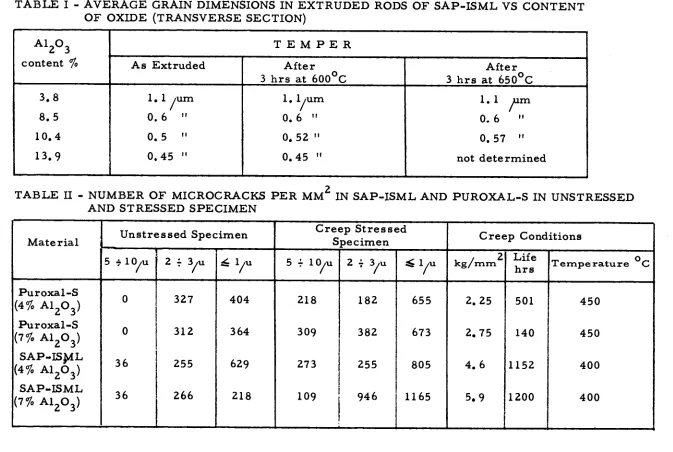
v e r s e proportionality between the oxide content (i. e. chemical composition) and the a v e r a g e d i a m e t e r of the grain (see table I, for the average dimensions).
The v e r y fine oxide p a r t i c l e s s o m e t i m e s do not show a good efficiency for blocking the dislocation w a l l s .
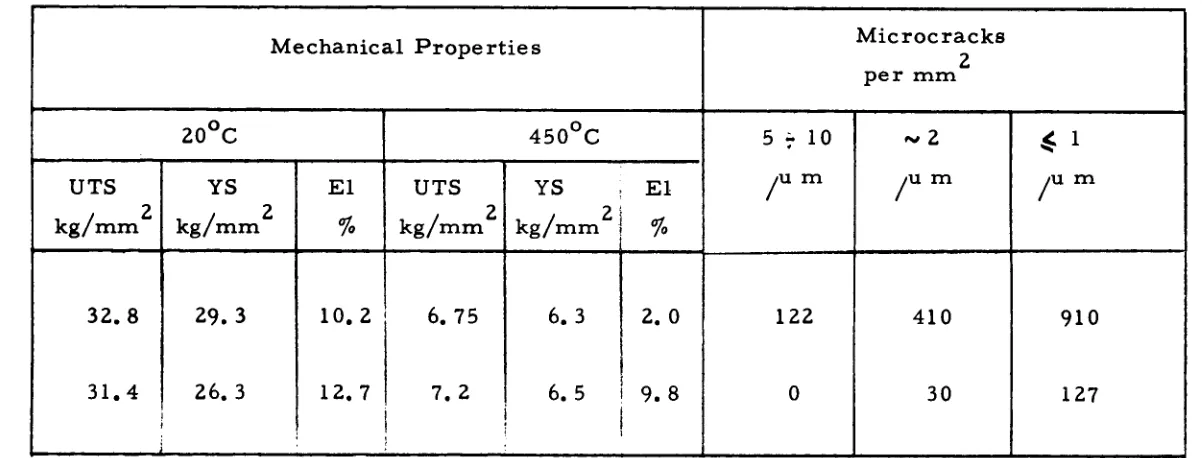
Another feature of the m a t r i x is the p r e s e n c e of m i c r o c r a c k s with different d i m e n s i o n s but n o r m a l l y in the range between 2 and 10/u. They a r e divided according to size and t h e i r num
of the surface of the specimen.
Τ
2
according to size and t h e i r number is given p e r m m of the observed replica
T h e s e m i c r o c r a c k s a r e located along the alignments of oxide p a r t i c l e s ; in the c r e e p p r o c e s s the p r e s e n c e of these m i c r o c r a c k s , inherent in the m a t e r i a l , is v e r y i m p o r t a n t .
Dislocations inside the grains
The density of dislocations in the interior of the grains in this type of m a t e r i a l s is normally not high, as can be seen from the typical s t r u c t u r e taken at the electron m i c r o s c o p e , shown previously in fig. 3.
In P u r o x a l - M , it has been found s o m e t i m e s a dislocation network in the i n t e r i o r of the grains (fig. 4).
4. 2) Structural p a r a m e t e r s affecting the d i s p e r s e d phase
The dimensions and the shape of the p a r t i c l e s of the dispersed phase a r e the first of the s t r u c t u r a l p a r a m e t e r s of this second group. F o r SAP, SAP-ISML, PUROXAL and PUROXAL-S these phases a r e ~η ALO-j and ^ A 1 203, shaped as platelets of 0. 01 m i c r o n thickness and 0. 1 m i c r o n average width.
Some of these platelets can be grouped in c l u s t e r s , of about 1-2 m i c r o n s in average d i a m e t e r . There is consequently a "factor" of homogeneity of the oxide platelets. Puroxal products have finer platelets and are m o r e h o m o g e neous as far as the oxide distribution is concerned.
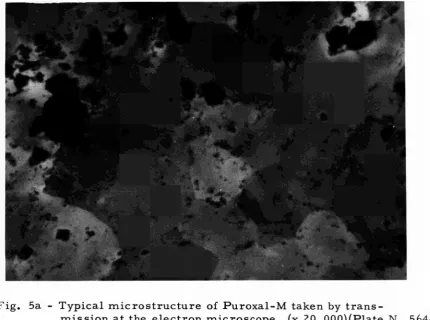
When instead of pure aluminium, an alloy Al-Mg (2-5 w% magnesium is the range tested), is atomized, oxidized and sintered, a different oxide is p r e s e n t , with a s i m i l a r dispersion but with tridimensional p a r t i c l e s , not platelets
(fig. 5); X - r a y diffractrometry and chemical analysis show these p a r t i c l e s to be constituted by a spinel (Al_0_-MgO) and MgO, without A L O - ,
It is interesting to note that the oxidation of Mg takes place not only during the milling of the powder, accomplished at room t e m p e r a t u r e or a little above room t e m p e r a t u r e , but continues during sintering at 600 C, by reduction of A 1203.
Magnesium a t o m s m i g r a t e to A 120 , p a r t i c l e s sites and there the reaction A 1203 + 3 Mg » 3 MgO + 2 Al takes p l a c e .
8
consequently be: ( A 120 , ) , MgO, MgO . A 1203, Mg2Si,
Given the diffusion coefficients of Mg and oxygen, the m o s t valid hypothesis is that MgO is formeduin situ, where f o r m e r l y were the platelets of AI2O3.
Other p h a s e s p r e s e n t in all m a t e r i a l s a r e A1N and A l . C o , which respectively take origin from the reaction of the powder with the nitrogen of the a t m o s -p h e r e (reaction v e r y active above 500 C) and with the carbon -p r e s e n t in the
s t e a r i c acid (or, in l e s s quantity, in the silicone compound).
In the p r e s e n c e of Mg a l s o a little quantity of magnesium carbide or nitride can probably form.
5) Mechanical p r o p e r t i e s of Al-A1^00 finished products
Before taking into special consideration the creep p r o p e r t i e s of the different types of A l A l O c o m p o s i t e s , it is useful to give an idea of the general m e -chanical p r o p e r t i e s of these m a t e r i a l s : t h e r e are a few general p a t t e r n s which a r e quite c h a r a c t e r i s t i c of the m e c h a n i c a l behaviour of the composites and can be so s u m m a r i z e d :
1. at a fixed t e m p e r a t u r e , the ultimate tensile strength and the yield strength r i s e with the oxide content. Ductility, as m e a s u r e d by total elongation, is i n v e r s e l y affected by the i n c r e a s e of the oxide content.
F r o m the s t r u c t u r a l point of view, higher oxide content can block the boun-d a r i e s of the s u b - g r a i n s to a stable s m a l l e r size.
2. What is said above is valid for extruded shapes obtained by hot t r a n s f o r m a -tion; when, via cold work, the g r a i n is subsequently m o r e fragmented, the behaviour changes a s follows: at room t e m p e r a t u r e , the strength is higher (and the elongation lower) in the cold worked specimens in comparison with the hot extruded m a t e r i a l . At high t e m p e r a t u r e however, the r e v e r s e is t r u e : m e c h a n i c a l strength is lower in the cold worked state with r e s p e c t to the extruded shapes of corresponding size with no apparent change in elonga-tion.
understood a s due to the m i c r o c r a c k s , which a r e m u c h l a r g e r and in g r e a t e r n u m b e r in cold worked s p e c i m e n s .
3. When the v a l u e s of UTS (or YS) a r e plotted a g a i n s t the c o r r e s p o n d i n g
v a l u e s of elongation, in conventional a l u m i n i u m , the points fall on the s a m e c u r v e r e g a r d l e s s of the t e s t t e m p e r a t u r e .
In SAP or PUROXAL the points group on different c u r v e s , ( e . g . one c u r v e for r o o m t e m p e r a t u r e and one for elevated t e m p e r a t u r e ) suggesting a dif ferent behaviour of the m a t e r i a l u n d e r t e s t at the two different t e m p e r a t u r e s . F r o m the s t r u c t u r a l point of view, this a l s o m a y be r e f e r r e d to the different influence, at different t e m p e r a t u r e s , of the g r a i n b o u n d a r i e s and of the m i c r o c r a c k s existing in the m a t r i x .
4. Another p e c u l i a r feature of A l A L O , c o m p o s i t e s in c o m p a r i s o n with c o n ventional A l a l l o y s is the fact that at e v e r y level of oxide content, the t i m e to r u p t u r e ( i . e . the r a t e of s t r a i n i n g the specimen) has at r o o m t e m p e r a t u r e a r a t h e r limited effect on total elongation and, at high t e m p e r a t u r e a v e r y m a r k e d influence on this p r o p e r t y (fig. 6).
6) C r e e p p r o p e r t i e s
Concerning c r e e p , t h e s e m a t e r i a l s show the following g e n e r a l c h a r a c t e r i s t i c s : 1. in SAP the c u r v e of elongation v s t i m e does not show evidence of t e r t i a r y
c r e e p (fig. 7). After the initial d e f o r m a t i o n the c r e e p curve continues with a v e r y s m a l l slope to the point of r u p t u r e of the specimen;
2. the slope of this p o r t i o n of the c r e e p c u r v e is p r a c t i c a l l y constant and v e r y s m a l l , denouncing a l i m i t e d d e f o r m a b i l i t y of the s m a l l g r a i n s ;
3. the l i n e s which give the s t r e s s n e c e s s a r y to bring about a c e r t a i n d e f o r m a tion (say 0 . 2 % , 0 . 3 % , 0.4%) a r e a l m o s t p a r a l l e l , v e r y close to each o t h e r and c l o s e a l s o to the line which gives the s t r e s s to rupture v s t i m e to
r u p t u r e (fig. 8);
4. the r e s i s t a n c e to c r e e p for m a t e r i a l s in the range 414% Al,Ο, in the a s extruded s t a t e , given a s the s t r e s s which p r o d u c e s the r u p t u r e in 1000 h r s at 400 C (see fig. 9) is about 70% of the UTS at the s a m e t e m p e r a t u r e ; 5. the s t r e s s to r u p t u r e does not b e c o m e négligeable (as would be the c a s e in
a l l o t h e r a l u m i n i u m alloys) even at a t e m p e r a t u r e (646 C), v e r y close to the melting point of a l u m i n i u m (see fig. 10).
IO
7) C r e e p behaviour of P u r o x a l and P u r o x a l - S
A group of c r e e p c u r v e s obtained at 450 C on a 10% ALO? Puroxal is shown in fig. 1 1 .
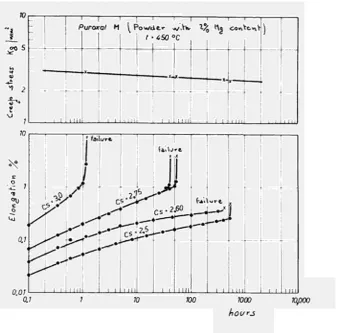
A s i m i l a r group of c u r v e s for a 10% A L O , Puroxal-S ( i . e . obtained with a silicone compound a s lubricant during the milling of the powder) is shown in fig. 12. The c o m p a r i s o n of the r e s u l t s indicates that the c r e e p strength of P u r o x a l - S is somewhat reduced but shows an elongation that r e a c h e s 1% for a life of the s p e c i m e n up to 50 h r s . SAP, in these conditions, has only 0. 2% (see a l s o fig. 13).
8) C r e e p behaviour of P u r o x a l - M
P u r o x a l - M is the name conventionally given to the m a t e r i a l when, instead of p u r e aluminium, the starting m a t e r i a l is an ΑΙ-Mg alloy, with 2 7 5% m a g n e
sium (see note in appendix).
The different p r o c e s s e s leading to these m a t e r i a l s (Puroxal, P u r o x a l - S ,
P u r o x a l - M ) have been d e s c r i b e d in the corresponding applications for p a t e n t s .
A group of c r e e p c u r v e s for a sintered m a t e r i a l of this last type, with 2% Mg, is shown in fig. 14. The s t r e s s e s leading to rupture in a given time a r e not reduced in c o m p a r i s o n with P u r o x a l or Puroxal-S when keeping in mind the oxide contents, but the elongations in the range of 1-500 h r s a r e much higher than in all previously d e s c r i b e d m a t e r i a l s : namely it is possible to have over
10% elongation with 1 h r life of the specimen, and over 5% with 50 h r s of time to r u p t u r e .
When the life of specimen is over 500 h r s the elongation is reduced to small v a l u e s , 0. 3^0. 5%, still somewhat higher than in SAP.
9) S t r u c t u r a l a s p e c t s of c r e e p 9. 1) Influence of g r a i n size
I I
dimensions of the grain is given in fig. 15.
Puroxal has finer p a r t i c l e s of A 120 , and the grain i s , with the s a m e oxide content, appreciably l a r g e r as shown in the same fig. 15.
This can explain the reduced mechanical and c r e e p strength observed.
9. 2) Influence of m i c r o c r a c k s
M i c r o c r a c k s a r e never found on a r e a s free of A1~0~ particles and a r e m o r e frequent in the regions where said p a r t i c l e s form c l u s t e r s .
They have normally their l a r g e r axis in the direction of extrusion and it is
a s s u m e d that the interface between the oxide p a r t i c l e s and the aluminium m a t r i x favours the p r e s e n c e of m i c r o c r a c k s .
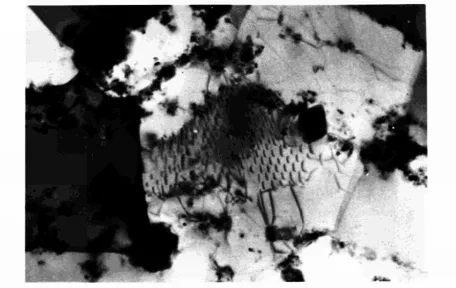
The influence of m i c r o c r a c k s is p a r t i c u l a r l y evident in ductility at elevated t e m p e r a t u r e as shown in table III.
During the c r e e p t e s t the influence of m i c r o c r a c k s is at its maximum because during the test itself new m i c r o c r a c k s form and those previously p r e s e n t , resulting from fabrication, grow in dimensions; as shown by observations at the electron m i c r o s c o p e .
The best performance of P u r o x a l - M with r e g a r d to elongation is due to the markedly reduced number of m i c r o c r a c k s .
10) Influence of the grain boundaries
The typical s t r u c t u r e of SAP and P u r o x a l given previously,clearly shows that the boundaries of the g r a i n s a r e dislocation walls which p r e s u m a b l y can not have the same mechanical p r o p e r t i e s of the interior of the grains, in which hardening p a r t i c l e s of A L O , a r e p r e s e n t . The higher strength of the interior of the grains with r e s p e c t to the boundary is a condition, a s it is well known, leading to i n t e r c r i s t a l l i n e fracture and reduced elongation.
12
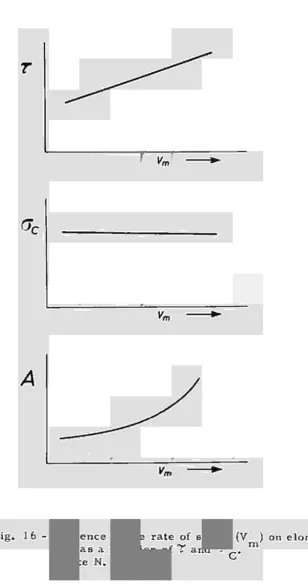
while the s h e a r i n g s t r e n g t h (f) of the boundary v a r i e s with the r a t e of s t r a i n a s shown in the s a m e figure.
The o v e r a l l influence of the r a t e of s t r a i n on elongation will be, as a c o n s e quence, of the type shown at the bottom of said fig. 16.
A s the r a t e of s t r a i n in c r e e p t e s t s is s m a l l , the influence of a quasi-viscous behaviour of g r a i n boundaries is towards a reduction of the elongation.
11) Conclusions
The e x p e r i m e n t a l data p r e s e n t e d can not bring to a general conclusion on c r e e p behaviour of A 1 - A 1203 composites but the following points appear e s t a blished:
a) the high m e c h a n i c a l strength at elevated t e m p e r a t u r e of the composites examined is m a i n l y c o r r e l a t e d with the v e r y reduced grain size, stable at high t e m p e r a t u r e , due to the p r e s e n c e of the d i s p e r s e d phase;
b) when comparing SAP m a t e r i a l and PUROXAL m a t e r i a l with different c o m position in oxide content, but with the s a m e grain size, the mechanical
s t r e n g t h is s i m i l a r in the two m a t e r i a l s ;
c) the s t r e n g t h of the g r a i n boundaries is reduced in comparison with the s t r e n g t h of the g r a i n s and the behaviour of the boundary with the rate of s t r a i n is such as to give s m a l l e r elongation when the rate of straining is reduced. Consequently, in c r e e p t e s t s reduced elongations a r e to be ex pected;
d) the p r e s e n c e of m i c r o c r a c k s in the s t r u c t u r e of these composites, which can grow in n u m b e r and d i m e n s i o n s , at elevated t e m p e r a t u r e under a s t r e s s producing a s t r a i n , is another factor that leads to rupture with a v e r y r e duced elongation;
13
APPENDIX
The name P u r o x a l is p r o t e c t e d by a t r a d e m a r k ; in o r d e r to d i s t i n g u i s h from it the p r o d u c t s in which the s t a r t i n g powder is an a l u m i n i u m m a g n e s i u m alloy, to t h e s e finished p r o d u c t s (containing a s d i s p e r s e d p h a s e s a m i x t u r e of MgO and MgO . Al O J the g e n e r a l n a m e ALMOX will be given, followed, if n e c e s s a r y , by l e t t e r s and f i g u r e s . F o r example ALMOX 64 would signify an o x i dized ΑΙMg alloy, with 6% A L O and 4% MgO in the finished p r o d u c t .
REFERENCES
1) GUALANDI, D . , JEHENSON, P . , "Contributo d e l l ' I s t i t u t o S p e r i m e n t a l e Metalli L e g g e r i allo studio d e l l ' a l l u m i n i o indurito p e r d i s p e r s i o n e con Α Ι O . p e r uso n u c l e a r e " ( p r o g r a m m a ORGEL d e l l ' E u r a t o m ) M e t a l l u r g i a Ital. , LIX, p . 347358 ( M a g . / l 9 6 7 )
2) EURATOM, " E u r a t o m Scientific A c t i v i t i e s ORGEL P r o g r a m ; T h e o r e t i c a l and conceptual s t u d i e s " . E u r a t o m Report EUR 1830 e (1964)
3) GUALANDI, D. , JEHENSON, P . , " A m é l i o r a t i o n s de la technologie du SAP en vue d e s applications n u c l é a i r e s . P r o p r i é t é s d e s m a t é r i a u x é t u d i é s " . Rapport EUR 272 f (1963) and in E n g l i s h EUR 272 e (1963)
4) GUALANDI, D. , JEHENSON, P . , "Contribution à l'étude de la technologie d e s c o m p o s i t e s A l A L O ". 3me Conférence Internationale d e s Nations Unies s u r l ' U t i l i s a t i o n pacifique de l ' é n e r g i e a t o m i q u e . Ed. Nations U n i e s , New York (1965) P a p e r A / 2 8 / P / 7 3 3 in F r e n c h and in English.
5) GUALANDI, D . , JEHENSON, P . , " P o w d e r M e t a l l u r g y of A l A l O C o m p o s i t e s (SAP) for n u c l e a r a p p l i c a t i o n s " , in Modern Developments in P o w d e r M e t a l l u r g y , Vol. Ill: Development and future p r o s p e c t s . Ed. P l e n u m P r e s s , New York (1966) (cfr. p . 3659)
TABLE I AVERAGE GRAIN DIMENSIONS IN EXTRUDED RODS OF SAPISML VS CONTENT OF OXIDE (TRANSVERSE SECTION)
A 12 ° 3
content %
3 . 8 8 . 5 10.4 13.9
T E M P E R As E x t r u d e d
1.1 /urn 0. 6 " 0 . 5 " 0 . 4 5 "
After
3 h r s at 600°C 1. 1/um 0 . 6 " 0.52 " 0.45 "
After 3 h r s at 650°C
1. 1 urn 0. 6 " 0.57 " not d e t e r m i n e d
TABLE II NUMBER OF MICROCRACKS P E R MM IN SAPISML AND PUROXALS IN UNSTRESSED AND STRESSED SPECIMEN
M a t e r i a l
P u r o x a l S (4% A 1203)
P u r o x a l S (7% A 1203)
SAPISML (4% A 1203)
SAPISML (7% A 1203)
U n s t r e s s e d Specimen —
5 τ 10 ,u
0
0
36
36
2 r 3/ U
327
312
255
266
¿z 1/U
404
364
629
218
C r e e p S t r e s s e d Specimen 5 f 1 0 / u
218
309
273
109
2 τ 3^u
182
382
255
946
^ 1/u
655
673
805
1165
C r e e p Conditions
k g / m m
2.25
2 . 7 5
4 . 6
5.9
Life h r s
501
140
1152
1200
_ o_
T e m p e r a t u r e C
450
450
400
[image:16.842.59.732.84.536.2]TABLE III - CORRELATION BETWEEN MECHANICAL PROPERTIES AND MICROCRACKS IN PUROXAL-S
Mechanical P r o p e r t i e s
20°C
UTS k g / m m
32.8
31.4
1
YS
k g / m m
29.3
26. 3
E l
%
10.2
12.7
450°C
UTS k g / m m
6.75
7 . 2
YS
k g / m m
6 . 3
6 . 5
E l
%
2 . 0
9 . 8
5 r 10 /U m
122
0
Microcracks 2 per m m
~ 2 /U m
410
30
4 ι
/u m
910
127
i tve "Λ
suae·*·' . ' · : . . ■ . · ; _ . ·..
se»»
-F i g . 1 T y p i c a l m i c r o s t r u c t u r e s (χ 100) of SAP (top, left), SAPISML (top, r i g h t ) , PUROXAL (bottom, left) and PUROXALS (bottom,
r i g h t ) . ( L a s t r e Ν. 33831, 35709, 37507, 38504) (Χ 100 Etching: HF 0. 5%).
[image:18.595.27.567.76.440.2] [image:18.595.90.542.424.790.2]17
Fig. 3 - Typical m i c r o s t r u c t u r e taken by t r a n s m i s s i o n at the electron m i c r o s c o p e . (Plate N. 2794 el. ) (x 50, 000)
[image:19.595.66.523.491.779.2]18
F i g . 5a Typical m i c r o s t r u c t u r e of PuroxalM taken by t r a n s
-m i s s i o n at the e l e c t r o n -m i c r o s c o p e , (x 20, 000)(Plate N. 5644)
[image:20.595.95.526.122.442.2] [image:20.595.92.525.481.776.2]19
^—
J
ν
■Ι Ι Ι 1 1 1 1
400°
ι ' 1 i
Γ
1111
ΛΙ2
ο
3κ
ι ι
%
1 1 1 1
Τ ι·, t .
ι ι l i l i ι ι I I I I
ao? 0.7 70 100 hours 1000
F i g . 6 Elongation v s . life of specimen. (Plate N. 31131/3
oxo
%
0250
0.200
0.150
0.100
0.050 Γ"
*%> « r ^ ^ * " ^
iß hg/"*"1
3.5 h g / " *
Α/2θ3 7%
41C V
L~~~~*—~
200 too eoo eoo noo aoo. uoo
hours
Fig. 7 Typical c r e e p curves with different s t r e s s of SAP 7% A l O .
20
70
a
kg/mm2
1 1 I I I I
E
ι ι
0 3
I I I I
^
E 0.1
ι ι I I I I
7000 hours 10000
F i g . 8 B e h a v i o u r u n d e r c r e e p conditions at 400 C. ( P l a t e N. 31 Í 1 4 / 3 ) .
75
kg/mm2
A
¿K70
N
600 1000
o
hou«
o ^ ,
70 75 AljOj % 20
21
hours
10000
F i g . 10 C r e e p c u r v e s of SAPISML 10% Al O at 646°C.
(Plate N. 31122/8). 3
70
a.,
1 Cs
¿ 0 5
-
--I I 1 1 1 Ml
Ρ jroxol Al203 70%
t-i,50°C
1 1 M Mill 1 1
\
1 1 1 M i l
Ν F
70
Χ
007
failure
* Failure
J CS^&^j —
' I I I Mill I I I I I m i l I I I I Mill I I I M i l l
Cs· 5.5
zZZ5=Rr
-CS-S0.7 70 700 ¡two
hours
TOpOO
F i g . 11 C r e e p c u r v e s of P u r o x a l (10% Al o ) at 450°C
[image:23.595.93.494.94.796.2]Π 10
σο
ύ
' I ι n m
Puroxal-S ( l O ^ A ^ O i ) f - 450 °C
' I I UMI ι ι π nul ι I I HIN I I I I IMI
c i o ; I — ι ι ι n u i l — I I I I m i l ι ι 11 imi ι ι 11 mil ι ι ι u m ]
ο.; 7 70 loo noo 1OJ000
\nours
F i g . 12 - C r e e p curves of P u r o x a l S (10% Al O ) at 450°C
(Plate N. 31162/6) 2 3
f
* 5
2-tø
_
ι ι 1 III
— χ
ι 1
SAP-AI203 7°A
ι t <50°C ι
1 III 1 I I I Mill )
1 1 1 III
_— T ._
J:
I I
%
MM
70000
ig. 13 C r e e p c u r v e s of SAPISML (7% Al O at 450°C).
[image:24.595.95.494.35.819.2]70
σο 5
1 2
ν VI
7 —
I I
ι 1
Puroxal M
1 I I I I I
1 ' !
t ■ 4 5 0 ° C
1 I I I 1 1 1 I I I 1
1% hg
*"
ι ι c o n
1 III r c n V
)
1 1 1111
10.000
'ig. 14 C r e e p c u r v e s of P u r o x a l M (starting powder with 2% Mg content^· (Plate N. 31160/9).
u
(lm
1.2
% 0.S
c E ■ β .c S ë, 0.6
-o 3 ΙΛ
«
O i
V O.i
0.2
\
\ \
\ ' k
\ \
\ S
s Ν Ν SAP' \ v ^PUROXAL Ν . vx »s v
> \ .
**-. »
10 12 U '/o AUO-, 16
F i g . 15 A v e r a g e Grain size v s . Al Q content. (Plate N. 31164/6).
[image:25.595.155.502.60.393.2]24
"m
'm
Tn
F i g . 16 - Influence of the rate of strain (V ) on elonga tion a s a function of Ύ and 5" .
[image:26.595.135.444.156.742.2]NOTICE TO THE READER
All Euratom reports are announced, as and when they are issued, in the monthly periodical EURATOM INFORMATION, edited by the Centre for Information and Documentation (CID). For subscription (1 year : US$ 15, £ 6.5) or free specimen copies please write to :
Handelsblatt GmbH
"Euratom Information" *
Postfach 1102 Γ,Κ
D-4 Düsseldorf (Germany)
or
Office central de vente des publications des Communautés européennes 2, Place de Metz Luxembourg
\ To disseminate knowledge is to disseminate prosperity — I mean ! general prosperity and not individual riches — and with prosperity
I disappears the greater part of the evil which is our heritage from
i darker times. "' '·-!"· rMiksH'i
'
SALES OFFICES
AU Euratom reports are on sale at the offices listed below, at the prices given on the back of the front cover (when ordering, specify clearly the EUR number and the title of the report, which are shown on the front cover).
OFFICE CENTRAL DE VENTE DES PUBLICATIONS DES COMMUNAUTES EUROPEENNES
2, place de Metz, Luxembourg (Compte chèque postal N° 191-90)
B E L G I Q U E — B E L G I Ë
MONITEUR BELGE
40-42, rue de Louvain - Bruxelles BELGISCH STAATSBLAD Leuvenseweg 40-42, - Brussel
LUXEMBOURG
OFFICE CENTRAL DE VENTE DES PUBLICATIONS DES COMMUNAUTES E U R O P E E N N E S 9, rue Goethe - Luxembourg
D E U T S C H L A N D
BUNDESANZEIGER
tälj« Postfach - Köln 1
FRANCE
SERVICE D E V E N T E EN FRANCE DES PUBLICATIONS DES
COMMUNAUTES E U R O P E E N N E S 26, rue Desaix - Paris 15e
NEDERLAND
STAATSDRUKKERIJ
Christoffel Plantijnstraat Den Haae
ITALIA
L I B R E R I A DELLO STATO Piazza G. Verdi, 10 - Roma
UNITED KINGDOM
H. M. STATIONERY OFFICE P. O. Box 569 - London S.E.I
EURATOM — C.I.D.
51-53, rue Belliard Bruxelles (Belgique'1