Munich Personal RePEc Archive
To estimate an equation explaining the
determinants of Dowry
Subhani, Muhammad Imtiaz and Afza, Sarwat
Iqra University Karachi
2009
Online at
https://mpra.ub.uni-muenchen.de/21365/
TO ESTIMATE AN EQUATION EXPLAINING THE DETERMINANTS OF
DOWRY
Ms. Sarwat Afzal, Research Fellow, Iqra University
Dr. Imtiaz Subhani, Incharge Research Dept., Iqra University
September , 2009
Abstract
The focus of this study is to estimate an equation explaining the determinants of dowry. In this paper,
we address a very common socio-economic problem for sub-continent, the problem of dowry. From a
social planner's perspective, who wants to reduce overall dowry transfers, we consider the effect of
change in a few relevant parameters like husband height, wife height, wet land, dry land, years of
marriage and years of education for women & men on these decisions.
According to the various studies the dowry phenomenon is exist heavily in rural sub-continent, at the
same time research related to this system is very rare. The aim of this paper is to estimate an equation
explaining the determinants of dowry. Several interpretations for dowry are distinguished using a simple
theoretical framework and the predictions of this model are tested. Using the data provided us for this
project is tested and reliable so that we will be able to draw our own testable relationships and
determinants of dowry. The data will be use in the following sections for further analysis by estimating
the determinants of dowry using multiple regression analysis. The study suggests that even though there
are religious and cultural differences, the system of dowry in Pakistan appears to be for the same
reasons as in India
A theoretical framework was developed that was inclusive of all the required variables by testing
through the multiple regression analysis and the experimental findings shows the independent variable
used to test have an impact on dowry by applying multiple regression step-wise method.
Key Word: Dowry, Household, Jahez, Marriage
INTRODUCTION:
Dowry is one of those social practices which no educated person would own up with pride, although
many still adhere to this much deplorable practice. Dowry continues to be given and taken. Even
among the educated sections of society, dowry continues to form an essential part the negotiations that
During the marriage ceremony the articles comprising the dowry are proudly displayed in the wedding
hall. Dowry is still very much a status symbol. A number of marriage-negotiations break down if there
is no consensus between the bride's and groom‟s families. Dowry deaths of a newly married bride are
still regularly in the news. Although the practice of dowry exists in many countries, it has assumed the
proportion of a challenge to the forces of modernity and change only in India. Many reasons are put
forward for explaining this practice. It is said that a dowry is meant to help the newly-weds to set up
their own home. Parents transfer wealth to their children in many ways. The dowry is distinctive
because it is a large transfer made to a daughter at the time of her marriage. (Botticini & Siow, 2000).
The sums of cash and goods involved are often so large that the payment can lead to impoverishment
of the bridal family. This has a devastating effect on the lives of unmarried women who are
increasingly considered burdensome economic liabilities. The custom of dowry has been linked to the
practice of female infanticide and, among married women, to the more obvious connection with
bride-burning and dowry-death, i.e., physical harm visited on the wife if promised dowry payments are not
forthcoming (Anderson, S., 2001). The dowry is given as compensation to the groom's parents for the
amount they have spent in educating and upbringing their son. These explanations may seem logical in
the present day context, but they cannot explain how this practice originated.
Dowry is a massive social ill on both sides of the Pakistan-India border and who hasn‟t heard of the
infamous bride burning where the girl who brings insufficient dowry is burnt „accidentally‟ by her in laws so that a new „prey‟ may be caught who can bring in a better dowry.(Sarfaraz. 2008)
PRELIMINARY LITERATURE REVIEW THEORITICAL FRAME WORK:
The rise of the dowry system among Muslims of subcontinent appears to date back only some
decades. White (1992: 102) and Rozario (1992: 134) note that the prevalence of the system
reflects a change over the last two generations, following the independence of Bangladesh.
Dowry was previously practiced mainly in urbanized, more affluent classes. The „tyranny of
dowry‟ existed in urban areas since the late 1960s, but has now spread to rural populations
(Alam and Matin, 1984:7).
Like many other customs and social institutions in subcontinent, dowry is said to originate
from Hindu customs. Traditional Hindu law recognizes several types of marriage, the most
approved being the Brahma form, where the bride‟s father gives her away without any
consideration (Jhabvala, 1981: 18). In the Brahma form, the bride‟s father offered his daughter
adorned properly, but was under no compulsion, and these gifts were given to the daughter
daughter in her new home and were considered as str¯ıdhan (property of the woman). Ahmed
and Naher (1987: 137) refer to Brahma marriage as dowry or joutuk marriage and argue that, though this form was once confined to Brahmins, it later became accepted by other
castes.(Shahnaz, 2006)
Some authors have tried to justify this system of dowry by reference to the practices of the Prophet
Mohammed, that is, sunna. Despite agreement that dowry payments are not among the basics of a
Muslim marriage, there are contentions that it forms part of the sunna of the Prophet, who gave certain
items to his daughter Fatima at her marriage to Ali, the Prophet‟s cousin (Ansari, 1978: 80–1). The second instance quoted by those who see dowry as Islamic is the marriage of Zainab, another daughter
of the Prophet, who was given a costly necklace by her rich mother (Ansari, 1978: 81). These are not
regarded as normative sunna, however, since jahez was not mentioned for several other marriages
during the Prophet‟s time, nor did the companions after the Prophet‟s time emphasize this practice
(Ansari, 1978: 82–3). The Koran, the traditions of the Prophet (sunna) and other early scholars (for
example, the Hedaya), do not back the practice of demanding dowry. The traditions of the Prophet
call for a man to avoid doing from marriage until he can afford marriage and dower. If he cannot afford
to get married, he should practice abstinence until Allah provides him with sufficient means.(Shahnaz.
2006)
In general, research directly pertaining to the custom of dowry in the rest of South Asia is relatively
sparse. A notable exception is the study by Lindenbaum (1981) which investigates the transition from
bride-price to dowry of a predominantly Muslim community in rural subcontinent.
A woman in Pakistan is entitled by law at marriage to: (i) a dowry and marriage gifts from her parents;
and (ii) a dower (mahr), a bridal gift from the groom which is generally intended to provide some
insurance for her in the case of divorce (see Patel 1979, Korson and Sabzwari 1984, and Afzal et. al.
1973). Further, Pakistani women have the right to inheritance and ownership of property. According to
Muslim Personal Law (Shariat), daughters are entitled to a half of the share which a son inherits from
his father. It is noted, however, that the dowry she receives at the time of marriage is usually
considered her pre-mortem inheritance, which is typically less than she is entitled to under the law (see
Donnan 1988 and Patel 1979).
A natural question to ask in the exploration of Pakistani dowries is how this custom differs from those
in India where the severe social consequences of rising dowries have motivated a large body of research
aimed at explaining the phenomenon. The total cash and goods involved are so large that the dowry
unmarried women who are increasingly considered stringent economic liabilities. For example, the
custom of dowry is often linked to the practice of female infanticide. Other repercussions include
extreme abuse of women as exemplified by terms like “bride-burning" and “dowry-death" becoming commonly used. The links to dowry inflation have been drawn by sociologists; for example, Kumari
(1989), Chauhan (1995), McCoid (1989), Pawar (1990), Lata (1990), and Pathak (1990) address these
issues.( Anderson, S., 2000).
As already mentioned, this role for dowry has been emphasized in the recent literature of modern-day
dowry payments in India. Others have observed that in societies where dowry has occurred, women
were considered an economic burden since a wife performed little or no income-producing work for
the household. The second interpretation of dowry therefore links the payments to the productivity of
women and treats bride-price and dowry paid as opposites. In societies where women are
economically productive, a bride-price payment is made to their families to compensate for the loss
of a worker. If women do not contribute to household income, dowry is paid to the groom's family as
a compensation for an unproductive member. However, the most common form of dowry is a pre
-mortem female inheritance where women retain ownership of her gift during marriage, and can
reclaim it for her own welfare if the marriage is dissolved (see, for example, Goody 1976 and
Hughes 1985). This third definition of dowry is therefore associated with societies in which
inheritance flowed to both sons and daughters. In several countries, dowry as a pre-mortem
inheritance given to women was written into the constitution, as was traditionally the case in
Pakistan (Anderson, S., 2000).
On the other hand, characteristics of the bride‟s family at the time of marriage in conjunction with the characteristics of her spouse and his family determine the conditions of marriage such as dowries,
marrying biological relatives, and age at marriage, which in turn affect subsequent socio-economic
outcomes for the woman and her children Dalmia, (2004), Rao, (1993) and Mobarak and Kuhn and
Peters, (2007).
The aim of the next section is to develop a model which embeds and distinguishes these given
variables in data in estimating the equation for dowry paid for marriage in rural subcontinent.
Methodology:
To examine the variables to determine the dowry size, data set on bride-groom characteristics and
dowry was selected and it was kindly been provided by A.B. Deo Lalikar.1 The data comprises 140
respondents. The data will be use in the following sections for further analysis by estimating the
determinants of dowry using multiple regression analysis by step-wise method.
The study has been focused on analysis that dowry paid is dependent on which variables Subject in the
rural subcontinent. Since the objective of study is to estimate the equation explaining the determinant
of dowry so all the variables given in the data are takes as independent and the dowry paid is taken as
dependent variable.
The findings suggested that dowry paid is based on the status and the affluence of husband‟s family as
well as the education of the husband‟s father that are the important determinants of the incidence of dowries. And also one more thing that the influence of husband‟s father education is accounted as a
predictor for the system of dowry paid. However the literature is also analyzing that since the traditional
custom of dowry in subcontinent is considered an inheritance to daughters, it appears that this custom
still persists in rural areas whereas, like in Pakistan, India and Bangladesh, the custom has evolved into a
groom price payment in urban areas (Anderson, S., 2000).
Data Analysis: Methods/ Testing Criteria:
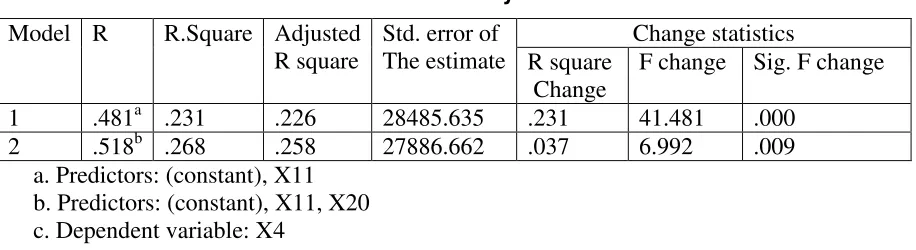
To more thoroughly determine the determinants of dowry we employed multiple regression analysis.
[image:6.612.77.535.466.591.2]Table 1 reports the model summary from this study.
Table 1. Model Summary
Model R R.Square Adjusted R square
Std. error of The estimate
Change statistics R square
Change
F change Sig. F change
1 .481a .231 .226 28485.635 .231 41.481 .000 2 .518b .268 .258 27886.662 .037 6.992 .009
a. Predictors: (constant), X11 b. Predictors: (constant), X11, X20 c. Dependent variable: X4
The rationale is that value of R square shows that the final regression model can be predicted with two
independent variables (wet land owned X11, and dummy Husband’s father secondary education
X20) out of 19 independent variables explains 26.8% of the variance of dowry X4. That‟s not great but
we‟re getting there. Value of Std. Error of the Estimate is also decreased in every step which
1
demonstrates the improvement in the overall model fit. The findings from this analysis is shown in
[image:7.612.97.492.149.277.2]Table 1.
Table 2 reports the information about ANOVA summary from this study.
Table 2.
ANOVAc
3E+010 1 3.366E+010 41.481 .000a
1E+011 138 811431412.0
1E+011 139
4E+010 2 1.955E+010 25.137 .000b
1E+011 137 777665899.0
1E+011 139 Regression Residual Total Regression Residual Total Model 1 2 Sum of
Squares df Mean Square F Sig.
Predictors: (Constant), X11 a.
Predictors: (Constant), X11, X20 b.
Dependent Variable: X4 c.
F and Sig. - The F-value is in last model 2 yielding F=25.137. The p-value associated with this F
value is very small (0.000) is used to answer the question "Do the independent variables reliably
predict the dependent variable?" Hence we could say that the group of variables (X11, X20) can be
used to reliably predict dowry X4 (the dependent variable). It means that the model is significantly
[image:7.612.100.514.459.615.2]acceptable for prediction purpose for dowry.
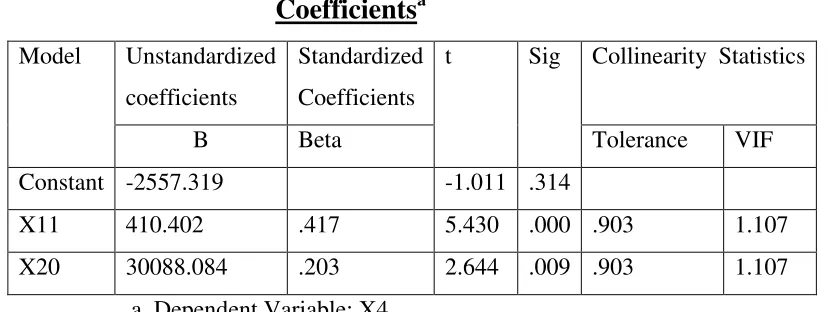
Table 3
.
Coefficients
aModel Unstandardized
coefficients
Standardized
Coefficients
t Sig Collinearity Statistics
B Beta Tolerance VIF
Constant -2557.319 -1.011 .314
X11 410.402 .417 5.430 .000 .903 1.107
X20 30088.084 .203 2.644 .009 .903 1.107
a. Dependent Variable: X4
Results from the estimation of parameters and coefficient values are reported in Table 3 above. Aside
from all the variables in particular wet land owned X11, and dummy Husband‟s father secondary
education X20 has a great influence on the amount of net dowry paid. The beta coefficients indicate
variable (the higher the value of b the more influential the independent variable) and the sign (pos.,
neg.) indicates the nature of the relationship (whether the independent variable and the dependent
variable move together or in opposite directions).
Y = a + b1X 11 + b 2X 20
As a result of above discussion the main estimating equation is better represented by:
Dowry Predicted = -2557.319 + 410.402 * X11 + 30088.064 * X20
The interpretation of the coefficients from a linear regression model is fairly straightforward which tell
us about the relationship between the independent variables and the dependent variables as well as the
amount of increase in dowry that would be predicted by a 1 unit increase in the predictor. Where as
the predicted values of constant (2557.319), also depicts that the dowry paid is expected to be
-2557.319, when no wet land owned by husband as well as no secondary education husband father is
completed. It means in this case dowry amount will be paid by the groom‟s family to bride‟s family in
rural areas of the subcontinent. X20 which is a dummy variable is commonly used to examine group
and time effects in regression. The dummy variables do not change the nature of the relationship or
slope, but only provide for differing intercept among the groups
Results:
The finding in the model is that in case of all the variables given the one variable which statistically
has an impact on dowry paid is the wet land owned by husband‟s house hold however there is no other
independent variables influence on the dependent variable which have an impact on the dowry paid in
the rural subcontinent.
Another finding is that the dowry paid has a negative intercept, when no wet land owned by husband
as well as no secondary education husband father is completed. It means in this case dowry amount
will be paid by the groom‟s family to bride‟s family in rural areas of the subcontinent.
Another finding is regarding the father‟s education that is also an important factor in all dummy variables which has an impact of getting education on secondary level, so it is inferred that in rural
areas of subcontinent the father who have education on secondary level have only provide differing
intercept among the group and add in the value of intercept not in the slope or the nature of
relationship. Statistically the result provide support that not all variables in the given data are the
determinant of dowry but only two variables in which one is dummy variable have an impact and
Conclusion:
The results of the empirical analysis support the wet land owned by husband‟s household explaining in
determining the value of dowry paid in urban areas, whereas dowries also serve the role of a pre-mortem
inheritance in rural areas. Since the traditional custom of dowry in subcontinent is considered an
inheritance to daughters, it appears that this custom still persists in rural areas whereas, like in Pakistan,
India and Bangladesh, the custom has evolved into a groom price payment in urban areas (Anderson, S.,
2000). This would seem to suggest, that from the male perspective, the institution of dowry is not
considered detrimental to either women or themselves.
This is suggested by the fact that status and the affluence of husband‟s family as well as the secondary
education of husband‟s father is an important determinant of the incidence of dowries. Moreover, the probability that brides' parents paid a dowry is not related to the age and schooling years of either brides
or grooms or their families.
Further, since most villagers support the practice of dowry, there is little threat of anyone
lodging a complaint. While the practical mechanisms for complaining about dowry are far
beyond most villagers, especially women, one of the greatest barriers for women going to
court is the realization that she will not be welcomed back to her own home if she makes an
official complaint (Shahnaz. 2006). As Raziya of Dhitua opined, “Without dowry, no one will
take our daughters. If only the boys’ fathers decline to take dowry, then the practice will
stop”. (Shahnaz. 2006).
Discussion and Managerial Implications:
From a scholarly perspective, dowry has spurred a flowering of sharp thinking about the
economics and sociology of dowry and marriage payments more broadly. In this sense,
whether dowry exists or not is somewhat beside the point, as the theory and empirical tools
that have been developed to address the issue are of broad utility to social scientists. From a
practical and policy-making perspective, however, the question of the existence of dowry paid is
critical. Using basic statistical techniques, we fail to corroborate the widespread cla im that real
dowry amounts have risen substantially in South Asia. (Arunachalam and Logan, 2008)
Despite this body of research, which is tested on the given data of rural areas of subcontinent is not
significantly and practically supported our equation of explaining determinants of dowry, however it is
context of this study, we cannot state which action should take to create specific behavior to control the
dowry system.
Thus we suggest that researcher should do more to understand the significant determinant of dowry.
This would provide useful guidance to manager and executives. Thus we recommended that much
work remains to be done to find out in term of developing a suitable equation of dowry system and
empirically testing our proposition. At the same time, encourage other scholars to continue the
important work being done in this area.
References
Afzal, M., L. Bean, and I. Husain (1973) \Muslim Marriages: Age, Mahr, and Social Status",
Pakistan Development Review, Vol. XII, No. 1, 48-61.
Ahmed, Rahnuma and Naher, Milu Shamsun (1987) Brides and the Demand System in
Bangladesh: A Study. Dhaka: Centre for Social Studies.
Alam, Sultana and Matin, Nilufer (1984) „Limiting the Women‟s Issues in Bangladesh: The Western
and Bangladesh Legacy‟, South Asia Buletin 4(2): 1–10.
.Anderson, Siwan. 2000. "The economics of dowry payments in Pakistan," mimeo, Tilburg University
Discussion Paper 82, Tilburg University, Center for Economic Research.
.Anderson, S., 2001. "Why dowry payments declined with modernization in Europe but are rising in
India," Discussion Paper 7, Tilburg University, Center for Economic Research.
Ansari, A.S. Bazmee (1978) „Is Dowry Obligatory?‟, Hamdard Islamicus 1(2): 78–84.
Apte, U.M. (1978) The Sacrament of Marriage in Hindu Society. Delhi: Ajanta Publications.
BNWLA (2005) Violence Against Women in Bangladesh 2004. Dhaka: Bangladesh National
Women‟s Lawyers Association.
.Arunachalam, Raj and Logan, Trevon (2008), “Is there Dowry Inflation in South Asia?”
NBER Working Paper No.13905.
Birodkar Sudheer (1994) Dowry, in the “Dowry, Sati and Child Marriage” on Hindu History & Social
Customs
.Botticini, Maristella & Siow, Aloysius (2000). "Why Dowries?," Econometric Society World
Congress 2000 Contributed Papers 0200, Econometric Society.
Chauhan, R. (1995) Dowry in twentieth century India: a window to the convict of caste, class, and
Dalmia, S. 2004. “A Hedonic Analysis of Marriage Transactions in India: Estimating
Determinants of Dowries and Demand for Groom Characteristics in Marriage,”
Research in Economics 58: 235-255.
Donnan, H. (1988) Marriage among Muslims: Preference and choice in Northern Pakistan.
Hindustan Publishing Co., Delhi.
Goody, J. (1976) Production and Reproduction, Cambridge University Press, Cambridge.
Goody, J. and S. Tambiah (1973) Bridewealth and Dowry. Cambridge University Press, Cam -bridge.
Hughes, D.O. (1985) “From Brideprice to dowry in Mediterranean Europe" in the marriage
bargains: women and dowries in European history, M. Kaplan (ed.), Havorth Press, New York,
13-58.
Jhabval, Noshirvan H. (1981) Principles of Hindu Law. Bombay: C. Jamnadas & Co.
Kishwar, Madhu (1988) „Rethinking Dowry Boycott‟, Manushi 48: 10–13.
Korson, J. H. (1971) \Endogamous marriage in a traditional Muslim society: West Pakistan".
Journal of Comparative Family Studies, Autumn, 145-155.
Korson, J. H. and M. Sabzwari (1984) “Age and social status at marriage, Karachi, Pakistan 1961-64
and 1980: a comparative study." Journal of Comparative Family Studies, Vol. XV, No.2, 257-279.
Kumari, R. (1989) Brides are not for burning. Dowry victims in India. Radiant Publishers, New
Delhi.
Lata, P.M. (1990) “Violence within family: experiences of a feminist support group" in Violence
against women (ed.) Sushama Sood, 223-235, Arihant Publishers, Jaipur.
Lindenbaum, Shirley (1975) „The Value of Women”, in John R. Mclane (ed.) Bengal in the
Nineteenth and Twentieth Centuries: South Asia Series Occasional Paper No. 25 (pp. 75–83).
Ann Arbor, MI: Asian Studies Center.
McCoid, C. (1989) \Dowry deaths in India: a materialist analysis. "Working Paper 188, One of
Women in International Development, Michigan State University.
Miller, Barbara D. (1980) „Female Neglect and the Costs of Marriage in Rural India‟, Contributions
to Indian Sociology 14(1): 95–129.
.Mobarak, A. Mushfiq and Kuhn, Randall and Peters, Christina (2007), “Marriage Market Effects of a
Wealth Shock in Bangladesh”, Working Paper
Naher, Milu Shamsun (1993) „Demand O Nari Nirjaton (Demand and Repression of Women)‟, in B.K.
Jahangir and Z.R. Khan (eds) Bangladeshe Nari Nirjaton (Women‟s Repression in Bangladesh)
(pp. 46–62). Dhaka: Samaj Nirikkhan Kendra.
Pathak, I. (1990) Women and family violence: policies and programs" in Violence against women”
(ed.) Sushama Sood, 259-265, Arihant Publishers, Jaipur.
Pawar, M. S. (1990) Women and family violence: policies and programs "in Violence against
women” (ed.) Sushama Sood, 237-258, Arihant Publishers, Jaipur.
Rao, V. 1993. “The Rising Price of Husbands: A Hedonic Analysis of Dowry Increases in Rural
India,” Journal of Political Economy 101: 666-677.
Rozario, Santi (1992) Purity and Communal Boundaries: Women and Social Change in a
Bangladeshi Vilage. London: Zed Books.
Sarfaraz Irum (2008), “The menace of dowry” article from Pakistaniat.com
.Shahnaz Huda (2006), “Dowry in Bangladesh: Compromising Women‟s Rights”, South Asia
Research Vol. 26 (3)
Shehab, Rafi-Ullah (1979) „Dowry in Islam‟, Hamdard Islamicus 2(1): 96–8.
White, Sarah C. (1992) Arguing with the Crocodile. Dhaka: University Press.
Appendix 1
Definitions of variables
N = Observation Number, X1 = wife‟s height (cm), X2 = wife‟s age at marriage, X3 = wife‟s
schooling years, X4 = net dowry paid (including marriage expenses) By the bride‟s household to the
Groom‟s household (in constant 1983 rupees), X5 = dry land owned by Wife‟s household when she was 15, X6 = wet land owned by wife‟s household when she was 15, X7 = Husband‟s age at marriage,
X8 = Husband‟s school years, X9 = Husband‟s height (cm), X10 = dry land owned by husband‟s
household when he was 15,
X11 = wet land owned by husband‟s household when he was 15, X12 = years of marriage, X13 = low-caste dummy, X14 = medium-low-low-caste dummy, X15 = medium-high-low-caste dummy(excluded category
is high caste), X16 = whether the husband‟s father was an agricultural cultivator (farmer), X17 =
whether the husband‟s father was an (landless) laborer, X18 = dummy (husband‟s father had some primary education)
X19 = dummy (husband‟s father completed primary education), X20 = dummy (husband‟s father