http://dx.doi.org/10.4236/msa.2016.74019
How to cite this paper: Verma, S., Amritphale, S.S. and Das, S. (2016) Synthesis and Characterization of Advanced Red Mud and MWCNTs Based EMI Shielding Material via Ceramic Processing. Materials Sciences and Applications, 7, 192-201. http://dx.doi.org/10.4236/msa.2016.74019
Synthesis and Characterization of Advanced
Red Mud and MWCNTs Based EMI Shielding
Material via Ceramic Processing
Sarika Verma
*, Sudhir Sitaram Amritphale, Satyabrata Das
Council of Scientific and Industrial Research-Advanced Materials and Processes Research Institute, Bhopal, India
Received 20 February 2016; accepted 21 April 2016; published 27 April 2016
Copyright © 2016 by authors and Scientific Research Publishing Inc.
This work is licensed under the Creative Commons Attribution International License (CC BY).
http://creativecommons.org/licenses/by/4.0/
Abstract
For the first time in the world advanced multi layered Red Mud and MWCNTs (ARMC) based EMI shielding material has been developed at CSIR-AMPRI, Bhopal. Red mud provides oxides of tita-nium and iron as precursor and the MWCNTs provides electrical conductivity characteristics ne-cessary for making desired EMI shielding materials. The novel process involves unique designing of chemical compositions and mineralogical phases of red mud, MWCNTs together with appropri-ate additive and solvent which results in the simultaneous and synergistic chemical reactions among various constituents thereby forming tailored precursor powder. Further, the ceramic processing of tailored precursor powder in appropriate environment enables formation of ad-vanced ARMC shielding material having a variety of ceramic phases with multi elemental compo-sitions and multi layered crystal structures. The synthesized material was characterized by vari-ous techniques namely XRD, PL, FESEM, EDXA. The reflection loss (R. L.) of the sample was calcu-lated based on the measured complex permittivity and permeability. The advanced ARMC materi-al with thickness t = 1.5 mm showed a minimum R. L. of −35.5 Db at 14.0 GHz with a response band width of 1.8 GHz. Thus, the developed advanced ARMC material acts as a good EMI wave absorber.
Keywords
Red Mud, MWCNTs, EMI Shielding, Ceramic Processing, Multilayered Structure
1. Introduction
magnetic or both the characteristics. Shielding of Electromagnetic Interference (EMI) is in demand 1) due to the interference of wireless devices with digital devices, 2) due to the increasing sensitivity, and 3) due to increased importance of electronic devices [1]-[4]. Shielding is particularly required for power transformers containing vaults and other electronics that are related to electric power and telecommunications. The desired characteris-tics for obtaining advanced EMI shielding materials should preferably be a) light in weight, b) efficiently ab-sorbing EM waves, c) possessing tunable absorption frequency, d) multifunctional, e) resistance to corrosion, f) flexible and g) having processing advantages [5]-[9].
Conventional EMI shielding materials are made using synthetic grade compounds of barium, titanium, iron and MWCNTs. The chemical reaction among these compounds leads to the formation of barium titanate, iron oxides in MWCNTs composite matrix. As reported by Tan et al. (2010) and Iyer et al. (1993), BaTiO3 and TiO2
posses high permittivity and dielectric constant, thereby improving the EMI shielding properties of the materials [10] [11]. Also as reported by Azadmanjiri et al. (2010) and Zhiguang Ding et al. (2015), the magnetic phases due to Fe2O show a marked increase in the absorption of EMI waves [12] [13].
In the present novel process red mud has been explored as a source of oxides of titanium and iron as precursor, MWCNTs provides desired electrical conductivity characteristics and barium hydroxide, being a source of ba-rium for making advanced EMI shielding material. Red mud [14] is an aluminum industry waste which inhe-rently contains varieties of elements namely iron, titanium, aluminum, silicon, calcium, magnesium and sodium etc and thus makes it a most suitable multi-component resource material for developing value added materials. Further these multi-elements in the red mud are present in the form of oxide, oxy-hydroxide and hydroxides, having low as well as high atomic numbers elements namely sodium, iron compounds respectively.
The unique structure and excellent properties of Carbon Nano Tubes (CNTs) (both single-walled and multi- walled (SWCNTs and MWCNTs)) like high aspect ratio, high conductivity, small diameter and mechanical strength have prompted its potential engineering applications, in the area of electronics, automotive and aero-space sectors. Further CNTs are use in electrostatic dissipation, electromagnetic interference (EMI) shielding, multilayer printed circuits and conductive coatings, etc. Several studies of using MWCNTs, as excellent option, for creating conductive composites for high-performance EMI shielding materials, have been reported [15]-[19].
So far no serious efforts have been made to explore the iron and titanium precursors of Red mud and MWCNTs together, for the development of novel advanced EMI shielding material. In order to obtain particle size of developed advanced ARMC shielding material ranging from micron to submicron up to nano size, cetyl-trimethylammonium bromide has been used for reducing the particles size down to the nanometer range as well as stabilizing the formed particles [20] [21].
2. Experimental
2.1. Material and Chemicals Required
2.1.1. Red Mud
The Red Mud was collected from HINDALCO, Renukoot (U.P) for the study was analyzed in the laboratory for physico-chemical characteristics and the results are given in Table 1.
2.1.2. Chemicals
Multiwalled CNTs, Barium hydroxide, Sodium hydroxide, Cetyltrimethylammonium bromide (CTAB), ammo-nium nitrate were procured from Rankem and Ethylene glycol was procured from Merck. All the chemicals were used as such without further purification.
2.1.3. Procedure
The experimental work for the obtaining advanced ARMC shielding material has been divided into two parts in the following way.
1) Synthesis of tailored precursor powder
Table 1. Chemical analysis of red mud HINDALCO, Renukoot (U.P).
Sr. No. Constituents %
1 LOI 8 - 10
2 Al2O3 17 - 19
3 Fe2O3 34 - 40
4 SiO2 7 - 8
5 TiO2 15 - 16
6 Na2O 5 - 6
7 CaO 1.8 - 5.0
8 P2O5 0.31 - 0.47
9 V2O5 0.035
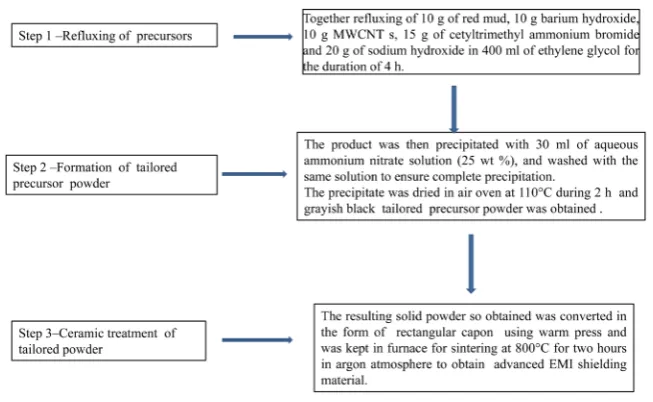
obtained was dried in air oven at 110˚C for 2 h and grayish black tailored precursor powder was obtained. 2) Ceramic processing of tailored precursor powder to obtain advanced ARMC shielding material
The resulting tailored precursor powder so obtained was converted in the form of rectangular coupon using warm press and was kept in furnace for sintering at 800˚C for two hours in argon atmosphere i.e. ceramic processing of tailored precursor to obtain EMI shielding material.
The various steps involved in the developed novel process for synthesis of advanced ARMC shielding mate-rials shown in Figure 1.
Figure 1. Flow sheet of advanced ARMC shielding material.
2.2. Characterization
[image:3.595.155.482.377.578.2]3. Results and Discussion
3.1. X-Ray Diffraction Studies
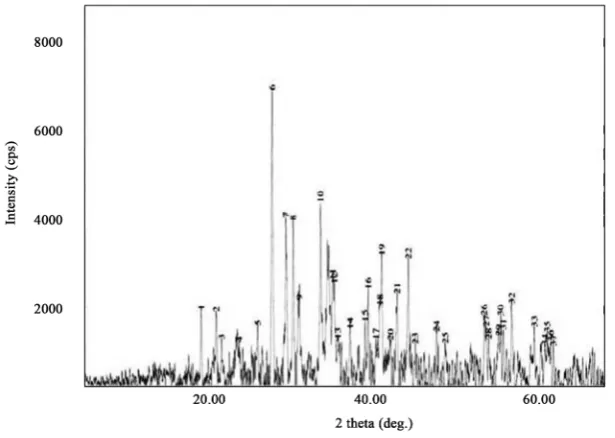
Identification of the various phases present in the synthesized advanced EMI shielding material formed during the reaction process was carried out by comparing the experimental inter planar spacing (d values) with those of the respective likely substances listed in the JCPDS standard X-ray diffraction (XRD) data files [22]. The X-ray diffraction spectrum (XRD) of the synthesized EMI material is shown in Figure 2 and the respective phases identified are given in Table 2 respectively.
In general the XRD patterns are composed of sharp peaks, indicating that the synthesized materials have good crystalline structure. The results of X-ray powder diffraction analysis of advanced material exhibited the pres-ence of a diverse mineralogical phases and compounds namely barium iron titanium silicate (Bafertisite), barium aluminum silicate, iron titanium oxide, barium titanate, barium iron titanium oxide, barium aluminum oxide, magnetite, iron sulphide (troilite).
Crystallite size was obtained by using the Debye’s Scherrer equation [23]:
( )
cosK D
β θ
=
[image:4.595.162.470.341.560.2]where K is the shape factor, λ is the wavelength, β is the line broadening at half the maximum intensity (FWHM) in radians and θ is the Bragg angle. The crystallite size was of the synthesized material was found to be in the range from 10 - 18 nm.
Figure 2. XRD pattern of advanced ARMC shielding material.
Table 2. Phases present in advanced ARMC shielding material.
No. Phase identified in material JCPDS data (file number) Crystal structure
1 Barium iron titanium silicate (Bafertisite) 14 - 541 Orthorhombic
2 Barium aluminum silicate 28 - 125 Hexagonal
3 Iron titanium oxide (pseudorutile) 13 - 270 and 19 - 635 Tetragonal and hexagonal
4 Barium titanate 8 - 368 Monoclinic
5 Barium iron titanium oxide 26 - 1032 Hexagonal
6 Barium aluminum oxide 28 - 121 Tetragonal to cubic
7 Magnetite 19 - 629 Cubic
[image:4.595.86.538.602.720.2]3.2. Photoluminescence
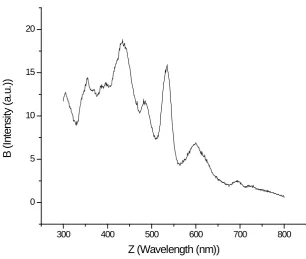
[image:5.595.159.466.180.439.2]The Photoluminescence spectra of the developed advanced ARMC shielding material is shown in Figure 3 and shows multiple peaks from 300 to 700 nm which confirms the presence of multi elemental and multi phased characteristics in the material. As reported by Ming-sheng Zhang et al. Strong photoluminescence spectrum centered at 696 nm was observed confirming the presence of barium titanate in the sample [24].
Figure 3. PL of advanced ARMC shielding material.
3.3. FESEM and EDXA Analysis
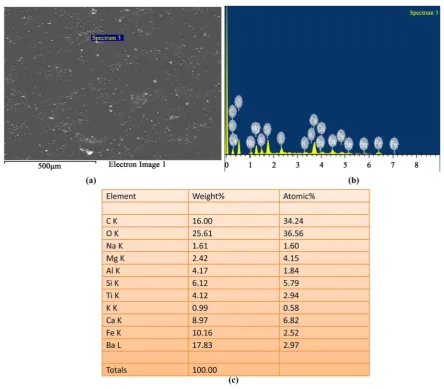
The particle size of synthesized advanced AFMC shielding material was examined using FESEM and EDXA respectively. Several particles were investigated to determine the particle size. FESEM image and EDXA spec-tra are shown in Figure 4 and Figure 5 respectively.
Figure 4. FESEM image of of advanced ARMC shielding material.
300 400 500 600 700 800
0 5 10 15 20
B
(
Int
ens
ity
(
a.
u.
))
Z (Wavelength (nm))
[image:5.595.160.469.532.707.2]Figure 5. EDXA image of (a) synthesized of advanced ARMC shielding material. Selected area (b) EDXA outcomes (c) Elemental compositions (weight % and atomic %).
The FESEM image showed that the particles are of spherical as well as irregular in shape confirming the mul-tiple types of chemical composition in synthesized material. The size varies in the range up to 29 - 46 nm. The EDXA spectra revealed the predominance of multi elements like Barium, titanium, Aluminum, Iron, Carbon, Magnesium, Silicon, Sodium, Calcium and Oxygen.
3.4. Permittivity and Permeability Study of Developed Advanced ARMC Shielding
Material
The study of permittivity (ɛ) and permeability (µ) represents the dielectric and magnetic properties of the mi-crowave absorber material. The real part of permittivity and permeability represents the storage of electric and magnetic energies respectively whereas the imaginary parts symbolize the loss and dissipation of both the ener-gies.
[image:6.595.88.533.82.471.2]energy is known as eddy current loss. Here, in the reported process as MWCNTs are used as high electrical conductivity material therefore decrease in permeability at high frequency is observed due to eddy current loss.
The value of complex permittivity including both real and imaginary part of advanced ARMC shielding ma-terial is shown in Table 3. The value shows the complex permittivity of the sample decreases with the increase in frequency. The dielectric loss may occur due to intrinsic electrical dipole moment with in the shielding ma-terial and presence of electromagnetic field due to polarization relaxation (electronic, ionic and orientation). Relatively high permittivity of the sample can cause diectric loss, mainly by dielectric polarization, spontaneous polarization and associated relaxation phenomenon. Due to the presence of MWCNTs having high electrical conductivity 1) the strong polarization, 2) dissipation of electrostatic charges and 3) ohmic losses or multiple scattering caused by the large surface area occurs, this leads to enhanced complex permittivity in the developed advanced ARMC shielding material.
3.5. EM Wave Absorption Properties of Developed Advanced ARMC Shielding Material
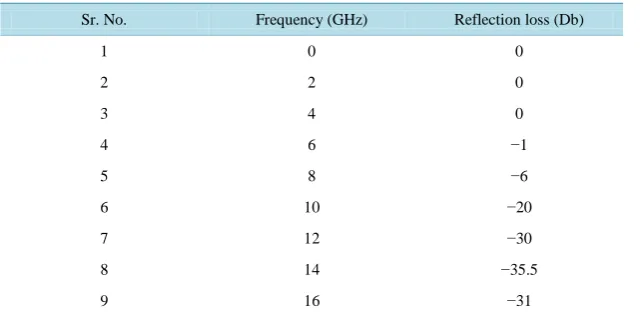
Reconnoiter of the EM wave absorption properties of the advanced ARMC shielding materials done by using metal plate (being anelectric conductor). A material considering for EM shielding is placed over the limit of 20 Db. The advanced ARMC material with thickness t = 1.5 mm showed a minimum R.L of −35.5 Db at 14.0 GHz with a response band width of 1.8 GHz as shown in Table 4. To obtain more R. L. value the thickness of the sample can be increased.The unique designing and ceramic processing of chemical compositions and mineralogical phases of red mud, MWCNTs together with appropriate additive and solvent has been done. It results in the simultaneous and syn-ergistic chemical reactions among various constituents results in the formation of tailored precursor. Further, the ceramic processing of tailored precursor powder in appropriate environment enables in formation of desired multiple ceramic phases namely barium iron titanium silicate (Bafertisite), barium aluminum silicate, iron tita-nium oxide, barium titanate, Barium iron titatita-nium oxide, barium alumitita-nium oxide, magnetite, iron sulphide (troilite) possessing multi elemental compositions and multi layered crystal structure possessing inherent proper-ties of shielding EMI efficiently.
It is reported in literature that Barium titanate, Barium iron titanium oxides are very good as electromagnetic wave absorber material [25]. Further, in the present process the oxides of titanium and iron present in red mud reacts with barium hydroxide in the presence of alkaline ethylene alcohol leads to the formation of major EMI shielding phase namely barium titanate, Barium iron titanium and alkaline iron oxide species in the matrix of
Table 3. Complex permeability (µ) and Permittivity (ɛ) of advanced ARMC shielding material.
Sr. No. Frequency (in GHz)
Complex Permeability (µ) Complex Permittivity (ɛ)
Real part Imaginary part Real part Imaginary part
1 1 0.5 0.1 4 16
2 2 0.8 0.2 3.9 14
3 3 1 0.3 3.8 13
4 4 1.2 0.4 3.4 12
5 5 1.3 0.4 2.8 11
6 6 1.4 0.45 2.5 8
7 7 1.5 0.50 2.3 6.5
8 8 1.6 0.55 2 5.8
9 9 1.65 0.7 1.8 5.3
10 10 1.7 0.8 1.75 5
11 11 1.85 1.1 1.50 4
12 12 2 2.5 1.2 3
Table 4. Reflection loss of advanced ARMC material.
Sr. No. Frequency (GHz) Reflection loss (Db)
1 0 0
2 2 0
3 4 0
4 6 −1
5 8 −6
6 10 −20
7 12 −30
8 14 −35.5
9 16 −31
in-situ functionalized MWCNTs ranging from micron to sub micron up to nanosize due to the presence of
CTAB chosen as one of the surfactant. Further, the multilayer characteristics of bafertisite phase and MWCNTs imparts efficient EMI shielding to the developed advanced ARMC material.
4. Conclusions
The following conclusions can be drawn from work carried out for the novel synthesis of advanced ARMC shielding material.
1) The results obtained represent a fundamental starting point for the synthesis of advanced ARMC shielding material utilizing red mud and MWCNTs together.
2) The process enables unique designing of chemical compositions and mineralogical phases of red mud, MWCNTs with appropriate additive and solvent for obtaining in-situ synthesis of advanced EMI shielding ma-terial by ceramic processing of tailored precursor.
3) The process involves ceramic processing of tailored precursor for the formation of major EMI shielding phase namely barium titanate, bafertisite phase and alkaline iron oxide species in the matrix of in-situ functiona-lized MWCNTs as confirmed by XRD studies.
4) The use of CTAB chosen as one of the surfactants enables obtaining particle size of advanced ARMC ma-terial raining from micron to sub micron up to nanosize.
5) The FESEM studies revealed that the nanoparticles were almost spherical in shape with particles size in the range of 29 - 46 nm.
6) The multi layer characteristics of bafertisite phase and MWCNTs impart efficient EMI shielding to the de-veloped ARMC.
7) The electrical conductivity of MWCNTs imparts efficient EMI shielding to the developed ARMC.
8) The presence of BaTiO3 and TiO2 imparts the EMI shielding due to high permittivity and high dielectric
constant.
9) The presence of the magnetic phases due to alkaline oxides of iron increases the absorption of EMI waves.
Acknowledgements
Authors are grateful to Director CSIR-AMPRI Bhopal for providing necessary institutional facilities and encou-ragement.
References
[1] Mottahed, B.D. and Manoocheheri, S. (1995) A Review of Research in Materials, Modeling and Simulation, Design Factors, Testing, and Measurements Related to Electromagnetic Interference Shielding. Polymer-Plastics Technology and Engineering, 34, 271-346. http://dx.doi.org/10.1080/03602559508015827
[3] Lu, G.H., Li, X.T. and Jiang, H.C. (1996) Electrical and Shielding Properties of ABS Resin Filled with Nickel-Coated Carbon Fibers. Composites Science and Technology, 56, 193-200. http://dx.doi.org/10.1016/0266-3538(95)00143-3
[4] Kaynak, A., Polat, A. and Yilmazer, U. (1996) Some Microwave and Mechanical Properties of Carbon Fiber-Poly- propylene and Carbon Black-Polypropylene Composites. Materials Research Bulletin, 31, 1195-1206.
http://dx.doi.org/10.1016/0025-5408(96)00124-9
[5] Melvin, G.J.H., Ni, Q.Q. and Natsuki, T. (2014) Electromagnetic Wave Absorption Properties of Barium Titanate/ Carnon Nanotube Hybrid Nanocomposites. Journal of Alloys and Compounds, 615, 84-90.
http://dx.doi.org/10.1016/j.jallcom.2014.06.191
[6] Micheli, D., Apollo, C., Passtrre, R. and Marchetti, M. (2010) X-Band Microwave Characterization of Carbon-Based Nanocomposite Material, Absorption Capability Comparison and RAS Design Simulation. Composites Science and Technology, 70, 400-409. http://dx.doi.org/10.1016/j.compscitech.2009.11.015
[7] Qin, F. and Brosseau, C. (2012) Review and Analysis of Microwave Absorption in Polymer Composite Filled with Carbonaceous Particles. Journal of Applied Physics, 111, 061301. http://dx.doi.org/10.1063/1.3688435
[8] Huo, J., Wang, L. and Yu, H.J. (2009) Polymeric Nanocomposites for electromagnetic Wave Absorption. Journal of Materials Science, 44, 3917-3927. http://dx.doi.org/10.1007/s10853-009-3561-1
[9] Melvin, G.J.H., Ni, Q.Q., Suzuki, Y. and Natsuki, T. (2014) Microwave-Absorbing Properties of Silver Nanoparticles/ Carnon Nanotube Hybrid Nanocomposites. Journal of Materials Science, 49, 5199-5207.
http://dx.doi.org/10.1007/s10853-014-8229-9
[10] Irwin, P., Tan, D.Q. and Cao, Y. (2010) Electromagnetic Interference Shielding Polymer Composites and Methods of Manufacture. US 7815820 B2.
[11] Iyer, V.R., Ungvichian, V. and Neelakanta, P.S. (1993) A Titanium-Dioxide Based Ceramic Composite Dispersed with Conducting Inclusions as an EMI Shielding Material. 1993 IEEE International Symposium on Electromagnetic Com-patibility, Dallas, 9-13 August 1993, 168-169. http://dx.doi.org/10.1109/ISEMC.1993.473756
[12] Azadmanjiri, J., Hojati-Talem, P., Simon, G.P., Suzuki, K. and Selomulya, C. (2011) Synthesis and Electromagnetic Interference Shielding Properties of Iron Oxide/Polypyrrole Nanocomposites. Polymer Engineering & Science, 51, 247-253. http://dx.doi.org/10.1002/pen.21813
[13] Ding, Z.G., Shi, S.Q., Zhang, H.L. and Cai, L.P. (2015) Electromagnetic Shielding Properties of Iron Oxide Impreg-nated Kenaf Bast Fiberboard. Composites Part B: Engineering, 78, 266-271.
[14] Yang, J. (2006) Research on Comprehensive Utilization of Red Mud from Alumina Plant. M.S. Thesis, Huazhong University of Science and Technology, Wuhan.
[15] Che, R.C., Peng, L.M., Duan, X.F., Chen, Q. and Liang, X.L. (2004) Microwave Absorption Enhancement and Com-plex Permittivity and Permeability of Fe Encapsulated within Carbon Nanotubes. Advanced Materials, 16, 401-405.
http://dx.doi.org/10.1002/adma.200306460
[16] Kim, H.M., Kim, K., Lee, C.Y., Joo, J., Cho, S.J., Yoon, H.S., et al. (2004) Electrical Conductivity and Electromag-netic Interference Shielding of Multiwalled Carbon Nanotube Composites Containing Fe Catalyst. Applied Physics Letters, 84, 589-591. http://dx.doi.org/10.1063/1.1641167
[17] Xiang, C.S., Pan, Y.B., Liu, X.J., Sun, X.W., Shi, X.M. and Guo, J.K. (2005) Microwave Attenuation of Multiwalled Carbon Nanotube-Fused Silica Composites. Applied Physics Letters, 87, 123103. http://dx.doi.org/10.1063/1.2051806
[18] Yang, Y.L. and Gupta, M.C. (2005) Novel Carbon Nanotube-Polystyrene Foam Composites for Electromagnetic In-terference Shielding. Nano Letters, 5, 2131-2134. http://dx.doi.org/10.1021/nl051375r
[19] Huang, Y., Li, N., Ma, Y.F., Du, F., Li, F.F., He, X.B., Lin, X., Gao, H.J. and Chen, Y.S. (2007) The Influence of Sin-gle-Walled Carbon Nanotube Structure on the Electromagnetic Interference Shielding Efficiency of Its Epoxy Compo-sites. Carbon, 45, 1614-1621. http://dx.doi.org/10.1016/j.carbon.2007.04.016
[20] Verma, S. and Amritphalae, S.S. (2015) A Novel Process for Preparation of Hybrid Nanosized Neodymium Oxybro-mide and Neodymium Oxide. Russian Journal of General Chemistry, 85, 1528-1531.
http://dx.doi.org/10.1134/S1070363215060286
[21] Chen, W., Mai, L.Q., Qi, Y.Y. and Dai, Y. (2006) One-Dimensional Nanomaterials of Vanadium and Molybdenum Oxides.Journal of Physics and Chemistry of Solids, 67, 896-902. http://dx.doi.org/10.1016/j.jpcs.2006.01.074
[22] (1984) Powder Diffraction File, Alphabetical Index Inorganic Phases. Published by JCPDS International Centre for Diffraction Data 1601, Park Lane Swarthmore, Pennsylvania.
[23] Rahman, M.N. (2003) Ceramic Processing and Sintering. CRC Press, Taylor and Francis Group, London.
659-663.
[25] Sukanta, D., Nayak, G.C., Sahu, S.K., Routray, P.C., Roy, A.K. and Baskey, H. (2014) Microwave Absorption Proper-ties of Double-Layer RADAR Absorbing Materials Based on Doped Barium Hexaferrite/TiO2/Conducting Carbon