m
1'
i
¡'M
S
3:Ù&
A S
K^'l
i
: « « ! ^ Í » $ T O É !
*'«<«<»* .,¡ Εΐ«Είίί; i :..
IPí»
it.íli?'
3w
mm
4ttíí
!*
« A
( I H Pap er
Joint Nuclear Research Center Ispra Establishment - Italy Reactor Physics Department Applied Mathematical Physics
presented at the „Convegno di Fisica dei Reattori" Milan, Italy - November 29-30, 1963
the European Atomic Energy Community (EURATOM).
Neither the EURATOM Commission, its contractors nor any person acting on their behalf
Io Make any warranty or representation, express or implied, with respect to the accuracy, completeness, or usefulness of the information contained in this document, or that the use of any information, apparatus, method, or process disclosed in this document may not infringe privately owned rights ; or
Ä
EUR 597.e
CALCULATION OF D„0 MODERATED LATTICES BY BASIC METHODS by B. STURM
European Atomic Energy Community — EURATOM
Joint Nuclear Research Center — Ispra Establishment (Italy) Reactor Physics Department — Applied Mathematical Physics Paper presented at the « Covegno di Fisica dei Reattori » Milan (Italy) — November 29-30, 1963
Brussels, March 1964 — 32 pages — 2 figures
For the calculation of D:0 moderated, organic cooled natural uranium lattices a calculational procedure is proposed on the basic of most refined reactor codes available at Ispra. For the calculation of fast group constants the GAM-I multigroup program is used. Weighting factors to take into account the heterogenity of the lat-tice, cell are calculated by the DSN program for macro- and
micro-EUR 597.e
CALCULATION OF D..O MODERATED LATTICES BY BASIC METHODS by B. STURM
European Atomic Energy Community — EURATOM
Joint Nuclear Research Center — Ispra Establishment (Italy) Reactor Physics Department — Applied Mathematical Physics Paper presented at the « Covegno di Fisica dei Reattori » Milan (Italy) — November 29-30, 1963
Brussels, March 1964 — 32 pages — 2 figures
micro-cell. For the calculation of thermal cross sections the THERMOS-code is used and the disadvantage factors for the different materials in the cell are obtained by a one group calculation using the DSN program.
On the basis of this procedure an analysis of critical experiments done by AECL for a 7 UO.,, rod organic cooled fuel element, is performed.
Reasonable agreement is found for material buckling as well as for measured thermal disadvantage factors, initial conversion ratio and fast fission ratio.
cell. For the calculation of thermal cross sections the THERMOS-code is used and the disadvantage factors for the different materials in the cell are obtained by a one group calculation using the DSN program.
On the basis of this procedure an analysis of critical experiments done by AECL for a 7 UO», rod organic cooled fuel element, is performed.
EUR 597.e
EUROPEAN ATOMIC ENERGY COMMUNITY - EURATOM
CALCULATION OF D
2
0 MODERATED LATTICES
BY BASIC METHODS
by
B. STURM
1964
Joint Nuclear Research Center Ispra Establishment - Italy Reactor Physics Department Applied Mathematical Physics
Contenta
påg«
1. Introduction 5 2. The method 6 2.1) Calculation of fast group oonstante 1**
2.2) Resonance absorption 19 2.3) Calculation of thermal group oonetants 21
3. Comparison with experimental resulte 25
3.1) Initial oonversion ratio 25
3.2) Fast fission ratio 2? 3.3) Thermal disadvantage factors 29
- 5
1. Introduction
Sinoe the second Geneva oonferenoe the following "classical" approach to the physical calculation of D_0 moderated lattioes has turned out to be the most promising one.
On the basis of a very simple model of the neutron oyole, the two group-four factor formula, a set of formula and oross seotions
2 2
is established that provides the oaloulation of f, g , ρ, L and Ls .
Together with experimental values of the material Buckling B1 whioh
is measured in exponential or critical assemblies for a range of different lattioe configurations, an adjusted value of the thermal reproduction faotor η is obtained from the relation
Λ
c
— F T F
This speoial approach was used by the Swedish group of the AB Atomenergi in Sweden £lj . Other groups for example the Saolay group in Prance adjusted both η and the resonanoe integral of U [2] where-,&s the Savannah river group in USA adjusts the reso nanoe integral only [3J .
The reaotor oodes written on the basis of this philosophy have the great advantage of small computer time and are therefore very suitable for optimisation studies. The accuracy of suoh calculations is ra ther good and allows reactivity predictions with an uncertainty of the order of Δ 0 ^ +_ O.OO5 for the cold clean reactor.
An evident disadvantage of this simplified approach is the fact that it is limited to the range of lattice configurations for which
2
the Β -correlation has been performed.
6
-As concernes the Orgel-project the situation is the followingi
The simplified reactor-physios-code CAROLINA I £4 J developped at lepra whioh is based on the Frenoh correlation method Γ 2 J with some additional features arising from the presence of orga-nio in the fuel element has been compared with results of oriti-oal-Euratom experiments for nine different lattice configurations with U0_ fuel and Monoisopropyl-diphenyl coolant. A fairly satis factory agreement has been found for this comparison and also for organic oooled 7 rod U 0? elements that where measured in the
ZED-2 reaotor in Chalk River Γ5Ι .
Although these promising results justified first optimisation of the ORGFBL— reactor on the basis of the CAROLINA I-oode, it seemed worthwhile to look for an independent and more sophisticated cal culation method, especially to calculate the reactivity balance and the temperature coefficients of the ORGEL-reactor in the hot irradiated condition.
For this reason we have investigated the possibility of applying the most refined codes already available at lepra for lattice oaloulation of organio-heavy water reaotors.
Due to the fact that the used computer codes start from basio oross seotion-data and do not contain any adjustment to integral experiments, we will oall this approach in oontrast to the above mentioned "correlated" methods, "basic" methods.
2. The method
A basic approaoh has therefore to start with a more refined oalou lation of the spaoe- and energy- dependence of neutron-flux and -ourrent. Onoe this dependence is known, oell averaged group con stante can be oaloulated and the maorosoopio behaviour of the neu tron-flux oan be treated by a few-group approaoh.
To derive the oonneotion between material buckling and group con stants (in view of doing comparison with experiments), we etart from the two group equations assuming that the group constants are averaged over the actual neutron spectrum in the unit oell. The joining point between the two energy groupe is more or less arbitrary but for unirradiated lattioes it should lie below the lowest U resonanoe and so high "that upsoattering of neutrons from thermal group into fast group is very small.
We have then
\Λφ1 - ( Ι Λ^ 2 ^1) JZJ, + ( « / ^ ^ + (v2f\ φ2 - 0
D2A02 - 2^-Ρχ - ^Α + ΙΦΛ - o
where D, 2^,^<s>land v2, denote space- and energy«averaged
values over the flux spectra in the two energy groups.
The solutions of this set of inhomogeneous differential equations for a bare reaotor are of the type
Δ φ . -Η tf φ. = 0 } 1-1,2 (2)
ρ
where Β is the geometrical buokling.
Introduoing (2) into (l) «re obtain the oritical equation
( Β ^ ν Σ , / Σ ^ - ^ Α ^ Σ Ο »
(ν**)*****
(3)
With the abbreviations
L ·2 *
1 " XR(VϻV, >
L2 &
L ~
2 ^Λ-ϊ
L Ì «
fa«).
J>«
2R
~° = l'È*
e * /y^*0
+
i_e^Ce,v)*Z4^fE,v)]4íe,^í*Êfl|a
(4)
we o b t a i n from ( 3 )
, * . _ 1 < Ì 1
2
)
+
' f i ( i
2 +
i
i2
f*J^2
(5)
L
2
L
i
I 4 Η
ΐξΐξ
I t oan be easily shown, that l"C i s the usual i n f i n i t e multipli cation fttotor defined as
u number of neutrons produoed in the oell /¿x
K-° " number of neutrone absorbed in the oell * '
If we write K.» in (4) in the form
- 9
with E denoting the energy limit between fast and thermal group and notice, that for neutron balance reasons
(8)
we obtain
and from (7)
lC.r * ~ i n agreement
with definition (6).
To check the validity of our method we oan compute from equation (5) the material buokling and compare with experimental values. But
even if the agreement between experimental and calculated 2> -valuee has been found to be suffioient, this may be due to a fortuitous oanoellation of systematio errors in the different group oonstants. To check aleo this "internal oonsistenoy" of our method, we have ohoosen for our comparison some experiments of the AECL group in
whioh for a 7 rod U0? organic cooled bundle, apart from the
raa-2
- 10
To do this oomparieon we have to derive the relation between ¡C~a T?.
and the group constants.
/; is defined as
y fast and thermal oapturee in U . .
0· " ,__
Α. . .
, . .
.
, „235
i 9'
r238
f a s t and thermal a b s o r p t i o n s i n U*
Let us d e f i n e t
of-
f l J ? M 4 M « i B ^
(10a)
c
28. fj^ce^+íE^cte^
( l 0 b )1
VJ
°
A
25. f f ^ ( ε , ) φ ( £
(^ 4 Ε ^
( l 0 o )2 »
A
25
j i i r ^ W i ^ H E c / *
(104)
1 c
t h e n we have
c
2 8+ c
2 8¿f·
= 425 ^
A25
( 1 1 )AT-' + A 2
Considering the relations»
' ΐ. **^\i. ι - ■ ι ■ ι Ξ? **) ■ J*
1
2 ,6*. .. . ~=^ƒ { νΓ^Ε,^φίε,^-)^^
ír 'i V, ir(12)
11
we obtain from (12) (13) and (14)
a.
A2
Cv*
f)x
25 ~5T '^'h
*|\*£H
ia'L\)
d e f i n i n g
«2
+*1*
*Γ
+°i
s ΛV F2 5 +V F2 8 ¿, rf) ,
s
V
Af
+
¡f<'
whereC
V
0 ^ ( ^ ) 4 ^ ¿ ^
are the fast oaptureep c pQ
i n struoture m a t e r i a l of t h e o e l l and v F .3 and vF are the
f a s t f i s s i o n s of U2 5 and U2 8
VF
25
{
[vl^tErftycerfdEAv
v F2 8 ƒ [ ν Σ ^ ( Ε , ν ) φ ί Ε ^ ) ^ ^
we have from (l6) and (17)
Inserting (l8) into (15) we obtain
(15)
p - : :
L2& %
:
Pstr - 4 — d o
(17)
Q « _L±_J L_rL (18)
¿ Λ
12
From (19) and from t h e r e l a t i o n
C2 8 N2 8 / ^ . \
ÍV 2 5 ' " % J
(20)
A
2 5N
25\5?*U
where <? ·· i s t h e o r o s s s e c t i o n of nucleus i averaged over t h e
thermal spectrum and N i s t h e number d e n s i t y , we o b t a i n from ( l l ) u s i n g t h e c r i t i c a l e q u a t i o n ( 3 ) ·
£'W\
+ c?
Tí*
Jf·
2 ν ξ " + ν ϊ " W--4-+ B1 1 I 7L 2>" Λ,,ιΓ
4—4£_ - X _ 1 —
so we can w r i t e
*2 8 «
' I s - "1 - "1 "*2 "2
C?8 s C2 8 C28+Q0-Q,
o (Ci8 +S) (l -p 2 8 ) 1 - p2 8 ft2 1 - p2 8
V ^ X
5+ 0 j
t r" ~ ^ ~ " Q
2+A
25
+A
128+C
1str" ^ ~
P(21)
Let us now d e f i n e y
Q "**
Ρ2 8 ^ H - - -ρ (22)
V
cl £,_, -
¿/^fgjtr^fcjvjdc^
P2 5 SgB- ^ ^ (23)
13
-and s i m i l a r l y we o b t a i n
* ? .
I-P
25if* if"
~7
r
'
S
(25)
Inserting (24) and (25) into (21) we obtain finaly
f
is/"·/
/f.. 4- ——— · 1/v ■
(26)
λ - 4 4 β α ΐ ' r"5"
All quantities in equation (26) can be simply oaloulated from the group oonstants as we will show later on the diecussion of the oaloulation of the group constants.
Let us now derive a similar equation for the faet fieeion ratio H»
R ie defined ae
pip
ρ „ number of fissions in ÏÏ , >
number of fissions in U^32 \¿l)
or p28
R
" ,25 Jô
(28>
F J + F* 1 ez
with p j - ^2^;(&,Ό-)φ^,Ν-) <ΊεΌ/ο t a k i n g the energy i n t e g r a t i o n over energy group j .
F25 . i L . . A25
2 vi c A2
and Ag5 f r 0 f f l e q i u a tio n (19) u s i n g the r e l a t i o n
14
t ξ — 13 + B L.. we obtain
pR ls+B2L2 VF.25 + .Pf
F2
5
.
L _i
i_
(30)
2 v£« s ^
I n s e r t i n g t h i s i n t o (28) we have for R
if
R =■ Ο—ρ õê 28 ^ 1 ^
^ ! ^ I
vFi
+^ i
.25
y«" s Γ1
n e pc pc; p ß
When the f a s t spectrijjn i s c a l c u l a t e d F , F. , F ^ and F, can
be o b t a i n e d e a s i l y .
2 . 1 . C a l c u l a t i o n of t h e f a s t group c o n s t a n t s
The Oeneral Atomics Multigroup program GAMI j ^ 7 ^ w a s u3Qd f o r t h e
c a l c u l a t i o n of t h e f a s t neutron spectrum. GAMI t r e a t s t h e slowing
problem i n t h e c o n s i s t e n t P.. a p p r o x i m a t i o n . The P1 e q u a t i o n s of
t h e energy dependent Boltzmann e q u a t i o n are i n t e g r a t e d over q u a r t e r
l e t h a r g y u n i t s from 10 MeV to Ο.414 MeV y i e l d i n g a t o t a l of 68
g r o u p s . The code p r o v i d e s group c o n s t a n t s for maximum of 32 broad
g r o u p s . Furthermore f o r each c a s e a s e t of o n e f a s t g r o u p c o n s t a n t s
i s p r o v i d e d . For each broadgroup a d i f f e r e n t l e a k a g e f a c t o r can be
p r o v i d e d . A, f u r t h e r advantage over o t h e r e x i s t i n g multigroup
programs i s the p o s s i b i l i t y of t r e a t i n g heterogeneous l a t t i c e s
by p r o v i d i n g f o r each nucleus i n each broadgroup so c a l l e d
" s e l f s h i e l d i n g " f a c t o r s i . e . w e i g h t i n g faotor3 of the flux i n eaoh
group to t a k e i n t o account the h e t e r o g e n e i t y e f f e c t s .
Resonance a b s o r p t i o n i s t r e a t e d by t h e Nordtieim method Γ8J .
Resonance p a r a m e t e r s a r e inoluded i n the l i b r a r y tape and r e s o
15
For our calculations the fast energy range has been devided
ft
from 10 MeV to E « 0.683 eV into 11 broad-groups with the
following energy limits t
Tab. 1 Group No. 1 2 3 4 5 6 7 8 9 10 11
l o w e r e n e r g y 3 . 6 8 MeV 1.35 MeV 0.388MeV O.lllMeV 3 1 . 8 KeV
9 . 1 2 KeV 0.96lICeV 130 eV
1 7 - 6 eV 5.O4 eV
0 . 6 8 3 eV
l e t h a r g y i n t e r v a l 1.0
1.0 I . 2 5 I . 2 5 I . 2 5 I . 2 5 2 . 2 5 2 . 0 2 . 0
I . 2 5 2 . 0
The treatment of the heterogeneity of the cell proceeds as follows«
Let us devide the cell into N subregions (fuelpins, canning, coolant, tubes and moderator) and let us define the mean flux in region n by
0(E) - 7 ( 0
(Β,
Ό
d-r
Vn J
1 Ν
Then we can w r i t e t h e i n t e g r a l f o r a n u c l e u s k 10 MeV
TK - \ ( lK( E, *r ) 0 (Ε,ΜΤ) dE cU
E C e l l
(32)
(33)
a s
16
where we have devided t h e energy r a n ^ e Β ■ 0.683 eV to 10 MeV i n t o
L subgroups 1» with
S
?
n^ ) ° k
(E) dB *m
^«t^i
(35)
fraudi
Let $ be the mean oell flux in energy group 1 and S N« n' ^ * / " ^k
n1 ^οβίΐ
the numberdensity of nucleus k in the oell.
Then we can write
M
ι. ·
2 1 "«ΛΛ
-ρ Φ,
*«<
·
^—-κ
* - t*- Φ* Σ ^κ
Λν^
(36)
or with
V
k tr J ^ Z L - (37)
·*=/!
/fONeï'
We see, that by introducing the weighting factors T«rke for each
group 1 and eaoh nucleus k we can reduce the heterogeneous problem
to a homogeneous one for the calculation of the energy dependent
17
The meanflux r a t i o s "/"φ whioh are needed for the o a l o u l a t i o n
of the weighting faotora l ^ a r e o a l o u l a t e d s e p a r a t e l y by a 11group o e l l o a l o u l a t i o n for « i o r o and maorooell. The macrooeil i s formed by the fuel rod bundle homogenised i n s i d e of the rubberband surfaoe, a l a y e r containing outer coolant and tube ( s ) and the moderator r e gion. The m i c r o c e l l i s composed of a s i n g l e fuel pin and a s s o c i a t e d cannine and c o o l a n t . The code used for t h i s o e l l o a l o u l a t i o n was the DSNcodo of Carlson and Bell Γ 9 J . The erose e e o t i o n s needed where c a l c u l a t e d from a homogeneized ÛAKI o a l o u l a t i o n . À subroutine w r i t t e n by M. Q,uiqmelle of Euratom made i t p o s s i b l e to punch the output of GAMI 11 group oross s e o t i o n s on cards whioh d i r e o t l y oould be introduced in DSN.
So the c a l c u l a t i o n of f a s t (roup constants turns out to be a i t e r a t i o n process which ia i l l u s t r a t e d in P i g . 1 .
From a homogeneous GAMI o a l o u l a t i o n ( ^ t * 1 for a l l k and l } we obtain a s e t of mioroaoopio 11group cross s e o t i o n s 0Ht for the
n u c l e i . From two D3Noaloulationa for « i o r o and maorooell we ob t a i n the weighting faotora Ό"^ that now are introduced into GAM-I
obtaining a new s e t of ö^| e t . o e t . Aa f i n a l r e s u l t we obtain from GAMI a s e t of 1group f a s t constants Ζβ 4 > Σ 0 1, 6^2^)^ ^ ^
and for each nucleus a s e t of 11group microscopio oross s e o t i o n s that are m u l t i p l i e d by the weighting faotors \jut . Moreover we obtain
for 11 broad groupa the values <Χ, « fi AUi and so we can c a l c u l a t e the reaotion i n t e g r a l s I, that are neoessary for the c a l c u l a t i o n of VÍ and Hi
18
¡«■fejr*/ calcuia+io* <s( l
U»':5„
|<r
r,s.(.f) I
M»,t ,T
j)S_N (SiD
D S W~
c.T')
M Dij eíií^k« ,<*< = cj^a
/κ 4...M. K M
Fig. It Iteration process for the oaloulation of fast group constants
ï
2 8
ï
τ
numberdensity of nuoleue k in oell, k 1 ... K
Buckling· in broad group 1, 1 =» 1...11 2 2
(for bare reaotor 3. » Β for all 1, for comparison with
? 2
experiments B~ was set equal to 3 )
r exp '
moderator cross section per resonance absorber atom
total scattering cross section per resonance absorber atom
effective cross section for unresolved resonanoe integral
oaloulation
lumped nuclear absorber density
mean chord length in the absorber lump
19
t*
Al25 * N25 Voell '%<l ^ l 4>cV¿«* (39b)
i*/
»28 tí
°1
6» *26
Vceir ¿
í í«
1 , n t Φ« *
U«
<»·>
425 « N25 Voell
«**
F
l
8»
N28
Voell * I «f? *>»« < L ' *"*
( 3 9 0 )¿«<«
νΡ
Γ- »28
Vcell ' 1 > ^ V
<*U L'*«t
(39d)V P
1
2 5
N25
Voell ' Σ V ^ J
* t „ <j>
eA*<*<
(39·)
In our calculations we »topped the iteration process GAMIDSJi
after the second GAMI run, calculating the weighting factors
%y ,1 only once. This was justified by the fact, that the micros
copie oross sections tf . from the homogeneous GAMI case showed
practioally no difference compared with the 0~L, of the heteroge
neous GAMI caso indicating that the mean cell energy dependent
flux was quite insensetive to the weighting factorsV, , . On the
oontraryi the macroscopic onefast group constants of the hetero
geneous GAMI calculation were vary different from the homogeneous
calculation especially in the case of the fast absorption^ 1
and the fast fission ( v 2 ^\ indicating the importance of heterogeneous
treatment of a lattice fast spectrum in the oase of D?0 moderated
natural uranium lattices.
2.2. Resonance absorption
In order to calculate the fast absorber cross section of nuclei
with strong resonances (U , Th ) GAMI uses the narrow reso
nance ( M ) approach for resonances with practical width smaller
20
For wide resonances the narrowresonance infinite absorbermass
(KRIA) approximation is applied. The following oonstants have
to be provided for input:
6^, the moderator cross seotion per absorber atom
iff 0 for pure metal, <Γ »2<Γθχ for UO_)
andmTH02 m P 2
GL total potential scattering oross seotion per
absorber atom
Ê 4 Vabs
g * —ρ mean cord length in the absorber lumps.
°eff V . being the total volume and S » the
effective surface of the absorber.
In the case of bundle elements composed of several fuel rods, 1
has been calculated using the well known formula of Carlvik and
Pershagen 9 *
eff ■ Srb + ï' \ (40)
Seff = Srb +
with
j f 2J
Hf
i(l?
o('VfO )
S , being the rubberband surface of the bundle
S. the inner surface
y the potential maoroscopic scattering cross section
of the medium between the rods of the bundle
G't radius, of the gratest circle which could be in
scribed between neighbouring fuel rods
Ρ collision probability for a oylinder of radius
and cross section
For the unresolved region the NRapproximation is employed through
out. The statistical distribution of neutron width is taken into
aooount and the equivalence theorem is U3ed to eliminate the surface
integration by substituting Cp* #jj for β|ί in the volume absorption
21
-The contribution of resonances above 30 KeV and p-states below 30 KeV is not included in the GAM-I code, as has been shown by comparison with experimental data of Hellstrand [9j for U-metall
and U09 and oaloulated values for UC reported by Vernon ΓΐοΊ. For
2^8
this reason the U capture oross seotion for input in the DSN-oaloulation have been oorreoted by adding 0.8 barns for energies
above 30 KeV and about O.9 barns (depending from rr - values for th<
bundle) below 30 KeV. A corresponding correction of the maorosoopio 1-fast group cross seotion of U was applied to the results of the heterogeneous GAM-I calculation»
2.3· Calculation of thermal group constants
For the calculation of space- and energy dependent thermal flux and neutron density and to obtain average thermal oross seotions we used the THERMOS-program written by Honeck ΓΐΐΊ , Γΐ2~] . THERMOS solves the space- and energy dependent Boltzmann equation numerically by dividing the energy-resp. spaoe interval into
22
1. For a given oell configuration a THERJIOS-oaloulation is per-formed and microscopic oross seotions for eaoh material aver-aged over the energy range 0-3 are obtained.
Brown-St. John-type scattering kernels are used for all materials assuming that in the case of D_0 moderated cells the free gas model used for the hydrogen in the organio is sufficient for
the calculation of the energy dependence of the neutron density.
2. Using this oross sections a DSN-Sg one group oaloulation is made to obtain flux disadvantage factors and from this oell averaged maorosoopio oross seotions are calculated. In the oase of
bundle elements a microscopio DSN-oaloulation is performed to obtain the microflux correction.
In the THSRMOS-oalculation the scattering oross seotion of hydrogen is used, whereas in the DSN oaloulation the transport approximation is made for hydrogen scattering.
To check this prooedure we have performed calculations of relative thermal neutron densities in a lattice for whioh experiments have been made by Boeuf and Tassan [_14] ·
The fuel element oonsisted of a 44 mm diameter U metal rod sheated by 1.0 mm Al with 45 B"O inner diameter. Between Al-sheath and
a pressure tube of 1.5 mm thiokness there was a 5 nun thiok layer of Monoisopropyl-diphenyl C. _ R. , . The neutron density distribution
164
was measured by Dy - activation and the epithermal correction using point - by - point valuee of the Cd-ratio was applied to ob-tain the thermal neutron density below the out-off at O.1265 eV.
23
Table 2s Comparison of measured and calculated relative thermal neutron densities
Method
THERMOS ΛΓ
^M22.7O9.0¿$T" Meff » 2.1
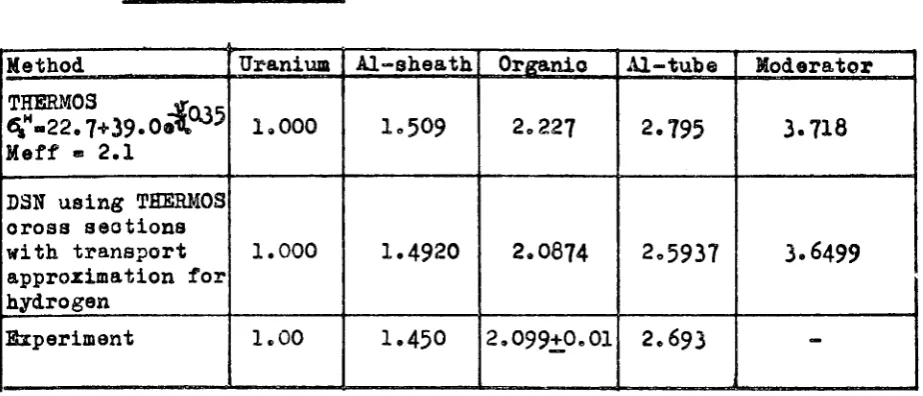
D3N using THERMOS oross seotions with transport approximation for hydrogen Experiment ι Uranium 1.000 1.000 1.00 Alsheath lo 509 I.492O I.45O Organic 2.227 2.0874 2.099+O.OI Altube 2.795 2.5937 2.693 . Moderator 3.718 3.6499
The results in the first line of the table were obtained by using
simply the output neutron densities of the THERMOS calculation. The
values of the second line were calculated with the above mentioned
procedures the cross seotions of the THERMOS oaloulation were used
for all materials exoept for hydrogen, for which the transport oross
seotion was taken. With these oro3S seotions a one group DSN cal
culation was performed. The outputfluxes were multiplied by the
corresponding values of the mean neutron celocities obtained by
THERMOS and the relative numberdensities ware calculated for eaoh
material. The transport oross seotion for hydrogen was obtained
hy applying the Radkowski prescription to the energy dependent
scattering oross section used in the THERMOScode.
From the oomparison of the different results with the experimental
values it is obvious that the negleetion of the anisotropic scattering
of hydrogen leads to errors in the flux disadvantage factors and
therefore in the thsrmal utilisation whioh are of the order of several
per mille.
The oaloulation of the thermal group constants ( V 5^ ) ( ¿o.a., s ?
proceeds now in a straight forward manners the mean fluxes éj> in
each material i of tue cell and the corresponding volumes V, and
-
u
-Σ
atι
S ¿ai Vi $c
4 4 x* ¿ ^ <fc
2 3 Σ
*
*
2 V . A
where V , · 2.43 ia the number of fast neutrons produoed per
thermal fission in U . The thermal utilisation f oan be obtained from'
(v Σ,\
^
Γ ■
with ν " J ? '
2 ^
Ί,
1
■■■■■'
and t h e thermal d i f f u s i o n l e n g t h i s given by
25
3. Comparison with experiments
In order to check the calculation methods described in seotion 2 we have calculated the physioal quantities /fa)R, {fi J fi )t h and
Β for a organio-oooled 7 rod U02 fuel element for whioh measure
ments of these quantities have been performed in Canada ( ι~6 | ) in the ZED-2 reaotor, for three lattice pitches. The detailed descrip tion of the fuel element are reported in the paper of O.A. Beer and D.W. Hone ["15J . The UO« was in the form of cylindrical pellets with 2.4O cm diameter and average density of 10.2 g/om . The pellets were stacked in a Al-tube with inside diameter of 2.44 om» a wall thickness of O.O5I om and a length of 46.5 'Onj to form a cluster rod. Seven such rods were bundled together in a hexagonal pattern with a center to oenter spacing of 2.667 co-Five bundles loaded into a A.1 preseure tube with a inside diameter of 8.256 cm and a wall thickness of Ο.Ό89 om formed one fuel assembly. The gap between the U0-, in adjacent clusters was I.63 cm. Additional aluminium due to tie rods, rod and plugs and endplates had to been
taken into account in the calculations. This was done homogenizing all materials over the total bundle length which was 47·31 cm·
The material filling the coolant channel was an organic liquid
(HB-40) with the bruttoformula C. oH?? ηΛ and density 1.01 g/cm
o 2 "
at 20 C. The measurement of Β", \Λ , R and the disadvantage factors were performed in a hexagonal pattern at three pitches: 19>22 and 28 cm.
3.I. Initial conversion ratio
The experimental method for the determination of the initial conversion ratio is described by Tunniciffe et. al. in Γΐ67 . It is based on the determination of relative fission rates and
239
relative Ν y production by foil activation techniques. By
26
τ238 flux and correcting for fission product aotivity of U ' one
239 235
obtains the ratio of Np J' production over U ^ fission i:
the rod to the Ν ™ production over Ü ^ fission in a purely
thermal speotrums
(N239prod)
rod
(»f
9proi)
thmultiplying Ρ by ( ^ ) and by > * ' ^ whioh can be obtained
¿ Ni«, /u (l+(x )
v 'rod
from tfestcott's report C RRP96O Tunnioliffe et. al. obtain the
initial conversion ratio
y«
¿?\ (4+«\jk *)fÅwhich gives after cancellation
T239 239
ï-
(ΝI a
prod) rod 25
rod number of Nn number of U 235 atoms produoed atoms destroidThe relative error of y# obtained by this method is estimated
[image:30.595.64.493.96.636.2]to be + 0.5$.
Table 3 gives the comparison of calculated and experimental
results.
Table 3' Comparison of calculated and experimental values of the
initial conversion ratio
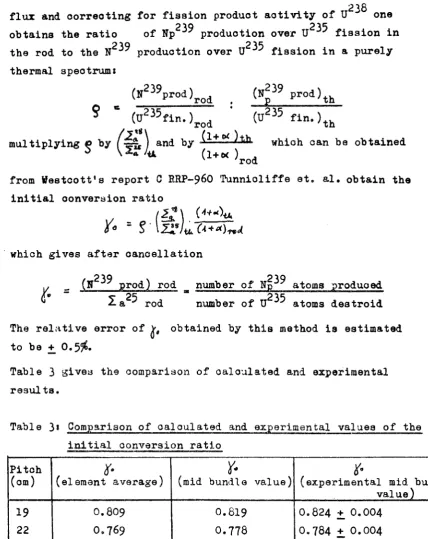
Pitch (om) 19 22 28 fi (element average) O.8O9 O.769 O.729
(mid bundle value)
0.819
0.778
0.735
fi
(experimental mid bundle value)
0.824 + O.OO4
0.784 + O.OO4
[image:30.595.75.524.515.660.2]27
-The K -values of the first oolumn are oaløulated using the axialy homogenized nuclear densities to take into aooount the
bundle end effects. The experiments however were performed In the middle of the bundle, therefore the values given in the seoond oolumn have been oorreoted to the midbundle density of U , to have a better oomparison with the experimental situation. It should be pointed out that the error limits of the oaloulated values coming from the uncertainty of nuclear oonstants entering into formula (26) are of the order of magnitude of + å$>. Keeping this in mind the agreement between oaloulation and experiment appears to be surprisingly good.
3.2. Fast fission ratio
The experimental teohnique for the measurement of fast fission ratios has been disoribed by Hanna and Tunnioliffe f_171·
The measured quantity is the ratio
ƒ»
fission product /-activity from depleted U-foil fission product ν-activity from natural U-foil .25/+> . 428Ag>(t) + A£(t)
" lJ5
(t); A28
(t)Let N_ resp. N„ (i » 28,25) be the numberdensity of nuoleus i in the depleted resp. natural uranium foil then we have
A*
5(*) -
«M *?&"*&
Afu) - ρ>ω·Μ?Κ"Φ^
4
8(i) - p(t) Α ί / ' ί ^ Φ ^
(47)
(48)
Introducing this and
28
-one obtains for Ò the expression
M
N28· N2 5
_JL_JL
«28 «25
ND NN
N2 8
N:
N;
(50)
An auxiliary experiment is necessary to determine the ratio
?(4)s <*i+)/(S(f) . This is done by measuring in a double chambered
fission oounter the ratio of fissiona ooouring in a natural foil to fissiona in depleted foil and oounting aleo the fission product activity apearing in this irradiation.
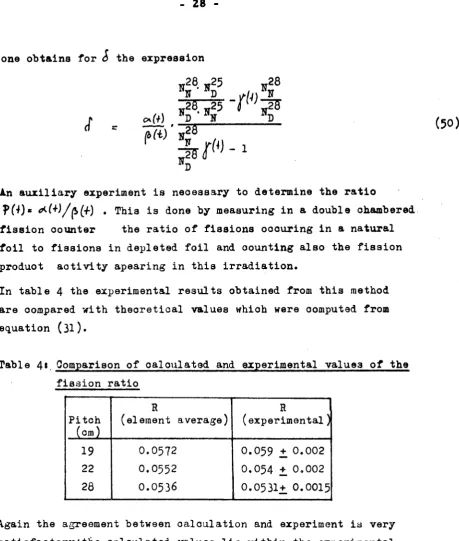
[image:32.595.79.539.56.598.2]In table 4 the experimental results obtained from this method are oompared with theoretical values whioh were oomputed from equation (3l)·
Table 4« Comparison of calculated and experimental values of the fission ratio Pitch (cm) 19 22 28 R (element average) 0.0572 O.O552 O.O536 R (experimental)
O.O59 + 0.002 O.O54 + 0.002 O.O53I+ O.OOI5
29
3·3· Thermal dlsadvatage factors
Neutron activation distributions were determined for the 7 rod
bundle plaoed in a oentral lattioe site. The deteotors used
were MnNi foils plaoed between fuel pellets and MuNi wires
looated in the fuel pellets and at various positions in the
coolant region and moderator. The total activities so obtained
were oorreoted for macroscopic flux variation and Mnresonanoe
aotivation to obtain the total neutron density distribution
throughout the oell. The average neutron densities in the various
oell material were then found by graphical integration. The mea°
surements were done at a moderator temperature of about 25 C;
[image:33.595.55.551.350.553.2]the errors are + 2$>.
Table 5
pitoh 19 f pitoh 22 pitoh 28
Material
itherm
2 calo
therm tot.
'exper
Ybherm.
feo)
Λ 2/îalo.
tot. exper.
uo
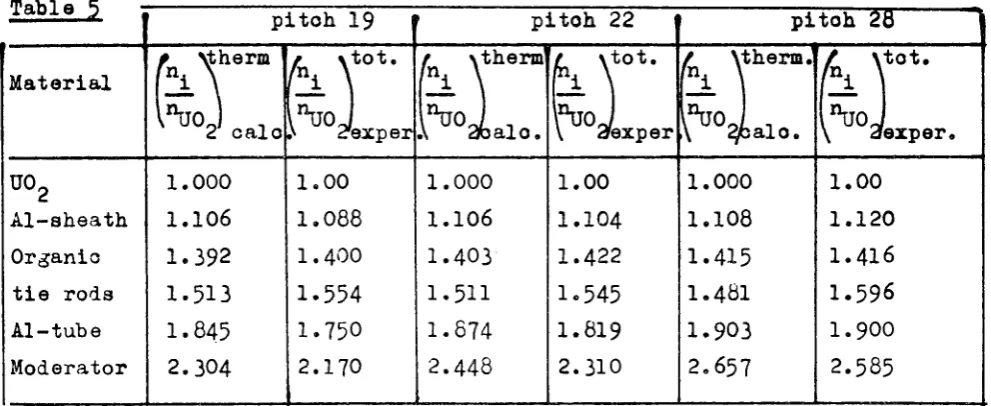
2 Alsheath Organio tie rods Altube Moderator 1.000 1.106 1.392 1.513 1.845 2.304 1.00 1.088 1.400 1.554 1.750 2.170 1.000 1.106 1.403 1.511 1.874 2.448 1.00 1.104 1.422 1.545 1.819 2.310 1.000 1.108 1.415 1.481 1.903 2.657 1.00 1.120 1.416 1.596 1.900 2.585In table 5 "the experimental results are compared with calculation
which were performed using the procedure outlined in section 2.3.
Before doing a comparison it must be mentioned that the calculated
quantities for several reasons have not the same physical meanings
1. the calculated quantities are relative thermal neutron densities,
whereas the experiment determines total densities.
2. the experiments were performed in the middle of the bundle whereas
30
-3. the calculated values belong to a moderator temperature of 20° C whereas the experiments were performed at 25 C.
Estimations using experimental determined values of the spectral parameter r and of flux peaking factors for the different materials
which are also reported in [6 J , show, that the effects of point
1. and 2. oancel out each other approximately and that the correc
tion due to effect 3. is of the order of 1 fa in the case of the
moderator disadvantage factor.
So the direct oomparison seems to be justified at least within
the experimental errors which are of the order of +_ 2?o. One sees,
that the calculations agree with the experiments for Al-sheath and for organic whereas for Al-tube and moderator there is a
overestimation of the neutrondensities especially at small pitches which is of the order of maximal 5$·
3.4« Material Buokling
Experimental material backlings for the 7 V0? rod bundle with
organic coolant obtained by Beer and Hone [5 J ^y ^^θ flux-map
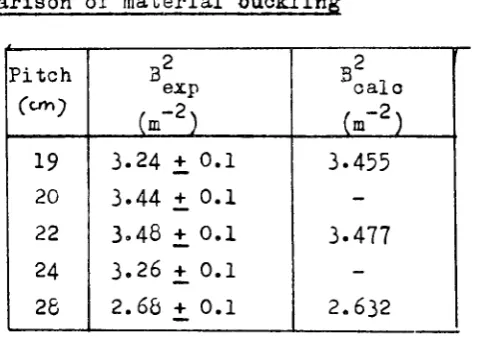
[image:34.595.161.407.516.698.2]ping technique are compared in table 6 with values whioh were calculated from equation (5).
Table 6s Comparison of material buckling
Pitch (cm)
32 exp
(°T
2)
Β -ι calo
19 20 22 24 26
3.24 + 0.1 3.44 + 0.1 3.48 + 0.1 3.26 + 0.1 2.66 + 0.1
3.455
3.477
- 31
2
In Fig. 2 the Β values are plotted as funotion of the pitoh. To have a comparison with results obtained by a correlation
me-2
thod, Β oaloulated by the CAROLINA-I oode are given by ourve 2. It is seen that both oaloulational methods tend to overestimate the material buckling at small pitches. In the oase of the "basic" method (ourve l) the reason for this is not known, but one could suppose that it may be due to some incorrectness in treating hydro gen beoause the relative hydrogen content Is greatest at small pitch. To olarify this more comparisons have to be done for organio cooled lattioes.
4« Conclusions
An attempt has been made, to oaloulate physical data of heavy water moderated organio colled lattices simply by using refined reaotor physios oodes available at Ispra. First calculations utilizing the codes GAM-I, DSN and THERMOS were performed for a lattice of 7U0_-rod organic cooled fuel elements at three pitches and gave promising results. The oaloulated fast fission ratioe agreed with the experiments within the error limits. In the oase of initial conversion ratio the maximal deviation of the oaloulation was 0.75?°· The calculated material bucklings agree sufficently well with
experiments exoept at- the smallest pitch where the maximal deviation
is of the order of S.&fo corresponding to an error in reaotivity
- 33 -
References
Lij B. Pershagen et. al,
DO
[5
M
T. Girard et. al.
G. Dessauer
G. Casini et. al.
G.A. Beer, D.V. Hone
R.E. Green et. al.
f*7j G.D. Joanou, J.S. Dudek
M
Γ?]
[io]
:«]
14 16Γ"]
Adler e t . a l .
E.H. Hellstrand
A.R. Vernon
H.C. Honeok
H.C. Honeck
H.C. Honeck, I. Kaplan
A. Boeuf, S. Tassan
G.A. Beer, D.W. Hone
P.R. Tunnicliffe et.al.
G.C. Hanna, P.R. Tunnioliffe
Progress in Nuclear Energy Series II Reactors Vol 2 p. 102 I96I Pergamon Press
Geneva Conference I958 15/P/336
Geneva Conference I958 15/P/590
CAROLINE is A calculation method for non irradiated organic liquid heavy water lattices EUR 134.Θ 1962
AECL1505 (1962)
AECL1684 (1963)
Paper presented at the I AEA panel on heavy water lattices GAMI s A consistent P.. multigroup oode for the calculation of fast neutron spectra and multigroup oonstants GAI85O (1961)
PICG 16 (1956) 155
J. Appi. Phys. 28 (1957) 1493
Nucl.Soi. Eng. 6 (i960) 252
Nuol. Sei.Eng. 8 (i960) 193
BNL5826 (1962)
Nucí. Sol. Eng.8 (i960) 203
External Euratom Report EUR 206 e
'àECL1505 (1962)
Nucí. Sci. Eng. 15 (1963) 268