Development and validation of a visual
grading scale for assessing image quality
of AP pelvis radiographic images
Mraity, H, England, A, Cassidy, SF, Eachus, P and Hogg, P
http://dx.doi.org/10.1259/bjr.20150430
Title Development and validation of a visual grading scale for assessing image quality of AP pelvis radiographic images
Authors Mraity, H, England, A, Cassidy, SF, Eachus, P and Hogg, P
Type Article
URL This version is available at: http://usir.salford.ac.uk/38215/
Published Date 2016
USIR is a digital collection of the research output of the University of Salford. Where copyright permits, full text material held in the repository is made freely available online and can be read, downloaded and copied for noncommercial private study or research purposes. Please check the manuscript for any further copyright restrictions.
1
Development and validation of a visual grading scale for assessing image quality
of AP pelvis radiographic images
Hussien Abid Ali Bakir Mraity
1,2MSc, PhD.
Andrew England
2MSc, PhD.
Simon Cassidy
2MSc, PhD.
Peter Eachus
2MSc, PhD.
Alejandro Dominguez
3,4BSc, MSc.
Peter Hogg
2,5, BSc, MPhil
1. University of Kufa, Faculty of Science, Deptartment of Physics, Najaf, Iraq.
2. School of Health Sciences, University of Salford, United Kingdom.
3. Haute Ecole de Sante Vaud, University of Applied Sciences and Arts Western
Switzerland, Lausanne.
2
ABSTRACT
Objective: Apply psychometric theory to develop and validate a visual grading scale for
assessing visual perception of AP pelvis digital image quality.
METHODS: Psychometric theory was used to guide scale development. Seven
phantom and 7 cadaver images of visually and objectively predetermined quality were
used to help assess scale reliability and validity. 151 volunteers scored phantom images; 184 volunteers scored cadaver images. Factor analysis and Cronbach’s alpha
were used to assess scale validity and reliability.
RESULTS: A 24 item scale was produced. Aggregated mean volunteer scores for each
image correlated with the rank order of the visually and objectively predetermined image qualities. Scale items had good inter-item correlation (≥0.2) and high factor loadings (≥0.3). Cronbach's alpha (reliability) revealed that the scale has acceptable levels of
internal reliability for both phantom and cadaver images (α= 0.8 and 0.9, respectively).
Factor analysis suggested the scale is multidimensional (assessing multiple quality
themes).
CONCLUSION: This study represents the first full development and validation of a
visual image quality scale using psychometric theory. It is likely that this scale will have
clinical, training and research applications.
ADVANCES IN KNOWLEDGE: This article presents data to create and validate visual grading scales for radiographic examinations. The visual grading scale, for AP pelvis
examinations, can act as a validated tool for future research, teaching and clinical
3
Introduction
The reliability and validity of image quality assessment methods are crucial in medical
imaging. Reliability refers to precision of a given assessment, and therefore high
reliability demands a small amount of random error. Validity represents the ability of
measures to define the phenomenon, and a high validity necessitates low systematic
error (1). In medical imaging, image quality is a phenomenon of considerable complexity
resulting from the diversity of radiographic projections and the ongoing improvement in
radiologic technology (2). As such it is easy to see the difficulties in identifying an image
quality measure that has high validity and reliability. A wide range of quality assessment
methods are currently used in medical imaging practice (1,3).
Several methods have been described to assess image quality (4), these include
physical (e.g. signal to noise ratio (SNR), contrast to noise ratio (CNR), modulation
transfer function (MTF), detective quantum efficiency (DQE)), visual grading and
observer performance (e.g. receiver operating characteristic (ROC)). SNR is a surrogate measure of feature contrast and MTF is a quantitative measure of a system’s
resolution (5). These highly precise physical metrics relate to a measure of detectability
of relevant features but they do not measure the visibility/reproduction of features
directly (1). In this context, MTF and contrast can be measured very precisely, but
observers may not directly observe MTF or contrast as entities since they almost always
observe certain features (e.g. anatomy) within an image. The observer must then
decide on the clinical relevance of these features, which is the difficult part of the
assessment task (6). By contrast, well designed and controlled observer performance
studies provide reliable and clinically useful information. Visual grading methods can
provide important information about clincial image quality, however for a number of
reasons they are the least reliable of all image evaluation methods (7). To illustrate, with
this approach the anatomical structures under evaluation must be pre-specified; no
formal and validated data on this exists, and it is likely that these will be highly variable
between publications and this makes comparisons difficult (8).
Poor reliability of visual grading methods may arise from a lack of universally accepted
4
(9,10). Image quality assessments are, therefore, almost always subjective; this in turn
leads to inter and intra observer variability which is a common problem in medical
imaging (11). The only published criteria for visual image quality assessment was
provided by the Commission of European communities (CEC) in 1996 (12). However,
no robust evidence was published alongside the CEC criteria to validate them. They
were produced in an era of film, so many of the criteria need revising to fit with the
digital environment (10, 13, 14), while other important criteria are missing (e.g. iliac
crests in AP pelvis radiography) (15). Revising the existing criteria is essential, new
digital concepts have been established such as signal, noise and signal to nosie ratio
and old film-based concepts such as darkening and blackness have been eliminated
(16,17). In an attempt to address the current problems in visual image quality
assessment, Mraity et al (10,15) has previously piloted a novel approach to create and
validate an image quality visual grading scale. This approach is based on psychometric
theory (also known by psychometrics). Psychometrics is a branch of psychology
concerned with the objective measurement of attributes that cannot be measured
directly such as image perception (18). It is suggested here that the application of
psychometric theory is likely to advance efforts at obtaining valid and reliable measurements of an observer’s perception, since the evaluation of image quality
involves the interaction between observer perception and image information. The
successful pilot by Mraity and colleagues developed and validated a visual grading
scale for assessing the image quality of PA chest images(10).
In order to build on the previous work by Mraity, our paper uses AP pelvis radiography
as a model in order to provide a full and detailed development and validation study of a
visual grading scale for measuring observer perception of image quality (15). The
rationale for selecting the AP pelvis projection was that the pelvic region includes the
reproductive organs which means they are inevitably exposed to primary beam (19, 20);
also pelvis / hip radiography has been reported to be the third most frequent
examination in the UK (21).
Further rationale for our work is based on literary analysis, indicating that there are no
5
(e.g. 22) report on the measurement of noise and contrast, others use CEC criteria (e.g. (23). In some cases the CEC criteria are actively avoided and ‘diagnostic usefulness’,
reflecting noise and image clarity, have been used instead (24). Two recent studies (25,
26) attempted to develop an optimisation framework for AP pelvis. One of these (25)
used CEC criteria with the addition of three more criteria; the other (26) used the CEC
criteria verbatim. Despite an intensive literature search no validated visual grading scale
for image quality assessment of AP pelvis images was identified. It is clear that a
complete lack of standards exist for assessing visual perception of AP pelvis image
quality (15).
The aim of this paper was to apply psychometric theory, in particular classical test
theory, in a novel fashion to construct and validate a visual grading scale for assessing
the visual perception of image quality of AP pelvis.
Method
Ethical approval was obtained from the University of Salford in order to recruit
volunteers for image quality assessments, membership of the focus group and also to
use images acquired from human cadavers. Our method followed the pilot work
described by Mraity et al (2014), which is based upon the principles of psychometric
scale development and validation (15, 27, and 28). The validation phases took place in
a room with PCs and computer screens dedicated to medical image analysis. Initial
scale validation was conducted using phantom images, as phantoms were readily
available. Further validation was then conducted using cadaver images, so that a range
of pelvis sizes and shapes could be assessed. Four cadavers without pathology were
used to acquire images of different estimated image qualities.
Scale development and validation
Two publications were identified which outlined how psychometric theory could be
applied to develop and validate a scale for assessing perception of image quality (10,
6
used to develop self-efficacy scales in many different disciplines (e.g. health and
education sectors).
Development and validation comprised of five steps:-
1. Define AP pelvis image quality; this included identifying the main factors/themes
of image quality on pelvic images. Establishing a clear definition of the construct
leads to the generation of a pool of items that represents the construct (27, 29).
The construct normally represents different factors/themes of image quality,
when combined they make up the whole construct. Two examples of themes for AP pelvis could be ‘anatomical detail’ and ‘technical detail’.
2. Create the scale; this included generating the scale items from each theme
identified in point 1. Scale items should cover the entire construct (i.e. image
quality of AP pelvis), which is important for scale validity and reliability. By
definition, an item is a statement that refers to a specific image quality attribute.
Identification of potential items was conducted initially through literature analysis.
This analysis was conducted by the researchers using relevant journal literature,
textbooks and reports (e.g. CEC guidelines (12)). Based on identified themes,
the image quality attributes within each theme were classified and written within a
draft document.
3. Assess scale face validity using a panel of volunteers with relevant insight. In this
step items were created and then reviewed critically by a focus group (6
radiographers, 1 radiologist and 1 medical physicist) to assess face validity. Face
validity can be defined as the degree to which the scale is subjectively viewed as
covering the concept (i.e. image quality) it is intended to measure. Focus group
analysis clarified item wording and the number of items. From this, an initial scale
of 29 items was created.Some scale items were worded negatively (i.e. items 9,
15, 24, see Appendix) and others positively to minimise affirmation bias.
4. Volunteer observers use the newly drafted scale to score images of ‘estimated image qualities’. A 5 point Likert scale was used for scoring (1 = strongly
7
5. Analyse volunteer observer data, using appropriate statistical tests (27, 29). It
should be noted that the final item selection will be based upon standard
psychometric principles and statistical testing (27, 30, 31). These statistical tests
will be decribed later in this methods section.
Estimation of image quality
Seven phantom and 7 cadaver images, of estimated and different qualities ranging from
low to high, were produced to validate the scale. Image production was achieved by
manipulating kVp and mAs; kVp affects both photon density and beam quality whereas
mAs affects photon density only, which in turn impacts on the image quality (32). It is
worth noting that the high quality image was based on standard acquisition parameters
including tube current termination using automatic exposure control (AEC). Image
selection and quality ranking was based on signal to noise ratio (SNR) (1, 33) by way of
an objective image quality measure and consensus opinion (6 experienced radiographers, 1 radiologist and 1 medical physicist).
Seven phantom images were used for the initial scale validation. An opaque
anthropomorphic pelvis phantom (Alderson, 19 cm thick) was positioned using the
standard AP radiographic positioning (37). For the phantom images, a series of
experiments were conducted to generate images, ranked from low to high SNR. The
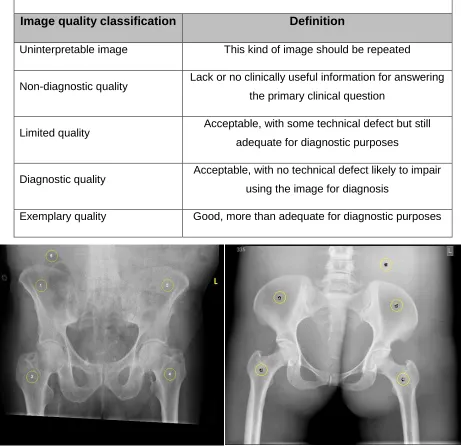
SNR was calculated using four regions of interest in order to obtain an overall objective
measure (Figure 1). SNR calculations were conducted using the following equation:
Mean signal (taken from ROI 1, 2 , 3, and 4)
Noise(σ of ROI5) ...(1)
The mean signal value was obtained by averaging the signals of the four ROIs, whereas
the noise value was identified from the standard deviation (σ) of the background ROI.
Then by dividing the mean signal value by noise value the SNR was calculated.
The 7 phantom images were then presented to the focus group for visual inspection to
determine whether they agreed that the images were different and ranked appropriately
8
1) from various sources to help identify image features which were consistent with the
most common disorders that pelvis radiology is tasked with investigating (34, 35, 36).
Table 1. Examples of the definitions used to help identify the image with different and predefined quality (34,35)
Image quality classification Definition
Uninterpretable image This kind of image should be repeated
Non-diagnostic quality Lack or no clinically useful information for answering the primary clinical question
Limited quality Acceptable, with some technical defect but still adequate for diagnostic purposes
Diagnostic quality Acceptable, with no technical defect likely to impair using the image for diagnosis
Exemplary quality Good, more than adequate for diagnostic purposes
Figure 1.This figure illustrates the four ROIs used to calculate the mean signal values across the pelvis and the fifth ROI (uniform area) used to identify noise (σ) for the purpose of SNR calculation in both
phantom and cadaver images (Left, cadaver image; right, phantom image)
The cadaver images were used for further validation of the scale. Unlike phantom
[image:9.612.73.534.158.604.2]9
soft tissue shadow variations. Acquisition factors which led to the acquisition of the final
seven phantom images were used as guidance to acquire the 7 cadaver images. Again,
it is worth noting that the high quality image was based on standard acquisition
parameters including tube current termination using an AEC. Similar to the phantom,
the cadavers were positioned using standard radiographic positioning (37). Seven
images of different SNRs were obtained. Additionally, for the 7 cadaver images,
positional and technical errors were introduced by either rotating the cadaver body to
either side, and/or through incorrect collimation. The reason behind these errors was to
test the capability of the scale in characterising the effect of the positional errors in
addition to the noise’s effect on image quality. Similar to the phantom images, the
cadaveric images were introduced to the focus group to ensure they were different in
terms of quality and again ranked appropriately (high to low, see Figure 3). Again, this
process was conducted with the aid of subjective definitions indicated in Table 1 (34,
35).
Phantom images were acquired on a Wolverson Acroma X-ray unit (high frequency
generator with VARIAN 130 HS standard X-ray tube with a total filtration of 3 mm
Aluminium equivalent). The same 35 cm × 43 cm Agfa image receptor and image
processing was undertaken using an Agfa 35-X digitiser. All equipment quality control
met the required specifications of Institute of Physics and Engineering in Medicine
10
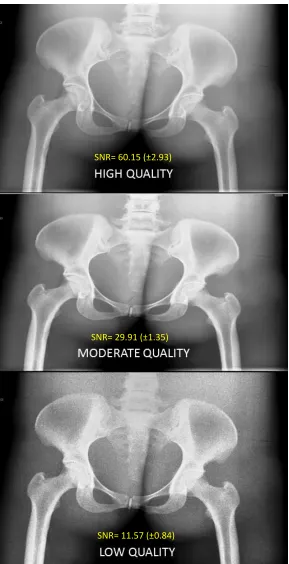
Figure 2. Examples of phantom images
SNR= 60.15 (±2.93)
SNR= 29.91 (±1.35)
11
Figure 3. Examples of cadaver images
SNR= 49.48 (±4.56)
SNR= 24.53 (±2.88)
12
Volunteers used for scale validation
Scale validation was conducted in two phases, first using phantom images and then
using cadaver images. Scoring involved volunteers completing one scale for each
image under controlled conditions: room lighting was dimmed (20-38 Lux) (39); 2.3
mega-pixel screens (22 inch Iiyama ProLite liquid crystal display monitors -B2206WS),
calibrated to the DICOM greyscale standard. No image manipulation was permitted by
the volunteers and they were blinded to image acquisition factors. Images were
presented in a random order. Immediately prior to image scoring all volunteers received
a training exercise in image quality. The training exercise focused on defining image
quality, physical aspects of quality (e.g. contrast) and how acquisition factors can affect
the quality of an image.
Sample size is an important aspect of psychometric scale validation. Reliability
assessment and factor analysis requires a minimum sample size of at least 150
participants (27, 40, 41). Consequently, 151 volunteers (resulting in 7x151=1057
completed scales) scored the phantom images and 184 (resulting in 7x184=1228
completed scales) scored the cadaver images. Volunteers comprised qualified
radiographers and student radiographers from six higher education institutions (Table
2). It was accepted that student radiographers may have lower levels of experience, however to achieve the required sample size they represented an easily accessed
group. Also, it is important to note they had all received training about image quality
appraisal in their undergraduate studies, and additional training for this research.
Table 2. Volunteer characteristics – phantom and cadaver images
Image set
Radiography students Qualified radiographers
Overall sample size
Year 1 Year 2 Year 3
Phantom 42 43 41 25 151
Cadaver 55 59 41 29 184
There was a small of overlap between the phantom and cadaver volunteer groups, 20%
13
Statistical testing
Different statistical tests were used to investigate outliers, testing the quality of individual items, items’ correlations and their reliability, items pattern correlation and
sample adequacy ready for factor analysis. Details of the statistics are indicated below.
Item analysis
Item analysis was conducted for each image ready for internal reliability testing and
factor analysis. Scale items with a standard deviation (SD) >1.5 were excluded (42).
Skewness for each item was also investigated; items with highly skewed scores (i.e.
>+1 or < -1) were removed (31, 43). Correlation of scale items was examined; this was
based on inter-item correlation coefficients among all items within a correlation matrix.
Scale items were eliminated if more than half of their responses had an inter-item correlation value ≤0.2 (44).
Internal consistency
Internal consistency of scale items was assessed using Cronbach’s Alpha coefficient
(45). A value of 0.6 was used as a standard lenient cut off point for each extracted factor (46). Cronbach’s Alpha was calculated for all images before and after removing
the redundant items to see how this affected scale internal reliability. Redundant items
are those items which had high skewed scores or had high standard deviations.
Factor analysis
Factor structure refers to the number and nature of factors as assessed by the items. A
factor on its own represents a group of items which represent different image quality
attributes. A factor (group of items) is assumed to have a specific image quality theme.
Factor analysis was used to explore whether any group of items had an underlying
factor structure, and to explore whether the scale is uni- or multi-dimensional. Scale
dimensionality expresses whether the scale is assessing a single image quality theme
(e.g. anatomical features) or multiple themes (e.g. anatomical and technical) (27).
Additionally, factor analysis can help remove items that have no meaningful contribution
14
scale items scores and generated factors for each of the images. This kind of
correlation is also known as factor loading (41). Factor analysis was conducted in two
ways. First, principal component analysis (unrotated) to generally assess scale factorial
structure. Second, a rotated factor analysis (varimax) approach helped determine how
many image quality themes the scale had. Principal component analysis was conducted
on the remaining items for each of the images. By contrast, factor analysis using the
varimax function was conducted on the same group of items again to examine whether
another factorial structure existed, and to reduce confusion/overlap that might arise from
principal component analysis (one item loaded high into two factors) (47). This analysis
was conducted separately for all images. Prior to conducting factor analysis, it was
necessary to confirm that correlation patterns between items were relatively compact.
For this purpose a Kaiser-Meyer-Olkin (KMO) statistic was used.
Results and analysis
Phantom data
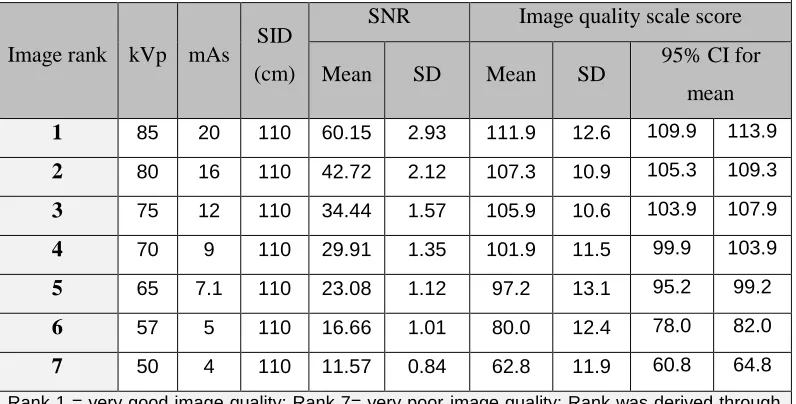
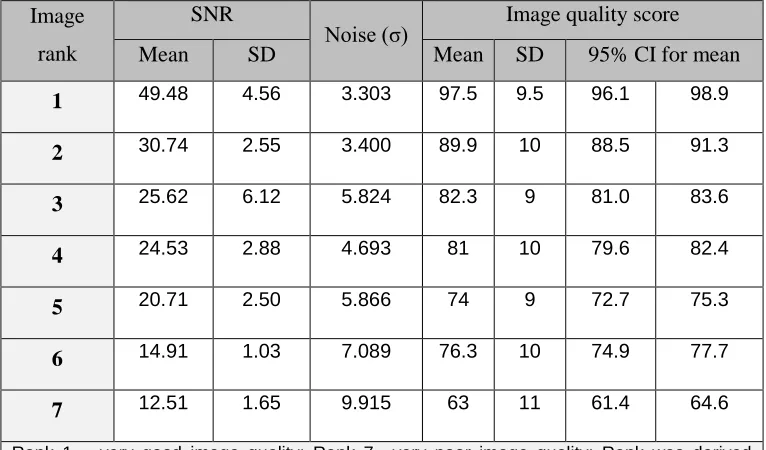
The SNR values of the 7 phantom images and the aggregated image quality scores are
[image:15.612.109.507.473.675.2]demonstrated in Table 3 together with the corresponding acquisition factors.
Table 3. This table presents SNR values, initial image quality scale scores of the 7 phantom images along with the corresponding acquisition factors.
Image rank kVp mAs SID (cm)
SNR Image quality scale score
Mean SD Mean SD 95% CI for mean
1 85 20 110 60.15 2.93 111.9 12.6 109.9 113.9
2 80 16 110 42.72 2.12 107.3 10.9 105.3 109.3
3 75 12 110 34.44 1.57 105.9 10.6 103.9 107.9
4 70 9 110 29.91 1.35 101.9 11.5 99.9 103.9
5 65 7.1 110 23.08 1.12 97.2 13.1 95.2 99.2
6 57 5 110 16.66 1.01 80.0 12.4 78.0 82.0
7 50 4 110 11.57 0.84 62.8 11.9 60.8 64.8
Rank 1 = very good image quality; Rank 7= very poor image quality; Rank was derived through
15
Using Grubb’s equation and a scatter plot (48), 6 outliers were detected across 4 image
sets and in order to minimise error these were removed - image 2 (1 outlier), image 5 (2
outliers), image 6 (2 outliers) and image 7 (1 outlier).
Scale Reliability
Cronbach’s Alpha values ranged from 0.803 to 0.913; this was after the redundant items
had been removed. Removing these items had no substantial influence on scale
reliability.
Factor analysis
To begin with, KMO values ranged from 0.823 to 0.888 (minimum acceptable ≥0.5)
across the 7 images (49), this provides an indication that the correlations between items
were compact. Principal component analysis revealed a series of single dominant factors with an eigenvalue ≥1, for all seven images. The variance (%) that these factors
accounted for ranged from 28.8 to 40.21%. This suggests that these factors explained
the most important information regarding the quality of the AP pelvis images (29). Therefore, this would support the scale’s construct validity.
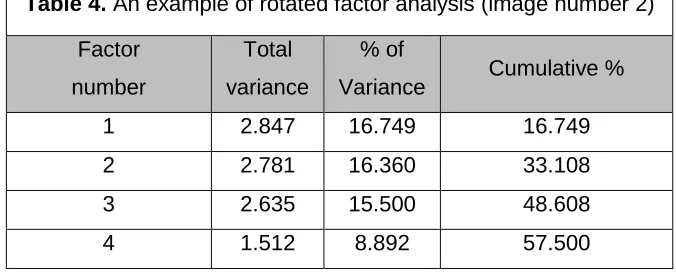
For 5 out of 7 images the rotated factor analysis demonstrated the first 3 factors had
similar and high variance (Table 4). For the remaining 2 image sets, the first factor in
each accounted for the highest variance - 25% and 37%, respectively; whereas the
16
Factors number 1, 2, and 3 from image sets 1, 2, 4, 5, and 6 can be considered as
significant factors (50, 51, 52), because of their high variance (%) and the number of
items that are highly loaded onto them (≥0.33). These factors were retained with their
items. Two factors from image set 7 and 1 factor from image set 3 were retained based
on the same criteria (50, 51).
Any item that had low factor loading (≤0.3) was removed because of its low correlation
with the extracted factor(s) (53). Factors that did not have an adequate number of items
were eliminated to improve psychometric properties of the scale. After analysis and item
removal, 24 items were retained in the final scale. This 24 item scale (see Appendix)
was used in the second phase of validation with the seven cadaver images.
Cadaver data
The details of the objective image quality metrics associated with the seven cadaver
images together with aggregated scores from each volunteer and each image can be
[image:17.612.125.463.83.221.2]seen in Table (5).
Table 4. An example of rotated factor analysis (image number 2)
Factor
number
Total
variance
% of
Variance Cumulative %
1 2.847 16.749 16.749
2 2.781 16.360 33.108
3 2.635 15.500 48.608
17
Cadaver scale data were analysed using the same approach used for phantom data.
One outlier was detected from image set 1. This was removed from the data for the
subsequent analysis to avoid systematic error.
Item analysis and scale reliability
Before calculating Cronbach’s Alpha and conducting factor analysis, item characteristics
were investigated individually for each of the seven cadaver images independently. Cronbach’s Alpha was then calculated to evaluate the internal reliability of the refined
scale after removing redundant items included within 24 scale items, Alpha coefficient
ranged from 0.791 to 0.889.
Table 5. This table presents SNR values, initial image quality scale scores of the 7 cadaver images along with the corresponding acquisition factors.
Image
rank
SNR
Noise (σ) Image quality score
Mean SD Mean SD 95% CI for mean
1 49.48 4.56 3.303 97.5 9.5 96.1 98.9
2 30.74 2.55 3.400 89.9 10 88.5 91.3
3 25.62 6.12 5.824 82.3 9 81.0 83.6
4 24.53 2.88 4.693 81 10 79.6 82.4
5 20.71 2.50 5.866 74 9 72.7 75.3
6 14.91 1.03 7.089 76.3 10 74.9 77.7
7 12.51 1.65 9.915 63 11 61.4 64.6
Rank 1 = very good image quality; Rank 7= very poor image quality; Rank was derived
[image:18.612.115.498.115.340.2]18
Factor analysis
KMO values were calculated first, KMOs ranged from 0.710 to 0.838; this suggests
good correlations. Principle component analysis demonstrated a single dominant factor
for all 7 images which accounted for highest variance (%), ranging from 24 to 32.7.
Similar to the phantom data, the highest variance factors explained the important information about the quality, meaning that these factors were highly loaded (≥0.4) into
the majority of items of different themes (e.g. anatomical and others).
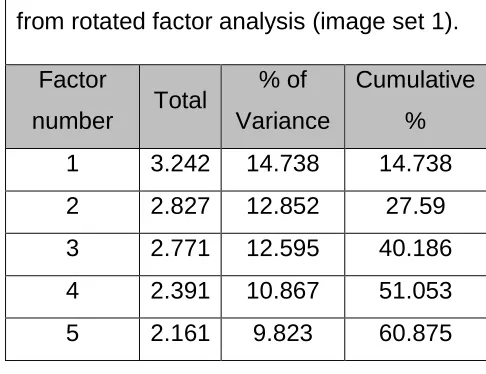
Rotated factor analysis demonstrates that factor numbers 1, 2, 3, and 4 for all the seven
images accounted for approximately 12.5± 2 % of total variance within the scale (Table 6). These factors loaded high onto their items (≥0.4) and they are therefore considered
significant factors to be included and support the scale validity (50, 51).
To improve factor analysis, scores of the 24 items for both phantom and cadaver were
combined (i.e., all the completed scales (14 images x335 volunteers = 2345)). Prior to
this an unpaired t test was conducted to see if phantom and cadaver scores were significantly different; no significant difference existed (P˃ 0.05). Cronbach’s Alpha for
the combined phantom and cadaver images ranged from 0.786 to 0.907, KMO ranged
from 0.734 to 0.908.
Table 6. An example of extracted factors from rotated factor analysis (image set 1).
Factor
number Total
% of
Variance
Cumulative
%
1 3.242 14.738 14.738
2 2.827 12.852 27.59
3 2.771 12.595 40.186
4 2.391 10.867 51.053
[image:19.612.183.426.344.531.2]19
Discussion
Psychometric literature (10, 15, 27), supported by Bandura’s guidelines (28), have
provided a theoretical basis for the first ever full development and validation of a visual grading scale to assess perception of AP pelvis image quality. We propose that psychometric theory can be used to develop valid and reliable visual grading scales to
assess image quality. This argument is supported by our scale having high reliability (Cronbach alpha ≥0.8), compact correlation patterns (KMO 0.7 to 0.9) and the ability to
assess anatomical and technical quality, reflecting the construct validity. The argument
is also supported by the excellent agreement between the visually and objectively
predetermined quality rankings and the overall image quality scale scores (i.e. phantom:
r2=0.94, p˂0.001; cadaver: r2=0.95, P˂0.001).
There is an overlap in the 95% CIs of the mean scale scores (see phantom images
ranked 2 and 3, in Table 3; cadaver images 3 and 4, in Table 5). This suggests that
scale sensitivity could be limited and it might not be able to differentiate between
images of very similar quality. However, this kind of subtlety may not be a problem in
real life situations and a slightly reduced scale sensitivity may not be critical (54, 55).
Importantly, on inspection of these 4 images it is clear some have positional errors
which the physical measure (i.e. SNR) would not have detected. Cases such as these
demonstrate the limitation of simple physical measures (e.g. SNR) conducted in
isolation of visual measures for the evaluation of image quality.
The final scale has 15 out of 24 anatomical items. These items relate to how clearly a
given structure can be visualised in the image. The remaining items (9 out of 24) are
positioning (e.g anatomical rotation) and technical (e.g. collimation errors). For the
phantom images, removing these 9 items does not adversely affect the scale
psychometric properties; the removal of scale items has similar outcomes within general
psychometric literature (52, 56). This suggests that the AP pelvis scale has a
uni-dimensional structure when used on phantoms. The explanation for this could be that
the phantom images were uniform, aside having varying noise and contrast levels. On
this basis it could be argued that phantoms can be used to create and validate visual
20
scale development and validation, as phantoms do not display a range of anticipated
anatomical variations. If such variations are not taken into consideration then the scale could have limitations. For example, for some cadaver images Cronbach’s alpha
decreased when the 9 items were removed, thereby demonstrating their necessity.
Consequently the use of human images should be considered in scale development
and validation.
It is possible to derive subscales from our AP pelvis scale. Subscales are commonly
derived from larger scales and published into the psychometric literature. For our AP
pelvis scale an example of a subscale would be the 15 items highlighted in the
appendix; these items can be used to assess AP pelvis anatomical image quality only. It
is worth noting that subscales are not available with previously published visual grading
scales in medical imaging, this highlights another novel value to the use of psychometric
theory.
A normal approach in scale validation would be to assess a newly validated scale
against an existing scale with known psychometric properties. Unfortunately no
validated scale currently exists for AP pelvis image quality. Consequently additional
work is warranted in order to further assess the validity of our scale.
Conclusion
No validated visual grading scale for AP pelvis image quality assessment exists within
the literature; consequently many researchers rely on CEC criteria despite major
deficiencies. In this paper, using AP pelvis as a catalyst, we have demonstrated that
psychometric theory can be applied to develop and validate a visual grading scale for
image quality. We propose that our method should be considered for developing and
validating visual grading scales for other imaging procedures. Our 24 item scale shows
a high level of internal reliability and validity. On this basis we propose our scale is likely
21
Appendix
AP pelvis image quality scale
1- The left hip joint is adequately visualised. 2- The right hip joint is adequately visualised.
3- The right lesser trochanter is visualizedadequately. 4- The left lesser trochanter is visualizedadequately. 5- The left greater trochanter is visualizedadequately. 6- The right greater trochanter is visualizedadequately. 7-The left iliac crest is adequately visualized.
8- The right iliac crest is adequately visualized.
9- The pubic and ischial rami are not adequately visualized. 10- The proximal femora are demonstratedadequately. 11- The left femoral neck is visualizedadequately. 12- The right femoral neck is visualizedadequately. 13- The left sacro-iliac joint is visualizedadequately. 14- The right sacro-iliac joint is visualizedadequately.
15- The sacrum and its intervertebral foramina are not visualizedadequately.
16-There is appropriate differentiation between soft tissues. 17- The exposure factors used for this image are correct. 18- This image is sufficient for diagnostic purposes.
19- The medulla and cortex of the pelvis are adequately demonstrated. 20- The body of L5 is adequately demonstrated.
21- The obturator foramina are symmetrical. 22- Both acetabula are visualised clearly
23-The levels of rotation and axial tilting are within acceptable limits. 24- Fine bony detail is sufficiently demonstrated.
Technical and positioning related
items
22
References