International Journal of Emerging Technology and Advanced Engineering
Website: www.ijetae.com (ISSN 2250-2459, ISO 9001:2008 Certified Journal, Volume 4, Issue 5, May 2014)
144
Transform Based Digital Image Watermarking Techniques for
Image Authentication
Mrugesh Prajapati
11
M.Tech (EC Deptt.), Truba Institute Of Engineering And Information Technology, Bhopal, India
Abstract—In the past few years many new techniques and concepts based on data hiding have been introduced for image authentication and copy right protection. With a lot of information available on various search engines, to protect the ownership of information is a crucial area of research. Digital watermarking is a popular technique that is used for
copyright protection and authentication. Digital
watermarking is hiding the information inside a digital media. This paper attempts to first introduce general idea behind digital watermarking as well as some of its basic characteristics followed by describing some applications of
watermarking techniques. In spatial domain,
Least-Significant Bit (LSB), Patchwork algorithm and Texture mapping coding method and in the transform domain,
Discrete Fourier Transform (DFT), Discrete Cosine
Transform (DCT), Discrete Wavelet Transform (DWT) has been discussed. In this paper it can be proposed frequency domain watermarking using DCT and watermark is embedded in the Mid Frequency Band of DCT.
Keywords— watermarking, authentication, copy right protection, (LSB), Discrete Cosine Transform, Discrete Wavelet Transform.
I. INTRODUCTION
With the increase in the availability of digital data such as multimedia services on the Internet, there is a pressing need to manage and protect the illegal duplication of data. The problem of protecting multimedia information becomes more and more important. Of the many approaches possible to protect visual data, digital watermarking is probably the one that has received most interest. Digital watermarking is the process of embedding information into a digital signal. The signal may be audio, pictures or video, for example. The kind of watermark consist the author and the user’s information, which could be the text, owner’s logo, serial number or any other control information [1,6,7]. If the signal is copied, then the information is also carried in the copy.
There are four factors that are used to determine the quality of watermarking. They are robustness, imperceptibility, capacity, and blindness [4-7]. Robustness means that the watermark should be difficult to remove or destroy.
It is a measure of immunity of the watermark against the different attacks like additive noise, scanning JPEG compression, filtering, scaling, rotation, and cropping. Imperceptibility means the quality of original host image should not be changed or destroyed by the presence of watermark. Capacity includes techniques that make it possible embed majority of information. Blind watermarking means that the extraction of watermark from watermarked image without the original image because the sometimes the original image is not available. An efficient watermarking algorithm is one which finds a good balance in all the above mentioned characteristics. [11,13]
II. LITERATURE REVIEW
There have been many watermarking techniques proposed for the digital images. The watermarking techniques can be broadly classified into two categories: spatial domain techniques (LSB, Patchwork algorithm, Texture mapping coding method) [12] and Transform domain techniques (DFT, DCT, DWT). [1,7,9,10,12]
Cox et. al [10] uses the DCT domain for the watermark embedding for the first time. As JPEG standard also uses DCT for image compression it is always a good idea to explore image watermarking in DCT domain.
B. Ram [1] described a digital image watermarking techniques based on Discrete Wavelet Transform (DWT) and Discrete Cosine Transform (DCT), where the method operates in the frequency domain embedding a pseudo random sequence of a real numbers in a selected set of DCT coefficients and watermark added to this selected DCT coefficients.
R. Shukla et. al [2] described a method that can recovered the watermarked image by the use of LSB modification and DCT techniques. This technique can be analyze by using various distortion matrices to verify their robustness.
International Journal of Emerging Technology and Advanced Engineering
Website: www.ijetae.com (ISSN 2250-2459, ISO 9001:2008 Certified Journal, Volume 4, Issue 5, May 2014)
145 D.Singh et.al in [4], described the comparative studies of spatial and frequency domain watermarking scheme. It can be concluded that frequency domain techniques embeds more bits and more robust than spatial domain techniques. From the result of this paper, it can be conclude that DCT method introduce a low noise.
R. Chaturvedi et. al in [5] proposed algorithm of image watermarking techniques based on DCT using Mid Band Coefficients for robustness. They have been used DCT Mid band coefficient for different image format and analyze PSNR value for different image format.
F.Namazi et. al in [6] described Block based Adaptive Image Watermarking techniques based on DCT and human visual characteristics. In order to achieve more robustness and transparency watermark has been embedded in to middle frequency component of the image.
V. santhi et. al in [7] proposed a robust non blind watermarking algorithm based on DC-coefficients for the color image.
M. Choubiasa et. al in [8] proposed algorithm of digital image watermarking based on DCT using permuting the image. In this algorithm, First permuted the original image using pseudo random sequence and apply DCT to permuted image and then embed the watermark. It can achieve better balance between robustness and invisibility.
A. Aggarwal et. al in [9] discussed review of spatial domain watermarking for the digital images. In this paper, Block based watermarking scheme, LSB techniques and secured watermarking algorithm were discussed.
T. Tewari et. al in [10] proposed DCT based additive watermarking technique. In this paper, watermark is embedded in to mid frequency sub band of the DCT.
In [11] B. Gunjal et. al described the complete overview of the digital image watermarking techniques in spatial domain as well as frequency domain. This paper indicates result of LSB, DCT and DWT.
Jiang Xuehua in [12] discussed the basic principle, characteristics and algorithms of digital watermarking techniques and DCT algorithm is selected to do the application test.
Yanqun Zhang in [13] reviewing the watermarking theory, attacks and the evaluation system of watermark.
A. Taherinia et. al in [14] proposed and implemented a DCT based blind watermarking scheme based on spread spectrum communication. In this algorithm watermark can extract even if watermarked image was compressed with quality factor of 1%. From the result, it can be conclude that it can robust with respect to Gaussian noise.
III. WATERMARKING PROCESS
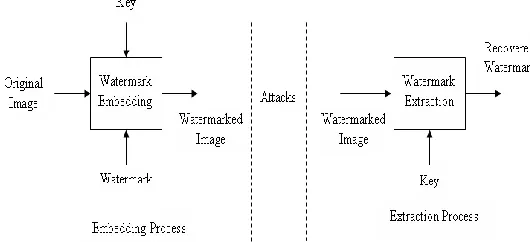
[image:2.612.328.593.198.319.2]A watermarking system is usually divided into two distinct steps, embedding, and detection. The general watermarking process is shown in figure 1.
Fig 1 General watermarking Process
In embedding, an algorithm accepts the original host image and the watermark to be embedded and produces a watermarked signal. The watermarked signal is then transmitted or stored, usually transmitted to another person. In watermark extraction, an algorithm accepts the signal to extract the watermark from it. If the signal was unmodified during transmission, then the watermark is still present and it can be extracted.
IV. APPLICATION AREA
Watermarking can be really useful in several areas of interest involving digital images. Some applications of invisible watermarks are listed here to; [2]
Copyright Protection: This is the most prominent application of watermarks. With lots of images being exchanged over insecure networks every day, copyright protection becomes a very important issue. Watermarking will prevent redistribution of copyrighted images.
Authentication: Sometimes the ownership of the contents has to be verified. This can be done by embedding a watermark and providing the owner with a private key which gives him an access to the message. ID cards, ATM cards, credit cards are all examples of documents which require authentication.
International Journal of Emerging Technology and Advanced Engineering
Website: www.ijetae.com (ISSN 2250-2459, ISO 9001:2008 Certified Journal, Volume 4, Issue 5, May 2014)
146
Content Labeling: Watermarks can be used to give more information about the cover object. This process is named content labeling.
Tamper Detection: Fragile watermarks can be used to detect tampering in an image. If the fragile watermark is degraded in any way then we can say that the image or document in question has been tampered.
Digital Fingerprinting:This is a process used to detect the owner of the content. Every fingerprint will be unique to the owner.
Content protection: In this process the content stamped with a visible watermark that is very difficult to remove so that it can be publicly and freely distributed.
V. CLASSIFICATION
Watermarking algorithms can be classified on several criteria as given below. [11]
1) According to domain of watermark insertion: a)Spatial Domain Techniques
b)Frequency Domain Techniques.
2) According to Watermark detection and extraction: a)Blind Watermarking
b)Non-blind Watermarking.
The non-blind watermarking requires that original image to exist for detection and extraction whereas blind techniques do not require original image.
3) According to ability of watermark to resist attack: a)Fragile Watermarking
b)Semi-fragile Watermarking 4) According to Visibility:
a)Visible Watermarks b)Invisible Watermarks
VI. WATERMARKING DOMAIN
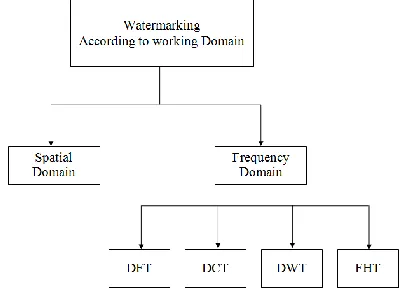
[image:3.612.347.547.143.294.2]There are mainly two direction of embedding the watermark in the original image namely the spatial domain and transform domain as shown in fig.3
Fig. 2 Classification of watermarking
In the spatial domain watermarking method, the watermark embedded using patchwork techniques, LSB, Statistical, texture mapping coding and block based technique. Spatial domain techniques works directly with pixel values. Generally the spatial domain techniques are easy to implement from a computational point of view [10], but more vulnerable in the common image attacks such as filtering and JPEG compression. [4,7,9] The frequency domain approaches are widely used for image watermarking. In these techniques, the image is being transformed via some common frequency transform and the watermarking is achieved by altering the transformed coefficients of the images. The transformed usually used are DFT, DWT, DCT [1-4] [7-8] [10-11] and HARR.
[image:3.612.326.570.536.673.2]As per P. Khatkale et.al in [3] Table 1 shows a small comparison between the spatial and frequency domain techniques.
Table. I
Comparison between Spatial and Frequency domain watermarking
Spatial Domain
Frequency domain Computational
cost
Low High
Robustness Fragile More Robust
Perceptual Quality
High Control Low Control
Capacity High (depends on the size of image)
Low
Example of Application
Mainly Authentication
International Journal of Emerging Technology and Advanced Engineering
Website: www.ijetae.com (ISSN 2250-2459, ISO 9001:2008 Certified Journal, Volume 4, Issue 5, May 2014)
147 Another, well known spatial domain based scheme is patchwork-based technique given by Bender et al. [7]. Depending on the statistics, the algorithm uses the statistical characteristics of pixels to embed the information into the brightness values of pixel. It is mainly used for the security of printing bills.
Texture mapping coding method
In this method, a region of random texture pattern found in the image is copied to an area of the image with similar texture.
Autocorrelation is then used to recover each texture region. The most significant problem with this scheme is that it is only appropriate for images that possess large areas of random texture. [13].
VII. FREQUENCY DOMAIN WATERMARKING
In Frequency Domain Watermarking, the watermark information is embedded in the transform domain. So this technique is also known as Transform Domain Watermarking. As discussed early, transformed domain watermarking schemes are more robust as compared to simple spatial domain watermarking schemes because information can be spread out to entire image. However, they are difficult to implement and are computationally more expensive. The most commonly used transforms are DCT, DFT, DWT and DHT. Each of these transforms has its own characteristics and represents the image in different ways. In this paper we will discuss watermarking in frequency domain such as DFT, DCT, and DWT.
Discrete Fourier Transform
As per Emir et. al in [15], Although DWT and DCT domain semi-blind watermarking schemes are robust against a number of attacks, they are not useful for geometric attacks like rotation, translation, and scaling because the location of the transform coefficients will change, resulting in a weaker detection. In DFT based watermarking scheme, the watermark is embedded by DFT magnitude and phase coefficients.
It is possible to embed a circularly symmetric watermark in the DFT domain using the additive formula
)
1
(
)
,
(
.
)
,
(
)
,
(
u
v
M
u
v
W
u
v
M
w
Where M denotes the magnitudes of DFT coefficients of the cover image, α is the scaling factor, and W is the circular watermark.
Discrete wavelet Transform:
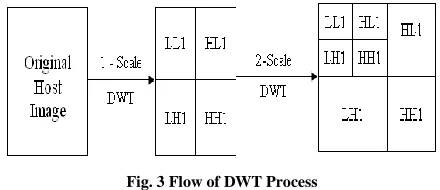
[image:4.612.333.553.206.301.2]The basic idea in the DWT for a one dimensional signal is the following. A signal is split into two parts, usually high frequencies and low frequencies. This splitting is called decomposition. [7,11]
Fig. 3 Flow of DWT Process
A step of wavelet transform decomposes an image into four parts: HH, HL, LH and LL in Figure. LL is low frequency coefficient, LH is high frequency coefficient horizontally, HL is high frequency coefficient vertically, and HH is high frequency coefficient diagonally. Watermark should be embedded in low frequency coefficients.
Furthermore, DWT image and video coding, such as embedded zero-tree wavelet (EZW) coding, are included in the upcoming image and video compression standards, such as JPEG2000. Thus DWT decomposition can be exploited to make a real-time watermark application. [11]
Discrete Cosine Transform
International Journal of Emerging Technology and Advanced Engineering
Website: www.ijetae.com (ISSN 2250-2459, ISO 9001:2008 Certified Journal, Volume 4, Issue 5, May 2014)
[image:5.612.40.300.156.412.2] [image:5.612.40.299.159.412.2]148 Table II
Comparison of different transform domain Watermarking Algorithm
Algorithm Advantages Disadvantages
DFT 1. DFT is rotation,
scaling and translation (RST) invariant. Hence it can be used to recover
from geometric
distortions
1. Complex
implementation 2. Cost of computing may be higher
DWT 1. Allows good
localization both in time and spatial frequency domain
2. Higher compression ratio which is relevant to human perception
1. Cost of computing may be higher.
2. Longer
compression time. 3. Noise near edges of images or video frames.
DCT 1. The watermark is
embedded into the coefficients of the middle frequency, so the visibility of image will not get affected and the watermark will not be removed by any kind of attack.
1. Block wise DCT
destroys the
invariance properties of the system. 2. Certain higher frequency
components tend to be suppressed during the quantization step.
PERFORMANCE PARAMETER:
The quality of watermarked image is studied with two metrics, peak signal to noise ratio (PSNR) and Similarity Factor(SM).
Peak Signal to Noise Ratio is calculated by the following formula ) 2 ( ) 1 2 ( log 2 MSE PSNR n
Where n is the number of bits used for image representation and MSE refers to the Mean Square Error between original and watermarked image of N X N and is calculated with the formula.
) 3 ( )] , ( ) , ( [ * 1 1 1 2 2
N x N y y x I y x I N N MSE Where)
,
(
x
y
I
: The pixel value of original image)
,
(
x
y
I
: The pixel value of watermarked image N: size of an imageSimilarity Factor is measure of the similarity of pixel intensities between the original image and the watermarked image. This helps us to calculate the changes in the perceptual quality of the image more precisely. The similarity factor has value [0,1] calculated using following equation . If SM = 1 then the embedded watermark and the extracted watermark are same. Generally value of SM>.75 is accepted as reasonable watermark extraction.
) 4 ( ) , ( ) , ( * ) , ( 2
x y x y y x I y x I y x I SFWhere
I
(
x
,
y
)
is the original image andI
(
x
,
y
)
is the watermarked image.VIII. PROPOSED SCHEME
The proposed algorithm uses the discrete cosine transform (DCT) using Mid Band Coefficient Exchange.
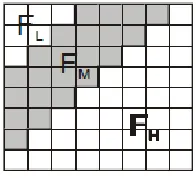
In the DCT, an image is segmented in non-overlapping 8*8 block and applies the DCT to each block. This will divide an image into three main region namely low frequencies sub-band (FL), middle frequencies sub-band
(FM) and high frequencies sub-band (FH) as shown in fig.4
which makes it easier to select the band in which the watermark is to be inserted. The literature survey indicates that middle frequency bands (FM) are most widely chosen
because of two facts. The first fact is that most of the signal energy lies at low-frequencies sub band which contains the most important visual parts of the image. The second fact is that high frequency components of the image are usually removed through compression and noise attacks. Therefore the watermark is embedded by modifying the coefficients of the middle frequency sub band so that the visibility of the image will not be affected and the watermark will not be removed by compression.
[image:5.612.394.492.554.643.2]International Journal of Emerging Technology and Advanced Engineering
Website: www.ijetae.com (ISSN 2250-2459, ISO 9001:2008 Certified Journal, Volume 4, Issue 5, May 2014)
149 Fig.5 Block Diagram of proposed Watermark Embedding scheme
Fig.6 Block diagram of proposed Watermark Detection
The Two dimensional DCT of an M X N matrix is defined as follow:
) 5 ( 2 ) 1 ( 2 cos 2 ) 1 ( 2 cos ) , ( ) , ( 1 0 1 0 N q n M p m n m I q p C M m N n q p
And the inverse DCT is given by
) 6 ( 2 ) 1 ( 2 cos 2 ) 1 ( 2 cos ) , ( ) , ( 1 0 1 0 N q n M p m q p C n m I M m N n q p
Where, 1 1 2 0 1 M p M p M p 1 1 2 0 1 M q N q N q The values C (p, q) are called the DCT coefficients of image I (m, n).
IX. FLOW CHART AND ALGORITHM OF PROPOSED
SCHEME
Watermark Embedding Algorithm:
Watermark embedding algorithm consists of following steps:
Step 1: Read the cover image and watermark logo.
Step 2: if the watermark logo is smaller than cover image then it is padded with ones (1’s)
Step 3: segment the cover image in to non overlapping blocks of 8*8. Step 4: Apply Forward DCT to these blocks. Step 5: Apply coefficient selection criteria (e.g. Highest, Mid, Lowest).
Step 6: Embedded watermark information by modifying the selected coefficients using classical coefficient scheme. Step 7: Apply Inverse DCT transform on each block. Most algorithms using DCT are classified based on step 5. The insertion of watermark information in mid band coefficient block gives the extra robustness to the watermark.
Watermark extraction Algorithm:
The watermark extraction algorithm consists of following steps:
Step 1: Read the watermarked image and original watermark.
Step 2: Segment the watermarked image into non-overlapping blocks of 8*8 and perform DCT on each blocks.
Step 3: Selected DCT coefficients are compared for every block. If the pixel at M1(ui,vi) is greater than the pixel at
M2(ui,vi), then hidden watermarked bit would be black i.e
the DCT block will encode “0” otherwise the hidden watermarked bit would be a white i.e DCT block will encode a “1”.
Step 4: Reshaping the extracted message vector to 2D binary watermarked image.
Step 5: Calculate the similarity ratio between the embedded and extracted watermark.
International Journal of Emerging Technology and Advanced Engineering
Website: www.ijetae.com (ISSN 2250-2459, ISO 9001:2008 Certified Journal, Volume 4, Issue 5, May 2014)
150 Fig.7 Flow chart of embedding process
X. CONCLUSION
Digital Watermarking defines methods and technologies that hide information, for example a number or text, in digital media, such as images, copyright protection, tamper proofing, video or audio. In this paper we are briefly defining the concepts of watermarking, the properties of a watermarking system, embedding and extracting algorithm of watermarking as well as an application of watermarking discussed, and the DCT algorithm is selected to do the application test of digital image copyright protection.
Fig.8 Flow chart of extraction process
The experiment proves that DCT-based watermark can well withstand a variety of image processing, and the watermark can survive after compression, cropping, and other attacks.
REFERENCES
[1] B Ram, “Digital Image Watermarking Technology Using Discrete Wavelet Transform And Discrete Cosine Transform”,International journal of Advancements in Research & technology, Volume 2, Issue 4,April 2013
International Journal of Emerging Technology and Advanced Engineering
Website: www.ijetae.com (ISSN 2250-2459, ISO 9001:2008 Certified Journal, Volume 4, Issue 5, May 2014)
151
[3] P. Khatkale, K. Jadhav, M. Khasne, “Digital Watermarking Technique for Authentication of Color Image”, International Journal of Emerging Technology and Advanced Engineering, (ISSN 2250-2459, Volume 2, Issue 7, July 2012).
[4] D. Singh, N. Choudhary, N. Agrawal, “Spatial and Frequency Domain for Gray level Digital Images”, Spatial issue of International journal of Computer applications (0975–8887) on communication security, No.4, March – 2012.
[5] R. Chaturvedi, A. Sharma, N. Hemrajani, D. Goyal “Analysis of Robust Watermarking Techniques Using Mid Band DCT Domain for Different Image Formats”, International Journal of Scientific and Research Publication, Volume – 2, issue 3, March – 2012.
[6] F.namazi, M. Karami, S.Ramazannia, “Block-based Adaptive Image Watermarking Scheme Using Visual Perception Model In DCT Domain”, International Journal of Computer Application (0975 – 8887), Volume 41 No.4 March 2012.
[7] V.Santhi, A. Thangavelu, “DC Coefficients based Watermarking Techniques for Color Images Using Singular Value Decomposition”, International Journal of Computer and Electrical Engineering,Vol.3, No.1, February 2011.
[8] M. Choubiasa, K. Hiran, S. Singh : “Permutation Based Invisible Digital Watermarking Techniques Using DCT Domain”, International Journal of Computer Application (0975–8887), Volume 31 No.6, October – 2011.
[9] A. Aggarwal, M. Singla, “Image Watermarking Techniques in Spatial Domain : A review”, IJCTA, Sept – Oct 2011.
[10] T. Tewari, V. Saxena, “An Improved and Robust based Digital image Watermarking Scheme”, International Journal of Computer Application (0975–8887), Volume 3 – No.1, June 2011.
[11] B. Gunjal, R. Manthalkar, “An Overview of Transform Domain Robust Digital Image Watermarking Algorithms”, Journal of Emerging Trends in Computing and Information science”, Volume 2,No.1 2011.
[12] J. Xuehua, “Digital Watermarking and its Application in Image Copyright Protection”,International Conference on Intelligent Computation Technology and Automation 2010.
[13] Y. Zhang, “Digital Watermarking Technology: A Review”, 2009 ETP International conference on Future Computer and Communication.
[14] A. Taherinia, M.Jamzad, “Two level DCT based Digital Watermarking”.