International Journal of Emerging Technology and Advanced Engineering
Website: www.ijetae.com (ISSN 2250-2459, ISO 9001:2008 Certified Journal, Volume 7, Issue 8, August 2017)
332
Optimization of Process Parameters for Milling of Al6061-T6
Using AHP, RSM and Jaya Algorithm.
Shraddha Deshpande
Assistant Professor Mech Engg Dept, GES’s R. H. Sapat College of Engineering Management Studies & Research, Nashik 422 005, Maharashtra, India.
Abstract-- With the widespread application of aluminium alloy Al6061-T6 mostly in automotive and aerospace industries, the machining of aluminium has become a subject of interest today. Proper understanding of behaviour of process input parameters and its optimal settings are required for improved product quality as well as for mass production. Prediction of surface roughness and material removal rate in multi-point machining process is important for engineers. However, due to the random and complex nature of multipoint machining process, with its many variables, it become difficult to formulate a realistic and accurate mathematical model. The present work here highlights the potential in application of Analytic Hierarchy process method, response surface methodology and a computational optimization algorithm, Jaya for the selection of optimal process output responses during the milling of Al6061-T6 aluminium alloy. Type of cutting, spindle speed, feed rate, depth of cut and coolant are the process input parameters considered for experimentation whereas material removal rate, surface roughness on left as well as right side, workpiece vibrations, tool vibrations, temperature of workpiece and tool while cutting and corner radius have been considered as process output parameters. Attempt has been made to identify the optimal setting of process input parameters for optimizing the aforesaid output responses, simultaneously. AHP with equal and unequal weights has been used for selection of set of process input parameters for optimized responses. In addition to this, mathematical models are solved using Jaya algorithm. Good agreement has been found in the results.
Keywords— Analytical Hierarchy process method, Al6061-T6, milling, Jaya algorithm.
I. INTRODUCTION
Nowadays aluminium alloys are widely used in many engineering fields and particularly where weight reduction is a critical factor, such as aerospace and automotive industries. A need for weight reduction has emerged and has led to the increased application of lightweight materials such as aluminium. The use of aluminium alloy offers an opportunity for vehicle weight reduction, which can lead to a reduction of fuel consumption and emission without compromising performance, comfort and safety.
International Journal of Emerging Technology and Advanced Engineering
Website: www.ijetae.com (ISSN 2250-2459, ISO 9001:2008 Certified Journal, Volume 7, Issue 8, August 2017)
333
Aluminium combined with various percentages of other metals to form the alloys that are used in aircraft construction. Aluminium is one of the most widely used metals in modern aircraft construction. It is vital to the aviation industry because of its high strength to weight ratio, its corrosion-resisting qualities, and its comparative ease of fabrication. This material has density one third of steel and when alloyed with proper ingredient has strength more than steel. Many researchers had worked on Al6061-T6. Ming et al. [6] presented work on machining of Al6061-T6for getting higher product quality by providing appropriate lubrication or coolant using nanoparticles of silicon dioxide in proper concentration at the machining zone to improve the tribological characteristics of the said alloy. Wang et al. [7] presented work on the heat generation on the machined surface of Al6061 aluminium alloy and presented the relationship between the heating time, heating temperature and average size of the precipitates for Al6061 alloy. Nityanandam and Radhakrishanan[8] evaluated the controlling of milling machine for Al6061 on different thicknesses such as 100 mm X 45 mm plate with 2 mm, 3 mm and 4 mm thickness. Rahmati et al. [9] presented a study on Al6061-T6 alloy to improve the product quality particularly the surface roughness by introducing correct lubrication in the form of nanoparticles of Molybdenum disuphide (MoS2). The structure, shape and size of nanoparticles play an important role in their tribological properties [10, 11]. Raju et al. [12] presented work on optimization of cutting conditions for surface roughness in CNC end milling. The authors developed the integrated study of surface roughness to model and optimize the cutting parameters for end milling of 6061 aluminium alloy. Use of HSS and carbide tool was made in wet and dry cutting conditions. Genetic algorithm supported with regression equations was utilized to determine the best combinations of cutting parameters providing roughness to the lower surface through optimization process. Yazdi and Chavisho[13] presented work on the effect of cutting parameters and machining forces on surface roughness and material removal rate of Al6061in CNC face milling operation using two different modelling techniques, regression analysis and multilayer perceptron (MLP) neural network. Sreejith[14] experimented on Al6061 aluminium alloy with minimum quantity lubrication (MQL), dry and flooded lubrication and studied the effect of different lubricant environments when Al6061 aluminium alloy was machined with diamond coated carbide tools.In the present work an attempt is made to correlate temperature change during the cutting process for work piece as well as cutter. Also here an attempt will be made to set a relation between vibration getting induced in the work piece and cutter during the cutting process. Also for the first time effect of type of cutting, spindle speed, feed rate, depth of cut and coolant conditions will be observed on the corner radius of the work piece using weighted sum method and analytic hierarchy process and validated by response surface methodology and Jaya algorithm. Details of experimental setup are given in the following section.
II. EXPERIMENTAL SETUP
Trials were performed on Deckel Maho DMF-180, 5 axis CNC milling machine having two cutting options- up-milling and down-up-milling. To mill the slots on Al6061-T6 plate, an uncoated tungsten carbide cutting tool was used having 3 flutes, 8 mm diameter and 40 mm length of flute. Maximum length of cutting tool is also 40 mm which was set with a tool pre-setter. Along with various spindle speeds, feeds and depth of cut, the machine has a facility for selecting the coolant as flooded coolant, through toll coolant and air purging. The factors and levels of input process parameters are as shown in Table 2.1.
Table 2.1:
Factors and levels for input process parameters
Symb ol
Factor Units Level 1 Level 2 Level 3 A Cutting Type
Up-milling
Down-milling
- B Spindle
speed
Rpm 7000 8000 9000
C Cutting feed rate
mm/m in
1800 2100 2400
D Depth of cut
mm 1.0 1.5 2.0
E Coolant Type Flooded Through tool
Air purge
International Journal of Emerging Technology and Advanced Engineering
Website: www.ijetae.com (ISSN 2250-2459, ISO 9001:2008 Certified Journal, Volume 7, Issue 8, August 2017)
334
[image:3.612.60.277.134.445.2]Fig.2.1: Mounting position of accelerometers
Temperature of workpiece and temperature of cutting tool during process was measured with the help of laser gun. The heat generated during the cutting process should be carried away by coolant. However with different types of coolant conditions and cutting conditions temperature of workpiece as well as cutting tool gets affected. Corner radius is measured with the help of coordinate measuring machine (CMM). Output responses of the experimentation are tabulated in Table 2.2.
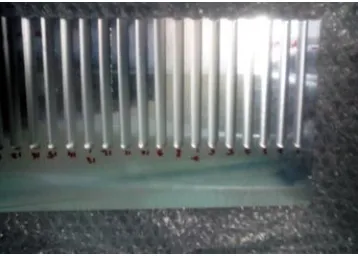
Fig. 2.2: Machined workpiece
[image:3.612.306.586.220.521.2]Slots of 100 mm x 8 mm having different depth of cuts, as per design of experiment were machined. Milling operation was performed overall size of Al6061-T6 aluminium alloy of 250 mm X 150 mm x 20 mm thickness. Analysis of responses is given in the next section.
Table 2.2:
Output responses of the experimentation.
Ru n No.
MRR mm3/se c
SRLH µm
SRR Hµm
VW/P g
VTOO L g
TW/ P °C
TTO OL °C
CR mm
1 201.51 1.861 1.629 0.0626 0.0064 26.3 26.1 0.0295
2 366.23 4.238 3.526 0.0600 0.0260 27.2 26.3 0.0520
3 536.91 1.801 2.581 0.0447 0.0077 26.8 27.2 0.0778
4 219.58 3.532 3.530 0.0765 0.0318 26.4 26.2 0.0389
5 373.83 3.134 3.593 0.0791 0.0143 25.2 26.4 0.0692
6 562.06 2.694 3.531 0.0782 0.0058 25.5 25.5 0.0666
7 345.16 3.200 4.040 0.1883 0.0054 25.2 25.3 0.0701
8 461.54 4.002 4.159 0.1870 0.0133 26.1 25.5 0.0649
9 270.57 7.209 2.598 0.1533 0.0023 25.5 25.9 0.0535
10 477.14 2.181 4.544 0.0701 0.0016 25.3 25.8 0.0819
11 279.07 1.774 2.201 0.0655 0.0021 24.9 25.4 0.0473
12 425.53 3.010 4.447 0.0658 0.0039 25.9 25.0 0.0693
13 360.00 4.640 4.206 0.0750 0.0011 24.4 26.1 0.0650
14 484.85 3.989 3.901 0.0744 0.0034 24.7 25.6 0.0705
15 274.60 1.898 2.753 0.0752 0.0093 25.6 25.2 0.0601
16 426.29 5.216 3.679 0.1810 0.0109 25.6 25.5 0.0560
17 268.16 4.087 2.222 0.1830 0.0021 23.8 26.1 0.0625
18 372.67 4.024 4.230 0.1557 0.0036 25.3 25.9 0.0705
[image:3.612.79.258.571.699.2]International Journal of Emerging Technology and Advanced Engineering
Website: www.ijetae.com (ISSN 2250-2459, ISO 9001:2008 Certified Journal, Volume 7, Issue 8, August 2017)
335
III. ANALYTIC HIERARCHY PROCESS
It is one of the most popular analytical techniques for complex decision making problems. Saaty [14] developed this method, which decomposes a decision making problem into a system of hierarches of objectives, attributes and alternatives. The main procedure of AHP using the radical root method or geometric mean method and its stepwise implementation is as follows. Step 1: Determine the objective and evaluation attributes. There are ten objectives in this experimentation. Step 2: Determine the relative importance of different attributes with respect to the objectives. Construct a pairwise comparison matrix using the scale of relative importance. Unequal weights are used for different attributes. The relative normalized weight of each attribute are obtained by calculating the geometric means of rows in the comparison matrix. Find maximum Eigen value λmax, calculate consistency index CI, using M as number of objectives and consistency ratio CR = CI / RI, where RI is Random index value. As CR < 0.1, the weights are acceptable. Applying these weights to the normalized data find the normalized scores and ranks for each run in the experimentation. Thus highest normalized weighted score is obtained by run#3 and marked as rank 1.The input process parameters used in run#3, A1-B1-C3-D3-E3 are the optimum process parameters from the parameters considered for the study.
IV. MATHEMATICAL MODELLING AND DATA ANALYSIS
The regression equations are formulated for each response using all input parameters ( Here A, B, C, D, E are referred to as X1, X2, X3, X4 and X5) and interaction between the input parameters (X1*X2, X1*X3 and so on).
The regression equation for material removal rate is
MRR = 372.54 - 0.21 X1 –8.57 X2 + 28.15 X3 +112.34 X4 -9.97 X5 -9.37 X1*X2-8.60 X1*X3 -4.78 X1*X4 +2.36 X1*X5 -15.05 X2*X3 -22.43 X2*X4 + 8.68 X2*X5 +8.40 X3*X4 -14.18 X3*X5 +2.33 X4*X5. -- --- --- -- -- -- --- --- -- --- --- -- --- --- ---- -- Eqn. (1)
R-Square = 99.90% and R-Square (adjusted) = 99.81%
The regression equation for SR-LH is
SR = 3.47–0.03 X1 +0.54 X2 + 0.27 X3 -0.58 X4+0.51 X5 +0.01 X1*X20.68 X1*X3 +0.76 X1*X4 0.11 X1*X5 -0.01 X2*X3 +0.82 X2*X4-0.46 X2*X5 -0.08X3*X4 +0.12 X3*X5 –1.03 X4*X5. - - - Eqn. (2)
R-Square = 91.31% and R-Square (adjusted) = 83.38%
The regression equation for SR-RH is
SR-RH = 3.41–0.01 X1 -0.05 X2 + 0.02 X3 + 0.24 X4 +0.36 X5 -0.34 X1*X2+ 0.29 X1*X3 + 0.29 X1*X4 +0.01 X1*X5 -0.15 X2*X3 +0.40 X2*X4-0.70X2*X5-0.54 X3*X5 - 0.44 X4*X5. --- -- -- -- -- -- Eqn. (3)
R-Square = 97.48% and R-Square (adjusted) = 95.04%
The regression equation for V-WP is
V-WP = 0.10–0.02 X1 + 0.09 X2 + 0.04 X4 -0.03 X5 +0.03 X1*X3 + + 0.00 X1*X5 -0.03 X2*X3 -0.06 X2*X4+0.08 X2*X5 -0.03X3*X4 -0.03 X3*X5 +0.07 X4*X5. -- -- --- --- -- --- - -- -- - - - -- --- --- Eqn. (4)
R-Square = 98.04% and R-Square (adjusted) = 96.12%
The regression equation for V-Tool is
V-Tool = 0.009 - 0.007 X1 -0.004 X2 -0.005 X3 -0.005 X4 +0.004 X5 + 0.003 X1*X2+ 0.002 X1*X3 - 0.000X1*X4 - 0.003X1*X5 - 0.004 X2*X3 +0.005 X2*X4-0.004 X2*X5 - 0.003 X3*X4 - 0.007 X3*X5 -0.006 X4*X5. -- --- --- -- --- --- --- -- --- --- Eqn. (5)
R-Square = 91.58% and R-Square (adjusted) = 83.87%
The regression equation for T-WP is
T-WP = 25.539–0.728 X1 -0.241 X2 + 0.562 X3 + 0.114 X4 +0.023 X5 +0.281 X1*X2+ 0.236 X1*X3 + 0.424 X1*X4 + 0.106 X1*X5 - 0.385 X2*X3 +0.172 X2*X4+ 0.091 X2*X5 - 0.423 X3*X4 - 0.311X3*X5 + 0.547 X4*X5. -- --- --- - --- --- -- --- --- -- --- --- Eqn. (6)
R-Square = 91.45% and R-Square (adjusted) = 83.64%
The regression equation for T-Tool is
T-Tool = 25.833 - 0.041 X1 -0.097X2 -0.248 X3 -0.095 X4 +0.286 X5 +0.286 X1*X20.162 X1*X3 0.130 X1*X4 -0.246 X1*X5 +0.251 X2*X3 - 0.048 X2*X4 - 0.278 X2*X5+0.330 X3*X4 + 0.181X3*X5 -0.092 X4*X5. -- -- --- --- -- --- -- --- --- -- --- --- Eqn. (7)
R-Square = 99.77% and R-Square (adjusted) = 99.55%
The regression equation for CR is
CR = 0.061 - 0.004 X1 -0.000X2 -0.001 X3 +0.009 X4 +0.003 X5 0.003 X1*X2+0.002 X1*X3 0.005 X1*X4 -0.001 X1*X5 +0.003 X2*X3 - 0.006 X2*X4 - 0.007 X2*X5+ 0.000 X3*X4 + 0.003X3*X5 -0.004 X4*X5. --- --- --- --- --- --- --- --- --- --- --- --- --- --- --- Eqn. (8)
International Journal of Emerging Technology and Advanced Engineering
Website: www.ijetae.com (ISSN 2250-2459, ISO 9001:2008 Certified Journal, Volume 7, Issue 8, August 2017)
336
ANOVA test is performed to indicate the percentage contribution of input process parameters on each output process parameters. This analysis is done at 95% confidence level. Larger F-value indicates that the variation of input process parameters makes big change on the performance of the process. . The most significant factor for MRR is Depth of cut, the percentage contribution of DOC to MRR is 88.80% for surface roughness LH it is Spindle speed, the percentage contribution of Spindle speed to SR-LH is 41.74%, the percentage contribution of DOC to SR-RH is 61.17%, the most significant factor is Spindle speed, the percentage contribution of Spindle speed to V-WP is 98.43%, the most significant factor to V-TOOL is Coolant having the percentage contribution 37.74%. Similarlyt
he most significant factor is cutting type to T-WP at 35.32% and the most significant factor to T-TOOL is coolant at 96.68.Validation ofMathematical models are used to predict the output parameters. The predicted output parameters are compared with that of experimental output parameters for all 18 runs. Error is calculated by taking absolute difference between experimental and predicted output parameters, average percentage error is found out to be 4.8494.
V. VALIDATION USING JAYA ALGORITHM
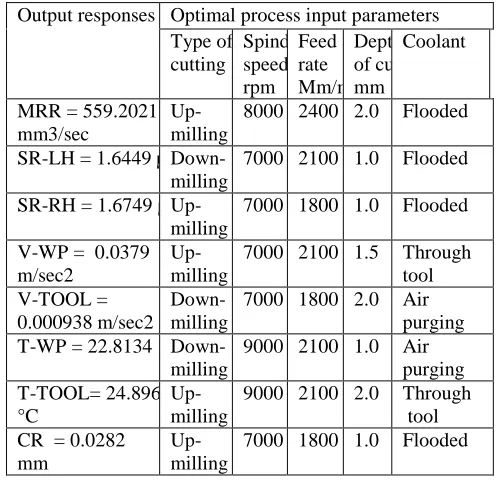
The mathematical model equations for MRR, SR-LH, SR-RH, V-WP, V-TOOL, T-WP, T-Tool and CR are solved using Jaya algorithm [15] for optimization of process output parameters within the considered input process parameters. Each run of JA gives optimal conditions and the corresponding output response values are produced. In the present experimentation, maximum MRR obtained using JA is 559.2021mm3/sec at up-milling type of cutting, spindle speed: 8000 rpm, feed rate: 2400 mm/min, depth of cut: 2.0 mm and type of coolant is flooded. Likewise results for all responses obtained by JA for different output responses are shown in Table 2.3.
Table 2.3:
Optimum responses obtained by solving the mathematical model equation by Jaya Algorithm.
Output responses Optimal process input parameters Type of
cutting
Spindle speed rpm
Feed rate Mm/min
Depth of cut mm
Coolant
MRR = 559.2021 mm3/sec
Up-milling
8000 2400 2.0 Flooded
SR-LH = 1.6449 µm Down-milling
7000 2100 1.0 Flooded
SR-RH = 1.6749 µm Up-milling
7000 1800 1.0 Flooded
V-WP = 0.0379 m/sec2
Up-milling
7000 2100 1.5 Through tool V-TOOL =
0.000938 m/sec2 Down-milling
7000 1800 2.0 Air purging T-WP = 22.8134 °C
Down-milling
9000 2100 1.0 Air purging T-TOOL= 24.8968
°C
Up-milling
9000 2100 2.0 Through tool CR = 0.0282
mm
Up-milling
7000 1800 1.0 Flooded
VI. CONCLUSION
[image:5.612.319.567.172.415.2]International Journal of Emerging Technology and Advanced Engineering
Website: www.ijetae.com (ISSN 2250-2459, ISO 9001:2008 Certified Journal, Volume 7, Issue 8, August 2017)
337
The process output parameters considered are: material removal rate, surface roughness (LH), surface roughness (RH), vibrations (WP), vibrations (Tool), Temperature (WP), temperature (Tool) and corner radius. The AHP method is used to select the optimum set of input process parameters using both equal and unequal weights of importance of the input process parameters and the process planner may make use of these results. Furthermore, the mathematical models are developed for prediction of all responses (i.e. process output parameters) which are expressed as functions of input process parameters. The mathematical models are found to be satisfactory showing maximum average percentage error as 4.85. Furthermore the mathematical models are solved by Jaya Algorithm, which is simple and easy to apply in practical optimization domain. Results obtained by RSM and JA are very close, MRR by RSM it is 559.202 mm3/sec whereas using JA it is 559.2021 mm3/sec, similarly SR-LH by RSM is 1.64489796 µm whereas with JA it is 1.6449 µm.REFERENCES
[1] Han L, Thornton M, Shergold M. A comparison of the mechanical
behaviour of self- piercing rivets and resistance spot welded aluminium sheets for the automotive industry. Materials and Design 2010; 31: 1457-1467.
[2] Lakshminarayanan A, Balasubramanian V, Elangovan K. Effect of
welding processes on tensile properties of AA6061 aluminium alloy joints. International Journal of Advanced Manufacturing Technology 2009; 40: 286 – 296.
[3] Shankar MR, Chandrasekar S, Compton W, King AH.
Characteristics of aluminium 6061-T6 deformed to large plastic strains by machining. Material Science Engineering-A 2005; 410-411, 364 – 368.
[4] Xu DC, Feng PF, Li WB, Ma Y, Lu B, (2014). Research on chip
formation parameters of aluminium alloy 6061-T6 based on high speed orthogonal cutting model. International Journal of Advanced Manufacturing Technology, 75 (5 -2); 955 – 962.
[5] Kamguem R, Djebara A, Songmene V, (2013). Investigation on
surface finish and metallic particle emission during machining of aluminium alloy machining of aluminium alloys using response surface methodology and desirability functions. International Journal of Advanced Manufacturing Technology 69(5-8); 1283 – 1298.
[6] Ming EO, Sayui M, Sarhan AAD. Fuzzy logic based approach to
investigate novel uses of nano suspended lubrication in precise machining of aerospace AL tempered grade 6061. International Journal of Cleaner Production 2015; 89: 286-295.
[7] Wang SJ, Chen X, To S, Ouyang XB, Liu Q, Liu JW, Lee WB,
(2015). Effect of cutting parameters on heat generation in ultra-precision milling of aluminium Al6061. International Journal of Advanced Manufacturing Technology 80:1265 – 1275.
[8] Nityanamdam and Radhakrishnan (2014). A six sigma approach for
precision in milling. Procedia Engineering 97, 1474 – 1488.
[9] Rahemati B, Sarhan AAD, Sayuti A, (2013). Investigating the
optimum molybdenum disulfide (MoS2) nanolubrication parameters in CNC milling of Al6061-T6 alloy. International Journal of Advanced Manufacturing Technology. 70 (5 - 8); 1143 – 1155. [10] He S, (1982). Solid lubrication materials for high temperature: a
review. Tribology International, 15: 303 – 314.
[11] Raju KVMK, Janardhana GR, Kumar PN, Rao VD, (2011).
Optimization of cutting conditions for surface roughness in CNC end milling. International Journal of Precision Engineering and Manufacturing 12(3):383 – 391.
[12] Yazdi MS and Chavoshi SZ (2010). Analysis and estimation of state
variables in CNC face milling of Al6061. Production Engineering Research Development 4:535 – 543.
[13] Sreejith PS, (2008). Machining of 6061 aluminium alloy with MQL,
dry and flooded lubricant conditions. Materials Letter, 62(2):276 – 278.
[14] Saaty TL and Millet I. On the relativity of relative measures – accommodating both rank preservation and rank reversals in AHP. European Journal of Operational Research 2000; 121(1): 205 – 212.
[15] Rao RV (2016) Jaya: A simple and new optimization algorithm for