International Journal of Emerging Technology and Advanced Engineering
Website: www.ijetae.com (ISSN 2250-2459, ISO 9001:2008 Certified Journal, Volume 7, Issue 10, October 2017)
434
Analysis of Factors Affecting Contractor Bid- Decision Making
in South Indian Construction Projetcs
M. Naresh Kumar
1, S. M. Renuka
2, C. Umarani
31PG Student, Construction Engineering And Management, College of Engineering, Guindy, Anna University Chennai, India 2Assistant Professor, 3Professor, Division Of Structural Engineering, College of Engineering, Guindy, Anna University
Chennai, India Abstract— The construction environment is changeable
and full of uncertainties. A successful project means that the project has accomplished its technical performance, maintained its schedule, and remained within budgetary costs. In construction industry, contractors want to maximize their profit in order to grow in the market. To achieve this aim, it is crucial for contractors to carefully identify the factors that affect the success of project and estimate their impacts before the bidding stage. Formal decision analysis techniques, such as the one based on utility theory, must be employed to model a decision maker's value system. Based on the concept of fuzzy sets for describing linguistic variables, fuzzy logic has found many applications in areas of control and decision .The basic idea is that artificial logic systems can be developed to emulate the linguistic way humans think judge, yet achieve consistency by following accountable rules. In this context, the fuzzy logic approach, like other quantitative methods, is intended to streamline the decision analysis process and produce an evaluation according to the decision maker's value system and judgments, while maintaining simplicity and tractability. As an alternative to those traditional techniques, this paper presents a fuzzy-logic-based, risk-incorporating approach to evaluating the factors influencing the contractors bid decision, intended to produce valuable inferences and implementation decisions for their upcoming projects. 17 different factors under time and cost were identified from literatures and using the factors a questionnaire survey was conducted to collect data regarding the impact level of those factors on projects. The questionnaire was distributed in personal and sent through email to different personnel relating to the construction industry. Data from the survey was analysed using SPSS and the statistical output was used to set membership function in the Fuzzy Inference System for preparing a decision support model using fuzzy logic.
Keywords—Bid-decision, fuzzy logic, Fuzzy inference system, risk value.
I. INTRODUCTION
A successful project means that the project has accomplished its technical performance, maintained its schedule, and remained within budgetary costs. Projects may differ in size, duration, objectives, uncertainty, complexity, pace, and some other dimensions.
It does not matter how different or unique a project is; there is no doubt that every project contains some degree of uncertainty. It is required to be aware of these uncertainties and to develop necessary responses to get the desired level of the project success. Schedule delays are common in various construction projects and cause considerable losses to project parties. It is widely accepted that construction project schedule plays a key role in project management due to its influence on project success.
The decision is made not only on the probability of winning the tender, but also on the need to consider the possibility that the company can finish the project successfully following the contract agreement. The contractors’ bid or not bid decision is affected by various factors. The decision is highly related to the specific project and macro environment. It is hard to make the decision in a limited time by the management team. The decision is based upon the experience, intuition and guesses. This research is concerned with the investigation of the contract bidding scenario and the application of a computer based information support system to the real world problems of contract bidding strategic decisions. Fuzzy logic has been expanded to new application areas such as construction engineering and management. Fuzzy logic methodologies are able to model subjective information, handle uncertainty and address the lack of comprehensive data sets available for modelling in construction engineering and management.
International Journal of Emerging Technology and Advanced Engineering
Website: www.ijetae.com (ISSN 2250-2459, ISO 9001:2008 Certified Journal, Volume 7, Issue 10, October 2017)
435
A systematic model helps the contractor to achieve his business objectives, increase productivity and improve the quality of decision making. The main objectives of this paper are to prepare an information system for contractor bid decision making and to study the impact of factors such as time and cost and its influence on contractor bid decision making.II. LITERATURE SURVEY
Koehn, E. (1984) studied on the utilization of fuzzy sets to the complex problems of building or facility satisfaction and productivity on a construction site. The researcher aimed to provide a basic framework for the utilization of the theory in construction risk evaluation. Kangari and Riggs (1989) described a system to test the concept of construction risk assessment using linguistic variables. A limited number of risks were covered to allow for greater detail in the assessment, and the problems and benefits of linguistic variables were discussed. Chun and Ahn (1992) proposed the use of fuzzy set theory to quantify the imprecision and judgmental uncertainties of accident progression event trees. Peak et al. (1993) proposed the use of fuzzy sets for the assessment of bidding prices for construction projects. They analysed risks which could result in a loss of money in construction contracts, and suggested a risk pricing method emphasizing the uncertainty, represented by fuzzy sets, associated with construction projects. Tah et al. (1993) presented a linguistic approach to risk management using fuzzy sets. The work was designed for risk assessment during the tender stage for contingency allocation, and utilized linguistic descriptions of risk probability and severity for assessment and analysis. Mansfield, N. R. et al. (1994) studied the causes of schedule delay and cost overrun in construction projects in Nigeria. They identified sixteen (16) major factors. According to their findings the most important factors were financing and payment for completed works, poor contract management, changes in site conditions, shortage of materials, and improper planning. Leu, S. S. et al. (2001) developed a new optimal construction time-cost trade-off method by using fuzzy set theory in order to provide an insight into the optimal balance of time and cost under different risk levels. Lowe and Parvar (2004) agreed that a systematic model would be able to helps the contractor to achieve the business objectives, increase productivity and improve the quality of the decision making. Dikmen, et al. (2007) proposed a fuzzy risk rating method, which rates the risk involved in cost overruns in international construction projects.
The model introduces “Controllability” or
“Manageability” concepts into the contractor’s decision making which determines if the contractor enters into the international market. It allows for the assessing of the contractor’s decision using four categories, i.e., internationalization, market selection, project selection, and mark-up selection. The system identifies risks, models the risks using influence diagrams, selects the membership function of each variable, captures the experts’ opinions using aggregation rules, aggregates fuzzy rules into a fuzzy cost overrun risk rating, carries out fuzzy operations, and determines the risk level of an international project by quantifying the final risk rating.
Scope of this project is to analyse the major factors under cost and time that affect the contractor bid decision making process and preparing an information system or support system for Contractors involved in South Indian Construction projects using Fuzzy Logic and also study the impact of factors on contractor bid decision making. Previously research has been done in optimizing the contractor bid decision making process and the application of fuzzy logic in construction risks. By integrating both the aspects a powerful tool for supporting decisions considering all aspects of risks can be developed. In addition to this, in a location like South India where major projects are being carried out a support system for making bid/no bid decisions is the need of the hour.
III. RESEARCH METHODOLOGY
To prepare the information model a need for data to set the benchmark for impact level is necessary. It is to be accomplished by conducting survey through questionnaire and analyzing data from it. From this the decision support system using fuzzy inference system can be created. The methodology followed is as follows
1.Identifying and selecting factors affecting contractor bid
decision
2.Categorizing factors under cost and time
3.Preparing questionnaire and collecting data through
phone, email and personal visits
4.Taking the time and cost dimension and available data
into consideration for data analysis using SPSS statistics software
5.Providing the data analyzed from statistical software to
make a gradual phase decision before receiving the bid documents
6.Developing an open process model and decision support
International Journal of Emerging Technology and Advanced Engineering
Website: www.ijetae.com (ISSN 2250-2459, ISO 9001:2008 Certified Journal, Volume 7, Issue 10, October 2017)
436
7. Studying the impact of factors under time and cost in the
bid/no-bid decision. The questionnaire is hosted in web as a survey and the link is being sent to the potential respondents via e-mail.
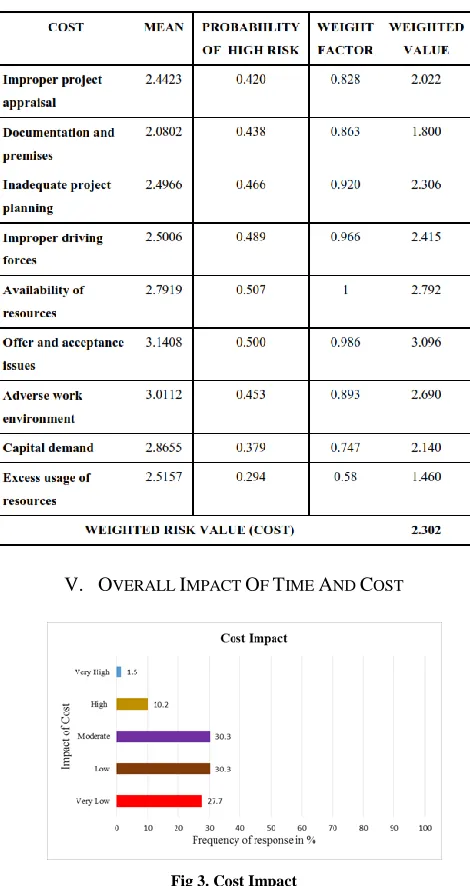
Questionnaire is also given in person to the potential respondents whose data would be more relevant for the study. The hardcopies of the questionnaire is also prepared and it will be used for collecting the data from the professionals and contractors. After collecting data from the survey, the collected data was entered into Microsoft Excel and imported into the SPSS statistics software. Descriptive Statistics was performed with the data and its mean and standard deviation was found. The mean value of each factor is considered for setting the impact level of factor on the bid/no-bid decision. In addition to this, the probability of high risk is found from the frequency table in SPSS output by dividing the frequency of occurrence of high risk with the total number of samples. Now the maximum probability is given weightage of 1 and the corresponding weight factor for different probability of factors is found using Direct Variation technique. By multiplying the mean value of factor with the weightage value the Risk Value of each factor under time and cost can be determined.
The weighted risk value of time and cost is calculated by finding the average of risk values under time and cost. This weighted risk value is used as the benchmark for defining the fuzzy membership functions in the fuzzy inference system. The input values below the weighted risk value is said to denote “low impact” and that above the weighted risk value denotes “high impact”.
The frequency of each impact level for the different factors under time and cost can be interpreted from the frequency table in SPSS. It can be used as a major criterion for prioritizing the factors under time and cost according to their impact level. By referring the frequency table in SPSS the frequency of occurrence of impact can be obtained. From this the probability of risk can be calculated.
The maximum probability is considered to have a weight factor of 1 and the weight values for the other factors are found by using direct variation. By multiplying the weight factor with the corresponding mean value the Risk Value can be determined. The average of the risk value of factors under time and cost gives us the risk value to be used as input for fuzzy inference system.
[image:3.612.352.540.148.392.2]IV. ANALYSIS AND RESULTS
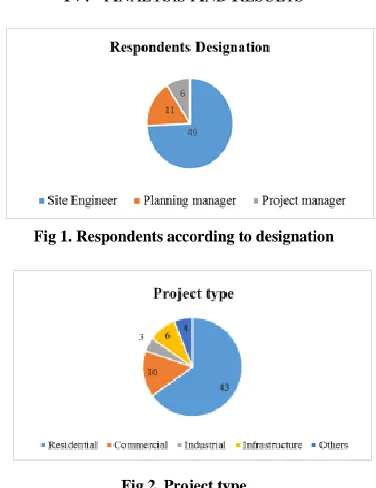
Fig 1. Respondents according to designation
Fig 2. Project type
66 number of samples were collected from the questionnaire survey. Fig 1 shows that majority of the respondents were Site Engineers followed by planning managers and project managers. Fig 2 shows that the majority comprised of residential type projects followed by Commercial, Infrastructure and Industrial projects. 43% of the respondents have agreed that cost has a high impact on their projects. On the other hand, 37.7% of the respondents have agreed that time has a high impact on their projects.
The mind-set is such that the lower levels of management feel that the impact of time is high and the higher levels of management feel that time has moderate impact on their projects. It is observed that bad work environment (2.8251) is the factor having major impact on time. Managerial skills (1.600) have the least impact on project duration.
International Journal of Emerging Technology and Advanced Engineering
Website: www.ijetae.com (ISSN 2250-2459, ISO 9001:2008 Certified Journal, Volume 7, Issue 10, October 2017)
437
Residential sector have been facing a lot of difficulties with respect to cost due to ineffective planning and inexperience of the contractors. There is so much ease in getting a contract through tender for these types of projects because of lack of knowledge of clients and improper research before awarding the contract which causes many of the builders to mis perform. On the other hand the usage of resources (1.460 risk value) seems to have the least impact which clearly indicates that the contractors nowadays have been more cost-oriented people. [image:4.612.327.562.135.578.2]The risk map shows that the scenario of a high impact of cost and low impact of time is common in South Indian construction projects. The least possible scenario is very high cost impact and very low time impact. By adjusting the scales of input across time and cost variables, different output values of bidding probability can be obtained. At any point on the three-dimensional graph of the surface viewer, the impact level of cost and time and the corresponding probability of bid decision can be obtained. Table 1 shows the descriptive statistics of the data collected
Table 1 Descriptive Statistics
V. OVERALL IMPACT OF TIME AND COST
Fig 3. Cost Impact
[image:4.612.50.284.398.617.2]International Journal of Emerging Technology and Advanced Engineering
Website: www.ijetae.com (ISSN 2250-2459, ISO 9001:2008 Certified Journal, Volume 7, Issue 10, October 2017)
[image:5.612.64.281.142.273.2]438
Fig 4. Time Impact
[image:5.612.331.560.322.448.2]Fig 4 shows that 62.3% of the respondents have said that there is low impact of time on their projects. The remaining 37.7% respondents have said that time has an average or high impact on their project.
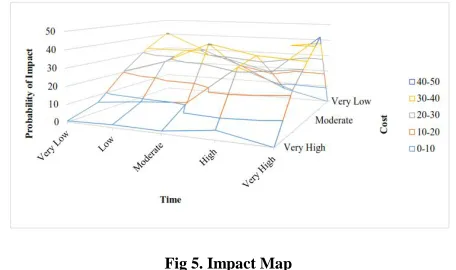
Fig 5. Impact Map
Fig 5 shows the impact map of time and cost in South Indian Projects. In this graph, impact level of time is plotted along the X-axis, impact level of cost is plotted along the Y-axis and the probability of impact along the Z-axis according to the data collected from the survey. It provides a visual representation of how the probability of impact varies according to the level of impact of time and cost.
At any point on the graph, the probability of impact for different level of impact can be obtained. The scenario of a very high impact of cost and low time impact is found to be common in most South Indian construction projects according to the survey. Very high impact of cost and very low impact of time is the least possible scenario in South Indian construction projects.
VI. FUZZY LOGIC
Fuzzy logic is a set of mathematical principles for knowledge representation based on degrees of membership. It deals with degrees of membership and degrees of truth. It reflects how people think and attempts to model our sense of words, our decision making and our common sense.
The basic structure of a fuzzy inference system consists of three conceptual components:
a rule base, which contains a selection of fuzzy rules;
a database which defines the membership function
used in the fuzzy rules
A reasoning mechanism which performs the inference procedure upon the rules and given facts to derive a reasonable output or conclusion
Fig 6. Fuzzy Inference System (FIS)
Fig 6 shows the process in fuzzy inference system. The FIS can be envisioned as involving a knowledge base and a processing stage. The knowledge base provides MFs and fuzzy rules needed for the process. In the processing stage, numerical crisp variables are the input of the system.
[image:5.612.54.282.329.464.2]International Journal of Emerging Technology and Advanced Engineering
Website: www.ijetae.com (ISSN 2250-2459, ISO 9001:2008 Certified Journal, Volume 7, Issue 10, October 2017)
[image:6.612.337.556.140.342.2]439
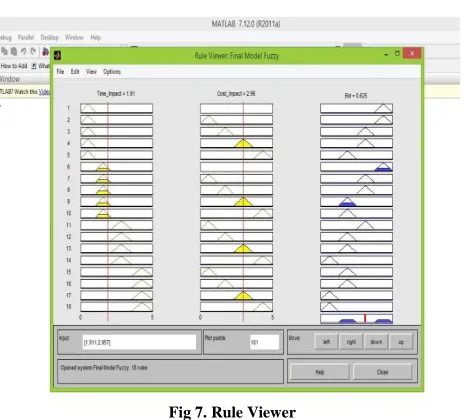
VII. FUZZY LOGIC OUTPUTFig 7. Rule Viewer
Fig 7 shows the rule viewer in FIS editor of MatLAB. It has three columns of variables. The yellow colour denotes input variable and the blue colour denotes the output variable. Time and cost are the input variables which can be adjusted and Bid decision is the output variables which cannot be adjusted.
The value of input ranges from 0 to 5 denoting impact level from nil to high. The value of output ranges from 0 to 1 denoting the probability of bid decision. By adjusting the scale across different input values, their corresponding output values can be obtained. For example, if the impact of time is low and the impact of cost is low, then the bid decision probability will be high and vice versa.
Therefore different combinations of variables, functions and their set of rules form the major framework of this decision support system. This can also be used as an information system to store and retrieve the data the output for future projects and study the variation across the timeline.
Fig 8. Surface Viewer
In Fig 8, surface viewer shows the variation of bid/no-bid decision with respect to time and cost in three dimensions. Therefore at any point on the three dimensional graph, the corresponding impact level of cost and time and the probability of bid decision can be obtained. This can be useful in solving problems during the contractual decision making process. It provides a visual representation of the decision model and helps to interpret the variation without giving any inputs to the system.
VIII. CONCLUSION
[image:6.612.52.286.156.366.2]International Journal of Emerging Technology and Advanced Engineering
Website: www.ijetae.com (ISSN 2250-2459, ISO 9001:2008 Certified Journal, Volume 7, Issue 10, October 2017)
440
This research aimed to propose a decision support tool for contractors before the bidding stage to quantify the probability of impact of time and cost on construction projects by using fuzzy logic. In this research, Fuzzy Theory was proposed as an effective probability analysis technique in construction projects, since; fuzzy theory is based upon uncertainties where there is an inherent impreciseness and it provides mathematical tools to deal with imprecise, uncertain, and vague data. In this research the simple form of Mamdani’s-style fuzzy rules was implemented taking into account of the advantages of the Mamdani’s approach (being most popular in the literature, being intuitive, having widespread acceptance, and well suiting to human input).In this research, the probability assessment model was developed by using Fuzzy Logic Toolbox of the MATLAB Program Software which can be easily utilized by the decision maker by entering the impact value of factors under time and cost (input). By considering the probability outputs, decision maker may determine a reasonable time contingency for the construction project before the bidding stage.
The scenario of a very high impact of cost and low time impact is found to be common in most South Indian construction projects according to the survey. Very high impact of cost and very low impact of time is the least possible scenario in South Indian construction projects .As a final conclusion, decision makers may test the tool proposed by the author in their different projects and determine whether it produces reasonable results and revise the model parameters if necessary.
At the end of the project, a decision support system for contractor bid-decision making was created and it will be suitable and relevant for use in South India. It will purely be based on the data collected through the questionnaire survey. It can be used as an information model for contractors for future use and bid/no-bid decision making. It will serve to be a powerful tool for business improvement and also improvise the quality of decision making for contractors during the bidding process.
Recommendations For Future Work:
Fuzzy logic toolbox available under MatLAB does not allow fuzzy inference computing with logarithmic scales. In future this work has to be extended for soft implementation to include the mathematical interpretations of logarithmic scales. This research involves very limited participants and therefore a greater sample size with trusted data is necessary. Involve large sized contractors, to observe the entire construction contractors‟ opinion on the bid/ no bid decision making process in South India.
REFERENCES
[1] Chun, M. and Ahn, K. (1992) Assessment of the potential application of fuzzy set theory to accident progression event trees with phenomenological uncertainties. Reliability Engineering and System Safety, 37(3): 237–52.
[2] Dikmen, I., Birgönül M.T., Han, S. (2007) Using fuzzy risk assessment to rate cost overrun risk in international construction projects. International Journal of Project Management. 25:494- 505. [3] Kangari, R. and Riggs, L. S. (1989) Construction risk assessment by
linguistics. IEEE Transactions on Engineering Management, 36(2): 126–131.
[4] Koehn, E. (1984) Fuzzy sets in construction engineering in Proc. CZB W-65. Waterloo,Ont., Canada.
[5] Leu, S. S., Chen, A. T. and Yang, C.H. (2001) A Gabased fuzzy optimal model for construction time-cost trade off. International Journal of Project Management, 19(1): 47-58.
[6] Lowe, D. and Parvar, J. (2004), A logistic regression approach to modelling the contractor’s decision to bid, Construction Management & Economics,22, 643-653.
[7] Mansfield, N.R., Ugwu, O.O. and Doran, T. (1994) Causes of delay and cost overruns in Nigerian construction projects. International Journal of Project Management, 12(4): 254-60.
[8] Peak, J.H., Lee, Y.W., and Ock, J.H. (1993) Pricing construction risk – fuzzy set application. ASCE Journal of Construction Engineering and Management, 119(4): 743–56. [9] Tah, J. H. M., and Carr, V. (2000). “A proposal for construction