http://dx.doi.org/10.4236/am.2015.63045
A Special Case on the Stability and Accuracy
for the 1D Heat Equation Using 3-Level and
θ
-Schemes
Pedro Pablo Cárdenas Alzate
1, José Gerardo Cardona
1, Luz María Rojas
2 1Department of Mathematics, Universidad Tecnológica de Pereira, Pereira, Colombia 2Fundación Universitaria del Area Andina, Pereira, ColombiaEmail: [email protected], [email protected], [email protected] Received 15 February 2015; accepted 5 March 2015; published 10 March 2015 Copyright © 2015 by authors and Scientific Research Publishing Inc.
This work is licensed under the Creative Commons Attribution International License (CC BY).
http://creativecommons.org/licenses/by/4.0/
Abstract
We establish the conditions for the compute of the stability restriction and local accuracy on the time step and we prove the consistency and local truncation error by using
θ
-scheme and 3-level scheme for Heat Equation with smooth initial conditions and for some parameter θ ∈[ ]
0,1 .Keywords
Global Truncation, Local Accuracy, Stability Restriction
1. Introduction
In this paper we have considered the heat equation ut =uxx with θ ∈
[ ]
0,1 . Usingθ
-scheme and 3-levelscheme in space we compute the order of local accuracy in space and time and stability restriction as a function
of
θ
on the time step ∆t. Much attention has been paid to the development, analysis and implementation ofaccurate methods for the numerical solution of this problem in the literature. Many problems are modeled by smooth initial conditions and Dirichlet boundary conditions. A number of procedures have been suggested (see,
for instance [1]-[3]). We can say that three classes of solution techniques have emerged for solution of PDE: the
finite difference techniques, the finite element methods and the spectral techniques (see [4] and [5]). The last
one has the advantage of high accuracy attained by the resulting discretization for a given number of nodes [6]-
[8].
We consider Scheme (1) for the 1D heat equation for some parameter θ ∈
[ ]
0,1 . We compute the order ofsolution with some fixed L∞ error with the smallest amount of CPU time, and finally we can see this findings producing the relevant convergence and efficiency plot. For the 3-level scheme we consider (11) for the 1D heat
equation and we compute the local truncation error. For different values of
δ
andβ
we find the stabilitycriterion of the scheme and its accuracy.
2.
θ
-Scheme
Let
(
)
1 1 1 1
1 1 1 1
2 2
2 2
1
n n n n n n n n j j j j j j j j
u u u u u u u u
t θ x θ x
+ + + +
+ − + −
− − + − +
= + −
∆ ∆ ∆ (1)
be the
θ
-scheme applied to the one-dimensional heat equation0
t xx
u −u = (2)
Now for the order of local accuracy in space and time as a function of
θ
we write the local truncation error.In time we have
1 1
n n
j
u U
τ= + − +
where Un+1 represents the exact solution of the heat equation. Now we perform Taylor expansion of n1
j
u + at tn.
( )
2( )
3( )
( )
1 4
2 6
n n n n n
j j j t j tt j ttt
t t
u + =u + ∆t u +∆ u +∆ u + ∆t
We can write the LHS of (1) as
( )
( )
( )
( )
1 3
2 4
1 1
2 6
n n
j j n n n n n
j j t j tt j ttt j
u u t
u t u t u u t u
t t
+ −
∆
= + ∆ + ∆ + + ∆ −
∆ ∆ (3)
( )
( )
2( )
( )
3 1
2 6
n n n
j t j tt j ttt
t
u t u ∆ u t
= + ∆ + + ∆ (4)
here
( )
nj tu represents the derivative with respect to time, of uj
( )
n . On the RHS, we have a centereddiffer-ence approximating second derivative of uj
( )
n( )
(
2)
( )
( )(
2)
( )
( )( )
1 1 6
2
2
4! 2 6! 2
n n n
j j j n n n
j xx j x iv j x vi
u u u x x
u u u x
x
+ − + − = + ∆ + ∆ + ∆
∆ (5)
As we are solving the heat equation, the previous expression is
( )
(
2)
( )
(
4)
( )
( )
6
4! 2 6! 2
n n n
j j j
t tt ttt
x x
u ∆ u ∆ u x
= + + + ∆ (6)
Now, at time n+1 we have
( )
(
)
( )
( )(
)
( )
( )( )
1 1 1 2 4
1 1 1 1 1 6
2
2
4! 2 6! 2
n n n
j j j n n n
j xx j x iv j x vi
u u u x x
u u u x
x + + +
+ − + − = + + ∆ + + ∆ + + ∆
∆ (7)
( )
(
2)
( )
(
4)
( )
( )
1 1 1 6
4! 2 6! 2
n n n
j j j
t tt ttt
x x
u + ∆ u + ∆ u + x
= + + + ∆ (8)
therefore, applying Taylor expansion with respect to ∆t we can write
( ) ( )
( )
2( )
3( )
( )( )
1 4
2 6
n n n n n
j t j t j tt j ttt j t iv
t t
u + = u + ∆t u +∆ u +∆ u + ∆x
( ) ( )
( )
2( )
( ) 3( )
( )( )
1 4
2 6
n n n n n
j j j j j
tt tt ttt t iv t v
t t
( ) ( )
( )
( ) 2( )
( ) 3( )
( )( )
1 4
2 6
n n n n n
j j j j j
ttt ttt t iv t v t vi
t t
u + = u + ∆t u +∆ u +∆ u + ∆x
So (8) becomes
( )
(
)
( )
(
)
( )
( )
( )
( )
( )
( )
( )( )
(
)
( )
( )
( )
( )( )
( )( )
(
)
( )
( )
( )( )
( )( )
( )( )
2 4
1 1 1 6
2 3
4
2 2 3
4
2 2 3
4
4! 2 6! 2
2 6
4! 2 2 6
6! 2 2 6
n n n
j t j tt j ttt
n n n n
j t j tt j ttt j t iv
n n n n
j tt j ttt j t iv j t v
n n n n
j j j j
ttt t iv t v t vi
x x
u u u x
t t
u t u u u x
x t t
u t u u u x
x t t
u t u u u x
+ + ∆ + + ∆ + + ∆ ∆ ∆ = + ∆ + + + ∆ ∆ ∆ ∆ + + ∆ + + + ∆ ∆ ∆ ∆ + + ∆ + + + ∆
+
( )
∆x4 ,
(9)
Here RHS of (1) becomes
(
)
(
)
( )
(
)
( )
(
)
( )
( )
( )
( )
( )
( )
( )( )
(
)
( )
( )
( )
( )( )
( )1 1 1
1 1 1 1
2 2
2 4
1 6
2 3
4
2 2 3
2 2
1
1
4! 2 6! 2
2 6
4! 2 2 6
n n n n n n
j j j j j j
n n n
j j j
t tt ttt
n n n n
j t j tt j ttt j t iv
n n n n
j tt j ttt j t iv j t v
u u u u u u
x x
x x
u u u x
t t
u t u u u x
x t t
u t u u u
θ θ θ θ + + + + − + − + − + − + + − ∆ ∆ ∆ ∆ = − + + + ∆ ∆ ∆ + + ∆ + + + ∆ ∆ ∆ ∆ + + ∆ + +
( )
(
)
( )
( )
( )( )
( )( )
( )( )
( )
44 2 3
4 4
,
6! 2 2 6
n n n n
j j j j
ttt t iv t v t vi
x
x t t
u t u u u x x
+ ∆ ∆ ∆ ∆ + + ∆ + + + ∆ + ∆
After the elimination of some terms we have
( )
(
)
( )
(
)
( )
( )
( )
( )
( )
( )( )
(
)
( )
( )
( )( )
( )( )
(
)
( )
( )( )
( )( )
( )( )
( )
2 4
1 6
2 3 2 2
4 3
4 2
3 4
4! 2 6! 2
2 6 4! 2 2 6
,
6! 2 2 6
n n n
j t j tt j ttt
n n n n n n
j tt j ttt j t iv j ttt j t iv j t v
n n n
j t iv j t v j t vi
x x
u u u x
t t t x t t
t u u u x u u u x
t x t t
u u u x x
θ + ∆ ∆ + + + ∆ ∆ ∆ ∆ ∆ ∆ ∆ + ∆ + + + ∆ + + + + ∆ ∆ ∆ ∆ ∆ + + + + ∆ + ∆
Now simplifying we obtain
( )
( )
( )
( )
( )
(
)
( )
(
)
( )
( )
( )
( )
( )
( )( )
(
)
( )
( )
( )( )
( )( )
(
)
( )
( )( )
( )( )
( ) 2 3 2 4 1 62 3 2 2
4 3
4 2
2 6
4! 2 6! 2
2 6 4! 2 2 6
6! 2 2 6
n n n
j t j tt j ttt
n n n
j j j
t tt ttt
n n n n n n
j j j j j j
tt ttt t iv ttt t iv t vi
n n n
j j j
t iv t v t vi
t t
u u u x
x x
u u u x
t t t x t t
t u u u x u u u x
x t t
u u u
θ + ∆ ∆ + + + ∆ ∆ ∆ = + + + ∆ ∆ ∆ ∆ ∆ ∆ ∆ + ∆ + + + ∆ + + + + ∆ ∆ ∆ ∆ + + + +
( )
3( )
4 ,x x
∆ + ∆
Cancelling
( )
njt
u and moving all terms to the right side, we get
( )
2( )
(
4)
2 2 2( ) ( )
2 4
0
2 6 6! 2 2 6 6! 2
n n
j tt j ttt
t x x t t t x
u ∆
θ
t ∆ u ∆θ
∆ ∆θ
∆ ∆ x x= − + ∆ + + + − + + ∆ + ∆
(10)
Scheme (10) is first order in time, second order in space. If for example θ =1 2, it becomes second order,
this is due to cancellation of the ∆
τ
.Stability Restriction as a Function of
θ
Here we will apply Von Neumann stability. Let
(
,)
eikxn
u x t = and
( )
1
n j n j
u G k
u +
= . Then Equation (1) can be
written as
(
)
(
(
1 1 1) (
)
)
1 11 1 1 1
2 2
1 2
2 2
n n n n
j n n n n n n j j j j j j j j j
u G u u u
u u u u u u
t x x
θ + + + + −
+ − + −
− − +
= − + − − + +
∆ ∆ ∆
Now dividing by n
j
u we have
(
)
1 1(
(
1 1 1) (
)
)
1 1 1 1
2 2
2 1
2 2
n n n
j j j n n n n n n
j j j j j j
n n
j j
u u u
G
u u u u u u
t u x u x
θ
+ − + + +
+ − + −
− +
−
= + − + − − +
∆ ∆ ∆
(
) (
)
(
)
1 1 1 1 1
1 1 1 1
2 2
2
2 2 1
n n n
j j j n n n n n n
j j j j j j
n n
j j
u u u t
G t u u u u u u
u x u x
θ
+ − + + +
+ − + −
− + ∆
= ∆ + − + − − + +
∆ ∆
Therefore by using unj 1 eikx ik x
± ∆
± = and 2
t r
x
∆ =
∆ we can rewrite the expression as
(
)
(
(
1) (
) (
1)
)
1 1 1 1 1
eik x 2 e ik x n nj nj 2 nj nj nj nj 1
j
G r u u u u u u
u
θ
∆ − ∆ + +
+ + + − −
= − + + − − − + − +
( )
(
(
(
eik x 2 e ik x)
(
1)
)
(
eik x 2 e ik x)
)
1G k =r ∆ − + − ∆ +θ G− ∆ − + − ∆ +
( ) (
1)
(
eik x 2 e ik x)
1(
eik x 2 e ik x)
G k =r −θ ∆ − + − ∆ + +r Gθ ∆ − + − ∆
( )
(
1(
eik x 2 e ik x)
)
(
1)
(
eik x 2 e ik x)
1G k −r
θ
∆ − + − ∆ =r −θ
∆ − + − ∆ +( )
(
1)
(
(
e 2 e)
)
1 1(
e(
2 e)
)
1 e 2 e 1 e 2 e
ik x ik x ik x ik x
ik x ik x ik x ik x
r r
G k
r r
θ
θ θ
∆ − ∆ ∆ − ∆
∆ − ∆ ∆ − ∆
− − + + − +
= = +
− − + − − +
By using the identity cos e e
2
ix ix
x
−
−
= we have
( )
1 2 1 cos(
(
(
(
)
)
)
)
1 2 1 cos
r k x
G k
r
θ
k x− − ∆
= +
+ − ∆
We can say this scheme is stable only for G k
( )
≤1. Now, let 2 1 cosr(
−(
k x∆)
)
=c. The inequality is( )
1 1 1c G k
cθ
= − ≤
+
thus
1
1, , 0 1
c c
c c
θ θ
θ
+ − ≤ >
Now multiplying by the denominator we have
1+cθ− ≤ +c 1 cθ
(
)
[ ]
1+c θ−1 ≤ +1 cθ, θ∈ 0,1
The expression in the absolute value becomes
(
)
11 1 1 , 2 , 2
c θ cθ c cθ θ
+ − ≤ + ≤ ≤
Therefore by the Von Neumann stability condition, the scheme is stable if 1
2≥θ.
In this case we can say the following about the best combination for
∆ ∆
t
,
x
andθ
. In order to have bothlocal accuracy and stability, the optimal value of
θ
is 12 and therefore this scheme represents the Crank-Ni-
cholson scheme. Here ∆x and ∆t appear in the form t2
x
∆ =
∆ .
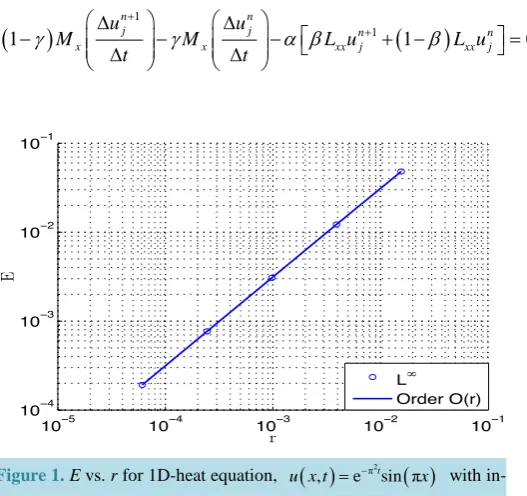
In Figure 1the convergence plot equation (varying the radio r) is
1
1 1
2 2
2 2
,
.
n n
n n
t t
I A Y I A Y
t t
Y I A I A Y
+
− +
∆ ∆
− = +
∆ ∆
= − +
[image:5.595.172.436.460.708.2]with matrix A described in the heat equation. We can say the scheme is unconditionally stable. We can see in
Figure 1 that we have a linear convergence with respect to r.
3. Three-Level Scheme
We start by computing the stability restriction one has to impose on ∆t. We apply Von Neumannstability analysis
to the scheme. Let
(
)
1 1(
)
1 1 0
n n
j j n n
x x xx j xx j
u u
M M L u L u
t t
γ
γ
α β
β
+
+
∆ ∆
− − − + − =
∆ ∆
(11)
where
Figure 1. E vs. r for 1D-heat equation,
( )
, e π2tsin( )
π1 1
1 1 1 1
2 2
, , j j j
n n n n n n n j j j j j j xx j
u u u
u u u u u u L u
x
+ −
+ + + − − +
∆ = − ∆ = − =
∆ (12)
and
(
)
1 1 2 1
x j j j j
M ∆ = ∆u δ u− + − δ ∆ + ∆u δ u+ (13)
By using (12) and (13) we can rewrite (11) as
(
)
(
)
(
)
(
)
1 1 1
1 1 1 1
1 1 1
1 1 1 1
1 1 1
1 1 1 1
2 2
1 1 2
1 2
2 2
1 0,
n n n n n n j j j j j j
n n n n n n j j j j j j
n n n n n n j j j j j j
u u u u u u
t t t
u u u u u u
t t t
u u u u u u
x x
γ δ δ δ
γ δ δ δ
α β β
+ + + − − + + − − − − − + + + + + + − + − − − − − + − + ∆ ∆ ∆ − − − − + − + ∆ ∆ ∆ − + − + − + − = ∆ ∆ (14) or as
(
)
1 1(
)
1 1 0
n n
j n j n
x xx j x xx j
u u
M L u M L u
t t
γ
αβ
γ
α β
+ + ∆ ∆ − − − + − = ∆ ∆
The local truncation error for this scheme
γ
is as follow.1 1
n n
j
u U
γ = + − +
where Un+1 represents the exact solution of the heat equation. Therefore we have
(
)
(
)
1 1 1 1 1 n nj j n n
x x xx j xx j
u u
M M L u L u
t t
γ
α β
β
γ
γ
+ + ∆ ∆ = + + − ∆ − ∆ − (15)
Now expanding Mx operator on the left side, we can isolate the forward difference in time at n
j
u , then
(
)
(
)
1 1 1
1 1 1 1
1 1 1
1 1 1 1
2 2 1 2 1 2 2 1 , 1
n n n n n n n
j j j j j j j
x
n n n n n n
j j j j j j
u u u u u u u
M
t t t t
u u u u u u
x x
γ
δ δ
γ
γ β β
γ + + + − − + + + + + + − + − − − − ∆ − = − + + ∆ ∆ ∆ − ∆ − + − + + + − − ∆ ∆ however,
(
)(
)
(
)(
)
(
(
)
)
1 11 1 1 1
1
1
1 2 1 1 2
1 ,
1 1 2
n n n n n
j j j j j
n n
j j x
n n
xx j xx j
u u u u u
t t
u u t M
t t t
t
L u L u
δ γ
δ γ δ
α β β
γ δ + + − − + + + + − − ∆ ∆ ∆ = ∆ − + + − ∆ ∆ − − ∆ ∆ + + − − −
Expanded this expression becomes
(
)
(
)(
)
(
(
)
(
)
(
) (
)
)
(
)(
)
(
(
)
)
1 1 1
1 1 1 1
1 1 1
1 1 1 1
1 1 2
1 2
1 1 2
1 ,
1 1 2
n n n n n n j j j j j j
n n n n n n
j j j j j j
n n
xx j xx j
u u t u u u u
t
u u u u u u
t
L u L u
δ δ
γ δ δ δ
γ δ
α β β
γ δ + + + − − + + − − − − − + + + = ∆ − − + − − ∆ + − + − − + − − − ∆ + + − − −
(
)
(
)(
)
(
(
)
(
)
(
) (
)
)
(
)(
)
(
(
)
)
1 1 1 1
1 1 1 1
1 1 1
1 1 1 1
1 1
1 2
1 2
1 1 2
1 ,
1 1 2
n n n n n n n
j j j j j j
n n n n n n
j j j j j j
n n n
xx j xx j
u U u t u u u u
t
u u u u u u
t
L u L u U
δ γ
δ
γ δ δ δ
γ δ
α β β
γ δ + + + + − − + + − − − + + + + + + = − = ∆ − − + − − ∆ + − + − − + − − − ∆ + + − − − −
4. Stability Criterion for the Three-Level Scheme and Its Accuracy When
1
12
δ
=
and
1
2
β
= +
γ
By using Equation (14) we have
(
)
11 1 1 11 1 1 11 1 1 111 1 1
1 1 1 1
2 2
1 5 1 1 5 1
1
12 6 12 12 6 12
2 2
1 1
2 2
n n n n n n n n n n n n j j j j j j j j j j j j
n n n n n n j j j j j j
u u u u u u u u u u u u
t t t t t t
u u u u u u
x x
γ γ
α γ γ
+ + + − − − − − + + − − + + + + + + − + − − − − − − − − + + − + + ∆ ∆ ∆ ∆ ∆ ∆ − + − + − + + − ∆ ∆
0,
=
Now applying Von Neumann stability again, the aim is to use
(
1)
( )
1
, e ,
n j ikx n n j u
u x t G k
u
− = = − and
1 1 e
n ikx ik x j
u±− = ± ∆ , therefore
(
)
(
)
(
)
(
1 1 1)
(
)
1 1 1 1
2
1 e 1 1 5 1 e 1 1 5 1
e e e e
12 6 12 12 6 12
1 1
2 2 ,
2 2
ikx ikx
ik x ik x ik x ik x
n n n n n n
j j j j j j
G G G
t t
u u u u u u
x
γ γ
α γ γ
− ∆ ∆ − ∆ ∆ + + + + − + − − − − + + − + + ∆ ∆ = + − + + − − + ∆
Multiplying both sides by
eikx
t
∆
and write r t2
x
∆ =
∆ we obtained
(
)
(
)
(
)
(
)
(
)
(
(
)
)
(
)
(
)
(
)
2
1 1 1 1 1 1
1 1 1 1 1 1 1 1
1 5 1 1 5 1
1 e e 1 e e
12 6 12 12 6 12
1
2 2
12 e
1
e 2 e 1 e 2
2
ik x ik x ik x ik x
n n n n n n n n n n n n
j j j j j j j j j j j j
ikx
ik x ik x ik x
G G G
r
u u u u u u u u u u u u
G G
r G G
γ γ α γ α γ − ∆ ∆ − ∆ ∆ + + + + + + + + − + + + − − ∆ − ∆ ∆ − − + + − − + + = + − + + + + − − − + − + = − + + −
(
− +)
(
)
2e
1 1
e 2 e ,
2 2
ik x
ik x ik x
r G G
α γ γ
− ∆ ∆ − ∆ = − + + − −
Using the cosine identity that 2cosx=eik x∆ +e− ∆ik x we have
(
)
(
)(
)
(
(
)
)
(
)
(
)
(
(
)
)
(
(
)
)
2 cos 5 1 12 1 cos 1
2
1
cos 5 12 1 cos cos 5 0
2
G k x r k x
G k x r k x k x
γ α γ
γ α γ γ
∆ + − + − ∆ + + − ∆ + + − ∆ − + ∆ + =
We have a quadratic equation in G, where 2
1
(
)
(
)(
)
(
(
)
)
(
)
(
)
(
(
)
)
(
(
)
)
1
cos 5 1 12 1 cos
2
1
cos 5 12 1 cos cos 5 0,
2
k x r k x
G k x r k x k x
γ α γ
γ α γ
∆ + − + − ∆ +
+ − ∆ + + − ∆ − + ∆ + ≤
After some cancellations, we can write
(
)
(
(
)
)
(
(
(
)
)
(
(
)
)
(
)
)
0≤cos k x∆ + +5 12
α
r 1 cos− k x∆β
≤Gγ
cos k x∆ + +5 12α
r 1 cos− k x∆ 1−β
Here, if all β γ ∈, 0,1
[ ]
we need(
)
(
)
(
γ
cos k x∆ +5)
>12α
r(
1 cos−(
k x∆)
)
(
1−β
)
(
)
(
)
(
)
(
)
(
)
(
)
cos 5
12 1 cos 1
k x r
k x
γ
α β
∆ + <
− ∆ −
Acknowledgements
We would like to thank the referee for his valuable suggestions that improved the presentation of this paper.
References
[1] Strikwerda, J.C. (1989) Finite Difference Schemes and Partial Differential Equations. Wadsworth & Brooks, Siam, Madison, Wisconsin.
[2] McRea, G.J. and Godin, W.R. (1967) Numerical Solution of Atmospheric Diffusion for Chemically Reacting Flows.
Journal of Computational Physics, 77, 1-42.
[3] Cárdenas Alzate, P.P. (2014) A Survey of the Implementation of Numerical Schemes for Linear Advection Equation.
Advances in Pure Mathematics, 4, 467-479. http://dx.doi.org/10.4236/apm.2014.48052
[4] Cárdenas Alzate, P.P. (2014) A Survey of the Implementation of Numerical Schemes for the Heat Equation Using for- ward Euler in Time. Journal of Applied Mathematics and Physics, 2, 1153-1158.
http://dx.doi.org/10.4236/jamp.2014.213135
[5] Hundsdorfer, W. and Koren, B. (1995) A Positive Finite-Difference Advection Scheme Applied on Locally Refined Grids. Journal of Computational Physics, 117, 35-36. http://dx.doi.org/10.1006/jcph.1995.1042
[6] Canuto, C. and Hussaini, M. (1988) Spectral Methods in Fluids Dynamics. Springer Series in Computational Physics, Springer-Verlag, Berlin. http://dx.doi.org/10.1007/978-3-642-84108-8
[7] Dehghan, M. (2007) The One-Dimensional Heat Equation Subject to a Boundary Integral Specification. Chaos, Soli-tons & Fractals, 32, 661-675. http://dx.doi.org/10.1155/MPE.2005.61
[8] Lu, X., et al. (2005) A New Analytical Method to Solve the Heat Equation for a Multi-Dimensional Composite Slab.