© 2018, IRJET | Impact Factor value: 6.171 | ISO 9001:2008 Certified Journal | Page 2983
Modulation Scheme identification and classification system using
Fuzzy Logic
Riddhi Patel
1, Nirali Shah
21PG student, Gujarat Technological University
2Assistant Professor, SAL Institute of Technology and Engineering research
---***---Abstract - Noise is the unwanted energy that interfereswith the ability of the receiver to detect the wanted signal. It may enter the receiver through the antenna along with the desired signal or it may be generated within the receiver. In radar, sonar and communication applications, ideal signals are usually contaminated with non-Gaussian noise. Signal detection using automatic modulation (SDMC) detects the modulation type of received communication signals. SDMC is a new technology implemented into communication receivers to automatically determine the modulation type of a received signal. SDMC uses some properties of received signal to get the original signal. In present work, we develop SDMC system that maintains a simple structure, which is an important feature for many practical applications. An SDMC is a system that automatically identifies the modulation type of the received signal. It is an intermediate step between signal interception and information recovery. When the modulation scheme of a received signal is identified, an appropriate demodulator can be selected to demodulate the signal and then recover information.
Key Words:Modulation classification, fuzzy logic, QAM, ASK,FSK, QPSK
1. INTRODUCTION
Recognition of the modulation type of an unknown signal provides valuable insight into its structure, origin and properties. Modulation is the process of varying a periodic waveform, i.e. a tone, in order to use that signal to convey a message. Now a day’s technological work is moving towards fast and secure communications. There are lots of communication signals with different modulation types and different frequencies. It is required to identify and monitor these signals for some applications. Some of these applications are for civilian purposes such as signal confirmation, interference identification and spectrum management. The other applications are for military purposes such as electronic warfare (EW), surveillance and threat analysis. In electronic warfare applications, electronic support measures (ESM) system plays an important role as a source of information required to conduct electronic counter measures (ECM), electronic counter-counter measures (ECCM), threat detection, warning, target acquisition and homing. In these type of application, it is necessary to make the signal secure. In a conventional communication system, receiver and Transmitters are synchronized with each other. Thus, the receiver has a priori knowledge of the format of
[image:1.595.314.553.274.315.2]transmitted signal such as modulation index, carrier frequency, modulation type etc. But two parties in communication channel do not want their communications being known by any third party. That is why security is the main goal in communication.
Fig.1 Mathematical model of Receiver system
2. RELATED WORK
Military organizations, governments, non-governmental organizations, industries have an interest in classifying modulation types in noisy environment. From an intelligence perspective, modulation classification is also used in further classifying, analyzing, decoding the message. Much number of attempts have been made since 1960s to classify various modulation types of different propagation channels and various noise. They used number of features of the signals. The following is some of the related papers is based on this topic.
In 1996, authors proposed Characterization of radio communication signals aims at automatic recognition of different characteristics of radio signals in order to detect their modulation type, the central frequency, and the level. Our purpose is to apply techniques used in image processing in order to extract pertinent characteristics. To the single analysis, we add several rules for checking the consistency of hypotheses using fuzzy logic. This allows taking into account ambiguity and uncertainty that may remain after the extraction of individual characteristics. The aim is to improve the process of radio communications characterization.
In 1998, Marchand researched on automatic detection and recognition of QAM and PSK modulation techniques by using statistics of higher order.
© 2018, IRJET | Impact Factor value: 6.171 | ISO 9001:2008 Certified Journal | Page 2984 In 2000, Wen Wei and Jerry M. Mendel presented a fuzzy
logic modulation classifier that works in non-ideal environments in which it is difficult or impossible to use precise probabilistic methods. They first transformed a general pattern classification problem into one of function approximation, so that fuzzy logic systems (FLS’s) can be used to construct a classifier; then, they introduced the concepts of fuzzy modulation type and fuzzy decision and developed a non-singleton fuzzy logic classifier (NSFLC) by using an additive FLS as a core building block. NSFLC uses two-dimensional (2-D) fuzzy sets, whose membership functions are isotropic so that they are well suited for a modulation classifier (MC). They established that NSFLC, although completely based on heuristics, reduced to the maximum-likelihood modulation classifier (ML MC) in ideal conditions. In the application of NSFLC to MC in a mixture of α-stable and Gaussian noises, they demonstrated that NSFLC performs consistently better than the ML MC and it gives the same performance as the ML MC when no impulsive noise is present.
In 2005, Octavia A. Dobre, Ali Abdi, Yeheskel Bar-Ness and Wei Su showed the survey of automatic modulation classification techniques. The automatic recognition of the modulation format of a detected signal, the intermediate step between signal detection and demodulation, is a major task of an intelligent receiver, with various civilian and military applications. Obviously, with no knowledge of the transmitted data and many unknown parameters at the receiver, such as the signal power, carrier frequency and phase offsets, timing information, etc., blind identification of the modulation is a difficult task. This becomes even more challenging in real-world scenarios with multipath fading, frequency-selective and time-varying channels. In this paper they provided a comprehensive survey of different modulation recognition techniques, in a systematic way. The two general classes of automatic modulation identification algorithms are discussed in this paper, which rely on the likelihood function and features of the received signal, respectively.
In 2011, authors proposed a new digital modulation recognition algorithm for classifying baseband signals in the presence of additive white Gaussian noise. Elaborated classification technique uses various statistical moments of the signal amplitude, phase and frequency applied to the fuzzy classifier. Classification results are given and it is found that the technique performs well at low SNR. The benefits of this technique are that it is simple to implement, has generalization property and requires no apriori knowledge of the SNR, carrier phase or baud rate of the signal for classification.
In the paper of 2014, they applied techniques used in image processing in order to extract pertinent characteristics. To the single analysis, we add several rules for checking the consistency of hypotheses using fuzzy logic. This allows taking into account ambiguity and uncertainty that may
remain after the extraction of individual characteristics. The aim is to improve the process of radio communications characterization.
In the paper of 2015, the authors applied Automatic Modulation Classification (AMC) is the technique for classifying the modulation scheme of an intercepted and possibly noisy signal whose modulation scheme is unknown. Automatic modulation classification of the digital modulation type of a signal has been taking much interest in the communication areas. This is due to the advances in reconfigurable signal processing systems, especially for the application of software radio system. Ten Digitally modulated signals are considered. Channel conditions have been modelled by simulating A WGN and multipath Rayleigh fading effect. Seven key features have been used to develop the classifier. Higher order QAM signals such as 16QAM, 64QAM and 256QAM are classified using higher order statistical parameters such as moments and cumulants. Feature based Decision tree and ANN classifier have been developed and their performances are compared under varying channel conditions for SNR as low as - 5dB.An Automatic Modulation Classifier is a system that automatically identifies the modulation type of the received radio signal given that the signal exists and its parameters lie in a known range.
3. PROBLEM DESCRIPTION
When a data is transmitted through the transmitter, it is important to modulate the data signal to some particular frequency. Here data signal is modulated into high frequency carrier signal. This modulated signal is transmitted through the transmitter. At the receiver, the first task is signal detection and signal demodulation. At the receiver first the received signal is demodulated. But it is necessary to know the receiver that which modulation scheme is used at transmitter. Using that knowledge receiver can demodulate the data signal from received signal. In coherent technique, the receiver has prior knowledge about modulation scheme used at receiver. But in non-coherent technique, receiver does not know which modulation scheme is used. So at that time we cannot get the exact data. To overcome this problem we can use automatic modulation scheme detection technique.
4. PROPOSED METHODOLOGY
© 2018, IRJET | Impact Factor value: 6.171 | ISO 9001:2008 Certified Journal | Page 2985 All the modulation schemes have different types of
constellation diagrams. We can also classify the signal according to the maximum value of PSD of normalized centered instantaneous amplitude, maximum value of DFT magnitude of kth power of analytic form of received signal and number of points of partitioned magnitude of constellation diagram. According to all these parameters, we can classify the modulation type of signal with proper accuracy. For this we use fuzzy logic classifier, which can be made in fuzzy logic toolbox of MATLAB.
5. FEATURE EXTRACTION
As we know, every type of modulation scheme different parameters to modulate the signal. According to which we can classify the type of modulation. For the required AMR, following key features are used to distinguish between modulation schemes and they are derived from the instantaneous phase φ (t), instantaneous amplitude a (t) as well as the instantaneous frequency f (t) of the signal. In ASK case – amplitude is being modulated, for FSK signals – frequency, QAM is the case where both amplitude and phase are being changed. Number of parameters and the way in which they are changed are specific to each modulation type. They may be described by a set of statistical parameters related to its moments and distributions.
Kurtosis is a measure of how outlier-prone the distribution is. The kurtosis of the normal distribution is 3. Distributions that are more outlier-prone than the normal distribution have kurtosis greater than 3, distributions that are less outlier-prone has kurtosis less than 3. Theoretically, the envelope distribution of PSK and FSK signals is a Rician distribution. In that case, kurtosis for these signals will be approximately equal 3. If we receive ASK signal, envelope distribution will be a mixture of Rayleigh and Rician distribution, and kurtosis will be approximately 1. In M-ary ASK and QAM cases, distributions will be a combination of Rayleigh and Rician distribution.
If x(i) is received signal then parameters can be given as below :
i. Instantaneous amplitude of analytic signal :
a(i)=abs(fft(x(i)))
ii. Instantaneous frequency of analytic signal :
f(i)=fft(x)
iii. Instantaneous phase of analytic signal
:φ(i)=180*angle(x)/pi
iv. Standard deviation of instantaneous phase σp =
std(φ(i))
v. Standard deviation of instantaneous frequency :
σf = std(f(i))
vi. Standard deviation of instantaneous amplitude :
σa = std(a(i))
vii. Mean value of instantaneous amplitude : ma
[image:3.595.311.549.102.410.2]mean(a)
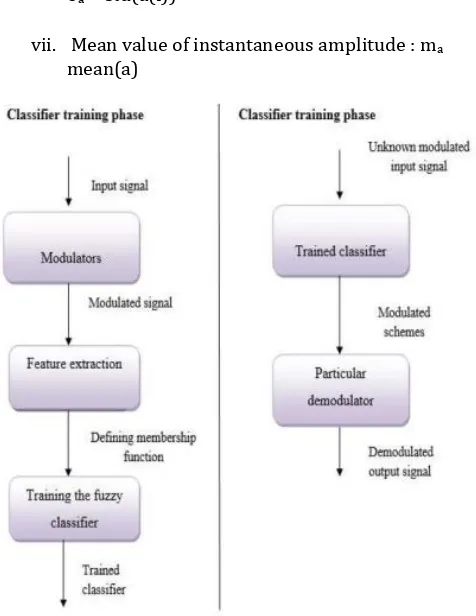
FIG-2 Modulation Classification System using Fuzzy Logic
6. RESULTS AND DISCUSSION
Figure-2 shows the classifier implementation flow diagram using fuzzy logic. Following are the simulation parameters defined in the training as well as testing phase.
i. Modulating Frequency : 1 KHz
ii. Carrier Frequency : 10 MHz
iii. Number of Signal Samples : 2001
iv. Features Extracted : Amplitude , Phase ,
Frequency
v. Fuzzy Model Used : name: 'am_pm_fm_rules' type:
'mamdani'
input: [1x3 struct] output: [1x1 struct] rule: [1x27 struct]
© 2018, IRJET | Impact Factor value: 6.171 | ISO 9001:2008 Certified Journal | Page 2986
Following are rules for this classifier.
1. If (amplitude is am) and (freq is am) and (phase is am) then (type is am)
2. If (amplitude is pm) and (freq is pm) and (phase is pm)
then (type is pm)
3. If (amplitude is fm) and (freq is fm) and (phase is fm)
then (type is fm)
4. If (amplitude is am) and (freq is am) and (phase is fm)
then (type is am)
5. If (amplitude is pm) and (freq is pm) and (phase is am)
then (type is pm)…
Likewise , Further 27 rules can be defined as below.
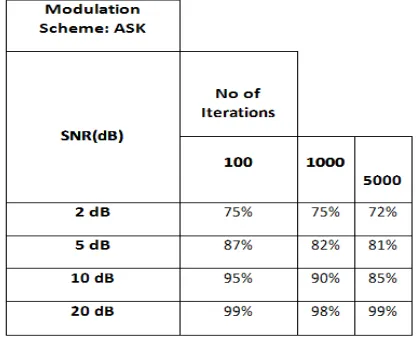
[image:4.595.318.545.65.257.2]The accuracy of Fuzzy system is detected for different values of SNR as shown in following table and for each modulation scheme , number of iterations are taken as 100,1000 and 5000 respectively and the probability of false detection can be measured using these results.
Fig-3 ASK Fuzzy Classifier Results
Fig-3 PSK Fuzzy Classifier Results
Fig-3 FSK Fuzzy Classifier Results
7. CONCLUSION
To create AMC using fuzzy logic, MATLAB software is used. Simulation results proved that the elaborated algorithm, using proposed set of the features is very robust with respect to SNR.From the results it can be said that for lower values of SNR and lower values of iterations, the fuzzy classifier performs better than Neural Networks. The robustness of the classifier follows from its fuzzy structure. Fuzzy classifier requires various parameters of the modulated signal from which they can be identified. This method allows creating intelligent radio links, efficient monitoring and control systems. This work is yet another small milestone in a large body of research conducted in this area.
The advances of computing power, advances in user-friendly mathematical modeling software and the research will continue to yield better results. Future work or extensions of this model will need to provide a greater number of modern modulation types including orthogonal frequency division multiplexing, cyclical shift keying, trellis coded modulation and others. Also, the work could be extended to include real-world signals.
REFERENCES
1) Zuzana Didekova, Beata Mikovicova, “Classification
of Radio Communication Signals using Fuzzy Logic”, World Academy of Science, Engineering and Technology, 2014.
2) Li Cheng, Jin Liu, “An Optimized Neural Network
Classifier for Automatic Modulation Recognition”, Harbin Engg. University, 2014.
3) Aluisio I. Fontes, Faud M. Abinader Jr, Vicente A. de
[image:4.595.57.265.353.526.2]© 2018, IRJET | Impact Factor value: 6.171 | ISO 9001:2008 Certified Journal | Page 2987
4) Hazza Alharbi, Shoaib Mobien, Saleh Alshebeili and
Fahd Alturki, “Automatic Modulation Classification of Digital Modulations in Presence of HF Noise”, Springer Open journal, 2013.
5) Kanterakis, E. and Su, W.,”Modulation
Classification in MIMO Systems, Military Com munications Conference, 2013.
6) Jerzy Lopatka, Maciej Pedzisz, “Fuzzy Logic
Classifier for Radio Signals Recognition”, Journal of Telecomm. & Info. Tech, 2011.
7) Druckmann, Plotkin E.I., Swamy M.N.S., “Automatic
Modulation Type Recognition”, IEEE, 2009.
8) Negar Ahmadi, Reza Berangi, “Symbol Based
Modulation Classification using Combination of Fuzzy Clustering and Hierarchical Clustering”, SPIJ Issue 2.
9) Lopatka J., Pedzisz M., “Automatic Modulation
Classification Using Statistical Moments and a Fuzzy Classifier”, IEEE, 2010.
10)B. Ramkumar, “Automatic modulation classification
for cognitive radios using cyclic feature detection,” IEEE Circuits and Systems Magazine, vol. 9, no. 2, June 2009.
11)Wen Wei and Jerry M. Mendel, “A fuzzy logic
method for modulation classification in nonideal environments”, IEEE, 2005.
12)Octavia A.Dobre, Ali Abdi, Yeheskel Bar-Ness and
Wei Su, “A Survey of Automatic Modulation Classification Techniques: Classical Approaches and New Trends“, Sarnoff Symposium, Princeton, NJ, USA, 2005.
13)P. Marchand, “Detection and recognition of