© 2017, IRJET | Impact Factor value: 5.181 | ISO 9001:2008 Certified Journal | Page 127
Synthesis, Characterization and Electrical Conductivity Study of
Conductive Polypyrrole doped with Nano Tin Composite
for Antibacterial Application
G. Sowmiya
1, P. M. Anbarasan
2, G. Velraj
31
Research Scholar, Department of Physics, Periyar University, Salem-636 011, Tamilnadu, India.
2Professor, Department of Physics, Periyar University, Salem-636 011, Tamilnadu, India.
3Associate Professor, Department of Physics, Anna University, Chennai-600 025, Tamilnadu, India.
---
---***---Abstract
- Polymer/metal nanocomposite consisting ofpolymer as matrix and metal nanoparticle as nanofiller generally give an idea about several attractive advantages such as structural, optical, mechanical and electrical characteristics. In the present study involves the synthesis of polypyrrole blended with nano tin particles via chemical oxidation polymerization method. The materials synthesized PPy & PPy/Sn composite were characterized by FT-IR spectroscopy, XRD (Powder X-ray diffraction), Field emission scanning electron microscope(FESEM), energy dispersive X-ray spectroscopy (EDX), electrical conductivity (Two probe method) and antibacterial acitvity studies. FT-IR analysis confirms the presence of nano tin particles in the molecular structure. XRD patterns revealed that the sample is crystalline nature with tetragonal structure. The average crystalline size for this PPy/Sn nanocomposite is found to be 35.68 nm. The electrical conductivity results indicate that the PPy/Sn nanocomposite was responsible for enhanced dielectric performance. The synthesized nanocomposite was also analyzed for antibacterial activity against Gram-positive and Gram-negative bacteria. The antibacterial study showed that the pure polypyrrole did not have a very good antibacterial activity but PPy/Sn nanocomposite is found to be effective against positive and Gram-negative bacteria.
Key Words: PPy/Sn, FT-IR, XRD, FE-SEM with EDAX, electrical conductivity and antibacterial activity.
1. INTRODUCTION
In recent years, conducting polymers such as polypyrrole, polythiophene and polyaniline have received much attention because of their potential applications in chemical and biological sensors, electronic devices, as well as efficient and low cost solar cells, due to their remarkable mechanical and electrical properties such as low operating temperature, low cost, flexibility and easy processability and so on [1–7]. In the current years, synthesis and application of conducting polymer
nanocomposite with various inorganic nanoparticles such as TiO2[8], MnO2[9], Cu2O[10], ZnO[11] have been
reported. The present paper reports the synthesis of polypyrrole nanocomposite by the incorporation of nano tin particles in the polypyrrole matrix. To achieve this goal, ppy and PPy/Sn have been synthesized by chemical oxidation polymerization method. These polymer hybrid nanocomposite have been characterized using various techniques. The structural properties were analyzed by FT-IR and XRD. The interaction of nano tin composite with the PPy has been visualized using FESEM analysis. The electrical conductivity measurement was studied using two probe techniques. Antibacterial activities of nanoparticles were tested against gram-positive;
Staphylococcus aureus and gram-negative; Escherichia coli.
2. EXPERIMENTAL METHODS
2.1 Synthesis of Polypyrrole
The Polypyrrole was prepared by using chemical oxidative polymerization method. H2SO4 is used as a dopant
(K2Cr2O7) is used as an oxidant. The pyrrole monomer
solution was stirred at ice temperature and the H2SO4
solution was added drop wise into this pyrrole monomer solution. The reaction mixture was stirred one hour at constant rpm value. The solution of 0.5 M of K2Cr2O7 was
added drop wise into the mixture.This reaction mixture kept under the ice temperature and stirred constant RPM value at 24 hours continuously. The black precipitate was separated out by filtering. The final product was dried in Laboratory oven at 100˚C for 90 minutes. Finally the product was ground into fine powder using mortar and pestle.
2.2 Synthesis of Ppy/Sn Nanocomposite
© 2017, IRJET | Impact Factor value: 5.181 | ISO 9001:2008 Certified Journal | Page 128 continuously. Then the precipitate was separated out by
filtering. The final suspension was dried in an oven at 100˚C for 60 m.
2.3 Antibacterial activity assessment
The following two human pathogenic bacterial strains such as Staphylococcus aureus MTCC 902 and Escherichia
coli MTCC2622 were purchased from Microbial type
culture collection and gene bank (MTCC), Chandigarh, India and maintained on nutrient agar (NA) slants. Antibacterial activities of the crude ethyl acetate extracts were measured using agar well diffusion assay according to Perez et al. against the test organism S.aureus and E. coli
[12]. Five wells (6 mm diameter well) were made using cork borer. Different amounts (50, 100, 150 and 200 µl) of ethyl acetate crude extract dissolved in dimethyl sulfoxide (DMSO), and chloramphenicol (5µl) as positive control, were added in respective wells. The zone of inhibition was measured in millimeter.
3. RESULTS AND DISCUSSION
3.1. FT-IR Analysis
The FT-IR spectra of synthesized PPy and PPy/Sn are shown in the Fig-1. The very strong band of 3124cm-1 is
due to C-H stretching in PPy. The medium band around 1697cm-1 corresponds to PPy is attributed to in plain and
out-of-plain bending vibration. The characteristic peak at 1541cm-1 corresponds to PPy ring vibration. The vibration
peak at 1457cm-1 attributed to the C-N and C-C symmetric
and asymmetric stretching vibration in the pyrrole ring vibration [13]. The strong bands in the 1200-1000cm-1
region can be referred to over tone bands of Sn-O-H structure units in polycrystalline structures, but they could be ascribed also anti symmetrical stretching vibrations. The peaks at very strong band at 1179cm-1
corresponds to C-N stretching vibration. The very strong peak at 1056cm-1 is attributed to (=C-H) in plane vibration.
The strong band at 932cm-1 region could be assigned to
symmetrical and anti symmetrical stretching vibration
[14]. The very strong peak at 883cm-1 is due to the C-H out
of plane bending in PPy. A week band around 421cm-1
reflect vibrations of Sn(IV)-O and Sn(II)-O bonds in mixed Sn(II) Sn(IV)oxides.
[image:2.595.318.541.168.315.2]Fig – 1: FTIR spectra of (a) PPy and (b) PPy/Sn
The peaks observed in the present work match well with the previous literature [13, 14] confirming the formation of PPy and PPy/Sn nanocomposite.
3.2 XRD Analysis
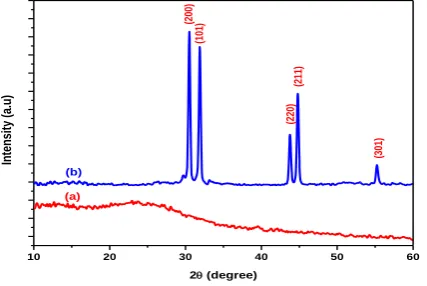
X-ray diffraction pattern of Polypyrrole (PPy) and Nano tin composite of polypyrrole (PPy/Sn) are shown in Fig-2(a), the XRD spectra showed that the PPy is amorphous in nature. The broad amorphous diffraction peak which appears at 2Ɵ = 22.85˚. In Fig - 2(b) shows that the XRD pattern of PPy/Sn. The sharp peaks are at about 30.49˚, 31.90˚, 43.73˚, 44.76˚ and 55.33˚ can be associated with (200), (101), (220), (211) and (301) respectively, which attributed clearly Sn nano particle are existing in PPy matrix. XRD spectra showed that the PPy/Sn is crystalline in nature. This matches well with JCPDS, tin file No. 89-2958. The PPy/Sn product shows tetragonal body centerted, which are in good agreement with the literature. The average crystalline size for this PPy/Sn is found to be 35.68 nm.
Fig – 2: XRD spectra of (a) PPy and (b) PPy/Sn
10 20 30 40 50 60
In
te
n
si
ty
(a
.u
)
2(degree)
(2
00
)
(1
01
)
(2
20
)
(2
11
)
(3
01
)
(a) (b)
4000 3500 3000 2500 2000 1500 1000 500
T
ra
n
sm
itta
n
ce
(%
)
wavenumber(cm-1
)
[image:2.595.323.537.608.751.2]© 2017, IRJET | Impact Factor value: 5.181 | ISO 9001:2008 Certified Journal | Page 129
3.3 FESEM with EDX Analysis
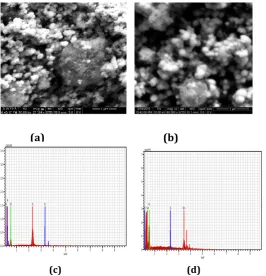
[image:3.595.308.526.183.285.2]The morphology of the obtained PPy & PPy/Sn nanocomposites has been studied using FESEM with EDAX and the images are shown in Fig 3(a) & (b) respectively. The high maginification FESEM image reveals the presence of nano tin particles uniformly distributed throughout the composite sample and nano tin Particles were found to be spherical in shape and there is some agglomeration also observed in the image. In order to further confirm the presence of Sn nanoparticle, energy dispersive X-ray (EDX) mapping was used to observe the distribution of Sn nanoparticle. The results are shown in Fig - 3. The weight percentages of each element are given in Table -1. Fig: 3(c) & (d) shows the EDX spectra of PPy & PPy/Sn. While the EDX result proved the existence of Sn nano particles. The elemental concentration of PPy/Sn nanocomposite shows the presence of tin and oxygen elements and it confirms the stoichiometry of nano particles.
(a) (b)
[image:3.595.39.522.399.711.2]
(c) (d)
[image:3.595.36.303.403.680.2]Fig – 3: FESEM with EDX image of (a & c)PPy and (b & d) PPy/Sn
Table -1: Elements present in the sample PPy and PPy/Sn
3. 4 Electrical Conductivity Analysis
Conductivity measurements have been performed by a typical two probe technique. The A. C electrical conductivities of PPy and PPy/Sn are shown in Fig 4. The A.C conductivity of pure PPy is found to be 8. 21 x10-3
S/cm, where as the conductivity of PPy/Sn is 1.12 x10⁻²
S/cm. When we compare the A.C conductivities of pure PPy with PPy/Sn, the conductivity has been increased by one order increase in A.C conductivity is there when we compare pure PPy with PPy/Sn. The result shows that nano composite posses better electrical conductivity than pure PPy. This enhanced conductivity of PPy/Sn is due to incorporation of nano metal particles into the polymer matrix. After doping, the increase in the A.C conductivity of PPy/Sn may be due to the even distribution of nano particles and increase in crystallite density in unit space which is evidenced by the XRD in Fig-2. The combination of amorphous and crystalline structure in the composite material may also be the reason for improved conductivity
[15].
Fig - 4: A.C Conductivity of (a) PPy and (b) PPy/Sn
Samples Elements Weight % Atomic %
PPy SK 53.59 39.49
OK 37.21 54.95
KK 9.20 5.56
PPy/Sn Sn K 53.92 13.96
O K 43.52 83.59
S K 2.56 2.45
1 2 3 4 5 6 7 8 9
keV 0.0
0.5 1.0 1.5 2.0 2.5 3.0 3.5
cps/eV
S S O K K
1 2 3 4 5 6 7 8 9
keV 0
1 2 3 4 5 6 7 cps/eV
Sn Sn
Sn O S S
0 200 400 600 800 1000 1200
0.0 2.0x10⁻³
4.0x10⁻³ 6.0x10⁻³
8.0x10⁻³
1.0x10⁻²
1.2x10⁻²
A
.
C
c
o
n
d
u
c
ti
v
ity
(S/
c
m
)
Frequency (Hz)
[image:3.595.317.537.569.727.2]© 2017, IRJET | Impact Factor value: 5.181 | ISO 9001:2008 Certified Journal | Page 130
3.5 Antibacterial Activity
[image:4.595.44.278.358.571.2]The antibacterial properties of PPy and PPy/Sn nanocomposite was evaluated against both Gram negative and Gram positive bacterial strains using agar well diffusion method. The bacterial suspensions were prepared by cultivating bacterial strains for overnight.For comparison, different amounts of PPy and PPy/Sn nanocomposites (50 µg, 100 µg, 150 µg and 200 µg) were placed.The zone of inhabition of bacteria and the effect of PPy and PPy/Sn nanocomposite on the growth of bacteria was shown in Fig-5, From the results, PPy/Sn composite is strongly inhibited the growth of both Gram negative (E. coli) (19 mm) and Gram Positive (S. aureus) (20 mm) at PPy/Sn concentration of 200 µg shows very good antibacterial activity.
Fig-5: Formation of zone of inhibition by PPy and PPy/Sn nanocomposite for both E. coli and S. aureus bacteria
4. CONCLUSION
Polypyrrole (PPy) and nano tin doped Polypyrrole composite (PPy/Sn) were synthesized by adopting a facile chemical oxidation polymerization method. The synthesized Polypyrrole (PPy) and PPy/Sn were characterized using FT-IR spectroscopy. The electrical conductivity measurements were investigated by two probe method using graphite for ohmic contact. The XRD figure shows that the PPy and PPy/Sn are amorphous in nature and crystalline in nature respectively. The average crystalline size of PPy/Sn was found to be 35.68nm. The FESEM morphology showed that the PPy and PPy/Sn has
the morphological modification due to doping and EDAX study reveals that the Sn nanocomposites is evenly distributed throughout the polymer matrix. The electrical conductivity of both the samples PPy and PPy/Sn was discussed in detail. The achieved results showed that the PPy/Sn had better electrical conductivity than pure polypyrrole (PPy) indicated the incorporation of tin nano composite in the polypyrrole sample. The PPy/Sn concentration of 200 µg shows very good antibacterial activity.
ACKNOWLEDGEMENTS
The author is very much thankful to instrumentation center, Bharathiyar University for the instrumentation facility of FESEM with EDX. One of the authors is thankful to the Periyar University for the financial assistance through University Research Fellowship (URF). One of the author thankful to CSIR New Delhi for funding the research project in this field.
REFERENCES
[1]
B. Adhikari, S. Majumdar, Polymers in sensor applications, Progress in Polymer Science 29, 2004,pp 699–766.[2] M. A. Chougule, et.al. Facile and efficient route for preparation of polypyrrole-ZnO nanocomposites: microstructural, optical and charge trans- port properties, Journal of Applied Polymer Science 125 2012, pp 1418– 1424.
[3] M. Woodson, J. Liu, Guided growth of nano scale conducting polymer structures on Surface- functionalized nanopatterns, Journal of the American Chemical Society 128, 2006, pp 3760 – 3763.
[4] D. K. Bandgar, D. M. Jundale, G. D. Kuspe, V. B. Patil, Facile and novel route for preparation of nanostructured polyaniline (PANI) thin films, Journal of Applied Nanoscience (2013), http://dx.doi.org/10.1007/ s13204-012-0175-8.
[5] G.D. huspe, D. K. Bandgar, ShashwatiSen, V. B. Patil, Fussy nanofi-brous network of polyaniline (PANi) for NH3 detection, Synthetic Metals 162, 2012,pp 1822 – 1827.
[6] Q. H. Li, J. H. Wu, Q.W. Tang, Z.Lan, P. J. Li,et.al, Application of Micro porous polyaniline counter electrode for dye-sensitized solarcells, Electrochemistry Communications 10, 2008, pp 1299 – 1302.
E. coli PPy
E. coli PPy/Sn S. aureus PPy/Sn
S. aureus PPy
c c
© 2017, IRJET | Impact Factor value: 5.181 | ISO 9001:2008 Certified Journal | Page 131 [7] S. G. Pawar, S. L. Patil, A. T. Mane, B. T. Raut, V. B.
Patil, Growth, characterization and gas sensing properties of polyaniline thin films, Archives of Applied Science Research 1 (2), 2009, pp 109 –114.
[8] M.Babazadeh, F. Rezazad Gohari, A. Olad, J. Appl. Polym. Sci. 123, 2012, pp 1922-1927.
[9] W. Ni, D.Wang, Z. Huang, J. Zhao, G.Cui, Mater. Chem. Phys. 124, 2010, pp 1151-1154.
[10] X. Wang, G.Chen, Zhang, J. Catal. Commun., 31, 2013, pp 57-61.
[11] A. Batool, F. Kanwal, M. Imran, T. Jamil, S.A. Siddiqi, Synth. Met. 161, 2012, pp 2753-2758.
[12] C. Perez, M. Pauli, P.Bazerque , An antibiotic assay by the agar well diffusion method. Acta Biol Med Exp. 15, 1990, pp 113-5.
[13] k. Arora, A. chaubey, R. Singhal, R.P.Singh, M.K Pandey, et.al, Application of electrochemically prepared polypyrrrole- polyvenlsul-phonate films to DNA: biosensors, Bioseens Bioelectron;21, 2006, pp 1777-83.
[14] S. Ram, K. Ram, IR and Raman studies and effect of γ radiation on crystallization of some lead borate glasses containing Al2O3,J.of Material science, 23, 1989, pp 4541- 4546.