© 2017, IRJET | Impact Factor value: 5.181 | ISO 9001:2008 Certified Journal | Page 300
Study of Ball Valve and Design of Thickness of Shell and Flange
AKSHAY CHOUGUL
1, Prof. RAMESH KATTI
21
M.Tech Student (Design Engineering), KLE Dr. M S Sheshgiri College of Engineering and Technology,
Belagavi, Karnataka, India
2
Professor, Department of Mechanical Engineering, KLE Dr. M S Sheshgiri College of Engineering and
Technology, Belagavi, Karnataka, India
---***---Abstract - Ball valves are widely used industrial fittings for the construction of oil and gas products transportation facilities (piping systems). They are quarter-turned (90 degrees), straight through flow valves having a round closure element with complementing rounded seats, which permits uniform sealing stress. The type of seat can vary according to the valve pressure rating and materials of construction. To design the ball valve shell and flange for a pressure 35 bar. CAD modeling of Ball Valve Shell & Flange design is made by means of CATIA V5 computer program Static analysis of the Ball Valve Shell body and Flange design is performed using ANSYS 14.5 to find the highest safe stress for equivalent payload/pressure
Key Words: Ball valves, ball valve shell, flange, safe
stress
1. INTRODUCTION
Valves are mechanical devices particularly intended to stop, start, blend, coordinate, or control the stream, temperature or pressure of fluid in a piping system. They are designed to handle either gas or liquid application. The operation of valves may be required continuously as in case of control valves, or they may be required to be operated occasionally. The design, application and function of valves arrive in a extensive range of sizes, style and pressure classes, and they can be manufactured from several materials types among which brass, iron, steel, bronze, plastic, or from a number of special alloys.
1.1 Objectives & Scope of Work
The objective of the proposed work is to design and analyze Ball Valve with different pressures for structural strength.
And the scope of this study is for using 20 bar designed ball valve for 35 bar pressure range:
2. Design of Ball Valve Flange and Shell Body
Design of Flange for 20 bars (2MPa)
It is designed as per ASME/ANSI standards for design of Pipe Flanges & Flanged Fittings- ASME B16.5.
Material selection:-the material selected A216 WCC from ASTM STD. as a material for flanges as well as for shell. Material Group (1.2) A216 WCC (C-Mn-Si) (Casting), Material
Properties:-
= 275MPa =485MPa
Youngs Modulus (E) = 190 GPA Poisson Ratio= 0.287
Selection of Flange: From Pressure-Temperature Rating for Flange selection, and hence the selected flange is Class 150 Flange.
Here, the flange specifications from ANSI 16.5 for 150/NB3” Weld-Neck flange for Ball valve.
Figure 2.1 Class 150 Flanges
NB 80 mm
OD 191mm
X 108mm
G 127mm
T 23.9mm
B1 78mm
T1 69.9 mm
A 88.9 mm
R 9.7 mm
No. of Bolts 04
© 2017, IRJET | Impact Factor value: 5.181 | ISO 9001:2008 Certified Journal | Page 301 Hole Diameter 19 mm
h2 (Neck height) 19 mm
= 275MPa Fos = 04
Allowable stress (f) = 68.75MPa
Formulae: --- (eqn 1)
Where, a- Radius of PCD, 76.2mm µ-Poisson’s ratio-0.278, P-Pressure acting, 20bar
(0.2039Kgf/mm2)
f- Allowable stress, 68.75MPa (7.0105 Kgf/mm2)
t- Thickness of flange.
Pitch circle diameter measured is 152.4mm
By substituting above values in formulae we get thickness, t = 14.408 mm
Selected Flange thickness is t= 23.9mm > 14.4 mm. Design is safe.
Design of Shell for 20 bars (2MPa)
The design as per ASME/ANSI standards for design of pipe Flanges & ASME B16.5
Material Properties:- = 275MPa = 485MPa
Young’s Modulus (E) = 190 GPA Poisson Ratio= 0.278
Design of shell:- = 275MPa FoS = 04
Allowable stress= 68.75MPa E= 190GPa
P= 20Bar (2MPa)
d= 78mm (Flange ID and Cylindrical Shell end ID) D= 106mm (Spherical Shell ID)
For spherical shell, Hoop stress is;
--- (eqn 2) t1= 0.77mm
But, it is an open shell with a cylindrical end, So, we apply Bernie’s Principle,
--- (eqn 3) t2= 1.161 mm
The cylindrical end thickness= 5.45mm to align with flange neck thickness.
And shell body thickness as 8mm including corrosion allowance as 3mm.
t= 8mm> t1 & t2, Hence Design is safe.
Where, P - Working pressure = 2MPa (0.2039 kg-f/mm2),
D – Maximum inner diameter of shell-106 mm, Constant – 3.7 (constant of material)
Allowable stress (f) = 68.75MPa
Formulae: --- (eqn 4)
t3= 4.4988 mm
So, t & t2 > t3
So, the selected shell thickness as 8mm and cylindrical end thickness as 5.45mm.
Requirement
Check above designed Ball Valve for 35 bar pressure of water through a pipe of NB=3” (80mm) at 25oC. Given data shall be
same only pressure has been increased, Design of Flange for P = 35bar (3.5MPa):
Where, a- Radius of PCD, 76.2mm µ-Poisson’s ratio-0.278,
P-Pressure acting, =3.5MPa (0.3569Kgf/mm2)
f- Allowable stress, 68.75MPa (7.0105 Kgf/mm2)
t- Thickness of flange.
By substituting above values in eqn 1 we get thickness, t = 19.0622mm
Selected Flange thickness is t= 23.9mm > 14.4 mm. Design is safe.
But, as per Pipe Flange & Flanged Fitting – ASME B16.5, For pressure above 19.8 bar 150 flanges cannot be used. Pressure-Temperature Rating, select Class 300 Flange with NB=80mm
© 2017, IRJET | Impact Factor value: 5.181 | ISO 9001:2008 Certified Journal | Page 302 Class 300 Flanges
NB 80 mm OD 210mm
X 117mm
G 127mm
T 28.4mm
B1 78mm
T1 79.2mm A 88.9 mm R 9.7 mm No. of Bolts 08
PCD 168 mm Hole Diameter 22 mm h2 (Neck height) 19 mm
= 275MPa FoS = 04
Allowable stress (f) = 68.75MPa Where, a- Radius of PCD, 84mm µ-Poisson’s ratio-0.278, P-Pressure acting, 35bar
(0.3569Kgf/mm2)
f- Allowable stress, 68.75MPa (7.0105Kgf/mm2)
t- Thickness of flange.
Pitch circle diameter measured is 168 mm.
By substituting above values in eqn 1we get thickness, t = 21.013 mm
Selected Flange thickness is t= 28.4mm > 21.013 mm. Design is safe.
Design of Shell for 35 bars (3.5MPa):-
Given:
= 275MPa FoS = 04
Allowable stress= 68.75MPa E= 190GPa
P= 35Bar (3.5MPa)
d= 78mm (Flange ID and Cylindrical Shell end ID) D= 106mm (Spherical Shell ID)
For spherical shell, we know Hoop stress is; From eqn 2
t1= 1.349 mm
But, it is an open shell with a cylindrical end, So, apply Bernie’s Principle, from eqn 2 t2= 2.068 mm
So, make the cylindrical end thickness= 5.45mm to align with flange neck thickness.
And shell body thickness as 8mm including corrosion allowance as 3mm.
t= 8mm> t1 & t2, Hence Design is safe.
Where, P - Working pressure = 3.5MPa (0.3569 kg-f/mm2),
D – Maximum inner diameter of shell-106 mm, Constant – 3.7 (constant of material)
Allowable stress (f) = 68.75MPa From eqn 4,
t3= 5.099 mm
So, t & t2 > t3; hence,
Design is Safe.
The same valve is used for 35bar pressure it has been found that it does not fail. But as per ASME safety norms we have used flange of higher pressure rating that is 300. & no need to change the shell body thickness.
3. Geometry Detail
Fig.3.1 Flange 150 NB 3”
Fig.3.2 Shell Model
© 2017, IRJET | Impact Factor value: 5.181 | ISO 9001:2008 Certified Journal | Page 303
[image:4.595.309.559.99.242.2]4 Material Properties of Ball Valve
Table 4.1 Material Properties
[image:4.595.42.282.115.489.2]5. Analysis
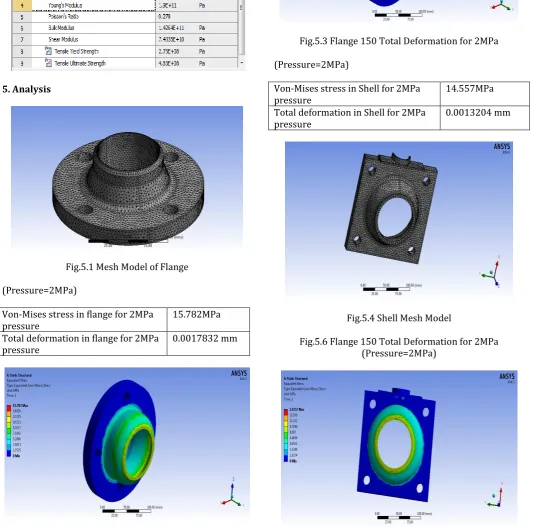
Fig.5.1 Mesh Model of Flange
(Pressure=2MPa)
Von-Mises stress in flange for 2MPa
pressure 15.782MPa
Total deformation in flange for 2MPa
[image:4.595.44.281.145.302.2]pressure 0.0017832 mm
Fig.5.2 Flange 150 von-mises stress for 2MPa
Fig.5.3 Flange 150 Total Deformation for 2MPa
(Pressure=2MPa)
Von-Mises stress in Shell for 2MPa
pressure 14.557MPa
Total deformation in Shell for 2MPa
[image:4.595.34.571.221.748.2]pressure 0.0013204 mm
Fig.5.4 Shell Mesh Model
Fig.5.6 Flange 150 Total Deformation for 2MPa (Pressure=2MPa)
[image:4.595.309.562.299.521.2] [image:4.595.39.553.505.750.2]© 2017, IRJET | Impact Factor value: 5.181 | ISO 9001:2008 Certified Journal | Page 304
Fig.5.8 Shell Total Deformation
(Pressure=3.5MPa)
Von-Mises stress in flange for 3.5MPa
pressure 27.618MPa
Total deformation in flange for
3.5MPa pressure 0.0031207 mm
Fig.5.9 Flange 150 Von Mises stress for a load of 35 bar (3.5MPa)
Fig.5.10 Flange 150 Total Deformation for a load of 35 bar (3.5MPa)
(Pressure=3.5MPa)
Von-Mises stress in flange #300 for
3.5MPa pressure 27.122MPa Total deformation in flange #300 for
3.5MPa pressure 0.0031233 mm
Fig.5.11 Mesh Model of Flange 300
Fig.5.12 Flange 300 Von Mises stress for 3.5MPa
© 2017, IRJET | Impact Factor value: 5.181 | ISO 9001:2008 Certified Journal | Page 305
(Pressure=3.5MPa)
Von-Mises stress in Shell for 3.5 MPa
pressure 25.474 MPa
Total deformation in Shell for 3.5
MPa pressure 0.0023107 mm
Fig.5.14 Shell Von Mises stress for pressure of 3.5 MPa
Fig.5.15 Shell Total Deformation for pressure of 3.5 MPa
It has been observed that in none of above cases equivalent/Von-mises stress doesn’t exceed the allowable stress limit as 68.75 MPa.
3. CONCLUSIONS
So, it can be concluded that the design for 20 bars is safe.
Current designed Ball Valve can also be used for 35 bar pressure.
As per ASME standard, Flange should be used of class 300 for pressures above 20bars, such as for 35 bars.
In future, DOE can be done to optimize the mass & other parameter by changing material to composite & changing geometric parameters.
The cylindrical shell body can also be designed and analysis can be performed in both cases.
REFERENCES
Book
[1] Khurmi R. S. and Gupta J. K. “Machine Design” first edition; Eurasia Publishing House Private Limited pages (310-315).
[2] Norton R. L. “Machine Design” third edition; Pearson Education Ltd. pages (454-457,621-624).
Papers
[1]Ming-Jyh Chern, Chin-Cheng Wang, Chen-Hsuan Ma., performance tests and flow visualisation of ball valves, Journal of experimental thermal and fluid sciences 31(2007)505-512.
[2] Janusz Rogula.a, The influence of seat fatigue test on the leakage in ball valve, Journal of Procedi Engineering 39(2012)91-97.
[3]A.Tudor, R.Nehriu, I.Radu, V.Dumitru, A Wear study case of ceramic ball seat valve, Tribology in industry, Volume 25, no 3&4, (2003) 83-88.
[4] Yogesh G, Dr.Vilas R.K, Vijay M, Modeling and Simulation of valve coefficients and cavitation characteristic in ball valves, Proceeding of the International Conferences on Fluid mechanics and Fluid power December 16-18, 2010.
[5] Ming-Jyh Chern, Chih-Cheng Wang, Controlling of volumetric flow rate of ball valves by V-ports, journal of fluid engineering may Vol-126(2004), 471-481.
[6]Ming-Jyh Chern, Chih-Cheng Wang, Effect of control device on flow in ball valve, Transaction of the Aero nautical and Astro nautical Society of the Republic of China.